
The link below is to an article that that takes a look at 10 of the best reading apps available for Android.
For more visit:
http://www.androidauthority.com/best-reading-apps-android-800928/

The link below is to an article that that takes a look at 10 of the best reading apps available for Android.
For more visit:
http://www.androidauthority.com/best-reading-apps-android-800928/

Lukman Solihin, Research and Development Agency of Indonesian Education and Culture Ministry
It was a sunny day at a public elementary school in a rural area near Yogyakarta. Students lined up to return the books borrowed from Helobook, a non-profit organisation that regularly lends books for free to schools in the province’s outskirts.
The kids looked happy and laughed a lot because this was their opportunity to access new, interesting books and movies.
Their school’s own library collection was mostly made up of books from government aid in 1990s, published by state-owned publisher Balai Pustaka. The books were out of date and there weren’t enough of them.
These students were also disadvantaged by the fact that their nearest book store is 15 kilometres away and the nearest public library is about 20 kilometres away. This is a problem because these students are from low-income families who can’t afford to travel to borrow books.
Low rates of interest in reading among Indonesians is something frequently referenced in news reports from media like Kompas, The Jakarta Post and Antara, which quote data supposedly sourced from UNESCO. These stories quote that one in every 1,000 Indonesians has a high interest in reading. But an exploration of UNESCO’s database and a request for this data have both failed to confirm these statistics.
This perception has also been reinforced by officials and public figures, who have raised the same concerns.

Last year, a Central Connecticut State University study put Indonesia’s literacy rate at 60th out of 61 countries, one above Botswana. Officials and public figures also quote this but the ranking is not about reading interest. It’s about computer access, newspaper circulation, and reading comprehension, among other things.
A National Socio-Economic Survey by Indonesia’s Central Statistics Agency showed the country’s TV audience reached 91.5% in 2015 while newspaper readers sat at 13.1%, the lowest point since 1984.
https://datawrapper.dwcdn.net/pnoVl/1/
This low rate of reading might not be due to a lack of interest but rather a lack of opportunity to read.
Let’s take a look at the data that could serve as a parameter to understand reading interest. First, school library data.
In 147,503 primary schools we only have 90,642 libraries, that’s 61.45%. The percentage shrinks more when we look at the condition. From the total 90,642 libraries, only 28,137 are in good condition (19% of schools, 31% of total libraries). Junior high and high schools have similar situation.
https://datawrapper.dwcdn.net/euDSv/1/
The quantity of village or subdistrict libraries is the same. From 77,095 villages, Indonesia has only 23,281 libraries or about 30%.
The number of book stores is also much lower compared to the vastness of the archipelago. The biggest book store network, Gramedia, has only 100 stores in only a handful of big cities, out of the 514 cities and regencies of Indonesia.
The number of book stores, school and public libraries show how limited the access to books is for many Indonesians. How would people develop some reading interest if access to books is limited?
Nurturing reading interest begins with making books available. Unfortunately, the number and condition of school and public libraries are far from adequate. Some school libraries might have a decent building, but the collection is an entirely different matter.
Libraries often serve a dual purpose, such as a storage room or sports hall. One library in Sleman in Yogyakarta, for example, is complete with a ping pong table to indicate its “flexible” function.
The government has instructed schools to allocate budget – increased to 20% of the government school funds in July from previously 5% – for library development and buying textbooks. But most of the funds are spent to buy school textbooks. The result is underdeveloped reading interests among students because of the inadequate book collection; students are bored with outdated books.
Amid this inadequacy, communities of readers in these have proven valuable. These communities open mini libraries in neighbourhoods. One example is the moving library network, Pustaka Bergerak. The growth of these communities is massive and sporadic, as readers reaching out to underrepresented and remote areas.
The government estimated there were over 6,000 mini libraries across the country. Meanwhile, as of August 2017, the Pustaka Bergerak network recorded reaching 312 communities, and counting.
This network has library ponies, libraries on rickshaw, libraries on bicycles, libraries on boats, and even a mobile herbal drinks seller that brings books to lend for free.

This movement has had a positive response from the government. After a meeting between literacy activists and President Joko Widodo on May 2 this year, the government, through state postal company PT Pos Indonesia, allowed citizens to send books free of charge to the communities registered in this list on the 17th day every month.
Communities of readers are usually built on the members’ love of books and their aspiration to share. Enthusiasm, idealism and capacity to build network are key to the growth of literacy communities and have less to do with the existence or the absence of government funds.
The network has been facilitated by Community Libraries Forum, initiated by the government. Pustaka Bergerak network has also shown great passion in their social media account, enabled by initiator Nirwan Ahmad Arsuka.

The number of these communities of readers, compared to the geographical and population size of the country, is perhaps minuscule. Nevertheless, this movement deserves an appreciation for its impact: nurture reading interest.
An example of the success of these communities is Pustakaloka Rumah Dunia in Serang, Banten. This community enabled a scavenger’s son to finish higher education, a fried snack seller to become a journalist, and a farmer’s son to become a poet. Their stories are compiled in a book Relawan Dunia (World Volunteers).
Discovering books also changed Muhidin Dahlan’s life. He was a kampung boy in Sulawesi’s remote area, who was curious about books, before he moved to Yogyakarta to become a writer and an activist in Indonesia Boekoe, a community known for its dedication in archive management, book publishing and establishing Radio Buku. His story is written in a book, Aku, Buku, dan Sepotong Sajak Cinta.
Unlike formal education institutions like schools, the success of reader communities is not measured quantitatively, like how many people have their access to books improved, or how large their book collection is. But the lack of impact in this area is dwarfed by their spirit, their effort to share the importance of books and the efforts to help others access books. Literacy, in this case, is not merely about reading materials and knowledge, but also about volunteer spirit.
 The author is doing a research on literacy movement by communities in Yogyakarta, in Anthropology Department in Gadjah Mada University.
Lukman Solihin, Researcher, Research and Development Agency of Indonesian Education and Culture Ministry
This article was originally published on The Conversation. Read the original article.

Margaret Kristin Merga, Murdoch University
Many of us will be able to recall the enjoyment of shared reading: being read to and sharing reading with our parents. However, my research has found that of the 997 Year 4 and Year 6 respondents at 24 schools who took part in the 2016 Western Australian Study in Children’s Book Reading, nearly three-fifths reported that they were not being read to at home.
A sample of these children also participated in interviews, where I asked them how they felt about shared reading. While a few children did not mind no longer being read to, others were disappointed when it stopped. For example, when I asked Jason about his experience of being read to by his parents, he explained:
… they kind of stopped when I knew how to read. I knew how to read, but I just still liked my mum reading it to me.
His experience is common, with other recent research suggesting that more than one-third of Australian respondents aged six to 11 whose parents had stopped reading to them wanted it to continue.
But why is it so important for us to keep reading with our children for as long as possible?
Research has typically found that shared reading experiences are highly beneficial for young people. Benefits of shared reading include facilitating enriched language exposure, fostering the development of listening skills, spelling, reading comprehension and vocabulary, and establishing essential foundational literacy skills. They are also valued as a shared social opportunity between parents and their children to foster positive attitudes toward reading.
When we read aloud to children it is also beneficial for their cognitive development, with parent-child reading activating brain areas related to narrative comprehension and mental imagery. While most of the research in this area focuses on young children, this does not mean that these benefits somehow disappear as children age.
As young people’s attitudes towards reading reflect their experiences of reading at home and at school in childhood and beyond, providing an enjoyable shared reading experience at home can help to turn our children into life-long readers.
However, not all shared reading experiences are enjoyable. Some children described having poor quality experiences of being read to, and children did not typically enjoy reading to distracted or overly critical parents. In some cases, parents attempted to outsource this responsibility to older siblings, with mixed results.
While many children really enjoyed the social aspects of reading and being read to as valuable time with their parents, they also felt that they learned from these experiences. For example, listening was felt to provide an opportunity to extend vocabulary, and improve pronunciation. Gina recalled the advantage she lost when her parents stopped reading to her, as:
… when they did read to me when I was younger, I learnt the words; I would like to learn more words in the bigger books and know what they are so I could talk more about them.
Similarly, Craig explained how being read to enabled his academic advantage in literacy, as “they were teaching me how to say more words”, and “that’s why I’m ahead of everyone in spelling and reading and English”. When this stopped “just because my mum thought I was smart enough to read on my own and started to read chapter books”, Craig was disappointed.
In addition, children were sometimes terrified of reading aloud in the classroom, and this fear could potentially be alleviated through greater opportunities to practice at home.
Hayden’s anxiety around reading aloud at school related to his lack of confidence, and his tendency to compare his skills with those of his peers. He described himself as “always standing up there shivering, my hands are shivering, I just don’t want to read, so I just start reading. And I sound pretty weird”. No-one read with him at home, so he had limited opportunity to build his confidence and skills.
This research suggests that we should not stop reading with our children just because they have learned to read independently.
 We should continue reading with our children until they no longer wish to share reading with us, ensuring that these experiences are enjoyable, as they can influence children’s future attitudes toward reading, as well as building their confidence and competence as readers. It is worth the effort to find time to share this experience with our children in the early years and beyond.
Margaret Kristin Merga, Senior Lecturer in Education, Murdoch University
This article was originally published on The Conversation. Read the original article.

Louise Phillips, The University of Queensland and Pauline Harris, University of South Australia
How can parents best help their children with their schooling without actually doing it for them? This article is part of our series on Parents’ Role in Education, focusing on how best to support learning from early childhood to Year 12.
Literacy involves meaning-making with materials that humans use to communicate – be they visual, written, spoken, sung, and/or drawn. Definitions vary according to culture, personal values and theories.
We look to a broad definition of literacy as guided by UNESCO to be inclusive for all families. Children learn to be literate in a variety of ways in their homes, communities and places of formal education.
New research in three-to-five-year-old children’s homes and communities in Fiji, has revealed that children’s regular engagement in literacy across many different media has supported good literacy outcomes.
There were ten main ways of engaging in literacy-building activities. These included print and information, communication and entertainment technologies, arts and crafts, making marks on paper, screens and other surfaces like sand and concrete, reading and creating images, and talking, telling and acting out stories that were real or imagined.
Children also engaged with reading, recording and talking about the environment, reading signs in the environment, engaging in music, dance, song and, lastly, with texts and icons of religions and cultures.
These activities were enjoyed and valued by children and their families as part of their everyday lives, and were further bolstered by creating books with children in their home languages and English.

This research can be used to add to our discussions on how parents can help develop their children’s early literacy.
The Melbourne Institute of Applied Economic and Social Research found daily reading to young children improves schooling outcomes, regardless of family background and home environment.
The OECD Program for International Student Assessment (PISA) results also indicate a strong correlation between parents reading and storytelling with children in the early years and reading achievement at age 15, with those students performing one to two years above their peers.
However, it is not just being read to that matters. The adult-child interactions are also very important.
These interactions need to be lively and engage children with the text-in-hand. Alphabet toys and phonics programs alone offer little to develop literacy, as they focus on a code without contextual meaning. Words, and their letters and sounds, are best understood when seen and applied in everyday experiences, driven by children’s motivations.
There are several practical things parents can do to encourage broad literacy and learning in early childhood years.
Don’t wait. Read what you are reading aloud to your newborn. Children become attuned to the sound of your voice and the tones of the language you speak as their hearing develops.
Share stories at mealtime. Provide prompts like: “Tell us what your teddy did today”. Alternatively, randomly select from ideas for characters, problems, and settings, for example: “Tell us about an inquisitive mouse lost in a library”. Oral storytelling provides a bridge to written stories.
Record on your phone or write down your child’s stories. Turn them into a book, animation, or slide show (with an app). Children will see the transformation of their spoken words into written words. These stories can be revisited to reinforce learning of words, story structure and grammar.
Talk about their experiences. For example, prompt them to describe something they have done, seen, read or heard about. Research shows children’s oral language supports their literacy development, and vice-versa.
Guide literacy in your children’s play, following their lead. For example, help them follow instructions for making something, or use texts in pretend play, such as menus in play about a pizza place. Children will engage with various texts and the purposes they have in their lives.
Books, books, books. For babies and toddlers, start with durable board books of faces, animals and everyday things with few words that invite interactivity (e.g., “Where is baby?”). Progress to more complex picture books with rhyming language. Talk about personal links with the stories and ask questions (such as “I wonder what will happen next or where they went to”) as these will support comprehension. Look to the Children’s Book Council for awarded quality children’s literature.
Talk about words children notice. Be sure the words make sense to children. Talk about what words look like, what patterns, letters and sounds they make. This builds children’s word recognition and attack skills, and understanding of what words in context mean.
Involve your children in activities where you use literacy. For example, if you make shopping lists or send e-cards, your children could help create these with you. Explain what you are doing and invite children’s participation (e.g., “I’m looking at a map to see how to get to your friend’s house”). Children can meaningfully engage with and create texts and see the place these texts have in their lives.
Use community and state libraries. Most offer interactive family literacy programs. Early Years Counts and The Australian Literacy Educators Association has a range of resources for families.
 Above all, be sure the experience is enjoyable, playful, and encourages children’s active involvement. Literacy should be engaging for your children, not a chore.
Louise Phillips, Lecturer, School of Education, The University of Queensland and Pauline Harris, Research Chair in Early Childhood, University of South Australia
This article was originally published on The Conversation. Read the original article.

Di Dickenson, Western Sydney University
It’s 20 years on June 26 since the publication of Harry Potter and the Philosopher’s Stone, the first in the seven-book series. The Philosopher’s Stone has sold more than 450 million copies and been translated into 79 languages; the series has inspired a movie franchise, a dedicated fan website, and spinoff stories.

I recall the long periods of frustration and excited anticipation as my son and I waited for each new instalment of the series. This experience of waiting is one we share with other fans who read it progressively across the ten years between the publication of the first and last Potter novel. It is not an experience contemporary readers can recreate.
The Harry Potter series has been celebrated for encouraging children to read, condemned as a commercial rather than a literary success and had its status as literature challenged. Rowling’s writing was described as “basic”, “awkward”, “clumsy” and “flat”. A Guardian article in 2007, just prior to the release of the final book in the series, was particularly scathing, calling her style “toxic”.
My own focus is on the pleasure of reading. I’m more interested in the enjoyment children experience reading Harry Potter, including the appeal of the stories. What was it about the story that engaged so many?
Before the books were a commercial success and highly marketed, children learnt about them from their peers. A community of Harry Potter readers and fans developed and grew as it became a commercial success. Like other fans, children gained cultural capital from the depth of their knowledge of the series.
My own son, on the autism spectrum, adored Harry Potter. He had me read each book in the series in order again (and again) while we waited for the next book to be released. And once we finished the new book, we would start the series again from the beginning. I knew those early books really well.
Assessing the series’ literary merit is not straightforward. In the context of concern about falling literacy rates, the Harry Potter series was initially widely celebrated for encouraging children – especially boys – to read. The books, particularly the early ones, won numerous awards and honours, including the Nestlé Smarties Book Prize three years in a row, and were shortlisted for the prestigious Carnegie Medal in 1998.

Criticism of the literary merit of the books, both scholarly and popular, appeared to coincide with the growing commercial and popular success of the series. Rowling was criticised for overuse of capital letters and exclamation marks, her use of speech or dialogue tags (which identify who is speaking) and her use of adverbs to provide specific information (for example, “said the boy miserably”).
The criticism was particularly prolific around the UK’s first conference on Harry Potter held at the prestigious University of St Andrews, Scotland in 2012. The focus of commentary seemed to be on the conference’s positioning of Harry Potter as a work of “literature” worthy of scholarly attention. As one article said of J.K. Rowling, she “may be a great storyteller, but she’s no Shakespeare”.
Even the most scathing of reviews of Rowling’s writing generally compliment her storytelling ability. This is often used to account for the popularity of the series, particularly with children. However, this has then been presented as further proof of Rowling’s failings as an author. It is as though the capacity to tell a compelling story can be completely divorced from the way a story is told.

The assessment of the literary merits of a text is highly subjective. Children’s literature in particular may fare badly when assessed using adult measures of quality and according to adult tastes. Many children’s books, including picture books, pop-up books, flap books and multimedia texts are not amenable to conventional forms of literary analysis.
Books for younger children may seem simple and conventional when judged against adult standards. The use of speech tags in younger children’s books, for example, is frequently used to clarify who is talking for less experienced readers. The literary value of a children’s book is often closely tied to adults’ perception of a book’s educational value rather than the pleasure children may gain from reading or engaging with the book. For example, Rowling’s writing was criticised for not “stretching children” or teaching children “anything new about words”.
Many of the criticisms of Rowling’s writing are similar to those levelled at another popular children’s author, Enid Blyton. Like Rowling, Blyton’s writing has described by one commentator as “poison” for its “limited vocabulary”, “colourless” and “undemanding language”. Although children are overwhelmingly encouraged to read, it would appear that many adults view with suspicion books that are too popular with children.
There have been many defences of the literary merits of Harry Potter which extend beyond mere analysis of Rowling’s prose. The sheer volume of scholarly work that has been produced on the series and continues to be produced, even ten years after publication of the final book, attests to the richness and depth of the series.
 A focus on children’s reading pleasure rather than on literary merit shifts the focus of research to a different set of questions. I will not pretend to know why Harry Potter appealed so strongly to my son but I suspect its familiarity, predictability and repetition were factors. These qualities are unlikely to score high by adult standards of literary merit but are a feature of children’s series fiction.
Di Dickenson, Director of Academic Program BA, School of Humanities and Communication Arts, Western Sydney University
This article was originally published on The Conversation. Read the original article.
Di Dickenson, Western Sydney University
It’s 20 years on June 26 since the publication of Harry Potter and the Philosopher’s Stone, the first in the seven-book series. The Philosopher’s Stone has sold more than 450 million copies and been translated into 79 languages; the series has inspired a movie franchise, a dedicated fan website, and spinoff stories.
I recall the long periods of frustration and excited anticipation as my son and I waited for each new instalment of the series. This experience of waiting is one we share with other fans who read it progressively across the ten years between the publication of the first and last Potter novel. It is not an experience contemporary readers can recreate.
The Harry Potter series has been celebrated for encouraging children to read, condemned as a commercial rather than a literary success and had its status as literature challenged. Rowling’s writing was described as “basic”, “awkward”, “clumsy” and “flat”. A Guardian article in 2007, just prior to the release of the final book in the series, was particularly scathing, calling her style “toxic”.
My own focus is on the pleasure of reading. I’m more interested in the enjoyment children experience reading Harry Potter, including the appeal of the stories. What was it about the story that engaged so many?
Before the books were a commercial success and highly marketed, children learnt about them from their peers. A community of Harry Potter readers and fans developed and grew as it became a commercial success. Like other fans, children gained cultural capital from the depth of their knowledge of the series.
My own son, on the autism spectrum, adored Harry Potter. He had me read each book in the series in order again (and again) while we waited for the next book to be released. And once we finished the new book, we would start the series again from the beginning. I knew those early books really well.
Assessing the series’ literary merit is not straightforward. In the context of concern about falling literacy rates, the Harry Potter series was initially widely celebrated for encouraging children – especially boys – to read. The books, particularly the early ones, won numerous awards and honours, including the Nestlé Smarties Book Prize three years in a row, and were shortlisted for the prestigious Carnegie Medal in 1998.
Criticism of the literary merit of the books, both scholarly and popular, appeared to coincide with the growing commercial and popular success of the series. Rowling was criticised for overuse of capital letters and exclamation marks, her use of speech or dialogue tags (which identify who is speaking) and her use of adverbs to provide specific information (for example, “said the boy miserably”).
The criticism was particularly prolific around the UK’s first conference on Harry Potter held at the prestigious University of St Andrews, Scotland in 2012. The focus of commentary seemed to be on the conference’s positioning of Harry Potter as a work of “literature” worthy of scholarly attention. As one article said of J.K. Rowling, she “may be a great storyteller, but she’s no Shakespeare”.
Even the most scathing of reviews of Rowling’s writing generally compliment her storytelling ability. This is often used to account for the popularity of the series, particularly with children. However, this has then been presented as further proof of Rowling’s failings as an author. It is as though the capacity to tell a compelling story can be completely divorced from the way a story is told.
The assessment of the literary merits of a text is highly subjective. Children’s literature in particular may fare badly when assessed using adult measures of quality and according to adult tastes. Many children’s books, including picture books, pop-up books, flap books and multimedia texts are not amenable to conventional forms of literary analysis.
Books for younger children may seem simple and conventional when judged against adult standards. The use of speech tags in younger children’s books, for example, is frequently used to clarify who is talking for less experienced readers. The literary value of a children’s book is often closely tied to adults’ perception of a book’s educational value rather than the pleasure children may gain from reading or engaging with the book. For example, Rowling’s writing was criticised for not “stretching children” or teaching children “anything new about words”.
Many of the criticisms of Rowling’s writing are similar to those levelled at another popular children’s author, Enid Blyton. Like Rowling, Blyton’s writing has described by one commentator as “poison” for its “limited vocabulary”, “colourless” and “undemanding language”. Although children are overwhelmingly encouraged to read, it would appear that many adults view with suspicion books that are too popular with children.
There have been many defences of the literary merits of Harry Potter which extend beyond mere analysis of Rowling’s prose. The sheer volume of scholarly work that has been produced on the series and continues to be produced, even ten years after publication of the final book, attests to the richness and depth of the series.
A focus on children’s reading pleasure rather than on literary merit shifts the focus of research to a different set of questions. I will not pretend to know why Harry Potter appealed so strongly to my son but I suspect its familiarity, predictability and repetition were factors. These qualities are unlikely to score high by adult standards of literary merit but are a feature of children’s series fiction.
Di Dickenson, Director of Academic Program BA, School of Humanities and Communication Arts, Western Sydney University
This article was originally published on The Conversation. Read the original article.
The link below is to an article that takes a look at a survey conducted by the Australia Council and Macquarie University on Australian reading habits.
For more visit:
http://www.australiacouncil.gov.au/research/reading-the-reader/
The link below is to an article that looks at 7 reasons to love reading.
For more visit:
http://www.omnivoracious.com/2017/05/7-reasons-to-love-reading-from-abebooks.html

Philip Steer, Massey University
There is a strange and troubled kind of intimacy between our own moment of climate change and 19th century Britain. It was there that a global, fossil fuel economy first took shape, through its coal-powered factories, railways, and steamships, which drove the emergence of modern consumer capitalism. 
What might we now find if we look again at the literature of the 19th century? Although Victorian writers lacked our understanding of a warming planet, we can learn from their deep awareness of the rapid and far-reaching ways that their society was changing. In their hands, the novel became a powerful tool for thinking about the interconnections between individuals, society, economics, and the natural world.
One place to start thinking about such things might be Elizabeth Gaskell’s North and South (1855), a classic example of the “industrial novel” genre that flourished in the middle decades of that century.
Most of the novel’s events take place in the industrial town of Milton-Northern (Manchester), the epicentre of Victorian coal-fired industrial production. Our protagonist, Margaret Hale, is forced to relocate there due to family circumstances, and her first numb impressions are that the environment, the economy, and the city’s urban geography have all been transformed by fossil fuel consumption:
For several miles before they reached Milton, they saw a deep lead-coloured cloud hanging over the horizon in the direction in which it lay … Nearer to the town, the air had a faint taste and smell of smoke; perhaps, after all more a loss of the fragrance of grass and herbage than any positive taste or smell. Quick they were whirled over long, straight, hopeless streets of regularly-built houses, all small and of brick.
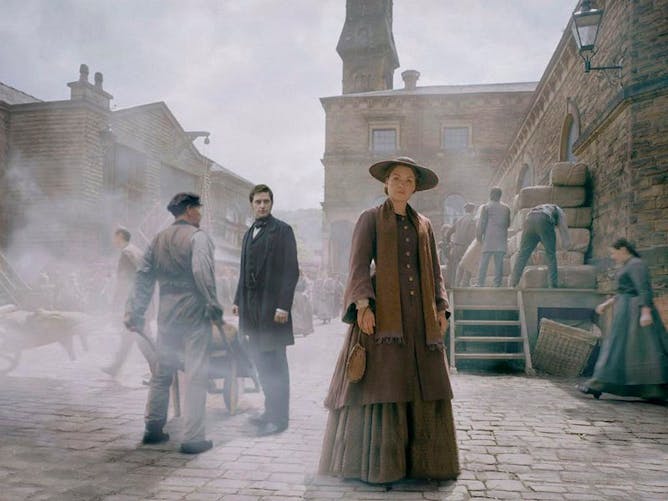
British Broadcasting Corporation
Gaskell brings her refined but impoverished heroine into contact with a forceful cotton-mill owner, John Thornton — imagine if Pride and Prejudice were set in a factory. Their love plot offers a symbolic means of restoring harmony to a nation disrupted by the new economy, as Margaret softens the edges of Thornton’s laissez faire practices and brings about improved relations with his workers. As he admits to one of his acquaintances, near the end of the novel,
My only wish is to have the opportunity of cultivating some intercourse with the hands beyond the mere ‘cash nexus’.
Thinking about this resolution in light of the fossil fuel economy, however, what comes into focus is how vulnerable this harmonious social vision is to wider social and environmental forces. By the novel’s conclusion, the global market — the source of raw materials, investors, and customers — proves to be so powerful and destabilising that the harmony of Thornton’s factory can provide only temporary solace at best, and he is bankrupted:
Meanwhile, at Milton the chimneys smoked, the ceaseless roar and mighty beat, and dizzying whirl of machinery, struggled and strove perpetually… . Few came to buy, and those who did were looked at suspiciously by the sellers; for credit was insecure… . [F]rom the immense speculations that had come to light in making a bad end in America, and yet nearer home, it was known that some Milton houses of business must suffer[.]
Looking back at North and South now, we can see how interconnected its vision of a fossil-fuelled society and the economy is, and how artificial the borders of the nation prove to be when faced with the instabilities that it causes.
Australian author James Bradley suggests that writers today, grappling with how to represent climate change, have found genres such as science fiction more suited to the task than classic realism.
“In a way this is unsurprising,” he comments, because of those genres’ interest in “estrangement” from everyday circumstances, and their fascination with “experiences that exceed human scales of being.”
The last decades of the Victorian era were, like now, a stunning time of generic innovation, and prominent amongst those late-century innovations were the “scientific romances” of H. G. Wells.

In The Time Machine (1895) Wells found a narrative device that would allow him to think about social and environmental change over enormous spans of history. Near the end of the novel, the inventor of the machine undertakes a voyage to the very end of the planet’s history:
I looked about me to see if any traces of animal life remained… . I saw nothing moving, in earth or sky or sea. The green slime on the rocks alone testified that life was not extinct… .
From the edge of the sea came a ripple and a whisper. Beyond these lifeless sounds the world was silent. Silent? It would be hard to convey the stillness of it. All the sounds of man, the stir that makes the background of our lives — all that was over.
In imagining this bleak beach, Wells is taking up contemporary predictions that the law of entropy meant the inevitable “heat death” of the universe. Global cooling rather than global warming, then, but one thing that resonates now is how the novel views humanity as a species — and a finite one, at that — rather than from a more limited individual or even national perspective.
The Victorians were the first to stare into the abyss of geological deep time, and to confront the idea of natural history as a succession of mass extinctions.
As a result, Wells raises the idea of a future where even technology cannot overcome calamitous natural processes, and dares to imagine a planet without a human presence.
The novelist Amitav Ghosh has recently described a “broader imaginative and cultural failure that lies at the heart of the climate crisis,” arguing that the characteristics of the realist novel have made it resistant to representing those environmental and social complexities. Does the realist novel really have nothing to offer and nothing to say in an era of climate change?

One place to look for an answer is another famously bleak Victorian text, Thomas Hardy’s Tess of the D’Urbervilles (1891). The plot is set in motion with Tess’s father’s discovery that his family name, Durbeyfield, is a corruption of D’Urberville, and they are in fact descended from an ancient family that once dominated the area. When they are ultimately thrown out of their home, the Durbeyfields end up seeking refuge at a church, amongst the graves of their ancestors:
They were canopied, altar-shaped, and plain; their carvings being defaced and broken; their brasses torn from the matrices, the rivet-holes remaining like marten-holes in a sand-cliff. Of all the reminders that she had ever received that her people were socially extinct there was none so forcible as this spoliation.
A bit like our own era of increasingly constrained resources, Tess inhabits an exhausted present, and she moves amidst the ruins left by previous generations who have consumed the material wealth that once made life abundant.
Hardy is also deeply attuned to the ecological damage produced by increasingly industrialised forms of agriculture. Late in the novel, when Tess is abandoned by her lover, Angel Clare, she is forced to accept work on the vast and stony fields of Flintcomb-Ash farm.
She labours through a brutal winter, and endures the relentless demands imposed by a steam-powered threshing machine — “a portable repository of force” — that reduces the workers to automatons. Around the same time, Angel abandons England for Brazil, only to find that English bodies do not translate to tropical ecosystems:
He would see mothers from English farms trudging along with their infants in their arms, when the child would be stricken with fever and would die; the mother would pause to dig a hole in the loose earth with her bare hands, would bury the babe therein with the same natural grave-tools, shed one tear, and again trudge on.

British Broadcasting Corporation
Both Tess and Angel — and the anonymous, sundered colonial families — seem to be climate refugees of a kind, caught between hostile climates and the environmental wreckage wrought by agribusiness.
What little Tess of the D’Urbervilles offers in the face of all this bleakness also centres on Tess. For one thing, she doesn’t just think of herself as an isolated individual, but sees herself as part of larger social and ecological collectives — her family, her fellow milkmaids, even the rural landscape.
She persists in her determination to care for those around her — including, most challengingly, the son she gives birth to after her rape — despite the weight of the moral and economic systems that bear down upon her. After her father refuses to let the parson visit, Tess chooses to baptise her dying son herself — naming him Sorrow — and then secures him a Christian burial:
In spite of the untoward surroundings … Tess bravely made a little cross of two laths and a piece of string, and having bound it with flowers, she stuck it up at the head of the grave one evening … putting at the foot also a bunch of the same flowers in a little jar of water to keep them alive.
Tess refuses to abandon her project of care despite its futility, persisting with her fidelity in the midst of catastrophe.
Literature in itself isn’t going to save us from global warming — if salvation is even possible, at this point — but then neither, on their own, will economics or science. But if Amitav Ghosh is right, and climate change has revealed an imaginative paralysis in western culture, one thing that the Victorian novel offers us is a means of thinking and feeling about our own moment anew.
The Sydney Writers Festival will host a session on the rise and rise of Cli-Fi featuring James Bradley, Sally Abbott, Hannah Donnelly and Ashley Hay on Friday May 26.
Philip Steer, Senior Lecturer in English, Massey University
This article was originally published on The Conversation. Read the original article.
The link below is to an article that will alert you to the dangers of reading in bed.
For more visit:
https://www.theatlantic.com/technology/archive/2017/05/reading-in-bed/527388/
 At the BookShelf


You must be logged in to post a comment.