Unknown's avatar

Edwin Morgan: remembering Scotland’s first poet laureate at 100


James McGonigal, University of Glasgow

Grey over Riddrie the clouds piled up,
dragged their rain through the cemetery trees.
The gates shone cold. Wind rose
flaring the hissing leaves, the branches
swung, heavy, across the lamps.
From King Billy (1963)

Why do we remember particular poems and poets – and happily forget others? The Scottish poet Edwin Morgan was born 100 years ago, and this week marks the the start of a year of celebration of the man and his work. It goes ahead in a virtual way, with public events cancelled in days of lockdown or deferred to 2021 – an advantage of a year-long celebration.

Born in Glasgow on April 27, 1920, Edwin George Morgan led a remarkable and wide-ranging creative life. He published 25 collections of his own poetry and translated hundreds of Russian, Hungarian, Italian, Spanish, Portuguese, French and German poems too. He also wrote plays, opera libretti, radio broadcasts, journalism, book and drama reviews and literary criticism.

His work continues to be published, produced, taught and celebrated. His poetry is memorable not only for Glasgow, his native city, and for Scotland – but for a wider audience thanks to Morgan’s lifelong concern with universal and cosmic matters.

Glasgow and Scotland

Morgan loved the city of his birth for its energy, industrial inventiveness, humour and crowded streets. He warmed to its humanity, shared its sorrows, wrote against scarring deprivation, recovered its history (real and imagined), and projected several Glasgows into the future.

He celebrated its changing cityscape in The Starlings in George Square, and its interactive street culture in Trio, where we encounter three Glaswegians bearing Christmas gifts of a guitar festooned with mistletoe, a new baby and a chihuahua, cosy in a tartan coat. He recorded the darker elements of Glasgow too, such as the city’s sectarian violence and notorious tribal gang culture in King Billy.

The directness of these interactions is carried in authentic urban speech rhythms new to Scottish poetry at the time. In the Snack-bar and Death in Duke Street vividly describe the long deprivation and the sudden death that are also part of the scene:

Only the hungry ambulance
howls for him through the staring squares.

Morgan taught English at Glasgow University all his working life, and became the city’s first poet laureate in 1999. He became Scotland’s laureate too, in 2004 – its first “makar” or national poet. He celebrated Scotland’s varied landscapes, people and places, whether humorously in Canedolia, or reflectively in Sonnets from Scotland.

For Morgan, part of a poet’s job was to remind Scots that if they want to achieve something in the world and to really be taken seriously, then they need to find words to show the world what they stand for. Poets and other writers can help them to do this. When Scotland’s ambitious new parliament building opened at Holyrood at the foot of the Royal Mile in Edinburgh, he wrote:

What do the people want of the place? They want it to be filled with thinking
persons as open and adventurous as its architecture.
A nest of fearties is what they do not want.
A symposium of procrastinators is what they do not want.
A phalanx of forelock-tuggers is what they do not want.
And perhaps above all the droopy mantra of “it wizny me” is what they do not want.
Lines from For the Opening of the Scottish Parliament, October 9 2004

The world, the universe and love

Morgan travelled widely – to Africa and the Middle East during the second world war, to Russia and Eastern Europe during the Cold War, to the US, New Zealand and the North Pole. These are the places he writes of in his poetry. The New Divan is his mysterious war poem in which he records in 100 sharp filmic stanzas, memories from the second world war desert campaign that shift like characters in an Arabian Nights tale – and yet are modern soldiers and lovers too.

Space and time travel fascinated him. A supersonic flight by Concorde to Lapland was the nearest he could actually get to outer space, where he had often journeyed in his imagination. The First Men on Mercury dramatises a linguistic encounter between Western astronauts and Mercurian beings that ends in a complete and hilarious transposition of language and power. Morgan believed that humanity would ultimately endeavour to create “A Home in Space”, which is the title of another poem that follows “a band of tranquil defiers” who decide to cut off all connection with the Earth.

This was a poet who could speak as a space module or a Mercurian, and also as an apple, a computer, an Egyptian mummy. He was an acrobat of words and identities. Perhaps his own identity as a gay man, risking censure or imprisonment through most of his life, encouraged that ability to shape-shift. His love poems are haunting. Some deal with loss or transience, as in One Cigarette, or Absence, or Dear man, my love goes out in waves, or with the physical risks of a forbidden lifestyle, as in Glasgow Green or Christmas Eve, which tells of a fleeting encounter with another man on a bus.

But his poems also celebrate ways in which all lovers share the tender details of everyday life together, as in Strawberries. His writing of gay and queer experience had a significant impact on social attitudes and political change in Scotland. His voice spoke for many young or isolated gay people, with an advocacy that was subtle but powerful in effect.

Collaboration

Morgan was an individualist, in some senses a loner. And yet he was also an inspirer of creative partnerships – in art, photography, opera, music and drama, cultural journalism and poetry in performance. His early support was invaluable to an array of groundbreaking poets and artists such as Ian Hamilton Finlay, Alasdair Gray, Tom Leonard, Liz Lochhead and Jackie Kay, and he enjoyed collaborations with Scots musicians such as jazz saxophonist Tommy Smith and indie band Idlewild.

Such lists could be extended. They continue to grow through the Edwin Morgan Trust, set up to administer his cultural legacy by supporting new poets and poetry in Scotland and Europe as well as wider artistic responses to Morgan’s work. There are centenary publications too with new collections of selected poems and prose. For those who loved this quiet man of Scottish poetry it promises to be a memorable year.The Conversation

James McGonigal, Emeritus Professor of English in Education, University of Glasgow

This article is republished from The Conversation under a Creative Commons license. Read the original article.
Unknown's avatar

Poetry has linked war and disease for centuries


Julia M. Wright, Dalhousie University

War has been widely used — and criticized — as a metaphor for dealing with COVID-19. But the metaphor didn’t come out of nowhere. Writers have long linked war and disease, and not only because war often contributes to the spread of disease.

In my study of British and Irish literature from around 1800, including writing about medicine, it’s clear that people struggled to understand disease without having evidence of bacteria or viruses. In a chapter on “Contagion” in his 1797 handbook on medicine, the physician Thomas Trotter even laughed at the suggestion that diseases were spread by “little animals.”

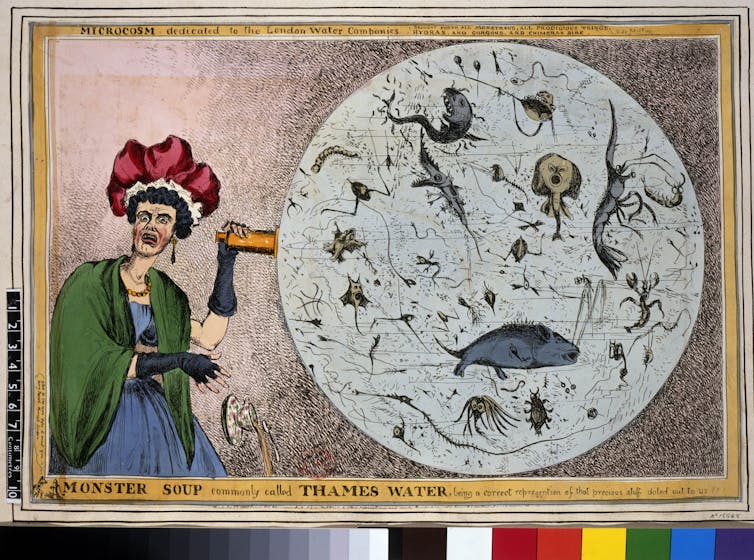
William Heath’s satirical drawing ‘Monster Soup’ in the British Museum shows artists in the early 1800s understood medicine and disease before technology.
(British Museum.), CC BY-NC-SA

Yet the idea persisted. In 1828, cartoon satirist William Heath imagined river water as “Monster Soup.” In 1854, English physician John Snow used what we might now call contact tracing to show that a London water pump was at the centre of a cholera outbreak. The same year, Italian physician Filippo Pacini used a microscope to identify the cause of the disease.

An easy step from disease to war

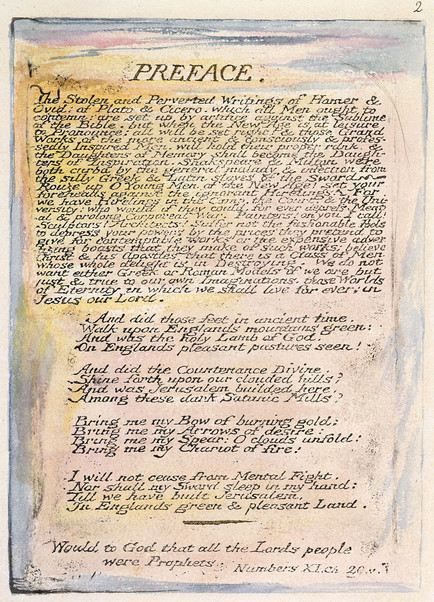
Writers were aware of public and research interests in medicine and drew on them, as in the familiar example of Mary Shelley’s Frankenstein in 1818. Writers also used medical metaphors: for instance, William Blake called the influence of Greek and Latin literature a “general malady and infection.”

These writers are using figures of speech to link concepts together: war is like a storm, disease is like war, and disease is like a storm, spread through clouds of bad air, raining contagion.


Read more:
Apocalyptic fiction helps us deal with the anxiety of the coronavirus pandemic


Metaphors aren’t simply decorative. They help explain unfamiliar ideas, and help us remember them by making them vivid or surprising. When Shakespeare had Hamlet talk about picking up weapons to fight “a sea of troubles,” he was communicating a sense of overwhelming odds. The metaphor was good enough to stick and is still widely used. Metaphors can also pass judgement, like Blake associating Greek and Latin literature with disease because it promoted war.

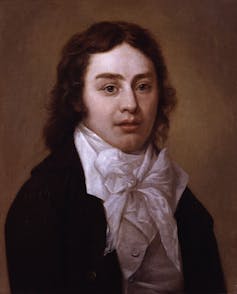
Writer and poet Samuel Taylor Coleridge was one of many British writers who used storms as metaphors for battles which were, in turn, used as metaphors for diseases.
(National Portrait Gallery, London), CC BY-NC-SA

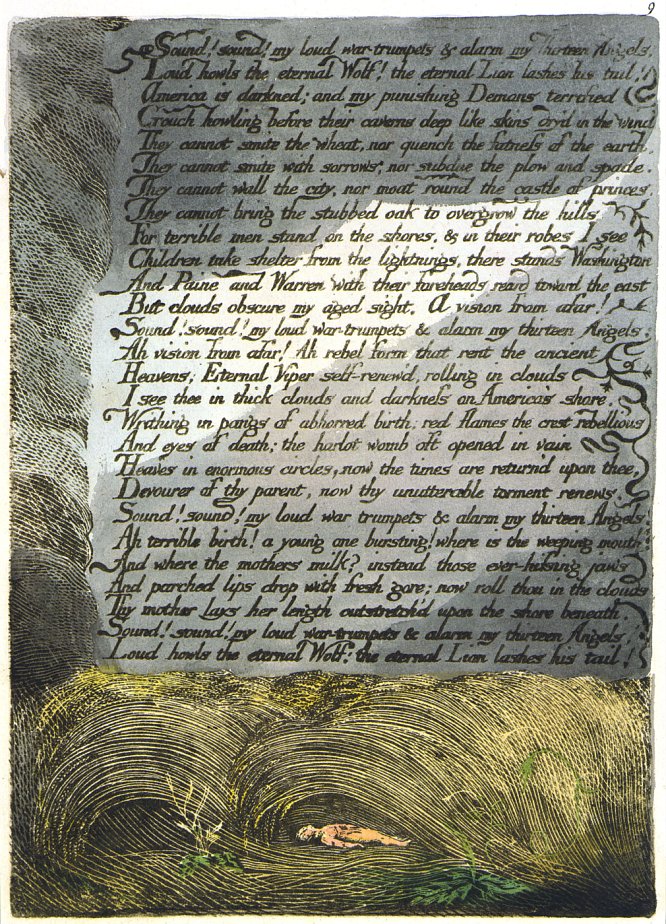
War was almost constant for Britain at this time, and writers often turned to thunderstorms to capture the terrible sound of battles. Blake’s 1793 poem about the American Revolutionary War describes the new United States as “darkned” by storm clouds while “Children take shelter from the lightnings” and leaders speak “in thunders.” A few years later, in his poem “Fears in Solitude,” Samuel Taylor Coleridge wrote about “Invasion, and the thunder and the shout.”

Medical writers of the era thought that bad air carried disease because they didn’t have the technology to see further. But they were able to connect the spread of disease with soldiers and ships. This made it an easy step from disease to war — with weather still in the mix.

In “Fears in Solitude,” Coleridge associated British imperialism with a spreading infection, carrying “to distant tribes slavery and pangs” “Like a cloud that travels on, / Steamed up from Cairo’s swamps of pestilence.” In “Adonais,” P.B. Shelley wrote of “vultures to the conqueror’s banner true … whose wings rain contagion.”

King Cholera goes to war

Two hundred years ago, disease wasn’t an “Invisible Enemy” or a “little animal”. It had power to kill, much like the kings who sent armies around the globe.

In her influential 1792 essay, Vindication of the Rights of Woman, English writer Mary Wollstonecraft wrote that “despots” are the source of a “baneful lurking gangrene” and lead to “contagion.” A quarter of a century later, the cholera pandemics began.

In John and Michael Banim’s 1831 poem “The Chaunt of the Cholera,” cholera doesn’t just “Breathe out the breath which maketh / A pest-house of the place.” It is a mercenary working for Europe’s monarchs: “Kings!–tell me my commission, / As from land to land I go.” Others, like English cartoonist John Leech, called the disease Lord Cholera or King Cholera.

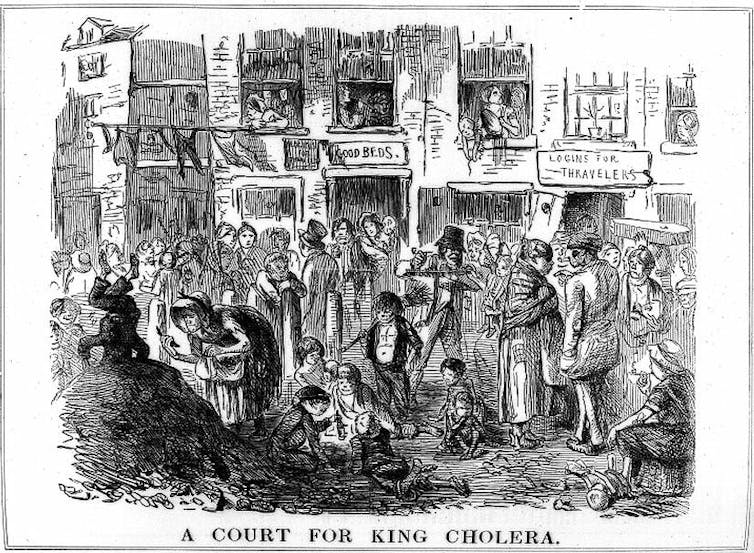
John Leech’s cartoon showing the association of cholera with squalor. A child stands on his head on top of a rubbish heap in the left-hand corner. An old woman scavenges from the heap, another child shows off his own find, and washing flutters in the breeze overhead.
(Wellcome Library), CC BY

John Leech’s 1852 cartoon, “A Court for King Cholera,” relayed a message we’re hearing now: inequality feeds pandemics. The 1853 poem “King Cholera’s Procession” also details the unsanitary conditions of the urban poor while condemning “Those that rule” for being King Cholera’s “friends.”

In her 1826 novel about a devastating pandemic, The Last Man, Mary Shelley also links rulers, war, and disease. The plague “shot her unerring shafts over the earth,” a shower of arrows, and becomes “Queen of the World.” Shelley idealizes the leader “full of care” who doesn’t want victory — only “bloodless peace.”

The coming storm

To these writers, war was a metaphor for the problem, not the solution.

In our time, business media suggest “battle metaphors” are overused. We have television shows like Robot Wars and Storage Wars, training sessions called “bootcamps” and elections in “battleground states.”

War is all too real and devastating in many parts of our world. But as a metaphor it is worn out — perhaps no longer vivid, no longer explanatory. Writers such as Coleridge, the Shelleys, and Blake may have seen close connections between war and disease, but their work also hints at another possibility.

Instead of talking about a war on COVID-19, let’s consider those storm metaphors. We need to stay inside and wait for it to pass.

And, while we are, perhaps we can also look to the past for help in understanding our present. Before they had evidence of germs, they could see that war and inequality spread disease.The Conversation

Julia M. Wright, University Research Professor, Dalhousie University

This article is republished from The Conversation under a Creative Commons license. Read the original article.
Unknown's avatar

Walking with Wordsworth on his 250th birthday


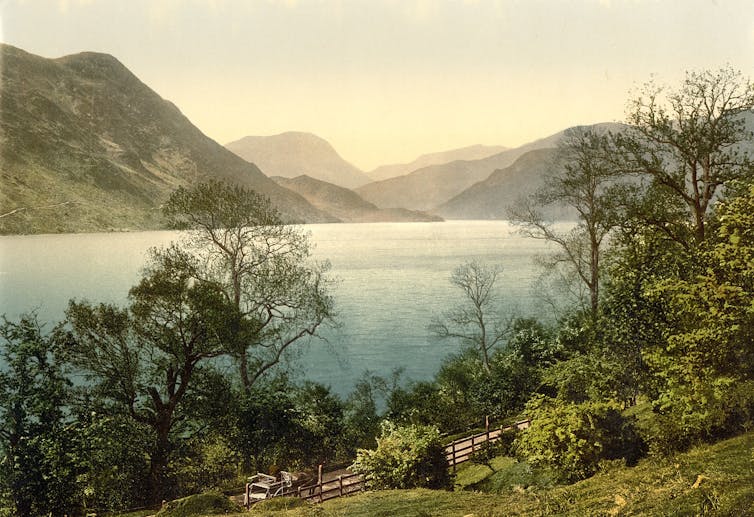
Ullswater from Gowbarrow Park in the Lake District where the Wordsworth walked often.
Wikimedia

Sally Bushell, Lancaster University

It is 250 years since the birth of the great English poet William Wordsworth. A lover of nature, his poetry abounds with images of lambs, flowers in full bloom, windswept crags and woodland scenes. His pleasure in nature, particularly that of his home the Lake District, is famous.

His contemporary Samuel Taylor Coleridge once describes his genius as “not a spirit that descended to him through the air; it sprang out of the ground like a flower.” Wordsworth did find much inspiration in the natural landscape that he would revel in on his long walks. In these house-bound times and on this anniversary, we can all find inspiration in the great poet and his love of walking as we take our daily exercise.

In a comic article from 1839 entitled Recollections of the Lakes and the Lake Poets: “Mr Wordsworth”, the writer Thomas De Quincey criticised Wordsworth’s unshapely legs while also noting that:

[He calculated], upon good data, that with these identical legs Wordsworth must have traversed a distance of 175,000 to 180,000 English miles

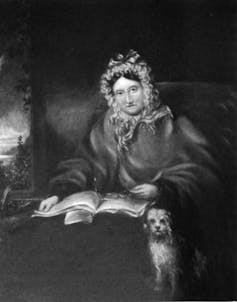
Dorothy Wordsworth with dog Pepper.
Wikimedia

In his summer vacation from Cambridge University in 1790, he walked right across revolutionary France, over the Alps and back through Germany (arriving late for the start of term). Wordsworth was still able to ascend Helvellyn, one of the highest peaks in the Lake District, aged 70 – a feat celebrated in Benjamin Robert Haydon’s portrait of him in 1842.

The walking Wordsworths

Wordsworth and his sister Dorothy were not only interested in large-scale walking tours but walked almost every day, at all times of the day. Dorothy’s famous Grasmere Journal, documents their walks and is itself a wonderful example of nature writing. In it she logs the minute details they would see on their walks, like daffodils near the Lake District’s Gowbarrow Park:

I never saw daffodils so beautiful. They grew about the mossy stones about and about them, some rested their heads upon these stones as on a pillow for weariness and the rest tossed and reeled and danced and seemed as if they verily laughed with the wind that blew upon them over the lake.

Walking was not just for pleasure, though. We know that Wordsworth frequently walked to write. Dorothy’s Journal describes how:

Though the length of his walk maybe sometimes a quarter or half a mile, he is as fast bound within the chosen limits as if by prison walls. He generally composes his verses out of doors, and while he is so engaged he seldom knows how the time slips away, or hardly whether it is rain or fair.

In a poem entitled When first I Journey’d Hither to his brother John, who was away at sea, Wordsworth writes of the joy of finding a path carved into the earth by him:

With a sense

Of lively joy did I behold this path

Beneath the fir-trees, for at once I knew

That by my Brother’s steps it had been trac’d.

My thoughts were pleas’d within me to perceive

That hither he had brought a finer eye,

A heart more wakeful: that more loth to part

From place so lovely he had worn the track,

Out of his own deep paths!

The poem ends by imagining John, walking up and down on the deck of his ship at sea in tune with William as he also walks up and down to write the poem on the path that John has made for him. He imagines an empathetic connection between the two constrained spaces:

Alone I tread this path, for aught I know

Timing my steps to thine

To the rhythm

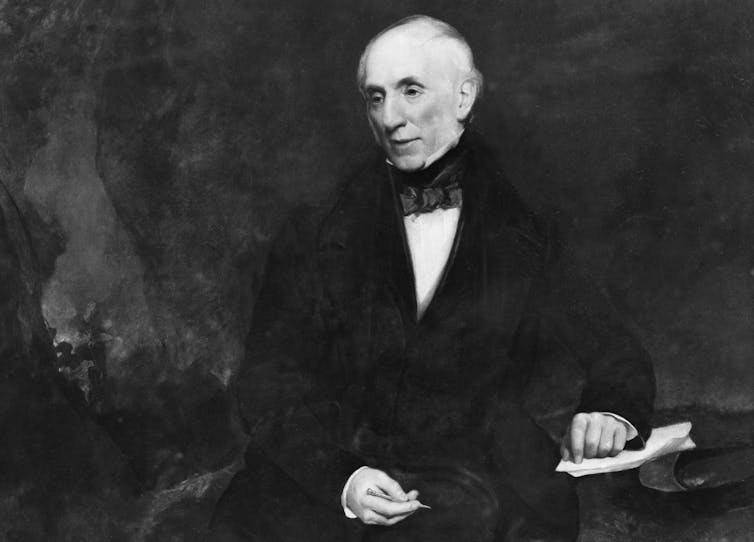
Wordsworth painted by Henry William Pickersgill.
Everett Historical/Shutterstock

Wordsworth is known for composing in the rhythm with the pace of his walking. In his epic autobiography, The Prelude, Wordsworth describes himself doing this and sending his terrier (Pepper) ahead to warn him of others:

And when at evening on the public way

I sauntered, like a river murmuring

And talking to itself when all things else

Are still, the creature trotted on before;

Such was his custom; but whene’er he met

A passenger approaching, he would turn

To give me timely notice, and straightway,

Grateful for that admonishment, I hushed

My voice, composed my gait, and, with the air

And mien of one whose thoughts are free, advanced

To give and take a greeting that might save

My name from piteous rumours, such as wait

On men suspected to be crazed in brain

This is also a wonderful example of why walking alone can be freeing. It allows us to be alone with our thoughts and to act freely (till someone happens by that is).

So, as you undertake your permitted daily walk, remember that constraint can also be creative, the familiar walk enjoyable in its very familiarity. Enjoy the calm of nature and, like William’s brother, John, receive that calm as a “silent poet” appreciative and receptive to the simple pleasures around you.The Conversation

Sally Bushell, Professor of English and Creative writing, Lancaster University

This article is republished from The Conversation under a Creative Commons license. Read the original article.

Unknown's avatar

Vale Bruce Dawe, Australia’s ‘Poet of Suburbia’


Lennon Cheng/Unsplash, CC BY

Kevin John Brophy, University of Melbourne

“Katrina, I had in mind a prayer, but only this came,” Bruce Dawe wrote to his infant daughter, new-born, in intensive care, her life in the balance, declaring as poets must that their poems are the best and only real gift they can give.

I did not know Dawe, who died aged 90 on Wednesday, but I knew his poetry from my first years of reading poems. For decades, the first contemporary poems many Australians read were his.

Born in 1930 in Fitzroy, a failed student after attending seven schools, he worked as a labourer like his father, a farmhand, a postman, and spent a year on the University of Melbourne campus where he became a poet and a Catholic. He joined the RAAF in 1959.

As well as publishing a growing list of books, he studied part time until he achieved a PhD. His teaching life at the Darling Downs Institute of Advanced Education and the University of Southern Queensland lasted from 1969 until 1993. By then he was easily Australia’s most well-read and well-loved poet. His death this week is a significant moment for poets and readers of poetry.

Poet Bruce Dawe reads Little Red Fox.
National Film & Sound Archive

A skilled mate

We know that poetry is somehow central to our nation’s soul, but mostly we like to keep its presence at the margins. In living memory, Les Murray and Dorothy Porter managed to bring poetry to wide audiences, but neither of them so broadly, neither of them prompting the passion of Dawe’s many readers.

When it comes to poetry, readers know pretty quickly what is authentic. Dawe’s poems are real enough to talk to you with one arm over your shoulder, or sit beside you, inviting you to look with them at what this whole damned creation is doing now.

But he couldn’t have survived as a poet by simply being genial. His poetry always held a deep steadiness of purpose in its gaze. This was his special skill. He was able to bring us in to seeing for instance how “the spider grief swings in his bitter geometry” (from Homecoming) when dead soldiers are freighted home.

He was uncannily capable of making poetry that talked plainly but still mysteriously about the most extreme of our experiences: funerals and suicides, drowned children, a mother-in-law’s glorious death falling out of her chair at a barbecue, the last nail being driven into the body of Christ (“the iron shocking the dumb wood”), the 1995 massacre at Srebrenica, or the hanging of Ronald Ryan.

You cannot read his poems without finding some personal connection to them too; my grandmother who once held a telegram announcing her son’s wartime death, and whose home was opposite Ronald Ryan’s bloody shootout on Sydney Road, had seemed to me to have had her life marked by images in Dawe’s poems.

In Australia, we know there’s another job requirement for any poet worth their salt, and that is a dry and thoroughly demotic wit. Dawe’s hilarious At Shagger’s Funeral is just one gem that Lawson would have been proud to have chiselled out.

Tests of time

New themes of gender, ethnicity, identity politics, the explosion of poetry since the avant-garde experiments of Fluxus might seem to leave Dawe’s poetry suspended in a historical moment, but this is to say no more than what happens to every strong and distinctive poet.

No one wrote poetry quite like Dawe. Lots of poets took inspiration from him too, many without realising it – the vibrant “street poetry” movement in Melbourne through the 1970s and 80s, morphing into performance poetry and spoken word – each take their impulse from Dawe’s confidence in poetry’s place as a voice for, about, and from life as it’s lived by the most desperate and the most ordinary of us.

The bravery of his poetry, its wit and sensitivity to the world are there in one of the most stark and touching love poems you could imagine reading:

Hearing the sound of your breathing as you sleep,

with the dog at your feet, his head resting

on a shoe, and the clock’s ticking

Like water dripping in a sink

– I know that, even if reincarnation were a fact,

given the inherent cruelty of the world

where beautiful things and people

are blasted apart all the day long,

I would never want to come back, knowing

I could never be this lucky twice …

(from You and Sarajevo: for Gloria)

He has been praised for the technical achievement of blending the colloquial with the lyrical, something he often got “right”. But beyond this deftness, his poems always reach towards our most humane responses to the world.

We know from our present troubles as a nation, as a planet, and as a species, that we need poets as right and true as Bruce Dawe to continue this sometimes visionary and sometimes laughably inadequate work. The Conversation

A mural dedicated to poet Bruce Dawe in his birthplace Fitzroy.

Kevin John Brophy, Emeritus Professor of Creative writing, University of Melbourne

This article is republished from The Conversation under a Creative Commons license. Read the original article.
Unknown's avatar

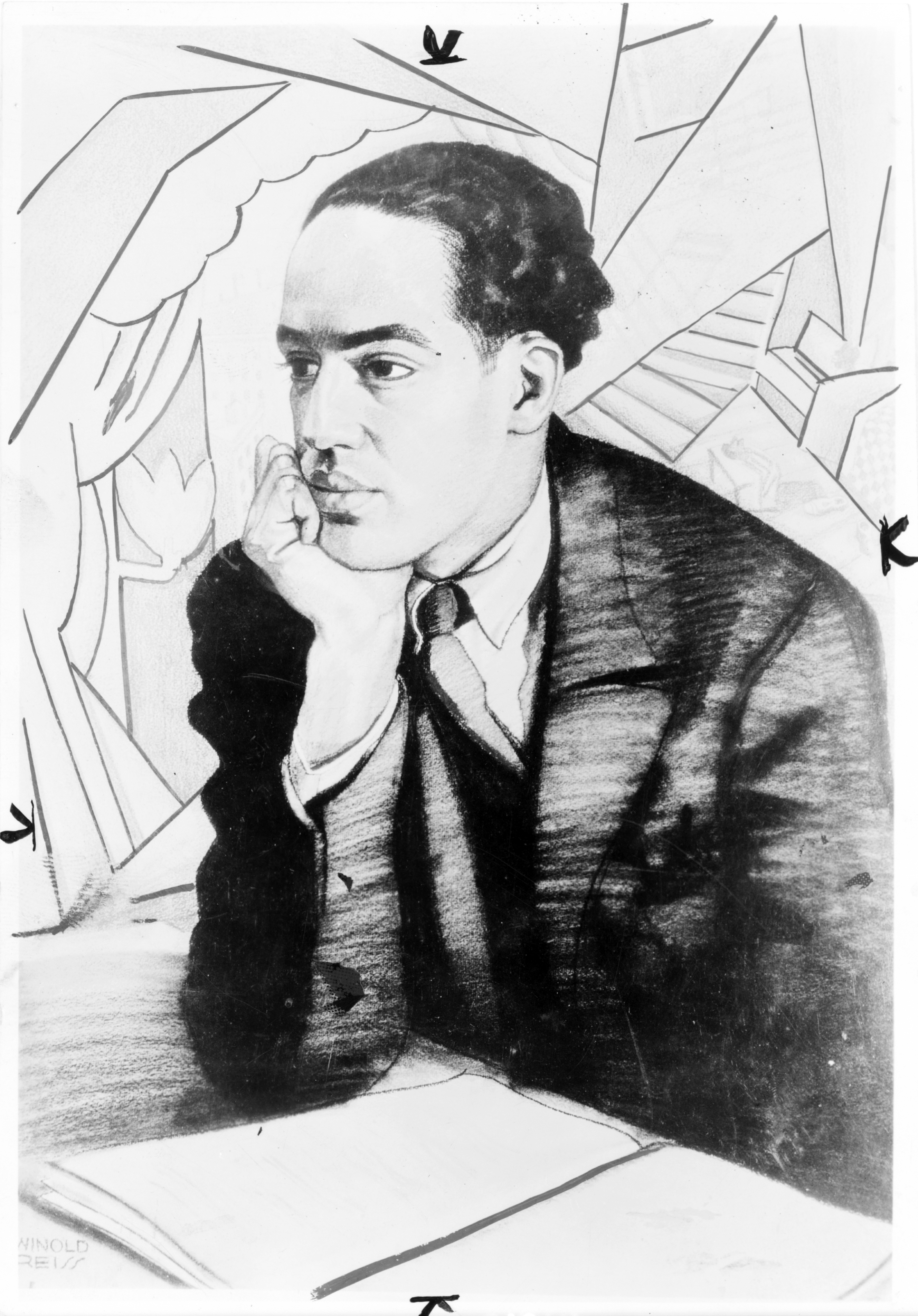
Langston Hughes – domestic pariah, international superstar


Throughout his career, Hughes was eager to mentor and promote the work of writers abroad.
Library of Congress

Jason Miller, North Carolina State University

A leading figure of the Harlem Renaissance, the inspiration behind Lorraine Hansberry’s play “A Raisin in the Sun” and an uncompromising voice for social justice, Langston Hughes is heralded as one of America’s greatest poets.

It wasn’t always this way. During his career, Hughes was routinely harassed by his own government. And the nation’s literati, balking at his subversive politics, tended to overlook his work.

But the opposite was true abroad, in places like France, Nigeria and Cuba, where Hughes had legions of devoted readers who were some of the first to recognize the promise and power of the poet’s words. In my new book, “Langston Hughes: Critical Lives,” I trace Hughes’ budding international stardom, and how it clashed with the hostility he faced back home.

Building a fan base

Growing up in America, Hughes had experienced racism firsthand. As he matured as poet and writer, he started looking beyond America’s borders, curious to learn more about how racism impacted different cultures.

Between 1924 and his death in 1967, Hughes made trips to places as varied as Italy, Russia, England, Nigeria and Ghana.

During a visit to Cuba in 1930, Hughes met a young Cuban poet named Nicolás Guillén. Hughes had already successfully written dozens of poems inspired by the 12-bar structures, cadences, rhymes and subject matter of blues music. Over the course of several late-night dinners at Lolita’s restaurant in Havana, Hughes encouraged Guillén to do the same with his home country’s music.

Within days of Hughes’ departure, Guillén started writing poems making use of Cuba’s “son tradition,” a form of popular dance music. This was a key moment in the development of an artist who would go on to become Cuba’s national poet.

Hughes was also the only figure of the Harlem Renaissance who traveled to Africa. After several trips to the continent, he became determined to promote the work of his African peers – writers like Bloke Modisane and eventual Nobel Prize-winner Wole Soyinka. So in 1960, he edited his anthology “African Treasury,” which introduced many in the West to some of Africa’s greatest writers.

In countries like Nigeria, Hughes needed no introduction. In the 1940s, 1950s and 1960s, dozens of Hughes’ poems had appeared in the country’s newspapers and journals. After Nigeria elected Nnamdi Azikiwe, its first native governor-general, in 1960, Azikiwe concluded his inaugural by reciting Hughes’ poem “Youth.”

When Hughes returned to Ghana and Senegal later in the decade, he was greeted like a superstar. Scores of his admirers trailed him in the streets of Dakar, much in the way sports heroes are hounded by children for autographs.

By the 1960s, Hughes’ works were being translated into Russian, Italian, Swedish and Spanish. But the first scholarly study of his poetry appeared in France. Literary critic Jean Wagner’s 1963 book “Black Poets of the United States” highlighted the talents of Hughes as both a poet and activist. Devoting over 100 pages to Hughes, Wagner noted that African Americans would never “produce a more fiery bard” who was simultaneously “one of the community refusing to stand apart as an individual.”

As the first black writer in the United States to make his living solely by writing, Hughes ultimately galvanized scores of emerging writers and poets in Europe, Africa and South America. To them, Hughes represented a critical Western link to other people of color around the world. He was also an exemplar of the jazz and blues music they so revered. As a testament to Hughes’ popularity abroad, it was Venezuela – not the United States – that sought to nominate him for the Nobel Prize in Literature in 1960.

Making enemies at home

Back in America, Hughes certainly had his admirers, especially among the African American community. But most establishment figures – in politics, in the media and in law enforcement – viewed him as a menace.

As Hughes’ international fame grew, he was being denigrated as a subversive and a communist by his own government. Hughes had been under FBI surveillance since at least 1933, after he had traveled to Russia. Meanwhile his adamant calls for justice in the Scottsboro case of 1931 – when eight young black men were falsely accused of raping two white prostitutes – earned him the ire of FBI director J. Edgar Hoover. Hughes’ piercing critiques of capitalism didn’t help his cause, either. Hoover would go on to wage a personal vendetta against Hughes, building a 550-page file on him that highlighted poems like “Goodbye, Christ” as evidence of his communist sympathies.

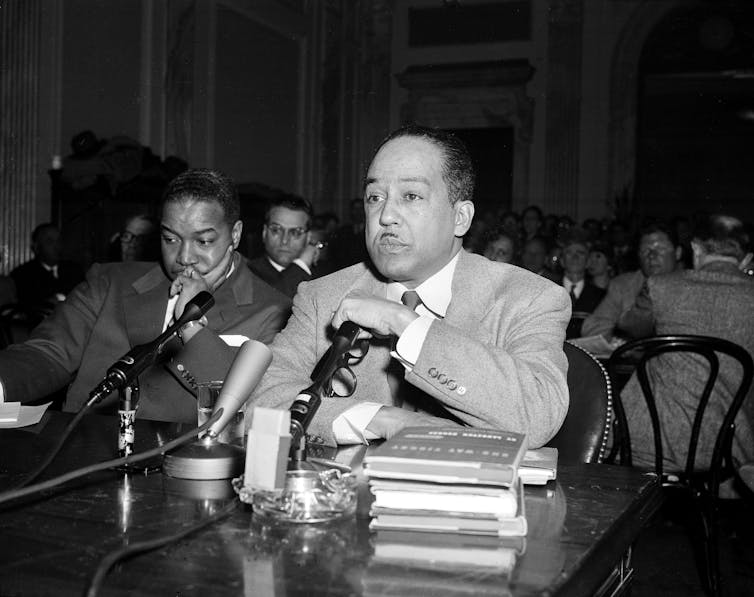
Then, in 1953, Hughes was called to testify before Sen. Joseph McCarthy, who wanted to use Hughes’ previous support of communist causes and his supposedly subversive allegiances to target suspected “reds” in the State Department.

The man who was exalted by political leaders overseas, who found himself elbowing his way through throngs of adoring crowds abroad, was attacked as “un-American” by McCarthy’s Senate Subcommittee.

Poet and author Langston Hughes speaks before the McCarthy Committee in Washington, D.C. on March 26, 1953.
AP Photo

Hughes was understandably conflicted about his native country, and he explored this ambivalence in poems such as “Let America Be America Again”:

    Let America be America again.
    Let it be the dream it used to be.
    Let it be the pioneer on the plain
    Seeking a home where he himself is free.

    (America never was America to me.)

That last line still resonates for many Americans – for those who have never known a golden age, nor tasted the nation’s promise of dreams, justice and equality for all.

How long, Hughes wondered in “Harlem,” would we have to wait? And what was the cost of kicking the can down the road?

  What happens to a dream deferred?

  Does it dry up
  like a raisin in the sun?
  Or fester like a sore—
  And then run?
  Does it stink like rotten meat?
  Or crust and sugar over—
  like a syrupy sweet?

  Maybe it just sags
  like a heavy load.

  Or does it explode?

Interestingly, Hughes had ended the first draft of this famous poem with the lines, “or does it atom-like explode / and leave deaths in its wake? Does it disappear / as might smoke somewhere?”

Writing on Aug. 7, 1948, the poet was keenly aware of what had happened only three years prior when nuclear bombs were dropped on Nagasaki and Hiroshima.

To me, this perfectly encapsulates Hughes’ international appeal. The poet sympathized with those who had felt the harshest wrath of American power and politics. His intended audience was never just his fellow Americans who were grappling with fear and anxiety; it was anyone who had suffered great and devastating loss – an anguish that knows no language or borders.

[Deep knowledge, daily. Sign up for The Conversation’s newsletter.]The Conversation

Jason Miller, Professor of English, North Carolina State University

This article is republished from The Conversation under a Creative Commons license. Read the original article.
Unknown's avatar

Friday essay: a real life experiment illuminates the future of books and reading


Andy Simionato, RMIT University and Karen ann Donnachie, RMIT University

Books are always transforming. The book we hold today has arrived through a number of materials (clay, papyrus, parchment, paper, pixels) and forms (tablet, scroll, codex, kindle).

The book can be a tool for communication, reading, entertainment, or learning; an object and a status symbol.

The most recent shift, from print media to digital technology, began around the middle of the 20th century. It culminated in two of the most ambitious projects in the history of the book (at least if we believe the corporate hype): the mass-digitisation of books by Google and the mass-distribution of electronic books by Amazon.

The survival of bookshops and flourishing of libraries (in real life) defies predictions that the “end of the book” is near. But even the most militant bibliophile will acknowledge how digital technology has called the “idea” of the book into question, once again.

To explore the potential for human-machine collaboration in reading and writing, we built a machine that makes poetry from the pages of any printed book. Ultimately, this project attempts to imagine the future of the book itself.

A machine to read books

Our custom-coded reading-machine reads and interprets real book pages, to create a new “illuminated” book of poetry.

The reading-machine uses Computer Vision and Optical Character Recognition to identify the text on any open book placed under its dual cameras. It then uses Machine Learning and Natural Language Processing technology to “read” the text for meaning, in order to select a short poetic combination of words on the page which it saves by digitally erasing all other words on the page.

Armed with this generated verse, the reading-machine searches the internet for an image – often a doodle or meme, which someone has shared and which has been stored in Google Images – to illustrate the poem.

Once every page in the book has been read, interpreted, and illustrated, the system publishes the results using an online printing service. The resulting volume is then added to a growing archive we call The Library of Nonhuman Books.

From the moment our machine completes its reading until the delivery of the book, our automated-art-system proceeds algorithmically – from interpreting and illuminating the poems, to pagination, cover design and finally adding the endmatter. This is all done without human intervention. The algorithm can generate a seemingly infinite number of readings of any book.

The poetry

The following poems were produced by the reading-machine from popular texts:

deep down men try there

he’s large naked she’s even

while facing anything.

from E.L. James’ Fifty Shades of Grey

how parties popcorn

jukebox bathrooms depressed

shrug, yeah? all.

from Bret Easton Ellis’ The Rules of Attraction

Oh and her bedroom

bathroom brushing sending it

garter too face hell.

from Truman Capote’s Breakfast at Tiffany’s

My algorithm, my muse

So what does all this have to do with the mass-digitisation of books?

Faced with growing resistance from authors and publishers concerned with Google’s management of copyright, the infoglomerate pivoted away from its primary goal of providing a free corpus of books (a kind of modern day Library of Alexandria) and towards a more modest index system used for searching inside the books Google had scanned. Google would now serve only short “snippets” of words highlighted on the original page.

Behind the scenes, Google had identified a different use for the texts. Millions of scanned books could be used in a field called Natural Language Processing. NLP allows computers to communicate with people using everyday language rather than code. The books originally scanned for humans were made available to machines for learning, and later imitating, human language.

Imagine infinite readings of the books we already have.
Unsplash, CC BY

Algorithmic processes like NLP and Machine Learning hold the promise (or threat) of deferring much of our everyday reading to machines. History has shown that once machines know how to do something, we generally leave them to it. The extent to which we do this will depend on how much we value reading.

If we continue to defer our reading (and writing) to machines, we might make literature with our artificially intelligent counterparts. What will poetry become, with an algorithm as our muse?

We already have clues to this: from the almost obligatory use of emojis or Japanese Kaomoji (顔文字) as visual shorthand for the emotional intent of our digital communication, to the layered meanings of internet memes, to the auto-generation of “fake news” stories. These are the image-word hybrids we find in post-literate social media.

To hide a leaf

Take the book, my friend, and read your eyes out, you will never find there what I find.

Ralph Waldo Emerson’s Spiritual Laws

Emerson’s challenge highlights the subjectivity we bring to reading. When we started working on the reading-machine we focused on discovering patterns of words within larger bodies of texts that have always been there, but have remained “hidden in plain sight”. Every attempt by the reading-machine generated new poems, all of them made from words that remained in their original positions on the pages of books.

The notion of a single book consisting of infinite readings is not new. We originally conceived our reading-machine as a way of making a mythical Book of Sand, described by Jorge Luis Borges in his 1975 parable.

Borges’ story is about the narrator’s encounter with an endless book which continuously recombines its words and images. Many have compared this impossible book to the internet of today. Our reading-machine, with the turn of each page of any physical book, calculates combinations of words on that page which, until that moment, have been seen, but not consciously perceived by the reader.

The title of our early version of the work was To Hide a Leaf. It was generated by chance when a prototype of the reading-machine was presented with a page from a book of Borges’ stories. The complete sentence from which the words were taken is:

Somewhere I recalled reading that the best place to hide a leaf is in a forest.

The latent verse our machine attempts to reveal in books also hides in plain sight, like a leaf in a forest; and the idea is also a play on a page being generally referred to as a “leaf of a book”.

Like the Book of Sand, perhaps all books can be seen as combinatorial machines. We believed we could write an algorithm that could unlock new meanings in existing books, using only the text within that book as the key.

Philosopher Boris Groys described the result of the mass-digitisation of the book as Words Without Grammar, suggesting clouds of disconnected words.

Our reading-machine, and the Library of Nonhuman Books it is generating, is an attempt to imagine the book to come after these clouds of “words without grammar”. We have found the results are sometimes comical, often nonsensical, occasionally infuriating and, every now and then, even poetic.

Now that machines can read, will we defer the task to them?

The reading-machine will be on display at the Melbourne Art Book Fair in March and will collect a Tokyo Type Directors Club Award in April. Nonhuman Books are available via Atomic Activity Books.The Conversation

Andy Simionato, Lecturer, RMIT University and Karen ann Donnachie, Independent artist / Lecturer (adjunct), RMIT University

This article is republished from The Conversation under a Creative Commons license. Read the original article.
Unknown's avatar

Do authors really put deeper meaning into poems and stories – or do readers make it up?


Many books, like ‘Charlotte’s Web,’ contain symbolism.
Dmitriy Os Ivanov/Shutterstock.com

Elisabeth Gruner, University of Richmond

Curious Kids is a series for children of all ages. If you have a question you’d like an expert to answer, send it to CuriousKidsUS@theconversation.com.


Do authors really put deeper meaning into poems and stories – or do readers make it up? Jordan, 14, Indianapolis, Indiana


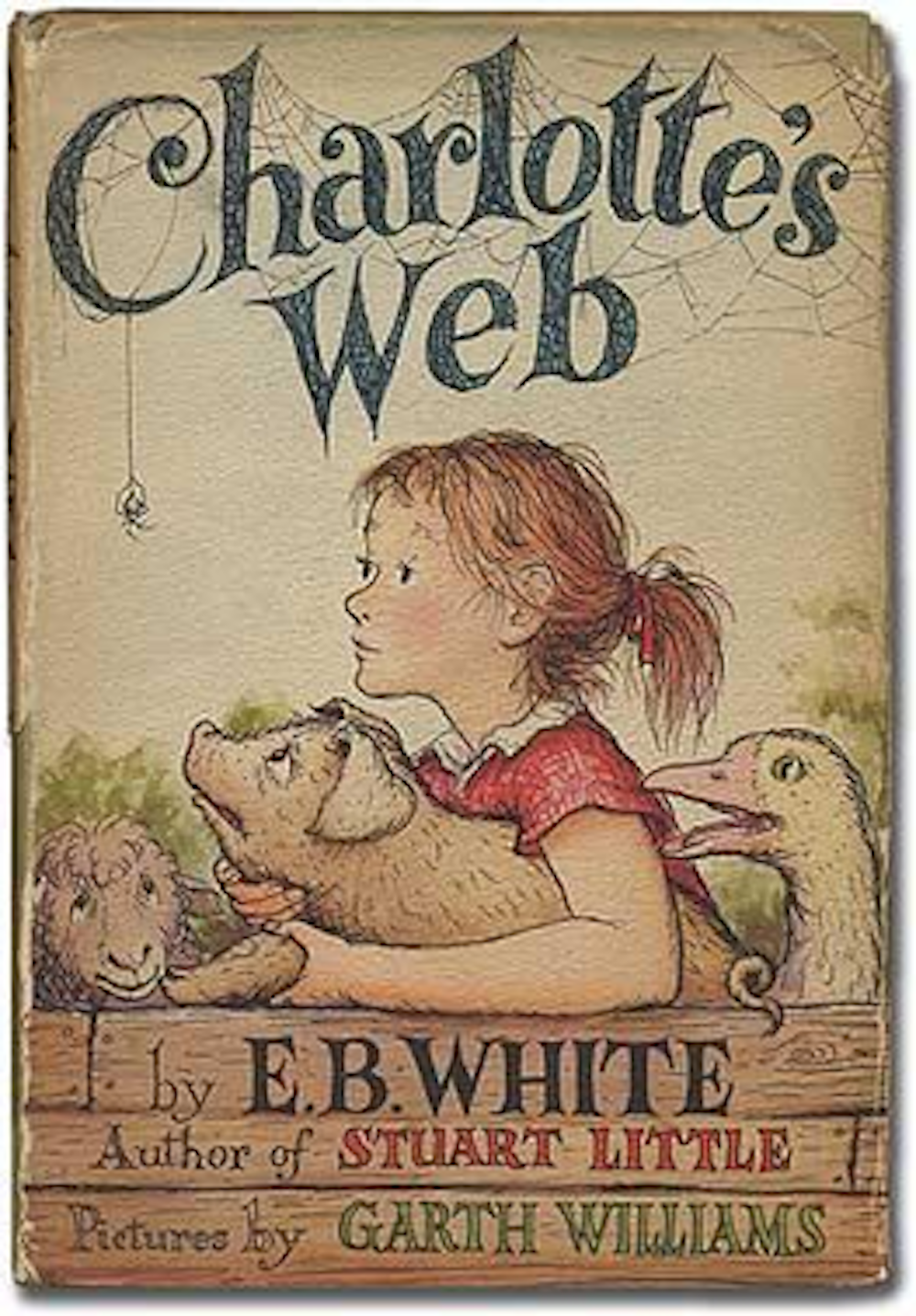
One of my favorite novels is “Charlotte’s Web,” the famous story of a friendship between a pig and a spider.

I often talk about this novel with my students studying children’s literature. At some point, someone always asks about “deeper meaning.” Is it really a story of, say, the cycle of death and rebirth? Or the importance of friendship? Or the significance of writing?

Or is it just a story of life in the barn, with talking animals?

In a way, it doesn’t matter. Because every writer is also a reader, and that means that whatever a writer puts into a story probably came from somewhere else, whether it’s another story, or a poem, or their own life experience.

And readers, too, will bring their own experience – of other stories, other poems and life – and that will direct their interpretation of what they absorb. We can see one example of this if we look at the spider in “Charlotte’s Web.”

The meaning of character

That spider, Charlotte, is based on a real spider. We know this because E.B. White drew pictures of spiders, studied them and made sure to be as accurate as he could when he wrote about them.

‘Charlotte’s Web’ by E. B. White.
Wikimedia Commons, CC BY

But, to a reader she may also represent Arachne, the talented weaver who challenged the goddess Athena and was changed into a spider for her pride. Or she may be the “noiseless patient spider” of Walt Whitman’s poem, who flings out thread-like filaments as the poet flings out words.

She may also be the spider who weaves “the silken tent” of Robert Frost’s poem. Maybe we’ll think about how the spider, like a human storyteller, generates something seemingly out of nothing, which makes her web miraculous.

Each of these spiders symbolizes different things. When we read about her, then, we may think of all those other spiders. Or we may just think about the spider we saw on our own front porch that morning, weaving her own web.

As the writer Philip Pullman said, “The meaning of a story emerges in the meeting between the words on the page and the thoughts in the reader’s mind.”

The reader is in charge

What Pullman is suggesting, then, is that it’s up to readers to make the meaning they want out of the stories they hear and the books they read.

It’s a powerful statement: We are in charge.

This doesn’t mean that anything goes. Meanings come from context, from convention, from older stories and from previous usage. But it’s up to us to interpret what we read and to make the case for how we’re doing it.

Or, as the novelist John Green writes of his books, “They belong to their readers now, which is a great thing – because the books are more powerful in the hands of my readers than they could ever be in my hands.”

What we do with the books we read matters, Green tells us. It’s up to us to make the meaning and up to us to decide what to do with that meaning once we’ve made it.

Hello, curious kids! Do you have a question you’d like an expert to answer? Ask an adult to send your question to CuriousKidsUS@theconversation.com. Please tell us your name, age and the city where you live.

And since curiosity has no age limit – adults, let us know what you’re wondering, too. We won’t be able to answer every question, but we will do our best.The Conversation

Elisabeth Gruner, Associate Professor of English, University of Richmond

This article is republished from The Conversation under a Creative Commons license. Read the original article.

Unknown's avatar

Remembering Robert Burns has never been straightforward


Shutterstock

Gerard Lee McKeever, University of Glasgow

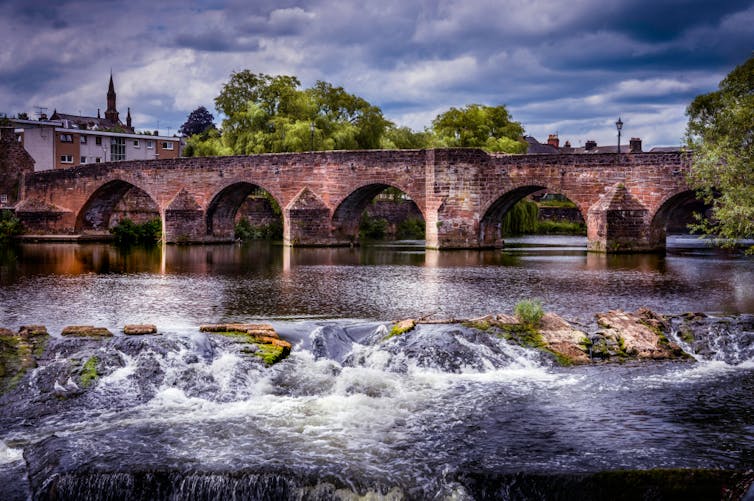
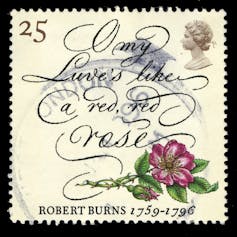
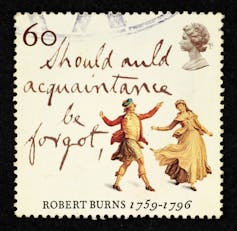
The memory of the Ayrshire-born Scottish poet Robert Burns has always been complicated, especially in Dumfries, the town where he died in July 1796. In the years following his untimely demise at the age of 37, literary tourists including Dorothy Wordsworth and John Keats visited this market town in south-west Scotland in search of their hero. What they found, however, was a vision of Burns and of Scotland itself that seemed out of place, difficult to comprehend and yet intensely personal.

Burns’s own relationship to Dumfriesshire was enigmatic from the start. When he arrived to take up the tenancy of Ellisland farm in the summer of 1788, he declared himself in a “land unknown to prose or rhyme”. But Burns’s view of the region would evolve many times. By August of the same year, he was commemorating the Nith Valley’s “fruitful vales”, “sloping dales” and “lambkins wanton”, and had already written back in October 1787 that: “The banks of Nith are as sweet, poetic ground as any I ever saw.”

Dumfries, where Burns died in 1796.
Shutterstock

Burns composed some of his best-known work during these years, including what many consider his masterpiece, Tam o’ Shanter. And yet a shift in focus from poetry to songwriting – as he worked to collect, revise and compose lyrics for collections of national song – changed the sense of both place and personality in his writing. In his earlier years, Burns’s poetry had often been intensely self-reflective, rooting a version of himself in the Ayrshire landscape where he was raised. Now, his persona receded into the background due to the inherently communal nature of folksong.

At the same time, Burns’s employment as an excise officer and his eventual poor health in Dumfries would lead 19th-century commentators such as the historian Thomas Carlyle to accuse the town of wasting the poet’s talents through a lack of patronage. That underestimates Burns’s agency as a member of the lower middle class, who took pride in supporting his family independently. Yet still, what emerged was a lingering sense of the Ayrshire Burns as the true Burns, where the Dumfries Burns was only a tragic, diminished echo of himself.


Shutterstock

Poetic pilgrimage

In 1803, Dorothy Wordsworth set off from the Lake District on a tour of Scotland in the company of her brother William and Samuel Taylor Coleridge. Among key items on their itinerary was a pilgrimage to Burns sites in and around Dumfries. Yet the poet’s memory would not be easily reckoned with.

In her tour journal, Wordsworth quoted Burns’s own A Bard’s Epitaph – “thoughtless follies laid him low, | And stain’d his name” – to underline the moral failings of a poet already famous for his love affairs and heavy drinking. She wrote:

We could think of little else but poor Burns, and his moving about on that unpoetic ground.

Burns proved an inescapable but difficult presence in Dumfries for Wordsworth. He became representative of a south-west Scotland that defied easy comprehension: neither quite “the same as England” nor “simple, naked Scotland”.

Further north at Ellisland farm, Wordsworth remembered catching a view back home to “the Cumberland mountains”. The idea was taken up by her brother in a poem originally titled Ejaculation at the Grave of Burns, in which William imagined himself and Burns as the hills of Criffel and Skiddaw staring at one another across the Solway Firth. Yet the dead poet remained out of reach, leaving these tourists to their personal musings about Dumfriesshire in the terms of tragedy: a visit to Burns in 1803 was already seven years too late.

Keats made a pilgrimmage to Burns’s grave.
Shutterstock

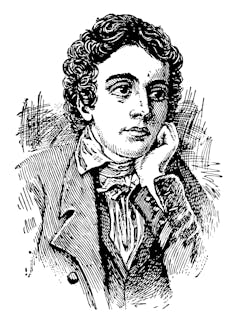
If anything, the situation was even more pronounced in John Keats’s account of his 1818 walking tour, in which Dumfries shoulders much of the blame for the tragic story of this “poor unfortunate fellow”. Keats would find himself disgusted at the tourism industry that had already sprung up at the poet’s birthplace further north in Ayrshire.

But when confronted with the spectacle of Burns’s death, Keats apparently struggled to make much sense of Dumfries at all. Performing a kind of theatrical bewilderment in On Visiting the Tomb of Burns, he wrote that the town seemed “beautiful, cold – strange – as in a dream”.

Memory and imagination

It is difficult to overstate the impact of Burns’s legacy in south-west Scotland, for better or worse. His influence on following generations of poets in the region could be both inspiring and suffocating, while civic pride in his memory took on new forms in Dumfries as elsewhere throughout the 19th century, not least in the extravagant centenary celebrations in 1859.


Shutterstock

Today, when the poet’s birthday is marked on January 25 around the world, many different and contradictory versions of Burns will be remembered. In their complex responses to Dumfries, where the poet’s death has often seemed more tangible than his birth, early literary tourists like the Wordsworths and Keats show that this is nothing new.

After all, the role of a national poet – a vehicle for our thoughts and dreams – underlines how much of both memory and geography is the work of the imagination.The Conversation

Gerard Lee McKeever, British Academy Postdoctoral Fellow, University of Glasgow

This article is republished from The Conversation under a Creative Commons license. Read the original article.
Unknown's avatar

Holocaust poetry and the reclamation of many identities


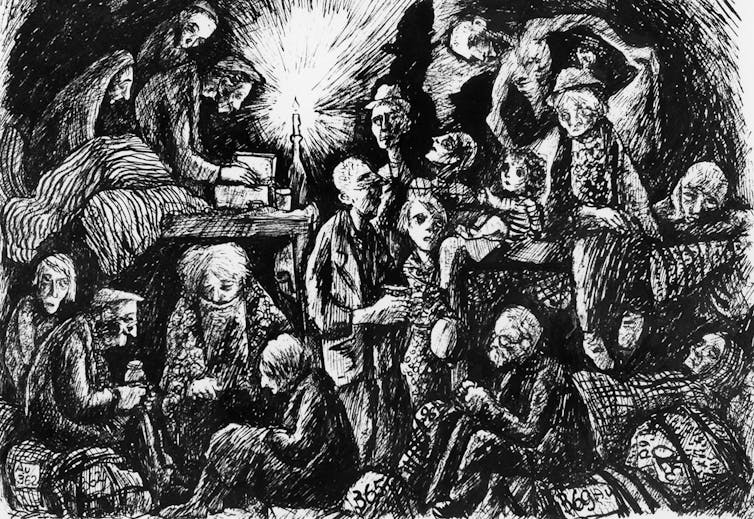
In the Living Quarters by Bedrich Fritta portrays Terezín (Theresienstadt) ghetto where early Holocaust poetry was written.
Wikimedia

Marian de Vooght, University of Essex

The first Holocaust poems were written 90 years ago, when the full extent of the horror was yet to be known. Starting in the 1930s, those first works foreshadowed the catastrophe that was soon to come. As the second world war erupted and the Nazi killings began, people continued to write poetry that recorded direct experiences of persecution and lamented the murder of loved ones.

While many writers of Holocaust poetry are Jewish, there are those who belong to other groups targeted by the Nazi regime. Including those who were perceived to have disabilities, Roma and Sinti people, political and religious opponents and homosexual men.

Writing poetry of the Holocaust has often been a way to reclaim identity, as writer and translator Lou Sarabadzic puts it:

Victims of the Holocaust are not the Other in these lines, but rather the authors, the ones we listen to, the ones expressing emotions.

As such, they continue to be written today as people continue to reckon with the memories and impact of the Holocaust.

Diverse backgrounds

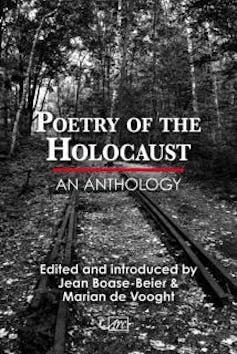
Published in 2019, Poetry of the Holocaust: An Anthology brings together poems from 19 languages that were previously unavailable in English. The translations in this book are followed by the original texts. These include poems in languages not normally associated with the Holocaust, such as Norwegian and Japanese, and from places like Argentina, Denmark and South Africa.


Author provided

Holocaust poetry in the 1930s and through the war wrestled with the incomprehensible reality its writers were facing. The earliest poems in Europe responded to the foreboding of the fascist regime and its politics of elimination.

In 1932, the German poet Eduard Saenger wrote in reaction to the sinister change of atmosphere that he was witnessing in his country:

A silent wind sends fear through the land / with an edge like the howling of wolves.

Like Saenger, many wrote poems warning of the approaching dark times and also in reaction to specific events, like the book burnings of May 1933 and Kristallnacht in November 1938.

During the war, the poems documented life in ghettos, prisons and concentration camps. They spoke of mass shootings and of seeing neighbours deported.

Writing in the Terezín (Theresienstadt) ghetto in the early 1940s, the Czech teenager Dagmar Hilarová expressed the desire to die rather than undergo further humiliation and torture:

Like a bird with wounded wings / To lie down, / And not to wait for morning.

Poems written in concentration camps were memorised or hidden, often later found by others. Sallie Pinkhof wrote a poem in Bergen-Belsen in 1944, in which he mocked the state of his body:

What a hoot / these loose-fitting tendons / and bones in my foot!

Pinkhof did not survive but his poems were preserved by fellow camp inmates. An anonymous poem found in the Zigeunerlager (Gypsy Camp) of Auschwitz-Birkenau opens with the wish:

Do not wake me from my dream, / so the world need never know / how they treat a Roma.


Read more:
Nazis murdered a quarter of Europe’s Roma, but history still overlooks this genocide


After the war

For many the horror of the Holocaust is both lifelong and unspeakable. As the memory and impact of the catastrophe continue to be felt by survivors, their children and people touched by its reverberations, poems continue to be written about the Holocaust to express what is almost beyond words. Dutch poet Chawwa Wijnberg (2001), whose father was executed by the Nazis:

Always present is the unsaid / the unsaid / that rips the wound open

Silence is a recurrent theme. Rita Gabbai-Simantov, a Sephardic-Turkish poet who lives in Greece and writes in Ladino, Judaeo-Spanish, about Thessaloniki – “old Saloniki” – and its wiped-out Jewish community (1992): “As you walk, your companion / will be silence”.

After her visit to Auschwitz, the Lithuanian poet Janina Degutytė recorded in 1966 the enduring silence of the people who were deported from her country and murdered:

Lips gasp for air … / The only sound is the rustling of golden leaves, / The rustling flow of time: which was – is – will be …“.

Later poetry also gave voices to persecuted groups who were previously unrepresented. In 1995, French writer André Sarcq was the first to express the fate of gay men who for decades after the war, in France and elsewhere, could not speak about their experience in concentration camps. This was because homosexuality continued to be outlawed and they felt, in Sarcq’s words, like “the rag of a pool of souls”.

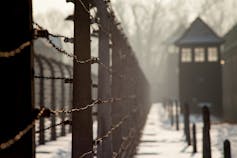
The poet Janina Degutytė wrote a poem about Lithuanian victims after visiting Auschwitz in Poland.
Szymon Kaczmarczyk/Shutterstock

Poetry of the Holocaust continues to be written in our time. A striking example is the poem by Angela Fritzen, a journalist who has Down’s syndrome. Written after visiting an exhibition in Bonn, Germany in 2016, the poem is about the fate of people with disabilities during the Nazi era. “To have strength” is how Fritzen ends her deeply felt poem.

Holocaust poetry is a rich and diverse genre that continues to be added to. Both the older and the contemporary poems need readers, because Holocaust poetry is about communication. The poets felt the need to share their pain and it is vital that readers take the chance to empathise with what they have been through. By way of reflecting on the experience of others we recognise what it means to be human.

The translators of the quoted lines of poetry in this article are: Jean Boase-Beier (Saenger, Fritzen, Sarcq), Anna Crowe (Gabbai-Simantov), Maria Grazina Slavėnas (Degutytė), Marian de Vooght (Pinkhof, Sarcq) and Philip Wilson (Hilarová).The Conversation

Marian de Vooght, Visiting Fellow, Department of Government, University of Essex

This article is republished from The Conversation under a Creative Commons license. Read the original article.
Unknown's avatar

UWA Publishing has helped take Australian poetry into the world. Its closure would be catastrophic for poets


Some of the many poetry books published in recent years by UWA Publishing.
UWA/Shutterstock

John Kinsella, Curtin University

I start with a disclaimer: I am a UWA Publishing poet. I have published a book of poetry with them (as well as a novel), and have two books forthcoming with them in 2020 — The Weave, a collection of poetry co-written with Thurston Moore, and an edited and introduced volume, The Collected Poems of C.J. Brennan, the great, Sydney-dwelling, symbolist poet (1870-1932).

Now, with UWAP on the verge of being shut down, partly through what I and many others see as a misguided sense of what constitutes an interface between universities and the broader public, the fate of these books is unclear.

The University of Western Australia has proposed that “UWA Publishing operations, in their current form, come to an end” to be replaced by an open-source digital publishing model. The jobs of its employees and director Terri-ann White would likely be “surplus to requirements”. In a statement released late last week it said

Current publishing works already in train this year and next year are expected to continue, as will consultation on innovation that will assist UWA Publishing to adapt to the demands of modern publishing, with options to examine a mix of print, greater digitisation and open access publishing.

But even if contracted books are published, the closure of this publisher would be catastrophic for Australian poetry. It would be as if those books didn’t exist as something connected to a future vision of writing with purpose and community. It’s a way of killing a humanistic, inter-cultural conversation. It ignores the people who do so much to make these conversations happen.

Many voices

UWAP, especially since 2016, publishes many poetry books a year — a very unusual act of creative support and belief. Its dynamic list includes such essential voices as Ania Walwicz, Candy Royalle, Peter Rose, Quinn Eades, Kate Lilley, David McCooey, and so many other voices of the now, along with collected and selected “greats” like Francis Webb, Lesbia Harford, and Dorothy Hewett.

Yes, I speak here from the inside, as an author. Yet I also speak from the outside as a reader of poetry, and with the incredible feeling of loss I get as a reader, at this ill-thought out proposal.

UWAP publishes many “big name” writers and scholars, but also many marginalised voices and/or voices that might find it hard to publish through purely market-driven publishing houses. It is part of the country’s literary and scholarly collective conscience.

Poetry is an active ingredient of social justice not only in what it can say and talk about, but in the way that it places language under pressure, and questions how expression is used in general discourse, and why. Words of oppression are so easily accepted — poetry questions the uses and “deployment” of language.

UWAP, under Terri-ann White, is part of a clutch of poetry publishers in Australia — and there are not many — who make a commitment to poetry beyond the canonical, and with a strong sense of the need to enact this scrutiny of language. What is said in poetry is seen to matter, and I believe it does.

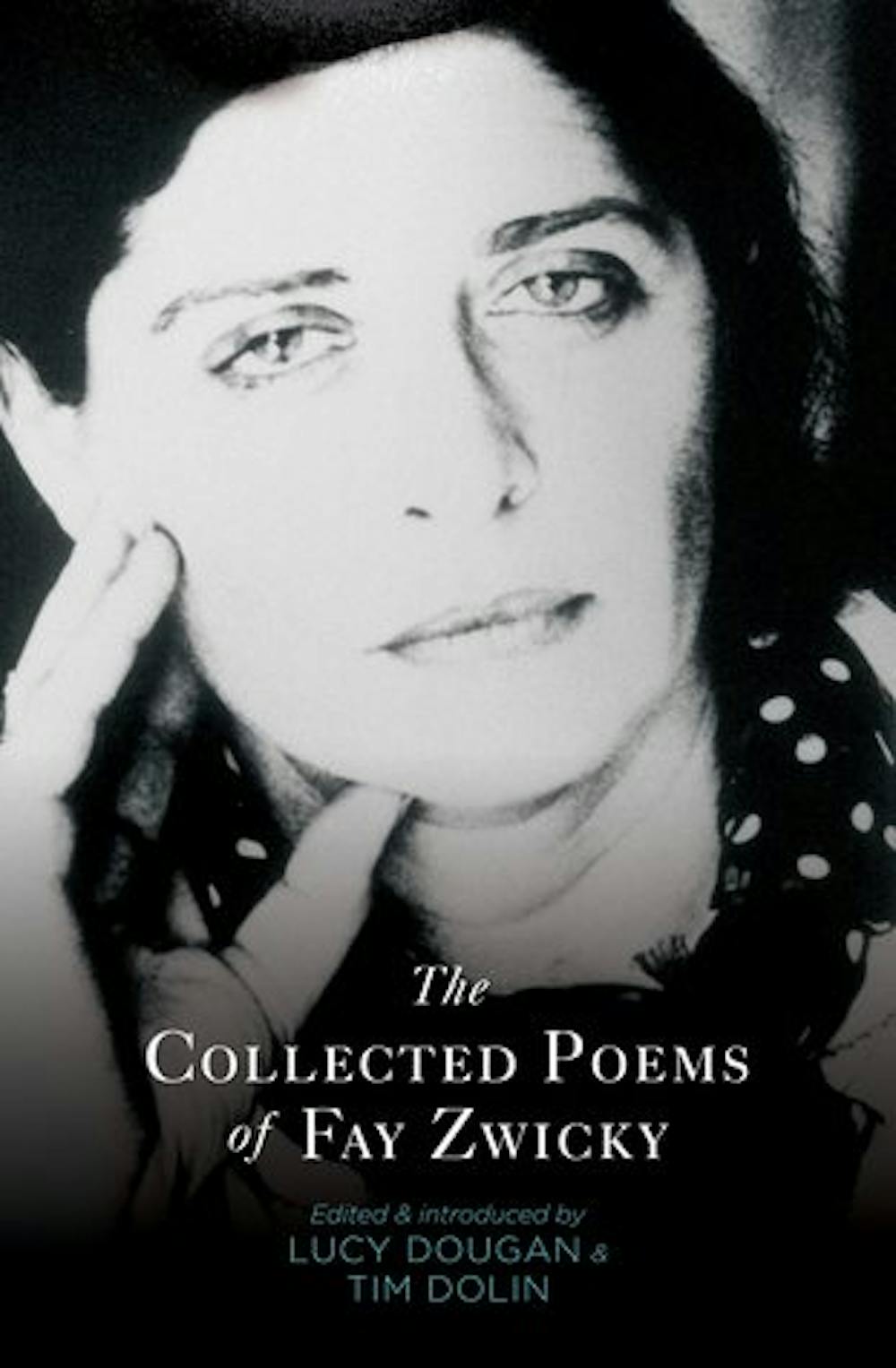
I will never forget speaking to the late Fay Zwicky in 2017, in her last weeks, about her forthcoming Collected Poems (UWAP, edited by Lucy Dougan and Tim Dolin) and her discussion of proofs and the book itself. A life’s work — one of the great bodies of poetry produced in Australia.

Zwicky had published volumes of poetry with other vital publishers in the Australia poetry community, University of Queensland Press and Giramondo. And then the collation of a life’s work — a big project that required so much attention and goodwill. It was clearly necessary, if not essential, to her.

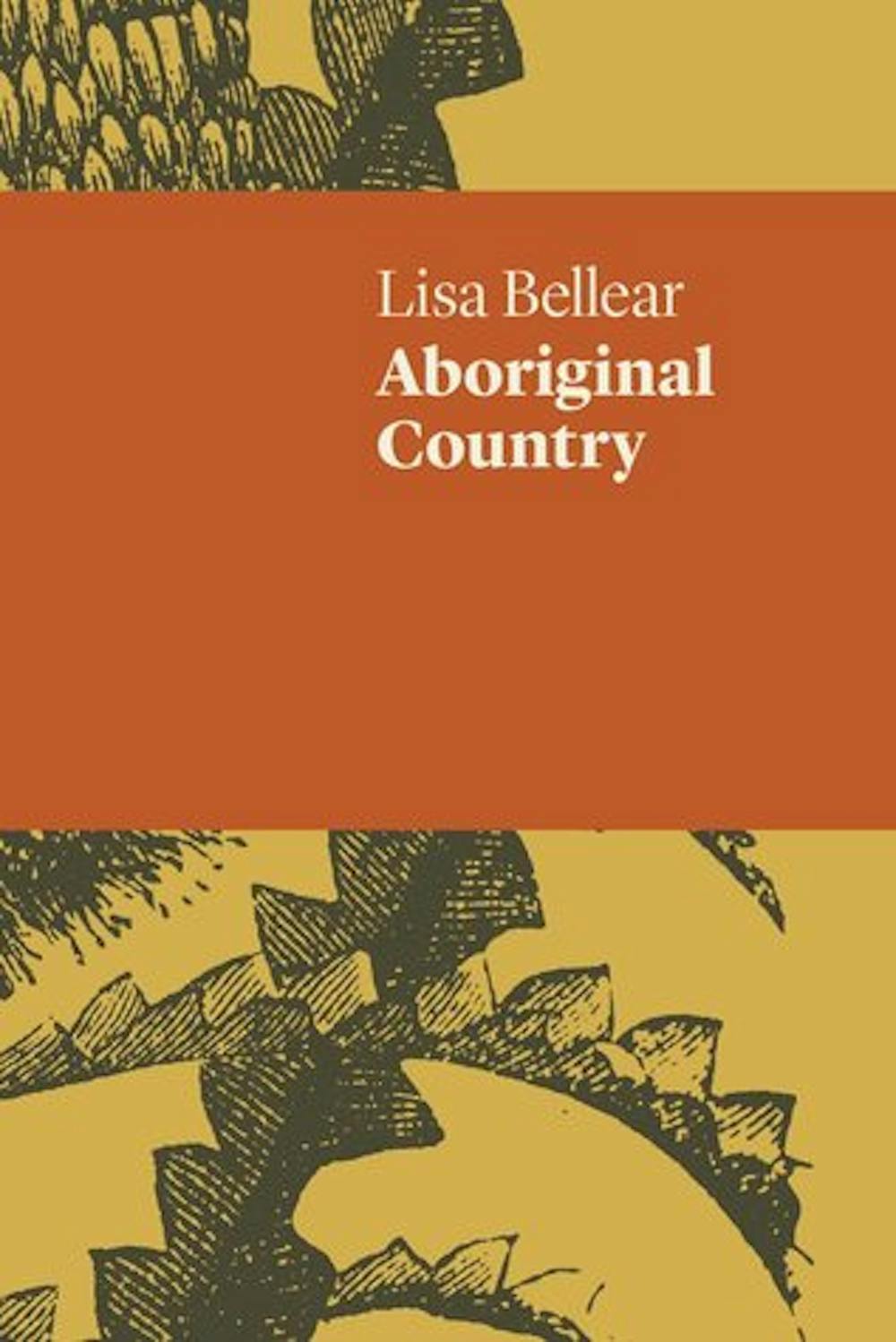
One of the many titles on the UWAP list that had a remarkable effect on so many readers, and which I noted in the Australian Book Review’s 2018 Books of the Year feature, was a collation of Lisa Bellear’s poetry — Aboriginal Country. As I said then, “the emphatic, committed voice of this remarkable Goernpil woman, feminist, poet, photographer, and activist shines through.” Not to have had access to Bellear’s work is unimaginable now we have encountered it gathered in this way.

There is huge engagement in seeing such a work through to press. It was edited (by Jen Jewel Brown), supported and seen onto the shelves via UWAP. An act of belief and support, among many such acts in a given year; all necessary.

Vitally, UWAP’s poetry list effectively manages that seemingly complex interaction between local work and that from the rest of the country. It seems too often assumed that a WA publisher will necessarily only publish WA work. Now, don’t get me wrong, I am a total believer in local publishing, but there’s also a strong necessity for a publisher that brings many localities together, as Magabala Books in Broome does with Australian Aboriginal writing.

UWAP publishes poets (and writers in general) from all over the country, and brings in some overseas titles as well. Terri-ann White actively takes her lists to readers and publishers outside Australia, and is an energetic and steadfast voice in international publishing for her authors, and for Australian and world literature.

To close UWAP would be a damaging of shared difference, of making community and discussion out of diverse voices.

While I have had the good fortune over the years to publish with some of the major poetry houses around the English-speaking world, I am especially proud and excited when a book of mine is selected for the UWAP list.

Shutting down UWAP would sever many ties and disrupt many conversations just begun, or prevent other conversations, especially of conscience, ever taking place.The Conversation

John Kinsella, Professor of Literature and Environment, Curtin University

This article is republished from The Conversation under a Creative Commons license. Read the original article.