Unknown's avatar

Know your place – poetry after the Black Death reflected fear of social change


Chaucer commended those who followed their societal roles and condemned those who didn’t.
Morphart Creation/Shutterstock

Stephen Rigby, University of Manchester

The sharp fall in population caused by the waves of plague which followed the arrival of the Black Death in 1348 led to one of the most dramatic periods of economic and social change in English history. By 1377, the population was around only a half of its pre-plague level but for those who survived there were new opportunities.

With a great deal of land now available, peasants could obtain larger holdings and rent them on more favourable terms. Likewise, those who worked for wages could take advantage of the labour shortage to obtain higher wages enjoy more varied diets – with more meat and dairy – and buy a wider range of manufactured goods.

The second half of the 14th century was thus a period of rising living standards, social mobility and increasing class conflict as the lower orders now sought to obtain improved terms from their landlords and employers.

The dramatic social changes of these years drew several responses from contemporary poets. In the medieval period, imaginative literature was often seen as having an ethical function by teaching virtue, which was defined as fulfilling the expected tasks of their social order. Modern literary critics often see imaginative literature challenging dominant ideologies or providing a sanctioned space for the expression of social dissidence. By contrast, the work of poets in the post-plague era often sought to buttress the social hierarchy against the threats with which it was now confronted.

Langland and Gower against the peasants

Such sentiments are to be found in William Langland’s allegorical poem, Piers Plowman (B-version written c. 1380). Here, the poet expresses his sympathy for those who were genuinely poor or hard-working but echoes post-plague labour legislation and attacked those who, he believed, preferred to beg rather than work.

There had been frequent complaints in parliament about labourers who preferred handouts to work or who took advantage of the labour shortage to demand higher wages. In response, a series of laws were introduced to reduce labour mobility and freeze wages at their pre-plague levels. Langland also calls upon the knightly class to defend the community from those “wasters” who refused to work and criticised the labourers who impatiently demanded higher wages and refused to obey the new legislation.

Contemporary moralists complained about those who rose above their allotted station in life and so in 1363 a law was passed that specified the food and dress that were appropriate for each social class. In line with such attitudes, Langland railed against the presumption of labourers who disdained day-old vegetables, bacon and cheap ale and instead demanded fresh meat, fish and fine ale.
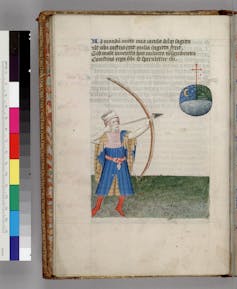
John Gower depicted as an archer in Vox Clamantis.
Berkley

Similar views are expressed in John Gower’s poem Vox Clamantis (the Voice of One Crying in the Wilderness) where the peasants are attacked for being idle and utterly wicked. The common people had fallen into an evil disposition in which they ignored the labour laws and were only willing to work if they received the highest pay.

When the lower orders refused to know their place, as in the Great Revolt of 1381 (also known as the Peasants’ Revolt), they were denounced by contemporary chroniclers as wicked, treacherous, and diabolical. In line with such criticism, Gower’s poem includes an allegorical account of the rising that portrays the rebels as farmyard animals rising up against their masters. They subsequently turn into monsters that attack humanity and becoming followers of Satan in their attachment to wrongdoing and slaughter.

Chaucer’s difficult voice

However, if Langland and Gower were openly hostile to the aspirations of the peasants and the labourers, Geoffrey Chaucer has proved more difficult to read. For many critics, Chaucer is a writer who prefers to present his readers with questions rather than providing them with stock answers. To them, his use of multiple voices and shifting perspectives pose a challenge to the accepted contemporary beliefs and exposes the kind of ideology found in the works of a Gower as partial and inadequate.
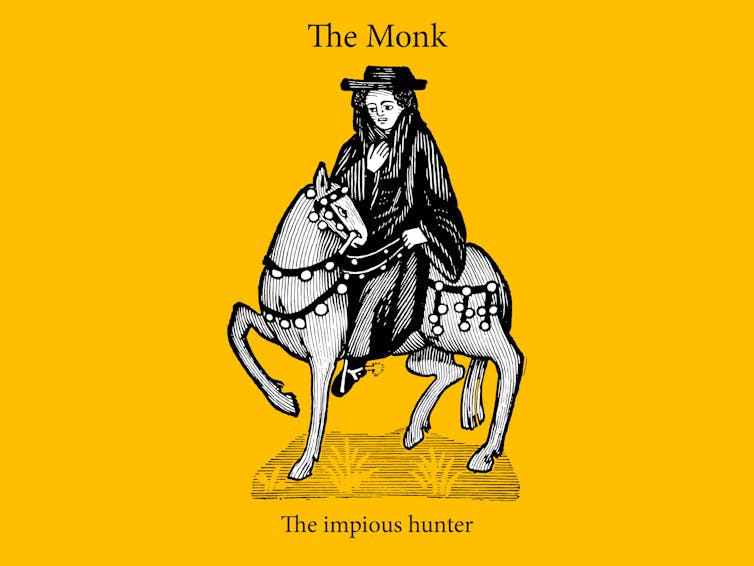
Instead of committing to a pious life of study and prayer, the monk pursued the pleasure of hunting.
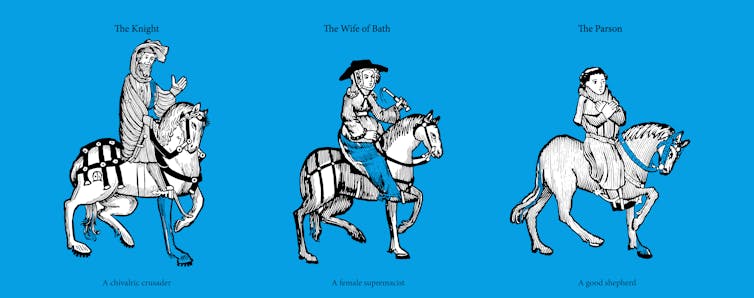
Morphart Creation/Shutterstock

Yet for other critics, Chaucer is much more conservative or even, as the medieval scholar Alcuin Blamires puts it, reactionary in his outlook. After all, among the pilgrims in the Canterbury Tales, those who are presented as admirable are the ones who dutifully perform the traditional functions of their social estate. For example, the Parson is a good shepherd to his flock, the Knight is a chivalrous crusader, and the Plowman works hard and faithfully pays his tithes. It is those who fail in their duties or seek to rise above their station whom Chaucer satirises – as when the Monk prefers hunting to a life of study and prayer or when the Wife of Bath seeks female supremacy in marriage.

Certainly, the Parson offers us a socially conservative message when, at the end of the Canterbury Tales, he preaches that as part of the divinely arranged cosmic order, God has ordained that some people should be of higher social rank and others should be lower. People should, therefore, render honour and obedience not only to God but also to their spiritual fathers and their secular superiors. Nobody should lament their misfortunes or envy the prosperity of others but rather should endure adversity in patience in the hope of obtaining joy and ease in the next life.

Given that medieval literary theory regards the ending of a text as being particularly important in conveying its meaning, we may perhaps regard Chaucer’s views as being in line with his Parson. If so, then Chaucer’s response to the social change of his day may have been rather closer to the views of Gower and Langland than many of his modern readers would like to admit.
Read and listen more from the Recovery series here.The Conversation

Stephen Rigby, Emeritus Professor of Medieval Social and Economic History, University of Manchester

This article is republished from The Conversation under a Creative Commons license. Read the original article.
Unknown's avatar

2020 Moth Poetry Prize Winner


The link below is to an article that reports on the winner of the 2020 Moth Poetry Prize.

For more visit:
https://www.booksandpublishing.com.au/articles/2020/05/01/149857/obrien-wins-e10000-moth-poetry-prize/

Unknown's avatar

A thousand yarns and snapshots – why poetry matters during a pandemic


Kenrick Mills/Unsplash

Christopher Wallace-Crabbe, University of Melbourne

Why do we have the arts? Why do they seem to matter so much? It is all very well muttering something vague about eternal truths and spiritual values. Or even gesturing toward Bach and Leonardo da Vinci, along with our own Patrick White.

But what can the poets make of, and for, our busy, present lives? What do they have to say during grave crises?

Well, they can speak eloquently to their readers for life, in writing from the very base of their own experiences. Every generation has laid claim, afresh, to its vital modernity. In the 17th century, Andrew Marvell did so with witty lyrical elegance in his verse To a Coy Mistress. Three centuries later, the French poet René Char thought of us as weaving tapestries against the threat of extinction. Accordingly, he wrote:

The poet is not angry at the hideous extinction of death, but confident of his own particular touch, he transforms everything into long wools.

In short, the poet will, at best, weave lasting, memorable, salvific tapestries out of words. The poems in question will come out live, if the poet is lucky, and possibly as disparate as the sleepy, furred animals caged in Melbourne Zoo.


Read more:
A beginner’s guide to reading and enjoying poetry


What is truly touching or intimate need not be tapped by elegies, for all that they can fill a mortal need. Yet the great modern poet W. H. Auden wrote in memory of poet, writer and broadcaster John Betjeman:

There is one, only one object in his world which is at once sacred and hated, but it is far too formidable to be satirizable: namely Death.

As William Wordsworth and Judith Wright both well knew, in their separate generations – and quite polar cultures – the best poetry grasps moments of our ordinary lives, and renders them memorable.

Poetry can give us back our dailiness in musical technicolour: in a thousand yarns or snapshots. Poems sing to us that life really matters, now. That can emerge as songs or satires, laments, landscapes or even somebody’s portrait done in imaginative words.

Yes, verse at its finest is living truth “done” in verbal art. The great Russian playwright Anton Chekhov once insisted “nothing ever happens later”, and the point of poetry in our own time – as always, at its best – is surely to shine the light of language on what is happening now. The devil is in the detail, yes. But so is the redemptive beauty, along with “the prophetess Deborah under her palm-tree” in the words of the Australian poet, Peter Steele.

Poetry sees the palm tree, and the prophetess herself, vividly, even in the middle of a widespread epidemic.


Read more:
Ode to the poem: why memorising poetry still matters for human connection


Modern poetry is an art made out of living language. In these times, at least, it tends to be concise, barely spilling over the end of the page: too tidy for that, unlike the vast memorised narratives of the Israelites, the Greeks or even the Icelanders. But what it shares with the ancient, oral cultures is its connection with wisdom, crystallising nodes of value, fables of the tribe, moments or decades that made us all.

In the brief age of a national pandemic, poetry’s role and its duties may come to seem all the more important: all the more civil and politically sane. The poem – even in the case when it is quite a short lyric, even if comic – carries the message of moral responsibility in its saddle bag. Perhaps all poets do, even when they are also charming the pants off their willing readers.


Christopher Wallace-Crabbe is judge of the ACU Prize for Poetry. Entries close July 6.The Conversation

Christopher Wallace-Crabbe, Emeritus Professor in the Australian Centre, University of Melbourne

This article is republished from The Conversation under a Creative Commons license. Read the original article.

Unknown's avatar

Poem: ‘Grizzly,’ by Ellen Bass


The link below is to a poem by Ellen Bass – ‘Grizzly.’

For more visit:
https://lithub.com/grizzly/

Unknown's avatar

Advice on Reading Poetry


The link below is to an article that gives some advice on reading poetry.

For more visit:
https://bookriot.com/2020/04/16/why-to-read-poetry/

Unknown's avatar

Reading Poetry in the Morning and Your Health


The link below is to an article that looks at whether reading poetry in the morning helps your health or not.

For more visit:
https://bookriot.com/2020/04/10/poetry-and-health/

Unknown's avatar

2020 Griffin Poetry Prize Shortlist


The link below is to an article that reports on the shortlist for the 2020 Griffin Poetry Prize.

For more visit:
https://lithub.com/heres-the-international-shortlist-for-the-griffin-poetry-prize/

Unknown's avatar

Poem: Instructions for Writing by Phan Nhiên Hạo


The link below is to a poem by Phan Nhiên Hạo, ‘Instructions for Writing.’

For more visit:
https://lithub.com/instructions-for-writing/

Unknown's avatar

A beginner’s guide to reading and enjoying poetry


Poetry doesn’t need to be meticulously studied. Like a novel, you can curl up on the sofa and read it for pleasure.
Oqvector/Shuttertsock

Andrew McMillan, Manchester Metropolitan University

One of the things you get asked most when people find out that you’re a poet is whether you can recommend something that could be read at an upcoming wedding, or if you know something that might be suitable for a funeral. For most people, these occasions – as well as their schooldays – are the only times they encounter poetry.

That feeds into this sense that poetry is something formal, something which might stand to attention in the corner of the room, that it’s something to be studied or something to “solve” rather than something to be lounged with on the sofa. Of course, this needn’t be true.

We’ve seen over the past couple of months how important poetry can be to people. It’s forming a response in advertisements and marketing campaigns, it’s becoming a regular part of the public’s honouring of frontline heroes and, for people who write poetry more often, it’s becoming a way to create a living historical document of these unprecedented times – this latter point was the aim of the new Write where we are Now project, spearheaded by poet Carol Ann Duffy and Manchester Metropolitan University.

In years to come, alongside medical records and political reporting, historians and classes of schoolchildren will look to art and poetry to find out what life was like on a day-to-day basis – what things seemed important, what things worried people, how the world looked and felt and was experienced. Write where we are Now will, hopefully, be one such resource, with poets from all over the world contributing new work directly about the Coronavirus pandemic or about the personal situations they find themselves in right now.

So the crisis has perhaps brought poetry – with its ability to make the abstract more concrete, its ability to distil and clarify, its ability to reflect the surreal and strange world we now find ourselves in – back to the fore.

Many of you might be thinking now is the time to try and get to grips with poetry, maybe for the first time. A novel might feel too taxing, watching another film just involves staring at another screen for longer, but a poem can offer a brief window into a different world, or simply help to sustain you in this one.

How to enjoy poetry

If you’re nervous around poetry or are scared it might not be for you, I wanted to offer up some tips.

1. You don’t have to like it

Poetry is often taught in very strange ways: you’re given a poem and told that it’s good – and that if you don’t think it’s good then you haven’t understood it, and you should read it again until you have, and then you’ll like it. This is nonsense. There are poets and poems for every taste. If you don’t like something, fine. Move on. Find another poet. Anthologies are great for this, and a good place to start with your poetry journey.

2. Read it aloud

Poetry lives on the air and not on the page, read it aloud to yourself as you walk around the house, you’ll get a better understanding of it, you’ll feel the rhythms of the language move you in different ways – even if you’re not quite sure what’s going on.

3. Don’t try and solve it

This is something else that goes back to our educational encounters with poetry – poems are not riddles that need solving. Some poems will speak to you very plainly. Some poems will simply move you through their language. Some poems will baffle you but, like an intriguing stranger, you’ll want to step closer to them. Poems aren’t a problem to be wrestled with – mostly poems are showing you one small thing as a way of talking about something bigger. Poems aren’t a broken pane of glass that you need to painstakingly reassemble. They’re a window, asking you to look out, trying to show you something.

4. Write your own

The best way to understand poetry is to write your own. The way you speak, the street you live on, the life you’ve lived, is as worthy of poetry as anything else. Once you begin to explore your own writing, you’ll be able to read and understand other people’s poems much better.


Read more:
Eavan Boland: the great Dublin poet and powerful feminist voice


I would say this as a poet, but poetry is going to be even more central to how we rebuild after this current crisis. Poetry, especially the teaching of how we might write it, has this wonderful ability to create a new language, to imagine new ways of seeing things, to help people to articulate what it is that they’ve just been through. The way we move forward, as a community, as a society and, in fact, as a civilisation, is to push language to new frontiers, to use language to memorialise, reimagine and rebuild, but also to remember that poetry can be an escape, something to be enjoyed, something to cherish.

With that in mind here is a poem I wrote for Write where we are Now.The Conversation

Andrew McMillan, Senior Lecturer, Department of English, Manchester Metropolitan University

This article is republished from The Conversation under a Creative Commons license. Read the original article.

Unknown's avatar

Eavan Boland: the great Dublin poet and powerful feminist voice


Adam Piette, University of Sheffield

The death of poet Eavan Boland comes as a soft shock to my sense of the world. The creative connections she forged between her richly various poetry, Irish culture and the fierce determinations of feminism were mesmerising. Just as important was her faith in poems as places to think and feel in, where those connections could be offered as intricate gifts to all readers.

She is rightly celebrated for her breakthrough collection, the 1980 In Her Own Image, which pitted itself against the lazy assumptions of a male-dominated poetry world and voiced the bitter extremes of female experience, like the anorexic’s fanaticism (“Flesh is heretic./ My body is a witch. / I am burning it”), the beaten wife’s survivalist plural selving (“I was not myself, myself”), the menstrual visionary (“I leash to her {the moon}, / a sea, / a washy heave, / a tide”), the crazy poetics of the kitchen (“the tropic of the dryer tumbling clothes. / The round lunar window of the washer”).

A true challenger to Yeats

Such poems gave centre stage to female experiences and had a huge impact on the Irish poetry scene in particular, which had taken its time responding to the feminist revolution of the 1960s and 1970s.

Eavan Boland in 1996.
Wikimedia

Their accurate representation of the marginalisation of women in history and by history (“still no page / scores the low music / of our outrage” It’s a Woman’s World, 1982) was belied by the poems as public and historical voices. A feminist collection, In Her Own Image showed the world that Boland’s was a powerful voice above all and a real challenge to the Yeatsian tradition of male poetics in Ireland.

The wonderful Mise Eire (1987), meaning “I am Ireland”, for instance, takes on the identity of the many emigrant women travelling from Ireland to the New World, and opens:

I won’t go back to it

my nation displaced

into old dactyls

and the poem is colourfully detailed about the historical record, as routines being played by Boland:

I am the woman –

a sloven’s mix

of silk at the wrists,

a sort of dove-strut

in the precincts of the garrison

The ancestral women whose being she inherits through her matriarchal line and her Irish identity, women under the control of the old dispensation, the women of Irish patriarchal history, molls to the men of power – that is what she won’t go back to. So what reads as a rich imagining of the emigrant glad to be leaving is also Boland’s coded challenge to the Irish lyric tradition with its old dactyls and assumptions about women poets as strutting doves; as well as a specific historical voicing of second-wave feminism – we are not going back to that old world.

Returning to Dublin

On the back of the extraordinarily febrile mind at work on her own culture and in concert with the feminism of her times, she built up a repertoire of voices that constitute some of the finest poetry in English.

Navigating between work in America and a full life in Ireland, she lived out that emigrant dream and made it real, made it her world. Her poems are intimately connected to the dailiness of her own life, to a sense of significances and exfoliations in the ordinary events in her patch of space and time. Equally, she writes poems of extraordinary power and complexity about the history of Ireland, about the Famine, the Troubles (the three-decade conflict between nationalists and unionists), about the acts of violence suffered by her people over time.

She was unafraid to make poetry do the work that once was most resolutely its task: the work of elegy, epic (her lyrics attend to history with the eye of an epic poet), lyric most of all and testimonial witnessing of experience with heart and mind.

For me, one of her tasks was to be the poet of Dublin, the Dublin she loved and cherished, and fought for and against too. Many of her very best poems bring that fabled city to new light. Her poem Anna Liffey (1997), which tussles with James Joyce’s representation of the female principle Anna Livia Plurabelle in Finnegans Wake, is also a hymn of praise to Dublin’s river Liffey:

It rises in rush and ling heather and

Black peat and bracken and strengthens

To claim the city it narrated.

Again, subtly, it is a woman’s story-telling (Anna Liffey narrating) that lays claim to this new post-feminist Dublin. Born abroad, she adopted Dublin as an émigré Irish returnee – but that journey home was also this complex act of kinship and claim:

It has taken me

All my strength to do this.

Becoming a figure in a poem.

Usurping a name and a theme.

Thank goodness for her usurpation! Such a harvest of gifts, as well.

In the incomparably beautiful And Soul (2007), Dublin’s rain is praised at the same time as Boland is battling the cloudburst of her grief for her dying mother. In The Lost Land (1998), her daughters growing up and living faraway reprise her whole life story (“memory itself / has become an emigrant”). Nobody has written so fully and well about the intimate relationship between Ireland and the United States. Ireland has lost its most exquisite chronicler:

In the end

everything that burdened and distinguished me

will be lost in this:

I was a voice.The Conversation

Adam Piette, Professor of Modern Literature, University of Sheffield

This article is republished from The Conversation under a Creative Commons license. Read the original article.