The season of the good old summer “fayre” is here and many UK readers will be heading off to eat tea and scones and take part in the tombola at their local village fete. There, it’s a good bet, they will hear of local people’s concerns that new housing developments foisted on them by the government will ruin the character of their idyllic rural community.
But the myth of tranquil village life was well and truly exploded in the Victorian age when many writers concluded that life in England’s small rural communities was not a simple idyll of tea, vicars and charitable works.
For many people, especially those who may not have visited the UK, the most accessible pictures of village life are those painted in novels: who can forget the timeless portrait of life in a sleepy Dorset community in PG Wodehouse’s Blandings series, or EF Benson’s Mapp and Lucia books, set in a fictional Sussex village? But fiction has also been highlighting the negatives of village living for more than a century.
The “greetings card” scenario of village life was established early. In her memoir Our Village (published in five volumes between 1824 and 1832), Mary Mitford – who lived at Three Mile Cross near Reading in Berkshire – gives us a classic rendition of peaceful village life. There are quaint depictions of servants, chaste suitors, elderly brides and grooms, blacksmiths and gypsy fortune tellers.
Our Village contains all the myths of village life. Everyone is familiar: a village is a little world “where we know everyone, are known to everyone, interested in everyone, and authorised to hope that everyone feels an interest in us”. There are no newcomers, nobody is systematically excluded and nobody is living a secret or misunderstood life. Poverty is relegated to the margins – there’s only the occasional mention of the workhouse and, Mitford assures her readers, the village is a collection of cottages, not “fine mansions finely peopled”.
But even in the 1820s, such a village felt under threat from the railways, improved roads and the increasing size of the towns of the industrialised North. And no sooner did Mitford complete Our Village than other authors began to parody or correct her vision.
Elizabeth Gaskell’s Cranford (1853) is a gentle text still very positive about life in a confined locality. Although Cranford is a town outside “Drumble” – her stand-in for Manchester – it resembles Mitford’s village in that everyone knows each other and the narrative is focused on a limited set of characters. In the case of this novel – and so many others in the tradition – the main characters are women, and it is women’s unpaid labour that makes the community run smoothly. Yet Gaskell gently mocks her characters, Matty Jenkyns, Miss Pole, and Mrs Jamieson, for their conventionality, triviality and timidity.
The women follow strict social rules – an entire chapter revolves around whether these august personages should stoop to visit a former ladies’ maid who has set up a milliner’s shop and hence was “in trade”. In another chapter, the women grow fearful of outsiders when they hear of a cluster of burglaries in the neighbourhood, which proves to be founded on rumour.
Thomas Hardy’s villages such as Weatherbury in Far from the Madding Crowd (1874) or Marlott in Tess of the D’Urbervilles (1891) are idyllic in some ways, but not in others. Shepherds are close enough to nature to saunter out of their huts at night to tell the time by stars, and the slow pace of life allows for ample opportunity for community and flirtation. Yet sexual transgressions are treated to the full judgement of an unforgiving community, and questions of money and class interrupt any readers’ expectations of rural bliss.
American moral tales
These books sold well in the US, even though villages there were subject to dramatic population shifts westward and industrial development. Writers in the US sought to reinforce or contest Mitford’s vision.
After reading Mitford and migrating to a new village in Michigan, Caroline Kirkland wrote A New Home, Who’ll Follow? (1839), which mercilessly satirised her vulgar frontier neighbours and the wealthier eastern newcomers. When her neighbours read the novel, they ostracised her – and she never wrote anything as trenchant again.
Although the American regionalism that flourished in the latter quarter of the 19th century is known for romantic visions of village life, upon closer examination, key writers such as Sarah Orne Jewett and Mary E Wilkins Freeman reveal many of village life’s negatives.
If Gaskell acknowledges in Cranford that her ladies’ kindness to the poor is “somewhat dictatorial”, Freeman’s A Mistaken Charity (1883) takes this point to its logical conclusion. Two elderly sisters living happily in their dilapidated cottage are visited by Mrs Simonds, a woman who is “a smart, energetic person, bent on doing good”. Mrs Simonds arranges to take Charlotte and Harriet to the poorhouse, where they are forced to wear lace caps and sit indoors. Charlotte and Harriet run away.
Revolt from the village
By the 1910s, there was a literary “revolt from the village”, and writers including Sherwood Anderson focused on the sexual repression of small town life. Although Sherwood Anderson’s Winesburg, Ohio, published in 1919, is set in a town, it is a town of 1,800 people, far smaller than many British villages today. Meanwhile, Stella Gibbons parodied rural melodramas in Cold Comfort Farm (1932), in which, instead of graciously fitting in like the urban narrators of Jewett’s fiction, Flora Poste, a visitor from London, forces the members of a dysfunctional family to follow their individual desires rather than their family destiny.
According to these writers, villages can be conformist, unimaginative, repressive, nepotistic. These fictions imply that villages will be harder to maintain now that women have other outlets for their energies. The negatives come from the same source as the positives in village life, and people who wish to defend villages, and the tradition of rural living, should remember this literary ambivalence and the fact that it has gone on for more than 100 years.
Following the announcement that Nick Drnaso’s Sabrina is the first graphic novel ever to be longlisted for the Man Booker Prize, Joanne Harris (the author of Chocolat) tweeted #TenThingsAboutGraphicNovels and stated simply: “graphic novels are novels”.
Once upon a time, graphic novels may have been viewed as disposable – and not especially literary – but such a value judgement has long since been challenged.
The graphic autobiography has become especially visible in recent years, with a noteworthy example being Persepolis by Marjane Satrapi (2000) – which details her experiences as a young woman during and after the Iranian revolution in 1979. The novel was adapted into a film in 2007.
A woman’s voice: Persepolis by Marjane Satrapi. Pantheon Books
The comic book has a long and rich history, as Scott McCloud’s 1993 book Understanding Comics explains. He looks at a pre-Columbian text from the Codex Nuttall about 8-Deer “Tiger’s Claw”, discovered by the Spanish conquistador Hernan Cortés around 1519. McCloud argues we can think about such early texts as comics.
Terminology is important here, too. The word “comics” usually refers to serialised publications – whereas “graphic novels” are issued as books. That said, they share many artistic and literary characteristics. Author Alan Moore has rejected the term “graphic novel” (along with the film versions of his work), suggesting it is nothing more than a marketing term. So, in no particular order – and with that caveat in mind – here are my top five literary reads in graphic novel and comic book genres.
Grandville (2009)
Author Bryan Talbot is well-known to comic and graphic novel fans, having penned The Adventures of Luther Arkwright in the 1970s and 1980s. Grandville is the first volume in a series of five, which tells the investigative story of a badger detective, Detective Inspector LeBrock, accompanied by his trusty sidekick, Roderick the Rat.
In this anthropomorphic universe, humans feature in servile roles as an underclass, with some critical comparisons to post-9/11 racial stereotypes. The Grandville of the title is an alternative history Paris, lovingly characterised with steampunk details and Belle Époque style. The city of Grandville takes its name from the pseudonym of a French artist, Gérard Grandville, famed for his satire of French politics and society.
An illustration by celebrated 19th-century caricaturist Gérard Grandville.
The book wears its intellectualism lightly – but, for those with a keen eye, look out for cultural references to Édouard Manet, Augustus Egg, Sarah Bernhardt, and intertexts such as Conan Doyle’s Sherlock Holmes stories, as well as children’s classics including Wind in the Willows, Tintin and Rupert the Bear.
From Hell (1999)
Alan Moore needs little introduction to cult readers or the academic community. He has amassed a wealth of literary criticism about his work, including plenty of material about the title I have chosen, From Hell. This was originally issued in serial form and later published as a single-volume collected work – the version with which most readers will be familiar.
From Hell was made into a film with Johnny Depp and Heather Graham. The author disapproved. Twentieth Century Fox
From Hell is not for the squeamish: it retells in gruesome detail the Whitechapel murders of the late 19th century, speculating Jack the Ripper was Sir William Gull, Queen Victoria’s royal physician. Gull’s murder spree, seeking to suppress an illegitimate heir to the throne and filtered through a lens of masonic imagery and misogyny, takes us through a psychogeographic tour of London.
Eddie Campbell’s exquisite illustrations contrast the privileged suburbs in which Gull lives with the poverty-stricken degradation of Whitechapel’s citizens.
Partly fictional and partly factual, the book is a wonderful parody of the dark tourist interest in the murders, with the careful reader becoming increasingly self-conscious of their own uncomfortable complicity in the narrative.
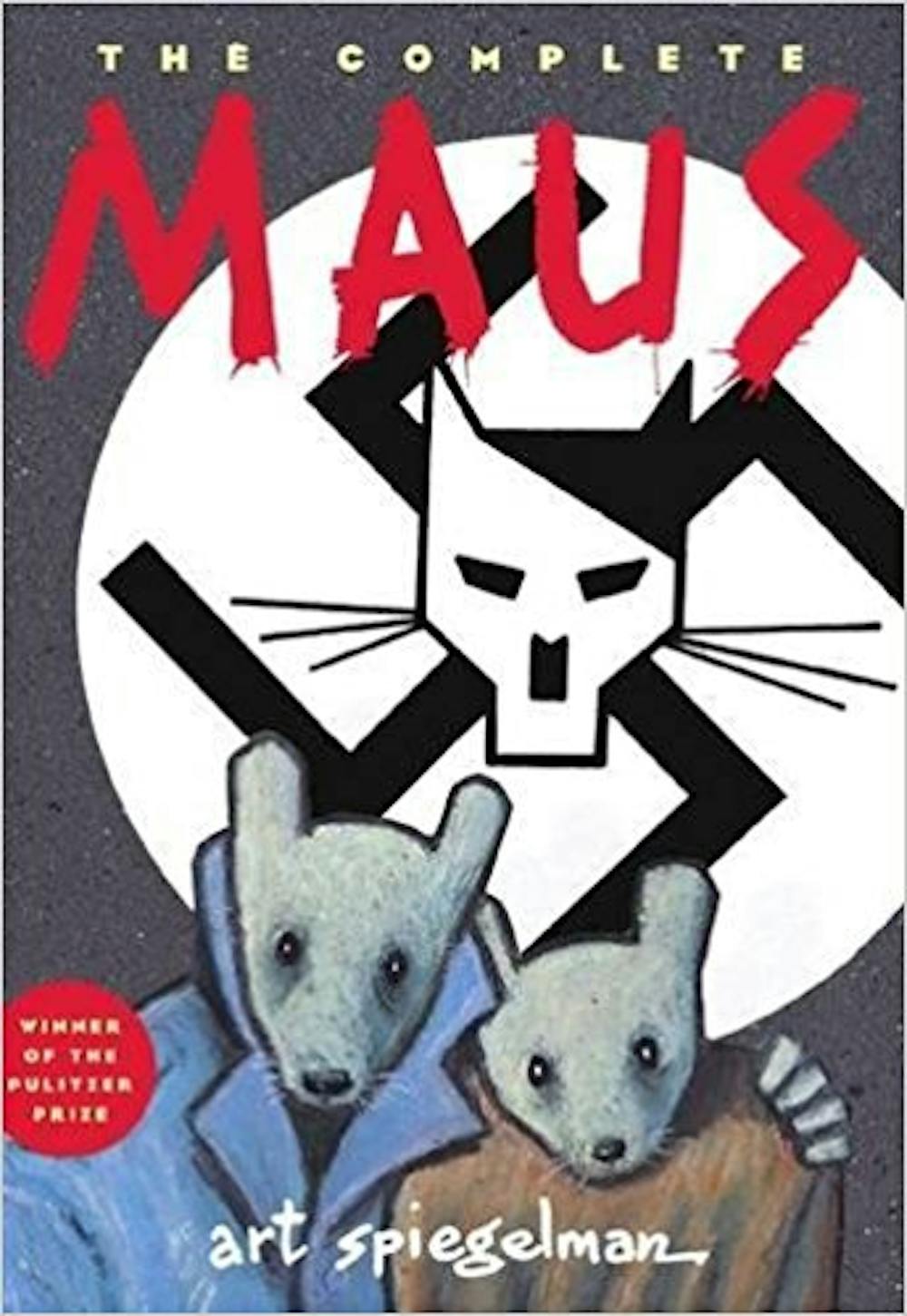
Maus (1991)
Like From Hell, Art Spiegelman’s Maus was originally published in serial form. Spiegelman began writing in 1978, telling the story of his father, Vladek Spiegelman, a Holocaust survivor.
In many ways, the text defeats simplistic categories and genres: it is a fiction, an autobiography and a history.
Powerful and moving: Art Spiegelman’s Maus. Amazon
It is also another anthropomorphic story in which Nazis are cats and the Jewish community are characterised as mice. The reader is placed in the unenviable but important position of bearing after-witness to the trauma of the Nazi regime, a point enhanced by the use of literary devices such as the framing narrative.
Spiegelman uses the more recent moment of the late 1970s and interviews with his elderly, widowed father as a departure point to revisit the 1930s through to the end of the Holocaust in 1945.
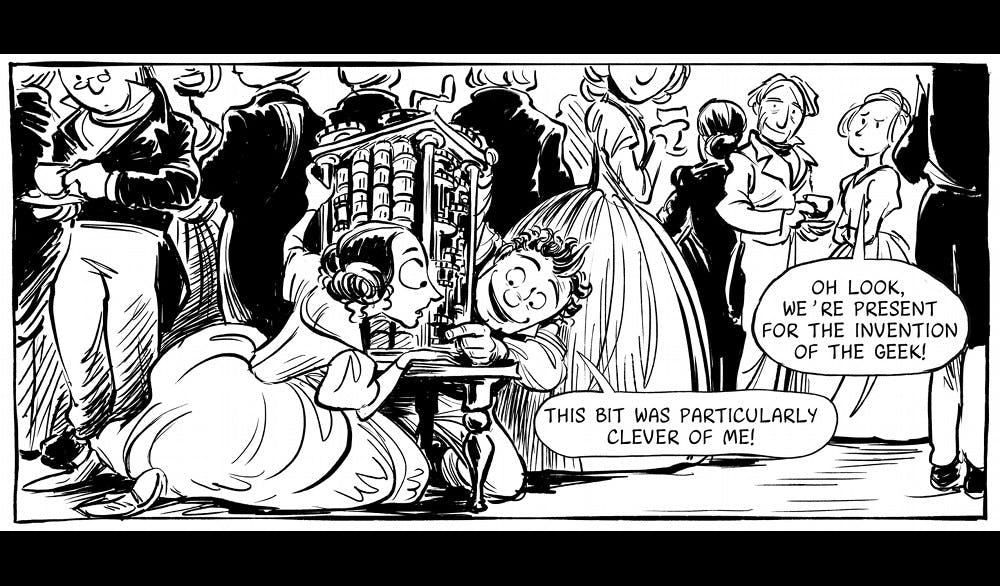
Fun with history’s greatest geeks. ScienceFriday.com
Like other examples here, the narrative is situated in an alternative universe, which offers a view of what would happen if the Difference Engine had been built. Along with an adventure plot, the graphic novel features references to a wealth of 19th–century characters such as Samuel Taylor Coleridge and the Duke of Wellington. It has elaborate pseudo-factual footnotes and endnotes of which writers such as Flann O’Brien or Mark Z. Danielewski would be proud.
Dotter of Her Father’s Eyes (2012)
It would be very remiss of me, as a longstanding aficionado of James Joyce, to omit reference to this Costa award-winning graphic memoir by Mary M. Talbot (with illustrations by Bryan Talbot, the writer’s husband), which follows Lucia Joyce’s troubled relationship with her father, and draws parallels with the author’s own relationship with her father, the eminent Joyce scholar James S. Atherton.
Lucia’s tragic love for Samuel Beckett – and her thwarted ambition to become a dancer – are beautifully juxtaposed with Talbot’s recollections of her upbringing, alongside the difficulties experienced by both talented women growing up with writerly fathers. Strategic use of colour, sepia tones and the frequent use of the Courier typeface (as well as Talbot’s own personal lettering font which features throughout his work), make this book an aesthetically delightful read.
So many masterpieces, so little time
Of course, there are many artists and writers I have omitted from this list – not least figures such as Neil Gaiman, whose work The Sandman (1989-) has been critically acclaimed, pushing as it does the Gothic tropes and metaphysical reflections of the genre.
There are also the recent works lauded in the Will Eisner Comic Awards, held earlier this month in San Diego as part of Comic-Con. Further reading can be found on that list.
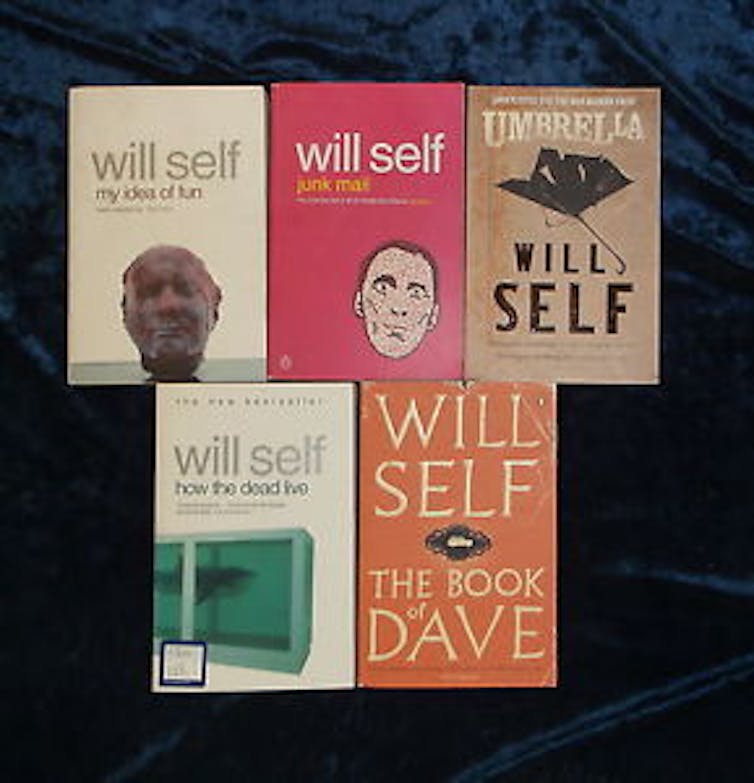
Will Self has declared the novel is “absolutely doomed” – ironically, in an interview to promote Phone, his latest outing in the very medium he is condemning to death. Even casual readers will note that this isn’t the first time that the reigning Eeyore of British literature has announced the imminent passing of our most popular literary form.
Since 2000, Self has used the occasion of the release of his own books to repeatedly argue that the novel is destined to “become a marginal cultural form, along with easel painting and the classical symphony”. During his promotional duties for Umbrella, Self asked whether we are evolving beyond the need to tell stories, while in 2014 he announced the declining cultural centrality of the novel due to the digitisation of print culture in an article to promote Shark.
Self’s obsession with killing off the novel might be more about ego than revenge, but his repeated attempts to plot its downfall form part of a much wider lament. For centuries, writers have been proclaiming the imminent passing of the novel form. More than 60 years ago, JB Priestley called it “a decaying literary form” which “no longer absorbs some of the mightiest energies of our time”. More recently, Zadie Smith complained of novel-nausea, while David Peace has asked how it is still possible to “believe in the novel form” because “storytelling is already quite ruined by the individualism of Western society”.
Difficult reading
Reading beyond the exhausted sentiments and sensationalist headlines provided by self-harming novelists, what these sentiments collectively highlight is not the death of the novel at all, but the decline of “literary fiction”. Self’s explicit cultural fear is that a serious kind of novel – novels such as his own – that confront us with “difficult reading” are destined for relegation to the realms of classical music and fine art. What Self’s repeated attempts on the life of the novel actually articulate is a deep-seated fear of the devaluation of literary fiction and its dethroning from a position of economic, popular and critical dominance as a result of the new contexts provided by a social media age.
Prophesying the imminent demise of the novel at the hands of digital technology has become popular in contemporary critical discourse, especially as the form entered the new millennium. Self is one of many authors who have publicly debated the challenges of writing novels in a digital era.
Andrew O’Hagan recently argued that the intense personal perspective offered by platforms such as Twitter and Facebook means that the novel has nowhere left to go in offering an inside account of the lives of others. The crux of both O’Hagan and Self’s sandwich-board arguments ultimately lie in a belief that future readers will be unwilling to disable connectivity and engage only with a physical form of text in relative isolation from the hyper-networked society around them.
But the “death” of literary fiction does not have to come at the expense of the rise of the popular – or of the digital. Smartphones and streaming can sit alongside literary awards and “difficult” novels and offer us vital insights into, and ways of representing, contemporary experience. The novel is perhaps the most hospitable of all forms and opens itself willingly to new voices, languages and technologies. And not all writers are hostile to the impact of the digital on literary form – in their use of social media to tell stories in new ways, both David Mitchell and Jennifer Egan have proved that the novel has an innate ability to ingest and adapt to a rapidly changing world.
The novels of a Self-publicist. Ebay
Importantly, the novel also presents us with perspectives and experiences different from our own. In its contemporary concern with the trope of an “other” who transgresses the boundary of the domestic home, the 21st-century novel offers a vital consideration of the implications of a post-Brexit Britain. The novel disrupts and challenges, and in turn elicits responses from readers to, the contemporary concerns it presents.
Understanding the world
The etymology of the word “novel” lies in the “new” – and all evidence suggests that the form will continue to evolve – and ingest, rather than ignore, the new languages of the contemporary. The novel – whether in the form of literary or “popular” fiction – helps us to understand the world in which we now live and informs our attempts to navigate both the past and the future. As well as its long-argued innate value, this capacity of the novel to help us negotiate the changes of the present is also key to its survival – and evolution – in the coming century.
As a case for its vitality, Self’s pervasive campaign against the novel couldn’t be more helpful. In repeatedly citing the death of the novel, Self and his band of merry naysaying novelists whip up resolve and resurrection of the form in a context of challenge and change. In doing so, their comments remind us to value this familiar, yet continually innovative form that continues to adapt, ingest and shape-shift, remaining relevant to each generation of readers – and writers.
Literary snobbery and Modernist nostalgia aside, Self’s headline-grabbing soundbites encourage new understandings of wider shifts in novel writing and reading in the 21st century. With writers continually sticking more nails in its half-open coffin, the novel seems destined to remain stuck in critical debates that remain wilfully oblivious to its sustained success in the new millennium.
Emerging from a long winter of discontent, perhaps it is the strange fate of the novel to exist in a permanent state of imminent demise and doom, with an innate awareness of itself as the one genre that literature simply cannot do without.
In 1790, Watkin Tench, the first officer with the First Fleet and a member of the fledgling British colony, stood on what we now know to be “The Heads” of Sydney, hungry and pining for news of England:
Here on the summit of the hill, every morning from daylight until sun sunk, did we sweep the horizon in hope of seeing a sail. At every fleeting speck which arose from the bosom of the sea, the heart pounded and a telescope lifted to the eye…
Tench’s palpable yearning for the mother country is an early account of British despair upon first settlement in Australia. One hundred years later, the sentiment remained. Many settlers were still unhappy with their surrounds, as evidenced in Edward Dyson’s musings in his 1898 short story The Conquering Bush:
The bush is sad, heavy, desparing; delightful for a month, perhaps, but terrible for a year.
In Barbara Baynton’s works, meanwhile, tales of harsh female experiences were set against even harsher Australian landscapes, devoid of respite or pleasure. In her 1896 short story The Chosen Vessel, a young wife and mother left alone in her bush home is stalked, raped and murdered by a swagman:
More than once she thought of taking her baby and going to her husband.
But in the past, when she had dared to speak of the dangers to which
her loneliness exposed her, he had taunted and sneered at her.
For over 200 years, the white sentiment of desolation and anxiety about this “untamed” land has pervaded much of Australian literature. Children went missing, men went mad, and women suffered what writer Henry Lawson called the “maddening sameness” in The Drover’s Wife and Others Stories. “Oh, if only I could go away from the bush!” wails Lawson’s central character in The Selector’s Daughter.
Desolate refuge
The works of these early writers did much to reveal the challenging realities of the bush. Those eking out an existence in a land where soil and weather disagreed with European sensibilities and practices were met with hard work. And what a place to work! There was little room for bucolic tranquillity in a land of drought, flood and searing heat.
Tim Winton’s Dirt Music. Picador
But, in the 21st century, there has been a change in how Australians read and write about the bush. Author and ecologist Tim Flannery, for one, urged his fellow country men and women to “develop deep, sustaining roots in the land” in his address as Australian of the Year in 2002 – which is what many of our contemporary writers seek to do. Unlike their predecessors, they’re increasingly likely to write about the bush as a destination for escape, rather than a place from which to flee.
Author Tim Winton’s Dirt Music does exactly that, as told through the tribulations of protagonist Luther Fox. After being forced out of his small south-west Australian town White Point for the crime of theft, he does not flee to the city; instead he journeys to a more remote region: the Kimberley.
Lost, injured and starving, Fox does not curse the land for his fate. Rather, he accepts his minor place in the universe and begins to come to terms with his family history through listening to and appreciating the powerful land:
He knows he lives and that the world lives in him. And for him and because of him. Because and despite and regardless of him.
Others, like Peter Temple in the The Broken Shore, highlight the beauteous potential of working with the land, as opposed to fighting it.
When the novel’s protagonist, Joe Cashin, leaves the city to return to his home town on the cold, south-west coast of Victoria, he does so a shattered man. With only the battering winds, shrieking cold and his dogs as company, Joe attempts to rebuild the home of his ancestors. He does not curse the sea for the death of his father or bemoan the land or its conditions. Rather, he finds a way to live in it alongside the people he grew up with:
Cashin walked around the hill, into the wind from the sea. It was cold, late autumn, last glowing leaves clinging to the liquid ambers and maples his great-grandfather’s brother had planted, their surrender close. He loved this time, the morning stillness…
Other authors such as Robert Drewe, Kate Grenville, Cate Kennedy, Murray Bail and Jenny Spence also create plots that entail leaving the city and finding refuge and peace in the Australian bush. This is a markedly different trajectory from that of Lawson’s The Drover’s Wife or even the doomed schoolgirls in Joan Lindsay’s Picnic at Hanging Rock, who journey through the scrub and rock to never return.
For the love of farmland
This sentiment toward the land does not aim to romanticise one’s “return” to nature. Rather, it’s as much concerned with exploring the cultural practices intrinsic to Australian land.
This is most apparent in literary interpretations of farming, or “pastoral” literature (writing that idealises country life). UK scholar Terry Gifford has coined a key term to consider here: “post-pastoral”, which is a “discourse that can both celebrate and take responsibility for nature without false consciousness”.
Gifford’s view is that post-pastoral is provisional and can be adapted to different regions. It does not idealise rural life. Nor does it exist only to highlight the harsh realities of life on the land. Rather, it seeks new ways of looking at the pastoral in all its forms.
In Australian writing, we appear to have an emerging “co-pastoral” discourse – a place where humans and the land co-exist. Humans do not, after all, always have to be the agents of disaster, and the land does not always have to be mundane and unforgiving.
Christie Nieman’s 2014 novel As Stars Fall. Pan Macmillan Australia
This is the case for Winton’s follow-up play to Dirt Music, Signs of Life, where we learn that Luther Fox and his partner Georgie return from the Kimberley to live and work on the Fox family farm. At the end of the play, Georgie resolves to harvest olives on the land.
Christie Nieman’s 2014 novel, As Stars Fall, follows the story of a family stricken with grief after the death of a mother in a bushfire. The children and their new friend, a daughter of farmers, begin to heal by uniting to save an endangered bush stone-curlew – an injured bird whose chicks also perished in the flames. The farming father is an avid birdwatcher who, in the end, suggests building a native refuge for the stone-curlew on his property.
“Farmers aren’t what a lot of people think they are,” writes the mother who dies in the fire.
They care a lot about their land and the wild animals that live there. They really do want to know the best things to do, and how to help the natural environment in a way that doesn’t hurt their own livelihoods.
Here, Nieman attempts to cast new light on farm culture, as one deserved of respect rather than contempt.
Another key figure is Australian bush romance writer Rachael Treasure, whose work fits firmly in the co-pastoral lens. The bestselling author of five books and self-confessed “bushland babe” supports sustainable farming and partly uses her work for advocacy. Treasure says she “consciously writes for a wide audience, because storytelling is the most powerful vehicle to convey your message”.
The Farmer’s Wife by Rachael Treasure. HarperCollins
Her message is that regenerative agricultural practices, such as pasture cropping, are the only way forward – not only to feed the country, but to heal a damaged land. If this needs to be told with a healthy mix of humour, tragedy and passion under the gum trees, then so be it.
“For the first time in her life, she saw the land with clear vision,” Treasure writes of her main character, Bec Saunders, in The Farmer’s Wife – who against the wishes of her husband and father, begins to farm without fertiliser, pasture crop, and build ground cover. Bec hopes that her children will “never see a sod turned again in their lifetime” and vows to “celebrate the seasons, not fight them”.
In this sense, Treasure’s work in The Farmer’s Wife is not environmentalist “green” literature. Farms mean clearing, crops, machinery, pesticides and animals whose hooves destroy the fragile landscape and whose methane contributes to greenhouse gases.
Co-pastoral literature does not dismiss the manufactured gardens, the introduced plants or the people who admit to wanting to work the land for profit. Nor does it forget the original Aboriginal landowners whose agricultural practices we now value. It does, however, seek to establish harmony between humans and the land.
Australian literature has long straddled this line between interpretations of bush life as harsh and incompatible, or of mutual benefit and interconnectedness.
But in fleeing to it, seeking refuge from it and working with it, our authors allow us, unlike the homesick Tench, to turn the telescope inward, toward the land and to ourselves.
There is a strange and troubled kind of intimacy between our own moment of climate change and 19th century Britain. It was there that a global, fossil fuel economy first took shape, through its coal-powered factories, railways, and steamships, which drove the emergence of modern consumer capitalism.
What might we now find if we look again at the literature of the 19th century? Although Victorian writers lacked our understanding of a warming planet, we can learn from their deep awareness of the rapid and far-reaching ways that their society was changing. In their hands, the novel became a powerful tool for thinking about the interconnections between individuals, society, economics, and the natural world.
North and South
One place to start thinking about such things might be Elizabeth Gaskell’s North and South (1855), a classic example of the “industrial novel” genre that flourished in the middle decades of that century.
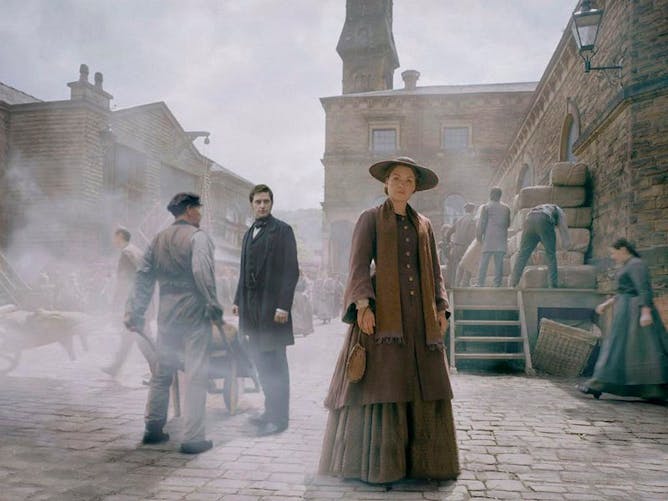
Most of the novel’s events take place in the industrial town of Milton-Northern (Manchester), the epicentre of Victorian coal-fired industrial production. Our protagonist, Margaret Hale, is forced to relocate there due to family circumstances, and her first numb impressions are that the environment, the economy, and the city’s urban geography have all been transformed by fossil fuel consumption:
For several miles before they reached Milton, they saw a deep lead-coloured cloud hanging over the horizon in the direction in which it lay … Nearer to the town, the air had a faint taste and smell of smoke; perhaps, after all more a loss of the fragrance of grass and herbage than any positive taste or smell. Quick they were whirled over long, straight, hopeless streets of regularly-built houses, all small and of brick.
Milton is covered in a thick layer of pollution as a result of the town’s industrialisation, as depicted in the BBC mini-series North and South (2004), which starred Daniela Denby-Ashe as Margaret. British Broadcasting Corporation
Gaskell brings her refined but impoverished heroine into contact with a forceful cotton-mill owner, John Thornton — imagine if Pride and Prejudice were set in a factory. Their love plot offers a symbolic means of restoring harmony to a nation disrupted by the new economy, as Margaret softens the edges of Thornton’s laissez faire practices and brings about improved relations with his workers. As he admits to one of his acquaintances, near the end of the novel,
My only wish is to have the opportunity of cultivating some intercourse with the hands beyond the mere ‘cash nexus’.
Thinking about this resolution in light of the fossil fuel economy, however, what comes into focus is how vulnerable this harmonious social vision is to wider social and environmental forces. By the novel’s conclusion, the global market — the source of raw materials, investors, and customers — proves to be so powerful and destabilising that the harmony of Thornton’s factory can provide only temporary solace at best, and he is bankrupted:
Meanwhile, at Milton the chimneys smoked, the ceaseless roar and mighty beat, and dizzying whirl of machinery, struggled and strove perpetually… . Few came to buy, and those who did were looked at suspiciously by the sellers; for credit was insecure… . [F]rom the immense speculations that had come to light in making a bad end in America, and yet nearer home, it was known that some Milton houses of business must suffer[.]
Looking back at North and South now, we can see how interconnected its vision of a fossil-fuelled society and the economy is, and how artificial the borders of the nation prove to be when faced with the instabilities that it causes.
The Time Machine
Australian author James Bradley suggests that writers today, grappling with how to represent climate change, have found genres such as science fiction more suited to the task than classic realism.
“In a way this is unsurprising,” he comments, because of those genres’ interest in “estrangement” from everyday circumstances, and their fascination with “experiences that exceed human scales of being.”
The last decades of the Victorian era were, like now, a stunning time of generic innovation, and prominent amongst those late-century innovations were the “scientific romances” of H. G. Wells.
The Time Machine’s bleak view of humanity’s future (seen here in the 1960 film adaptation) is a chilling one. George Pal Productions
In The Time Machine (1895) Wells found a narrative device that would allow him to think about social and environmental change over enormous spans of history. Near the end of the novel, the inventor of the machine undertakes a voyage to the very end of the planet’s history:
I looked about me to see if any traces of animal life remained… . I saw nothing moving, in earth or sky or sea. The green slime on the rocks alone testified that life was not extinct… .
From the edge of the sea came a ripple and a whisper. Beyond these lifeless sounds the world was silent. Silent? It would be hard to convey the stillness of it. All the sounds of man, the stir that makes the background of our lives — all that was over.
In imagining this bleak beach, Wells is taking up contemporary predictions that the law of entropy meant the inevitable “heat death” of the universe. Global cooling rather than global warming, then, but one thing that resonates now is how the novel views humanity as a species — and a finite one, at that — rather than from a more limited individual or even national perspective.
The Victorians were the first to stare into the abyss of geological deep time, and to confront the idea of natural history as a succession of mass extinctions.
As a result, Wells raises the idea of a future where even technology cannot overcome calamitous natural processes, and dares to imagine a planet without a human presence.
Tess of the D’Urbervilles
The novelist Amitav Ghosh has recently described a “broader imaginative and cultural failure that lies at the heart of the climate crisis,” arguing that the characteristics of the realist novel have made it resistant to representing those environmental and social complexities. Does the realist novel really have nothing to offer and nothing to say in an era of climate change?
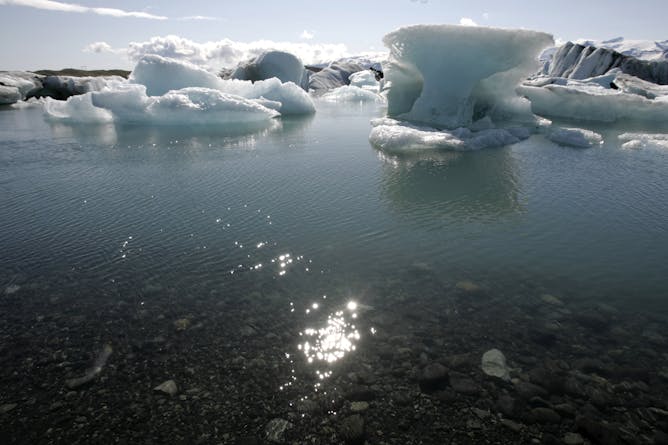
The melting icebergs of Breidamerkurjokull’s Vatnajokull glacier in Iceland: is there a role for the realist novel in an era of climate change? Ints Kalnins/Reuters
One place to look for an answer is another famously bleak Victorian text, Thomas Hardy’s Tess of the D’Urbervilles (1891). The plot is set in motion with Tess’s father’s discovery that his family name, Durbeyfield, is a corruption of D’Urberville, and they are in fact descended from an ancient family that once dominated the area. When they are ultimately thrown out of their home, the Durbeyfields end up seeking refuge at a church, amongst the graves of their ancestors:
They were canopied, altar-shaped, and plain; their carvings being defaced and broken; their brasses torn from the matrices, the rivet-holes remaining like marten-holes in a sand-cliff. Of all the reminders that she had ever received that her people were socially extinct there was none so forcible as this spoliation.
A bit like our own era of increasingly constrained resources, Tess inhabits an exhausted present, and she moves amidst the ruins left by previous generations who have consumed the material wealth that once made life abundant.
Hardy is also deeply attuned to the ecological damage produced by increasingly industrialised forms of agriculture. Late in the novel, when Tess is abandoned by her lover, Angel Clare, she is forced to accept work on the vast and stony fields of Flintcomb-Ash farm.
She labours through a brutal winter, and endures the relentless demands imposed by a steam-powered threshing machine — “a portable repository of force” — that reduces the workers to automatons. Around the same time, Angel abandons England for Brazil, only to find that English bodies do not translate to tropical ecosystems:
He would see mothers from English farms trudging along with their infants in their arms, when the child would be stricken with fever and would die; the mother would pause to dig a hole in the loose earth with her bare hands, would bury the babe therein with the same natural grave-tools, shed one tear, and again trudge on.
Gemma Arterton as Tess in the 2008 mini series adaptation. Stuck on a farm, Tess seesk to make ethical choices despite overwhelming constraints in Hardy’s novel. British Broadcasting Corporation
Both Tess and Angel — and the anonymous, sundered colonial families — seem to be climate refugees of a kind, caught between hostile climates and the environmental wreckage wrought by agribusiness.
What little Tess of the D’Urbervilles offers in the face of all this bleakness also centres on Tess. For one thing, she doesn’t just think of herself as an isolated individual, but sees herself as part of larger social and ecological collectives — her family, her fellow milkmaids, even the rural landscape.
She persists in her determination to care for those around her — including, most challengingly, the son she gives birth to after her rape — despite the weight of the moral and economic systems that bear down upon her. After her father refuses to let the parson visit, Tess chooses to baptise her dying son herself — naming him Sorrow — and then secures him a Christian burial:
In spite of the untoward surroundings … Tess bravely made a little cross of two laths and a piece of string, and having bound it with flowers, she stuck it up at the head of the grave one evening … putting at the foot also a bunch of the same flowers in a little jar of water to keep them alive.
Tess refuses to abandon her project of care despite its futility, persisting with her fidelity in the midst of catastrophe.
Literature in itself isn’t going to save us from global warming — if salvation is even possible, at this point — but then neither, on their own, will economics or science. But if Amitav Ghosh is right, and climate change has revealed an imaginative paralysis in western culture, one thing that the Victorian novel offers us is a means of thinking and feeling about our own moment anew.
The Sydney Writers Festival will host a session on the rise and rise of Cli-Fi featuring James Bradley, Sally Abbott, Hannah Donnelly and Ashley Hay on Friday May 26.
What happens when novelists actively incorporate the idea of failure in their books?
We generally understand failure as a negative attribute, particularly when looking at politics, the economy – and, yes, art. As individuals, we are driven by thoughts of success and achievement, so it makes sense that failure might make us feel slightly uneasy.
Turning that unease into something aesthetically pleasing is no mean feat, and yet, that’s where we are with the work of several well-known contemporary authors.
the essence of poetry is […] of trying (and failing) to speak about the thing itself and not just ideas about the thing.
While this might not seem to relate to the novel, what they were setting up there was a relationship between “trying to speak” and “failing to speak”.
One of the pervading motifs in McCarthy’s novels is an emphasis on some form of failure. In his first novel, Remainder (2005), the narrator tries, and fails, to reenact a moment of perfection.
In Men in Space (2007), McCarthy’s character Ivan Manasek forges a stolen Byzantine painting in an attempt to perfectly recreate the original object. In McCarthy’s most recent novel, Satin Island (2015), the narrator, U, is tasked with writing The Great Report of our age.
Long-listed for this year’s Man Booker Prize, this novel is, at its core, about the failure to write. The Great Report’s essential function is one of identification, one that “name[s] what’s taking place right now”.
U’s boss, Peyman, asks him to “[s]peak its secret name”. For U, this is rather like trying to name “Rumpelstilskin”, but it seems that McCarthy is directly engaging with the enduring aim of poetry to “speak to the thing”, even if he fails.
Trying and struggling
We don’t always feel pleased with artistic expressions of failure. In an article in June for the London Review of Books, American poet and novelist Ben Lerner suggested that the reason that we might “dislike or despise or hate poems” is because, in some way, “they are – every single one of them – failures”.
In Lerner’s first novel, Leaving the Atocha Station (2011), the narrator, Adam, is obsessed with artistic and linguistic failures because they allow him to experience an almost transcendent ambiguity. While in 10:04 (2014), the narrator, Ben, often addresses the second person – “You have failed to reconcile the realism of my body with the ethereality of the trees” – despite never being heard.
For Lerner, the “you” occupies “a collective person who didn’t yet exist, a still-uninhabited second person plural to whom all the arts, even in their most intimate registers, were nevertheless addressed” – or, in other words, an audience that he will always fail to reach.
But it is Karl Ove Knausgaard’s six-part literary project, My Struggle, that is perhaps the most overt example of such an attention to failure. It offers a prosaic, not poetic, assessment of failure.
Indeed, it is a project that strives deliberately towards constructing “real” experience. In framing the work as a novel, Knausgaard has claimed that he was able to “use [him]self as a kind of raw material,” enacting “an existential search” of the self.
The “struggle” suggested in the title references, in part, the struggle to write without shame to create something of value.
Rooted in ancient Japanese tea ceremonies from the 15th century, wabi-sabi recognises beauty in imperfection, impermanence, and incompletion. To a Western eye, beauty is often equated with perfection, but for Krasznahorkai, fleeting moments are established as beautiful even if they go on to decay.
The novel’s first vignette describes the magnificent beauty of a white heron hunting, in contrast to industrial Kyoto.
But it is wabi-sabi’s focus on “the now” that makes it interesting when thinking about contemporary writing. What might be expected from a novel that reflects on its own inability to say things successfully? Or, more pressingly, that constructs failure as an aesthetically-pleasing subject?
By focusing on failure, contemporary novelists might find they can wield surprisingly equal critical, ethical, political, and aesthetic power.
In This Will Destroy That, also known as Book V, Chapter 2 of Notre Dame de Paris, Victor Hugo presents his famous argument that it was the invention of the printing press that destroyed the edifice of the gothic cathedral. Stories, hopes and dreams had once been inscribed in stone and statutory, wrote Hugo. But with the arrival of new printing technologies, literature replaced architecture.
Today, “this” may well be destroying “that” again, as the Galaxy of the Internet replaces the Gutenberg Universe. If a book is becoming something that can be downloaded from the app store, texted to your mobile phone, read in 140-character instalments on Twitter, or, indeed, watched on YouTube, what will that do to literature – and particularly Hugo’s favourite literary form, the novel?
Caricature of Hugo by Honoré Daumier (1849). Wikimedia Commons
Debates about the future of the book are invariably informed by conversations about the death of the novel. But as far as the digital novel is concerned, it often seems we’re in – dare I say it – the analogue phase. The publishing industry mostly focuses on digital technologies as a means for content delivery – that is, on wifi as a replacement for print, ink, and trucks. In terms of fictional works specifically created for a digital environment, publishers are mostly interested in digital shorts or eBook singles.
At 10,000 words, these are longer than a short story and shorter than a printed novel, which, in every other respect, they continue to resemble.
Digital editions of classic novels are also common. Some, such as the Random House edition of Anthony Burgess’s A Clockwork Orange (1962), available from the App store, are innovatively designed, bringing the novel into dialogue with an encyclopaedic array of archival materials, including Burgess’ annotated manuscript, old book covers, videos and photographs.
Also in this category is Faber’s digital edition of John Buchan’s 39 Steps (2013), in which the text unfolds within a digital landscape that you can actually explore, albeit to a limited degree, by opening a newspaper, or reading a letter.
But there is a strong sense in which novels of this sort, transplanted into what are essentially gaming-style environments for which the novel form was not designed, can be experienced as deeply frustrating. This is because the novel, and novel reading, is supported by a particular kind of consciousness that Marshall McLuhan memorably called the “Gutenberg mind”.
Novels are linear and sequential, and post-print culture is interactive and multidimensional. Novels draw the mind into deeply imagined worlds, digital culture draws the mind outward, assembling its stories in the interstices of a globally networked culture.
For the novel to become digital, writers and publishers need to think about digital media as something more than just an alternative publishing vehicle for the same old thing. The fact of being digital must eventually change the shape of the novel, and transform the language.
Charles Dickens, not at his laptop. Wikimedia Commons
Far from destroying literature, or the novel genre, digital experimentation can be understood as perfectly in keeping with the history of the novel form. There have been novels in letters, novels in pictures, novels in poetry, and novels which, like Robinson Crusoe (1719), so successfully claimed to be factual accounts of actual events that they were reported in the contemporary papers as a news story. It is in the nature of the novel to constantly outrun the attempt to pin it down.
So too, technology has always transformed the novel. Take Dickens, for example, whose books were shaped by the logic of the industrial printing press and the monthly and weekly serial – comprising a long series of episodes strung together with a cliffhanger to mark the end of each instalment.
So what does digital media do differently? Most obviously, digital technology is multimodal. It combines text, pictures, movement and sound. But this does not pose much of a conceptual challenge for writers, thanks, perhaps, to the extensive groundwork already laid by graphic novel.
Rather, the biggest challenge that digital technology poses to the novel is the fact that digital media isn’t linear – digital technology is multidimensional, allowing stories to expand, often wildly and unpredictably, in nonlinear patterns.
palo
Novelistic narratives – as we currently know them – are sequential, largely predicated on the presence of a single unifying consciousness, and designed to be read across time in the order designated by the author.
Last year, this presented a serious problem for many would-be readers of David Mitchell’s short story The Right Sort, a fictional work composed of 280 tweets, sent out in groups of 20, twice a day, for seven days. Frustrated readers complained that they couldn’t catch the tweets – that half the narrative had gone missing in the digital ether.
It was basically far more comfortable reading the printed version via the link in the Guardian – where readers found a beautifully turned albeit somewhat conventional short story, whose major concession to its digital environment was that it was composed of short scenic snatches 140-characters long.
Another difference between digital and print technologies is that the printed novel encourages private reading, whereas digital readers tend to share their experiences in networked, highly social environments.
Bluestar Tam
Today, even authors of traditional novels are expected to maintain an online presence for themselves. In order to publish a book, you need a hashtag, a Facebook page, a blog tour, a book trailer on Vimeo or YouTube and a Twitter account.
Much was made of the potential for this type of media to supplement a novelistic text when Richard House’s “digitally augmented” thriller The Kills (2013) was long-listed for the Man Booker Prize. But potential exists for this kind of interaction to go beyond merely “augmenting” a novel, to integrating with, and actually expanding it.
In the not-too-distant future, digital novels will find themselves expanding horizontally across platforms, and readers may well be finding themselves interacting with, transforming, and even contributing the content.
This may well be the moment when the walls of literature (as we know it) come tumbling down. Yet, the scathing critic might do well to remember that Dickens was revolutionary in his day, not only for charting the course of serialisation, thereby making literature popular and accessible, but also for making ordinary people the subject matter of his writing.
One novel that gives you a glimpse of what the digital novel might turn out to be is The Silent History (2014), created by Eli Horowitz – best known as an editor at the New York based literary journal McSweeneys – in collaboration with Matthew Derby and Kevin Moffett.
The Silent History (2014). Vintage Digital, part of Vintage Publishing.
The story is set in the second quarter of the 21st century, when children begin to be born who fail to develop the necessary cognitive functions to acquire, understand or use language. The prose is dazzling, the characters, and their predicaments are moving, and just as importantly, the digital aspects of the book are set deeply in its design.
They are not only present in its themes – though these aptly deal with the problem of communication – but also in its collaborative structure, and interactive details.
The Silent History is available in print and ink, but it was originally developed as an app. The written sections of the text – called “Testimonies” – which contain the main trajectory of the story, were uploaded sequentially, along with a variety of mixed-media elements, including video and photographs.
One of the striking aspects of the work is its capacity to grow through user-generated content. The writers gradually expanded the “Testimonies” through the inclusion of “Field Reports” – that is, short narratives submitted by readers and other writers.
These can only be unlocked using the map on your mobile or tablet device at a specific location – a bit like a GPS-activated and endlessly proliferating instalment of Dickens.
The digital novel wasn’t on show at the Sydney Writers’ Festival last week, but there are clear signs that this counter cultural curiosity is edging its way into the literary mainstream. But the wary can rest assured. Despite Hugo’s protestations, architecture wasn’t destroyed by the printing press. It was only transformed.



 According to these writers, villages can be conformist, unimaginative, repressive, nepotistic. These fictions imply that villages will be harder to maintain now that women have other outlets for their energies. The negatives come from the same source as the positives in village life, and people who wish to defend villages, and the tradition of rural living, should remember this literary ambivalence and the fact that it has gone on for more than 100 years.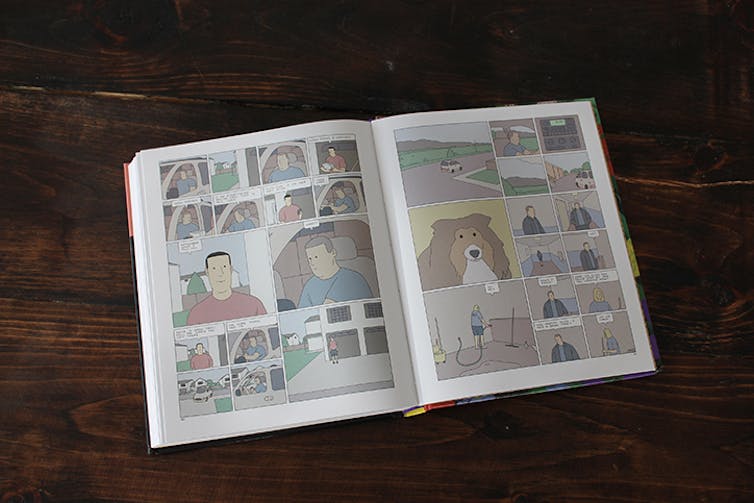


 There are also the recent works lauded in the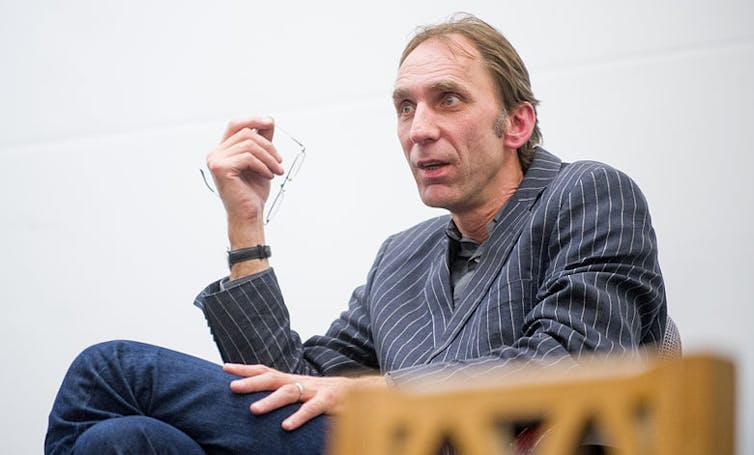
 Emerging from a long winter of discontent, perhaps it is the strange fate of the novel to exist in a permanent state of imminent demise and doom, with an innate awareness of itself as the one genre that literature simply cannot do without.


 But in fleeing to it, seeking refuge from it and working with it, our authors allow us, unlike the homesick Tench, to turn the telescope inward, toward the land and to ourselves.




 At the BookShelf


You must be logged in to post a comment.