Crime fiction often thrives in periods of social and political tension, when readers long for both justice and stability. So it’s no wonder that as the pandemic took root, crime fiction salesrose.
Doggedly pursuing justice, they defend those in distress, earning little for their efforts.
In 1945, novelist Raymond Chandler famously defined the hard-boiled hero as “a man … who is not himself mean, who is neither tarnished nor afraid… He must be, to use a rather weathered phrase, a man of honor, by instinct, by inevitability, without thought of it, and certainly without saying it.”
These were reassuring characters who served as models of competent leadership and ideal authority figures. But it didn’t exactly paint the full American picture. In truth, no matter how many Marlowes or Joneses came to the rescue, signs of America’s deranged underbelly were always lurking just beneath the surface.
One crime author, the singularly harrowing Jim Thompson, gave this unique brand of American craziness center stage.
Unreliable, deceptive and sadistic
Author of more than 20 novels including “The Killer Inside Me,” “Pop. 1280” and “The Grifters,” Thompson created a sinister army of corrupt police, cunning con-artists and psychopathic murderers.
“The Killer Inside Me,” published in 1952, is his best-known novel. Its narrator is Lou Ford, a 29-year-old Texas sheriff who pretends to be a bland and boring rube but ends up committing every murder in the novel.
Unlike classic hard-boiled characters who understate their own misfortunes but have compassion for others, Ford exults when others suffer. He claims spiritual authority and a superior intellect but displays an “aw-shucks” helplessness to seem innocent.
Unreliable as a narrator, he talks in populist clichés – saying things like “haste makes waste” and “every cloud has a silver lining!” – while confiding in the reader that he “should have been a college professor or something like that.” He sometimes references his “sickness,” hinting he is schizophrenic, but he shows no signs of psychosis – only psychopathy.
Most of all, he consistently and calculatingly shirks responsibility, making sure others take the fall for his misdeeds. When a man witnesses him brutalize a town prostitute, he bullies that witness before murdering and framing him.
“Don’t you say I killed her,” he warns the terrified witness. “SHE KILLED HERSELF!”
The gaslit 1950s
The novel arrived at a period in American history that was rife with demagoguery, paranoia and manipulation.
In 1950, the National Security Council paper NSC 68 advised a massive buildup of military power in response to the threat of the Soviet Union. The report remarked that “a democracy can compensate for its natural vulnerability only if it maintains clearly superior overall power in its most inclusive sense,” and warns against our “tendency to expect too much from people widely divergent from us.” It would soon become apparent that retaining power – and a readiness to mistrust those deemed too different – were becoming fundamental to the country’s foreign policy.
It’s no wonder that American novelist Norman Mailer called the 1950s “years of conformity and depression,” while “Homeward Bound” author Elaine Tyler May described the decade as one of “containment,” with fearful insularity as characteristic of American society as it was of foreign policy.
When Jim Thompson published “The Killer Inside Me,” Lion Books nominated it for the National Book Award, calling it “the most authentically original novel of the year.” An editor at the New American Library found in his books “the passions of men and women revealed in their naked, primeval fury.” Thompson’s characters, from the gloating gaslighter Lou Ford to the messianic delusionist Nick Corey, echoed the paranoid thoughts, delusions and deceptions already patent in 1950s politics.
The writer’s fiction dismantles point-by-point the classical hard-boiled heroes whose word was good and whose ethics were reliable. Its real bleakness comes from the vacuum that replaces any sense of accountability, empathy or reliability.
His novels are chilling precisely because they smash the beloved American illusion that with rugged individualism comes rugged integrity.
Echoes today
“The Killer Inside Me” is a testament to moral accountability exultantly shredded, and its resonance today is uncanny.
But today’s craziness has reached another level. From Walmart to the White House, Americans are claiming to be both completely righteous and entirely blameless.
As Stephen King famously wrote in the introduction to a 2011 edition of Killer, “In Lou Ford, Jim Thompson drew for the first time a picture of the Great American Sociopath.”
Those in power readily pass the buck, even managing to seem innocent or misguided. The contrived specter of helplessness – combined with claims of absolute conviction – create chaos and dissolve accountability. That Thompson did all this in a book famous for its bleakly sociopathic vision testifies to the insanity and abusiveness that surround us.
A torrent of lies and injustice has demoralized Americans much as it dejected Ford’s victims. To me, we are living in Thompson’s world and can only dream of such fundamentals as honesty, empathy and accountability.
Crime and detective fiction continues to top bestseller lists across the world, spawning TV series and films. In the hands of African writers, though, the genre offers a particularly textured world view.
That Ever-blurry Line Between Us and the Criminals: Re-Visioning Justice in African Noir is a colloquium paper by Sam Naidu. It focuses on African crime and detective fiction as a complex and disruptive variety of classic, Western crime and detective fiction.
Aretha Phiri: Your paper addresses classic noir and African noir, sub-genres of crime and detective fiction?
Sam Naidu: African crime fiction builds on and extends classic crime fiction to explore philosophical questions about identity, knowledge and power. Referencing the same dark aesthetic of classic noir – characterised by themes of alienation, pessimism, moral ambivalence and disorientation – African crime fiction amplifies political awareness. And, occasionally, it destabilises the conventions of classic crime fiction, which arose during the aftermath of the two world wars when the world was in the grip of the Cold War.
Aretha Phiri: What is the ‘political’ relationship between classic and African crime fiction?
Sam Naidu: African crime fiction builds on and extends classic crime fiction’s exploration of philosophical questions about identity, knowledge and power in the modern world.
Politically, there is a deliberate shift to consider fundamental questions about Africa and its specific requirements. The novels I have read demonstrate a preoccupation with the ambiguity of justice. They express a poignant, Afro-pessimistic lament for a continent and its injustices.
They provide this focus in terms of colonialism and the power differentials of neo-colonialism in Africa. So, you find that economic exploitation and inequalities, race, war, genocide, corruption and state capture are common subject matter.
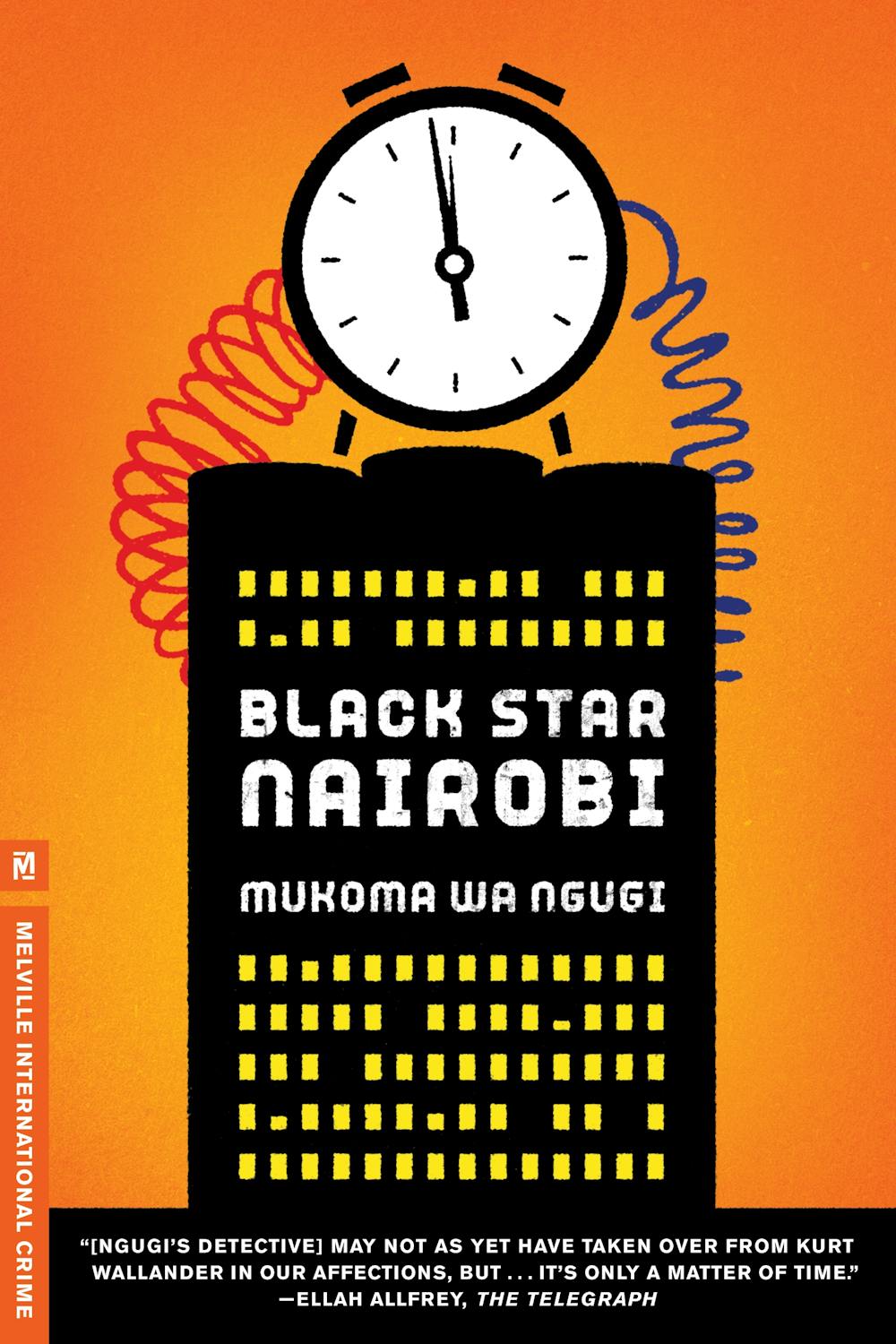
Aretha Phiri: You read Mũkoma wa Ngũgĩ’s novel Black Star Nairobi (2013) as a valuable way of demonstrating the disruption of the classical by the African? What’s it about?
Sam Naidu: It’s set mainly in Nairobi, Kenya, in 2007. It’s the eve of Barack Obama’s election as the first black US president and presidential elections in Kenya. O (short for Odihambo), a Kenyan former policeman who still works part-time for the police, has teamed up with Ishmael from the US, a former cop. Together they’ve formed a detective agency, Black Star, which is given a lucky break when O’s former boss hires them to investigate the murder of an unidentified person whose corpse is found gruesomely disfigured in the Ngong Forest outside Nairobi.
Melville House International, 2013
Aretha Phiri: You conclude in your paper that the predominant effect of African crime fiction is not so much a ‘dark’ sensibility as it is one of obscurity and poignant Afro-pessimism?
Sam Naidu: I reach this conclusion based on the literary texts. This is not my opinion of the state of the continent. The novels are very dark. They overwhelm the reader, with the mess, tragedy, garbage, cruelty, indignity and inhumanity that Africans face in reality. Due, of course, to historical and ongoing systemic oppression and corruption. For characters – and for readers – this can lead to muddledness and despair.
But the novels also offer a counterpoint – in the form of fearless detectives on the quest for justice. In the midst of the disquiet there is a faint flicker … It is this murkiness, taken to new depths, which makes African crime fiction particularly effective and significant. For example, the novel closes with a highly lyrical and metaphorical scene of African musicians in a market. Ishmael describes the competing rhythms of African music – a metaphor for the strife and power struggles of the continent. Despite the discord he detects a harmony –- “a tense harmony”.
Aretha Phiri: How does Black Star Nairobi manage to disrupt classic crime fiction?
Sam Naidu: For example, through its innovative use of setting, characterisation, pace and conclusion to comment on ontological, existential and ethical themes to do with justice, it’s an exemplary African noir text. It explicitly extends classic noir into the realms of neo-noir.
Its blend of previous influences, use of setting, and its specific thematic concern with Afro-pessimism prompt the observation that African crime fiction extends classic noir into new literary, geo-political, and moral territories.
Murkiness, so characteristic of classic noir sensibility, mutates, at times, in African crime texts such as Black Star Nairobi and Leye Adenle’s When Trouble Sleeps, to a deliberate generic nebulousness. And thematically, to a moral blurriness so obscure as to disorient the reader and dismantle the basic binaries on which classic detective and crime fiction were predicated.
In classic noir or classic crime fiction there are clear detective heroes set up against indisputable villains (think of Sherlock Holmes) but in African crime fiction the heroes and villains often exchange roles or are complicit in some way.
Aretha Phiri: You describe this evolving genre as occupying a kind of borderland. How does this connect to your research in migration and diaspora?
Sam Naidu: In my work on literature of migration and diaspora I am mainly concerned with the experience of migrants. I am, however, also interested in how literary genres migrate. What processes of cross-pollination occur as a result of diaspora?
Aretha Phiri: What do you see African crime fiction contributing to Black Atlantic scholarship?
Sam Naidu: As a form of postcolonial, transnational writing, African crime fiction points to the relations between Africa and America. Gilroy’s Black Atlantic puts forward that race is fluid and ever-changing, rather than static. That it is transnational and intercultural, rather than national. I am arguing that African crime fiction represents race as a transnational or diasporic phenomenon while at the same time engaging with the notion that race is closely bound up with both nationality and ethnicity.
So, look at the detective hero figure Ishmael. He is an African-American who returns to Africa, gesturing, of course, to transatlantic slavery and colonialism. He’s neither African nor American – he is both. The novel explores his hybridity. At the same time, the novel presents Kenya as nation marred by ethnic clashes and wide-scale civil unrest.
African crime fiction, being the second most popular literary genre on the continent after romance, is worthy of study because of its accessibility, wide-spread, diverse readership and also its capacity for socio-political analysis. It is the ideal vehicle for such pertinent ‘detection’.
If COVID-19 has taught us anything, it’s that humans are connected, and that an individual’s actions can have profound consequences for the local community, the nation, and beyond. A good detective story, whether it takes place within an English country house or travels across international borders, reminds readers of this fundamental truth.
But in both country-house and hard-boiled traditions their function is similar. They link disparate individuals and communities as they reconstruct events, and raise the possibility that, whoever pulled the trigger or administered the poison, we all share some responsibility for allowing such things to happen.
The selection below, I hope, reflects the genre’s diversity. What connects these books, for all their stylistic variety, is a preoccupation with links between people and communities and a desire to explore the implications of every action, deliberate or accidental.
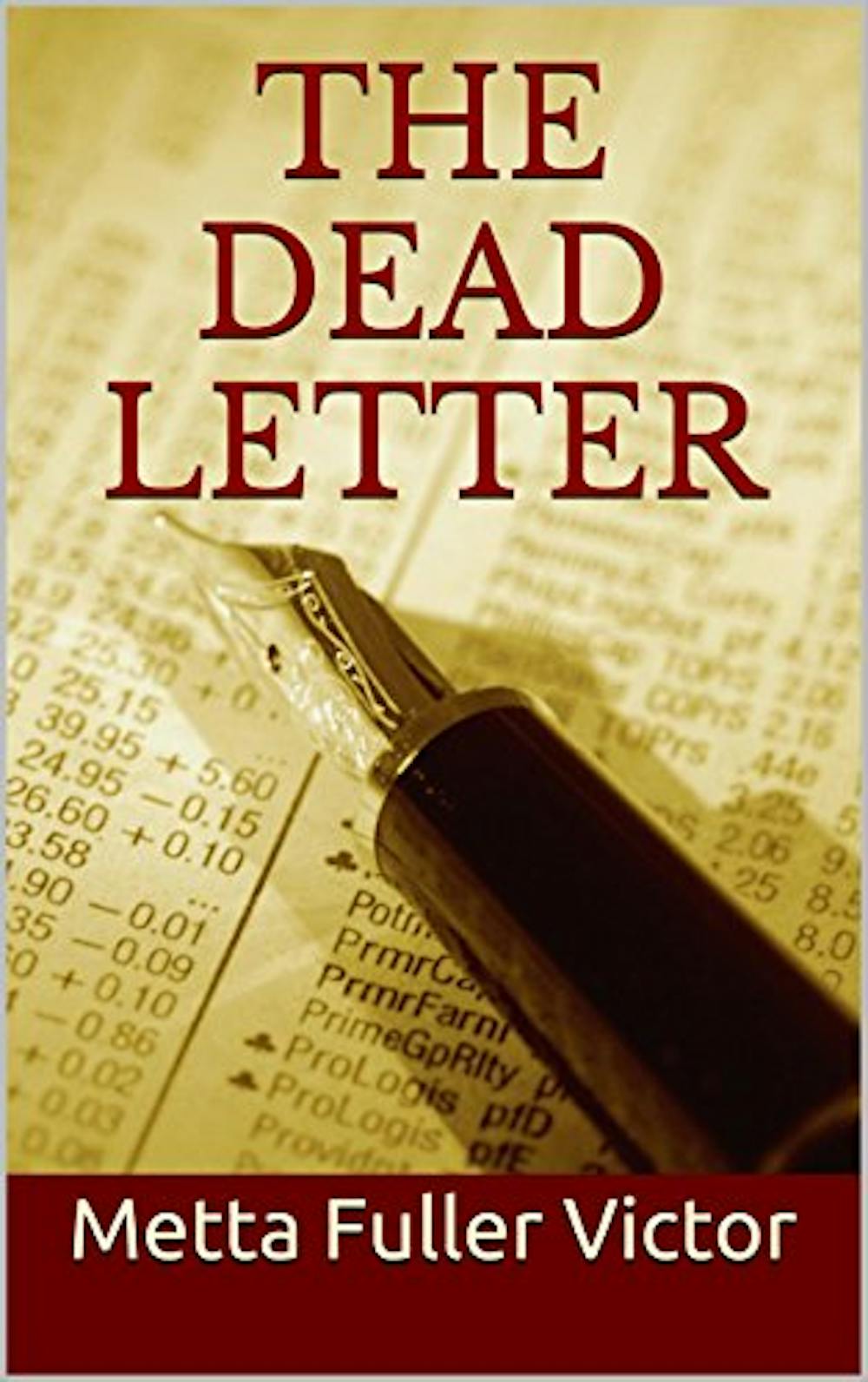
Metta Fuller Victor: The Dead Letter (1866)
The first full-length detective novel in American literature, The Dead Letter, published under the pen-name Seeley Register, is a curious hybrid. Featuring a country house that might be haunted, a clairvoyant child who – conveniently – is the detective’s daughter, and scenes of deathly pale women wandering moonlit gardens, mourning lost lovers, it shows how 19th-century detectives emerged from Gothic literature.
First American detective novel. Amazon
It is also a sentimental love story and a meditation on the corrupting power of money.
Like the Edgar Allan Poe stories which influenced it, and the Sherlock Holmes tales that followed, its narrator is not the detective, but the detective’s friend who – like the reader – is inclined to romanticise the sleuth’s heightened abilities.
The Dead Letter can be florid and outlandish, but it combines its eclectic elements to highly entertaining effect.
Raymond Chandler: The Long Goodbye (1953)
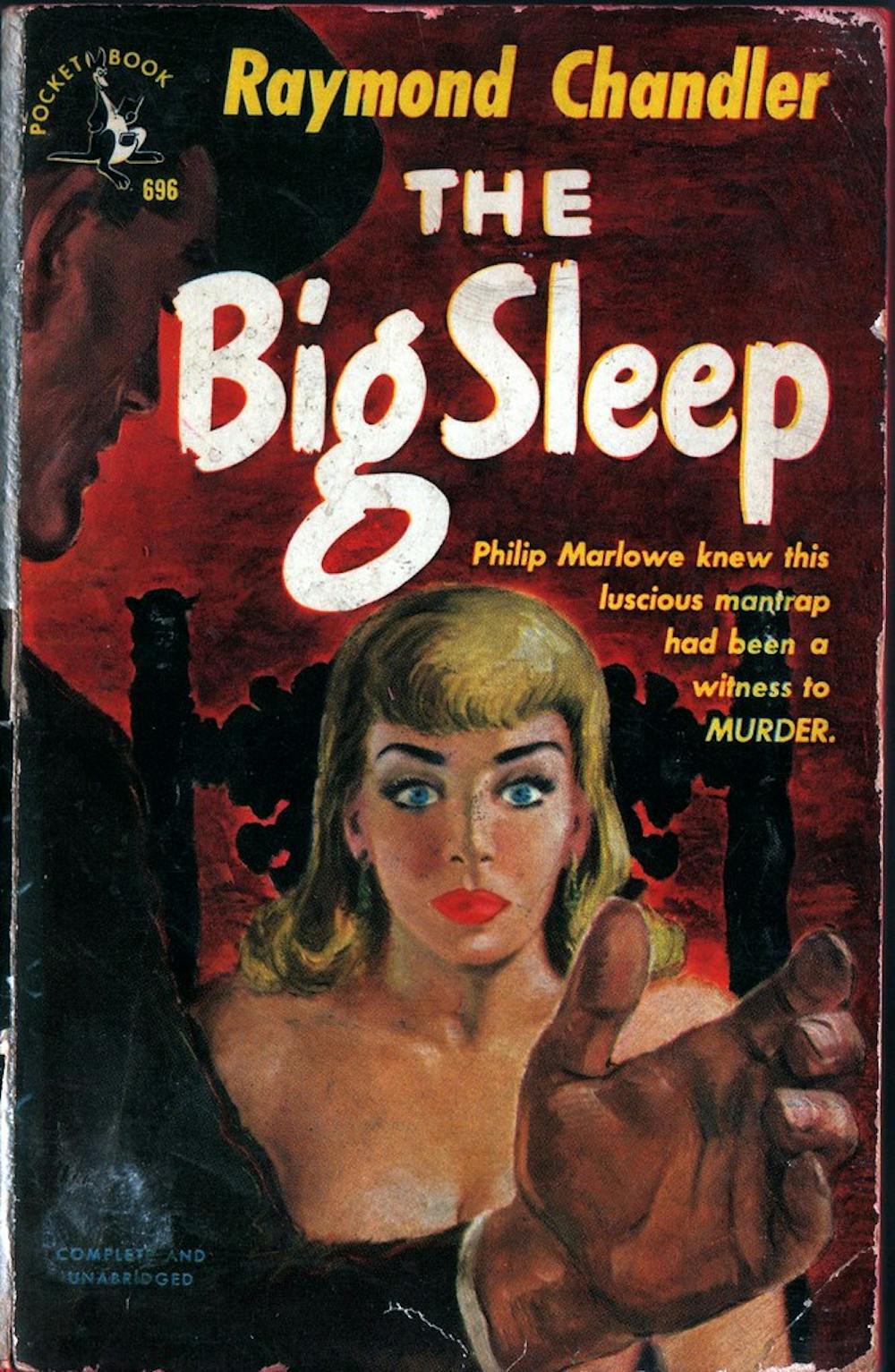
Philip Marlowe, the hero of seven novels and numerous short stories by Raymond Chandler, is tall, handsome, witty and admirably cynical about the effects of wealth. I’d love to recommend all the Marlowe stories and, given that its author intended it to be the last, The Long Goodbye might seem an idiosyncratic choice.
Pulp fiction (cover art by Harvey Kidder). admiral.ironbombs via Flickr, CC BY-SA
Stranger still, its pleasures are less to do with the detective thriller’s traditional virtues – intricate plotting, dynamic action – and more with the air of nostalgic melancholia Chandler conjures. There are murders, of course, and there is the vivid evocation of Los Angeles in its grubby splendour. There is also Marlowe’s trademark gift for metaphor: at the beginning, watching two people arguing outside a club, he remarks:
The girl gave him a look which ought to have stuck at least four inches out of his back.
But the novel’s heart is the unlikely friendship between Marlowe and Terry Lennox, a rich, dipsomaniac veteran locked in a loveless marriage, emotionally scarred by his combat experiences. As its title suggests, this epic and heartbreaking novel is about goodbyes: to innocence, to friendship, to the conventions of the detective story, and to an America untainted by consumerism.
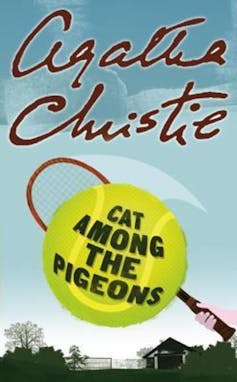
Agatha Christie: Cat Among the Pigeons (1959)
Christie remains the pre-eminent writer of the “whodunit”. Her sheer prolificacy masks the fact that she is a consistently innovative plotter, unafraid to experiment with point-of-view in sometimes radical ways. She also produces stories that are dark, disturbing, and morally ambiguous – characteristics highlighted in recent adaptations such as the BBC’s version of The Pale Horse.
Mallory Towers with added murder. AgathaChristie.com
Though not among her most celebrated novels, Cat Among the Pigeons delightfully combines international espionage and country house mystery, with the “country house” being a prestigious girls’ prep school in England where members of staff start dying in suspicious circumstances.
Ingenious and laced with cruelty, it might be read as a story about Great Britain’s declining empire, or the fragile isolation of the upper classes, or it might simply be read as Mallory Towers with added murder.
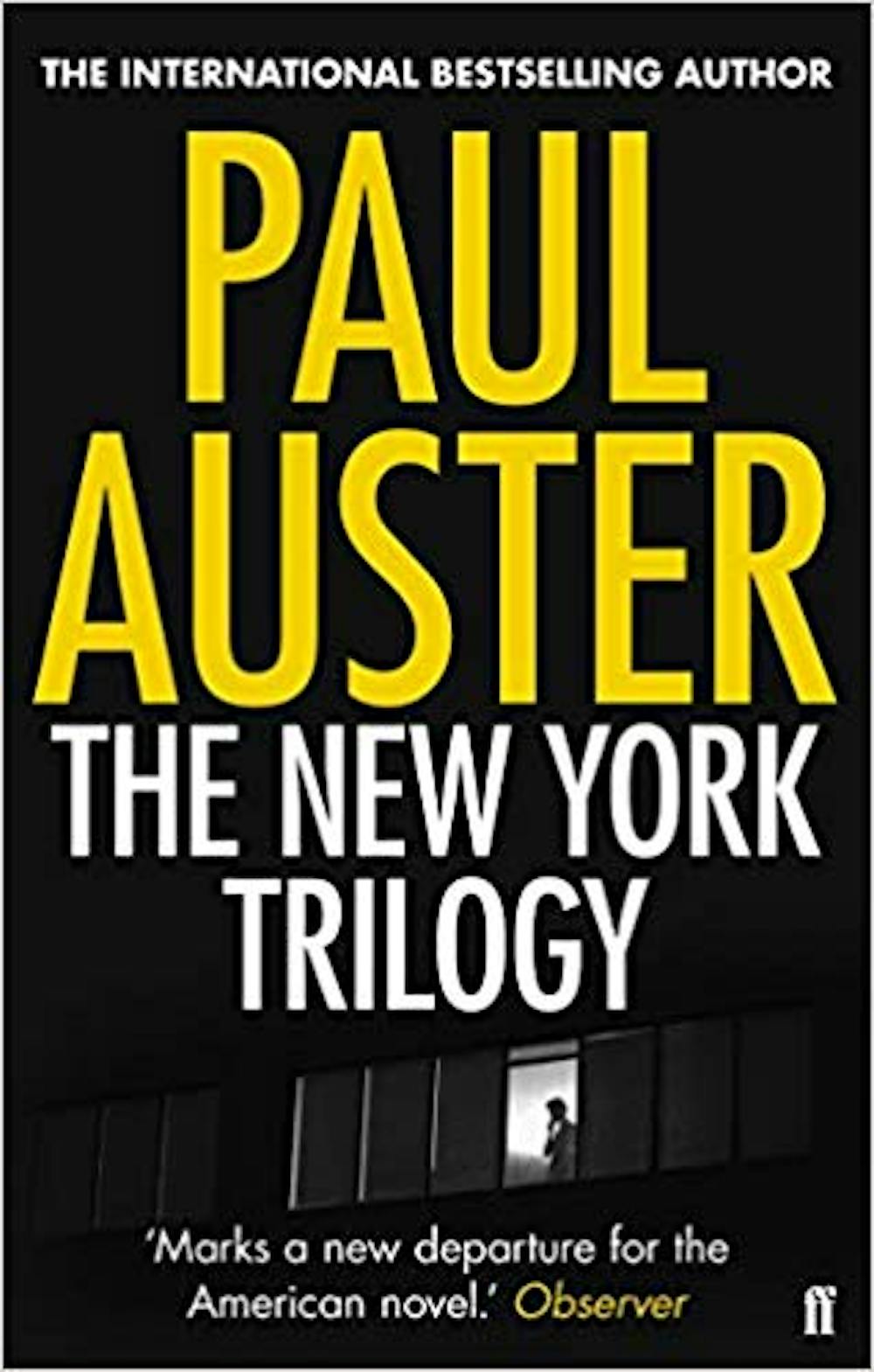
Paul Auster: The New York Trilogy (1987)
This comprises three distinctive tales: City of Glass, Ghosts and The Locked Room, that conspire to connect in surprising ways. Often regarded as a model of “antidetection”, Auster’s trilogy frequently confounds expectations, promising stock elements of the hard-boiled story – the enigmatic loner gumshoe, the femme fatale, the dirty city – before jettisoning the cliches and exploring new territory.
Elaborate puzzles. Amazon
Auster’s New York is a labyrinth ruled by chance, where one’s doppelganger can appear for no reason, where a man can devote his life to collecting and renaming bits of rubbish, and where “Paul Auster” can appear as a character. These are elaborate puzzles yet highly readable thrillers.
They are perfect stories for lockdown because they are about the consolations of reading and the paradoxical truth that the deeper into solitude we go, the more we understand our vital connection to others.
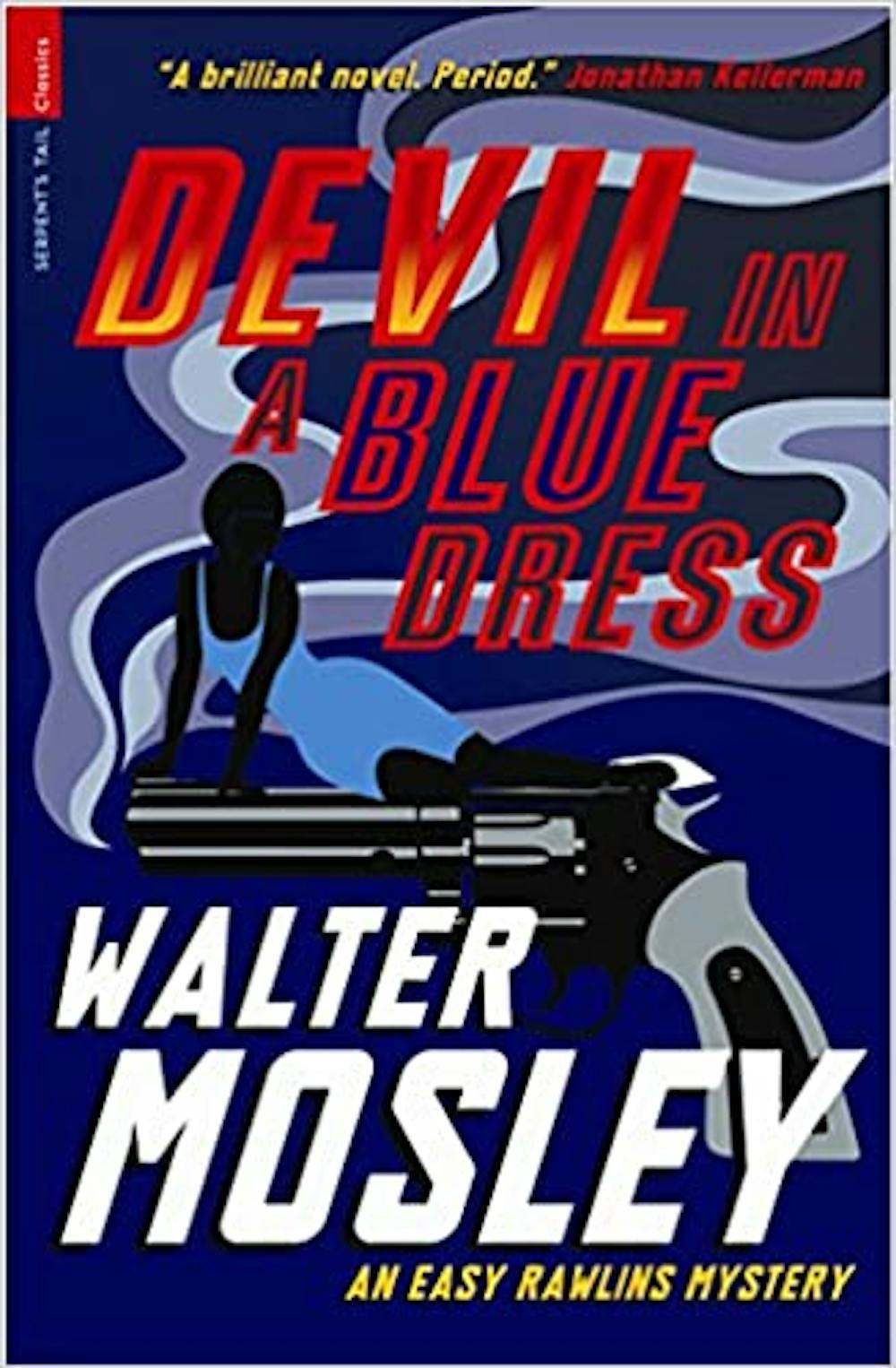
Walter Mosley: Devil in a Blue Dress (1990)
This is the first thriller starring Ezekiel “Easy” Rawlins, an African-American factory worker in the Watts area of Los Angeles, who falls into detection when a stranger enters his local bar and offers him a missing persons job. Mosley’s work exemplifies the ways in which detective stories, tightly bound to specific places and times, function not only as entertainment but also as historical documents.
Realistic and wry account of race relations. Amazon
Devil in a Blue Dress, through energetic vernacular dialogue, realistic situations and wry observations on race relations, brilliantly evokes the lives of African-American families who moved from the southern states to California during the Second Great Migration.
More than the talented amateurs of the country house mystery, who possess a timeless quality and whose successful investigations tend to reinstate cosy normality – and Marlowe, a 20th-century knight errant with a nostalgic impulse – Easy Rawlins demonstrates that detectives are shaped by historical circumstances. He also happens to have one of the most captivatingly unstable sidekicks in all detective writing.
Detectives are people who move, tracing links between people, places and times. They are also expert readers: of clues, people, situations. During lockdown, these stories can transport us elsewhere and remind us that reading is an empathetic act, a way of reaching out and trying to connect with others.
Green is a colour that evokes nature, fecundity, sustainability.
At the traffic lights it signals go; on a boat, starboard.
It’s a soft celadon glaze; an intense Van Eyck wedding dress; frothy, aromatic matcha tea; aurora borealis; a meditative praying mantis. It’s jungle camouflage, Joyce’s snotgreen sea, green mould and Martians.
If green had a smell, would it be freshly cut grass – or bile-infused Exorcist vomit?
Green, like all colours, has innumerable meanings and cultural associations. My interest in green stems from the books I curated in Lurid: Crime Paperbacks and Pulp Fiction.
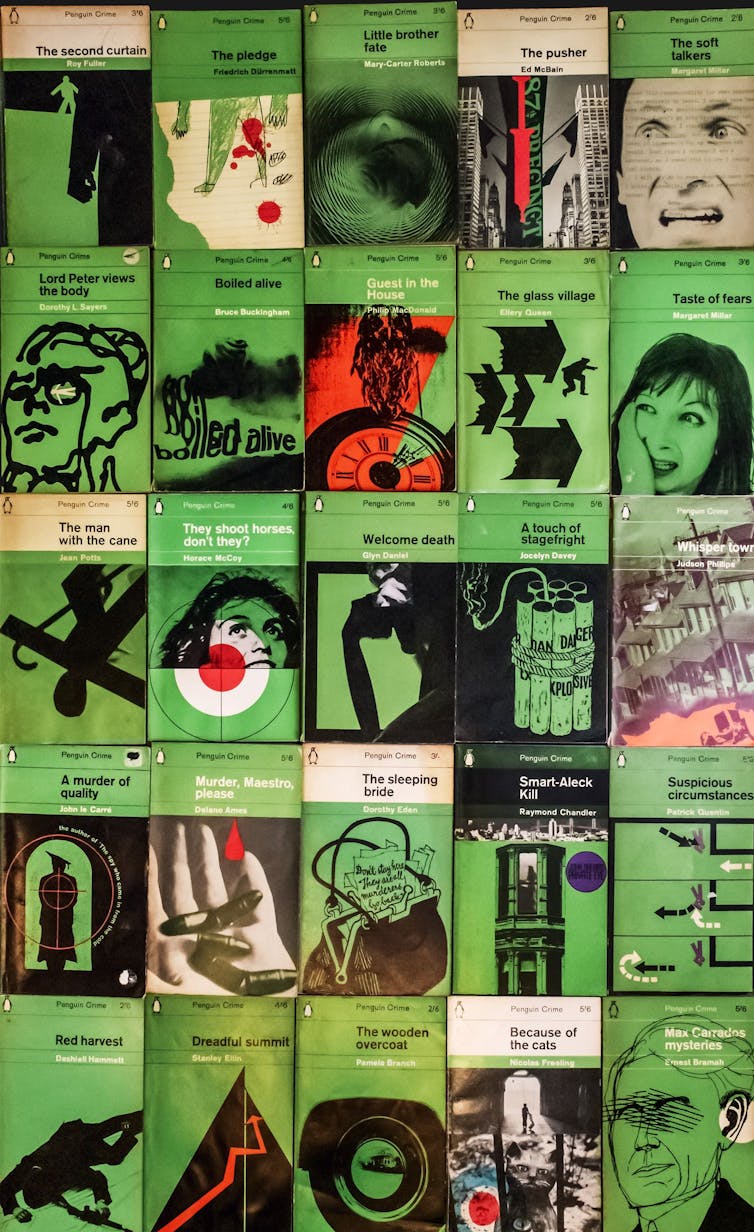
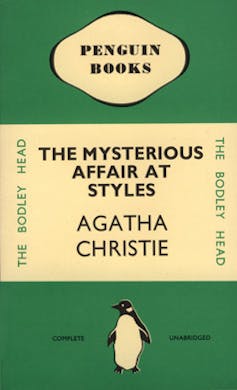
My favourite books in Lurid are the green Penguin crime series from the 1960s. Penguin was founded by Allen Lane in 1935 and revolutionised publishing through a focus on well-designed, pocket-sized and affordable high-quality literature, as distinct from mere pulp.
The covers were standardised yet stylish and instantly recognisable: two horizontal bands of colour separated by a central white band featuring the author’s name and title in Gill Sans font. Initially designed by Edward Young, the aesthetic was strengthened in 1947 by German typographer Jan Tschichold’s Penguin Composition Rules.
The cheerful Penguin logo, also designed by Young, was the only pictorial element on these early covers. In Jeremy Lewis’s Penguin Special, he writes Penguin eschewed the lurid picture jackets – “breastsellers” – adopted in the US in favour of English restraint and text-only designs.
The books were colour-coded by subject: the now classic orange for fiction, dark blue for biographies, red for drama. Of the first ten Penguin books published, two were crime and colour-coded green.
Since curating the Lurid exhibition, I’ve been wondering: why green? Why not blood-spatter red or noir black?
The affect of green
As a visual artist as well as a visual criminologist, I have a great interest in colour and its affective qualities.
The initial green used on Penguin crime covers was a slightly earthy green, not unlike terre verte. This is a soft green pigment traditionally used as a cool element when mixing flesh tones in a limited palette of flake white, yellow ochre, Venetian red and ivory black, depending on the subject’s skin tones.
Terre verte is often used as a grisaille or underpainting in figurative works and portraiture. But there are so many other irresistible greens in oil painting: cobalt, emerald, viridian, phthalo, cadmium, sap, olive, chromium.
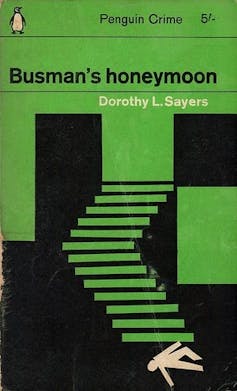
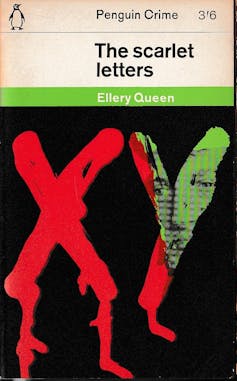
The original earthen green hue of Penguin crime was brightened in the 1960s when Italian art director Germano Facetti challenged the traditional Penguin design rules and hired Polish graphic designer Romek Marber to revitalise the book covers.
The “Marber Grid” and pictorial covers placed the typography and Penguin logo in the top third of the cover and allowed two-thirds of the layout for striking modernist illustration and graphic design.
The Busman’s Honeymoon, in particular, shows Marber at his best. The geometric design evokes a staircase with a corpse – the identifying device of the white cut-out – at the bottom.
Marber’s last Penguin crime cover design was for Ellery Queen’s The Scarlet Letters in 1965. With the letters X and Y that, in the novel, a dying man traces in his own blood, the design introduces trickles of red, photography and a solid black background.
Looking at these book covers today, there is power in the simplicity of these designs with their limited colour palette, elements of photomontage, collage, drawing and geometric pattern, and use of sans serif font.
And, of course, there is the bright green.
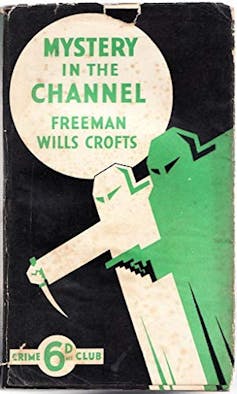
The Penguin crime series is not the only one to feature green. Launched by Collins in the 1930s, the White Circle Crime Club used a bold graphic design featuring two menacing figures and variations on a restricted palette of green, black and white.
This green branding was an intentional strategy to compete directly with the green Penguins.
Green to kill
Why green? Perhaps the answer lies in green’s association with toxicity.
The 18th century’s Scheele’s green, derived from arsenic, was vivid and alluring. The 19th century’s emerald green was highly desirable, and used extensively in clothing and wallpaper, including that of William Morris. Unfortunately, it was horribly poisonous: arsenic fumes from Emerald Green wallpaper killed.
Green, then, is deadly. Green radioluminescent paint shone brightly on watches and caused radium poisoning; green chlorine gas was first used as a chemical weapon in the first world war.
The green of absinthe’s la fée verte, the green fairy, is intoxicating, once thought to be hallucinogenic, and an ingredient in Ernest Hemingway’s Death in the Afternoon cocktail.
With these lethal associations the green of crime fiction starts to make sense.
A recent project to encourage South Australian prisoners to write provides insights into how prisoners may benefit from written expression.
The project, Life Sentences, gave more than 70 contributors professional feedback, certificates of merit and publication in a booklet produced annually from 2017 to 2019.
The submissions revealed a surprising diversity of topics, considerable talent and self-awareness.
The back story
Life Sentences began as an offshoot of Art by Prisoners, a visual arts competition organised by Jeremy Ryder, who wanted to showcase art from prisoners across South Australia.
We wondered if prisoners may also want to express themselves through writing. Department for Correctional Services officers promoted Life Sentences and prisoners responded with interest. After the program, Life Sentences booklets were available to the public at the Art by Prisoners exhibitions.
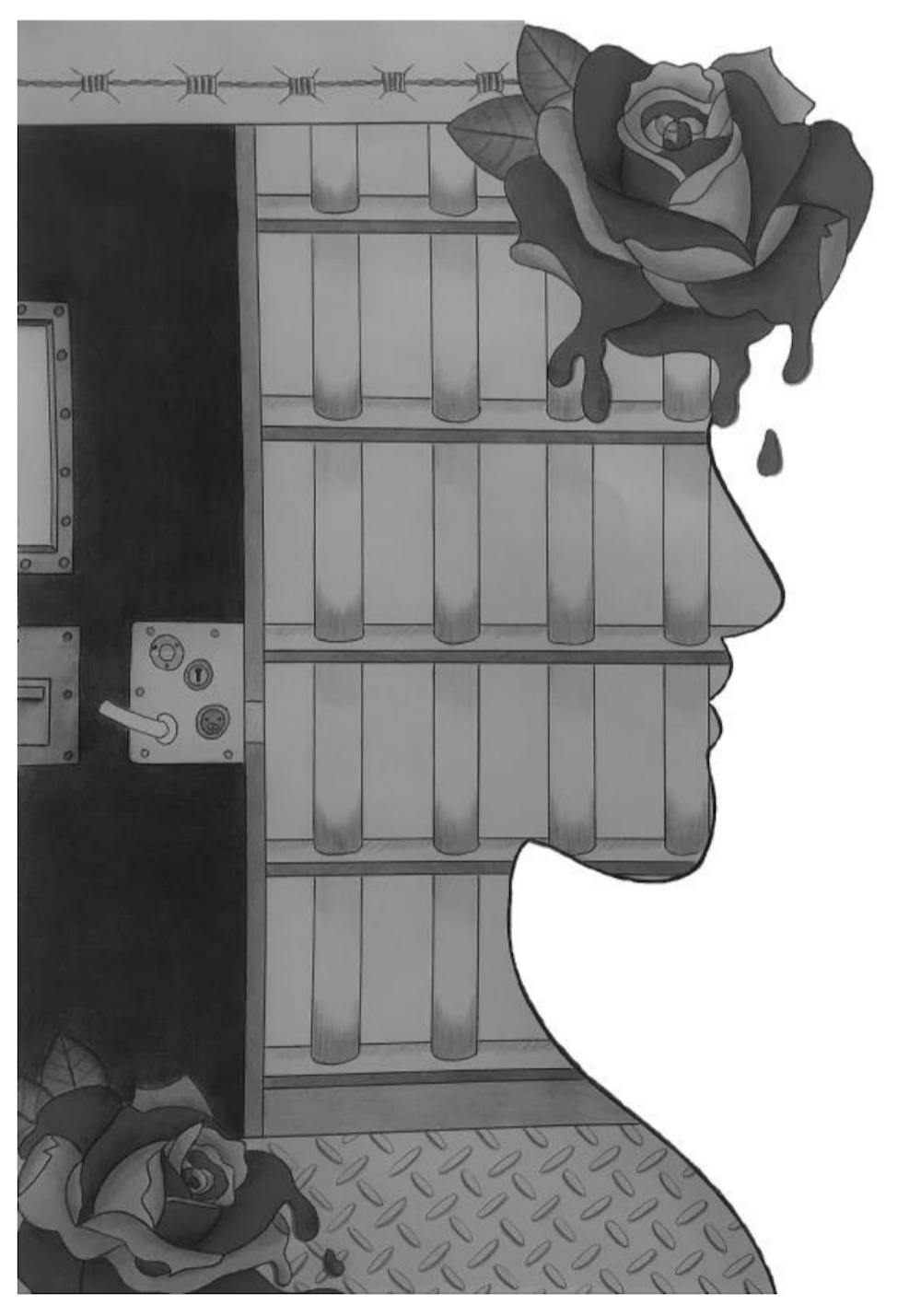
Prisoners also provided cover designs for the project. Life Sentences, Author provided
Firsthand writing from and about prisons isn’t new. Prison literature has a rich tradition, with writers such as Jack London, O. Henry and Oscar Wilde writing about their experiences in jail. The nine years Dostoyevsky spent in Siberian imprisonment and exile gave him the focus and depth of understanding to become one of the greats.
Conversely, illiteracy in Australian prisons is prevalent. A recent government report found around one in three Australian prisoners had only completed Year 9 (or under) at secondary school. One aim of Life Sentences was to provide encouraging feedback for prisoners of varying literacy levels. Although not all of the writing submitted was grammatically perfect, feedback focused on what the prisoners did well in their writing. This was seen as a first step in getting prisoners to enjoy writing and begin the adventure of literacy.
Stories of pain and humour
What Life Sentences contributors wrote about was telling. Most entries directly related to what American criminologist Greshem Sykes called the “pains of imprisonment” in 1958. This wasn’t surprising, and it is hoped writing about such pains was healing for the writers. What was more surprising was the number of entries not directly about imprisonment.
Of 77 contributors over three years, 26 expressed pain, fear and depression from imprisonment (even suicidal thoughts), and often how much they missed their children or loved ones. The heartbreaking lines from a 26-year-old woman’s poem called Little Treasure illustrate this:
But I will never forget
His sweet little smile
My darling little boy
Is now their child.
Although male and female prisoners both expressed tender feelings towards their lost partners, the male writers would at times also express sexual longing for their loved ones or for imagined partners. In Prisoner’s Lament, a 61-year-old male wrote:
I can but lament the way my life went,
Before I ended up here,
Instead of a gun and a greed-driven bent,
I’d be armed with a babe and a beer.
Eight of the poems – both fictional and autobiographical pieces – describe prison life using humour. In Lean Cuisine, a man, 45, wrote of the food, gloryless food he got over the course of a week:
Friday’s no surprise with some sort of sloppy pasta
Nothing is as bad as that tomato disaster.
Saturday is early lockup: chicken wings and rice
Some blokes sprint for seconds, yelling ‘This shit’s so fucking nice!‘
Although some contributors wrote about their abusive childhoods, others wrote with nostalgia about their upbringings. A 51-year-old man’s poem, Edge of the World, tells of spending a day on a jetty with his father and siblings:
Like well-practised commandos
we inched along the side rail
dodging gut stains
jagged notches and salty scales.
One prisoner wrote a nostalgic poem about his childhood. Shutterstock
Eight entries philosophised about life, and two honoured religious deities. Two contributors wrote about their lives, with the goal of inspiring others to stay out of jail and lead happier, more productive lives.
Five entries pondered the personal meanings of art or writing. Other themes explored drugs and alcohol, futuristic societies, rock band membership, friendship, political statements (Fuck the System), dreams and the supernatural (The Love of a Lycan was a song about a werewolf). Three entries were hip hop raps.
Being recognised
The Western Australian literary journal Westerly included several of the 2017 entries in a special edition about South Australian writing.
Hidden talents emerged. A 22-year-old male rapper demonstrated advanced verbal skills in his Laggin Rap:
I want my chance to climb but I’m firmly underground
proud to get his lips clappin louder than a thunder cloud.
Man, Hip Hop’s beautiful — totally therapeutical —
better health benefits than pharmaceuticals.
Another contributor submitted two novels in 2017 and two more in the following competitions. Although already an accomplished writer, he incorporated the feedback he received in the first year. His manuscript was an exciting adventure set in 18th century France. The novel begins:
The battlefields were torn by heavy hooves and ran red with blood. Pieces of meat that used to be men lay tossed about and were scattered in windrows. Mud made it difficult to distinguish between uniforms, yet they found uniformity in a death that made a mockery of it all. It was not yet lunchtime.
The same author printed, bound and illustrated his own novels. He and other contributors also revealed a pattern by the third edition of Life Sentences: a growing awareness of their new identities as writers.
Life Sentences is giving prisoners a chance to write expressively. Shutterstock
What Prisoners Need
Australian prison libraries are often inadequate for supporting prisoners who seek to improve their literacy skills.
Knowing what prisoners like to write about could inform decisions about the types of books to stock in prisons to encourage reading and writing. Prisoners who wish to write motivational books could be exposed to notable authors in this genre, such as Tony Robbins and Dale Carnegie.
To stay out of prison, ex-prisoners need to achieve what criminologists call “secondary desistance”, meaning both the prisoner and society see the prisoner as changed and occupying a law-abiding role in society. Writing might be one way to achieve this and open up new career paths. Writing may also allow prisoners and “civilians” to connect. As one Life Sentences writer put it:
Without seeing their individual faces, I recognise that I am part of the greater consciousness that makes up the brotherhood of writers across the world.











 At the BookShelf
You must be logged in to post a comment.