
The link below is to an article that looks at 10 of the most famous bookshops in the world.
For more visit:
https://lithub.com/the-10-most-famous-bookstores-in-the-world/

The link below is to an article that looks at 10 of the most famous bookshops in the world.
For more visit:
https://lithub.com/the-10-most-famous-bookstores-in-the-world/
The link below is to an article reporting on the possible end of Liquavista by Amazon.
For more visit:
https://the-digital-reader.com/2018/03/15/is-amazon-shutting-down-liquavista/

Bronwen Thomas, Bournemouth University
In the days before social media – and, presumably, media training – Gerald Ratner’s description of some of the products sold in his chain of jewellers as “total crap” became a byword for the corporate gaffe. Recently the chief executive of publisher Hachette Livre, Arnaud Nourry, seems to have suffered his own “Ratner moment” when he described ebooks in an interview with an Indian news site as a “stupid product”.
The interview, which was intended to address the future of digital publishing and specific issues facing the Indian publishing market, was widely misquoted and Nourry’s comments taken out of context. But there is no denying the fact that the publisher criticises his own industry (“We’re not doing very well”) and attacks ebooks for lacking creativity, not enhancing the reading experience in any way and not offering readers a “real” digital experience.
Some commenters on social media welcomed Nourry’s comments for their honesty. They highlight his seeming support for the idea that publishers should be championing writers and artists working to exploit the creative potential of digital formats to provide readers with experiences that may be challenging and disruptive, but also exhilarating and boundary pushing.
//platform.twitter.com/widgets.js
But many of the 1,000-plus commenters reacting to coverage of the story on The Guardian’s website spoke out against “fiddling for the sake of it” – claiming they were not interested in enhanced features or “gamified dancing baloney” borrowed from other media. They also listed the many practical enhancements that ebooks and ereaders do offer. The obvious one is the ability to instantly download books in remote locations where there are no bricks and mortar bookstores. But there are other less obvious enhancements, including being able to instantly access dictionary and encyclopedia entries (at least if you have wifi access) and the option to have the book read to you if you have visual impairments.
Elsewhere, Australian researcher Tully Barnett has shown how users of Kindle ereaders adapt features such as Highlights and Public Notes for social networking, demonstrating that even if ebooks are not that intrinsically innovative or creative, that doesn’t necessarily mean that they can’t be made so by imaginative users.
Nourry clearly isn’t averse to the provocative soundbite – in the same interview he went on to say: “I’m not a good swallower” when asked about mergers and conglomeration in the publishing industry. On the other hand, he also seems very aware of the special place of books and reading in “culture, education, democracy” – so his use of the word “stupid” in this context is particularly inflammatory and insensitive.
My research on digital reading has taught me that debating books vs ereaders is always likely to arouse strong passions and emotions. Merely mentioning the word Kindle has led in some instances to my being shouted at – and readers of “dead tree” books are rightly protective and passionate about the sensory and aesthetic qualities of physical books that the digital version possibly can’t compete with.
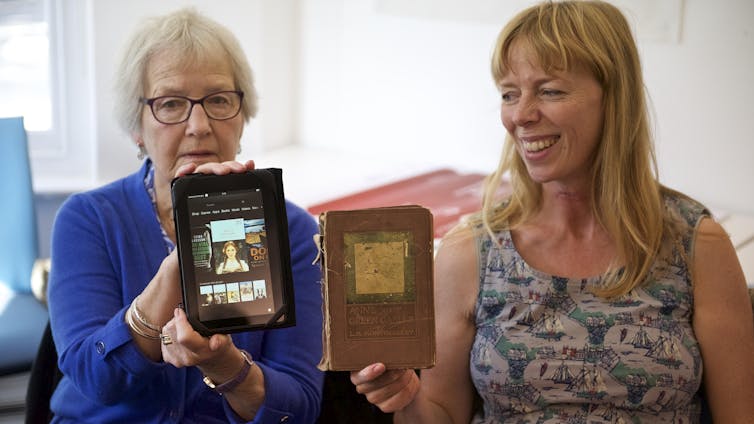
But, equally, my research has shown that enhancements in terms of accessibility and mobility offer a lifeline to readers who might not be able to indulge their passion for reading without the digital.
In my latest project, academics from Bournemouth and Brighton universities, in collaboration with Digitales (a participatory media company), worked with readers to produce digital stories based on their reading lives and histories. A recurring theme, especially among older participants, was the scarcity of books in their homes and the fact that literacy and education couldn’t be taken for granted. Our stories also demonstrated how intimately reading is connected with self-worth and helps transform lives disrupted by physical and mental health issues – making comments about any reading as “stupid” particularly damaging and offensive.
I would like to know if Nourry would still call ebooks stupid products after watching Mary Bish’s story: My Life in Books from our project. A lifelong reader who grew up in a home in industrial South Wales with few books, Mary calls her iPad her “best friend” and reflects how before the digital age her reading life would have been cut short by macular degeneration.
 As well as demonstrating that fairly basic digital tools can be used to create powerful stories, our project showed that the digital also makes us appreciate anew those features of the physical book we may take for granted, the touch, smell and feel of paper and the special place that a book handed down from generation to generation has in the context of family life.
Bronwen Thomas, Professor of English and New Media, Bournemouth University
This article was originally published on The Conversation. Read the original article.
There has been a recent controversy surrounding remarks by Arnaud Nourry, chief executive of Hachette Livre, concerning ‘stupid ebooks.’ The links below are first to an article reporting on the remarks and the second link is a response to them. I think the response is brilliant – though more could be said.
For more visit:
– https://www.theguardian.com/books/2018/feb/20/ebooks-are-stupid-hachette-livre-arnaud-nourry
– https://www.theguardian.com/books/2018/feb/21/ebooks-are-not-stupid-theyre-a-revolution-erin-kelly
The link below is to an article that responds to Hachette’s CEO and his ebooks are stupid remarks.
For more visit:
https://the-digital-reader.com/2018/02/19/ebooks-stupid-product-blinkered-ramblings/
The link below is to an article that reports on comments from the Hachette CEO, in which he basically says ebooks are stupid.
For more visit:
https://goodereader.com/blog/e-book-news/hachette-ceo-proclaims-ebooks-are-a-stupid-product
The link below is to an article that looks at Amazon and Audible on there strategy for audiobooks into the future.
For more visit:
http://observer.com/2018/02/amazon-audible-audiobooks-changes-book-publishing/
The link below is to an article that takes a look at ‘Browsery,’ a new social network for book discovery by Barnes and Noble.
For more visit:
https://goodereader.com/blog/spotlight-on-android/barnes-and-noble-releases-browsery-a-book-discovery-social-network
The link below is to an article reporting on moves by Apple to revisit and update the iBooks reading experience to better compete with Amazon.
For more visit:
https://goodereader.com/blog/e-book-news/apple-is-revising-ibooks-app-to-better-compete-against-amazon
Jeanne-Marie Jackson, Johns Hopkins University
African literature is the object of immense international interest across both academic and popular registers. Far from the field’s earlier, post-colonial association with marginality, a handful of star “Afropolitan” names are at the forefront of global trade publishing.
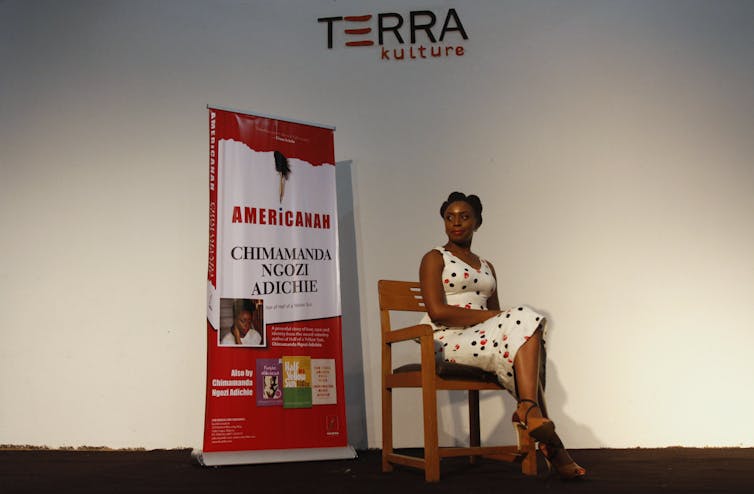
Books like Chimamanda Adichie’s “Americanah” and “Half of a Yellow Sun”, Teju Cole’s “Open City”, Taiye Selasi’s “Ghana Must Go” and Yaa Gyasi’s “Homegoing” have confounded neat divisions between Western and African literary traditions. The Cameroonian novelist Imbolo Mbue captured a million-dollar contract for her first book, “Behold the Dreamers”. That’s even before it joined the Oprah’s Book Club pantheon this year.
Such commercial prominence, though, has attracted considerable and unsurprising push back from Western and Africa-based critics alike. Far from advancing narratives with deep roots in local African realities, such critics fear, many of Africa’s most “successful” writers hawk a superficial, overly diasporic, or even Western-focused vision of the continent.
The most visible of these critiques has been directed at the Zimbabwean writer NoViolet Bulawayo’s “We Need New Names” (2013). The Nigerian novelist Helon Habila worried in a review in the London Guardian that it was “poverty-porn”. The popular Nigerian critic Ikhide Ikheloa (“Pa Ikhide”) frequently makes a similar point. Fellow Nigerian writer Adaobi Nwaubani critiqued the West’s hold on Africa’s book industry in a much-circulated New York Times piece called “African Books for Western Eyes”.
Such debates about African writing could, and likely will, go on forever. Questions about Africa’s place in the current global literary marketplace broaden some of the most urgent queries of the postcolonial era. Who gets to document African realities? Who are the “gatekeepers” of African publishing traditions?
It goes on: To what sort of audience does African writing cater? What is the role – and what should it be, if any – of Western institutions in brokering cultural prestige?
All these issues merit concern.
Too often, though, African writing ends up volleyed between two default poles of “corporate global” and “activist local”. Some onlookers, as in a recent essay by the Canadian scholar Sarah Brouillette, go as far as to name the biases of even Africa-based print outlets. Kenya’s Kwani Trust is exposed as “Western-facing” due to a web of donor relations. “West” here is code for neoliberal. “Western-facing” is for complicity with a market that skews toward British and American interests.
Faced with a “world system” argument like Brouillette’s, African literature would seem trapped between a rock and a hard place.
But, in fact, this tells only a small part of the story of how African writing now makes its way through the world. It is incomplete to the point of being outdated, given the boom over the past five years in new, globally conscious small US literary presses collaborating with African writers.
A “West subsuming Africa” brand of critique works fine for scholars with no real skin in the game of literary publishing. It also denies real agency to a lot of African writers and other literary professionals. On the ground the literary field is far more forward-thinking and diverse.
There is an entire new body of African writing that escapes this closed circuit of damning truisms. A wave of new or recently galvanised independent literary presses in the US and the UK are working in tandem with some of Africa’s most generative outlets. Together they are publishing and promoting work by young and adventurous African writers.
Books published originally by presses like Umuzi (South Africa), amaBooks (Zimbabwe) and Kwani (Kenya) find second lives with international publishers working to defy the constraints of profitability. They’re mostly labours of love with skeleton staffs that speak to a transcontinental commitment to innovative African writing.
Here are a few key examples of African texts published by independent American outlets – “independent” here refers to presses beyond the “Big Five” US trade publishers (Hachette Book Group, HarperCollins, Macmillan, Penguin Random House and Simon and Schuster.
These include Jennifer Nansubuga Makumbi’s Ugandan epic “Kintu” which was originally launched by Kwani. It was the first Anglophone novel put out by the brand-new Transit Books based in Oakland, California. The press seeks maximum visibility for translated fiction alongside texts originally written in English. They advocate for more ethical legal and financial dealings with translators, as well as international writers.
A number of similarly tiny, ambitious ventures have published some of the most acclaimed recent African writing in translation. Deep Vellum Publishing was behind the English translation of Fiston Mwanza Mujila’s Etisalat Prize-winning “Tram 83”.
Also dedicated exclusively to works in translation, LA-based Phoneme Media in 2016 published the first ever Burundian novel in English, Roland Rugero’s deeply contemplative “Baho!”. Phoneme’s tagline, fittingly, is “curious books for curious people”.
In a similar vein, Brooklyn’s Restless Books was founded to combat “parochial, inward-looking, and homogenised trends in American publishing”. Among their forthcoming titles, translated from the French is Naivo’s “Beyond the Rice Fields”. It’s the first novel from Madagascar to see its way to English.
Veteran nonprofit press Archipelago Books is also in Brooklyn. In 2015, it published the translation from the Portuguese of Angolan writer Jose Eduardo Agualusa’s “A General Theory of Oblivion”.
Every one of these throws a wrench in a clear, cynical sense of what kind of novel Western presses prize. That is not to mention the many African writers, publishers, and editors working in concert to promote these same texts.
It applies to the Anglosphere too. Books that offer a decidedly more locally textured experience than those of the “Afropolitan” rock stars have made their way abroad through small, focused channels.
These works might include Tendai Huchu’s “The Maestro, the Magistrate, and the Mathematician” (published originally by amaBooks, and in the US by Ohio University Press); Imraan Coovadia’s “Tales of the Metric System” (from Umuzi, and again by Ohio University Press); and Masande Ntshanga’s “The Reactive” (also Umuzi; in the US by family-run Two Dollar Radio.
Clearly, this collection just scratches the surface. But what these works have in common is an investment in stylistic and structural experimentation that confounds rather than caters to an international taste for “digestible” fiction, or to mostly Western points of cultural and institutional reference.
This counter-current of transnational African literary life complicates the equation of culture, geopolitics and economics in more useful ways than stale materialist critiques.
As such titles and presses continue to gain acclaim and recognition by an international readership that is aware of and hostile to shallow representations of Africa – and who crave engagement with challenging fiction, regardless of its origin – critics will need to rethink some of their orthodoxies.
 There is more to both African literature and Western publishing than meets an eye too practised in its suspicion. If literature is doomed only to echo the failings of globalisation, then why bother? On the contrary, a new generation of writers and publishers deserve our awareness of the “global literary marketplace” as a meaningfully multidimensional space.
Jeanne-Marie Jackson, Assistant Professor of World Anglophone Literature, Johns Hopkins University
This article was originally published on The Conversation. Read the original article.
 At the BookShelf
You must be logged in to post a comment.