Children from disadvantaged backgrounds, very remote areas, and Indigenous Australians are up to two times more likely to start school developmentally vulnerable than the national average.
In 2018, 21.7% of Australian five year olds (70,308 children) were not developmentally ready when they started school. And in Year 7, nearly 25% of students (72,419) didn’t have the required numeracy and literacy skills.
The statement aims for a quality education system for all young people, that supports them to be creative and confident individuals, successful learners and active and informed members of the community.
But our report finds students’ location and family circumstances continue to play a strong role in determining outcomes from school entry to adulthood.
While this crisis in educational inequality isn’t new, it’s likely to get a lot worse, as COVID-19 increases levels of student vulnerability and remote learning widens gaps in achievement.
Disadvantaged children missing out as school progresses
The Alice Springs declaration sets two ambitious goals:
the Australian education system promotes excellence and equity. In part, this is about ensuring all young Australians have access to high-quality education, inclusive and free from any form of discrimination
all young Australians become confident and creative individuals, successful lifelong learners, and active and informed members of the community. This includes all children having a sense of self-worth, self-awareness and personal identity that enables them to manage their emotional, mental, cultural, spiritual and physical well-being.
The declaration was signed last year, and builds on previous ones signed in Hobart, Adelaide and Melbourne over three decades. It recognises the role education plays in preparing young people to contribute meaningfully to social, economic and cultural life.
Our report uses the best available data to paint a comprehensive picture of Australia’s performance against the above important goals.
It shows the gap in academic learning as well as other key areas, such as creativity and confidence, is clear from school entry and usually grows over time.
Analysis in our report tracked students’ learning from when they started school in 2009 to when they were in Year 5 in 2014. It showed that in literacy and numeracy for instance, the gap between the proportion of children from the most disadvantaged and advantaged families meeting relevant standards grew from 20.6 percentage points at school entry to 27.2 percentage points in Year 5.
The report also shows too many students in the senior years of school are not developing key skills. In 2018, 27.8% of 15 year olds (88,314) didn’t meet or exceed the international benchmark standards in maths, reading and science.
While some students receive the support they need to catch up to their peers, many don’t.
A lot of young people are also not developing the qualities needed to confidently adapt to challenges in adulthood and contribute to their communities.
The report shows that in 2017, 28.1% (110,410) of 23 year olds were not confident in themselves or the future and 29.9% were not adaptable to change and open to new ideas. It shows 38.1% (145,056) of 23 year olds were not actively engaged in their community and 33.2% were not keeping informed about current affairs.
Additionally, many young Australians are not being well prepared and supported to find and secure meaningful employment. Overall, according to the 2016 census, nearly 30% of 24 year olds (112,695) weren’t in full-time education, training or work.
Around half of all 24 year old Indigenous Australians, and one in three of the most disadvantaged Australians, were not engaged in any work or education, compared to 15% nationally.
This failure to address educational inequality reproduces and amplifies existing poverty across generations. It saps productivity, undermines social cohesion and costs governments and communities billions of dollars.
There are no quick ways to fix educational inequality, but there are several key improvements that will make a difference.
Closing gaps in participation and lifting the quality of early childhood education services — particularly in disadvantaged communities where services tend to be lower quality — should be one of our highest priorities. Early childhood education is critical to giving every child the best possible start. Evidence shows preschool raises children’s chances of being developmentally ready for school in key areas by around 12 percentage points.
Despite efforts through the Gonski reforms, there is still significant room to improve how Australia targets funding and support to schools with the highest level of need. We need to address the imbalance in resources between advantaged and disadvantaged Australian schools, which is the worst in the OECD.
This is not just about money, but building strong leadership and teaching capability in every school. High quality teaching is proven to be critical to improving student outcomes. We also need to support high quality use of data and assessment to tailor teaching to students’ needs, provide feedback and measure progress.
Government projections show 90% of employment growth in the next four years will require education beyond school. This means we must prepare young people for an economy requiring higher levels of skill than ever. We need to rethink existing models of tertiary education to make it accessible to all students.
Addressing educational inequality is as much about what happens outside the classroom as inside. Nurturing every child’s development and well-being is best achieved through a partnership between schools, families, communities and other support services.
Australia cannot afford education systems that fail so many students. That’s not just in economic terms – because the cost of lost opportunity is even greater down the track – but also in human terms. We know the social and health costs of disengaging in education are significant.
The link below is to an article reporting on the winner of the 2020 Blake Poetry Prize, Judith Nangala Crispin, for the poem ‘On Finding Charlotte in the Anthropological Record.’
A highlight for Australian children’s literature is the announcements of the Children’s Book Council of Australia (CBCA) Book of the Year award winners. This year’s winners will be announced on Friday October 16 — right before the start of CBCA’s Book Week on October 19.
Making the shortlist brings great exposure for the books and their creators. The shortlisted books are put on special display in public school libraries and supermarket shelves. They are even made into teaching resources, suggesting an exploration of the book’s themes, for instance.
Crucially, award lists contribute to the “canon” of literary works that become widely read. This canon is distributed through libraries, schools and homes. Sometimes, benevolent relatives give them as gifts.
We investigated the diversity — including ethnicity, gender and sexuality — of the 118 shortlisted books in the early childhood category of Book of the Year between 2001 and 2020. We also examined diversity among the 103 authors and illustrators who have made the shortlist over the past 20 years.
Our yet unpublished study found most (88%) human main characters in the shortlisted books were white; none of the main characters were Asian, Black or Middle Eastern.
Why diversity matters
The CBCA was formed in 1945, as a national not-for-profit organisation promoting children’s literary experiences and supporting Australian writers and illustrators. The first awards began in 1946.
There were originally three categories for Book of the Year: older readers, younger readers and picture book.
In 2001, “early childhood” was added as a category. This was for picture books for children up to six years old.
Picture books are significant for not only developing early literacy skills, but also for the messages and values they convey about society. They help children learn about their world.
The diversity children see represented in that world affects their sense of belonging and inclusion. At this age, cultural values and bias settle in and become the foundation for how we develop. These values and biases have a profound influence on our successes and struggles in our adult lives.
A positive for gender diversity, but not ethnicity
We used visual content analysis to examine ethnic diversity, we well as gender, disability, sexuality and linguistic variation in the 118 early childhood category shortlisted books — between 2001 and 2020.
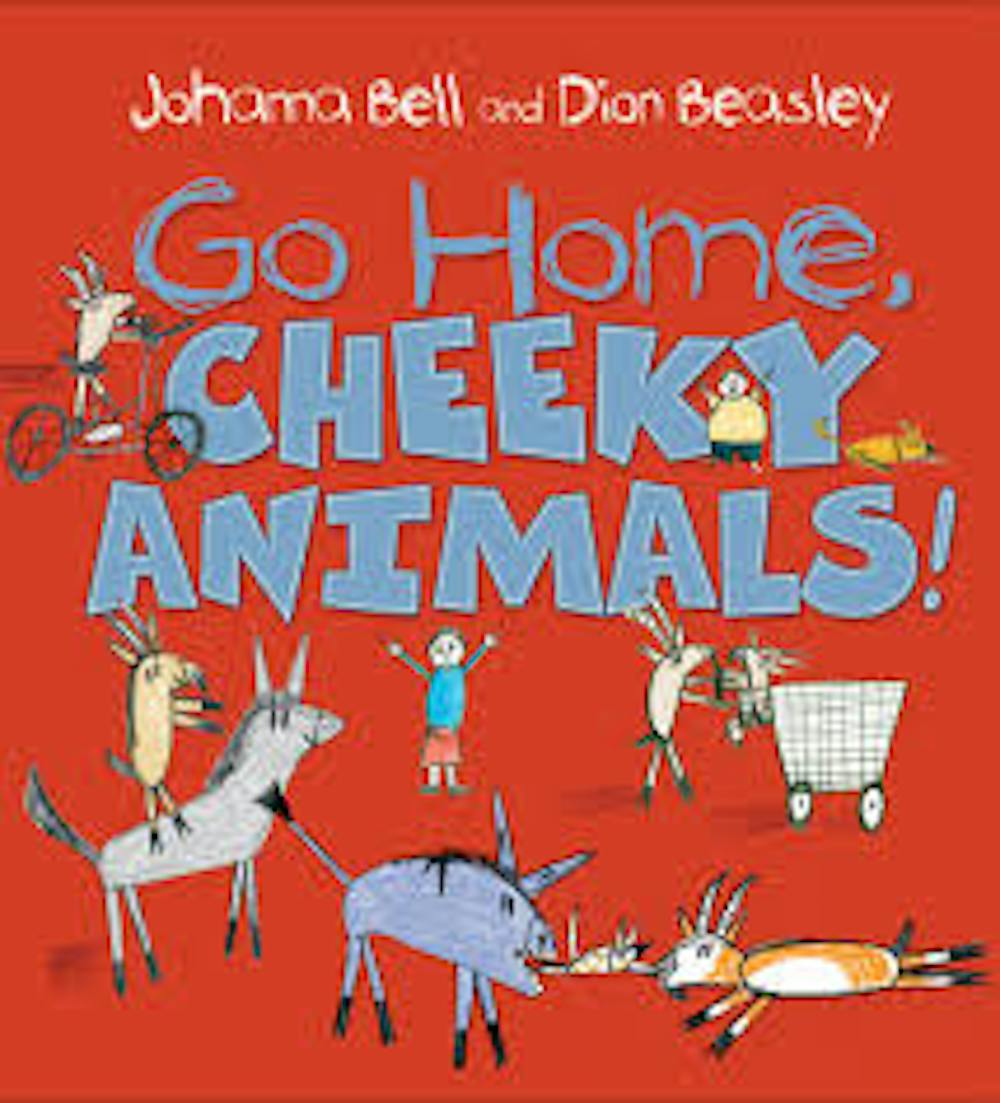
We also examined diversity among the 103 authors and illustrators who have made the shortlist over the past 20 years. Only one person — Alywarr illustrator Dion Beasley, from the Northern Territory, and winner in 2017 for Go Home Cheeky Animals — identifies as Indigenous.
Female authors and illustrators, however, were more represented (66%) than male (34%).
Looking at the picture books, we first identified four major types of characters: human (52.5%), animal (41.5%), object (4.4%) and imaginary (1.4%).
We then distinguished between main characters and those in supporting roles that make up the story world in which the main characters act.
One of the most encouraging findings was the gender parity among main characters. We identified 52 solo human main characters across all 118 books. Fifty-one of these are children, with 25 boy and 24 girl main characters (two main characters were not identified by gender).
But in terms of ethnicity, the human main characters are overwhelmingly white (88%). There are just two Indigenous main characters and one who is multiracial. There have been no Asian, Black or Middle Eastern main characters.
Looking at the wider story world, supporting characters are still overwhelmingly white. But this world does marginally include characters of Asian, Black and Middle Eastern heritage. Overall, human characters appear in 85 (72%) of the 118 books.
White characters appear in 74 of these books, and only nine books have no white characters. Non-white characters appear in a total of 18 books (21%).
Our results for ethnic diversity don’t correlate well with the latest Australian census data (from 2016). The cultural heritage of Australia’s population is described as: 76.8% white, 10% East and Southeast Asian, 4.6% South Asian, 3.1% West Asian and Arabic, 2.8% Aboriginal and Torres Strait Islander, 1.5% Maori and Pacific Islander, 0.7% African, 0.6% Latin American.
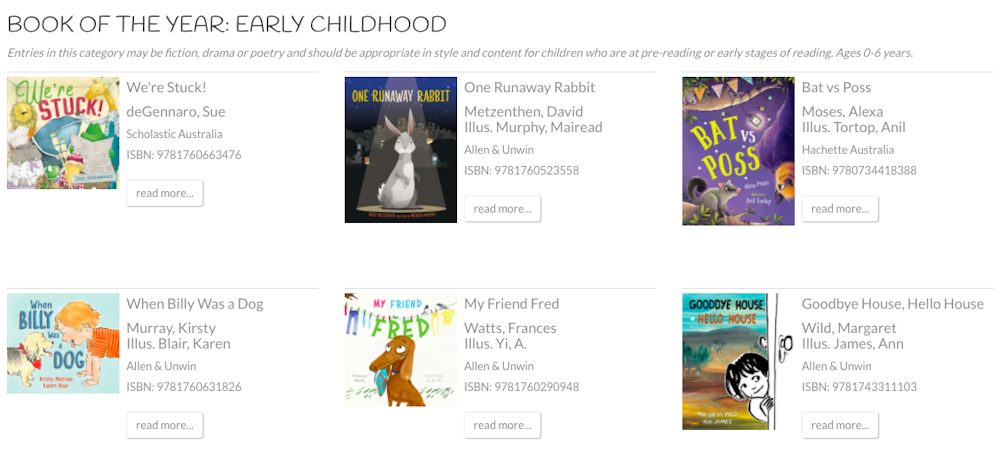
The 2020 Early Childhood Book of the Year shortlist. CBCA/Screenshot
The CBCA early childhood shortlist minimally represents other forms of diversity. We see only two main characters living with a disability and no characters who are sexually and gender diverse.
Other types of diversity
Linguistic variation is also minimal, in only four books, which does not reflect the linguistic diversity of the wider Australian population.
In response to our queries regarding their judging criteria, the CBCA said:
we do not select books for entry into our awards. It is the publishers and creators who select the books for entry. Our main criterion is literary merit, we do not actively exclude diversity, themes or genre.
Only two of the six 2020 shortlisted books in the early childhood category have human main characters. And these are both white.
The age of zero to six years is a crucial stage of development. It is important for young readers to see people and surroundings that are like their own to cultivate a sense of belonging. It is equally important to see a different world they are not familiar with.
If award-winning books sit at the top of reading lists, these books also need to embrace and reflect the full and rich diversity that makes up our country.
The link below is to an article reporting on the winner of the 2020 National Biography Award, ‘Tiberius with a Telephone: The life and stories of William McMahon,’ by Patrick Mullins.





 At the BookShelf
You must be logged in to post a comment.