Unknown's avatar

Friday essay: the remarkable, prize-winning rise of our small publishers


File 20180503 138586 fsnmax.jpeg?ixlib=rb 1.1
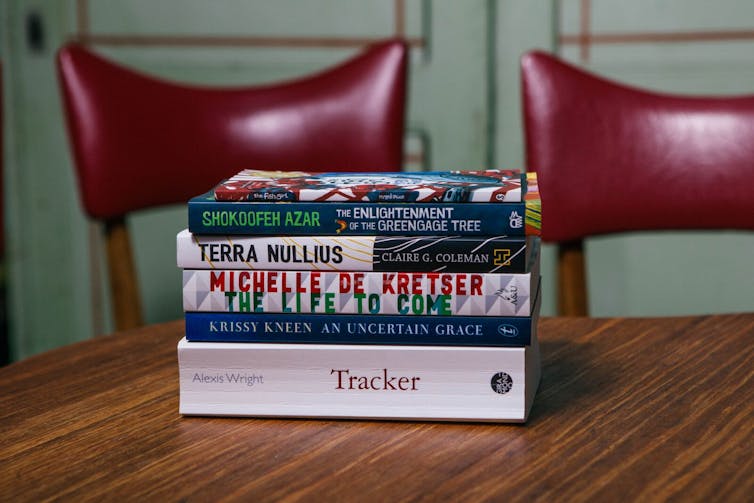
Four of the six shortlisted books for the 2018 Stella Prize were from smaller presses, as was the winner, Alexis Wright’s Tracker.
Stella Prize

Emmett Stinson, Deakin University

It has been a big 12 months for Australian small publishers, who have swept what are arguably the three most important national literary awards. Sydney press Giramondo published Alexis Wright’s biography Tracker, winner of the 2018 Stella Prize; Melbourne’s Black Inc. published Ryan O’Neill’s Their Brilliant Careers, which won the 2017 Prime Minister’s Literary Award for Fiction; and Josephine Wilson’s Extinctions (University of Western Australia Publishing) won the 2017 Miles Franklin Literary Award.
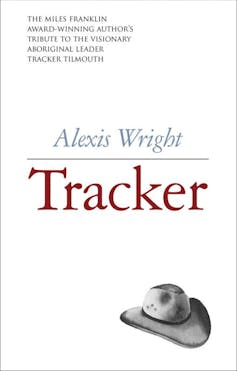
Alexis Wright’s Tracker is published by Giramondo.
Giramondo

Another work from a small publisher, A. S. Patric’s Black Rock White City (Transit Lounge) also won the Miles Franklin in 2016. Small publishers have dominated these awards’ shortlists as well, comprising 80% of the shortlisted titles for the last Miles Franklin and Prime Minister’s awards and 66% of the shortlisted titles for the last Stella.

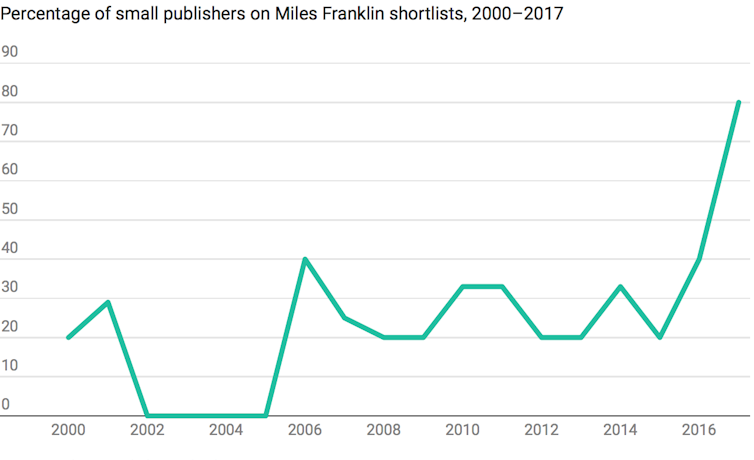
This is a significant reversal: these awards have historically been dominated by large publishers. Since 2000, for example, only 21% of shortlisted titles for the Miles Franklin have been published by small publishers.

There are dozens of important and respected Australian literary prizes, which help to solidify authors’ reputations and subsidise their writing (this is not an exaggeration; as Bernard Lahire has demonstrated through sociological surveys in France even most “successful” authors draw the majority of their income through other, and often unrelated, work).
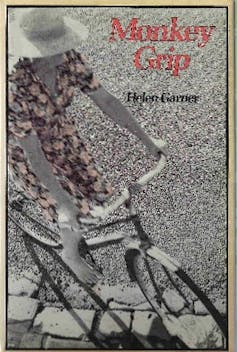
The first edition of Monkey Grip, originally published by McPhee-Gribble in 1977.
Wikipedia

But these three awards — the Stella, the Miles Franklin, and the Prime Minister’s — are particularly important because they have broader recognition among the media and the reading public. These three prizes not only increase authors’ and publishers’ status within the literary field but also tend to increase book sales. This is particularly important for smaller publishers, where one successful book can cross-subsidise the publication of many others.

Small publishers have a long history in Australia, and have played a culturally important role. Many of Australia’s most famous contemporary writers started out at small publishers. Peter Carey’s early books were all published by University of Queensland Press. Helen Garner’s Monkey Grip (1977) was published by the influential small publisher McPhee-Gribble, which launched the careers of many other notable writers before being wholly acquired by Penguin in 1989. While large multinationals dominated much of the market for Australian literary fiction in the 1980s and 1990s, small publishers started to become particularly important in Australian literature again in the 2000s.

Retreat of the large publishers

There are many reasons why larger publishers have moved away from literary publishing, as Mark Davis discussed in his 2006 essay The Decline of the Literary Paradigm in Australian Publishing. As Davis argued, the big drivers of this change were increased competition and the rise of data-based decision making among publishers. With the appearance of book data provider Nielsen BookScan in Australia, publishers suddenly had good and fast data on what kinds of titles were selling and which weren’t.
Larger publishers are increasingly chasing bestselling titles, rather than investing in literary works.

Moreover, the rise of literary blockbusters in the 1990s, including series such as Harry Potter and, more recently, Twilight, has had a huge impact on the way publishers do their business. Blockbuster titles are worth an inordinate amount of the market. For example, Fifty Shades of Grey, at one point, sold one million copies in four days; a novel in Australia is usually considered successful if it sells 6,000 copies in total.

Not only do blockbusters sell in greater numbers, but the marginal costs associated with manufacturing books decrease as more are sold. For these reasons, large publishers have increasingly chased bestselling titles, rather than investing in literary works. The latter, although culturally important, rarely become blockbusters, unless they have won a major award or been adapted into a successful film or television series.

The retreat of large publishers from literary publishing is particularly visible in their virtually non-existent investments in low-selling but culturally significant forms, such as short stories or poetry. While large publishers occasionally publish high-profile collections of short stories, like Nam Le’s The Boat (Penguin, 2007) or Maxine Beneba Clarke’s Foreign Soil (Hachette, 2014), they rarely bring out more than one or two such collections per year. Large publishers have basically no investment whatsoever in contemporary poetry publishing. Australian poetry, in particular, is kept in circulation by a handful of small publishers, such as Giramondo, Cordite, UWA Publishing, Five Islands, and Puncher & Wattmann.

Large publishers’ withdrawal from these areas of literary publishing has also left space for smaller ones to flourish. On the one hand, it has meant that a number of well-known Australian writers have decided to publish their later works with smaller publishers. J.M. Coetzee, Helen Garner, and Murray Bail, for instance, publish their books with Text in Melbourne. Gerald Murnane and Brian Castro publish with Sydney-based Giramondo, while Amanda Lohrey has published her last several books with Black Inc.
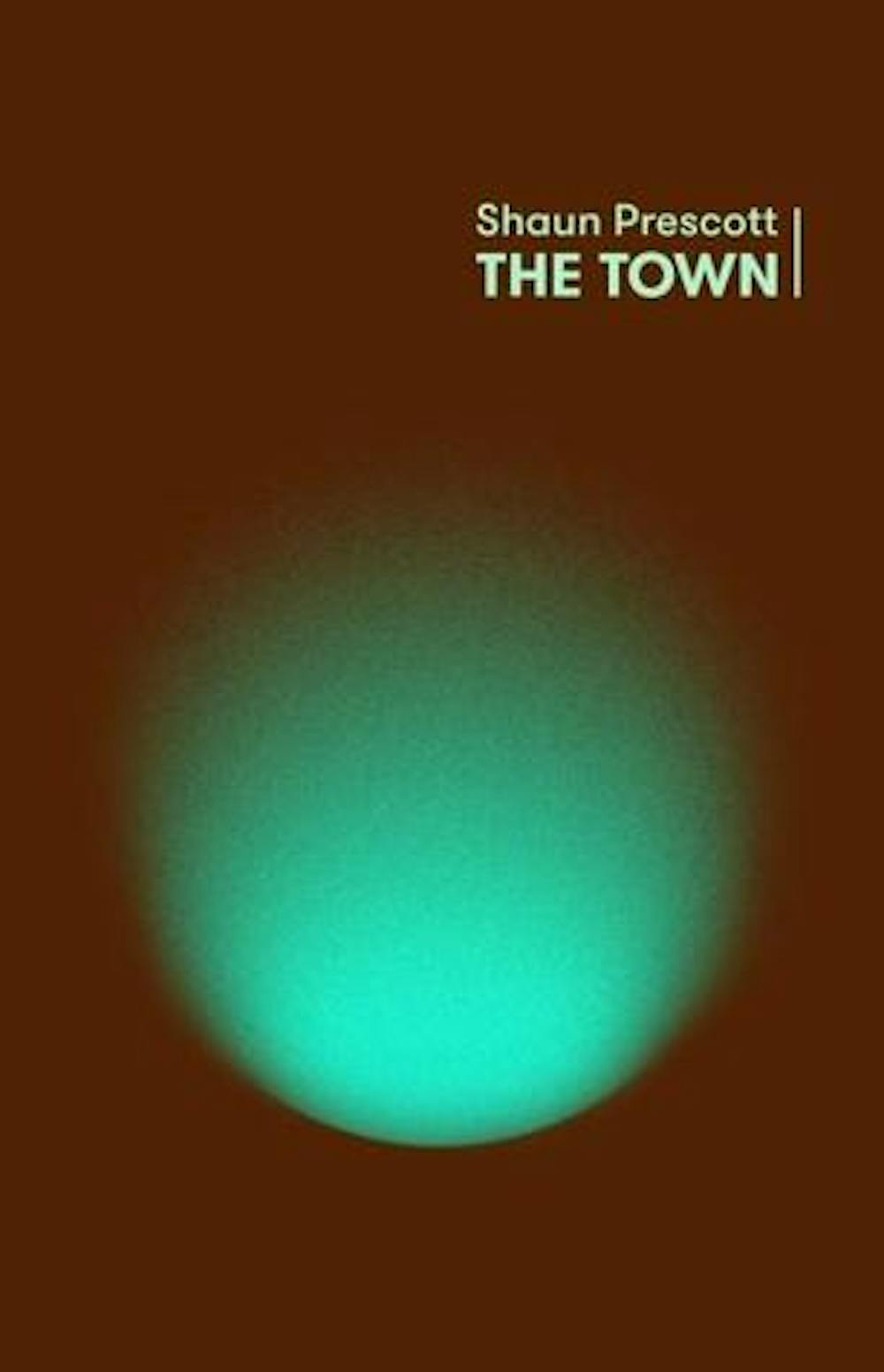
Rights to The Town, published by Brow Books, have been sold to Faber & Faber in Britain and Farrar, Straus & Giroux in the US among other publishers.

On the other hand, small publishers have also been very good at identifying new and unique voices. Steven Amsterdam’s first novel, Things We Didn’t See Coming (2009), was published by the (now-defunct) Melbourne small publisher Sleepers Publishing, and went on to win the (also defunct) Age Book of the Year award. More recently, the Melbourne-based literary journal The Lifted Brow has entered into book publishing, and had great success in selling overseas rights to Shaun Prescott’s The Town (2017). It has just published a new work, Axiomatic, by the lauded author Maria Tumarkin.

Small publishers have become so important within Australia that, as I have argued elsewhere, they now publish the majority of Australian fiction and probably have done so for about a decade. Despite their significance, they have not had particularly great success with major awards like the Miles Franklin and Prime Minister’s until quite recently. But these trends appear to be changing.

Crunching the numbers on major prizes

The chart below shows a strong upward trend for small publishers over the past two years in relation to titles shortlisted for the Miles Franklin. While the historical average since 2000 was only 21% of shortlisted titles coming from small presses, this jumped to 40% in 2016 and 80% in 2017. This is a particularly dramatic spike, and I would be surprised if small presses continued to dominate at this rate, but there are good reasons to believe that the general trend is real.
Indeed, the shortlisting data from the Prime Minister’s Literary Award for Fiction shows a nearly identical trajectory to the Miles Franklin data over the last two years, as the chart below illustrates. Like the Miles Franklin, this award saw a jump in shortlisted small press titles in 2016 (40%) and 2017 (80%). In 2017, in fact, both awards shortlisted the same four small press titles: Josephine Wilson’s Extinctions (UWA Publishing), Ryan O’Neill’s Their Brilliant Careers (Black Inc.), Mark O’Flynn’s The Last Days of Ava Langdon (University of Queensland Press), and Phillip Salom’s Waiting (Puncher & Wattmann).
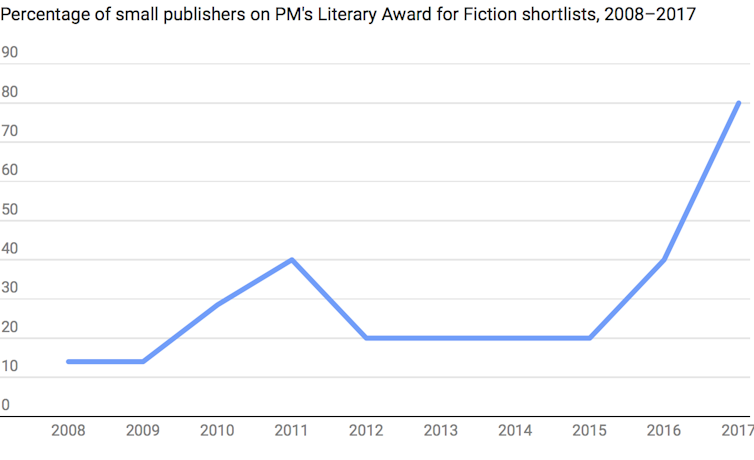
On the one hand, this suggests an enormous shift in the way that the Prime Minister’s award values small publishers; on the other, the unusual — and even bizarre — correlation between the shortlists of the Miles Franklin and the Prime Minister’s awards suggest that this particular instance of small press dominance may be to some degree anomalous. Regardless, the trends are clear, and are also supported by data I have collected on longlisted titles for the latter two awards, which match the trends in the shortlist data.

The Stella Prize longlists and shortlists have also recognised small publishers, as you can see in the chart below. Moreover, despite a lower result for small presses in the Stella’s inaugural year (33% in 2013), at least half of its shortlisted titles have been produced by small publishers in every year since.
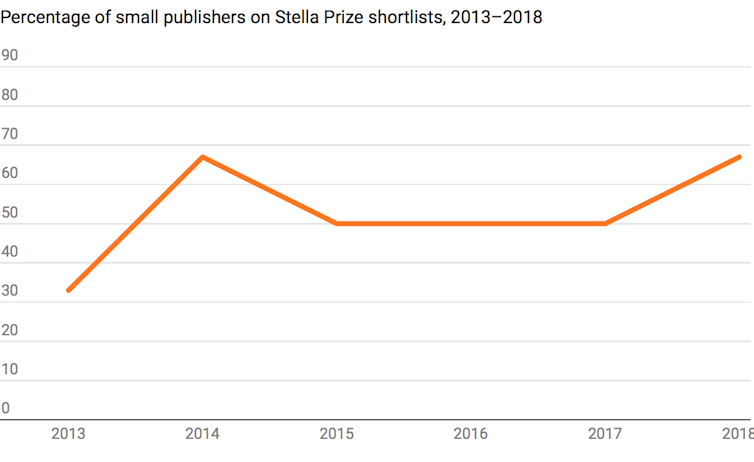
Small publishers comprise a slim majority of Stella Prize shortlisted titles, with 19 of the 36 shortlisted works (53%) coming from them. Similarly, three of the six winning titles have been produced by small publishers (Text, Giramondo, and Affirm Press). In other words, the Stella Prize has recognised small presses at effectively double the rate of both the Miles Franklin and the Prime Minister’s awards. The dominance of small publishers in the Stella is also replicated in the longlists, with 40 of 72 titles (55%) being produced by small publishers.

Small publisher acceptance

There are material reasons why the Stella Prize has probably been more open to small publishers. Co-founder and former executive director Aviva Tuffield is a highly regarded editor, who has worked at small publishers such as Scribe, Affirm, and Black Inc. Current General Manager (and original Prize Manager) Megan Quinlan previously worked at Text Publishing and The Monthly (which has the same ownership as Black Inc.) Many of the Stella Prize judges past and present, such as Tony Birch and Julie Koh, have published their fiction solely through small publishers.

It is also not coincidental that a prize championing women’s writing and gender equity would recognise small publishers. Indeed, these publishers, as Sarah Couper has demonstrated, have a significantly higher proportion of women in executive roles than large publishers do.

I suspect, too, that small publishers are probably more inclusive both in terms of the authors they publish and the kinds of views and perspectives they present. In this sense, the dominance of small publishers’ titles in the Stella is unsurprising given that it is an award that seeks to champion diversity as well as literary quality.

The ConversationThe Stella’s tendency to recognise small publishers has probably influenced the other prizes to do the same. The routine appearance of such works on the Stella lists has normalised the recognition of small press books by prestigious prizes and thus made it more acceptable for other such prizes to do so. While it’s unlikely that small presses will continue to dominate the major prizes at this rate, I nonetheless suspect that they will continue to be taken much more seriously by such awards than they have been in the past.

Emmett Stinson, Lecturer in Writing and Literature, Deakin University

This article was originally published on The Conversation. Read the original article.

Unknown's avatar

Australian National University’s Chifley Library Flood Damage


The link below is to an article reporting on flood damage to the Australian National University’s Chifley Library in Canberra, Australia.

For more visit:
http://www.abc.net.au/news/2018-03-02/anu-staff-begin-urgent-salvage-job-of-books-at-chifley-library/9500414

Unknown's avatar

Australia’s consumer laws still don’t cover e-books and many other digital products


File 20180220 116365 1tkqbl9.jpg?ixlib=rb 1.1
E-books, downloaded music and other digital products aren’t covered by Australian consumer law.
Shutterstock

Benjamin Hayward, Monash University

Australia’s consumer laws aren’t adequately protecting Australians who buy digital products such as e-books and digital music. If a TV doesn’t work, or an iPod or computer is faulty, the law provides a remedy. The same is true for physical books and music media – but not for their online counterparts.

Under Australian law consumers are entitled to receive goods that are of acceptable quality and fit for their purposes, and that correspond with their description, among other legally enforceable consumer guarantees. But these guarantees apply only to “goods” and “services”.

How digital products fit (or don’t fit) into the goods and services categories has been debated for decades, and the law still hasn’t properly accommodated them.

Australia’s consumer laws went through a major update in 2010, but remain out of date. The digital world moves fast, but our consumer laws remain rooted in a system that assumes “goods” and “services” are the only types of trade. These laws still owe much to sale of goods legislation passed in the United Kingdom all the way back in 1893.

What are consumer laws?

The law generally expects that people and companies entering into contracts are able to look after their own interests. Consumer laws exist to provide additional legal protection to consumers, who are usually in an unequal bargaining position compared to the companies they deal with.

A consumer is someone who acquires goods or services that are ordinarily bought for personal, domestic or household use, or for a price of A$40,000 or less.

Consumer purchases include a range of items – TVs, iPods and computers are just some examples. Where a consumer purchases goods, the law requires that those goods comply with particular consumer guarantees, no matter what the terms and conditions of sale say.

If a new “smart TV” won’t connect to wifi, or if an iPod or computer’s battery doesn’t last as long as it should, the consumer guarantees provide a remedy.


Read more:
Australian consumer law is failing beer drinkers


It was during the 1980s and through to the 2000s that initial questions arose over how the law treated software. The question at this time was whether software counted as “goods”. A series of court cases found that software was considered goods only if it was supplied within a tangible object – for example, on a disk (later, on a CD or DVD).

Because of this, when consumers started downloading software over the internet they were left without many protections. If software downloaded directly from the internet didn’t do what it was supposed to do, they might have no effective legal rights at all.

In 2010, with the Competition and Consumer Act, the definition of goods was finally amended to include “computer software”. But this still excludes many common digital products, such as e-books and digital music. These do not constitute “computer software” as the law understands it.


Read more:
So you bought the new iPhone? Here are your rights if it breaks


Recent court proceedings highlight the large gap in the Australian consumer law.

In 2016, the Australian Competition and Consumer Commission brought a Federal Court case against Valve Corporation, alleging it misrepresented consumers’ rights concerning content bought through the Steam video game platform.

Justice Edelman found that Valve Corporation had supplied “goods”, being “computer software”, but also found that “non-executable data was not computer software”, and that such non-executable data could include “music and html images”.

In other words, the computer games were “goods” (attracting the law’s protection) because they were executable programs. This part of the Federal Court’s decision was not challenged in the Full Court of the Federal Court, which dismissed Valve Corp’s appeal in December 2017.

If this definition of computer software is applied in future cases, then there is a legal gap when it comes to other types of digital products. E-books and digital music (among others) require executable files to work, but aren’t themselves executable files, so would not constitute computer software.

If they don’t constitute computer software, they also aren’t goods under the law. And if they aren’t goods, consumers who acquire these digital products don’t obtain the protections and guarantees of Australia’s consumer laws.

The wider consequences of inequality in the law

Beyond this problem for consumers, this legal gap also creates an inequality for retailers. Retailers that deal in physical books and music (whether they are “bricks and mortar” or online) are required to comply with the guarantees and protections under Australian consumer law.

This means that businesses dealing in physical goods incur costs that those that sell only digital equivalents (apart from software) can avoid. Australia is in effect subsidising those who sell only digital products (many of them foreign companies) by not subjecting them to the same legal liabilities.


Read more:
Like it or not, you’re getting the NBN, so what are your rights when buying internet services?


A simple legislative amendment can easily solve this problem. Rather than providing that goods includes “computer software”, a legal provision stipulating that goods include “computer software and other types of digital products” would capture the broader range of products we see in the marketplace today.

We can learn from the United Kingdom, where digital products are given their own dedicated consumer rights regime. The United Kingdom has a series of consumer rights applicable to the supply of goods, the supply of services, and also to the supply of digital content.

The ConversationAustralia doesn’t necessarily need to move this far – yet. But the British legislation could be an interesting model for longer-term consumer law reform in Australia.

Benjamin Hayward, Senior Lecturer, Monash University

This article was originally published on The Conversation. Read the original article.

Unknown's avatar

Why the not-for-profit cultural sector needs tailor-made copyright safe harbours


File 20180205 19952 1xsusrq.jpg?ixlib=rb 1.1
There are many ways the not-for-profit GLAM sector – public galleries, libraries, archives and museums – could be protected from potential copyright damages claims.
from http://www.shutterstock.com, CC BY-ND

Graeme Austin, Victoria University of Wellington and Emily Hudson, King’s College London

A bill before the Australian Parliament will extend immunities from copyright infringement currently enjoyed by internet service providers (ISPs) to cultural institutions, educational institutions, and organisations assisting people with disabilities.

These immunities are known as “safe harbours”. They can be a useful policy tool. They help ensure that exposure to copyright liability doesn’t inhibit socially or economically useful activity such as developing internet infrastructure.

We argue that copyright issues for not-for-profit organisations differ from those affecting ISPs and their subscribers. Rather than expanding existing safe harbours, policy makers should tailor the concept to the needs of the cultural sector.


Read more:
Instagram is changing the way we experience art, and that’s a good thing


How the existing safe harbours work

Safe harbours have been justified as a quid pro quo to encourage investment in Internet infrastructure. ISPs were concerned that they could themselves be liable for their customers’ copyright infringements. Investment in internet technologies might have been inhibited by the risk of potentially enormous damages claims.

Currently, Australian safe harbours apply only to telecommunications providers such as Telstra and Optus. They shelter ISPs against monetary awards for copyright infringement for actions such as transmission and caching, and storage of infringing material uploaded by subscribers. The immunities don’t apply when the ISP is itself responsible for storing infringing material.

Immunity can also be lost when an ISP fails to meet key conditions, such as removing infringing material once the ISP knows about it.

Fresh thinking on safe habours

At first blush the bill makes sense. The institutions mentioned in the Copyright Amendment (Services Providers) Bill 2017 (Cth) do important work. A not-for-profit running a website that allows the uploading of material suitable for people suffering from visual disabilities, for instance, deserves immunity from copyright damages claims if some of that material turns out to be infringing.

However, the Australian bill should also prompt us to revisit the safe harbour concept itself. A safe harbour reflects a policy that certain activities are sufficiently important that they should not be inhibited by the risk of copyright proceedings. Rather than extending existing safe harbours to other institutions, we should look at how such institutions are currently inhibited by exposure to copyright claims, and how the law might be adapted.

There are many ways we can craft copyright immunities for the not-for-profit GLAM sector: public galleries, libraries, archives and museums. GLAM institutions currently enjoy some exemptions from copyright infringement, and there have been calls for a broader fair use or fair dealing defence.

Specific shelter for GLAM sector

Another possibility would be a safe harbour that is tailor-made for the GLAM sector.

The reforms in the Australian bill would apply only where the infringing activity is undertaken by patrons. But unlike ISPs, GLAM institutions need the greatest protection for the things they do themselves. We value museums, for example, for the expert work of their own curators and collection managers, not because they sometimes allow other people to upload material to their websites.

GLAM organisations use digital technologies in innovative ways. They put their collections online, link to the online collections of other institutions, and create vast repositories of metadata about collection items. Some exhibitions are digitally curated, with links to related objects and information, often located on remote sites. While some GLAM organisations allow third parties to post material to their websites, that’s not their core work.

Anyone working in the GLAM sector will tell you how copyright concerns limit their work. Institutions also fear the reputational damage of allegations that they disregard copyright. But so long as GLAM organisations act responsibly, these valuable contributions to cultural life should not be unduly inhibited by risks of copyright liability.

Striking a balance

Most GLAM sector organisations are responsible about copyright. If GLAM institutions use some material without copyright permissions, this is typically of limited commercial significance – quite unlike the commercially valuable material that is transmitted by ISP subscribers every second.

A fit-for-purpose GLAM safe harbour could encourage responsible behaviour while ensuring that the GLAM sector’s work is less impeded by risks of copyright claims. Unlike the ISP scheme, a GLAM safe harbour would not be limited to patrons’ activities. It might be conditioned on good faith efforts to raise copyright awareness among staff, including regular training. In the digital context, it might have a take down requirement.

The ConversationIn summary, the copyright issues for publicly funded not-for-profits doing valuable social work are not the same as those affecting ISPs and their subscribers. Lumping them together in the same safe harbour avoids more nuanced thinking about their relative social value and the different risks each poses for those who rely on copyright protections for their livelihood.


Graeme Austin, Professor of Law, Victoria University of Wellington and Emily Hudson, Senior Lecturer in Law, King’s College London

This article was originally published on The Conversation. Read the original article.

Unknown's avatar

How copyright law is holding back Australian creators


File 20180207 74476 7evtzf.jpg?ixlib=rb 1.1
In a new study, various creators described the process of obtaining copyright permission as ‘incredibly stressful’, ‘terrifying’ and ‘a total legal nightmare’.

Kylie Pappalardo, Queensland University of Technology and Karnika Bansal, Queensland University of Technology

Australian creators struggle to understand copyright law and how to manage it for their own projects. Indeed, a new study has found copyright law can act as a deterrent to creation, rather than an incentive for it.

Interviews with 29 Australian creators, including documentary filmmakers, writers, musicians and visual artists, sought to understand how they reuse existing content to create. It considered issues such as whether permission (“licences”) had been sought to reuse copyrighted content; the amount of time and cost involved in obtaining such permissions; and a creator’s recourse if permission was either denied or too expensive to obtain.

For the majority interviewed, seeking permission to reuse copyrighted content – for example, as snippets of music or video in films, or long quotes in written works – was a source of great frustration and confusion. The process was variously described as “incredibly stressful”, “terrifying” and “a total legal nightmare”.

Problems mostly centred on time delays and financial expenses. Creators found that the paperwork required to request permission was often long, complex and not standard across publishers and other rights-holder bodies. Many waited months for a response to a request; some never received one at all. Many reported feeling ignored and disrespected.

One interviewee, a composer, waited over a year for permission to set poetry to music. The music was due to be performed in a theatre production. The original poet was deceased but his publisher controlled the copyright.

After waiting months and not receiving a response, the composer was forced to painstakingly replace the words to the song with new ones that fit the same rhyme scheme, stresses, cadences and meaning as the original poem. This was a long and difficult process. Roughly a year after the play was staged, permission to use the poem came through from the publishers. By then it was too late.

Licence fees were also an issue for the creators interviewed. Licence fees can be expensive, even for very small samples. Many creators thought that copyright fees demanded for reusing small samples were unfair and stifling.

Projects abandoned

A filmmaker making a documentary about a small choir in rural Australia could not afford the licence fees to release the film to the public. To show snippets of songs sung by the choir, totalling less than two minutes of copyrighted music in a 20-minute film, with each snippet only seconds in length, the licence fees came to over $10,000. The project was ultimately abandoned because the filmmaker could not raise the funds to cover the licensing fees.

Faced with costly licence fees, one filmmaker had to abandon the project.
Shutterstock

Avoiding and abandoning projects were common reactions to the restraints imposed by copyright law, although a very small number of creators proceeded anyway, hoping to “fly under the radar”.

Some changed projects to try to circumvent copyright restrictions. For example, filmmakers might degrade the sound on their films for scenes where background music might be playing, such as those filmed in a pub or restaurant.

Ideas were filtered out early at the brainstorming stage because they were “too risky” or licensing would be “too expensive”. Some people avoided entire areas of creativity, such as appropriation art, music sampling or documentaries about music or musicians, because it was all just “too hard”.

Court decisions such as the 2010 “Kookaburra” case have further aggravated the problems. In this case, despite significant elements of original creativity, the Australian band Men at Work were found to have infringed copyright of a 1934 folk song, Kookaburra Sits in the Old Gum Tree.


Read more:
The Down Under book and film remind us our copyright law’s still unfair for artists


This case is a classic example of the gap that exists between law and creative norms. The law’s concern, in that case and others, is with what has been taken from an existing work. Creators, on the other hand, most commonly focus on the elements they have added to the work.

The study also highlights creators’ confusion about the scope and application of Australian copyright law. Creators were especially confused about legal exceptions to copyright infringement. In Australia, these are called “fair dealing” exceptions and they are narrow – they apply only to specified purposes (such as for research and study; parody and satire; reporting the news; and criticism and review).


Read more:
Explainer: what is ‘fair dealing’ and when can you copy without permission?


Creators expressed concern about what, exactly, fell within “parody and satire” or “criticism or review”. What do those terms mean when applied to art? Once participant remarked: “Everybody is out there flying a bit blind about this.”

Other countries, including the United States, South Korea and Sri Lanka, have broader exceptions to copyright infringement, which permit reuse for things such as remix or appropriation art, provided that the use is “fair”. These exceptions are generally called “fair use”. Importantly, these exceptions do not require the use to fall within a predetermined category, like reporting the news. Each use is assessed on its own merits.

Courts apply some basic standards in determining what amounts to “fair use”, which include examining the purpose for which an original work has been used; the extent to which it has been transformed; and the extent to which a new work impacts on the market of the original work.

In recent years, the Australian Law Reform Commission and Productivity Commission’s recommendations that Australia adopt a US-style fair use exception attracted significant criticism from much of Australia’s creative sector. Many considered that such an exception would be too broad and too uncertain. However, the study suggests this criticism may be largely unfounded.

The creators interviewed used their own strong sense of morality and fairness to guide what reuse they considered to be acceptable. These principles and norms align quite closely with the factors that courts use in assessing fair use, including how much new creativity has been added to the existing work and whether the new work commercially impacts the existing work in an unfair way.

The ConversationThis new study suggests that more flexibility in the law might actually help to spur the creation of new Australian work.

Kylie Pappalardo, Lecturer, School of Law, Queensland University of Technology and Karnika Bansal, Research Assistant, Faculty of Law, Queensland University of Technology

This article was originally published on The Conversation. Read the original article.

Unknown's avatar

New bill would make Australia worst in the free world for criminalising journalism


particularkev's avatarRandom Thoughts

File 20180131 157481 116ctzp.jpg?ixlib=rb 1.1
Would the ABC’s publication of confidential cabinet documents would be in breach of a proposed government bill?
AAP/Joel Carrett

Johan Lidberg, Monash University

Australia is a world leader in passing the most amendments to existing and new anti-terror and security laws in the liberal democratic world. Since September 11, 2001, it has passed 54 laws.

The latest suggested addition is the Turnbull government’s crackdown on foreign interference. The bill has been heavily criticised by Australian Lawyers for Human Rights, Human Rights Watch, and major media organisations for being too heavy-handed and far-reaching in the limits it would place on freedom of expression and several other civil liberties.

The government’s own intelligence watchdog, the Inspector-General of Intelligence and Security, argues the bill is so widely worded that its own staff could break the law for handling documents they need to access to do their job.

A case…

View original post 821 more words

Unknown's avatar

Anthems, ‘ranthems’, and otherwise loves: nationalism in Australian poetry


File 20180123 182955 16vulc3.jpg?ixlib=rb 1.1
Dorothea MacKellar’s My Country, with its paen to a sunburnt landscape, excoriated Australians for their nostalgic love of English ‘grey-blue’ countryside and English weather.
Mark Wassell/flickr, CC BY-NC

Kevin Brophy, University of Melbourne

A young woman of 23, Dorothea MacKellar (1885-1968), had a poem published in the London Spectator in 1908, titled Core of My Heart. She was the daughter of a wealthy pastoral family, educated privately, a graduate of the University of Sydney. She is said to have written the first draft of the poem in 1905 in response to the breaking of a prolonged drought on the family cattle and tobacco farming property, Torryburn, near Maitland in NSW. The poem was also written in protest against the anti-Australianism of many Australians at that time, excoriating them for their nostalgic love of English “grey-blue” landscapes and English weather.

Dorothea Mackellar.
Wikimedia commons

Later, she re-titled the poem My Country and its second stanza remains the best known most quoted stanza of poetry in Australia, beginning with that belligerent, youthful and anthemic cry of “I love a sunburnt country”. She declared she could not share a love of “coppice”, “field”, “ordered woods” or “soft dim skies” because “My love is otherwise”.

She was in effect working to create not only pride at being here in such a raw and dramatic and vast place, but to make a new vernacular against the prissiness of English idioms of paradise. She even declared, defiantly, a love for the “stark white ring-barked forest” so common to Australia’s landscapes. We have forgotten how much of a rant this anthemic poem was in its time. It was a poem openly turning truisms on their head, giving a new generation its new native voice.

And of course, the poem exaggerated its argument, and opened itself to ongoing arguments over what it might mean to be in Australia, to be Australian, to find an identity in triumphant harmony with this place.

Kevin Gilbert (1933-1993), born on the banks of the Lachlan (Kalara) River at Condobolin, the youngest of eight children, found himself on the receiving end of, as he put it, “White Australia’s apartheid system”. In hospitals, Kevin Gilbert and his people were confined to verandahs and given blankets with “Abo” stamped on them. In his New True Anthem, he found his own moment of protest in the undiminished arguments over nationalism:

Despite what Dorothea has said
about the sun scorched land
you’ve never really loved her
nor sought to make her grand
you pollute all the rivers
and litter every road
Your barbaric graffiti
cut scars where tall trees grow
the beaches and the mountains
are covered with your shame
injustice rules supremely
despite your claims to fame
the mud polluted rivers
are fenced off from the gaze
of travellers and the thirsty
for foreign hooves to graze
a tyranny now rules your soul
to your own image blind
a callousness and uncouth ways
now hallmarks of your kind
Australia oh Australia
you could stand proud and free
we weep in bitter anguish
at your hate and tyranny
the scarred black bodies writhing
humanity locked in chains
land theft and racial murder …

It’s not so much MacKellar he had in his sights, for she was a fellow poet of protest, and a fellow poet in love with the land, but it was the profiteers, the racist systems, polluters and exploiters of every kind he wanted to expose. How that word “grand” has been mis-used and degraded, how far we are from being “proud and free”. No punches are pulled in this anti-anthem, and all the necessary questions are asked. Kevin Gilbert’s poem participates in the tradition of the corrective poem of insult, adopting the anthem as an anti-starting point.

Anti-anthems

Alec Hope (1907-2000) similarly used the moment of Australia’s commitment of troops to the Second World War to write his famous poem, Australia, allowing himself to speak over the top of Dorothea MacKellar to paint Australia as “drab green and desolate grey”.

Her rivers of water drown among inland sands,
The river of her immense stupidity
Floods her monotonous tribes from Cairns to Perth.
In them at last the ultimate men arrive
Whose boast is not: ‘we live’ but ‘we survive’.
A type who will inhabit the dying earth.
And her five cities like five teeming sores,
Each drains her: a vast parasite robber-state
Where second-hand Europeans pullulate
Timidly on the edge of alien shores.

There is nothing in Australia to celebrate and very little to admire in European modernism. Our only hope (Hope?), he ends gloomily, from a place we might call “love-hate”, is to remember that from such deserts as we have in abundance, prophets do come.

And now, the new voices of new poets come to this troubled tradition and make a claim to a voice, a language, an imagery that might wake us up to who we are and where we might be going. Omar Musa, raised as a Muslim, whose heritage is Irish-Malaysian, inspired by his poet father and the example of Muhammed Ali, is more famous as a novelist, a rapper, a slam performer and a You Tube sensation than as a poet to be read in a slim volume of verse.

His new book, Millefiori, is a solid and powerful and sometimes heartfelt incursion into poetry publishing, a book quickly read, but one that needs to be lived with and read over a number of times if the inner voice is to come through and the imagery work on its reader.

The longest poem in the book is Ranthem, an anti-anthemic poem in the tradition of Dorothea MacKellar’s and Alec Hope’s outspoken, youthful defiance and Kevin Gilbert’s hard won anger:

The people tell me love it or leave it. Fuck that.
How about love-hate it and stay? I’ll carry the flame.
They try to disqualify everything that I say
Cos I’m a big brown brother with an Arabic name.
They call me ungrateful and unpatriotic.
Sheeeeit! That attitude is straight idiotic.
If loving your country means wanting change for the better
That means criticizing the ugly
Side of society ASAP.

We need this kind of poetry to be published, to be happening, to be out there provoking us and projecting images of ourselves that might push us, in Musa’s phrases, to be “nuanced, shift the lens, be brave and consider again”. There might be more accomplished poets, more worthy commentators, but it’s clear that this one’s got a voice that says a lot of what needs to be said just now, and we’re interested.

Musa comes to his poems as both himself and, like Hope and MacKellar and Gilbert, as a voice made by a generation:

But do I have the right to commentate at all?
A middle-class Aussie man, that’s a lot of gall.
Cos this isn’t about me, so maybe adding my voice
Is just making the debate more cloudy …
but part of me feels it’s way worse if I don’t say shit.

The ConversationYou can’t help but admire the ways he catches phrases and phrasing, but you listen too to what he’s saying, hearing the reframing of the whole country going on inside those Ranthems.
Kevin Brophy, Professor of Creative writing, University of Melbourne

This article was originally published on The Conversation. Read the original article.

Unknown's avatar

Get yer hand off it, mate, Australian slang is not dying


File 20180121 110121 1ridt58.jpg?ixlib=rb 1.1
Aussie slang such as ‘budgie’, ‘greenie’, ‘pollie’, ‘surfie’, and even ‘mozzie’ are now also making appearances in global English.
shutterstock

Kate Burridge, Monash University and Howard Manns, Monash University

As the debate continues over whether Australia Day should be celebrated on January 26, this series looks at the politics of some unresolved issues swirling around Australia Day – namely, the republic and reconciliation. And just for good measure, we’ll check the health of Australian slang along the way.


The Australian attachment to slanguage (slang language) goes back to the earliest settlements of English speakers in Australia. As Edward Gibbon Wakefield noted in his 1829 Letter from Sydney:

The base language of English thieves is becoming the established language of the colony … No doubt [terms of slang and flash] will be reckoned quite parliamentary, as soon as we obtain a parliament.

Wakefield’s observation was spot-on. The cant of the underworld (so-called “flash” or “kiddy” language) flourished in these early days. Slang had become an important way of fitting in and avoiding the label “stranger” (or “new chum”) – and, as linguist Evan Kidd confirms, it still is.

Yet, every few years there’s a furphy that our beloved “Strine” slang is doing a Harold Holt.

Reports of the death of slang downunder are total bulldust

Early in 2017, the Australian pie company Four’N Twenty expressed its concern that Australians hadn’t been “slinging slang” enough, and so launched its “Save Our Slang” campaign, aimed at promoting some 70 you-beaut, dinky-di, true-blue Aussie-isms (bloke, bogan, grouse, straya, you bewdy, and so on).

A few years earlier, in 2014, the appearance of Tony Thorne’s Dictionary of Contemporary Slang sparked a series of articles heralding the end of the golden era of Australian slang, prompted by the fact that the work had added only three new (not terribly usual, to our mind) Australian terms: tockley “penis”, ort “buttocks” and unit “bogan”).

We commonly pin the blame for the death of Aussie slang on our anklebiters-cum-adolescents and their love of seppo (short for “septic tank”, rhyming slang for Yank) slang. But it’s worth noting seppo influence has been a lexical and moral concern at least since the introduction of American “talkies” in the 1920s, as documented by historian Joy Damousi:

… that influx of nauseous American slang and vile English which regularly appears upon the screen, and threatens to reduce the Australian vernacular to the level of the New York gutter-snipe.

It’s also worth noting that some of what we consider to be true-blue slang in fact finds its origins in – hold onto your Akubra – early contact with American English.

There was an influx of Americans to the goldfields from the 1850s, and they brought with them a bunch of American colloquialisms. These included bonza/bonzer, which is probably from American English bonanza (originally from Spanish and used in the US in the 1840s for a successful gold mine).

Even waltzing – “carrying” – is probably from American slang, or at least was used at the same time and in the same way. Sure, we have records of Australians “waltzing Matilda” in 1890, but Tom Sawyer and Huck Finn were “waltzing” with this same meaning (albeit sans Matilda) in 1884.

Australian slang: like the eggs of the codfish

Some align the disappearance of Aussie slang with Australia’s maturing as a nation.

Certainly words, more than other aspects of language, are linked to life and culture, and perhaps the changes in Australian society are such that the days of the chiacking larrikin (or cheeky lovable prankster) have passed?

But it is the nature of slang that there will always be a turnover of terms – today’s cobber is tomorrow’s mate, ranga for a redhead replaces blue/bluey, bogan replaces ocker and so on.

As American writer Gelett Burgess put it in his 1902 essay, In Defence of Slang:

Like the eggs of the codfish, one survives and matures, while a million perish.

An expression that fills a need becomes accepted but, as Burgess describes:

… it is a frothy compound, and the bubbles break when the necessity of the hour is past, so that much of it is evanescent.

His own brilliant creation blurb for “a short publicity notice” was clearly one of the eggs that survived – and thrived.

We are continuing to sling slang

It seems we get so obsessed with the death of Australian English that we miss those many great terms that are being created beneath our very eyes in Australia and by Australians. Just look at the slew of recent additions to the Australian National Dictionary (most stemming from the 1980s and 90s):

hornbag, snot block, checkout chick, houso, reg grundies, ambo, rurosexual, seppo, spunk rat (previously also spunk bubble), chateau cardboard, firie, tradie, trackie daks

And we continue to play with these terms – goon has been around for a while, but it keeps on inspiring new creations, including goon bag (1998), goon juice (2000), goon of fortune (2004), goon sack (2009), and so on.

The rhyming hoon is another great example of how language is always on the move. It’s attested as a noun in 1938 (“lout”, “exhibitionist”), but with the shift to “young hooligan, especially as a driver” in the late 80s, we see a rich proliferation of changes, including hoon as a verb (1988), and nouns denoting the act of being a hoon, including hoonery (1987), hoonishness (1993), hoondom (1998) and their weapon of choice, the hoonmobile (1994), with which they could be adjectives hooney or hoonish.

The other interesting thing about hoon is that it illustrates how one meaning can oust another. The driver sense of hoon has pushed out the pimp sense that existed alongside it from the 1950s to the turn of the century (a very rare case where a risqué meaning hasn’t won out).

So, slang continues to flourish. It’s also clear there’s no sign that we’re about to give up our shortenings – as seppo, firie and trackie daks attest, Australians still love abbreviations. And we are exporting them it seems.

Aussie contributions to world lexicon

Australian selfie was the Oxford Dictionaries “Word of the Year” for 2013 (the frequency of the word had increased by a whopping 17,000% since the previous year). Its success was astonishing – in the same year it was even crowned Dutch Word of the Year (no squeamishness about loanwords in the Netherlands).

But there are plenty of other success stories too: budgie, greenie, pollie, surfie, even mozzie are now also making appearances in global English, as are demo, preggo and muso. These join many other exports – no worries, like a rat up a drainpipe, to put the boot in, to rubbish (someone) to name a few.

Australia recently scored another global hit with Macquarie’s Word of the Year 2017, milkshake duck, “a person who is initially viewed positively by the media but is then discovered to have something questionable about them, which causes a sharp decline in their popularity”.

It’s a “patriotic pick”, as Tiger Webb points out. Coined by Australian cartoonist Ben Ward, milkshake duck not only marks an Australian contribution to the global lexicon, but also carries shades of an Australian cultural contribution: the tall poppy.

So, let’s not milkshake duck (verb) Australian slang by focusing too much on the past cultural cringe and underplaying the evolving nature of slang.

After all, it’s funny to think that at the same time as we’re complaining about Australian slang dying, the Brits are complaining about Australian language features slipping into their kids’ repertoires.


The ConversationCatch up on others in the series here.

Kate Burridge, Senior Fellow at the Freiburg Institute for Advanced Studies and Professor of Linguistics, Monash University and Howard Manns, Lecturer in Linguistics, Monash University

This article was originally published on The Conversation. Read the original article.

Unknown's avatar

Schools can’t tackle child literacy levels alone – it takes a village


File 20180110 46709 ypjxix.jpg?ixlib=rb 1.1
More than half of children under two and nearly half of children aged three to five are not being read to every day at home.
Shutterstock

Catherine Wade, Parenting Research Centre

The recently released NAPLAN 2017 results and findings from the latest Progress in International Reading Literacy Study (PIRLS) have got Australia talking again about how our children are faring when it comes to literacy.


Read more: NAPLAN 2017: results have largely flat-lined, and patterns of inequality continue


We know from PIRLS, while most Australian children are meeting international benchmarks for reading at year 4, nearly one in five are not meeting these benchmarks. Australia has one of the largest proportions of students who fall below the “intermediate” benchmark into the “low” or “below low” categories, compared to other English-speaking countries, including the US, Canada, and England.

Despite the range of steps that have been taken to address literacy levels across Australia, a large proportion of children are still not meeting international standards for reading. So what other approaches could we try?

Parents: an untapped resource

New research from the Parenting Research Centre highlights an area ripe for intervention: better supporting parents in reading to their children.

Our findings from a study of 2,600 parents showed more than half of children under two and nearly half of children aged three to five are not being read to every day.


https://datawrapper.dwcdn.net/ciPKO/1/


We found, while most children were being read to by an adult in the household four to five days a week, a concerning proportion were not being read to at all or very infrequently. Specifically, 13% of 0–2-year-olds and 4% of 3–5-year-olds were not read to at all by an adult at home in the previous week.

Our research also looked at how important parents’ educational values and aspirations for their children were and how they felt about their interactions with their children’s educators. The survey has national relevance, as most of the findings relate to broader parenting issues.

Why early reading is vital

We know from decades of international research that what parents do at home with their children has a profound effect on children’s learning outcomes. Children who experience enriched, cognitively stimulating home environments are at an advantage in the learning process because they have had exposure to many more words.

The evidence in support of providing a language-rich environment to children is vast. Children with language delays at school entry are at greater risk for academic difficulties. With flow-on effects to later academic and socio-emotional challenges, the imperative to tackle language and literacy problems early is paramount.

Sitting together, opening a book, and reading and pointing to words can be incredibly helpful in building the foundations of good literacy.
Shutterstock

A number of high-quality reviews of the scientific literature show good evidence for the benefits of parental shared reading for children’s literacy.

And while older children typically need less input from parents when it comes to actually looking at words on the page, that doesn’t mean the parents’ role in supporting reading diminishes. Creating a home environment that encourages time and space for books is key.


Read more: Research shows the importance of parents reading with children – even after children can read


If we know reading works, why don’t we do it?

The message that simply sitting together, opening a book, and reading and pointing to words can be incredibly helpful in building the foundations of good literacy has certainly cut through with many parents of young children.

But there are many reasons parents don’t read at home. As we know from sectors such as health, simply telling people what needs to be done – such as exercising more – does not take their personal context into consideration. Alone, it’s not enough to motivate people to adopt new patterns of behaviour.

Considering how best to support parents to read more often to their children is an important question and will depend on a thorough understanding of the barriers that are preventing them from doing so. Family and work pressures and parental confidence around reading books are some possible factors that could be further explored as barriers.

A shared concern

Children’s literacy is not the sole responsibility of parents, but it’s clearly an area where parents and schools can work together. This parent-educator partnership featured in our survey, which explored parents’ views about their interactions with kindergarten, child care and school teachers.


https://datawrapper.dwcdn.net/1bDZe/3/


Most parents (92%) felt comfortable communicating with their children’s teachers. Although 21% did not think or were unsure if their child’s teacher understood their child.


https://datawrapper.dwcdn.net/rK1uG/2/


Also, 20% did not agree they were able to participate in decisions that affected their child at kinder or school.

Of note, fathers tended to feel less comfortable talking with their child’s teachers than mothers did.

While 82% of parents felt their opinions were valued in discussions with their child’s educators, 11% had mixed feelings about this and 7% felt their opinions weren’t valued.


https://datawrapper.dwcdn.net/ILYt4/1/


Given what we know from research about the value of parents being connected with their children’s educational settings, it follows that parent-teacher partnerships are important for children’s educational outcomes.

Consequently, it’s important issues like literacy are looked at holistically. Literacy is not just as an education system issue, and not just a parenting issue. It’s a societal issue.

Parents are ready to engage

We found the vast majority of parents (93%) see their own contribution to their children’s learning in the early years as important. This supports the view that today’s parents are generally well placed for taking on information about how to improve their children’s literacy and educational outcomes.

It’s encouraging that most children are being read to at home – even if not every day. But in the context of concerns about Australia’s position in international literacy rankings there’s more to be done.

The ConversationThe message to parents is clearly “read early and read often”. The message for policy makers and professionals is “support parents to better engage with their children’s learning”. This could take many forms and is dependent on context. It could include strategies such as building literacy messages and materials into existing parenting support services and promoting online resources for parents, given our survey found 79% of parents look for answers online about parenting issues.

Catherine Wade, Principal Research Specialist, Parenting Research Centre

This article was originally published on The Conversation. Read the original article.

Unknown's avatar

Australian tech start-ups stand to lose out in proposed copyright reforms


File 20171208 11318 io08ds.jpg?ixlib=rb 1.1
YouTube and Facebook are protected from Australia’s copyright laws, since they already operate within the US safe harbours.
from www.shutterstock.com

Kylie Pappalardo, Queensland University of Technology

The Australian government quietly introduced the Copyright Amendment (Service Providers) Bill 2017 to the Senate on Wednesday. If enacted, the bill will extend the scope of Australia’s copyright safe harbours – very slightly.

Safe harbours protect internet hosts and platform providers from monetary liability for copyright-infringing content posted or shared by their users. For example, if you post the latest Thor movie to YouTube, YouTube won’t be responsible for copyright infringement if it takes down that video. In Australia, we only extend this protection to internet services providers, not general purpose websites.

This matters because technology firms rely on limits to liability to manage their risks. Companies like Facebook or YouTube, which host millions of pieces of user content, would face serious difficulty starting in Australia because our laws on copyright infringement are so strict.


Read more: It’s time to future-proof Australia’s copyright laws for the 21st century


The new legislation is a step in the right direction, but it doesn’t go far enough to create an environment that fosters Australian innovation.

Excluding platforms from safe harbours doesn’t make much difference to tech giants like YouTube and Facebook, since they already operate within the United States safe harbours. But it does discourage Australian tech start-ups from the chance to experiment in a reduced-risk environment.

It is not just the US with broader copyright safe harbours than Australia – jurisdictions around the world extend safe harbours to internet intermediaries beyond ISPs.

The European Union, for example, provides that member states must ensure that any hosting provider will not be liable for unlawful content posted by users, provided it acts quickly to remove the content upon notice.

Low hanging fruit

It’s the second time this year that the government has amended Australia’s copyright laws. The first was the Copyright Amendment (Disability Access and Other Measures) Act 2017, passed in June, which provides greater access to copyrighted content for people with disabilities such as vision impairment.

Both measures are low hanging fruit for the government. They improve our existing copyright law, but they don’t advance us far from the status quo.

The government is staying well clear of the more contentious, though far more impactful, potential reforms to the Copyright Act recommended by bodies such as the Australian Law Reform Commission and the Productivity Commission.

What are the copyright safe harbours?

The copyright safe harbours came about as a result of the US Digital Millennium Copyright Act (DMCA) in 1998. The DMCA represented an important bargain struck between the established content industry, such as big film and TV studios, and the burgeoning tech industry.

The content industry got a “notice-and-takedown” regime that required online service providers to remove material that infringes copyright. In exchange, the tech industry got copyright safe harbours.

Under this system, the service provider must quickly and efficiently remove infringing content if they are informed about it by the copyright owner. This notice-and-takedown scheme has become fundamentally important to the way the internet works today.

Why are Australian safe harbours so limited?

In the 2005 Australia-US Free Trade Agreement, Australia agreed to adopt these provisions into Australian domestic law.

But in enacting the copyright safe harbours, parliament made a drafting error. Instead of extending protection to “service providers”, as the US law does, we gave protection to “carriage service providers” as defined in the Telecommunications Act.

Essentially, Australia only gave protection to internet service providers like Telstra, Optus and TPG, and not to platform providers like Whirlpool, RedBubble, YouTube or Facebook. For more than a decade, this has been a critical difference between US and Australian copyright law.

What’s changing?

The new bill appears to close the glaring gap between US and Australian law by replacing the term “carriage service provider” with, simply, “service provider”.

But the bill defines “service provider” to be either a carriage service provider; an organisation assisting persons with a disability; or a body administering a library, archives, cultural institution or educational institution.

It does not extend the safe harbour to those who actually need it the most – Australia’s internet hosts and platform providers.

This is a seriously missed opportunity for Australian innovators. There is a real risk for businesses, both large and small, who want to provide online spaces for people to communicate.


Read more: Australian copyright laws have questionable benefits


Our copyright laws potentially make hosts liable for much of the copyright infringing content that users may upload or share. But it can be prohibitively expensive and time-consuming to pre-screen all content before it is uploaded.

This is one of the reasons why many large social media platforms don’t base their operations in countries like Australia, and why Australian businesses are at a major competitive disadvantage compared to those in other countries.

Why not extend the safe harbour to Australian innovators?

There were early indications that the Australian government intended to extend the safe harbours to all online service providers, but these amendments were shelved.

Entertainment industry groups have been lobbying hard in recent years for measures that go beyond the notice-and-takedown scheme that the safe harbours provide. They want what they call notice-and-staydown: proactive filtering of unlicensed copyright content by service providers.


Read more: Explainer: what is ‘fair dealing’ and when can you copy without permission?


At the same time, copyright owners want higher payments. They use the term “value gap” to describe what they see as the difference between sites like Spotify that pay hefty licence fees to make content available to users and sites like YouTube that do not.

Content owners are no longer happy with the bargain they struck in the DMCA – they allege that sites like YouTube are gaming the system of the safe harbours.

There is a false equivalency at work here. Spotify is not a site for user-generated content and does not purport to be; sites like YouTube have everyday users at their core. If we believe that creative discourse, engagement and play matters then there is a cogent reason why sites that facilitate user-generated content might need some legal latitude.

However, this debate misses a more fundamental point. Limited safe harbour provisions hurt Australian creators and innovators. They increase the risk to innovators developing new technology products and platforms.

The ConversationAnd, importantly, Australian creators miss the opportunity to exercise greater control over their creations through notice-and-takedown mechanisms that are easy to use and far cheaper than copyright lawsuits.

Kylie Pappalardo, Lecturer, School of Law, Queensland University of Technology

This article was originally published on The Conversation. Read the original article.