
The link below is to an article reporting on the 2021 Davitt Awards Shortlist.
For more visit:
https://www.booksandpublishing.com.au/articles/2021/07/26/190342/davitt-awards-2021-shortlists-announced/

The link below is to an article reporting on the 2021 Davitt Awards Shortlist.
For more visit:
https://www.booksandpublishing.com.au/articles/2021/07/26/190342/davitt-awards-2021-shortlists-announced/
The link below is to an article reporting on the winner of the 2021 Readings Young Adult Book Prize, Asphyxia for her novel ‘Future Girl.’
For more visit:
https://www.booksandpublishing.com.au/articles/2021/07/16/189766/future-girl-wins-2021-readings-ya-book-prize/
The link below is to an article reporting on the finalists for this year’s Ngaio Marsh Awards for New Zealand crime, mystery or thriller writing.
For more visit:
https://www.booksandpublishing.com.au/articles/2021/07/20/189909/ngaio-marsh-awards-2021-finalists-announced/
The link below is to an article reporting on the shortlist for the 2021 Furphy Literary Award shortlist.
For more visit:
https://www.booksandpublishing.com.au/articles/2021/07/23/190315/furphy-literary-award-2021-shortlists-announced/
The links below are to articles reporting on the winner of the 2021 Miles Franklin Literary Award, Amanda Lohrey for ‘The Labyrinth.’
For more visit:
– https://www.theguardian.com/culture/2021/jul/15/amanda-lohrey-wins-miles-franklin-prize-for-the-labyrinth
– https://www.booksandpublishing.com.au/articles/2021/07/15/189746/lohrey-wins-2021-miles-franklin-literary-award-for-the-labyrinth/
The link below is to an article reporting on the finalists of the 2021 World Fantasy Awards.
For more visit:
https://bookriot.com/2021-world-fantasy-awards-finalists/
The link below is to an article that reports on the winners of the 2020 Kitschies in the United Kingdom.
For more visit:
https://bookriot.com/2020-kitschies/
Jennifer Wollock, Texas A&M University
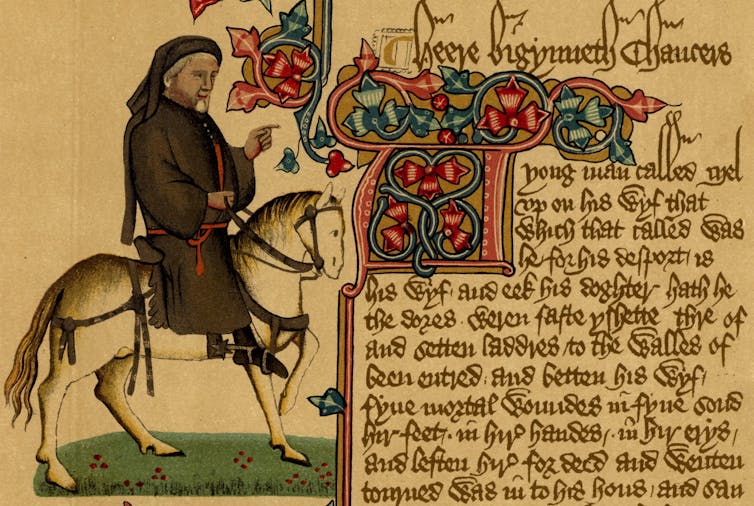
Spying is a risky profession. For the 14th-century English undercover agent-turned-poet Geoffrey Chaucer, the dangers – at least to his reputation – continue to surface centuries after his death.
In his July 2021 essay for the Times Literary Supplement, A.S.G. Edwards, professor of medieval manuscripts at the University of Kent in Canterbury, England, laments the removal of Geoffrey Chaucer from university curricula. Edwards says he believes this disappearance may be propelled by a vocal cohort of scholars who see the “father of English poetry” as a rapist, racist and antisemite.
The predicament would have amused Chaucer himself. Jewish and feminist scholars, among others, are shooting down one of their earliest and wisest allies. This is happening when new research reveals a Chaucer altogether different from what many current readers have come to accept. My decades of research show he was no raunchy proponent of bro culture but a daring and ingenious defender of women and the innocent.
As a medievalist who teaches Chaucer, I believe the movement to cancel Chaucer has been bamboozled by his tradecraft – his consummate skill as a master of disguise.
It’s true that Chaucer’s work contains toxic material. His “Wife of Bath’s Prologue” in “The Canterbury Tales,” his celebrated collection of stories, quotes at length from the long tradition of classical and medieval works on the evils of women, as mansplained by the Wife’s elderly husbands: “You say, just as worms destroy a tree, so a wife destroys her husband.”
Later, “The Prioress’s Tale” repeats the anti-Semitic blood libel story, the false accusation that Jews murdered Christians, at a time when Jews across Europe were under attack.
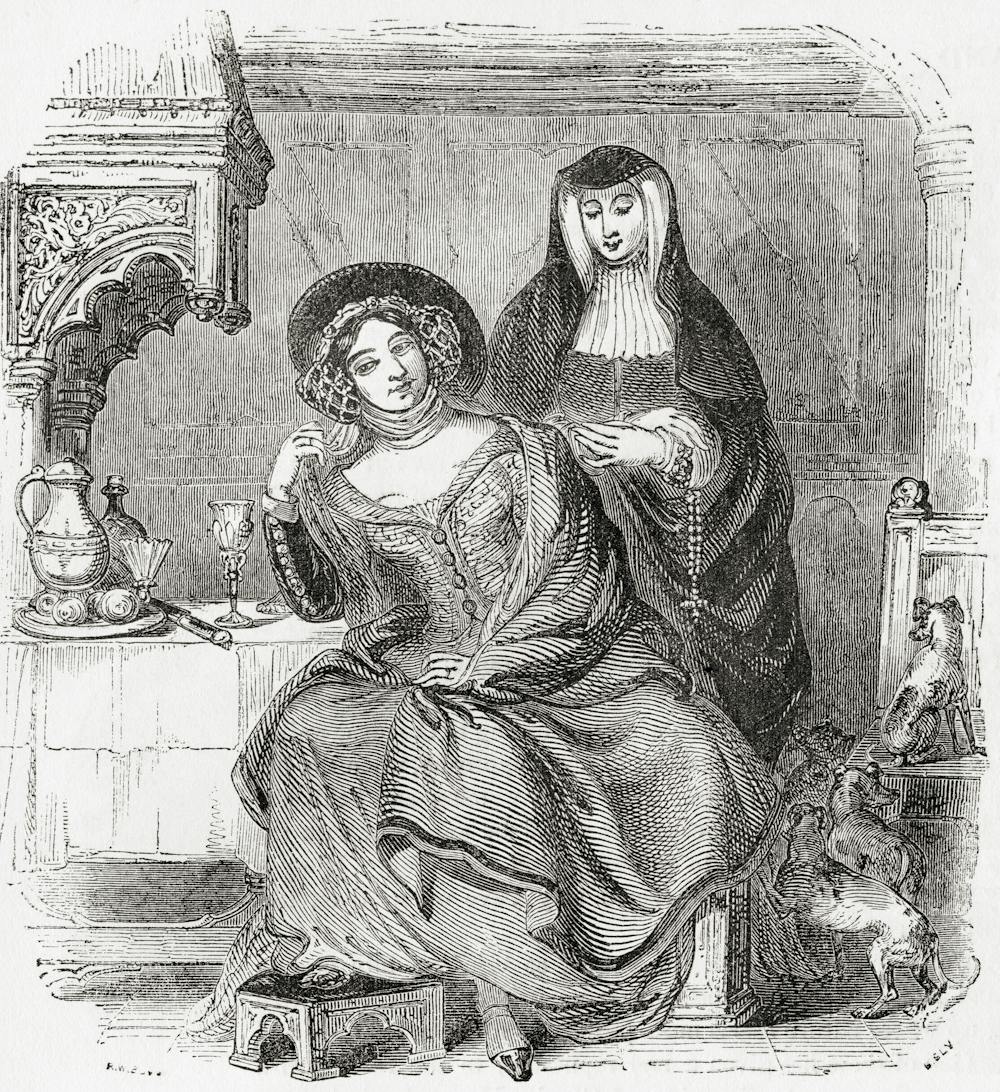
These poems in particular generate accusations that Chaucer propagated sexist and antisemitic material because he agreed with or enjoyed it.
Several prominent scholars seem convinced that Chaucer’s personal views are the same as those of his characters and that Chaucer is promoting these opinions. And they believe he abducted or raped a young woman named Cecily Chaumpaigne, although the legal records are enigmatic. It looks as though Cecily accused Chaucer of some such crime and he paid her to clear his name. It’s unclear what actually happened between them.
Critics cherry-pick quotations to support their claims about Chaucer. But if you examine his writings in detail, as I have, you’ll see themes of concern for women and human rights, the oppressed and the persecuted, reappear time and time again.
Readers often assume Chaucer’s characters were a reflection of the writer’s own attitude because he is such a convincing role player. Chaucer’s career in the English secret service trained him as an observer, analyst, diplomat and master at concealing his own views.
In his teens, Chaucer became a confidential envoy for England. From 1359 to 1378, he graced English diplomatic delegations and carried out missions described in expense records only as “the king’s secret business.”
Documents show him scouting paths through the Pyrenees for English forces poised to invade Spain. He lobbied Italy for money and troops, while also perhaps investigating the suspicious death of Lionel of Antwerp, an English prince who was probably poisoned soon after his wedding.
Chaucer’s job brought him face to face with the darkest figures of his day — the treacherous Charles the Bad, King of Navarre, a notorious traitor and assassin, and Bernabò Visconti, lord of Milan, who helped devise a 40-day torture protocol.
Chaucer’s poetry reflects his experience as an English agent. He enjoyed role-playing and assuming many identities in his writing. And like the couriers he dispatched from Italy in 1378, he brings his readers covert messages split between multiple speakers. Each teller holds just a piece of the puzzle. The whole story can only be understood when all the messages arrive.
He also uses the skills of a secret agent to express dangerous truths not accepted in his own day, when misogyny and antisemitism were both entrenched, especially among the clergy.
Chaucer does not preach or explain. Instead, he lets the formidable Wife of Bath, the character he most enjoyed, tell us about the misogyny of her five husbands and fantasize about how ladies of King Arthur’s court might take revenge on a rapist. Or he makes his deserted Queen Dido cry: “Given their bad behavior, it’s a shame any woman ever took pity on any man.”
While current critiques of Chaucer label him as an exponent of toxic masculinity, he was actually an advocate for human rights.
My own research shows that in the course of his career he supported women’s right to choose their own mates and the human desire for freedom from enslavement, coercion, verbal abuse, political tyranny, judicial corruption and sexual trafficking. In “The Canterbury Tales” and “The Legend of Good Women,” he tells many stories on such themes. There he opposed assassination, infanticide and femicide, the mistreatment of prisoners, sexual harassment and domestic abuse. He valued self-control in action and in speech. He spoke out for women, enslaved people and Jews.
“Women want to be free and not coerced like slaves, and so do men,” the narrator of “The Franklin’s Prologue” says.
[Like what you’ve read? Want more? Sign up for The Conversation’s daily newsletter.]
As for Jews, Chaucer salutes their ancient heroism in his early poem “The House of Fame.” He depicts them as a people who have done great good in the world, only to be rewarded with slander. In “The Prioress’s Tale” he shows them being libeled by a desperate character to cover up a crime of which they were manifestly innocent, a century after all Jews had been brutally expelled from England.
Chaucer’s own words demonstrate beyond the shadow of a doubt that when his much underestimated Prioress tells her antisemitic blood libel tale, Chaucer is not endorsing it. Through her own words and actions, and a cascade of reactions from those who hear her, he is exposing such guilty and dangerous actors as they deploy such lies.
And was he a rapist or an abductor? It’s unlikely. The case suggests he might well have been targeted, perhaps even because of his work. Few authors have ever been more outspoken about man’s inhumanity to women.
It is bizarre that one of the strongest and earliest writers in English literature to speak out against rape and support women and the downtrodden should be pilloried and threatened with cancellation.
But Chaucer knew the complexity of his art put him at risk. As his character the Squire dryly observed, people all too often “demen gladly to the badder ende” – “They are happy to assume the worst.”
Jennifer Wollock, Professor of English, Texas A&M University
This article is republished from The Conversation under a Creative Commons license. Read the original article.

Jen Webb, University of Canberra
And the winner of 2021’s Miles Franklin Literary Award is The Labyrinth, by Amanda Lohrey!
Two of Lohrey’s previous novels (Camille’s Bread in 1996 and The Philosopher’s Doll in 2005) have been shortlisted for the prestigious $60,000 prize. Her latest has been recognised as the literary volume that best presents Australian life now. She is the second Tasmanian author to ever win the prize.
As a long-time fan of Lohrey’s voice and eye, and someone with a lifetime of longing for more recognition of women’s achievements, I am thrilled to see her novel and her protagonist Erica achieve this standing.
Read more:
The saddest of stories, beautifully told: your guide to the Miles Franklin 2021 shortlist
Erica is an often prickly but generous and appealing character. Though she grows up “in an asylum, a manicured madhouse”, her childhood is much happier than is the norm for characters in literary fiction. Her father, the chief medical officer of the hospital, trains his children in diversity. All of us are “lunatics”, he teaches them, in that “we are all affected by the moon”. “Evil,” he tells them, is no more than “a chemical malfunction in the brain”.
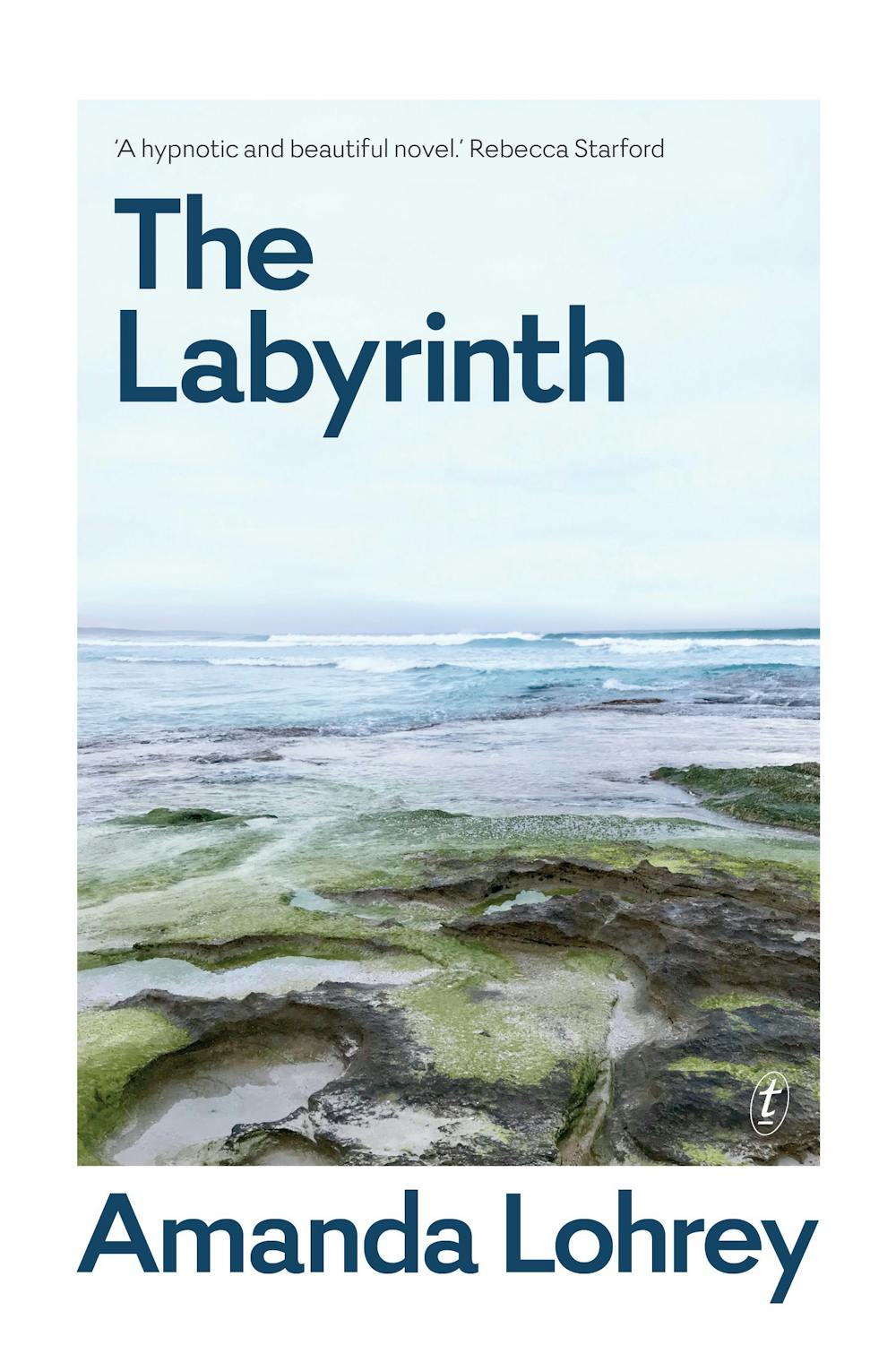
This is an excellent foundation for someone who, in later life, finds herself with a son whose “chemical malfunction” leads him to commit an inadvertent but terrible crime. The beach shack she purchases to be near him, and far from everyone else she knows, is as disorganised and disreputable as her child. But it gives her somewhere to review her life and re-imagine a future.
That future circles around the concept of the labyrinth. Much of the novel is a masterclass in types of these mazes and the meanings and feelings the various designs afford.
All this operates as a healing process following the agony of her son’s act, trial and imprisonment. She — or rather, her planned labyrinth — gradually draws the attention of other isolates who live in the same coastal community. Various people become closely connected to her and one, Jurko, happens to know about labyrinths and their construction.
The young man, “an illegal immigrant who has overstayed his visa”, is a stonemason (a master of that ancient art) and he gradually inserts himself into her home and her life to become her “surrogate son”.
Sand, he explains, is the best foundation for a labyrinth, and this captures Erica’s attention:
I am struck by the paradox here: sand so volatile in its essence and yet so firm a basis for the rigidity of concrete.
For the reader, this becomes the novel’s coda: though everything seems so unstable, it still affords a firm foundation for our difficult, drifting lives.
As the novel unfolds, Erica’s deepening relationships with her new neighbours, and shared responsibilities and understandings, form a sort of labyrinth that leads her to the point where she can declare: “The fugue is over.”

Read more:
The Flanagan effect: Tasmanian literature in the limelight

Jen Webb, Dean, Graduate Research, University of Canberra
This article is republished from The Conversation under a Creative Commons license. Read the original article.
Jen Webb, University of Canberra
Since Aristotle, humans have pondered the role and function of fictional narratives. Now, there is general agreement the reading of fiction builds empathy, supports our capacity for uncertainty and ambiguity, and offers new perspectives on the world.
Perhaps it is writers reaching for this combination of emotion and reflection which leads to complaints literary fiction is unremittingly bleak. But even the saddest of stories, well told, can be leavened by captivating use of language, rich portraiture and, very often, veins of humour.
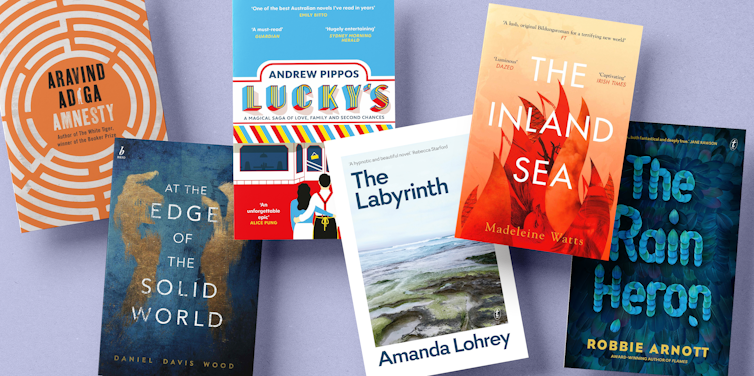
This is evident in each of the novels shortlisted for the 2021 Miles Franklin award. Here the destruction of the environment, there the abuse of refugees, and over there the despair occasioned by the everyday suffering of being human. Yet they each shimmer with energy, tenderness and threads of optimism — and even occasionally joy.
Amnesty, the fourth novel from Booker Prize winner Aravind Adiga, possesses all the ingredients for unrelenting tragedy.
Danny, a young Tamil man, comes to Australia as one of the myriad international students who, pre-COVID, used to keep our economy afloat, but then drops out of what he terms this “racket” to live as an “illegal alien” with all the attendant uncertainties and anxieties.

Working as a cleaner for the rich and mostly white people of Sydney, he finds himself in possession of information about a murder, and is probably the only person who knows whodunnit. The novel tracks him through a long day where, with Hamlet-esque indecisiveness, he agonises about whether to tell the police (and expose himself to the likelihood of arrest and deportation) or to lie low (and allow a second murder to be committed).
Despite this, the novel is infused with a lightness of being and a sense of hope. Danny’s Sydney houses rats and predators, but also libraries providing sanctuary for “illegals”, his tolerant vegan Vietnamese girlfriend, his Japanese-Brazilian abseiling friend, and accommodating householders who pay him to clean their attractive apartments.
Often very funny, often deeply touching, Adiga manages to combine serious literary fiction with satire and critique. He also offers a clear-eyed portrait — or perhaps a sociology — of contemporary Australia, and of the holy grail of amnesty always floating just out of reach.
In his second novel, Daniel Davis Wood weaves the complex stories of individuals and families with history and culture, space and time.
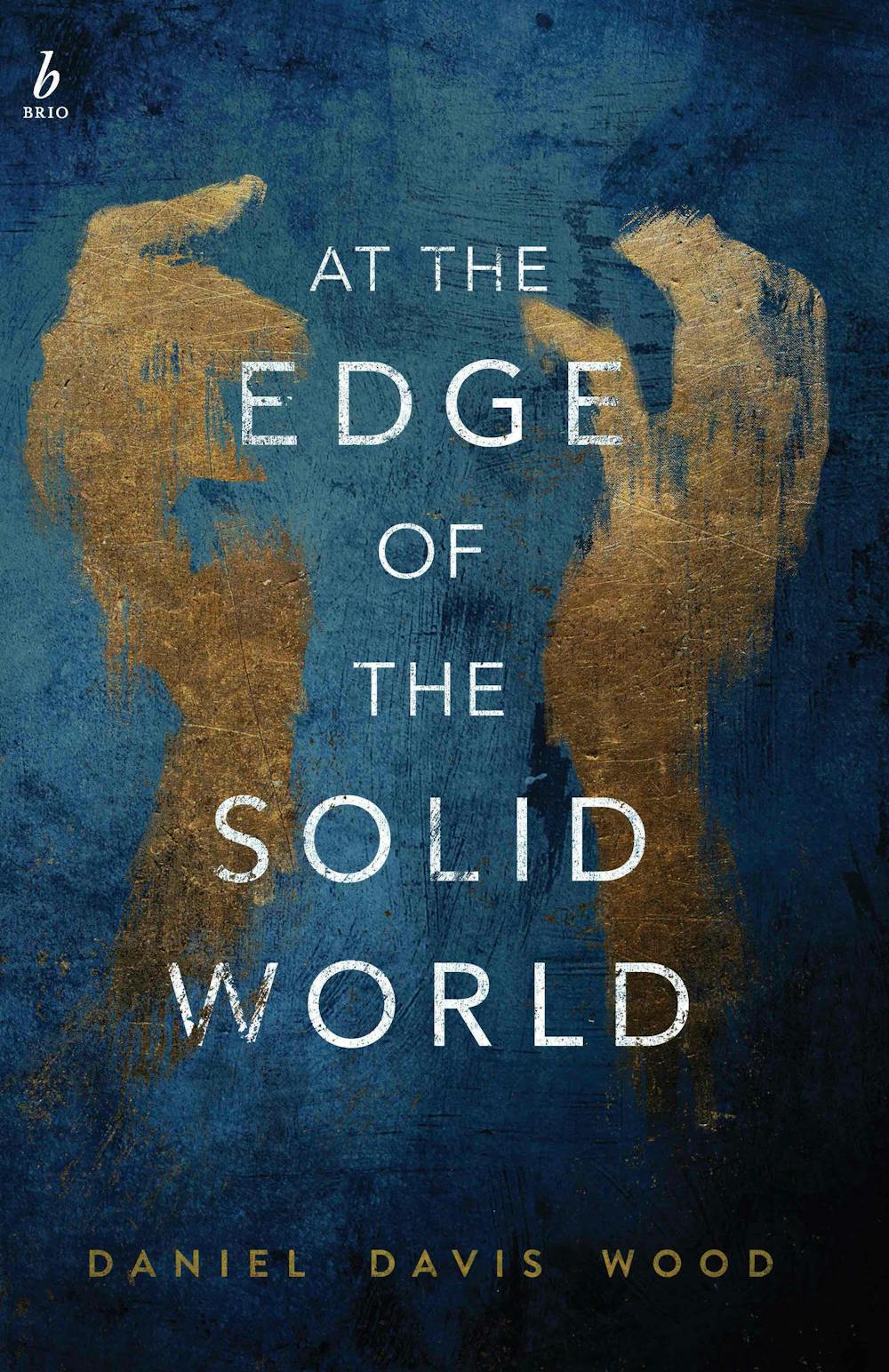
After a family tragedy, the first person narrator of At The Edge of the Solid World gradually fractures into shards of himself.
As the novel unfolds, he unfolds, as does time. His grief is overlaid with the grief of those caught up in a current Sydney massacre, as well as the ruined cultures museumed in the songs folklorist Francis J Child attempted to save from history.
The narrator obsessively reports on every conceivable small and global disaster, spreading out across history and culture, drenching him in a lineage of loss.
The ripple effects of all the events in this account of his present are tragic, but the tragedy is enfolded in love and acts of tenderness and memory. It’s not a comfortable read. But it is an extraordinary read.
We have probably all had lunch at a place like Lucky’s, a Greek-Australian franchise offering “home cooked” food with an acceptably mainstream menu, and where, behind the counter, a febrile life simmers away.
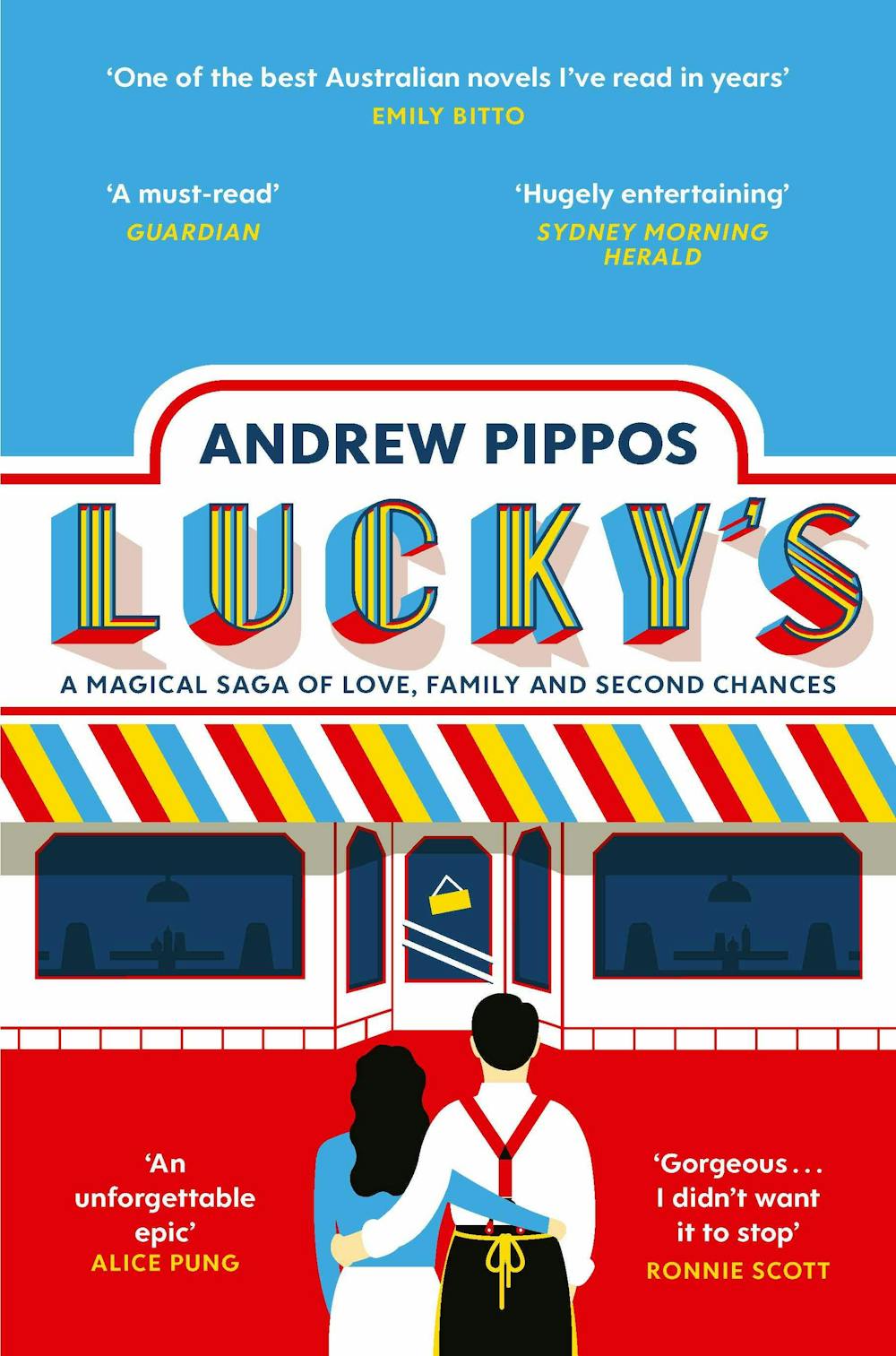
Andrew Pippos’ first book, Lucky’s, paints a dense and convoluted landscape spanning from the second world war through to the present.
The eponymous Lucky is a Greek-American with adequate skills on the clarinet, who impersonated Benny Goodman at a wartime concert in one chapter of a lifetime of bare competence.
Matching him is Emily, a young UK journalist who, in flight from a failed marriage, is trying to write a piece about Lucky and his doomed chain of restaurants.
Between the two people and the two periods of time there is a large cast of well-written characters and a smorgasbord of joys and catastrophes.
The title of the book is sauteed in irony, but what could have fallen into bathos is rescued by the character of Lucky, whose loyalty and hapless charm kept me reading through to the almost-optimistic end.
Madeleine Watts’ debut novel is set during the record-breaking Sydney summer of 2013, and a stage in the narrator’s life where “The open wilderness of adulthood stretched ahead like so much wasteland”.

In formal terms, it is a Bildungsroman — a coming of age novel — and, as expected of its genre, the narrator spends a fair bit of time in naïve narcissism, pursuing an emotionally unsatisfying affair she knows will end in heartbreak and engaging in self-destructive behaviours that alienate her friends. But there is considerably more to it than this.
The setting for much of the novel is her job at an emergency call centre, where shift after shift she surfs the tide of desperate callers from places no one knows about and for whom the emergency services will never arrive.
Read as a standard Bildungsroman, the book doesn’t deviate far from the conventions. But read as an allegory for a nation struggling to find a way into its future, Watts shifts the grounds of this genre and offers sustained narrative traction.
Amanda Lohrey has been recognised as a fine novelist since the late 1980s. In The Labyrinth, her eighth novel, her expertise, observant eye and ear, and sense of story are fully present.

Erica has undertaken a sea-change, moving from central Sydney to a coastal hamlet close to the prison where her son is incarcerated. She purchases a rather disreputable beachside shack with a garden large enough to contain a labyrinth. She is determined to build not just a labyrinth, but the right labyrinth: one that will deliver the promise of “reversible destiny”.
A labyrinth is a powerful trope, and here it drives not only the narrative and Erica herself, but also a range of possibilities of meaning for the various characters with whom her life becomes intertwined. Though she had intended to isolate herself, the forces of kindness capture her and, gradually, she connects with those around her.
With their help, she constructs a labyrinth that is, she says, “a challenge […] to the heart”, the place where “you let go”. In her own letting go she finds no magic solution to sadness, but rather the consolations — however temporary — of connectedness.
Speculative fiction doesn’t often appear on literary award shortlists, which means when they are selected they are worth our attention.
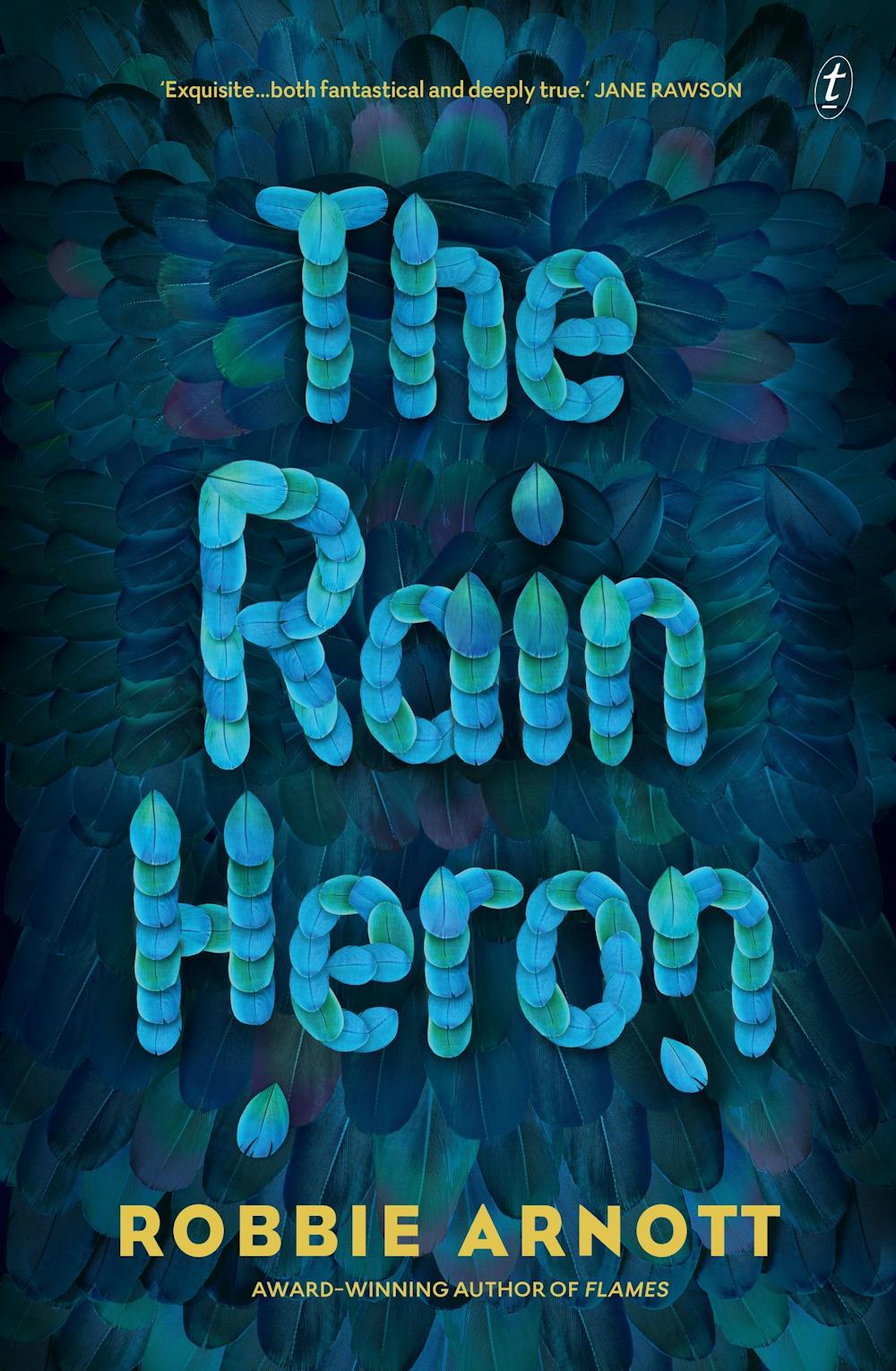
Robbie Arnott’s The Rain Heron (another second novel) is set in an ecodystopia — probably not far into the future, given the current state of the planet — under military rule, where the people are simply hoping to survive.
The novel is threaded through with a strong sense of myth: the assault by capitalist imperatives on communities living in harmony with nature; the magical uncontainable rain heron; the diminished land; the woman surviving in the mountains, waiting for some sort of salvation. So far, so standard dystopia.
But this book astounds me not just for the quite brilliant conception and rendition of the eponymous rain heron, but also because of the portraits it offers: of generosity, of tenderness, of a turning toward rather than away from others. And of a plot where the deaths are caused by clumsiness or carelessness, rather than malevolence.
In a desolate social and ecological landscape, the human networks of compassion make this novel a thing of rare beauty.
The winner of the 2021 Miles Franklin literary award will be announced at 4pm AEST today.
Jen Webb, Dean, Graduate Research, University of Canberra
This article is republished from The Conversation under a Creative Commons license. Read the original article.
 At the BookShelf
You must be logged in to post a comment.