
The link below is to an article reporting on efforts to close down Kiss Library as an alleged ebook piracy site.
For more visit:
https://goodereader.com/blog/e-book-news/amazon-and-publishers-target-major-ebook-pirate-website

The link below is to an article reporting on efforts to close down Kiss Library as an alleged ebook piracy site.
For more visit:
https://goodereader.com/blog/e-book-news/amazon-and-publishers-target-major-ebook-pirate-website

John Foxwell, Durham University
Many famous writers claim it’s the characters who actually drive the plot, create the dialogue, and essentially “do their own thing” in the novels they write.
To investigate this phenomenon, we ran a survey at the Edinburgh International Book Festival in 2014 and 2018, asking writers how they experienced their characters. Over 60% of the 181 participants said they heard their characters’ voices, and over 60% said their characters sometimes acted of their own accord. Some authors even said they could enter into dialogue with their characters and that their characters sometimes “talked back” and argued with them.
These writers were often fairly explicit that all of these experiences were imaginary. But writers also talked about being “surprised” by what their characters said and did – even sometimes laughing because of the jokes their characters told. This brings up questions around control and “agency”, since these writers did not always feel as if they were consciously deciding what happened in the narrative.
This experience is often explained by the suggestion that writers are somehow special or different, and that their imaginings are more “vivid” or “powerful”. But in our study, there was a much greater degree of variation than such theories account for. Indeed, there was a significant minority of writers who did not report the experience of their characters having agency.
But recent studies on “inner speech” may help to explain writers’ experiences of their characters in a different way. Inner speech is the inner monologue and or dialogue that most of us have when we think verbally. It can vary a great deal from person to person. For instance, some people are aware of hearing their inner speech most of the time, and some are barely conscious of it at all.
Some people, for example, experience their inner speech more as a monologue, while for others it is more of a dialogue. People can also be aware of having the voices of “other people” in their inner speech – for instance, hearing the voice of one of their parents giving them a piece of advice or criticism.
In much the same way, we might also imagine hearing the voices of other people when we do things like think about how an argument might have gone differently, or how someone we know is likely to respond to the news we’re about to give them.
It’s not unreasonable then to question the extent to which we’re aware of actually controlling these imaginary versions of real people. After all, the feeling that a friend or family member is more likely to say one thing than another isn’t usually something that’s consciously decided or laboriously worked out through reasoning. Usually it’s immediate and intuitive, at least when we know that person well. And this is different again from simply deciding to imagine them responding the way we want them to.
According to this line of thinking, most of us actually have independent and agentive “characters” and hear their voices – it’s just that these characters have the same identities as the people we know in the real world.
Indeed, some of the writers in our survey explicitly compared hearing their characters to the “other people” in their inner speech:
It’s like when you see a dress in a shop window and you hear your mum’s voice saying ‘it won’t wash [well]’ in your mind. It’s involuntary but not intrusive.
So perhaps it isn’t so much a question of how writers have these experiences of independent characters. Instead, it might be more a question of why the agency of fictional characters is so much more noticeable (and therefore more noteworthy). One possible explanation lies in the way this experience of characters’ agency relates to other experiences, both real and imaginary.
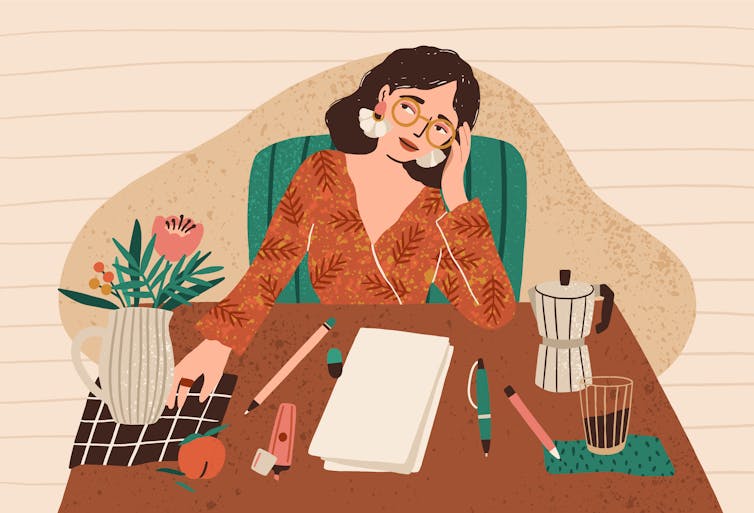
On the one hand, there is a contrast that emerges because of how the characters develop over time. First, there are the initial stages where the writer consciously determines what the characters do and say. Yet after a certain point, the writer’s greater familiarity with the characters provides the same kind of immediate and intuitive sense of what they would do or say that often applies to our imaginings of real people.
On the other hand, there is a contrast which usually pertains to our imaginings of real people: the contrast between our imaginings of what they will do and what they actually do in the world. But of course, fictional characters do not have a counterpart out there that has conspicuously more independence and agency. In other words, those qualities aren’t being constantly “overshadowed” by the real-life versions.
These theories may go some way towards explaining some of the broader aspects of what’s going on. Yet the more researchers delve into thought and imagination, the more difficult it is to say exactly how much control over our thoughts and actions any of us actually have – and to what extent the control we feel we have is an illusion.
John Foxwell, Postdoctoral Research Fellow in the Department of English, Durham University
This article is republished from The Conversation under a Creative Commons license. Read the original article.
The link below is to an article reporting on the longlist for the 2020 Edge Hill Short Story Prize.
For more visit:
https://www.booksandpublishing.com.au/articles/2020/07/07/153100/ocallaghan-longlisted-for-edge-hill-short-story-prize/
The links below are to articles regarding the Kindle Cloud Reader, with a fair amount of speculation surrounding its future.
For more visit:
– https://goodereader.com/blog/kindle/amazon-is-discontinuing-the-kindle-cloud-reader
– https://the-digital-reader.com/2020/07/09/has-amazon-killed-the-offline-mode-for-the-kindle-cloud-reader/
The link below is to an article reporting on the winners of the Australian Booksellers Association’s (ABA) 2020 Booksellers’ Choice Book of the Year Awards.
The link below is to an article that looks at fan impatience – i.e. as in waiting for George R. R. Martin to finish the next book.
For more visit:
https://www.theguardian.com/books/booksblog/2020/jul/29/first-george-rr-martin-now-patrick-rothfuss-the-curse-of-sequel-hungry-fans
The link below is to an article reporting on the shortlists for the 2020 Western Australian Premier’s Book Awards.
For more visit:
https://www.booksandpublishing.com.au/articles/2020/07/01/152841/wa-premiers-book-awards-shortlists-announced-2/
Stevie Marsden, University of Leicester
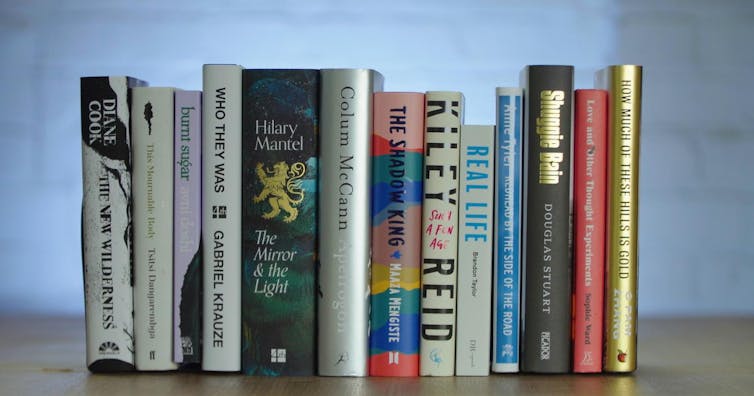
When she announced the 2020 Booker Prize longlist recently, the chair of the judging panel, Margaret Busby, noted that the selected books “represent a moment of cultural change”. And while one could be tempted to see her words as the sort of hyperbole that often accompanies these announcements, the selection of 13 novels (the “Booker dozen”) for 2020 is – in some ways – one of the more interesting and diverse we’ve seen in a long time.
Two key aspects of the list made for the most discussion for literary commentators and social media. First, the inclusion of Hilary Mantel’s latest book, and the final in her Wolf Hall trilogy, The Mirror & the Light. Both the two previous books in the trilogy – Wolf Hall and Bring Up the Bodies – won the Booker Prize, in 2009 and 2012 respectively. If Mantel was to win the 2020 Booker Prize for The Mirror & the Light she would be the first author to ever win three Bookers.
Second, nearly half of the longlist is made up of debut novels, which even the literary director of the Booker Prize Foundation, Gaby Wood, has admitted is an “unusually high proportion”. This is certainly something the Booker Prize and its judging panel should be commended for.
Like all other creative industries, publishing has been hit hard by the worldwide pandemic. From the cancellation of major events, including the London Book Fair in March, and the closing of bookshops, to the postponement of major releases, including Ruth Jones’ second novel Us Three, the 2020 publishing calendar has been turned upside down.
The celebration of debut novels in the Booker Prize longlist, then, is particularly fortuitous, since many debut writers have lost the opportunity to go through the usual new book tours, literary event circuits and bookshop signings.
Independent publishers in particular have been hit hard in 2020. A survey conducted in May by the Bookseller and Spread the Word found that 85% of the publishers surveyed saw their sales drop by over a half since the UK’s national lockdown in March. So the 2020 Booker Prize longlist might also be applauded for its celebration of titles from indie presses.
Six of the 13 longlisted books come from four (admittedly well-known and larger) independent presses: Diane Cook’s The New Wilderness (Oneworld Publications), Tsitsi Dangarembga’s, This Mournable Body (Faber & Faber), Colum McCann’s Apeirogon and Kiley Reid’s Such a Fun Age (Bloomsbury), Maaza Mengiste’s The Shadow King (Canongate) and Brandon Taylor’s Real Life (Daunt Books Publishing).
The seven other books are from Pan Macmillan, Penguin Random House, HarperCollins and Hachette. I’ve written before about how the Booker’s terms of submission may sway the prize in favour of big publishers, but this year there is at least some semblance of balance.
I’ve also written before about how the Booker Prize has historically failed to award writers of colour – an issue which was highlighted once again in 2019 when Bernardine Evaristo became the first black British woman to win the award.
Evaristo’s win was considered by many to be a long overdue recognition for a widely acclaimed writer, but the fact that Evaristo had to share the award with Margaret Atwood, a white, former Booker Prize winner, did not go unnoticed. It is perhaps promising, then, that nine of the new 13-strong Booker longlist are women – and more than half are writers of colour.
The overwhelming majority are US-based or born. This is significant since American writers have only been eligible for the prize since 2014 – and the change in rules that led to the inclusion of American writers was criticised by a number of authors and publishers at the time. Since the rule change, only two American authors have won the award: Paul Beatty in 2016 and George Saunders in 2017. The prize is also now sponsored by the American-based charitable foundation Crankstart, founded by Silicon Valley venture capitalist Michael Moritz.
Finally, it is worth highlighting the kinds of themes and issues dealt with in the longlisted books. The books examine race, homosexuality, gender and gender identity, poverty, class (and in some cases, intersections of them all), homelessness and climate change.
The subjects foregrounded by many of the longlisted books, therefore, not only speak to current socio-political movements and conflict – most notably Black Lives Matter and the call for active anti-racism. But they also foreshadow the kinds of issues we will undoubtedly come up against (and, in some circumstances, already are) in a post-coronavirus world. In other words, more so than ever before, this longlist feels both born from, and representative of, the very particular moment in history in which we are in.
But only time will tell if this will be reflected in the final shortlist which will be announced on September 15, with the winner being announced in November. If Mantel were to be crowned the winner – receiving her third Booker Prize in just over a decade – it would arguably prove that yet again the Booker Prize acts only to reinforce, as opposed to disrupt as hoped, the systemic inequalities and imbalances of contemporary publishing culture.
Stevie Marsden, Research Associate, CAMEo Research Institute for Cultural and Media Economies, University of Leicester
This article is republished from The Conversation under a Creative Commons license. Read the original article.
The links below are to articles reporting on the shortlist and the winner of the 2020 Furphy Literary Award.
For more visit:
https://www.booksandpublishing.com.au/articles/2020/07/07/153115/furphy-literary-award-2020-shortlist-announced/
– https://www.booksandpublishing.com.au/articles/2020/07/29/154409/furphy-literary-award-2020-winners-announced/
The link below is to an article reporting on the longlist for the 2020 Colin Roderick Award.
For more visit:
https://www.booksandpublishing.com.au/articles/2020/06/30/152720/colin-roderick-award-2020-longlist-announced/
 At the BookShelf
You must be logged in to post a comment.