Unknown's avatar

Jane Austen and Germaine de Staël: a tale of two authors


File 20170714 14248 172m48c

Chawton House Library

Catriona Seth, University of Oxford

Two prominent writers died in July 1817. The first was arguably the most famous woman in Europe. The other was a country clergyman’s daughter whose life had revolved around her family and her home county.

Germaine de Staël travelled widely and her work had been translated into several languages. She was the only daughter of wealthy Swiss banker Jacques Necker, who became finance minister to Louis XVI, and was brought up in the stimulating environment of Parisian society. She published major treatises on the influence of passions on individuals and nations, on literature and its relationship to society, not to mention on Germany (1813). She wrote on Marie Antoinette’s trial, on peace, on translation, on suicide.

Her novels Delphine (1802) and Corinne or Italy (1807) were bestsellers throughout Europe. She was also a commentator on, and historian of, the French Revolution in texts which only appeared after her death. Most periodicals felt that anything she penned, fact or fiction, political or philosophical, was worthy of a mention – whether to praise or to condemn it.

Unlike Staël’s father, George Austen encouraged his daughter Jane’s literary pursuits: he bought her notebooks for her early stories, gave her a mahogany writing desk and attempted (unsuccessfully) to get her work into print in 1797. Jane Austen’s first published book, Sense and Sensibility, “a new novel by a lady”, which came out in 1811, bore no author’s name on its title page. The same would go for the other novels published in her lifetime – all sold well and brought a welcome income but, to the outsider, nothing could connect them with the discreet woman who, through her richer brother’s generosity, lived with her mother and sister in a cottage on his estate.

Death notices

Staël’s death in Paris was widely reported. The Monthly Magazine, before commenting at length on the funeral arrangements, opened a “Further Notice of Madame de Staël” with the following assertion:

To speak of the literary celebrity of Madame de Staël, of the elevated talent which distinguished her, of all the talent which placed her among the first writers of the age, would be to speak of all things known to all France and to all Europe … To speak of her generous opinions, her love for liberty, her confidence in the powers of intelligences and of morality, confidence which honours the soul which experiences it, would be, perhaps, in the midst of still agitated parties, to provoke ill-disposed impressions.
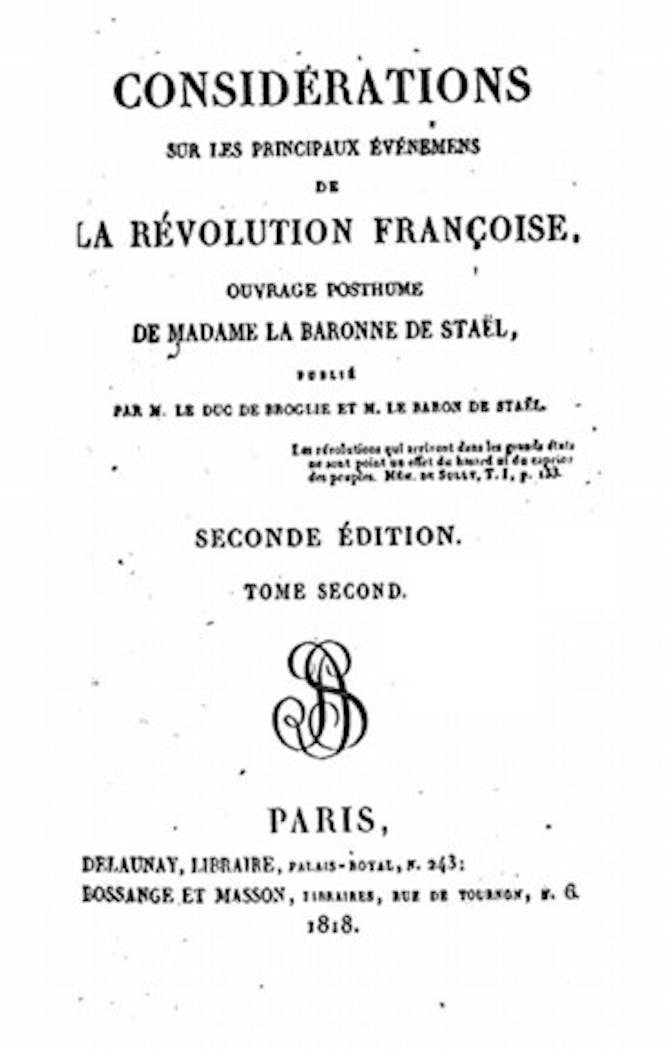
Germaine de Staël: her thoughts on the French Revolution.
Online Library of Liberty

Staël had been reviled for her political ideas, caricatured by the gutter press for her unconventional looks and lifestyle, exiled by several regimes, and treated by Napoleon as a personal enemy, to the extent that it was said that the emperor recognised three powers in Europe: England, Russia and Madame de Staël.

When the unmarried “Miss Jane Austen” died in Winchester four days after Staël, the announcement her family (probably) wrote recalled she was the daughter of a clergyman and acknowledged that she was the author of Emma, Mansfield Park, Pride and Prejudice and Sense and Sensibility. It added:

Her manners were most gentle, her affections ardent, her candour was not to be surpassed, and she lived and died as became a humble Christian.

Future biographical notes, including the one penned by her nephew – A Memoir of Jane Austen – developed this image. He wrote of his aunt:

Of events her life was singularly barren: few changes and no great crisis ever broke the smooth current of its course. Even her fame may be said to have been posthumous: it did not attain to any vigorous life till she had ceased to exist. Her talents did not introduce her to the notice of other writers, or connect her with the literary world, or in any degree pierce through the obscurity of her domestic retirement.

Bestseller: but who is it by?
Lilly Library, Indiana University via Wikimedia Commons

To this day, in the only authenticated portrait of her – a sketch by her sister Cassandra – she looks the part in her simple cap and dress, so unlike Staël’s flamboyant turban and scarlet gown. More than “Miss Austen”, she is “Jane Austen”, someone to whom we feel we can relate. Her admirers, readers but also cinephiles who have enjoyed the adaptations, come from all the corners of the earth, are known as “Janeites”.

Many of Staël’s works have long been out of print or available only in pricey scholarly editions. She is recognised as one of the forerunners of 19th-century liberalism but does not have the common appeal and widespread recognition that time has brought to Austen.

Contrasting legacies

The seeds for the “fickle fortunes” – to borrow the title of the current exhibition at Chawton House (the “Great House” lived in by her brother Edward Austen-Knight which is now home to a library of early women’s writing) – of the international literary superstardom of Austen and the waning of Staël’s fame are partly present in these obituaries.

Austen’s family cleverly crafted a reputation for demureness and devotion to both God and family as a way of deflecting from the sometimes ambiguous contemporary attitude towards women authors. Her life was presented as quintessentially English and uneventful and her character as modest and self-effacing – in many ways the opposite of Staël’s.

In a late addition to his biographical sketch about his sister, 15 years after the death of both women, Henry Austen claimed that when invited to a party Staël was due to attend, Austen “immediately declined”.

The ConversationThis probably imaginary anecdote illustrates an essential reason for Austen’s success: yes, she is a great writer, but so too is Staël. Austen’s existence threatened nobody. Staël’s championing of republican ideals, consideration of the role of emotion in politics and use of fiction to promote geopolitical and societal reflections meant her life could be discussed and her works forgotten. Considering them jointly can help us question what shapes our canon of great writers.

Catriona Seth, Marshal Foch Professor of French Literature, University of Oxford

This article was originally published on The Conversation. Read the original article.

Unknown's avatar

The Library of Congress opened its catalogs to the world. Here’s why it matters


File 20170705 28939 r7aodn
The Library of Congress is in Washington, D.C.
Valerii Iavtushenko/Shutterstock.com

Melissa Levine, University of Michigan

Imagine you wanted to find books or journal articles on a particular subject. Or find manuscripts by a particular author. Or locate serials, music or maps. You would use a library catalog that includes facts – like title, author, publication date, subject headings and genre.

That information and more is stored in the treasure trove of library catalogs.

It is hard to overstate how important this library catalog information is, particularly as the amount of information expands every day. With this information, scholars and librarians are able to find things in a predictable way. That’s because of the descriptive facts presented in a systematic way in catalog records.

But what if you could also experiment with the data in those records to explore other kinds of research questions – like trends in subject matter, semantics in titles or patterns in the geographic source of works on a given topic?

Now it is possible. The Library of Congress has made 25 million digital catalog records available for anyone to use at no charge. The free data set includes records from 1968 to 2014.

This is the largest release of digital catalog records in history. These records are part of a data ecosystem that crosses decades and parallels the evolution of information technology.

In my research about copyright and library collections, I rely on these kinds of records for information that can help determine the copyright status of works. The data in these records already are embodied in library catalogs. What’s new is the free accessibility of this organized data set for new kinds of inquiry.

The decision reflects a fresh attitude toward shared data by the Library of Congress. It is a symbolic and practical manifestation of the library’s leadership aligned with its mission of public service.

Some history

To understand the implications of this news, it helps to know a bit about the history of library catalog records.

Today, search engines let us easily find books we want to borrow from libraries or purchase from any number of sources. Not long ago, this would have seemed magical. Search engines use data about books – like the title, author, publisher, publication date and subject matter – to identify particular books. That descriptive information was gathered over the years in library catalog records by librarians.

Card catalog at the Library of Congress.
Rich Renomeron/flickr, CC BY-NC-ND

The library’s action sheds light on this unseen but critical network. This infrastructure is invisible to most of us as we use libraries, buy books or use search engines.

For many, the idea of a library catalog conjures up the image of card catalogs. The descriptions contained in catalog records are “metadata” – information about information. Early catalog records date back to 1791, just after the French Revolution. The revolutionary government used playing cards to document property seized from the church. The idea was to make a national bibliography of library holdings confiscated during the Revolution.

For many years, library collections were organized individually. As the number of books and libraries grew, the increased complexity demanded a more consistent approach. For example, when the Library of Congress purchased Thomas Jefferson’s personal library in 1815, it arranged its collections around Jefferson’s personal system organized around the themes of memory, reason and imagination. (Jefferson based this on Francis Bacon’s own model.) The library sought to arrange its collections on that model into the 19th century.

Books on my shelf, marked with KF and HB. The K indicates that the book relates to law, the H that it relates to social science. The second letter indicates a subcategory.
Melissa Levine, CC BY

As the number of books and libraries grew, a more systematic approach was needed. The Dewey Decimal System appeared in 1876 to tackle this challenge. It combined consistent numbers (“classes”) with particular topics. Each class can be further divided for more specific descriptions.

In the 1890s, the library developed the Library of Congress Classification System. It is still used today to predictably manage millions of items in libraries worldwide.

Catalogs, cards and computers

By the 1960s, systematic descriptions made the transition from analog cards to online catalog systems a natural step. Machine-Readable-Cataloging (or MARC) records were developed to electronically read and interpret the data in bibliographic cataloging records. The structured categorization coincided naturally with the use of computers.

Now, MARC records too are on the way out, making room for more modern and flexible standards.

The Library of Congress remains a primary – but not the only – source for catalog records. Individual libraries produce catalog records that are compiled and circulated through organizations like OCLC. OCLC connects libraries around the globe and offers an online catalog. WorldCat coordinates catalog records from many libraries into a cohesive online resource. Groups like these charge libraries through membership fees for access to the compiled data. Libraries, though, typically do not charge for the catalog records they produce, instead working cooperatively through organizations like OCLC. This may evolve as more shared effort and crowdsourced resources can be combined with the library’s data in ways that improve search and inquiry. Examples include SHARE and Wikipedia.

One month later

In the short time since the Library of Congress’ data release, we see inklings of what may come. At a Hack-to-Learn event in May, researchers showed off early experiments with the data, including a zoomable list of nine million unique titles and a natural language interface with the data.

For my part, I am considering how to use the library’s data to learn more about the history of publishing. For example, it might be possible to see if there are trends in dates of publication, locations of publishers and patterns in subject matter. It would be fruitful to correlate copyright information data retained by the U.S. Copyright Office to see if one could associate particular works with their copyright information like registration, renewal and ownership changes. However, those records remain in formats that remain difficult to search or manipulate. The records prior to 1978 are not yet available online at all from the U.S. Copyright Office.

Colleagues at the University of Michigan Library are studying the recently released records as a way to practice map-making and explore geographic patterns with visualizations based on the data. They are thinking about gleaning locations from subject metadata and then mapping how those locations shift through time.

There’s a growing expectation that this kind of data should be freely available. This is evidenced by the expanding number of open data initiatives, from institutional repositories such as Deep Blue Data here at the University of Michigan Library to the U.S. government’s data.gov. The U.K.‘s Open Research Data Task Force just released a report discussing technical, infrastructure, policy and cultural matters to be addressed to support open data.

The ConversationThe Library of Congress’ action demonstrates an overarching shift in use of technology to meet historical research missions and advance beyond. Because the data are freely available, anyone can experiment with them.

Melissa Levine, Lead Copyright Officer, Librarian, University of Michigan

This article was originally published on The Conversation. Read the original article.

Unknown's avatar

Refuge in a harsh landscape – Australian novels and our changing relationship to the bush


File 20170503 4135 gufh31
Summer afternoon, Templestowe by Louis Buvelot, 1866. The bush was commonly seen by 19th-century writers as a place of despair.
Wikimedia Commons

Margaret Hickey, La Trobe University

In 1790, Watkin Tench, the first officer with the First Fleet and a member of the fledgling British colony, stood on what we now know to be “The Heads” of Sydney, hungry and pining for news of England:

Here on the summit of the hill, every morning from daylight until sun sunk, did we sweep the horizon in hope of seeing a sail. At every fleeting speck which arose from the bosom of the sea, the heart pounded and a telescope lifted to the eye…

Tench’s palpable yearning for the mother country is an early account of British despair upon first settlement in Australia. One hundred years later, the sentiment remained. Many settlers were still unhappy with their surrounds, as evidenced in Edward Dyson’s musings in his 1898 short story The Conquering Bush:

The bush is sad, heavy, desparing; delightful for a month, perhaps, but terrible for a year.

In Barbara Baynton’s works, meanwhile, tales of harsh female experiences were set against even harsher Australian landscapes, devoid of respite or pleasure. In her 1896 short story The Chosen Vessel, a young wife and mother left alone in her bush home is stalked, raped and murdered by a swagman:

More than once she thought of taking her baby and going to her husband.
But in the past, when she had dared to speak of the dangers to which
her loneliness exposed her, he had taunted and sneered at her.

For over 200 years, the white sentiment of desolation and anxiety about this “untamed” land has pervaded much of Australian literature. Children went missing, men went mad, and women suffered what writer Henry Lawson called the “maddening sameness” in The Drover’s Wife and Others Stories. “Oh, if only I could go away from the bush!” wails Lawson’s central character in The Selector’s Daughter.

Desolate refuge

The works of these early writers did much to reveal the challenging realities of the bush. Those eking out an existence in a land where soil and weather disagreed with European sensibilities and practices were met with hard work. And what a place to work! There was little room for bucolic tranquillity in a land of drought, flood and searing heat.

Tim Winton’s Dirt Music.
Picador

But, in the 21st century, there has been a change in how Australians read and write about the bush. Author and ecologist Tim Flannery, for one, urged his fellow country men and women to “develop deep, sustaining roots in the land” in his address as Australian of the Year in 2002 – which is what many of our contemporary writers seek to do. Unlike their predecessors, they’re increasingly likely to write about the bush as a destination for escape, rather than a place from which to flee.

Author Tim Winton’s Dirt Music does exactly that, as told through the tribulations of protagonist Luther Fox. After being forced out of his small south-west Australian town White Point for the crime of theft, he does not flee to the city; instead he journeys to a more remote region: the Kimberley.

Lost, injured and starving, Fox does not curse the land for his fate. Rather, he accepts his minor place in the universe and begins to come to terms with his family history through listening to and appreciating the powerful land:

He knows he lives and that the world lives in him. And for him and because of him. Because and despite and regardless of him.

Others, like Peter Temple in the The Broken Shore, highlight the beauteous potential of working with the land, as opposed to fighting it.

When the novel’s protagonist, Joe Cashin, leaves the city to return to his home town on the cold, south-west coast of Victoria, he does so a shattered man. With only the battering winds, shrieking cold and his dogs as company, Joe attempts to rebuild the home of his ancestors. He does not curse the sea for the death of his father or bemoan the land or its conditions. Rather, he finds a way to live in it alongside the people he grew up with:

Cashin walked around the hill, into the wind from the sea. It was cold, late autumn, last glowing leaves clinging to the liquid ambers and maples his great-grandfather’s brother had planted, their surrender close. He loved this time, the morning stillness…

Other authors such as Robert Drewe, Kate Grenville, Cate Kennedy, Murray Bail and Jenny Spence also create plots that entail leaving the city and finding refuge and peace in the Australian bush. This is a markedly different trajectory from that of Lawson’s The Drover’s Wife or even the doomed schoolgirls in Joan Lindsay’s Picnic at Hanging Rock, who journey through the scrub and rock to never return.

For the love of farmland

This sentiment toward the land does not aim to romanticise one’s “return” to nature. Rather, it’s as much concerned with exploring the cultural practices intrinsic to Australian land.

This is most apparent in literary interpretations of farming, or “pastoral” literature (writing that idealises country life). UK scholar Terry Gifford has coined a key term to consider here: “post-pastoral”, which is a “discourse that can both celebrate and take responsibility for nature without false consciousness”.

Gifford’s view is that post-pastoral is provisional and can be adapted to different regions. It does not idealise rural life. Nor does it exist only to highlight the harsh realities of life on the land. Rather, it seeks new ways of looking at the pastoral in all its forms.

In Australian writing, we appear to have an emerging “co-pastoral” discourse – a place where humans and the land co-exist. Humans do not, after all, always have to be the agents of disaster, and the land does not always have to be mundane and unforgiving.

Christie Nieman’s 2014 novel As Stars Fall.
Pan Macmillan Australia

This is the case for Winton’s follow-up play to Dirt Music, Signs of Life, where we learn that Luther Fox and his partner Georgie return from the Kimberley to live and work on the Fox family farm. At the end of the play, Georgie resolves to harvest olives on the land.

Christie Nieman’s 2014 novel, As Stars Fall, follows the story of a family stricken with grief after the death of a mother in a bushfire. The children and their new friend, a daughter of farmers, begin to heal by uniting to save an endangered bush stone-curlew – an injured bird whose chicks also perished in the flames. The farming father is an avid birdwatcher who, in the end, suggests building a native refuge for the stone-curlew on his property.

“Farmers aren’t what a lot of people think they are,” writes the mother who dies in the fire.

They care a lot about their land and the wild animals that live there. They really do want to know the best things to do, and how to help the natural environment in a way that doesn’t hurt their own livelihoods.

Here, Nieman attempts to cast new light on farm culture, as one deserved of respect rather than contempt.

Another key figure is Australian bush romance writer Rachael Treasure, whose work fits firmly in the co-pastoral lens. The bestselling author of five books and self-confessed “bushland babe” supports sustainable farming and partly uses her work for advocacy. Treasure says she “consciously writes for a wide audience, because storytelling is the most powerful vehicle to convey your message”.

The Farmer’s Wife by Rachael Treasure.
HarperCollins

Her message is that regenerative agricultural practices, such as pasture cropping, are the only way forward – not only to feed the country, but to heal a damaged land. If this needs to be told with a healthy mix of humour, tragedy and passion under the gum trees, then so be it.

“For the first time in her life, she saw the land with clear vision,” Treasure writes of her main character, Bec Saunders, in The Farmer’s Wife – who against the wishes of her husband and father, begins to farm without fertiliser, pasture crop, and build ground cover. Bec hopes that her children will “never see a sod turned again in their lifetime” and vows to “celebrate the seasons, not fight them”.

In this sense, Treasure’s work in The Farmer’s Wife is not environmentalist “green” literature. Farms mean clearing, crops, machinery, pesticides and animals whose hooves destroy the fragile landscape and whose methane contributes to greenhouse gases.

Co-pastoral literature does not dismiss the manufactured gardens, the introduced plants or the people who admit to wanting to work the land for profit. Nor does it forget the original Aboriginal landowners whose agricultural practices we now value. It does, however, seek to establish harmony between humans and the land.

Australian literature has long straddled this line between interpretations of bush life as harsh and incompatible, or of mutual benefit and interconnectedness.

The ConversationBut in fleeing to it, seeking refuge from it and working with it, our authors allow us, unlike the homesick Tench, to turn the telescope inward, toward the land and to ourselves.

Margaret Hickey, Lecturer in Academic Communication, La Trobe University

This article was originally published on The Conversation. Read the original article.

Unknown's avatar

Explainer: what is ‘fair dealing’ and when can you copy without permission?


File 20170713 19649 1bw3nuh
Fair dealing allows Australians to use copyrighted content for news and reporting.
antb/Shutterstock

Nicolas Suzor, Queensland University of Technology

Copyright law sometimes allows you to use someone else’s work – as long as it’s fair. In Australia this is called “fair dealing”, and it’s different to the law in the US, which is called “fair use”.

These exceptions are safety valves in copyright law – they allow lots of beneficial uses that society has agreed copyright owners should not be able to charge for, or worse, prevent.

There’s a serious ongoing debate about whether Australia should update its copyright laws and introduce fair use. The current law is not easy to understand – our research shows that Australian creators are often confused about their rights – and many think we already have fair use.

Fair dealing: What can you do in Australia?

The key difference between “fair use” and “fair dealing” is that Australia’s “fair dealing” laws set out defined categories of acceptable uses. As we will see, “fair use” in the US is much more flexible.

Australian copyright law sets out five situations where use of copyrighted material without permission may be allowed:

  • research or study
  • criticism or review
  • parody or satire
  • reporting the news
  • provision of legal advice.

We’ll explain the first four, as they’re most useful to the average Australian.

Research or study

You do not need permission to copy a reasonable portion of copyrighted material if you are studying it or using it for research. You do not have to be enrolled in school or a university course to rely on the research or study exception.

For example:

  • you can make a copy of a chapter of a book to study it
  • you can print or take screenshots of content you find on the web for your research
  • you can include quotes or extracts of other work when you publish your research.

The main thing to watch out for is how much you copy. It’s fair to photocopy a book chapter but not the whole book.

Criticism or review

It is lawful to use a work without permission in order to critique or review it.

Criticism or review involves making an analysis or judgement of the material or its underlying ideas. It may be expressed in an entertaining way, or with strong opinion, and does not need to be a balanced expression to be fair.

For example, a film critic does not need permission to play a short clip from a film they are reviewing. They may also use film clips from other movies to compare or contrast.

Ozzy Man Reviews runs a popular channel that reviews existing material, relying on the fair dealing exceptions.

It’s also legal to quote an excerpt of a book or song lyrics, or to reference a photograph in another publication as part of a review or critique of the work.

You need to be really critiquing your source material. So, for example, a review video that is really just the highlights of a film or show probably won’t be fair.

This is something that tripped up Channel 10 in its clip show, The Panel. When the panellists discussed and critiqued the clips they showed, it was generally fair dealing. But when they just showed clips that were funny, a court found them liable for copyright infringement.

Reporting the news

You don’t need permission to use existing copyrighted material while reporting on current or historic events. The law is designed to ensure that people can’t use copyright to stifle the flow of information on matters of public interest.

The key issue to check here is whether a work has been used in a way that is necessary to report the news. If the material is just used incidentally, to illustrate a story or provide entertainment, it won’t count as fair dealing.

Parody or satire

It is legal to use another person’s copyrighted material without their permission to make fun of them, or to make fun of another person or issue.

Making something funny is not sufficient to rely on this exception. The use must be part of some commentary (express or implied) on the material or some broader aspect of society.

FriendlyJordies is known for his satirical videos that comment on and criticise politics and everyday life in Australia.

When is a use ‘fair’?

Fair dealing only applies when the use is “fair”.

When assessing fairness in Australia, there are a number of relevant considerations, including:

  • how important copying is to your work (“nature and purpose of the use”)
  • the type of work being copied (less original works may not be protected as strongly as more creative works)
  • whether it is easily possible to get a licence within a reasonable time at an ordinary commercial price
  • the effect of your copying on the potential market for the original
  • the amount taken from the original work
  • whether attribution has been given to the original author.

Generally, a use will be fair if you are copying for a valid reason, you don’t copy more than you need, you give attribution where possible, and your work is not directly competing in the market against the original.

Things to remember:

  • Is copying necessary? Copying has to be necessary for one of the purposes above. This means that it might be fair to copy part of a song to review it, but it won’t be fair if you’re just using the song as background music.
  • Copy no more than you need. Sometimes you need to copy the entirety of an existing work – if you’re critiquing a photograph, for example. Usually, though, you should only copy the parts that are necessary. You can’t get away with showing a whole TV episode in order to critique one scene.
  • It’s usually not fair if you’re competing with the original. This is often the most important factor. When you copy existing material for your own study, to report on the news, or to create a parody, you usually won’t be undercutting the market for the original. But if you’re just repackaging the original material in a way that might substitute for it – a consumer might be satisfied with your work instead of the original – then your use probably won’t be fair.

How is ‘fair use’ different – what can’t you do with fair dealing?

In the United States, the law is more flexible, because it can adapt to allow fair use for purposes that lawmakers hadn’t thought of in advance.

Some of the things that are legal without getting permission in the US but not in Australia include:

Adapting to new technologies: Fair use is flexible enough to adapt to change, but fair dealing is not. For example, in the US, fair use made it legal to use a VCR to record television at home in 1984. In Australia, this wasn’t legal until parliament created a specific exception in 2006 – just about the time VCRs became obsolete.

Artistic use: In Australia, it’s legal to create a parody or a critique, but not to use existing works for purely artistic purposes. For example, Australian law makes it largely unlawful for a collage artist to reuse existing copyright material to create something new.

Machinima uses game environments to create new stories – but is not legal in Australia without permission from the game’s publisher.

Uses that document our experiences: Media forms a big part of our lives, and when we share our daily experiences, we will often include copyright material in some way. Without fair use, even capturing a poster on a wall behind you when you take a selfie could infringe copyright.

In a famous example, Stephanie Lenz originally had an adorable 29-second clip of her baby dancing to a Prince song removed from YouTube, due to her use of the song. She was able to get it put back up under US fair use law – but an Australian wouldn’t have that right.

Stephanie Lenz’s “dancing baby” video is legal under US “fair use”, but would likely infringe copyright in Australia.

Technical and non-consumptive uses: The internet we love today is built on fair use. When search engines crawl the web, making a copy of every page they can in order to help us find relevant information, they’re relying on fair use.

Under Australian law, even forwarding an email without permission could be an infringement of copyright.

The copyright reform debate

Two recent government reports, from the Australian Law Reform Commission and the Productivity Commission, have recommended that Australia simplify its copyright law by introducing fair use.

Many of us copyright academics have written here extensively in support of fair use over the past few years, but there are still many myths about what the law would do.

It’s been suggested that introducing fair use here would provoke a “free for all” use of copyrighted work, but that hasn’t happened in the US. In fact, some of the same major studios that oppose fair use in Australia are at pains to point out that they support fair use in the US because it is vital to commercial production that happens there.

The Motion Picture Association of America, for example, says that “Our members rely on the fair use doctrine every day when producing their movies and television shows”.

To put it simply: we don’t think that fair use will harm creators.

The “fair” in fair use means that it’s not about ripping off creators – it mainly allows uses that are not harmful. But we do think that fair use would provide an important benefit for ordinary Australians – both creators and users.

The ConversationKatherine Gough, a musician and law student at Queensland University of Technology, co-authored this article.

Nicolas Suzor, Associate professor, Queensland University of Technology

This article was originally published on The Conversation. Read the original article.

Unknown's avatar

Millennial bashing in medieval times


File 20170626 29085 1kzq3gv
In Sir Thomas Malory’s ‘Le Morte d’Arthur,’ a character complains that young people are too sexually promiscuous.
The British Library

Eric Weiskott, Boston College

As a millennial and a teacher of millennials, I’m growing weary of think pieces blaming my generation for messing everything up.

The list of ideas, things and industries that millennials have ruined or are presently ruining is very long: cereal, department stores, the dinner date, gambling, gender equality, golf, lunch, marriage, movies, napkins, soap, the suit and weddings. In true millennial fashion, compiling lists like this has already become a meme.

A common thread in these hit pieces is the idea that millennials are lazy, shallow and disruptive. When I think of my friends, many of whom were born in the 1980s, and my undergraduate students, most of whom were born in the 1990s, I see something different. The millennials I know are driven and politically engaged. We came of age after the Iraq War, the Great Recession and the bank bailout – three bipartisan political disasters. These events were formative, to an extent that those who remember the Vietnam War might not realize.

The idea that young people are ruining society is nothing new. I teach medieval English literature, which gives ample opportunity to observe how far back the urge to blame younger generations goes.

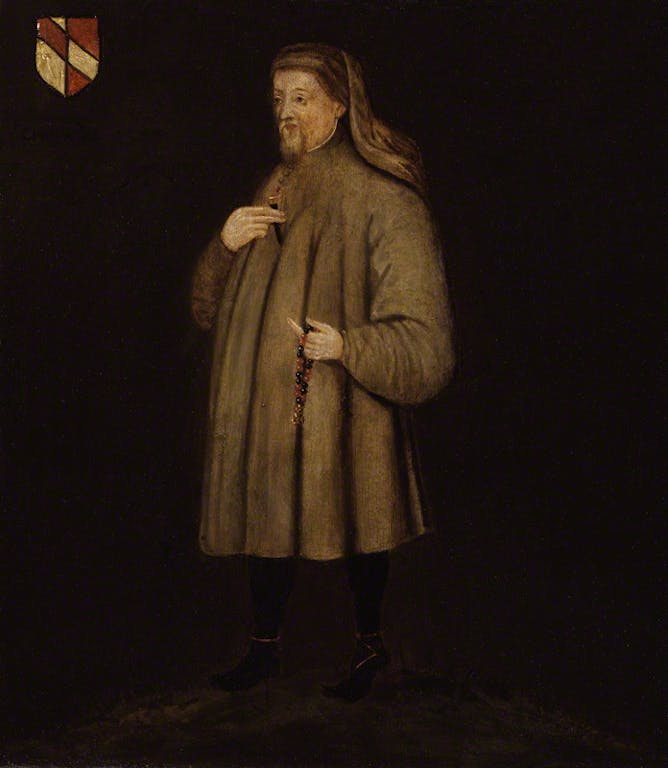
The most famous medieval English author, Geoffrey Chaucer, lived and worked in London in the 1380s. His poetry could be deeply critical of the changing times. In the dream vision poem “The House of Fame,” he depicts a massive failure to communicate, a kind of 14th-century Twitter in which truths and falsehoods circulate indiscriminately in a whirling wicker house. The house is – among other things – a representation of medieval London, which was growing in size and political complexity at a then-astounding rate.

Geoffrey Chaucer.
Wikimedia Commons

In a different poem, “Troilus and Criseyde,” Chaucer worries that future generations will “miscopy” and “mismeter” his poetry because of language change. Millennials might be bankrupting the napkin industry, but Chaucer was concerned that younger readers would ruin language itself.

Winner and Waster,” an English alliterative poem probably composed in the 1350s, expresses similar anxieties. The poet complains that beardless young minstrels who never “put three words together” get praised. No one appreciates old-fashioned storytelling any more. Gone are the days when “there were lords in the land who in their hearts loved / To hear poets of mirth who could invent stories.”

William Langland, the elusive author of “Piers Plowman,” also believed that younger poets weren’t up to snuff. “Piers Plowman” is a psychedelic religious and political poem of the 1370s. At one point, Langland has a personification named Free Will describe the sorry state of contemporary education. Nowadays, says Free Will, the study of grammar confuses children, and there is no one left “who can make fine metered poetry” or “readily interpret what poets made.” Masters of divinity who should know the seven liberal arts inside and out “fail in philosophy,” and Free Will worries that hasty priests will “overleap” the text of the mass.

On a larger scale, people in 14th-century England began worrying that a new bureaucratic class was destroying the idea of truth itself. In his book “A Crisis of Truth,” literary scholar Richard Firth Green argues that the centralization of the English government changed truth from a person-to-person transaction to an objective reality located in documents.

Today we might see this shift as a natural evolution. But literary and legal records from the time reveal the loss of social cohesion felt by everyday people. They could no longer rely on verbal promises. These had to be checked against authoritative written documents. (Chaucer himself was part of the new bureaucracy in his roles as clerk of the king’s works and forester of North Petherton.)

In medieval England, young people were also ruining sex. Late in the 15th century, Thomas Malory compiled the “Morte d’Arthur,” an amalgam of stories about King Arthur and the Round Table. In one tale, Malory complains that young lovers are too quick to jump into bed.

“But the old love was not so,” he writes wistfully.

If these late medieval anxieties seem ridiculous now, it’s only because so much human accomplishment (we flatter ourselves) lies between us and them. Can you imagine the author of “Winner and Waster” wagging a finger at Chaucer, who was born into the next generation? The Middle Ages are misremembered as a dark age of torture and religious fanaticism. But for Chaucer, Langland and their contemporaries, it was the modern future that represented catastrophe.

These 14th- and 15th-century texts hold a lesson for the 21st century. Anxieties about “kids these days” are misguided, not because nothing changes, but because historical change cannot be predicted. Chaucer envisioned a linear decay of language and poetry stretching into the future, and Malory yearned to restore a (make-believe) past of courtly love.

But that’s not how history works. The status quo, for better or worse, is a moving target. What’s unthinkable to one era becomes so ubiquitous it’s invisible in the next.

Millennial bashers are responding to real tectonic shifts in culture. But their response is just a symptom of the changes they claim to diagnose. As millennials achieve more representation in the workforce, in politics and in media, the world will change in ways we can’t anticipate.

The ConversationBy then, there will be new problems and a new generation to take the blame for them.
Eric Weiskott, Assistant Professor of English, Boston College

This article was originally published on The Conversation. Read the original article.

Unknown's avatar

From The Secret Garden to Thirteen Reasons Why, death is getting darker in children’s books


File 20170613 23620 1wy8o53
Young adult literature is starting to explore death in depth.
Lionsgate

Erin Farrow, Victoria University

The inevitable and universal nature of death has made it a popular topic of children’s literature. While death has appeared in these stories for centuries, death in young adult novels has become much darker and more complex.

The recent controversy over Netflix’s adaptation of the novel Thirteen Reasons Why, which depicts the aftermath of teen suicide, shows that dealing with death in kids’ fiction can be fraught. While some defended the show’s graphic depiction of suicide, others argued it was gratuitous and dangerous.

This raises the question of whether children’s literature and young adult fiction is still a safe place to discuss death. At the recent Emerging Writer’s Festival panel, Sex, Death and YA, young adult literature was celebrated for exploring such complex themes. While there may be a trend toward darker themes in literature written for a young adult audience, there is still room for hope.

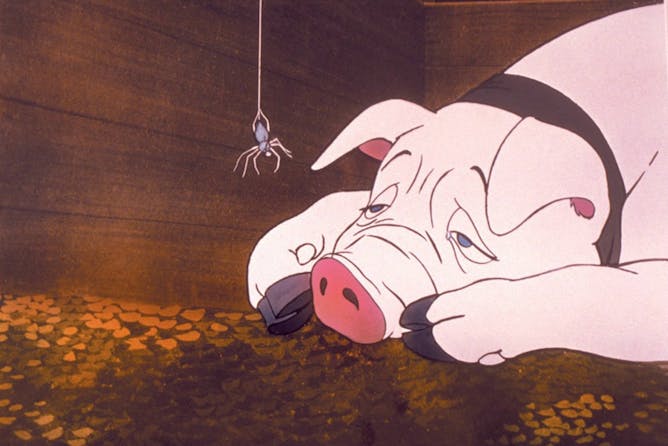
Charlottes’ Web (1973) manages to deal with death by making the subject a spider instead of a person.
Hanna-Barbera Productions

Putting death on the page

When early works of children’s literature broached the topic of death, it was usually to show how the protagonist copes in the aftermath of the death of a family member or friend. In many of these early works, depictions of death were softened for the reader, occurring outside the text. For instance, Mary’s parents in The Secret Garden (1911) die “off page”, which acts as a plot device to facilitate Mary’s arrival at Mistlethwaite Manor, where she discovers the secret garden. Charlotte’s Web (1952) softens the blow by making the characters non-human – in this case a spider.

Modern young adult novels are different. These texts not only depict young adult protagonists dealing with the aftermath of a loved one’s death, but also the trauma of witnessing it. Such as in the case of The Outsiders (1967), when the 14-year-old protagonist Ponyboy is present when his best friend Johnny dies in hospital and when Dally, a member of Ponyboy’s gang, is killed by the police.

In recent years, young adult novels have featured their protagonists doing the killing. The characters in books such as Harry Potter (1997), The Hunger Games (2008) and Tomorrow When the War Began (1993), struggle not only with the inevitability of death and the pain of losing loved ones, but also with the guilt and ethical dilemma of having to kill to survive.

The Fault in our Stars, both novel and film, deals with a terminally-ill character.
Fox 2000 studios

Life after death

There has recently been an influx of novels that present death from the perspective of the protagonist. These novels show characters who are terminally ill, presenting a rarely explored viewpoint in young adult novels – the perspective of dying. In books such as Sonya Hartnett’s Surrender (2005), Jenny Downham’s Before I Die (2007) and John Green’s The Fault in Our Stars (2012) the protagonist portrays the fear and pain of dying, the challenge of accepting one’s own mortality and the guilt of leaving their loved ones to cope after their death.

Other recent novels come from the perspective of someone who is already dead. They speak to the reader, and sometimes even their own friends and family, from beyond the grave, such as in Lauren Oliver’s Before I Fall (2010) and, although technically not a young adult novel, in Alice Sebold’s The Lovely Bones, which has been widely read by young people.

In the beginning of Jay Asher’s 2007 novel Thirteen Reasons Why it is made clear that the protagonist, Hannah Baker, has taken her own life. As the novel continues, Hannah’s story and the reasons for her actions are disclosed through a series of tapes, 13 in total, all recorded before her death.

The Netflix series also demonstrates the shift of how death is portrayed to an adolescent audience. While Asher’s novel leaves the method of Hannah’s suicide largely undisclosed, the series, released ten years after the book, portrays the suicide in excruciating detail.

Talking about death

There are many children’s picture books, such as The Heart and the Bottle by Oliver Jeffers, and Harry & Hopper written by Margaret Wild and illustrated by Freya Blackwood, that talk about death to help parents discuss the concept with young children, possibly for the first time. When talking to kids about loss and grief the Victorian government’s Better Health Channel recommends the use of “storybooks” to explain death, stating that, “It is important to recognise children’s feelings and speak with them honestly and directly about death and grief”.

John Marsden’s Tomorrow series graphically depicts the effect of war on adolescents.
Goodreads

Why is the honest and direct depiction of death in young adult novels often so controversial? Perhaps it comes from a desire to shelter young readers from topics such as war, terrorism, and human mortality – topics that young adult readers not only read about in the news and on social media, but experience. Or perhaps it is because depicting death is seen to be void of hope. But possibly the idea of hope has also shifted, away from a fairytale notion of happily ever after and towards a reality that acknowledges the existence of darkness and light.

The ConversationThere is little research on the possible benefits of discussing death with young people. For those who are yet to be affected by the death of a loved one, reading about it from the perspective of another young adult can offer a way of building resilience. For those readers who have experienced the death of a family member or friend, being able to read about the experiences of others can offer consolation. Death is an indisputable part of adolescent lives, and books can provide a place for them to reflect on its influence on life.

Erin Farrow, PhD Candidate and Academic Sessional, Victoria University

This article was originally published on The Conversation. Read the original article.

Unknown's avatar

How to encourage literacy in young children (and beyond)


File 20170704 13632 caakrr
Ask your child what their toys did while they were out today or invite them to help you read the mail.
Evgeny Atamanenko/Shutterstock

Louise Phillips, The University of Queensland and Pauline Harris, University of South Australia

How can parents best help their children with their schooling without actually doing it for them? This article is part of our series on Parents’ Role in Education, focusing on how best to support learning from early childhood to Year 12.


Literacy involves meaning-making with materials that humans use to communicate – be they visual, written, spoken, sung, and/or drawn. Definitions vary according to culture, personal values and theories.

We look to a broad definition of literacy as guided by UNESCO to be inclusive for all families. Children learn to be literate in a variety of ways in their homes, communities and places of formal education.

What research tells us

New research in three-to-five-year-old children’s homes and communities in Fiji, has revealed that children’s regular engagement in literacy across many different media has supported good literacy outcomes.

There were ten main ways of engaging in literacy-building activities. These included print and information, communication and entertainment technologies, arts and crafts, making marks on paper, screens and other surfaces like sand and concrete, reading and creating images, and talking, telling and acting out stories that were real or imagined.

Children also engaged with reading, recording and talking about the environment, reading signs in the environment, engaging in music, dance, song and, lastly, with texts and icons of religions and cultures.

These activities were enjoyed and valued by children and their families as part of their everyday lives, and were further bolstered by creating books with children in their home languages and English.

Parents and communities include their children in daily activities, encouraging their literacy experiences.
ChameleonsEye/Shutterstock

This research can be used to add to our discussions on how parents can help develop their children’s early literacy.

The Melbourne Institute of Applied Economic and Social Research found daily reading to young children improves schooling outcomes, regardless of family background and home environment.

The OECD Program for International Student Assessment (PISA) results also indicate a strong correlation between parents reading and storytelling with children in the early years and reading achievement at age 15, with those students performing one to two years above their peers.

However, it is not just being read to that matters. The adult-child interactions are also very important.

These interactions need to be lively and engage children with the text-in-hand. Alphabet toys and phonics programs alone offer little to develop literacy, as they focus on a code without contextual meaning. Words, and their letters and sounds, are best understood when seen and applied in everyday experiences, driven by children’s motivations.

How to be a talking, reading, writing, viewing, and listening family

There are several practical things parents can do to encourage broad literacy and learning in early childhood years.

  1. Don’t wait. Read what you are reading aloud to your newborn. Children become attuned to the sound of your voice and the tones of the language you speak as their hearing develops.

  2. Share stories at mealtime. Provide prompts like: “Tell us what your teddy did today”. Alternatively, randomly select from ideas for characters, problems, and settings, for example: “Tell us about an inquisitive mouse lost in a library”. Oral storytelling provides a bridge to written stories.

  3. Record on your phone or write down your child’s stories. Turn them into a book, animation, or slide show (with an app). Children will see the transformation of their spoken words into written words. These stories can be revisited to reinforce learning of words, story structure and grammar.

  4. Talk about their experiences. For example, prompt them to describe something they have done, seen, read or heard about. Research shows children’s oral language supports their literacy development, and vice-versa.

  5. Guide literacy in your children’s play, following their lead. For example, help them follow instructions for making something, or use texts in pretend play, such as menus in play about a pizza place. Children will engage with various texts and the purposes they have in their lives.

  6. Books, books, books. For babies and toddlers, start with durable board books of faces, animals and everyday things with few words that invite interactivity (e.g., “Where is baby?”). Progress to more complex picture books with rhyming language. Talk about personal links with the stories and ask questions (such as “I wonder what will happen next or where they went to”) as these will support comprehension. Look to the Children’s Book Council for awarded quality children’s literature.

  7. Talk about words children notice. Be sure the words make sense to children. Talk about what words look like, what patterns, letters and sounds they make. This builds children’s word recognition and attack skills, and understanding of what words in context mean.

  8. Involve your children in activities where you use literacy. For example, if you make shopping lists or send e-cards, your children could help create these with you. Explain what you are doing and invite children’s participation (e.g., “I’m looking at a map to see how to get to your friend’s house”). Children can meaningfully engage with and create texts and see the place these texts have in their lives.

  9. Use community and state libraries. Most offer interactive family literacy programs. Early Years Counts and The Australian Literacy Educators Association has a range of resources for families.

The ConversationAbove all, be sure the experience is enjoyable, playful, and encourages children’s active involvement. Literacy should be engaging for your children, not a chore.

Louise Phillips, Lecturer, School of Education, The University of Queensland and Pauline Harris, Research Chair in Early Childhood, University of South Australia

This article was originally published on The Conversation. Read the original article.

Unknown's avatar

Read, listen, understand: why non-Indigenous Australians should read First Nations writing


File 20170703 32578 hod947
Alexis Wright won the Miles Franklin award for her 2006 novel Carpentaria.
AAP Image/Dean Lewins

Meera Atkinson, University of Sydney

Do you read Australia’s First Nations (Indigenous) writers? If not, why not? People read for many reasons: information, entertainment, escape, to contemplate in company, to be moved. Reading can also be a political act, an act of solidarity, an expression of willingness to listen and to learn from others with radically different histories and lives.

In his new book, Australia’s Unthinkable Genocide, professor Colin Tatz writes that Australia suffers from “wilful amnesia”; storytelling is a way of remembering.

Despite good intentions, Royal Commissions, and endless policy initiatives such as Closing the Gap, conditions for many First Nations people remain unacceptable. During National Reconciliation Week, the Uluru Statement from the Heart was released, calling for “the establishment of a First Nations Voice enshrined in the Constitution”. Even if there remain differences of opinion within First Nations communities as to process and aims, the onus is on non-Indigenous Australians to respect First Nations demands to speak and be heard.

The time is well overdue for non-Indigenous Australians to engage with the First Nations of this country, and their narratives, on their terms. Interest in the experience and concerns of others is crucial to combating social ills like racism. Writing and reading literature can be acts of intimacy, and as such reading can be a vital form of listening.

Where to start?

In Australia, white writers and scholars are more read than writers and scholars of colour. Non-Indigenous Australians often simply fail to seek out other voices and perspectives. Sometimes it’s a case of not knowing where to start.

Tony Birch and Sandra Phillips have offered excellent suggestions for those keen to explore First Nations writing, and as Michelle Cahill points out, literary journals are also a rich source of discovery.

My own list is by no means definitive or exhaustive. It is but a handful of books I view as important reading. These are unique literary voices that command attention.

Don’t Take Your Love to Town
Ruby Langford Ginibi (Penguin Books 1988, UQP 2007)


Goodreads

This bestselling autobiography precedes the impressive entries into the emerging 21st century First Nations canon that follow. It is a contemporary classic of Australian literature, and it was the first book I read by a First Nations writer. Published the same year of Australia’s contested “bicentenary”, Langford Ginibi’s story continues to test the learned indifference of white Australians. Written during the Royal Commission into Aboriginal Deaths in Custody, Don’t Take Your Love to Town tells the tale of a woman caught at the intersection of gendered and raced injustice with admirable and endearing honesty.

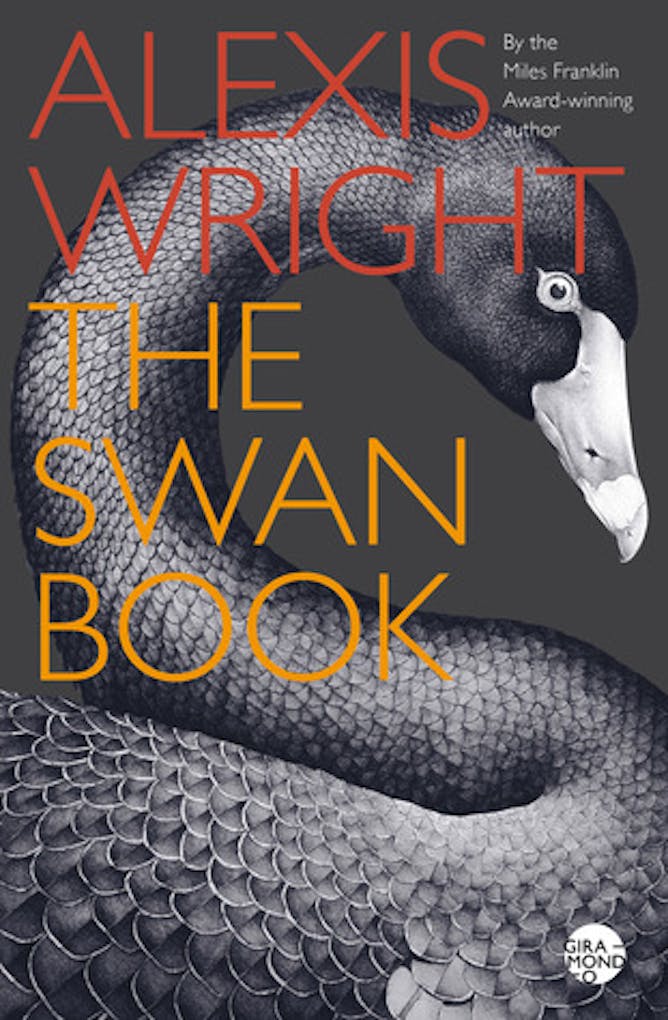
Carpentaria and The Swan Book
Alexis Wright (Giramondo 2006, 2013)


Goodreads

I’ve written about Carpentaria in an essay for Reading Australia, and I discuss both books at length in my forthcoming academic book The Poetics of Transgenerational Trauma. In short, these books matter. This is innovative writing forging cross-cultural trauma testimony that portrays a country in crisis and in desperate need of recovery from the devastating realities of colonialism and racism. There’s no way around it, Wright is not an easy read. These two novels are as far from literary comfort food as it gets. But those able to relax into Wright’s wildly experimental world-making are rewarded with insights and nothing less than a renewed vision of this land and appreciation for the complex communities that inhabit it.

Dirty Words
Natalie Harkin (Cordite Books 2015)

One of my favourite books of recent years, Dirty Words is a whip-smart conceptual collection of poems about the state of the nation and the spectre of its shameful history. Authored by a Narungga scholar and creative practitioner, this slim volume may well knock your socks off and leave you questioning everything you read and hear. Harkin’s poems about the domestic servitude of her Narungga forebears might even move you to tears.

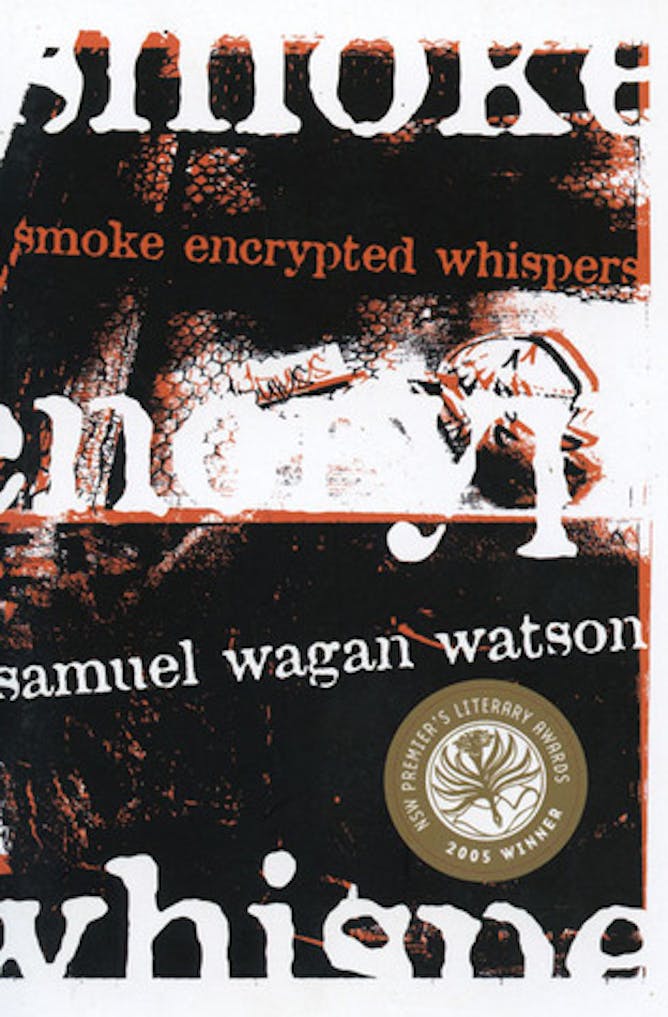
Smoke Encrypted Whispers
Samuel Wagan Watson (UQP 2004)

“Childhood anxieties would eventually help me realise the power of imagination”, writes Wagan Watson in “author’s notes # 1”. This generous, award-winning collection of poems later became a multi-modal arts project when its cycle of 23 poems served as inspiration for musical compositions. Poems like “white stucco dreaming” evoke familial ties within societal divides and the daily rituals of suburbia, while “a verse for the cheated” depicts the hidden tragedies of Queensland’s glamorous coastal tourist traps. At times Wagan Watson turns his muscular lyricism outward to consider the world at large, but he soon circles back to home-grown griefs and wonders.

Other highly recommended titles

Heat and Light
Ellen van Neerven (UQP 2014); Inside my Mother
Ali Cobby Eckermann (Giramondo Poets 2015); Mogwie-Idan: Stories of the Land
Lionel Fogarty (Vagabond Press 2012)

These books do the crucial work of testifying to transgenerational trauma and representing and celebrating surviving First Nations cultures and peoples. Each demonstrates, as Tony Birch puts it, the “potential for Aboriginal writing to productively shift the national story”.

Witnessing trauma

Australians, generally speaking, have an inadequate understanding of transgenerational trauma and underestimate the effects of the extreme and sustained traumas experienced by First Nations communities. Transgenerational trauma is the process by which trauma is passed down through successive generations.

There is some debate about if and how this takes place, but transmission likely has various pathways through families, individuals, and culture at large. Colonialism and its aftermath – frontier wars, slavery, dispossession, and stolen children – proved a hotbed for severe traumas and legacies of transmission. The challenge is for non-Indigenous Australians to take responsibility for their own education and become familiar with the voices and concerns of those who have peopled this continent for eons.

Given the depth and scope of the inequity, clearly much more than reading alone is called for. But reading truth-telling accounts of our history and contemporary Australia by First Nations writers is one way of participating in a national dialogue.


What’s your favourite book by a First Nations writer? Leave your recommendations in the comments below.

The ConversationRead also: a Warlpiri translation of ‘Dreamtime’ and ‘The Dreaming’ – an introduction.

Meera Atkinson, Sessional Tutor, Creative Writing, University of Sydney

This article was originally published on The Conversation. Read the original article.

Unknown's avatar

Julius Caesar in our times


File 20170616 1205 oltgpb
Gregg Henry portrays President Donald Trump in the role of Caesar in the Public Theater’s Free Shakespeare in the Park production of ‘Julius Caesar,’ in New York City.
Joan Marcus/The Public Theater via AP

Jyotsna G. Singh, Michigan State University

“All the world’s a stage,” Shakespeare once wrote.

In recent weeks, that Shakespearean adage has been particularly resonant, with the New York Public Theater’s production of “Julius Caesar” attracting worldwide scrutiny because of the staged likeness between Caesar and President Trump.

Extolling the play as a masterpiece about power and political violence, director Oskar Eustis persuasively defended his interpretation as a warning about “what happens when you try to preserve democracy by nondemocratic means.”

Others, however, questioned whether this production was in good taste – and denounced it for encouraging violence against President Trump, particularly the scene in which Caesar is stabbed to death. Due to the backlash, Delta Airlines and Bank of America withdrew their corporate sponsorship.

In some ways, the contention – even rancor – of these debates about the Public Theater production would have delighted, and perhaps bemused, Shakespeare. They articulate the richness and urgency of our own democratic struggles – similar to the rich political complexity reflected in Shakespeare’s text itself.

Caesar in Shakespeare’s times

As Shakespeare wrote the play, he drew on Roman history, a popular topic in 16th-century England. But he was also commenting on the political conflicts of the era. The power struggles depicted in “Julius Caesar” mirrored ongoing concerns in England with legitimacy, tyranny and potential threats of rebellion and deposition against Queen Elizabeth I, who did not have an heir. These anxieties were also exacerbated by historical memories of the English Civil War, also called the War of the Roses, going far back as the deposition and death of Richard II.

Shakespeare’s Rome is a place of brutal struggles between democratic ideals and human ambition. The assassination of Caesar is one of the most important events in Roman history, and Shakespeare had inherited over 1,600 years of ambiguity, with little consensus over whether Caesar’s killing was justified. He incorporated these debates into his play, offering his viewers multiple perspectives on the characters. Caesar is either a heroic, benevolent ruler or tyrant; Brutus is either a patriot or assassin.

Shakespeare’s Caesar is clearly a leader and politician with power – including some vanity and propensity to flattery – but also with wide popular appeal. When he returns triumphant from wars, the conspirators fear he will become a tyrant, a “Colossus” whereby the “wide walls” of Republican Rome “encompass’d but one man.”

Yet he seems to love and trust his fellow Romans, warmly inviting Brutus and other conspirators to share wine. And we also learn he bequeaths to his people, on his death, his personal possessions: To every Roman citizen he gives “seventy-five drachmas” and “all his walks, His private arbours and new-planted orchards” for public use.

Shakespeare also gives Brutus, the leader of the assassination plot, a refined conscience throughout the play. It’s evident in the many discussions Brutus has with his fellow conspirators, and it’s summed up when he describes his motivation for killing Caesar: “If then [any] friend demand why Brutus rose against Caesar, then my answer: Not that I loved Caesar less but that I loved Rome more.”

“Julius Caesar” offers a complicated, even poignant vision at the end. It ends in civil war and the defeat of the conspirators, following their internal dissensions and accusations of betrayal. Brutus commits suicide, but Mark Antony and Octavius, Julius Caesar’s grandnephew, victorious at the end, acknowledge Brutus’s nobility and wish to bury him with honor. Toward the close of Shakespeare’s next Roman play, “Antony and Cleopatra,” we see Octavius Caesar emerge as the singular ruler of Rome. Importantly, then, the Republican, democratic ideal is defeated, both in the play and in the Western world (until the American Revolution).

A deeply democratic offering

Overall, this picture of a divided Rome – a mix of power politics, of stoic ideals giving way to ego – should give pause to modern audiences. From the shifting perspectives on competing ambitions we learn that all rigid value judgments of “good” and “evil” politicians can be relative – and problematic – in our contingent world.

Yet, the ideals of democracy – in Rome and in our own times – have to be constantly guarded against demagogues, who also may be idealists, of all political stripes. Productions of “Julius Caesar” have typically evoked topical political analogies. Even seemingly traditional, period productions, such as the current Royal Shakespeare Company’s version in Britain, resonate with topical relevance, enabling the audience to deduce connections to today’s political climate.

It may be true – as some have suggested – that the analogy between Julius Caesar and Donald Trump is a bit forced. Regardless, the production is, as one reviewer put it, “a deeply democratic offering, befitting both the Public and the public – and the times.”

As a researcher and teacher of Renaissance drama, I’ve studied Shakespeare’s role as a cultural icon across different societies, cultures and eras. It seems that no matter where (and when) his works are being performed, they provide us with a complex, poetic language for imagining and interpreting the intractable world in which we live.

The ConversationDuring politically contentious times, it’s befitting that we turn more – rather then less – to Shakespeare.

Jyotsna G. Singh, Professor, Department of English, Michigan State University

This article was originally published on The Conversation. Read the original article.

Unknown's avatar

What do protests about Harry Potter books teach us?


File 20170623 7817 1mo0y8j
What justifies keeping some books out of the hands of young readers?
Sodanie Chea, CC BY

Trisha Tucker, University of Southern California – Dornsife College of Letters, Arts and Sciences

On Monday, June 26, 2017, Harry James Potter – the world’s most famous wizard – will celebrate his 20th birthday. His many fans will likely mark the occasion by rereading a favorite Harry Potter novel or rewatching one of the blockbuster films. Some may even raise a butterbeer toast in Harry’s honor at one of three Harry Potter-themed amusement parks.

But not everyone will be celebrating Harry’s big day. In fact, a vocal group of Christians – usually identified as “Bible-believing” or fundamentalist Christians – has been resistant to Harry’s charms from the start. Members of this community, who believe the Bible to be literal truth, campaigned vigorously to keep J.K. Rowling’s best-selling novels out of classrooms and libraries. They even staged public book burnings across the country, at which children and parents were invited to cast Rowling’s books into the flames. These fiery spectacles garnered widespread media coverage, sparking reactions ranging from bemusement to outrage.

Harry Potter turns 20 on June 26.
Lesley Choa, CC BY-NC-ND

What could justify the use of such drastic measures to keep these books out of the hands of young readers?

The different views on Harry Potter

Book burnings may be relatively rare in modern America, but efforts to protect young readers from “dangerous” texts are not. Such texts, and the efforts to limit their readership, are the subject of a class I teach at the University of Southern California.

In this class, students survey a collection of books that have been challenged on moral, political and religious grounds. These include classics such as “1984” and “To Kill a Mockingbird,” as well as newer texts like “Persepolis” and “The Perks of Being a Wallflower.” The point is not to determine which challenges are “good” and which are “bad.” Instead, we seek to understand how differing beliefs about reading and subjectivity make certain texts seem dangerous and others seem safe to particular populations of readers.

Harry Potter is one of the first books we discuss.

Most readers of Rowling’s novel – including many Christian readers – interpret the characters’ tutelage in spells and potions as harmless fantasy, or as metaphors for the development of wisdom and knowledge. Similarly, they read incidents in which Harry and his friends disobey adults or make questionable choices as opportunities for characters and readers alike to learn important lessons and begin to develop their own moral and ethical codes.

What makes some literary texts appear ‘dangerous?’
kayepants, CC BY-NC-SA

For some fundamentalist Christians, however, Harry’s magical exploits pose an active danger. According to them, Hogwarts teaches the kinds of witchcraft explicitly condemned as punishable by death and damnation in the biblical books of Deuteronomy and Exodus. They believe the books must be banned – even burned – because their positive portrayal of magic is likely to attract unsuspecting children to real-world witchcraft.

Similarly, they think that when Harry disobeys his cruel Muggle guardians or flouts Dumbledore’s rules to save his friends, he actively encourages child readers to engage in lying and disobedience, which are explicitly forbidden by the Bible. As Evangelical writer Richard Abanes puts it,

“The morals and ethics in Rowling’s fantasy tales are at best unclear, and at worst, patently unbiblical.”

Making assumptions

Why don’t Bible-believing Christians trust young readers to discern the difference between fantasy and reality? And why don’t they think children can learn positive lessons from Harry’s adventures – like the importance of standing up to injustice?

According to scholar Christine Jenkins, people who try to censor texts often hold a set of false assumptions about how reading works.

One of those assumptions is that particular literary content (like positive portrayals of witchcraft) will invariably produce particular effects (more witches in real life). Another is that reactions to a particular text are likely to be consistent across readers. In other words, if one reader finds a passage scary, funny or offensive, the assumption is that other readers invariably will do so as well.

As Jenkins points out, however, research has shown that readers’ responses are highly variable and contextual. In fact, psychologists Amie Senland and Elizabeth Vozzola have demonstrated this about readers of Harry Potter.

Readers’ responses can vary widely.
Seamus McCauley, CC BY

In their study comparing the perceptions of fundamentalist and liberal Christian readers of Harry Potter, Senland and Vozzola reveal that different reading responses are possible in even relatively homogeneous groups. On the one hand, despite adults’ fears to the contrary, few children in either group believed that the magic practiced in Harry Potter could be replicated in real life. On the other, the children disagreed about a number of things, including whether or not Dumbledore’s bending of the rules for Harry made Dumbledore harder to respect.

Senland and Vozzola’s study joins a body of scholarship that indicates that children perform complex negotiations as they read. Children’s reading experiences are informed by both their unique personal histories and their cultural contexts.

In other words, there’s no “normal” way to read Harry Potter – or any other book, for that matter.

Distrusting child readers

Fundamentalist Christians aren’t the only group who have trouble trusting the capabilities of child readers.

Take the case of “To Kill a Mockingbird.”

For decades, parents have argued that Harper Lee’s novel poses a danger to young readers, and have sought to remove it from classrooms for this reason. Some parents worry that the novel’s vulgar language and sexual content will corrupt children’s morals, while others fear that the novel’s marginalization of black characters will damage the self-image of black readers.

Despite their different ideological orientations, I believe that both of these groups of protesters – like the fundamentalists who attempt to censor Harry Potter – are driven by surprisingly similar misapprehensions about reading.

In all of these cases, the protesters presume that being exposed to a phenomenon in literature (whether witchcraft, foul language or racism) naturally leads to a reproduction of that phenomenon in life. They also believe that their individual experience of a text is correct and applicable to disparate readers.

The ConversationThese cases of attempted censorship show a profound distrust of child readers and their imaginations. And they ignore evidence that child readers are far more sophisticated than adults tend to credit them for.

Trisha Tucker, Assistant Professor of Writing, University of Southern California – Dornsife College of Letters, Arts and Sciences

This article was originally published on The Conversation. Read the original article.