Unknown's avatar

Inside North Korea’s literary fiction factory


File 20180123 33564 16n5jhg.jpg?ixlib=rb 1.1
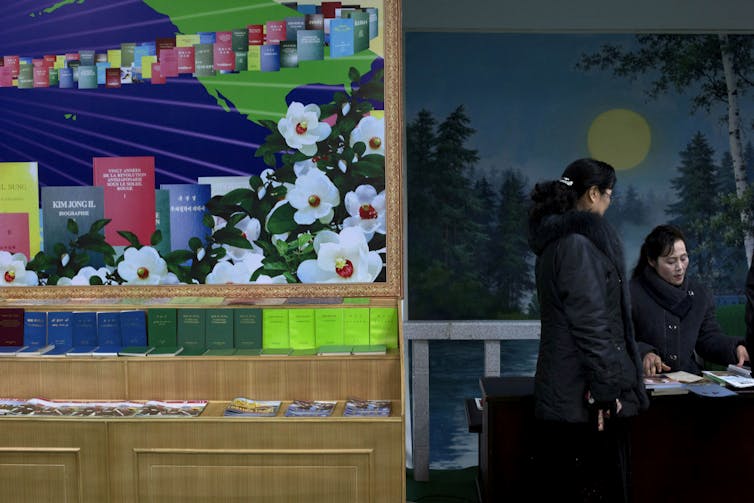
North Korean women work at the cashier table of a bookstore in Pyongyang, North Korea.
AP Photo/Ng Han Guan

Meredith Shaw, University of Southern California – Dornsife College of Letters, Arts and Sciences

With colorful rhetoric about dotards and nuclear buttons, North Korean propaganda is attracting attention around the world.

Outside observers can now easily access some of this propaganda by visiting regime-sponsored websites. These have, in turn, spawned foreign feeds like the excellent KCNA Watch media aggregator and satirical sites such as “Kim Jong Un Looking at Things.”

However, there’s another side to North Korean political messaging, one directed at the domestic population.

Difficult to access and written in a highly stylized, dogmatic prose, North Korea’s domestic propaganda is not only largely ignored abroad, but it’s also difficult for even South Koreans to understand. It includes state-sponsored Chosun Central TV broadcasts, state-produced films, and revolutionary operas and ballads.

But one of the more illuminating forms of internal propaganda is the regime’s state-produced fiction. Published in monthly literary journals, these stories are distributed by the ruling Korean Workers’ Party to select schools and offices around the country.

In an effort to make this internal propaganda more accessible to non-Koreans, I have been translating and blogging about selected works of North Korean fiction as part of my research on North Korean cultural politics.

These stories can offer outsiders revealing insights into the regime’s shifting concerns and priorities, which include a recent campaign to reinforce the legitimacy of their young leader, Kim Jong Un.

Penning tales for the regime

No other autocratic regime today has such a well-developed stable of artists and writers producing works aligned with the party’s ideological needs. The ruling Korean Workers’ Party has an extensive bureaucracy in charge of training talent, defining standards and commissioning projects in literature and other branches of the arts.

Like most professionals within North Korea, fiction writers belong to their own organization within the ruling Korean Worker’s Party: the Chosŏn Writer’s Union. The Party, therefore, has direct control over what gets written about and which themes get emphasized.

Works of fiction are published in one of a handful of monthly literary journals, the most prestigious of which is Korean Literature, produced by Chosŏn Literature and Art Union Publishing. Other journals include Children’s Literature, Youth Literature and Literary Newspaper.

Within the Chosŏn Writer’s Union, the most elite authors comprise the April 15 Literary Production Unit. This group has produced all the major works dramatizing the personal histories of the leaders, including the “Immortal History” (Pulmyŏl ŭi Yŏksa) and “Immortal Leadership” (Pulmyŏl ŭi Hyangdo) series, which constructed the official hagiography of Kim Il Sung and Kim Jong Il, respectively.

The list of authorship of new fiction about Kim Jong Un reveals many well-known names from these series, including Kim Sam Bok, Baek Bo Hŭm and Chŏng Ki Jong. Chŏng, one of North Korea’s most well-known contemporary authors, passed away in 2016, but not before penning the short story “Sky, Earth and Sea,” which details Kim Jong Un’s role in the Ŭnha and Gwangmyŏngsŏng satellite launches.

Since consumer demands and preferences are irrelevant to the creation of North Korean fiction, it cannot be evaluated as a reflection of the average North Korean’s underlying social anxieties (which is how a cultural anthropologist might study literature). Through interviews with North Korean defectors living in Seoul, I found that most North Koreans don’t spend their leisure time reading these journals for fun. Many, however, told me that they had been exposed to these stories at some point in school.

The anthropologists’ loss, however, is the political scientists’ gain. North Korean fiction offers a window into the ruling party’s priorities that’s just as informative as its official, externally directed propaganda.

Reading between the lines

Many of these stories dramatize events in the leaders’ lives. Some are morality tales that showcase characters who embody certain socialist ideals. Others reflect concerns about the geopolitical landscape – and, not surprisingly, American leaders sometimes make guest appearances.

Chŏng Ki Jong’s most famous novel, “Ryŏksa ui Taeha,” depicts President Bill Clinton cowering under blankets during the 1994 nuclear crisis. Another short story from around that time, “Maehok,” tells the story of President Jimmy Carter’s famous 1994 visit from the perspective of his wife Rosalynn, as she meets (and is smitten with) the Great Leader Kim Il Sung.

More recently, however, stories have centered on one subject: Kim Jong Un.

Kim was formally designated as successor in September 2010. Prior to that, his very existence had been virtually unknown to the general public within the country. In a country where schoolchildren ritualistically memorize idealized accounts of their leader and his ancestors, it must have been mind-boggling to see a new leader on TV that they knew almost nothing about.

The regime had to rush to put together a personal legend worthy of the grandson of the nation’s founder. The first works of fiction to mention Kim by name appeared in early 2013, over a year after he succeeded his late father as leader. In these stories, there’s a marked thematic shift, with an emphasis on youth, creativity and innovation.

For example, the 2017 short story “Blossoming Dreams,” by Kim Il Su, depicts the young leader as a talent scout of sorts. He finds gifted young artists and architects and encourages them to participate more fully in various national construction projects. At one point he pontificates to one of his advisers about the value of youthful thinking:

“Our future as a socialist nation of culture will not be built by architects and experts alone. It will require all our citizens to become gardeners and creators adorning our country with beauty. And it is the young generation that must stand up to bring about this bright future. Lately, I hear the saying ‘everything’s getting younger,’ but isn’t that wonderful? This era is young, and our people are getting younger … ”

References to new luxuries and recreational facilities are another notable feature of recent stories. Since Kim became supreme leader, he has poured resources into developing Western-style amusements such as water parks and ski resorts.

One such site, the Rungna People’s Pleasure Ground, attracted international media attention after Kim Jong Un toured the facility in 2012 on his first official photo op with his new wife. An ode to the Rungna park appeared in Literary Newspaper in October 2012, celebrating it as “the creation of heaven and earth following the leader’s path.” In “Blossoming Dreams,” Kim Jong Un’s faithful minister of architecture recalls how the young leader “suffered in the summer heat and fierce winds” when touring the site of the soon-to-be-opened theme park.

A similar prestige project is the new Changjŏn Street complex in Pyongyang, which features gleaming, high-rise apartment buildings and sports facilities.

In “Teacher,” a short story published in 2013, a family of schoolteachers is thrilled to receive notice that they have been given a spacious new apartment in the Changjŏn complex. The family is surprised to learn they made the list: It’s well known that the first apartments were supposed to go to “workers and innovators.” Later it becomes clear that Kim Jong Un personally directed that some apartments be set aside for educators as well, as part of a general priority for “cultivating the next generation.”

North Korean fiction, of course, shouldn’t be interpreted as a realistic depiction of actual conditions within the country.

The ConversationBut by reading between the lines, one may discern clues to the regime’s internal concerns, along with the messages it is most eager to convey to its captive domestic audience.

Meredith Shaw, Ph.D. Candidate in the Politics and International Relations, University of Southern California – Dornsife College of Letters, Arts and Sciences

This article was originally published on The Conversation. Read the original article.
Unknown's avatar

Frankenstein at 200 and why Mary Shelley was far more than the sum of her monster’s parts


File 20180122 46244 y1z3q7.jpg?ixlib=rb 1.1
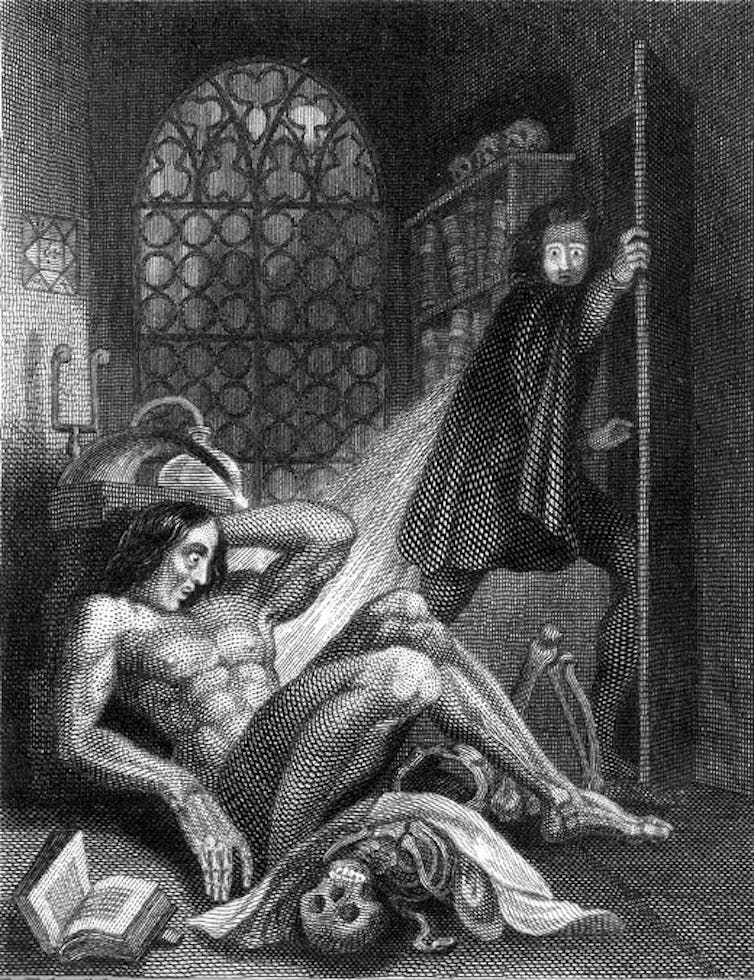
The frontispiece to the 1831 Frankenstein by Theodor von Holst, one of the first two illustrations for the novel.
Tate Britain. Private collection, Bath.

Angela Wright, University of Sheffield

Mary Wollstonecraft Shelley’s Frankenstein, or the Modern Prometheus was published anonymously 200 years ago in January, 1818. It has since become the most analysed and contested novel of all time.

It is cited today in debates on the ethics of scientific progress. The “Frankenstein effect” has become synonymous with questionable advances in genetics, in vitro fertilisation and artificial intelligence, evoking the spectre of dangerous science. It has become an example of what goes wrong when science goes too far.

When we return to Frankenstein’s origins, however, we uncover a different story. As Shelley was later to document, the story was forged during the Summer of 1816 in debates that took place between herself, her partner (later husband) Percy Bysshe Shelley, Lord Byron, her stepsister Claire Clairmont and John Polidori at the Villa Diodati on the shores of Lake Geneva.

There, she records, the group was debating the arguments of poet and chemist Sir Humphry Davy and discussed “the nature of the principle of life, and whether there was any probability of its ever being discovered and communicated”.

Shelley had accompanied her father William Godwin to hear Davy give his lectures on chemistry at the Royal Institution in 1812, and later, in 1816, she read his Elements of Chemical Philosophy as she was composing Frankenstein.

Davy’s account of science was mesmerising for the sheer excitement that it conveyed: “Science has … bestowed upon [man] powers which may be called almost creative,” he declared. Frankenstein, drawing upon the scientific advancements of its age, Erasmus Darwin’s early theory of evolutionary development in the 1790s, vitality, galvanism and Davy’s quest to determine the “hidden origins” of nature, partakes of the fascination and anxiety about scientific progress. But it is wrong to read the novel as being straightforwardly sceptical of scientific advancement.

‘A torrent of light’

Victor Frankenstein’s aims in creating new life are, after all, commendable. Reflecting the mixed aspirations of his mythological counterpart Prometheus, Frankenstein wishes to “pour a torrent of light into our dark world” and in so doing “renew life where death had apparently devoted the body to corruption”. He seeks to eradicate diseases which corrupt the human frame before its time.

These are not bad ambitions. But it is the way in which he pursues nature to “her hiding places” that makes his quest so fatal. Ventriloquising Shelley’s views, Frankenstein later observes that:

A human being in perfection ought always to preserve a calm and peaceful mind, and never to allow passion or a transitory desire to disturb his tranquillity. I do not think that the pursuit of knowledge is an exception to this rule.

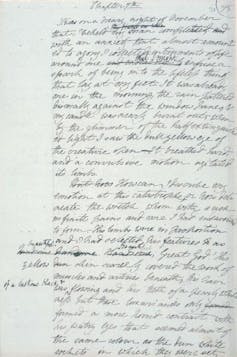
A manuscript page from Frankenstein by Mary Shelley.
Wikimedia Commons

Knowledge, Shelley argued, should always be pursued in tranquillity; creation should always be the intellectual fruit of a “peaceful mind”.

The words that Frankenstein utters can be read, too, as an expression of Shelley’s approach to authorship. Much has been made of her comparative youth when she wrote Frankenstein. The novel was begun when she was 18.

Despite the fact that Matthew Gregory Lewis, known to both Shelleys, published his own Gothic tale – The Monk (1796) – at the age of 21, some ask how such a young woman could have composed Frankenstein, and falsely ascribe authorship to Percy Bysshe Shelley.

Sir Walter Scott, reviewing Frankenstein for Blackwood’s Magazine, was the first to commit this error, commenting that it “is said to be written by Percy Bysshe Shelley, who, if we are rightly informed, is son-in-law to Mr Godwin”.

Shelley’s response to Scott’s review of her novel was swift. Writing to Scott on June 14, 1818, she pointed out his error, noting, “I am anxious to prevent your continuing in the mistake of supposing Mr Shelley guilty of a juvenile attempt of mine.”

Shelley’s response to Scott’s mistake was decisive in her assertion of authorship. Her journal further illustrates the intensive work that she invested in her manuscript.

Percy Bysshe Shelley may have edited her work, but this was the gesture of one who wished to support and encourage another’s authorial career. Frankenstein was the first in a line of seven novels by Shelley that she published across three decades.

The ConversationIt may be the one for which we now celebrate Shelley, but all of her works reveal an assertion of women’s rights to create as authors and artists, associating these rights with a calm pursuit of knowledge. Shelley, author of Frankenstein, cautious supporter of scientific advancement, was much, much more than the sum of the parts of her first monster.

Angela Wright, Professor of Romantic Literature, University of Sheffield

This article was originally published on The Conversation. Read the original article.
Unknown's avatar

Anthems, ‘ranthems’, and otherwise loves: nationalism in Australian poetry


File 20180123 182955 16vulc3.jpg?ixlib=rb 1.1
Dorothea MacKellar’s My Country, with its paen to a sunburnt landscape, excoriated Australians for their nostalgic love of English ‘grey-blue’ countryside and English weather.
Mark Wassell/flickr, CC BY-NC

Kevin Brophy, University of Melbourne

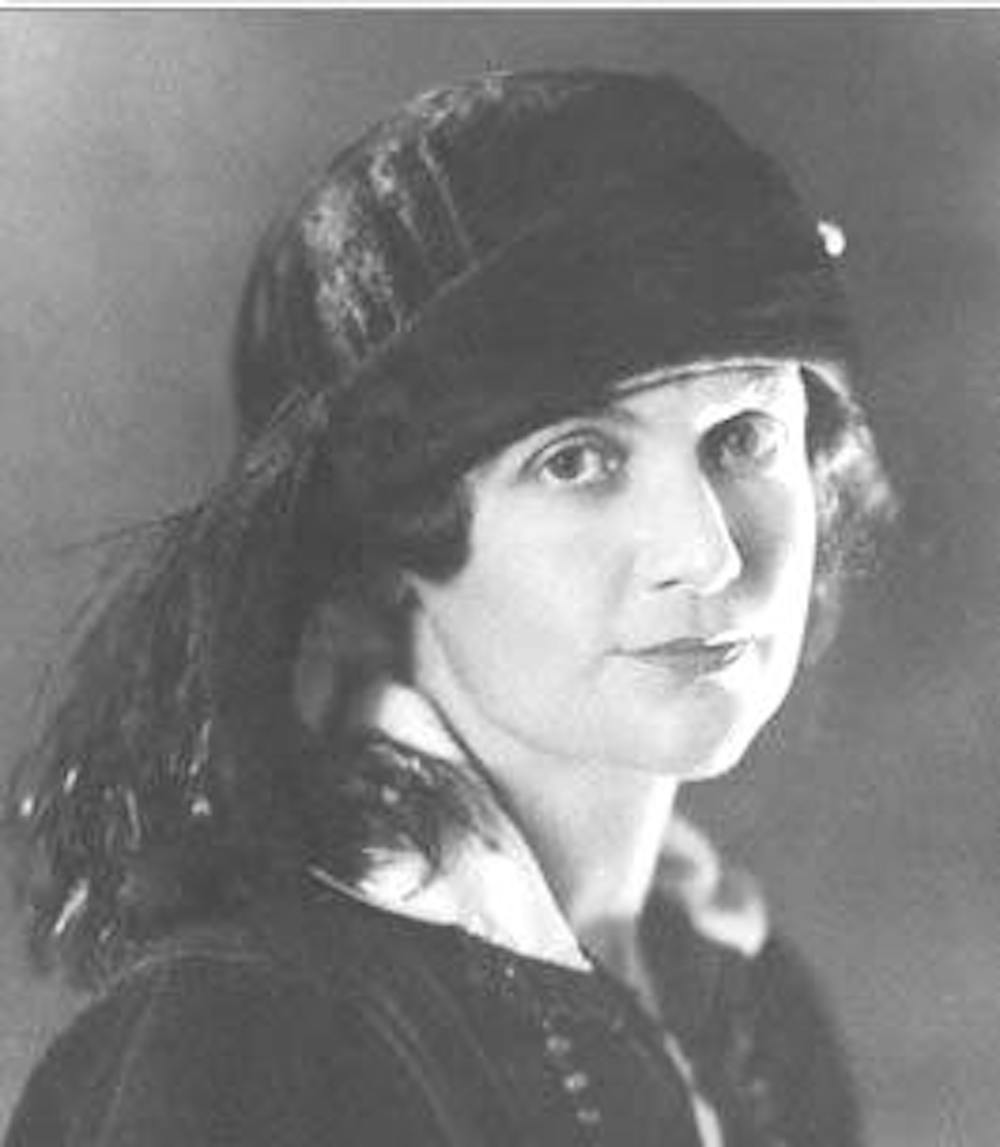
A young woman of 23, Dorothea MacKellar (1885-1968), had a poem published in the London Spectator in 1908, titled Core of My Heart. She was the daughter of a wealthy pastoral family, educated privately, a graduate of the University of Sydney. She is said to have written the first draft of the poem in 1905 in response to the breaking of a prolonged drought on the family cattle and tobacco farming property, Torryburn, near Maitland in NSW. The poem was also written in protest against the anti-Australianism of many Australians at that time, excoriating them for their nostalgic love of English “grey-blue” landscapes and English weather.

Dorothea Mackellar.
Wikimedia commons

Later, she re-titled the poem My Country and its second stanza remains the best known most quoted stanza of poetry in Australia, beginning with that belligerent, youthful and anthemic cry of “I love a sunburnt country”. She declared she could not share a love of “coppice”, “field”, “ordered woods” or “soft dim skies” because “My love is otherwise”.

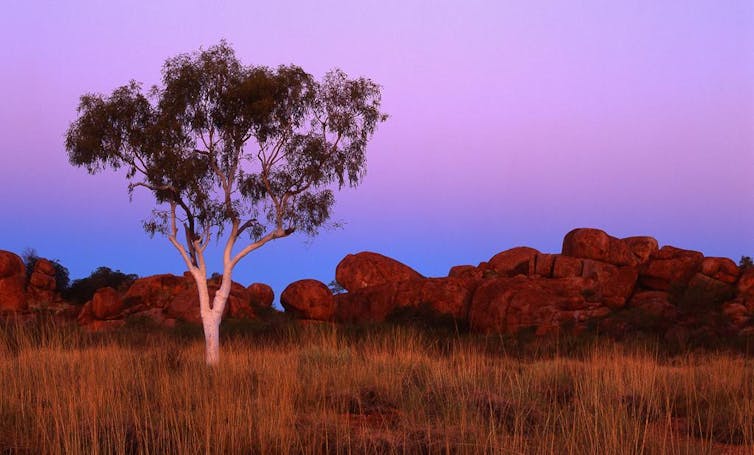
She was in effect working to create not only pride at being here in such a raw and dramatic and vast place, but to make a new vernacular against the prissiness of English idioms of paradise. She even declared, defiantly, a love for the “stark white ring-barked forest” so common to Australia’s landscapes. We have forgotten how much of a rant this anthemic poem was in its time. It was a poem openly turning truisms on their head, giving a new generation its new native voice.

And of course, the poem exaggerated its argument, and opened itself to ongoing arguments over what it might mean to be in Australia, to be Australian, to find an identity in triumphant harmony with this place.

Kevin Gilbert (1933-1993), born on the banks of the Lachlan (Kalara) River at Condobolin, the youngest of eight children, found himself on the receiving end of, as he put it, “White Australia’s apartheid system”. In hospitals, Kevin Gilbert and his people were confined to verandahs and given blankets with “Abo” stamped on them. In his New True Anthem, he found his own moment of protest in the undiminished arguments over nationalism:

Despite what Dorothea has said
about the sun scorched land
you’ve never really loved her
nor sought to make her grand
you pollute all the rivers
and litter every road
Your barbaric graffiti
cut scars where tall trees grow
the beaches and the mountains
are covered with your shame
injustice rules supremely
despite your claims to fame
the mud polluted rivers
are fenced off from the gaze
of travellers and the thirsty
for foreign hooves to graze
a tyranny now rules your soul
to your own image blind
a callousness and uncouth ways
now hallmarks of your kind
Australia oh Australia
you could stand proud and free
we weep in bitter anguish
at your hate and tyranny
the scarred black bodies writhing
humanity locked in chains
land theft and racial murder …

It’s not so much MacKellar he had in his sights, for she was a fellow poet of protest, and a fellow poet in love with the land, but it was the profiteers, the racist systems, polluters and exploiters of every kind he wanted to expose. How that word “grand” has been mis-used and degraded, how far we are from being “proud and free”. No punches are pulled in this anti-anthem, and all the necessary questions are asked. Kevin Gilbert’s poem participates in the tradition of the corrective poem of insult, adopting the anthem as an anti-starting point.

Anti-anthems

Alec Hope (1907-2000) similarly used the moment of Australia’s commitment of troops to the Second World War to write his famous poem, Australia, allowing himself to speak over the top of Dorothea MacKellar to paint Australia as “drab green and desolate grey”.

Her rivers of water drown among inland sands,
The river of her immense stupidity
Floods her monotonous tribes from Cairns to Perth.
In them at last the ultimate men arrive
Whose boast is not: ‘we live’ but ‘we survive’.
A type who will inhabit the dying earth.
And her five cities like five teeming sores,
Each drains her: a vast parasite robber-state
Where second-hand Europeans pullulate
Timidly on the edge of alien shores.

There is nothing in Australia to celebrate and very little to admire in European modernism. Our only hope (Hope?), he ends gloomily, from a place we might call “love-hate”, is to remember that from such deserts as we have in abundance, prophets do come.

And now, the new voices of new poets come to this troubled tradition and make a claim to a voice, a language, an imagery that might wake us up to who we are and where we might be going. Omar Musa, raised as a Muslim, whose heritage is Irish-Malaysian, inspired by his poet father and the example of Muhammed Ali, is more famous as a novelist, a rapper, a slam performer and a You Tube sensation than as a poet to be read in a slim volume of verse.

His new book, Millefiori, is a solid and powerful and sometimes heartfelt incursion into poetry publishing, a book quickly read, but one that needs to be lived with and read over a number of times if the inner voice is to come through and the imagery work on its reader.

The longest poem in the book is Ranthem, an anti-anthemic poem in the tradition of Dorothea MacKellar’s and Alec Hope’s outspoken, youthful defiance and Kevin Gilbert’s hard won anger:

The people tell me love it or leave it. Fuck that.
How about love-hate it and stay? I’ll carry the flame.
They try to disqualify everything that I say
Cos I’m a big brown brother with an Arabic name.
They call me ungrateful and unpatriotic.
Sheeeeit! That attitude is straight idiotic.
If loving your country means wanting change for the better
That means criticizing the ugly
Side of society ASAP.

We need this kind of poetry to be published, to be happening, to be out there provoking us and projecting images of ourselves that might push us, in Musa’s phrases, to be “nuanced, shift the lens, be brave and consider again”. There might be more accomplished poets, more worthy commentators, but it’s clear that this one’s got a voice that says a lot of what needs to be said just now, and we’re interested.

Musa comes to his poems as both himself and, like Hope and MacKellar and Gilbert, as a voice made by a generation:

But do I have the right to commentate at all?
A middle-class Aussie man, that’s a lot of gall.
Cos this isn’t about me, so maybe adding my voice
Is just making the debate more cloudy …
but part of me feels it’s way worse if I don’t say shit.

The ConversationYou can’t help but admire the ways he catches phrases and phrasing, but you listen too to what he’s saying, hearing the reframing of the whole country going on inside those Ranthems.

Kevin Brophy, Professor of Creative writing, University of Melbourne

This article was originally published on The Conversation. Read the original article.

Unknown's avatar

Google Assistant and Audiobooks


With Google’s arrival on the audiobook scene, it should come as no surprise that Google Assistant can now play your Google audiobooks.

For more visit the link below:
https://arstechnica.com/gadgets/2018/01/the-google-assistant-can-now-read-you-audiobooks-from-google-play/

Unknown's avatar

Apple iBooks Renewal Project


The link below is to an article reporting on changes at Apple iBooks and some thoughts on what is needed.

For more visit:
https://www.digitalbookworld.com/single-post/2018/01/25/Thoughts-on-Apple-Books

Unknown's avatar

Essays On Air: Why libraries can and must change


File 20180124 72597 ot1ryv.png?ixlib=rb 1.1
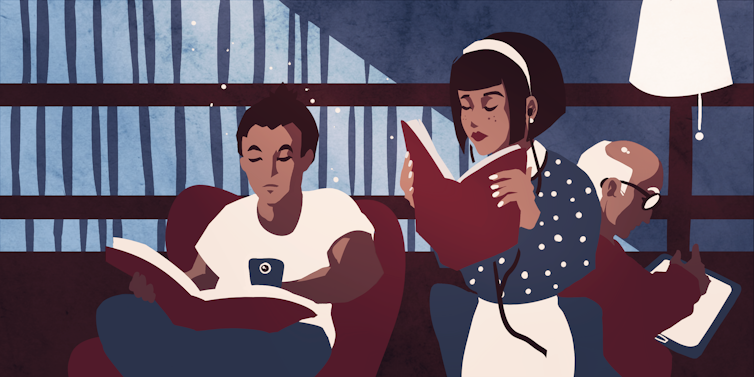
The much heralded ‘death of the book’ has nothing to do with the death of reading or writing. It is about a radical transformation in reading practices.
Marcella Cheng/NY-CC-BD, CC BY-NC-ND

Sunanda Creagh, The Conversation

In the age of the globalisation of everything – and the privatisation of everything else – libraries can and must change. In fact, it’s already underway, as new technologies take books and libraries to places that are, as yet, unimaginable.

That’s what we’re unpacking today on Essays On Air, where we bring you fascinating long form essays in audio form.

Today, Camilla Nelson, Associate Professor of Writing at the University of Notre Dame, reads her essay, titled Why libraries can and must change.

Nelson takes us from the ancient Library of Alexandria to the New York Public Library and explores the problems that arise when books are excluded, destroyed, censored and forgotten. And, indeed, when libraries are decimated.

Join us as we read to you here at Essays On Air, a podcast from The Conversation.

Find us and subscribe in Apple Podcasts, in Pocket Casts or wherever you get your podcasts.

Additional audio

Snow by David Szesztay

Big chain by daveincamas

Traffic noise in the street by jcgd2

Automatic door by Kyodon

Kids Birthday Party Crowd by jakobthiesen

Cardboard burning by Rare Mess Recordings

Plunger-pop by Quistard

environment 1st floor by mariiao2

Moderate waves on the edge of a river by Duophonic

breaking objects by deleted_user_3667256

Vacuum cleaner, by InspectorJ

Morning docks by nathanaellentz

Tearing paper by ScreamStudio

Shhh Sounds by AryaNotStark

Best Bernard Black Moments, Black Books by Channel 4

Ye Olde Green Inn by MAT64

Robo Hobo by The Freeharmonic Orchestra

The ConversationThis episode was edited by Jenni Henderson. Illustration by Marcella Cheng.
Sunanda Creagh, Head of Digital Storytelling, The Conversation

This article was originally published on The Conversation. Read the original article.

Unknown's avatar

Kindle Book License Limit


The link below is to an article that explains the Kindle Book License Limit and how to manage it.

For more visit:
http://blog.the-ebook-reader.com/2018/01/27/kindle-book-license-limit-explained/

Unknown's avatar

iBooks Being Revisited By Apple


The link below is to an article reporting on moves by Apple to revisit and update the iBooks reading experience to better compete with Amazon.

For more visit:
https://goodereader.com/blog/e-book-news/apple-is-revising-ibooks-app-to-better-compete-against-amazon

Unknown's avatar

Get yer hand off it, mate, Australian slang is not dying


File 20180121 110121 1ridt58.jpg?ixlib=rb 1.1
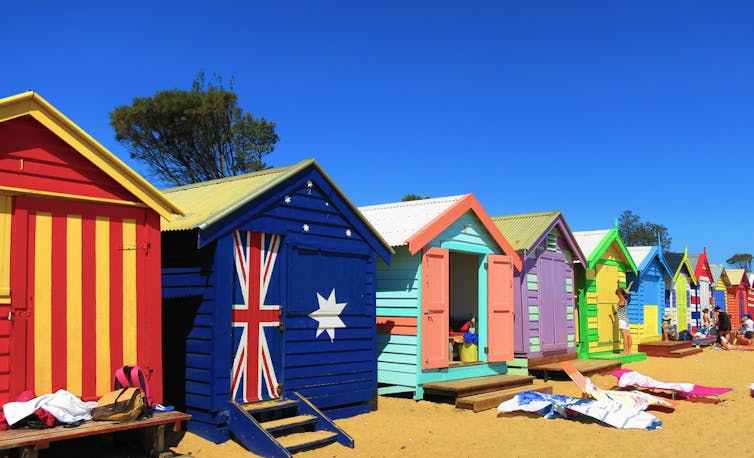
Aussie slang such as ‘budgie’, ‘greenie’, ‘pollie’, ‘surfie’, and even ‘mozzie’ are now also making appearances in global English.
shutterstock

Kate Burridge, Monash University and Howard Manns, Monash University

As the debate continues over whether Australia Day should be celebrated on January 26, this series looks at the politics of some unresolved issues swirling around Australia Day – namely, the republic and reconciliation. And just for good measure, we’ll check the health of Australian slang along the way.


The Australian attachment to slanguage (slang language) goes back to the earliest settlements of English speakers in Australia. As Edward Gibbon Wakefield noted in his 1829 Letter from Sydney:

The base language of English thieves is becoming the established language of the colony … No doubt [terms of slang and flash] will be reckoned quite parliamentary, as soon as we obtain a parliament.

Wakefield’s observation was spot-on. The cant of the underworld (so-called “flash” or “kiddy” language) flourished in these early days. Slang had become an important way of fitting in and avoiding the label “stranger” (or “new chum”) – and, as linguist Evan Kidd confirms, it still is.

Yet, every few years there’s a furphy that our beloved “Strine” slang is doing a Harold Holt.

Reports of the death of slang downunder are total bulldust

Early in 2017, the Australian pie company Four’N Twenty expressed its concern that Australians hadn’t been “slinging slang” enough, and so launched its “Save Our Slang” campaign, aimed at promoting some 70 you-beaut, dinky-di, true-blue Aussie-isms (bloke, bogan, grouse, straya, you bewdy, and so on).

A few years earlier, in 2014, the appearance of Tony Thorne’s Dictionary of Contemporary Slang sparked a series of articles heralding the end of the golden era of Australian slang, prompted by the fact that the work had added only three new (not terribly usual, to our mind) Australian terms: tockley “penis”, ort “buttocks” and unit “bogan”).

We commonly pin the blame for the death of Aussie slang on our anklebiters-cum-adolescents and their love of seppo (short for “septic tank”, rhyming slang for Yank) slang. But it’s worth noting seppo influence has been a lexical and moral concern at least since the introduction of American “talkies” in the 1920s, as documented by historian Joy Damousi:

… that influx of nauseous American slang and vile English which regularly appears upon the screen, and threatens to reduce the Australian vernacular to the level of the New York gutter-snipe.

It’s also worth noting that some of what we consider to be true-blue slang in fact finds its origins in – hold onto your Akubra – early contact with American English.

There was an influx of Americans to the goldfields from the 1850s, and they brought with them a bunch of American colloquialisms. These included bonza/bonzer, which is probably from American English bonanza (originally from Spanish and used in the US in the 1840s for a successful gold mine).

Even waltzing – “carrying” – is probably from American slang, or at least was used at the same time and in the same way. Sure, we have records of Australians “waltzing Matilda” in 1890, but Tom Sawyer and Huck Finn were “waltzing” with this same meaning (albeit sans Matilda) in 1884.

Australian slang: like the eggs of the codfish

Some align the disappearance of Aussie slang with Australia’s maturing as a nation.

Certainly words, more than other aspects of language, are linked to life and culture, and perhaps the changes in Australian society are such that the days of the chiacking larrikin (or cheeky lovable prankster) have passed?

But it is the nature of slang that there will always be a turnover of terms – today’s cobber is tomorrow’s mate, ranga for a redhead replaces blue/bluey, bogan replaces ocker and so on.

As American writer Gelett Burgess put it in his 1902 essay, In Defence of Slang:

Like the eggs of the codfish, one survives and matures, while a million perish.

An expression that fills a need becomes accepted but, as Burgess describes:

… it is a frothy compound, and the bubbles break when the necessity of the hour is past, so that much of it is evanescent.

His own brilliant creation blurb for “a short publicity notice” was clearly one of the eggs that survived – and thrived.

We are continuing to sling slang

It seems we get so obsessed with the death of Australian English that we miss those many great terms that are being created beneath our very eyes in Australia and by Australians. Just look at the slew of recent additions to the Australian National Dictionary (most stemming from the 1980s and 90s):

hornbag, snot block, checkout chick, houso, reg grundies, ambo, rurosexual, seppo, spunk rat (previously also spunk bubble), chateau cardboard, firie, tradie, trackie daks

And we continue to play with these terms – goon has been around for a while, but it keeps on inspiring new creations, including goon bag (1998), goon juice (2000), goon of fortune (2004), goon sack (2009), and so on.

The rhyming hoon is another great example of how language is always on the move. It’s attested as a noun in 1938 (“lout”, “exhibitionist”), but with the shift to “young hooligan, especially as a driver” in the late 80s, we see a rich proliferation of changes, including hoon as a verb (1988), and nouns denoting the act of being a hoon, including hoonery (1987), hoonishness (1993), hoondom (1998) and their weapon of choice, the hoonmobile (1994), with which they could be adjectives hooney or hoonish.

The other interesting thing about hoon is that it illustrates how one meaning can oust another. The driver sense of hoon has pushed out the pimp sense that existed alongside it from the 1950s to the turn of the century (a very rare case where a risqué meaning hasn’t won out).

So, slang continues to flourish. It’s also clear there’s no sign that we’re about to give up our shortenings – as seppo, firie and trackie daks attest, Australians still love abbreviations. And we are exporting them it seems.

Aussie contributions to world lexicon

Australian selfie was the Oxford Dictionaries “Word of the Year” for 2013 (the frequency of the word had increased by a whopping 17,000% since the previous year). Its success was astonishing – in the same year it was even crowned Dutch Word of the Year (no squeamishness about loanwords in the Netherlands).

But there are plenty of other success stories too: budgie, greenie, pollie, surfie, even mozzie are now also making appearances in global English, as are demo, preggo and muso. These join many other exports – no worries, like a rat up a drainpipe, to put the boot in, to rubbish (someone) to name a few.

Australia recently scored another global hit with Macquarie’s Word of the Year 2017, milkshake duck, “a person who is initially viewed positively by the media but is then discovered to have something questionable about them, which causes a sharp decline in their popularity”.

It’s a “patriotic pick”, as Tiger Webb points out. Coined by Australian cartoonist Ben Ward, milkshake duck not only marks an Australian contribution to the global lexicon, but also carries shades of an Australian cultural contribution: the tall poppy.

So, let’s not milkshake duck (verb) Australian slang by focusing too much on the past cultural cringe and underplaying the evolving nature of slang.

After all, it’s funny to think that at the same time as we’re complaining about Australian slang dying, the Brits are complaining about Australian language features slipping into their kids’ repertoires.


The ConversationCatch up on others in the series here.

Kate Burridge, Senior Fellow at the Freiburg Institute for Advanced Studies and Professor of Linguistics, Monash University and Howard Manns, Lecturer in Linguistics, Monash University

This article was originally published on The Conversation. Read the original article.

Unknown's avatar

Latest on the Internet Archive Copyright & Piracy Controversy


The links below are to articles with the latest on the copyright and piracy controversy engulfing the Internet Archive, with a response from the Internet Archive.

For more visit:
https://the-digital-reader.com/2018/01/24/internet-archive-responds-coverage-ebook-piracy-good-works-defense/
http://blog.archive.org/2018/01/24/digital-books-on-archive-org/