Unknown's avatar

A brief history of science writing shows the rise of the female voice


File 20190321 93054 n9w7ij.jpg?ixlib=rb 1.1
Women played a role as both readers and authors in the history of science writing.
Shutterstock/Africa Studio

Robyn Arianrhod, Monash University

Three centuries ago, when modern science was in its infancy, the gender disparity in education was not a gap but an abyss: few girls had any decent schooling at all.

The emerging new science was clearly a male enterprise.

But it arose from a sense of curiosity, and women, too, are curious. If you look closely enough, it’s clear women played an important role, as both readers and authors, in the history of science writing.

New vs old ideas

Both science and science writing were up for grabs in the 17th century. Technology was rudimentary and researchers struggled to obtain even the simplest observational evidence, and then searched for ways to make sense of it.


Read more:
How not to write about science


You can see this struggle in the Italian astronomer Galileo Galilei’s famous Dialogues of 1632 and 1638. He painstakingly and somewhat tortuously tries to justify his arguments for heliocentrism – in which the planets go around the Sun – and the nature of motion and gravity.
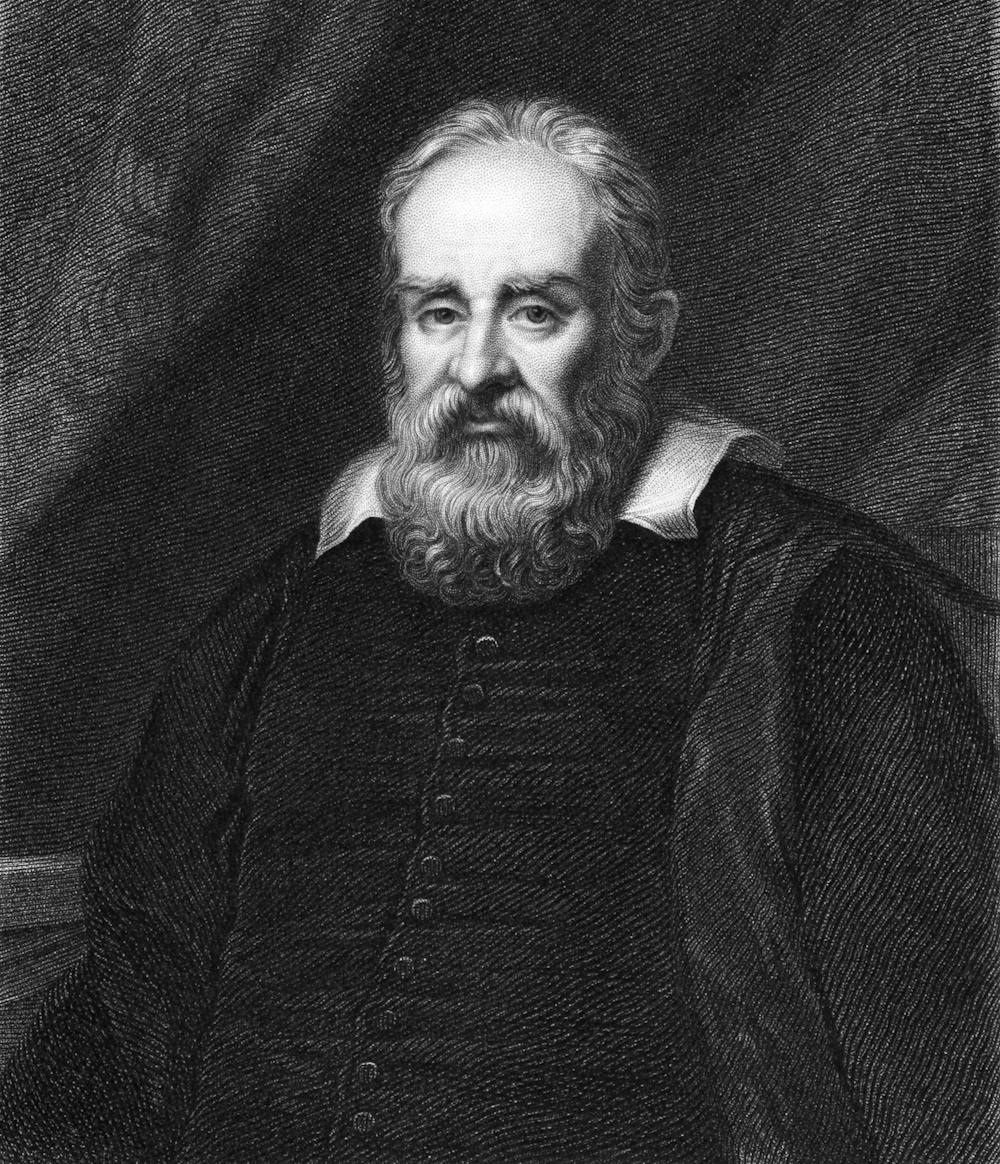
Galileo Galilei (1564-1642). Engraved by R Hart and published in The Gallery Of Portraits With Memoirs encyclopedia, United Kingdom, 1833.
Shutterstock/Georgios Kollidas

Tortuously, not only because he was bending over backwards to please the censors – heliocentrism was held to defy scripture – but especially because most of the experiments, methods, and even the mathematical symbolism of modern science did not yet exist.

So although yesteryear’s scientific content was simple compared with today’s overwhelming complexity, Galileo’s Dialogues show that the lack of data, methods and scientific language presented its own problems for science communication.

Conversation in science

Galileo resorted to the Socratic device of a conversation, in which he debated his ideas in a long dialogue between an innovative philosopher, Salviati, and two (male) friends.

In trying to convince even the least scientifically learned of his interlocutors, Galileo was writing what we might call popular science (although the more complex parts of the 1638 Dialogue read more like a textbook).

There were no scientific journals then, and there wasn’t quite the same distinction between the announcement of scientific discoveries to colleagues and the communication of those ideas to a wider public.

Perhaps the first mass-market popular science book was another dialogue related to heliocentrism, Frenchman Bernard le Bovier de Fontenelle’s 1686 Conversations on the Plurality of Worlds.

It was a runaway success that helped non-specialists accept the Copernican system – a Sun-centred solar system – rather than the time-honoured, seemingly self-evident geocentric one with Earth at the centre.

The hero of Fontenelle’s story, too, is a male philosopher – but this time he is conversing with a pretty marquise, who is spirited and quick to grasp new facts. Although its style was flirtatious, Fontenelle’s book was a significant recognition that women are curious and intelligent.

Science gets complex

Then, the very next year, everything changed. The English physicist and mathematician Isaac Newton published his monumental Principia Mathematica. Suddenly science became a whole lot more complex.
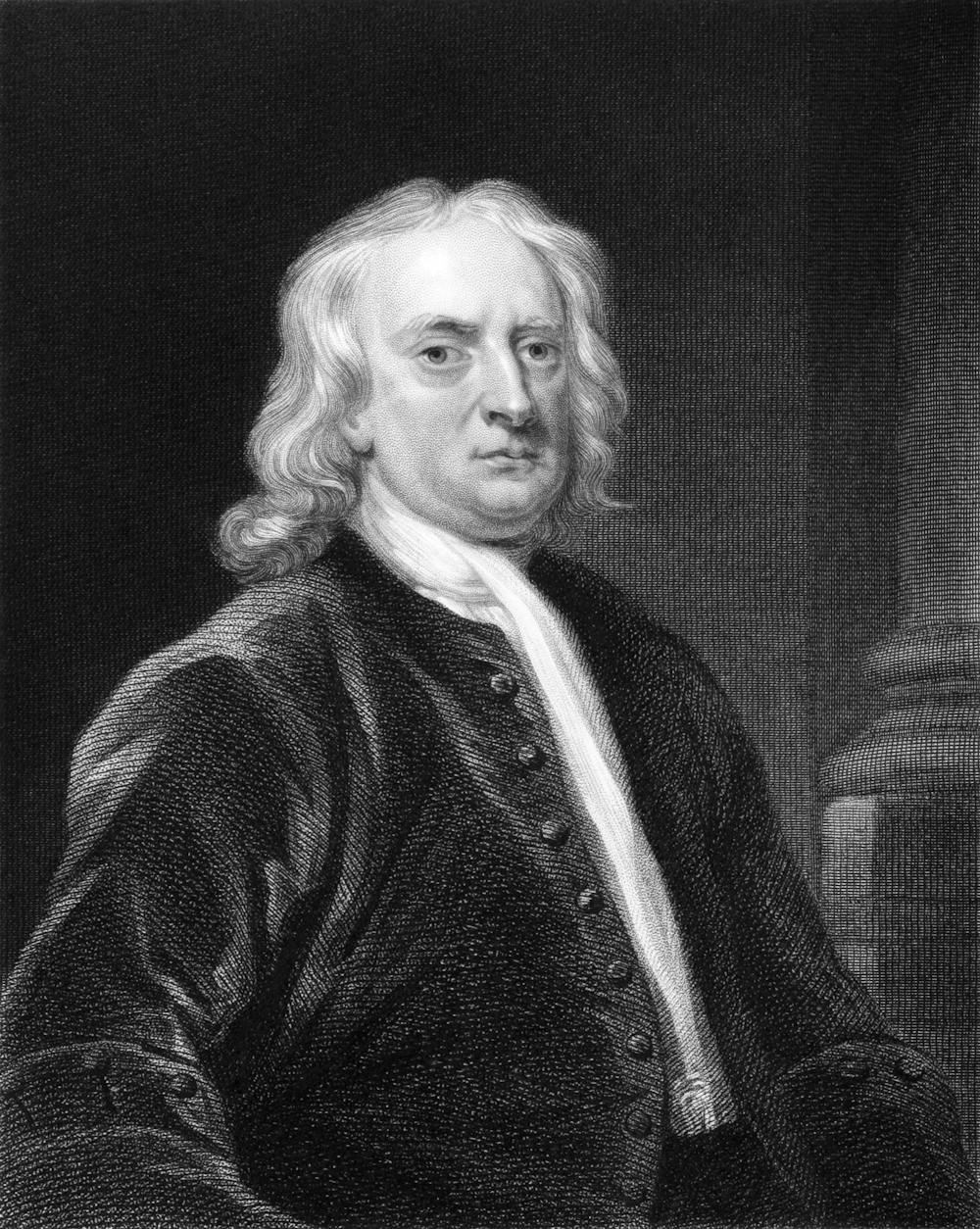
Isaac Newton (1643-1727). Engraved by E Scriven and published in The Gallery Of Portraits With Memoirs encyclopedia, United Kingdom, 1837.
Shutterstock/Georgios Kollidas

For instance, Fontenelle’s explanation of the cause of heliocentrism had been based on Frenchman René Descartes’ notion that the planets were swept around the Sun by gargantuan cosmic ethereal vortices.

Newton replaced this influential but unproven idea with his predictive theory of gravity, and of motion in general, which he developed in 500 dense pages of axioms, observational evidence, and a heap of mathematics.

Principia provided the modern blueprint for experimentally based, quantitative, testable theories – and it showed the fundamental role of mathematics in the language of physics.

The trouble was that only the best mathematicians could understand it. It was so innovative (and tortuous in its own way) that some of the greatest of Newton’s peers were sceptical, and it took many decades for his theory of gravity to become universally accepted in Europe.

Science writers played a key role in this process.

Something ‘for ladies’

The earliest popularisations of Newton’s work were short or semi-technical, such as that by the French mathematician Pierre-Louis Moreau Maupertuis.

In the 1730s, Maupertuis tutored a real-life marquise, Émilie du Châtelet, but she was of a very different calibre from Fontenelle’s fictional student – or indeed the curious but rather flighty marquise in another mass market popularisation: the Italian Francesco Algarotti’s Newtonianism for “the ladies”.
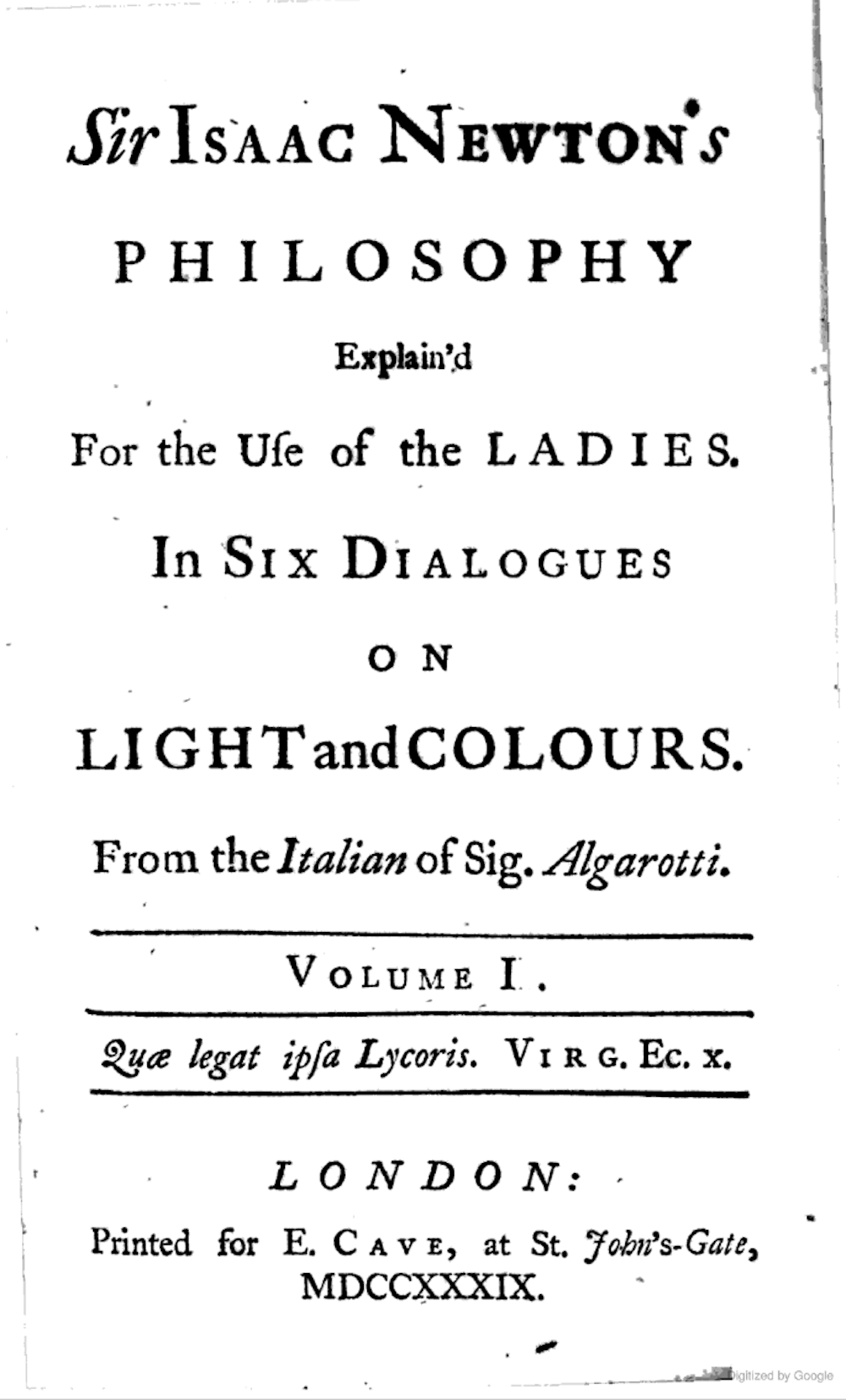
Translated from the original French: l newtonianismo per le dame ovvero dialoghi sopra la luce e i colori.
Google Books

Newtonianism here referred not just to Newton’s theory of gravity. As its somewhat patronising title might suggest, it focused mostly on his more accessible 1704 work, Opticks, which explains his experiments on the behaviour of light and the nature of colour. But these, too, were controversial, and Algarotti was an expert in optics.

He had been inspired to address “the ladies” by two outstanding female contemporaries: his French mathematical friend Émilie du Châtelet, and the Italian physicist Laura Bassi. But both women disliked his book’s flirtatious style.

An oil painting of Madame Du Châtelet at her desk.
Wikimedia

Du Châtelet and her lover Voltaire were writing their own more serious (and non-gendered) popularisation of Newton’s work. Du Châtelet later wrote a very successful popular synthesis of the scientific ideas of Newton and his German rival Gottfried Wilhelm Leibniz – Bassi used the Italian translation of it in her own teaching.

Du Châtelet then went on to produce the first translation of Principia outside Britain – an insightful work that is also interesting in the context of popular science writing. She appended a 110-page commentary, summarising Newton’s method in everyday language, and explaining more recent applications of his theory.

The self-taught science writers

Nearly a century later, the Scottish mathematician Mary Somerville felt the same compulsion to reach out to the non-specialist reader – male and female – in the introduction to her book explaining the latest developments of Newton’s theory, Mechanism of the Heavens.
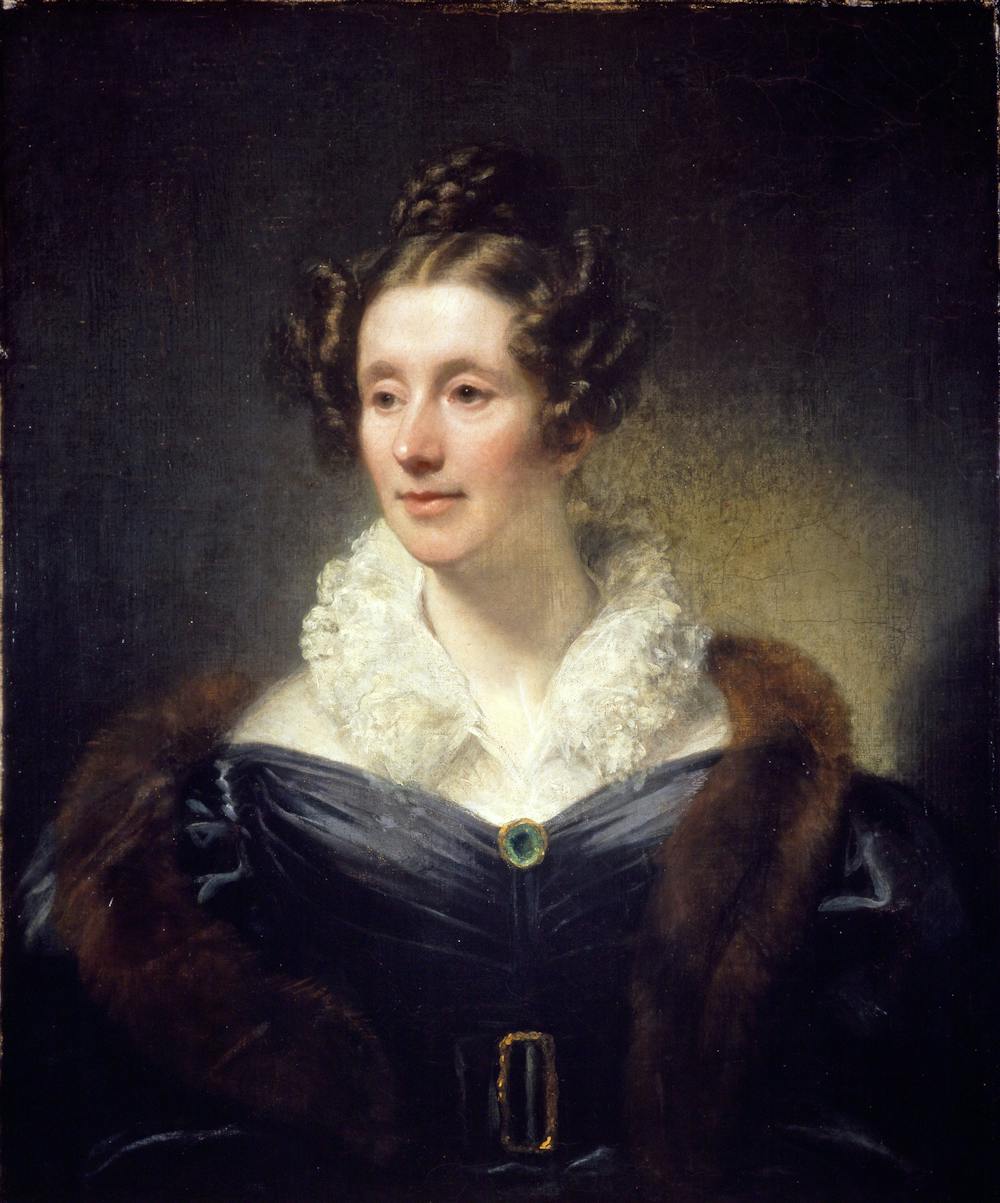
Oil painting of Mary Somerville who was a largely self-taught in science.
National Galleries of Scotland

It is worth celebrating the fact that Somerville’s Mechanism was used at Cambridge as an advanced textbook in celestial mechanics – and at a time when women were not allowed to attend university.

Like Du Châtelet, Somerville was mostly self-taught. She understood the importance of science writing in educating the public, especially those denied formal education, and went on to write two best-selling popular science books: On the Connexion of the Physical Sciences and Physical Geography.

Another successful British female science writer in the early 19th century was Jane Marcet. Unlike those of Du Châtelet and Somerville, Marcet’s two books – Conversations on Chemistry and Conversations on Natural Philosophy – were aimed particularly at women.

They were built around conversations between two teenage girls and their female teacher. Unlike Fontenelle’s and Algarotti’s works for “the ladies”, these books were down-to-earth, non-patronising attempts to educate women in practical chemistry and physics.

But like those of Fontenelle and Algarotti, Marcet’s books proved popular with male lay readers, too – including the self-taught British physicist and chemist Michael Faraday, who went on to become co-discoverer of electromagnetism.


Read more:
Let there be light! Celebrating the theory of electromagnetism


Biology was also progressing in the 19th century, but this had a downside for women. The discovery that women had smaller brains was used to reinforce the stereotype that women were incapable of intellectual study.

Somerville wrote movingly on how this affected her life. She would have been thrilled to read this year’s book by female neuroscientist Gina Rippon, The Gendered Brain, which asserts that brain plasticity and connectivity should displace old notions of gendered brains.

Do women and men have different brains? An interview with Gina Rippon.

Rippon’s is one of a growing number of female-authored popular science books on all aspects of science, and it is also an example of how women can contribute important new perspectives to scientific topics.

Another example is the ecological perspective of pioneering biologist and science writer Rachel Carson, whose 1962 Silent Spring played a leading role in launching the modern environmental movement.

Scientific understanding is often driven initially by a reductionist approach, and Carson was the first to clearly point out the role of artificial pesticides on the whole food chain.


Read more:
Who writes science and technology stories? More men than women


Then there’s the question of ethics in science. Rebecca Skloot’s 2010 book The Immortal Life of Henrietta Lacks tells the little-known story of the 1951 illegal harvesting and selling of cells from poor black farmer Henrietta Lacks.

Having diverse voices of all kinds in science and science writing is a good thing for science, as even a brief look at history shows. As far as women’s participation goes, we’ve come a long way.

But we still need more women to help shape and tell the story of science.The Conversation

Robyn Arianrhod, Adjunct Associate , School of Mathematical Sciences, Monash University

This article is republished from The Conversation under a Creative Commons license. Read the original article.

Unknown's avatar

Terrible Things Happen in Bookshops


The link below is to an article that takes a look at some gross things found in bookshops (and yes, some are truly disgusting).

For more visit:
https://bookriot.com/2019/02/21/grossiest-things-at-a-bookstore/

Unknown's avatar

2019 PEN/Hemingway Award Winner


The links below are to articles reporting on the 2019 PEN/Hemingway Award winner, Tommy Orange for ‘There There.’

For more visit:
https://www.nytimes.com/aponline/2019/03/19/us/ap-us-books-pen-hemingway-award.html
https://www.hemingwaysociety.org/2019-penhemingway-award-winner
https://www.hemingwaysociety.org/2019-penhemingway-award-finalists-announced

Unknown's avatar

2019 Whiting Award Winners


The link below is to an article that takes a look at the 2019 Whiting Award winners.

For more visit:
https://lithub.com/announcing-the-2019-whiting-award-winners/

Unknown's avatar

Nelson Algren


The link below is to an article that takes a look at the writer Nelson Algren.

For more visit:
https://www.thenation.com/article/nelson-algren-biography-norton/

Unknown's avatar

The Poetic Legacy of W.S. Merwin


The link below is to an article that considers the poetic legacy of W. S. Merwin.

For more visit:
https://lithub.com/on-the-poetic-legacy-of-w-s-merwin/

Unknown's avatar

A Guide to Listening to Audiobooks on the iPhone


The link below is to an article that provides a guide for listening to audiobooks via an iPhone.

For more visit:
https://bookriot.com/2019/02/18/how-to-listen-to-audiobooks-on-iphone/

Unknown's avatar

The Book Review in the Digital Age


The link below is to an article that considers the role of the book review in the current digital age.

For more visit:
https://harpers.org/archive/2019/04/like-this-or-die/

Unknown's avatar

From ‘Wild Horses’ to ‘Wild Things,’ a window into Maurice Sendak’s creative process


File 20190306 100805 xnhs5l.jpg?ixlib=rb 1.1
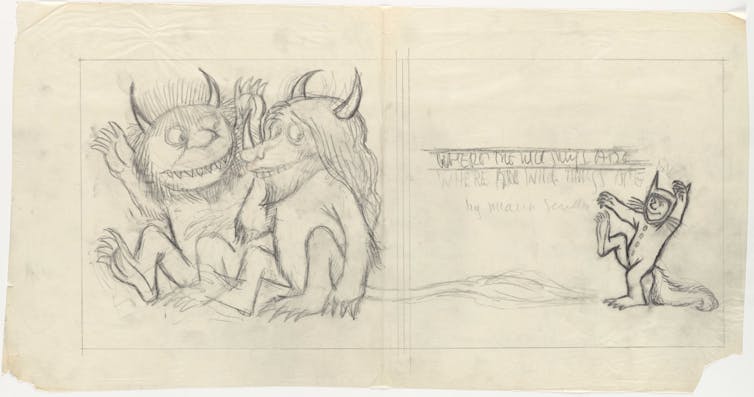
Preliminary drawing of title page for ‘Where the Wild Things Are’ (New York: Harper & Row, 1963), 26:7, The Maurice Sendak Collection.
Archives & Special Collections at the Thomas J. Dodd Research Center, University of Connecticut Library. © The Maurice Sendak Foundation.

Katharine Capshaw, University of Connecticut and Cora Lynn Deibler, University of Connecticut

Fans of “Where the Wild Things Are,” Maurice Sendak’s most famous book, might know every page by heart.

But few know the winding path it took from idea to published book – a gestation process that involved experimentation, playfulness and persistence.

As professors of children’s literature and illustration, we are thrilled to witness the arrival of The Maurice Sendak Collection at the University of Connecticut’s Archives and Special Collections at the Thomas J. Dodd Center. The collection – which contains Sendak’s original sketches, book dummies, artwork and final drafts of his work, amounting to nearly 10,000 items – allows us to begin to trace the trajectory of Sendak’s creative process.

It contains evidence of Sendak’s prodigious imagination and lifelong intellectual curiosity, and offers insight into how Sendak developed his ideas over time.

The making of “Where the Wild Things Are” was a journey, and the vivid materials in Sendak’s archive illuminate the level of investment that was required to complete it.

A years-long process

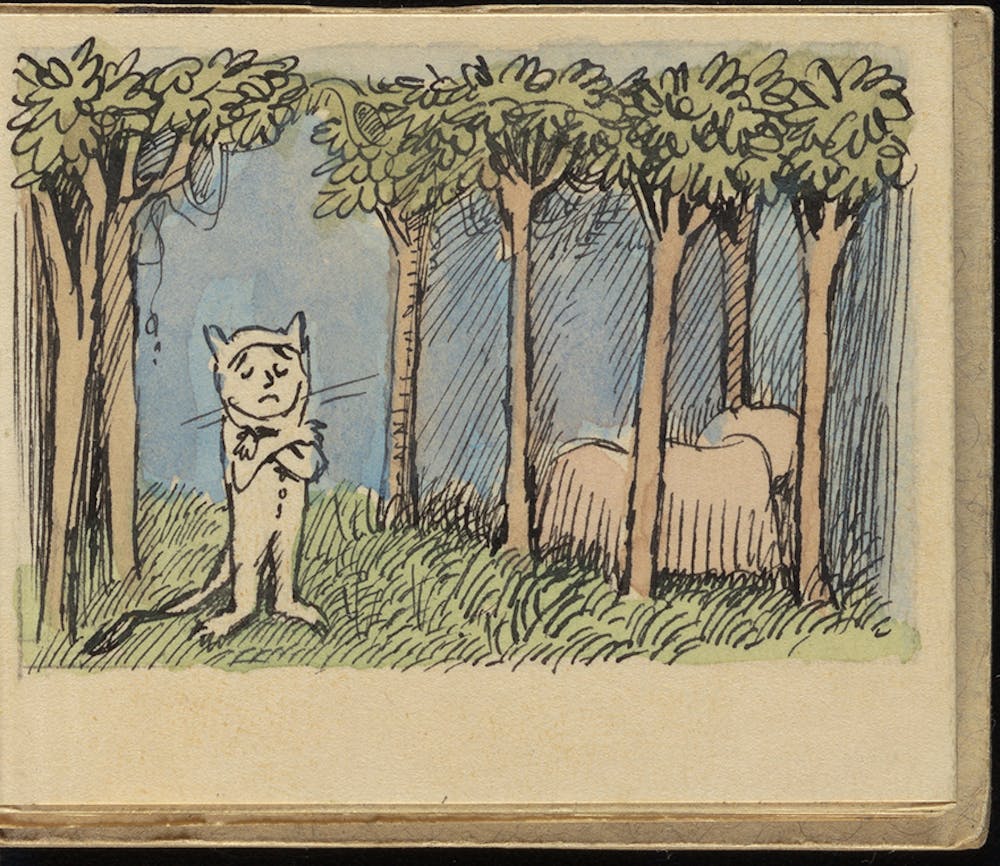
One of the items in the collection is a small, horizontal book dummy dated Nov. 17, 1955, titled “Where the Wild Horses Are.” As one of the earliest forms of what would become “Where the Wild Things Are,” the book dummy contains many of the elements that would appear in the final version, including a boy who takes a journey, gets chased by monsters and sails a boat to an island.

But what’s with the horses?

This earliest version includes images of the child pulling the animals’ tails. In response, they kick him into the air – and out of his clothes.

Dummy for ‘Where the Wild Horses Are’ (1955), 26:9, The Maurice Sendak Collection.
Archives & Special Collections at the Thomas J. Dodd Research Center, University of Connecticut Library. © The Maurice Sendak Foundation.

In interviews, Sendak claimed that, when revising the story, he gave up on horses because he couldn’t draw them. But Sendak spent his life immersing himself in a variety of art styles, from romantic painters William Blake and Domenico Tiepolo to American cartoonist Winsor McCay. Sendak possessed immense skill.

So if he wanted to illustrate horses, he probably would have. In fact, in 1955 he handily illustrated “Charlotte and The White Horse,” a children’s book authored by Ruth Krauss, with whom he had a longstanding collaborative relationship.

But Sendak must have decided horses weren’t right for this story, and he took time to let his ideas percolate.

The wild things do appear in his other surviving book dummy, which is entirely recognizable as an early stage of the finished book we now know. Appearing eight years after the first dummy, this one, square and slightly larger than the first, shows the evolution of the book’s characters and visual rhythm. The changing borders – think of the page in which the trees take over Max’s bedroom – compel the reader to turn the pages.

Dummy for Where the Wild Things Are (1963), 26:9, The Maurice Sendak Collection.
Archives & Special Collections at the Thomas J. Dodd Research Center, University of Connecticut Library. © The Maurice Sendak Foundation.

“I had never seen fantasy depicted in American children’s books in illustrations that were so powerfully in motion,” critic Nat Hentoff wrote in the New Yorker in 1966, a few years after the book’s publication.

Curiosity and creation

But what happened during the preceding eight years?

Much of the time was spent focusing on other projects. Sendak illustrated other picture books for his publisher, Harper and Row, and collaborated with Else Holmelund Minarik on her “Little Bear” series and with Ruth Krauss on books like “I Want to Paint my Bathroom Blue.”

He also published his own picture books during this period, from “Kenny’s Window” in 1956 to “The Sign on Rosie’s Door” in 1960.

Yet most picture book authors and illustrators work diligently and juggle multiple projects. How was Sendak different?

Unlike illustrators who use a singular style that appears throughout their work, Sendak developed a unique visual approach for each project. He was always seeking out inspiration from other artists whom he admired.

“Wild Things,” for example, owes a great deal to the influence of French post-impressionist painter Henri Rousseau. You can see the influence of Swiss painter Henry Fuseli on “Outside Over There” and the influences of British caricaturist Thomas Rowlandson and Czech painter Josef Lada on the recently published “Presto and Zesto in Limboland,” which Sendak created with friend and collaborator Arthur Yorinks.

He also read widely – he especially loved Herman Melville, Emily Dickinson and John Keats – and as he worked he played music in the background, choosing songs and albums that reflected his creative moods.

“Sketching to music is a marvelous stimulant to my imagination,” he said during his Caldecott award speech in 1964.

And he was always trying to become a better artist; he was, as Yorinks explained in an interview, “constantly teaching himself.” In the long gestation period between the dummy and the publication of “Where the Wild Things Are,” Sendak was able to learn a range of new styles, including the crosshatching technique that would appear in “Wild Things.”

As Jonathan Weinberg, curator and director of research at The Maurice Sendak Foundation, told us, “I can think of no other artist – illustrator or otherwise – who has employed so many different forms of expression, not only over time but often on projects that were in production simultaneously.”

The wild things emerge

During the period in which “Wild Horses” became “Wild Things,” Sendak enlarged the interpretive possibilities of his subject.

Just as Sendak fertilized his imagination with a range of artists and sensory experiences, from Mozart to Melville, the wild things themselves are hybrid creatures that possess qualities that are both human-like and animal-like. They roar but speak English, walk upright but have horns sprouting from their heads.

By drawing and redrawing the creatures, Sendak could play with their expressions and postures, toying with the ways they might move and engage the reader.

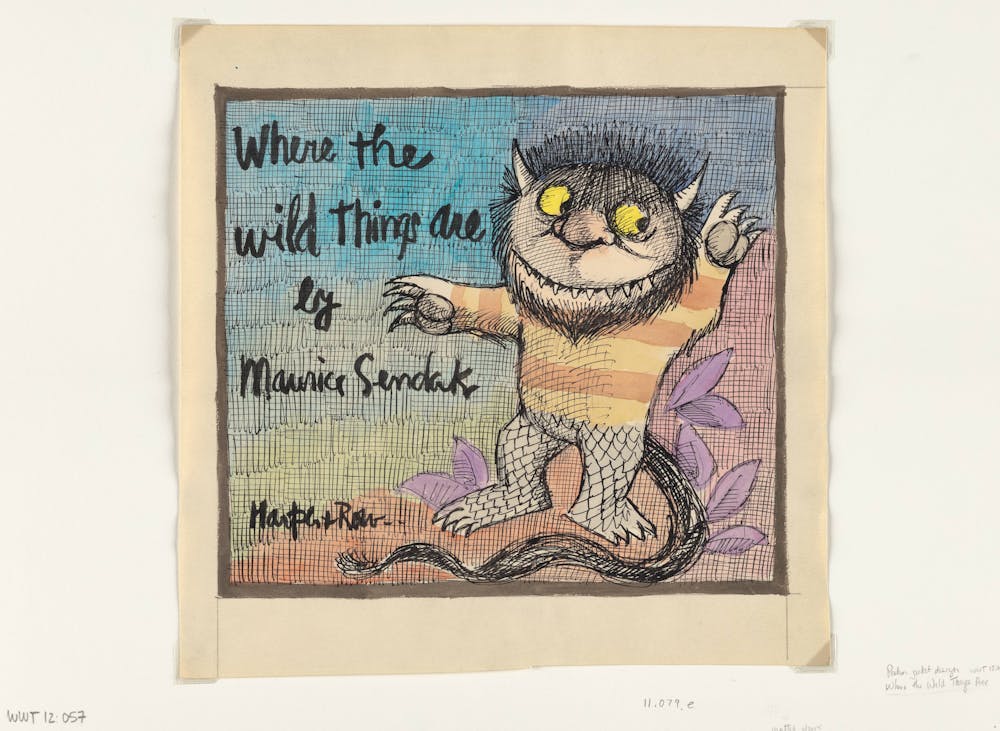
The Sendak Collection contains multiple versions of what would become the book’s jacket. Many of them focused on a particular wild thing wearing a striped sweater. In one version, he looks to the side as he waves to the reader.

Preliminary drawing of dust jacket for ‘Where the Wild Things Are’ (New York: Harper & Row, 1963), 26:2, The Maurice Sendak Collection.
Archives & Special Collections at the Thomas J. Dodd Research Center, University of Connecticut Library. © The Maurice Sendak Foundation.

In another, he creeps out from the underbrush, hands and foot raised in motion.

Preliminary drawing of dust jacket for ‘Where the Wild Things Are’ (New York: Harper & Row, 1963), 26:1, The Maurice Sendak Collection.
Archives & Special Collections at the Thomas J. Dodd Research Center, University of Connecticut Library. © The Maurice Sendak Foundation.

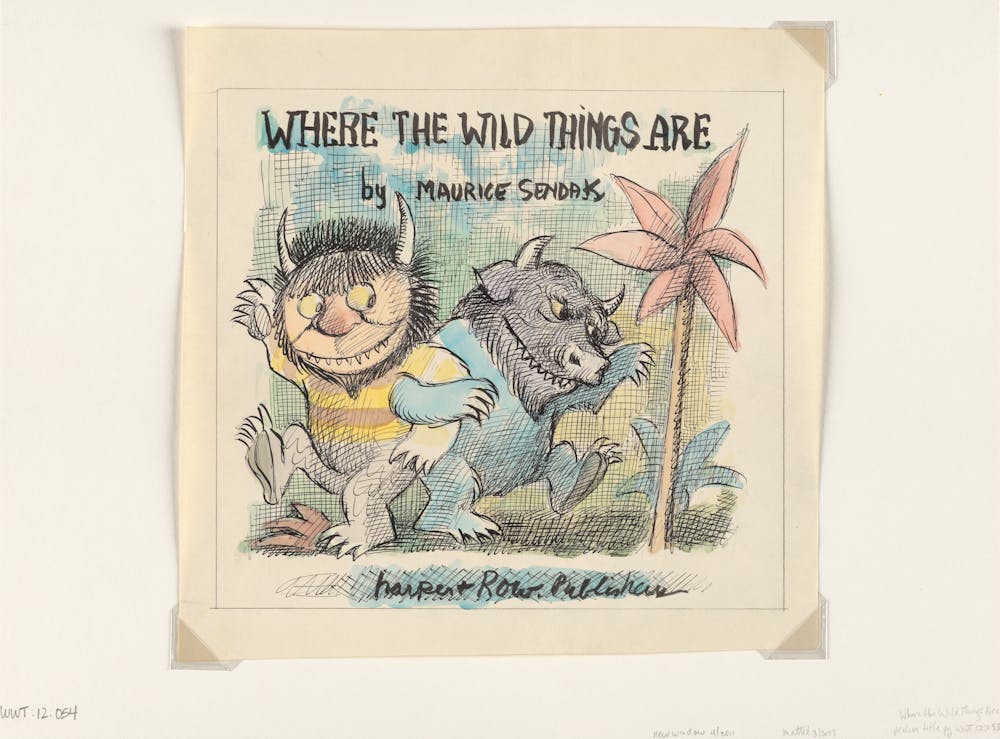
In a third, he seems to dance, arms locked with another creature, a smile on his face.

Preliminary drawing of dust jacket for ‘Where the Wild Things Are’ (New York: Harper & Row, 1963), 26:1, The Maurice Sendak Collection.
Archives & Special Collections at the Thomas J. Dodd Research Center, University of Connecticut Library. © The Maurice Sendak Foundation.

Even though these drafts don’t appear in the final version, they offer a window into Sendak’s imagination. Yes, attempting multiple drafts is a form of diligence. But it’s also creative play – a fusion of discipline with dynamism.

According to Lynn Caponera, president of The Maurice Sendak Foundation, the artist couldn’t have known that this book would eventually become his most significant work. But she can see why kids are so drawn to the book’s characters. The wild things, she noted – with their large heads, stumbling gait and round bodies – “have the proportions of toddlers, of King Kong, of Mickey Mouse.”

Perhaps that is why the wild things seem so fully to capture the humanity of the young – their longings and rage, their imagination and joy.

Picture books, Yorinks explained, are a medium that the “world doesn’t take seriously.” Yet Sendak decided to make them because they’re “the simplest form to express the most complicated thoughts and feelings.”

The materials at the University of Connecticut show how the work of writing and illustrating a book is a kind of journey, not unlike Max’s, into the deepest recesses of the imagination.The Conversation

Katharine Capshaw, Professor of English, University of Connecticut and Cora Lynn Deibler, Professor of Illustration, University of Connecticut

This article is republished from The Conversation under a Creative Commons license. Read the original article.
Unknown's avatar

Update Paperbacks?


The link below is to an article that looks at whether paperbacks need to be upgraded as they age.

For more visit:
https://bookriot.com/2019/02/15/do-beloved-paperbacks-need-an-upgrade/