The links below are to articles reporting on the 2020 winner of the Arthur C. Clarke Award for science fiction in the United Kingdom, Namwali Serpell, for ‘The Old Drift.’
A highlight for Australian children’s literature is the announcements of the Children’s Book Council of Australia (CBCA) Book of the Year award winners. This year’s winners will be announced on Friday October 16 — right before the start of CBCA’s Book Week on October 19.
Making the shortlist brings great exposure for the books and their creators. The shortlisted books are put on special display in public school libraries and supermarket shelves. They are even made into teaching resources, suggesting an exploration of the book’s themes, for instance.
Crucially, award lists contribute to the “canon” of literary works that become widely read. This canon is distributed through libraries, schools and homes. Sometimes, benevolent relatives give them as gifts.
We investigated the diversity — including ethnicity, gender and sexuality — of the 118 shortlisted books in the early childhood category of Book of the Year between 2001 and 2020. We also examined diversity among the 103 authors and illustrators who have made the shortlist over the past 20 years.
Our yet unpublished study found most (88%) human main characters in the shortlisted books were white; none of the main characters were Asian, Black or Middle Eastern.
Why diversity matters
The CBCA was formed in 1945, as a national not-for-profit organisation promoting children’s literary experiences and supporting Australian writers and illustrators. The first awards began in 1946.
There were originally three categories for Book of the Year: older readers, younger readers and picture book.
In 2001, “early childhood” was added as a category. This was for picture books for children up to six years old.
Picture books are significant for not only developing early literacy skills, but also for the messages and values they convey about society. They help children learn about their world.
The diversity children see represented in that world affects their sense of belonging and inclusion. At this age, cultural values and bias settle in and become the foundation for how we develop. These values and biases have a profound influence on our successes and struggles in our adult lives.
A positive for gender diversity, but not ethnicity
We used visual content analysis to examine ethnic diversity, we well as gender, disability, sexuality and linguistic variation in the 118 early childhood category shortlisted books — between 2001 and 2020.
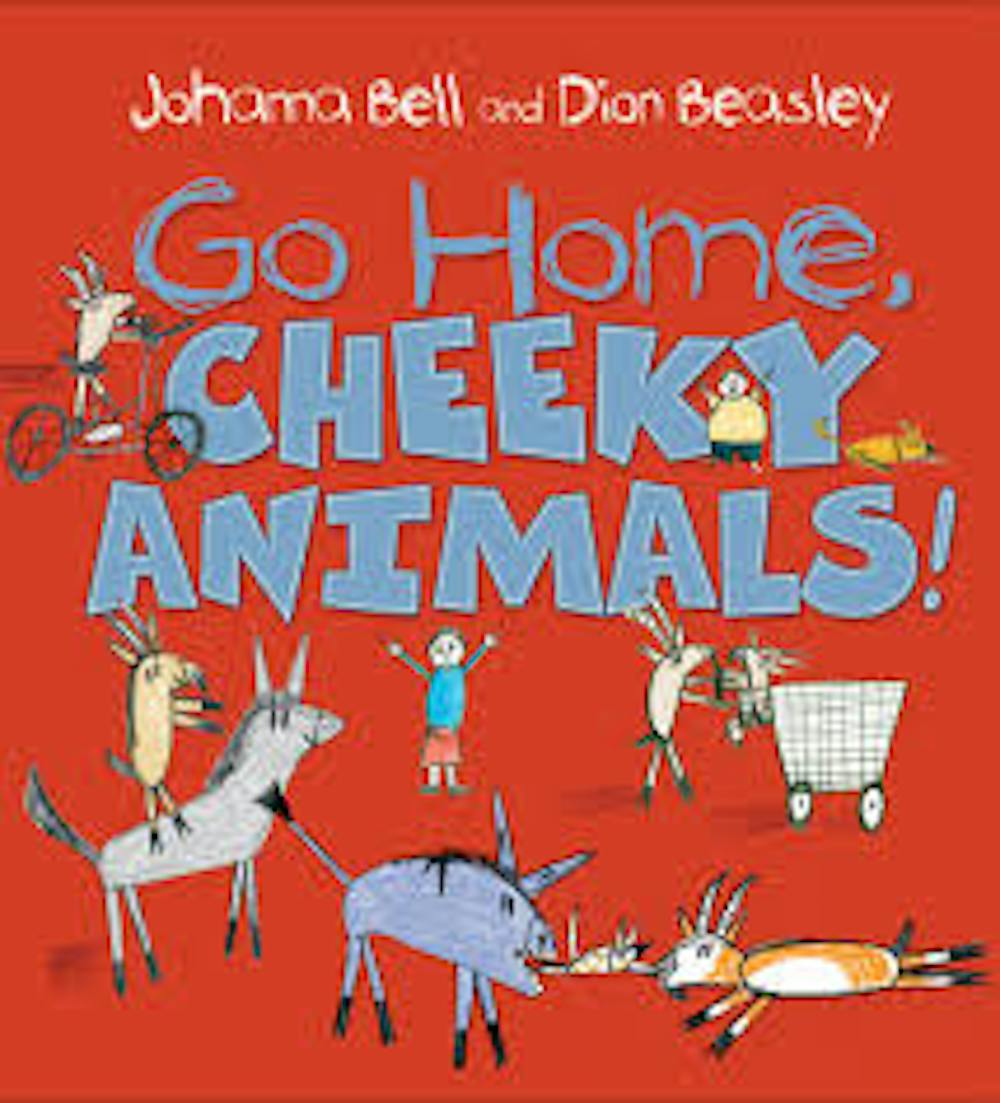
We also examined diversity among the 103 authors and illustrators who have made the shortlist over the past 20 years. Only one person — Alywarr illustrator Dion Beasley, from the Northern Territory, and winner in 2017 for Go Home Cheeky Animals — identifies as Indigenous.
Female authors and illustrators, however, were more represented (66%) than male (34%).
Looking at the picture books, we first identified four major types of characters: human (52.5%), animal (41.5%), object (4.4%) and imaginary (1.4%).
We then distinguished between main characters and those in supporting roles that make up the story world in which the main characters act.
One of the most encouraging findings was the gender parity among main characters. We identified 52 solo human main characters across all 118 books. Fifty-one of these are children, with 25 boy and 24 girl main characters (two main characters were not identified by gender).
But in terms of ethnicity, the human main characters are overwhelmingly white (88%). There are just two Indigenous main characters and one who is multiracial. There have been no Asian, Black or Middle Eastern main characters.
Looking at the wider story world, supporting characters are still overwhelmingly white. But this world does marginally include characters of Asian, Black and Middle Eastern heritage. Overall, human characters appear in 85 (72%) of the 118 books.
White characters appear in 74 of these books, and only nine books have no white characters. Non-white characters appear in a total of 18 books (21%).
Our results for ethnic diversity don’t correlate well with the latest Australian census data (from 2016). The cultural heritage of Australia’s population is described as: 76.8% white, 10% East and Southeast Asian, 4.6% South Asian, 3.1% West Asian and Arabic, 2.8% Aboriginal and Torres Strait Islander, 1.5% Maori and Pacific Islander, 0.7% African, 0.6% Latin American.
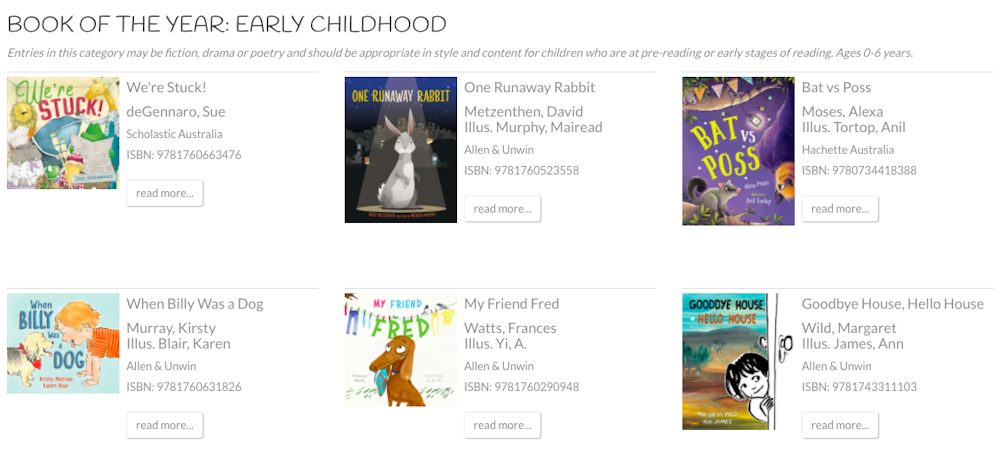
The 2020 Early Childhood Book of the Year shortlist. CBCA/Screenshot
The CBCA early childhood shortlist minimally represents other forms of diversity. We see only two main characters living with a disability and no characters who are sexually and gender diverse.
Other types of diversity
Linguistic variation is also minimal, in only four books, which does not reflect the linguistic diversity of the wider Australian population.
In response to our queries regarding their judging criteria, the CBCA said:
we do not select books for entry into our awards. It is the publishers and creators who select the books for entry. Our main criterion is literary merit, we do not actively exclude diversity, themes or genre.
Only two of the six 2020 shortlisted books in the early childhood category have human main characters. And these are both white.
The age of zero to six years is a crucial stage of development. It is important for young readers to see people and surroundings that are like their own to cultivate a sense of belonging. It is equally important to see a different world they are not familiar with.
If award-winning books sit at the top of reading lists, these books also need to embrace and reflect the full and rich diversity that makes up our country.
Who is Shakespeare’s greatest villain? Richard III? Iago? Macbeth? They all have a claim to the title; however, the correct answer is Hamlet.
Hamlet not only behaves villainously throughout his eponymous play, but has somehow persuaded generations of audiences and critics that he is actually its hero. That is what takes his villainy to the next level.
Look at the roll call of Hamlet’s crimes.
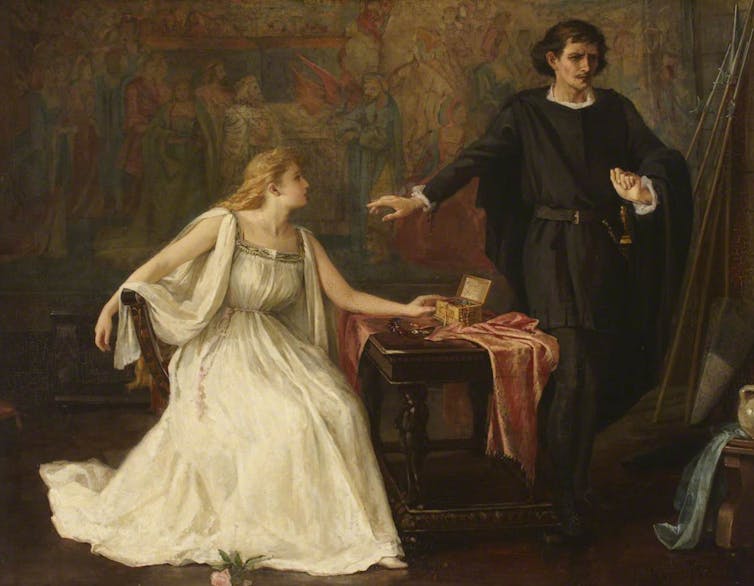
First he kills Polonius – chief counsellor to the King and the father of Laertes and Ophelia. Hamlet skewers him when he discovers him eavesdropping from behind a tapestry. Polonius may be an “intruding fool,” as Hamlet dismissively calls him on discovering his body; but Hamlet is in no position to feel superior, having “intruded” on Claudius’s private meditations in just the previous scene. Double standards are, however, a hallmark of this play.
To make his treatment of Polonius worse, once dead, Hamlet drags his corpse through the court, hiding it from his loved ones and leaving it to decay and rot without proper burial.
Such disrespect of Polonius in death, however, is no different from how the prince treated him in life. Using his rank, Hamlet continuously insults Polonious, ridiculing him for his age, calling him names and refusing to talk to him directly at times. Hamlet does so knowing Polonius can not answer back. Punching down is Hamlet’s usual style with social inferiors: Rosencrantz, Guildenstern and Osric all experience similar treatment.
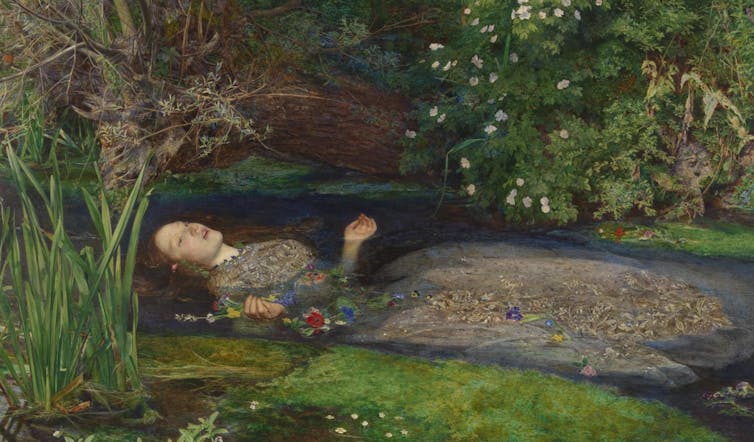
The most egregious crime is the death of Ophelia, whom Hamlet drives to madness and suicide with a campaign of misogyny, gaslighting and open sexual harassment, one moment condemning her for the crime of being female, the next degrading her in public with obscene puns.
Then there’s his casual proxy murder of Rosencrantz and Guildenstern, whose only crime is to obey the king’s order to find out what is troubling their friend and then to escort him to England. Although Hamlet has no evidence that his friends know the fatal contents of the letter they carry, commanding the prince’s execution, he goes out of his way to ensure that they are not only killed but damned for eternity by being denied confession. By his own account, he never gives them another thought.
Laertes, like Hamlet, has a murdered father, as well as a sister driven to suicide. When he takes a few lines to mourn at her graveside, Hamlet (whose self-absorbed soliloquies have already filled many pages) is outraged that the focus of attention should be on anyone else even for eight lines (“What is he whose grief/ Bears such an emphasis?”) and declares, on the basis of no evidence that we have seen, that he loved Ophelia 40,000 times more than her brother. Despite this hyperbolic protestation, he never again mentions or alludes to Ophelia from that moment on, let alone expressing regret at her death.
The usual excuse made for Hamlet is that many of these deeds are committed when he is of unsound mind. Indeed, this is his explanation to Laertes for the death of Polonius (“Was’t Hamlet wrong’d Laertes? Never Hamlet”). That excuse would carry more weight had Hamlet not persuasively told his mother the opposite within moments of the killing:
My pulse, as yours, doth temperately keep time,
And makes as healthful music: it is not madness
That I have utter’d: bring me to the test,
And I the matter will re-word; which madness
Would gambol from.
By the end of the play, Hamlet has not only ruined his own life and those of his family and friends, but freely given away his country to a foreign power – the very thing his admired father had struggled so hard to prevent.
In short, Hamlet is a self-centred, entitled, manipulative, callous bully. However, he is also intensely charismatic, so much so that he has persuaded the world to share his Hamlet-centric view.





 At the BookShelf
.jpg)
You must be logged in to post a comment.