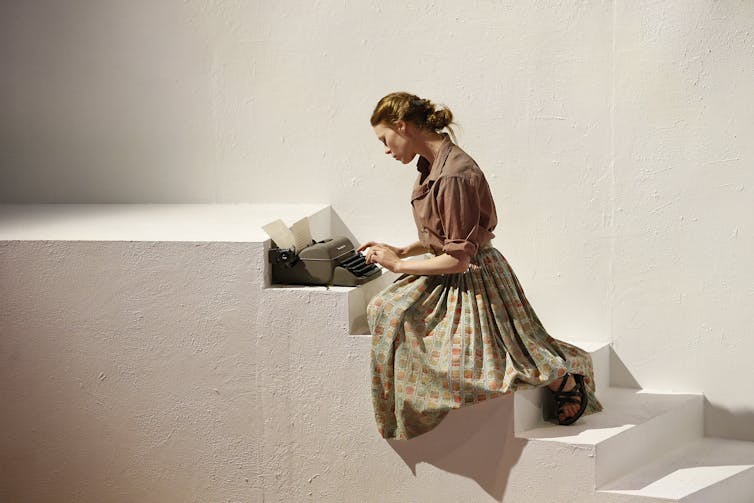
Anna McGahan as Charmian Clift in Sue Smith’s play Hydra. Long overshadowed by her husband George Johnston, recent years have seen a resurgence of interest in Clift’s life and work. Jeff Busby/Queensland Theatre
Fifty years after her death, Australian writer Charmian Clift is experiencing a renaissance. Born in 1923, Clift co-authored three novels with her husband George Johnston, wrote two under her own name, produced two travel memoirs, and had weekly column widely syndicated to major Australia papers during the the 1960s.
Clift has long been overshadowed by the legacy of Johnston, whose novel My Brother Jack is considered an Australian classic. Her novels and memoirs are sadly out of print, yet she is increasingly recognised for her important place in Australian culture.
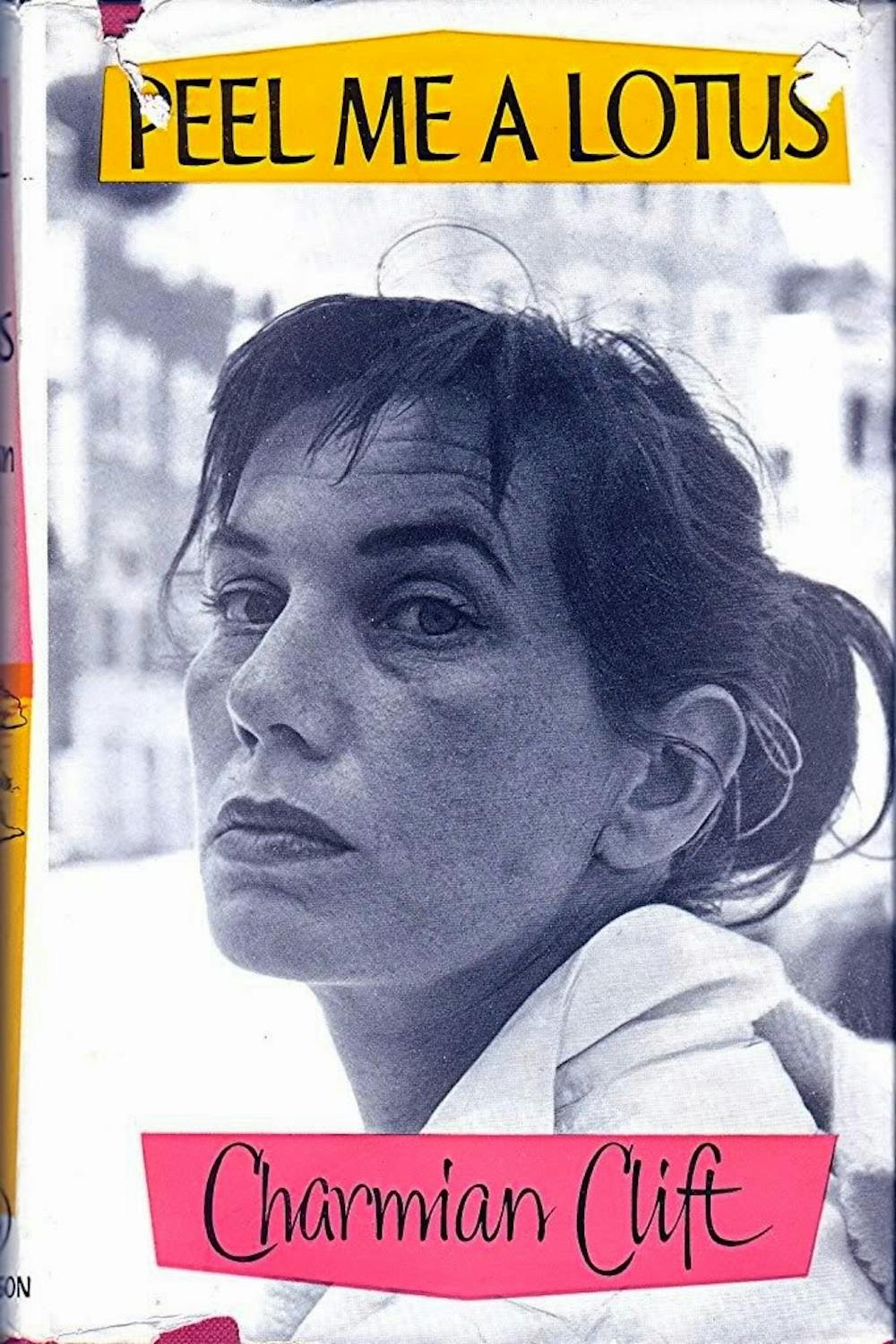
Charmian Clift, pictured on the front cover of her memoir, Peel Me a Lotus. Hutchinson, 1959
In 2018 she, along with Johnston, was inducted into the Australian Media Hall of Fame in recognition of her work as a columnist. She is also being reimagined in fiction, as the subject of A Theatre of Dreamers (2020), a forthcoming novel by English author, Polly Samson, and in Tamar Hodes’ The Water and the Wine (2018).
The revival of interest in Clift is more than a collective nostalgia or feminist correction of the historical record, although both are relevant. Many of her readers from the 60s still remember her newspaper column, and the impact that it had on their view of Australia’s place in the world, with great affection.
Younger generations, particularly women, have also been exposed to Clift’s clear and passionate voice after the columns were published in several volumes in the years following her death. That Clift and her writing continue to resonate with contemporary Australia tells us something about both her and the nation.
The Hydra years
Much of the renewed interest in Clift is focused not only on her writing, but also on the near decade that she and Johnston lived on the Greek Island of Hydra. In late 2015, artist Mark Schaller’s Melbourne exhibition, Homage to Hydra, featured paintings depicting Clift and Johnston’s island lives, with several featuring other residents from Hydra’s international population of writers and artists, including Canadian poet and songwriter, Leonard Cohen.
The same year, Melbourne musicians Chris Fatouros and Spiros Falieros debuted Hydra: Songs and Tales of Bohemia, marrying Cohen’s songs to a narrative about Clift and Johnston’s time on Hydra.
To date in 2019, Sue Smith’s play, Hydra, has been staged in Brisbane and Adelaide, casting Clift in ways that resonate sympathetically with the concerns of contemporary audiences. As Smith writes in her script’s introduction:
Charmian was a woman ahead of her time. We see this in the choices she made both in her personal life, whether it be scandalising the Greek locals by wearing trousers and drinking in bars, to insisting upon her personal and sexual freedom and, of course, through her work.
Modern readers might respond to Clift the writer, but the focus on her years on Hydra suggests there is also great interest in her charismatic personality and tempestuous life with Johnson, as their dream of a cheap and sun-soaked creative island life slowly soured.
While researching the couple’s lives on Hydra, we came across a suggestive, eye-witness diary entry by a fellow writer, New Zealander Redmond Wallis, written in 1960.
Charm is her greatest creation, Charmian Clift, the great Australian woman novelist. Charmian is very curious. She is, potentially at least, a better writer than George but she has and is deliberately creating a picture of herself … which one feels she hopes will appear in her biography some day.
The head of a literary coterie, beautiful, brilliant, compassionate but still the mother of 3 children, running a house. Sweating blood against almost impossible difficulties – a husband inclined to unfounded jealousy, the heat, creative problems, the children, the problems foisted on her by other people … and yet producing great art.
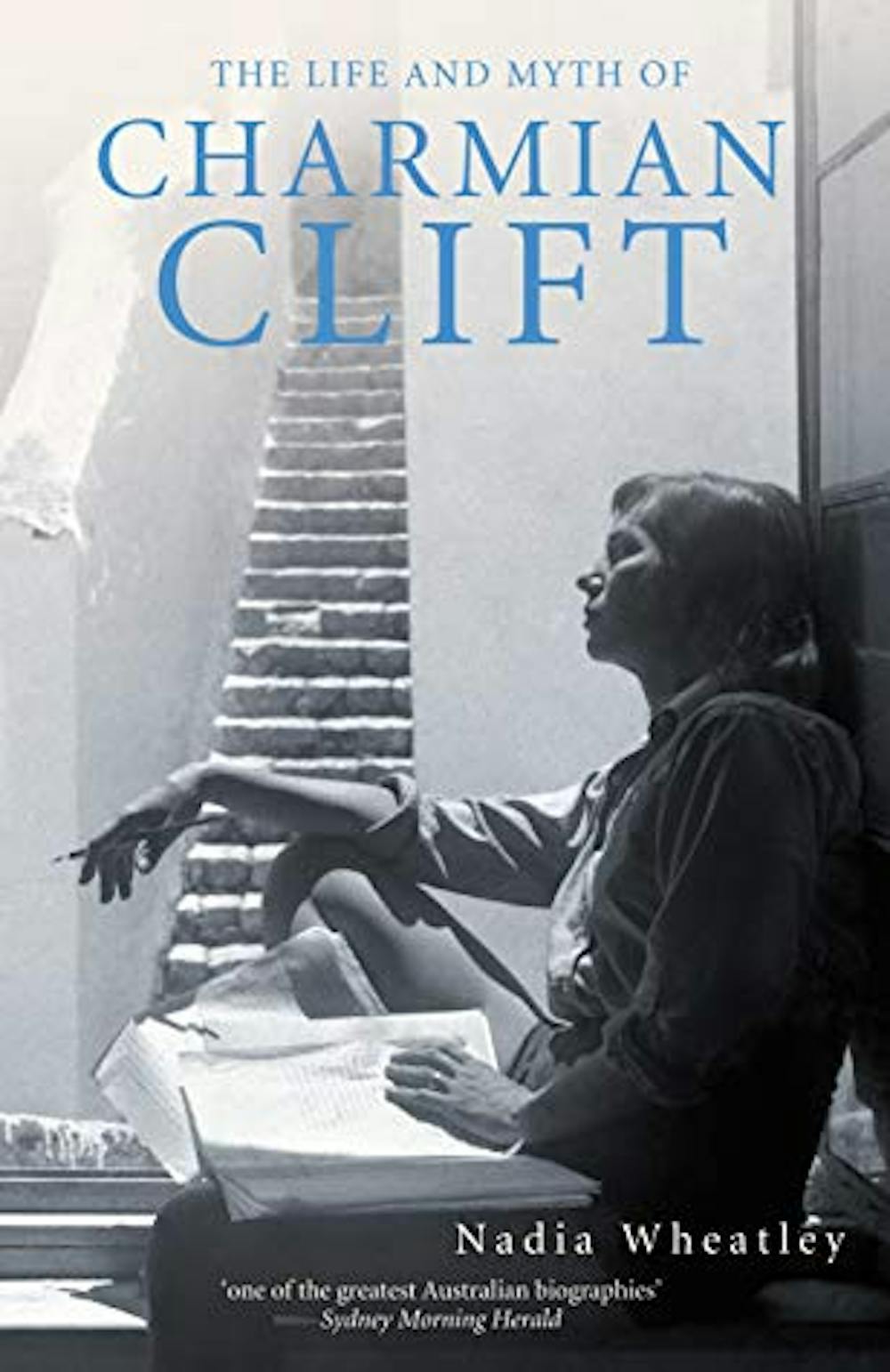
Wallis’s observations are accurate, and prophetic, in noting Clift’s capacity for self-mythologising and her belief that both she and her Hydra idyll would be remembered. Nearly four decades after Clift returned from Greece to Australia amid the acclaim for My Brother Jack, she did become the subject of an excellent biography, Nadia Wheatley’s The Life and Myth of Charmian Clift (2001).
Nadia Wheatley’s biography of Clift. Goodreads
But there were also failures amongst the success. The vision she and Johnston shared for a writing life on Hydra floundered amid poverty, alcoholism and illness. Their return to Australia in 1964 was an unlikely triumph for Johnston following the success of My Brother Jack, but Clift did not return with the same profile.
Wheatley also traced another of Clift’s great disappointments – her failure to complete her long-dreamt of autobiographical novel The End of the Morning, a struggle that was the subject of Susan Johnson’s 2004 novel, The Broken Book.
Clift did, however, leave an autobiography of sorts, in her newspaper articles. These often focused on domestic circumstances and everyday thoughts – ranging from conscription, to the rise of the Greek military junta after she left Hydra, to the changing social circumstances in Australia, and her daughter’s engagement.
These articles might not have always reflected the experiences of her readers – not everyone invited Sidney Nolan over for drinks – but Clift’s first-person narratives of a life lived with great passion and a sceptical eye to the consequences, garnered a large readership.
These readers responded to an incisive intellect with a vision of a culturally enriched Australia. She understood well the need for the country to outgrow its entrenched conservatism in order to realise its potential; and she emerged as a generous spirit who realised that the dreams and passions that drove her life were found everywhere in Australian suburbs.
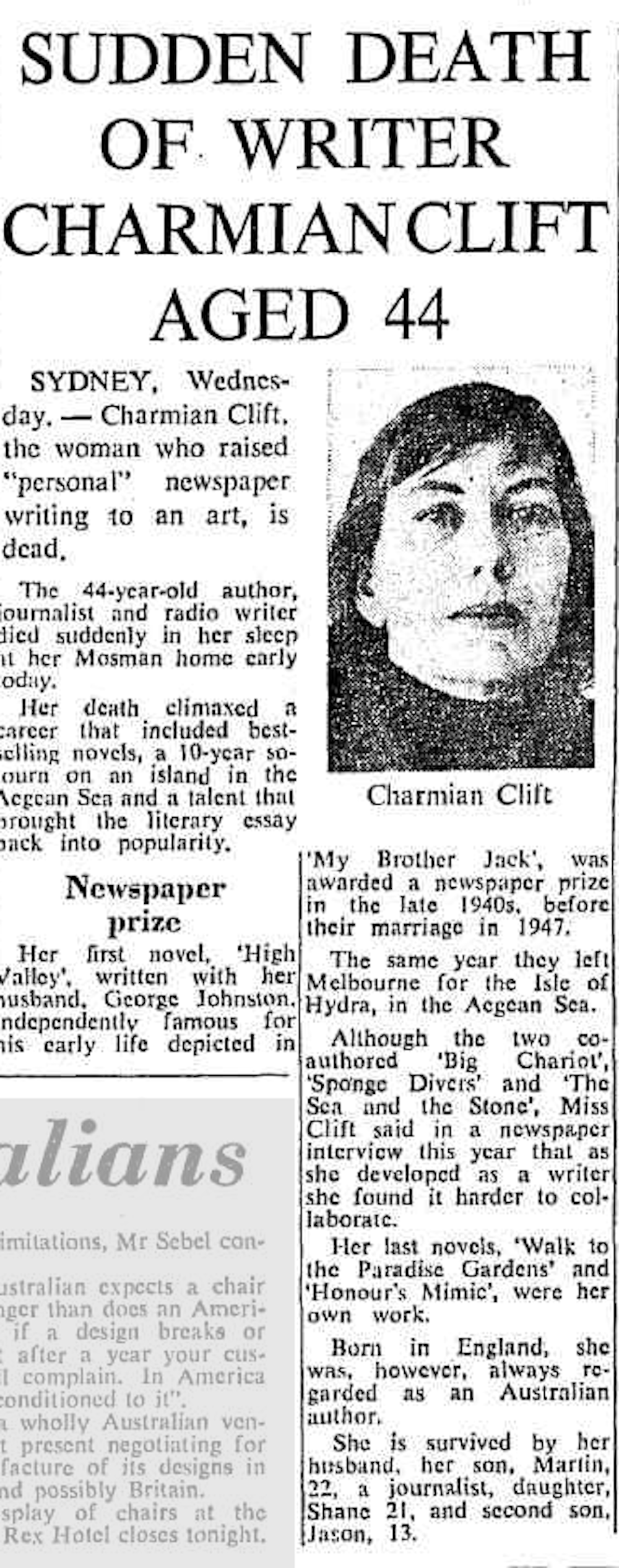
Clift’s death reported by The Canberra Times in July, 1969.
Wallis’s detection of Clift’s hubris and narcissism paints her as a potentially tragic figure. It was a fate she perhaps fulfilled, when Johnston eventually wrote of Clift’s infidelities on Hydra. Clift took her own life on July 8 1969, an event that curtailed her voice while leaving behind a legacy of loyal and grieving readers.
A natural cosmopolitan
Clift’s is one of the voices – and one of the most important female voices – that rose above the crowd during the post-war period, as the western world unknowingly girded itself for the social revolution that was to come.
Through her columns she advocated for a bolder, more outward looking future, and as someone who was naturally cosmopolitan she was avidly interested in seeing Australia become more open to the world and better integrated into the Asia-Pacific.
She didn’t always get it right (an essay decrying the rise of the Beatles and the Rolling Stones stands out!), but she helped navigate the path to a more broad-minded and inclusive vision of Australia.
Over the years Clift has emerged as someone who was not only modern, but also engaged in that most post-modern of activities, self-creation. For while Wallis scorned Clift’s self-mythologising at the time, it might now be recognised as the finest gift of the creative artist – to re-make oneself in the image of a world yet to be made. It was her gift to her readers and Australia.
Not every child is a bookworm, but research shows that developing a love of reading early in life can provide many benefits. From a positive impact on academic achievement, increased general knowledge, vocabulary growth, improved writing ability, and helping children to develop empathy, it’s clear reading can play an important role in a child’s development.
Some teachers believe that parents should be more active in supporting their child’s reading. This is understandable as studies on successful literacy achievement often feature either support from a parent or a teacher – indicating how both can help children to develop a love for reading.
But while it’s important that parents and teachers become actively involved in helping children to read more, my research reveals there are some things parents and teachers may do that actually put children off reading.
Let them choose their own books
In my research with children between the ages of nine and 12, I explored the extent to which they read for pleasure and the different factors that affected their reading engagement.
Things such as parents or teachers selecting the books the children read in their leisure time, or parents not allowing the children to read their preferred books were shown to have a negative impact on children’s reading engagement. As were parents or teachers forcing children to read and parents insisting that children read books to the end.
Children enjoy reading more when they’ve chosen their own books. Shutterstock
Some of the children in my study complained that their parents always selected the books they read in their leisure time and that the parents’ selections were not always books that the children liked. A little boy described the books his father selected for him to read at home as “hard books” and could only recall one occasion when he had enjoyed reading the book his father selected.
There were also complaints by other children that their teachers selected the books they read during the reading period at school, and that usually, they did not like the books and often did not read them.
Don’t force it
Some children also complained that their parents did not allow them to read the books they had an interest in. For instance, one boy said that he liked Enid Blyton books, but his father did not allow him to read these. A girl complained that her father stopped her from reading Diary of a Wimpy Kid books because “they don’t teach anything”.
A few children complained of either being forced to read when they would rather not read, or being forced to complete a book they had lost interest in.
So, as important as reading is for a child’s development, my research shows why children must be allowed to exercise their right to not read or stop reading at anytime – as to do otherwise is likely to put them off reading altogether.
Make it fun
From my interviews with the children, I also discovered that it was common practice for teachers and parents to ask children questions about the books they read and that reading aloud done by teachers at school was usually accompanied by questions. While this might seem like a useful learning technique, it’s not one that goes down well with the kids.
All the children I spoke with said they did not like being asked questions after reading – and that it took away the fun from reading. One boy said that knowing he would be asked questions about the reading “kind of makes me feel like they’re going to give us an exam or a test afterwards”.
Don’t force it, reading should feel fun for kids. Shutterstock
As the findings from my study show, when it comes to books, it’s important to respect your child’s preferences – even if they do not meet your expectations. Indeed, there is evidence to show that children best enjoy reading books they self-select – and doing otherwise may reduce the potential for pleasurable engagement in reading.
So given this, both parents and teachers would do well to remember that sometimes children just want to curl up with a good book, of their choice, and simply enjoy the process of reading for what it is.
Mad Magazine is on life support. In April 2018, it launched a reboot, jokingly calling it its “first issue.” Now the magazine announced it will stop publishing new content, aside from year-end special issues.
But in terms of cultural resonance and mass popularity, its clout has been fading for years.
At its apex in the early 1970s, Mad’s circulation surpassed 2 million. As of 2017, it was 140,000.
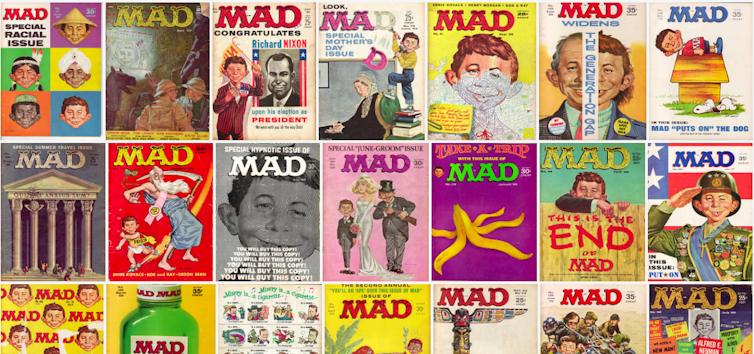
As strange as it sounds, I believe the “usual gang of idiots” that produced Mad was performing a vital public service, teaching American adolescents that they shouldn’t believe everything they read in their textbooks or saw on TV.
Mad preached subversion and unadulterated truth-telling when so-called objective journalism remained deferential to authority. While newscasters regularly parroted questionable government claims, Mad was calling politicians liars when they lied. Long before responsible organs of public opinion like The New York Times and the CBS Evening News discovered it, Mad told its readers all about the credibility gap. The periodical’s skeptical approach to advertisers and authority figures helped raise a less credulous and more critical generation in the 1960s and 1970s.
Today’s media environment differs considerably from the era in which Mad flourished. But it could be argued that consumers are dealing with many of the same issues, from devious advertising to mendacious propaganda.
While Mad’s satiric legacy endures, the question of whether its educational ethos – its implicit media literacy efforts – remains part of our youth culture is less clear.
A merry-go-round of media panics
In my research on media, broadcasting and advertising history, I’ve noted the cyclical nature of media panics and media reform movements throughout American history.
The pattern goes something like this: A new medium gains popularity. Chagrined politicians and outraged citizens demand new restraints, claiming that opportunists are too easily able to exploit its persuasive power and dupe consumers, rendering their critical faculties useless. But the outrage is overblown. Eventually, audience members become more savvy and educated, rendering such criticism quaint and anachronistic.
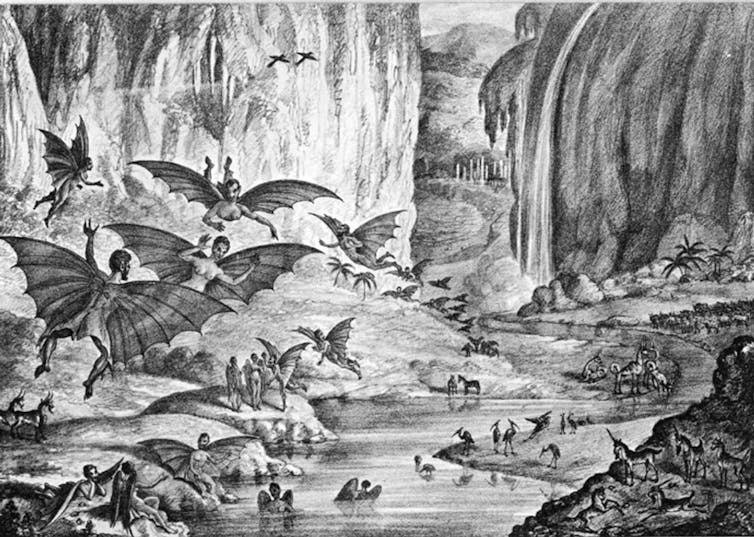
During the penny press era of the 1830s, periodicals often fabricated sensational stories like the “Great Moon Hoax” to sell more copies. For a while, it worked, until accurate reporting became more valuable to readers.
During the ‘Great Moon Hoax,’ the New York Sun claimed to have discovered a colony of creatures on the moon. Wikimedia Commons
When radios became more prevalent in the 1930s, Orson Welles perpetrated a similar extraterrestrial hoax with his infamous “War of the Worlds” program. This broadcast didn’t actually cause widespread fear of an alien invasion among listeners, as some have claimed. But it did spark a national conversation about radio’s power and audience gullibility.
Aside from the penny newspapers and radio, we’ve witnessed moral panics about dime novels, muckraking magazines, telephones, comic books, television, the VCR, and now the internet. Just as Congress went after Orson Welles, we see Mark Zuckerberg testifying about Facebook’s facilitation of Russian bots.
Holding up a mirror to our gullibility
But there’s another theme in the country’s media history that’s often overlooked. In response to each new medium’s persuasive power, a healthy popular response ridiculing the rubes falling for the spectacle has arisen.
For example, in “The Adventures of Huckleberry Finn,” Mark Twain gave us the duke and the dauphin, two con artists traveling from town to town exploiting ignorance with ridiculous theatrical performances and fabricated tall tales.
They were proto-purveyors of fake news, and Twain, the former journalist, knew all about selling buncombe. His classic short story “Journalism in Tennessee” excoriates crackpot editors and the ridiculous fiction often published as fact in American newspapers.
Then there’s the great P.T. Barnum, who ripped people off in marvelously inventive ways.
“This way to the egress,” read a series of signs inside his famous museum. Ignorant customers, assuming the egress was some sort of exotic animal, soon found themselves passing through the exit door and locked out.
They might have felt ripped off, but, in fact, Barnum had done them a great – and intended – service. His museum made its customers more wary of hyperbole. It employed humor and irony to teach skepticism. Like Twain, Barnum held up a funhouse mirror to America’s emerging mass culture in order to make people reflect on the excesses of commercial communication.
‘Think for yourself. Question authority’
Mad Magazine embodies this same spirit. Begun originally as a horror comic, the periodical evolved into a satirical humor outlet that skewered Madison Avenue, hypocritical politicians and mindless consumption.
Teaching its adolescent readers that governments lie – and only suckers fall for hucksters – Mad implicitly and explicitly subverted the sunny optimism of the Eisenhower and Kennedy years. Its writers and artists poked fun at everyone and everything that claimed a monopoly on truth and virtue.
“The editorial mission statement has always been the same: ‘Everyone is lying to you, including magazines. Think for yourself. Question authority,’” according to longtime editor John Ficarra.
That was a subversive message, especially in an era when the profusion of advertising and Cold War propaganda infected everything in American culture. At a time when American television only relayed three networks and consolidation limited alternative media options, Mad’s message stood out.
Just as intellectuals Daniel Boorstin, Marshall McLuhan and Guy Debord were starting to level critiques against this media environment, Mad was doing the same – but in a way that was widely accessible, proudly idiotic and surprisingly sophisticated.
For example, the implicit existentialism hidden beneath the chaos in every “Spy v. Spy” panel spoke directly to the insanity of Cold War brinksmanship. Conceived and drawn by Cuban exile Antonio Prohías, “Spy v. Spy” featured two spies who, like the United States and the Soviet Union, both observed the doctrine of Mutually Assured Destruction. Each spy was pledged to no one ideology, but rather the complete obliteration of the other – and every plan ultimately backfired in their arms race to nowhere.
Mad skewered those who mindlessly supported the people who controlled the levers of power. Jasperdo, CC BY-NC-SA
The cartoon highlighted the irrationality of mindless hatred and senseless violence. In an essay on the plight of the Vietnam War soldier, literary critic Paul Fussell once wrote that U.S. soldiers were “condemned to sadistic lunacy” by the monotony of violence without end. So too the “Spy v. Spy” guys.
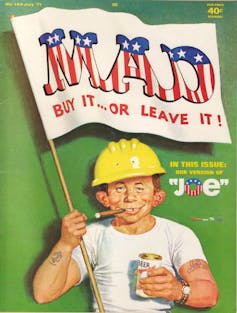
As the credibility gap widened from the Johnson to Nixon administrations, the logic of Mad‘s Cold War critique became more relevant. Circulation soared. Sociologist Todd Gitlin – who had been a leader of the Students for a Democratic Society in the 1960s – credited Mad with serving an important educational function for his generation.
“In junior high and high school,” he wrote, “I devoured it.”
A step backward?
And yet that healthy skepticism seems to have evaporated in the ensuing decades. Both the run-up to the Iraq War and the acquiescence to the carnival-like coverage of our first reality TV star president seem to be evidence of a widespread failure of media literacy.
We’re still grappling with how to deal with the internet and the way it facilitates information overload, filter bubbles, propaganda and, yes, fake news.
But history has shown that while we can be stupid and credulous, we can also learn to identify irony, recognize hypocrisy and laugh at ourselves. And we’ll learn far more about employing our critical faculties when we’re disarmed by humor than when we’re lectured at by pedants. A direct thread skewering the gullibility of media consumers can be traced from Barnum to Twain to Mad to “South Park” to The Onion.
While Mad’s legacy lives on, today’s media environment is more polarized and diffuse. It also tends to be far more cynical and nihilistic. Mad humorously taught kids that adults hid truths from them, not that in a world of fake news, the very notion of truth was meaningless. Paradox informed the Mad ethos; at its best, Mad could be biting and gentle, humorous and tragic, and ruthless and endearing – all at the same time.
That’s the sensibility we’ve lost. And it’s why we need outlets like Mad more than ever.
This is an updated version of an article originally published on May 11, 2018.
These days all text is digital. From writing an email to publishing a new edition of War and Peace, text nearly always exists on a computer first. Yet there are writers who take full advantage of the computer’s possibilities, utilising new technologies to broach complex subject matter.
Electronic or digital literature does not refer to e-books, but to works that depend on electronic “code” to exist. Put simply, you can print an e-book, but you cannot print electronic literature.
Within the field there is emphasis on experimentation. Many works are the result of authors simply trying new things out and seeing what happens. Here, then, are ten significant works of electronic literature you should know about.
Alan Bigelow’sHow to Rob a Bank reinvents Bonnie and Clyde for the digital age. It can be viewed on a smart phone or in-browser. Users swipe the touchscreen or hit the space bar to reveal a narrative told through iPhone web searches, text messages, and app activities.
Critiquing a classic
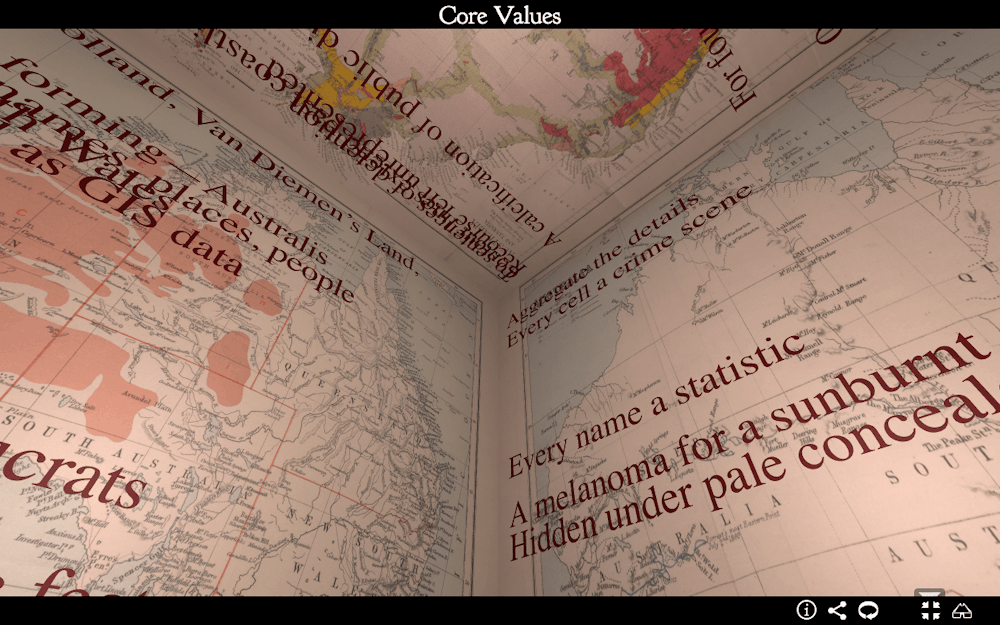
Digital poet Benjamin Laird wrote Core Values in response to Dorothea Mackellar’s classic Australian poem My Country. Laird’s work is displayed in a three-dimensional box, viewed in-browser or using a virtual reality headset.
Text is broken, animated, and infused with geographical coordinates and data.
Unlike Mackellar’s “sweeping plains”, “mountain ranges”, and “flooding rains”, Laird’s poem evokes claustrophobia. It critiques Mackellar’s poem, creating an Australia where the reader feels trapped.
Benjamin Laird’s Core Values critiques the classic Australian poem My Country. Courtesy the artist
Rewriting AI
Montréal-based David Jhave Johnston produced ReRites, using artificial intelligence trained to imitate contemporary poetry. The AI generates text which is then edited by Jhave. Recordings show this process in real time.
Jhave’s ReRites.
Twitterbots
Piotr Marecki’sCenzobot is a Twitter “bot” (an automatically generated Twitter account) that tweets fragments from real Polish censors’ reviews of publications from the communist era.
Marecki conceived of this project following the Twitter Bot Purge of February 2018. He suspects Cenzobot will also be purged. Indeed, it is the goal of his work.
An environmental statement
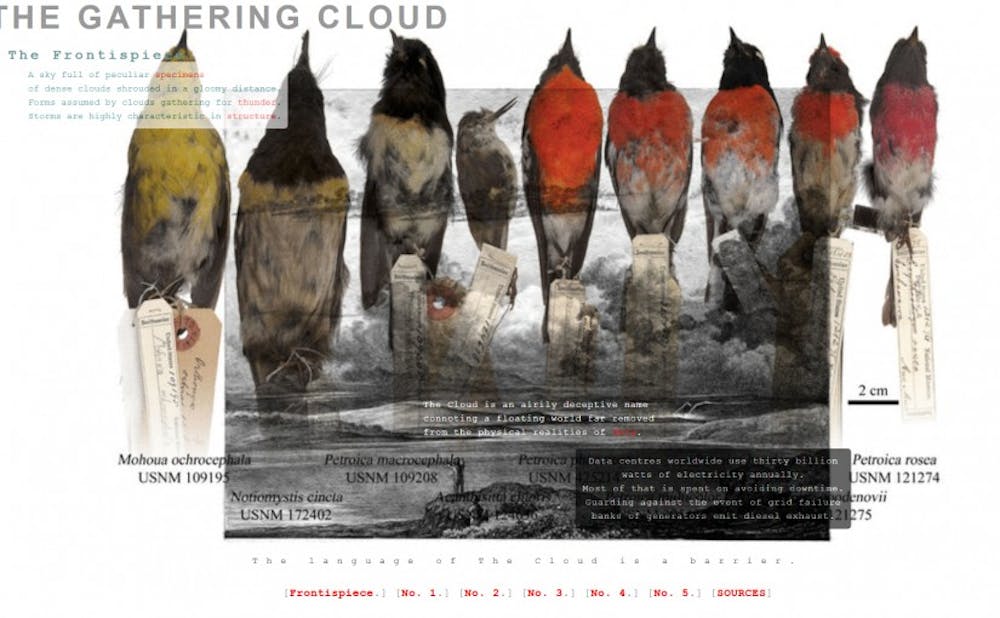
The term “cloud” computing emerged because clouds are perceived to be infinite resources. However, neither type of cloud is infinite, and few people acknowledge the energy used by large data centres. J.R. Carpenter’sThe Gathering Cloud tackles the environmental impact of “cloud” computing by calling attention to the clouds above us.
Fragments from Luke Howard’s 1803 Essay on the Modifications of Clouds are pared down to produce Carpenter’s poetic verses with hypertext links that users can interact with.
The poetry is accompanied by animations of animals, which bridge the link between clouds in the sky and “cloud” computing. A cumulus cloud weighs as much as 100 elephants. By indicating 100 elephants in animation, the full weight of “cloud” computing’s environmental impact is evoked.
J.R. Carpenter’s The Gathering Cloud explores the environmental impact of cloud computing. Courtesy the artist
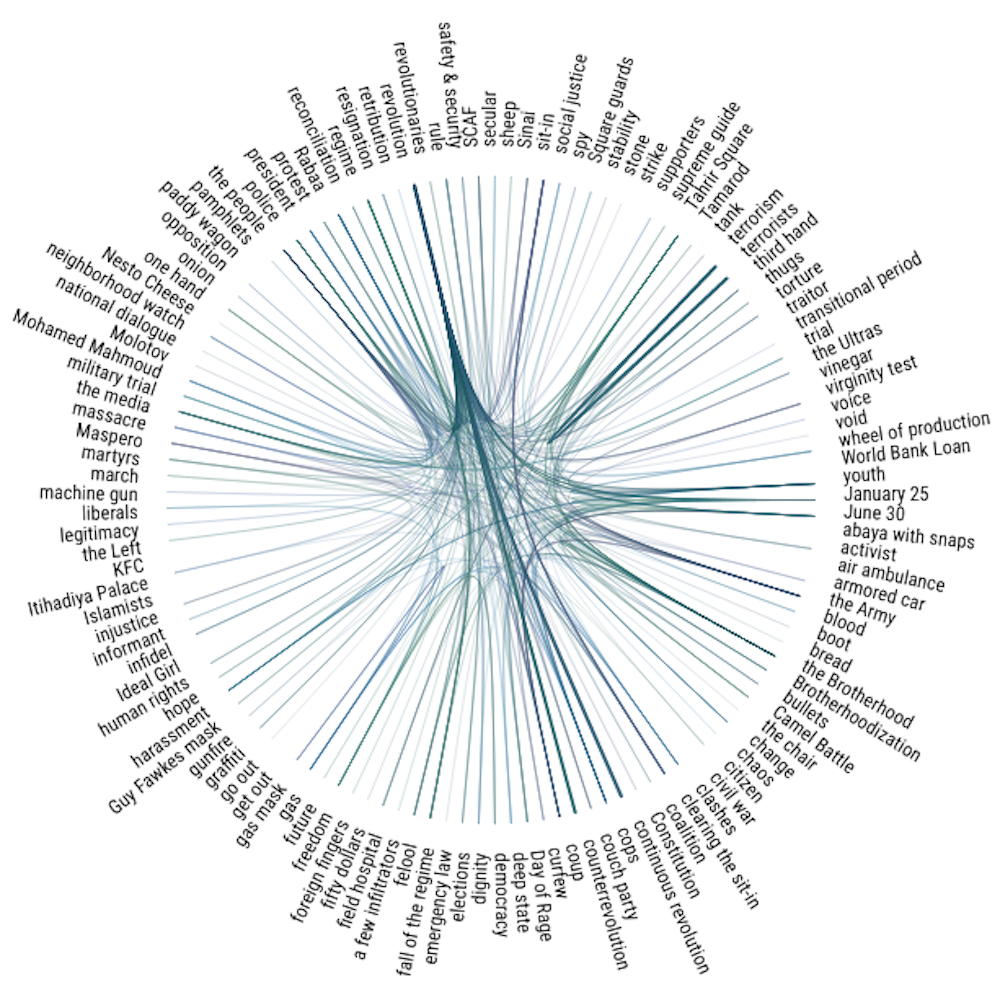
Choosing cards from the box, subjects discussed what the words meant to them and how the words’ meanings had changed. This research informed the project that includes woven imagined dialogues around each term.
Users click on the word to learn the story behind its meaning. Each word is connected to several others, forming a linguistic maze users are encouraged to get lost in. A Dictionary of the Revolution is available in both Arabic and English.
Amira Hanafi’s A Dictionary of the Revolution explores the language of the Egyptian revolution. Courtesy the artist
The work arranges media fragments in six-minute cycles to suggest a narrative between four characters. The interface changes every 30 seconds, or whenever the user clicks the screen, creating an ever-evolving story.
Robot interaction
The Listeners by John Cayley is a third-party app that creates a work of spoken, interactive literature. It builds on the infrastructure of the domestic robot “Alexa” (it is also possible to experience The Listeners using a smartphone and the Alexa app).
The user begins by addressing Alexa, saying: “Alexa, ask The Listeners.” The Listeners responds, listening and speaking in its own way. The user may extend the performance by saying “Continue” or “Go on” or “I am filled with anger”. This work explores themes of surveillance, and the very notion of allowing a domestic robot such as Alexa into one’s home.
Poetry/fiction hybrids
Jason Nelson’sNine Billion Branches is a poetic narrative accessed online. Each page has numerous arrows, poems, and highlighted areas to read, play, and explore.
Nine Billion Branches is preoccupied with the poetry of the immediate world. Poetry exists beside photographs of escalators, garbage bins, and bedside tables. Much of Nelson’s recent work exists beyond the web, sometimes projected onto real buildings or landscapes.
Virtual reality
In the past decade, Mez Breeze has merged digital literature with virtual reality. In 2017, she created the virtual reality Poem/Experience Our Cupidity Coda, which can be viewed online or with a virtual reality headset.
This work emulates the conventions of early cinema. Just as early motion picture devices had the viewer look through a peephole window, the viewer (or reader) of Our Cupidity Coda is encouraged to treat the virtual reality headset in the same way.










 At the BookShelf


You must be logged in to post a comment.