Unknown's avatar

Summer reads: When you can’t travel, let a book transport you


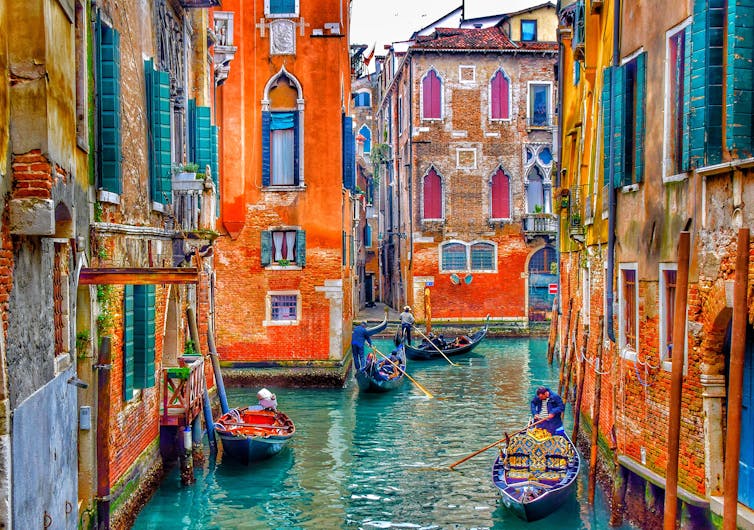
If you can’t get to Venice, Italy, allow a book translated from Italian to transport you there.
Tom Podmore/Unsplash

Amy McLay Paterson, Thompson Rivers University

I don’t understand beach reads. And I’m not the only one. There’s no universal consensus about the category, though the marketing tends to revolve around those books popularly considered disposable, unserious, or at the very least, books “you don’t mind getting wet.”

Last year, I toted Anna Karenina along with me — it got soaked, and I abandoned it in an AirBnB in Dubrovnik, Croatia, after I’d finished reading it. It lasted nearly the whole trip and left a gaping, souvenir-sized hole in my suitcase; it was perfect. So as much as I’d like to dissolve the beach read label entirely, I must also admit I have a type: I want a meaty, absorbing book that takes me further into a vacation by connecting with the cultures that produced it. I want a book that can’t be disposed of, one that will take me somewhere entirely new.

What I really want is to decouple the notion of summer reading as a lifestyle marker of class or gender. If the “pursuit of intellectual betterment” feels inaccessible or off-putting, I would like to propose at least the pursuit of expanding our emotional connections.

In a cultural climate where the limits of empathy are increasingly under a microscope, forging cross-cultural connections feels like a pressing task. Much has been made of the relationship between fiction reading and empathy, but what happens when the limits of our worldview are bounded by the English language? While linguistic diversity is growing in Canada, the majority of Canadians still speak only English at home, and comparatively few books are translated into English. If, as José Ortega y Gasset proposes, reading in translation should transport the reader into the language — and therefore the perspective — of the author, then reading translated works may be one of the best ways to expand empathy beyond the boundaries of language.

I’m not going abroad this summer, at least not physically. I’ll be staying in Canada, with only my books to pull me to other times and places. While in recent years, I’ve focused on keeping up with new releases, this year I’m fixated on atmosphere and transportation, in a mix of old favourites and new-to-me classics from around the world.

Italy

‘Arturo’s Island,’ 1957.
Arnoldo Mondadori Editore

I won’t tell you to read Elena Ferrante, because you’ve probably heard that before. Instead, I will be delving into the work of Elsa Morante, a possible inspiration for Ferrante’s pseudonym. Arturo’s Island, originally published in English in 1959, has been published in a new translation by Ann Goldstein (translator of Ferrante’s Neapolitan novels). The novel promises a mix of the remote island setting steeped in Morante’s preoccupation with social issues and the spectre of war.


Poland

‘Flights,’ 2018.
Riverhead Books

One of my favourite themes in European literature is that of movement and fluidity, the running sense of unity of purpose amidst myriad diverse pockets of culture. The ubiquity of trains and boats support transcontinental journeys by characters who switch language mid-conversation. Last year’s Man Booker International winner, Flights by Olga Tokarczuk takes traveling and travelers as the subject of its interconnected musings, making it an ideal choice for the vacation headspace. This year’s winner, Celestial Bodies from Oman’s Jokha Alharthi, has an English edition but has not yet been published in Canada.


Croatia
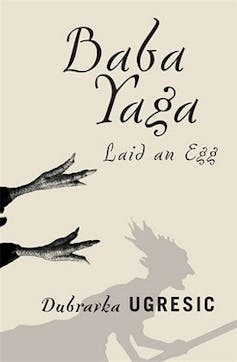
‘Baba Yaba Laid an Egg’ 2009.
Canongate Books

In my opinion, no contemplation of Pan-European lore can be complete without Dubravka Ugrešic’s Baba Yaga Laid an Egg. Once labeled a witch herself and driven into exile from Croatia, Ugrešic’s take on Baba Yaga explores the shifting nature of popular folklore.


Nigeria

‘Half of a Yellow Sun,’ 2006.
Knopf

Half of a Yellow Sun by Nigerian author Chimamanda Ngozi Adichie is not a translation, but it will take you to a place that only briefly existed: Biafra, a West African state founded in 1967. While the brutality of recent war may not make a particularly appetizing subject for vacation, Adichie contrasts the brutality with sumptuous descriptions of pre-war food and luxury, giving her vision of Biafra the aura of a lost dream. Adichie has referred to the war as a shadow over her childhood.


Norway

‘Kristen Lavransdatter,’ 2005.
Penguin Books

There are no beaches in Kristen Lavransdatter and many more Christmases than summers, but if you start Nobel Prize-winner Sigrid Undset’s oeuvre now, it may take you until winter to finish it. Set in Medieval Norway, the book follows the titular Kristen from childhood until death, focusing on her tumultuous love affair and marriage to Erlend Nikulaussøn. Tiina Nunnally’s translation, focusing on plain, stripped-down language, presents a change in philosophy from the first English translation that cut large portions of the text and enforced stiff, archaic language absent from the original Norwegian.


Argentina

‘Fever Dream,’ 2017.
Riverhead Books

Samanta Schweblin’s Fever Dream is slight in length but packs a heavy punch in both atmosphere and psychological investment. The story of a vacation gone terribly wrong, the novel’s Spanish title closely translates to “rescue distance,” a recurring concept instantly familiar to parents of young children and terrifying as it becomes repeatedly destabilized. Fever Dream is so unsettling that I sometimes hesitate to recommend it, but I’ve found myself repeatedly drawn back to its tantalizing surrealism.


Canada

‘Secwépemc People, Land and Laws,’ 2017.
McGill-Queen’s University Press

I’ve spent much of my life moving around, and as a recent settler on unceded Secwepemc territory, I want to learn more about the land I live on. In a summer steeped in fiction, Secwépemc People, Land, and Laws by Marianne and Ronald Ignace is the only history on my list, but in many ways it feels similar to the others, reaching out to add a new dimension to a place in which I’m still mostly an outsider. For better or for worse, Kamloops feels the most like itself in summer, the climate wants to have its stories told. It can feel intimidating to contemplate a 10,000 year history I know nothing about, but also comforting and necessary to reach back and hear the tales of the land I now call home.The Conversation

Amy McLay Paterson, Assessment and User Experience Librarian, Thompson Rivers University

This article is republished from The Conversation under a Creative Commons license. Read the original article.

Unknown's avatar

Melvil Dewey Medal Renaming


The links below are to articles reporting on the renaming of the Melvil Dewey (yes, that Dewey) Medal because… well, he was something of a disgraceful scrub.

For more visit:
https://www.theguardian.com/books/2019/jun/27/melvil-deweys-name-stripped-from-top-librarian-award
https://bookriot.com/2019/06/25/melvil-dewey-award-renamed/

Unknown's avatar

Best and Cheap Gadgets for Reading PDF Files


The link below is to an article that looks for the best tablet or ebook reader (that is cheap) for reading PDFs.

For more visit:
https://www.theguardian.com/technology/askjack/2019/jun/27/whats-the-best-cheap-tablet-or-e-reader-for-pdf-files

Unknown's avatar

United Kingdom: Book/Ebook/Audiobook Sales


The link below is to an article that reports on book/ebook/audiobook sales in the United Kingdom – the big winner? Audiobooks.

For more visit:
https://www.theguardian.com/books/2019/jun/26/new-chapter-uk-print-book-sales-fall-while-audiobooks-surge-43

Unknown's avatar

Microsoft Ebooks Update


As most people probably know by now (certainly if you used Microsoft for ebooks), Microsoft is getting out of the ebooks market. The link below is to an article with some news on that front.

For more visit:
https://the-digital-reader.com/2019/06/25/microsoft-ebook-refunds-are-coming-in-july/

Unknown's avatar

Australian writer Yang Hengjun is set to be charged in China at an awkward time for Australia-China relations


Charges against Yang appear to relate to his work as a writer and blogger in which he has been sharply critical of the Chinese regime.
Facebook

Tony Walker, La Trobe University

Australia’s relations with China will be further complicated by the news that Australian citizen Yang Hengjun is set to be charged with endangering state security.

This is a serious charge that carries the penalty of at least three years in jail.


Read more:
Australian-Chinese author’s detention raises important questions about China’s motivations


Yang’s wife Yuan Xiaoliang was notified earlier today that her husband would be charged, a day before the six-month deadline determining whether he is to be released, charged or have his detention extended.

Charges against Yang appear to relate to his work as a writer and blogger in which he has been sharply critical of the Chinese regime. He developed a large following on Chinese social media and on Twitter, and his criticisms will have infuriated Chinese authorities.

Yang was arrested after he returned to China earlier this year with his family. He has been held in a Beijing state security prison since then, without access to lawyers, and denied contact with his family.

Australian attempts to secure access have been rebuffed.

Canberra’s relations with Beijing

China’s decision to charge Yang comes at an awkward moment in relations between Beijing and Canberra.

Australia this week was obliged to step up its consular efforts to persuade China to allow Uyghur families to leave Xinjiang to be reunited with their Australian families.

This followed broadcast an ABC four Corners program that drew attention to the plight of Uighurs in Xinjiang. Up to a million out of a population of 11 million in the region are reported to be in “re-education” camps.

This has drawn outrage globally.


Read more:
Four Corners’ forced labour exposé shows why you might be wearing slave-made clothes


China’s official media responded harshly to the ABC program and to criticism of China’s treatment of Uyghurs more generally. The Global Times newspaper, which tends to reflect a hardline nationalist view, accused critics of “recklessly attacking” China.

Yang’s case reflects China’s extreme sensitivity to criticism.

This episode won’t help Australia’s efforts to get its relationship with China on more stable footing after several years of difficulties.

China had objected to criticism of its attempts to interfere in Australian domestic politics via Chinese nationals associated with Beijing. This led to a freeze on visits to China by Australian political leaders. While that freeze has thawed, tensions remain.

Chinese laws affect other western democracies

Australia is far from alone among western democracies whose citizens have fallen foul of opaque and arbitary Chinese law and legal procedures.

Canada is wrestling with the cases of two of its citizens who have been held without charge since last year. China has accused the pair of stealing state secrets.

This is a serious charge that can result in the death penalty.

The two Canadians were detained after the arrest at Vancouver airport of Meng Wanzhou, daughter of the founder of the Chinese telecommunications giant, Huawei. Meng is appealing attempts by the United States to extradite her to face charge of fraud.

This is a highly contentious issue, and one that is complicating relations between Washington, Ottawa and Beijing.


Read more:
Avoiding the China trap: how Australia and the US can remain close despite the threat


Apart from arresting the Canadians accused of stealing state secrets, China has also taken aim at Canada economically. It has stopped Canadian rapeseed oil imports, dealing a hefty blow to a multibillion dollar canola industry.

What the Canadian arrests, and now that of an Australian writer, demonstrates is that relations with China are unlikely to become less complicated. Rather, it is likely they will become more so.

Among challenges for countries like Australia is how to quarantine issues of mistreatment of its citizens and broader human rights abuses, from the functioning of broad-ranging bilateral relations.The Conversation

Tony Walker, Adjunct Professor, School of Communications, La Trobe University

This article is republished from The Conversation under a Creative Commons license. Read the original article.
Unknown's avatar

Amazon on Book Counterfeiting


The link below is to an article that gives Amazon’s take on book counterfeiting in their stores.

For more visit:
https://blog.aboutamazon.com/books-and-authors/our-response-to-the-new-york-times-story-on-book-counterfeiting

Unknown's avatar

How a stone knight inspired two very different visions of love from John Keats and Philip Larkin


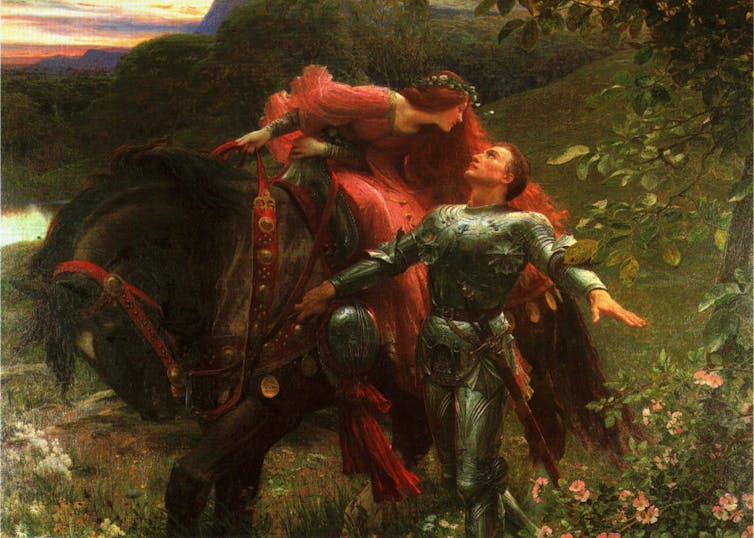
La Belle Dame sans Merci, as painted by Frank Dicksee, circa 1901.
Bristol City Museum and Art Gallery, given by Mrs Yda Richardson/Wikimedia, CC BY-NC-SA

Richard Marggraf-Turley, Aberystwyth University

Any prize for the most enigmatic character in English poetry would probably go to the truant knight in John Keats’s much-loved 1819 ballad La Belle Dame Sans Merci. All the desolate knight is able to tell us with any clarity is that a beautiful lady whom he met “in the meads” stole his heart before cruelly abandoning him. Even that account is open to interpretation, since we never hear La Belle Dame’s own version of events.

200 years on, we’re no closer to agreeing what the highly symbolic poem might mean, let alone to tracing the knight back to an actual historical figure. But a new discovery from the archives of the British Museum might be about to change that.

At some level, the ballad probably registers Keats’s own sense of doom over his relationship with fiancée Fanny Brawne. Illness and financial uncertainty were proving barriers to consummation and marriage. Beyond that lies only guesswork. Many have grown used to thinking about the famous romantic poem as the purest example of spontaneous inspiration. It even appears without preamble in one of Keats’s letters, increasing the impression that it arrived out of nowhere, dictated by the muse.

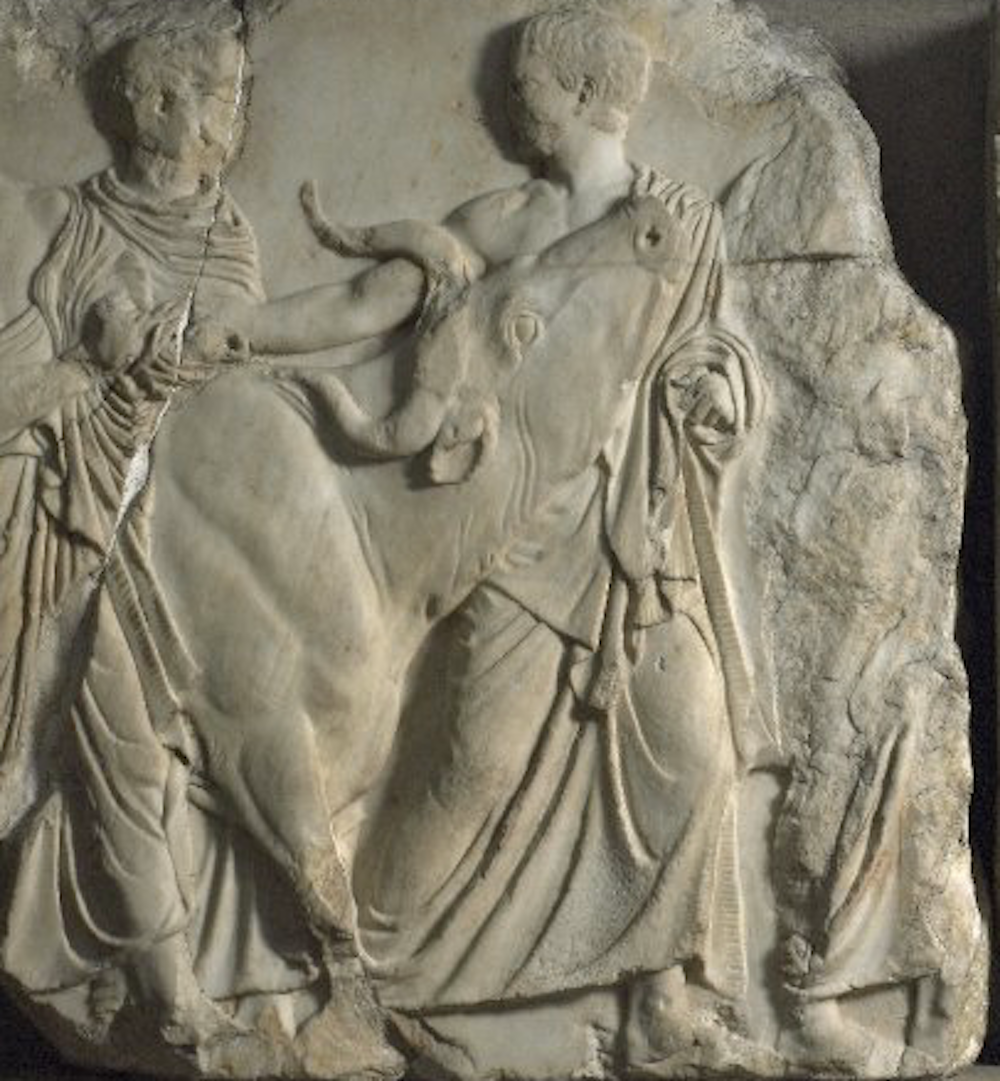
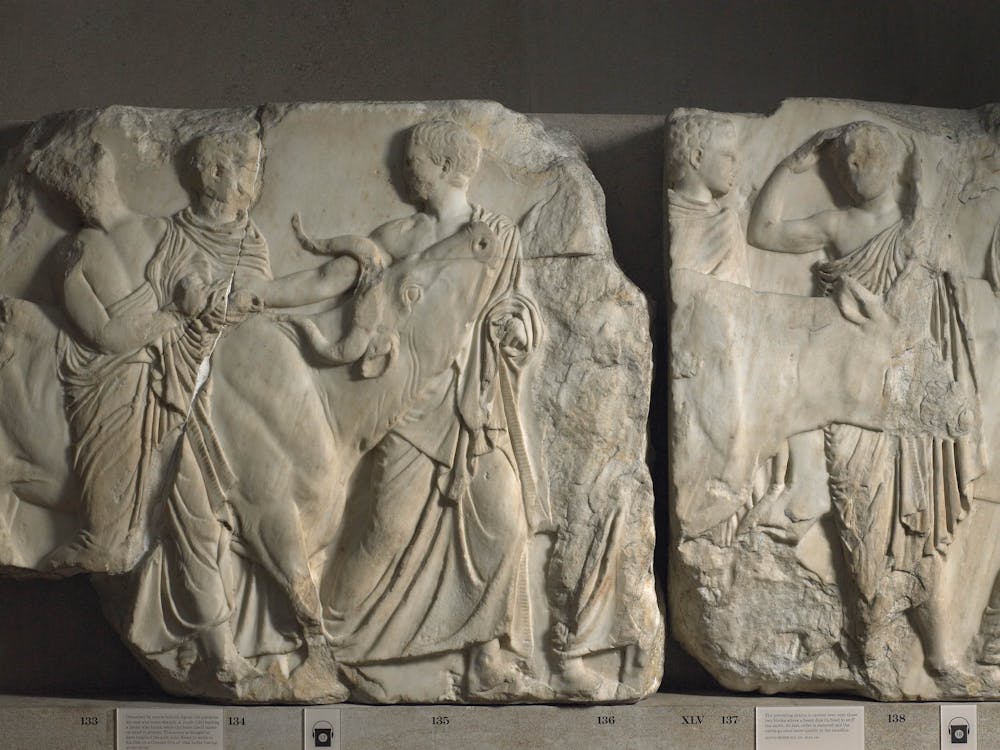
Marble relief (Block XLIV) from the South frieze of the Parthenon.
©Trustees of the British Museum, CC BY-NC-SA
Marble relief (Block XLIV) from the South frieze of the Parthenon, showing a cow being led to sacrifice.
©Trustees of the British Museum, CC BY-NC-SA

But that’s not how Keats usually worked. Many of his best-known poems take vital cues from the physical objects he saw around him. Think of the “heifer lowing at the skies” in Ode on a Grecian Urn. The mooing cameo owes its existence to a sculpted cow on the Parthenon frieze that Keats saw in the British Museum. Similarly, the anguished Titans in The Fall of Hyperion were likely inspired by the grimacing statues depicting manic and melancholic madness that adorned the gateposts of Bethlem Hospital (known to London and the world as Bedlam). Keats knew them only too well as a young boy growing up in Moorfields.

Stoney origins

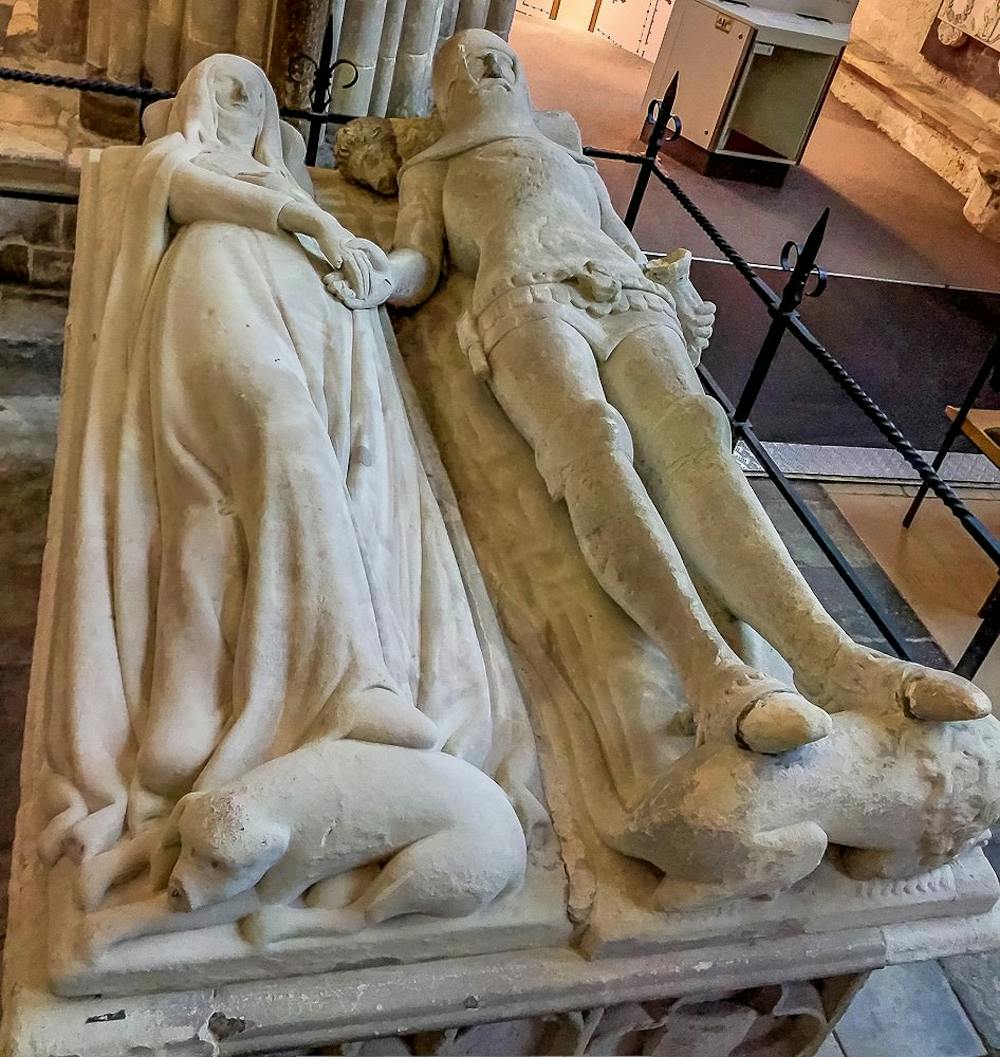
In the run-up to the ballad’s composition Keats was in Chichester to finish his medieval romance The Eve of St Agnes. During his stay he visited Chichester Cathedral, where a very striking knight-at-arms was housed. Millions of readers know it today from the perennial favourite Philip Larkin poem, An Arundel Tomb. Larkin visited in 1956, when the brawny alabaster effigy of a chain-mailed Richard FitzAlan, tenth Earl of Arundel, lying hand-in-hand beside his own Belle Dame, Eleanor of Lancaster, inspired one of the poet’s most quoted lines: “What will survive of us is love”.

The knight and his lady at Chichester Cathedral (2016).
Brett Jones/Flickr, CC BY-NC-ND

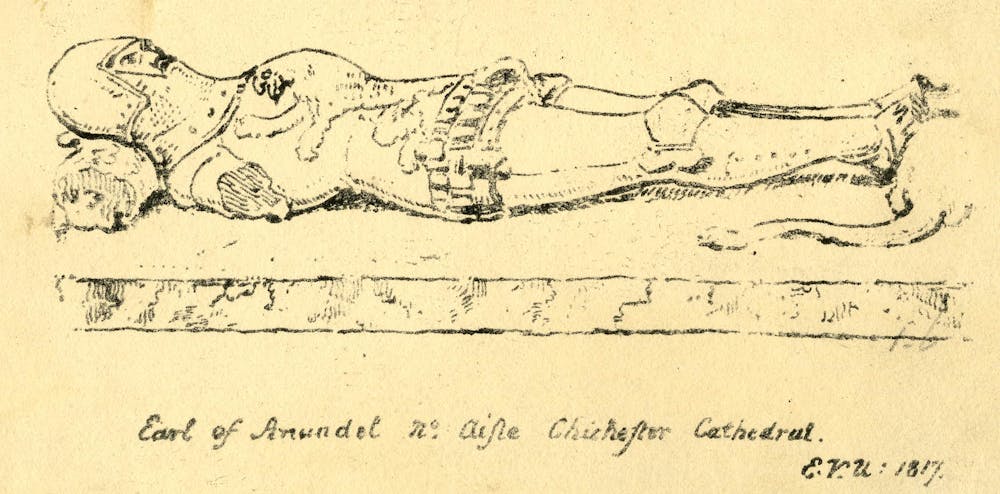
It’s never occurred to anyone that Keats’s imagination might also have been set racing by the stone avatars of the Arundels, because the serene gleaming effigies don’t seem to have much in common with Keats’s haggard knight. However, intriguing visual evidence in the form of two little-known sketches in the British Museum may hold the key to the mystery.

Larkin viewed the alabaster effigies after their Victorian restoration. In 1843, the extensively damaged statues of Richard and Eleanor, which had been torn apart to save space, were reunited, presenting the sentimental tableau of conjugal affection that moved Larkin to an uncharacteristic moment of (albeit cagey) optimism about love.

When Keats visited the cathedral in January 1819, things were very different. The recumbent knight was grimy and badly weathered from having lain for a century outside in the elements (“sadly mutilated”, in the words of the 1844 Antiquarian and Architectural Yearbook). He was heavily graffiti-ed with “dates and initials of the mischievous and ignorant”, the earliest from 1604 – and he was missing an arm. His lady lay not beside him but stowed a few metres away at his feet, separated by a pillar. He was the very model of woe-begone.

Edward Vernon Utterson’s 1817 sketch of the Tomb of the Earl of Arundel in Chichester Cathedral, with effigy as a knight, head to left, his right arm missing.
©Trustees of the British Museum, CC BY-NC-SA

The effigies also retained faint traces of medieval paint, including “small quantities of crimson”, which perhaps throw light on the “fading rose” of the feverish knight’s complexion in Keats’s ballad.

Sketch of a lady seated on a knight’s tomb – which also has a missing arm – in Chichester Cathedral, made by John Flaxman in 1826.
©Trustees of the British Museum, CC BY-NC-SA

After visiting Chichester, Keats moved on to nearby Bedhampton, where he stayed with prosperous millers John and Letitia Snook. When illness allowed him to venture beyond the garden gate, he would have found a granary, a sedgy lake, and in the centre of the village Bidbury Mead. All feature in La Belle Dame Sans Merci, from the withered vegetation around the lake, and the meads where the knight encounters the lady, to the “squirrel’s granary”.

Visions of love

Could Chichester Cathedral’s famous effigies have inspired not just one but two well-known – though very different – visions of love? Larkin’s holds out the possibility that love conquers all. Keats’s looks towards the abyss. It’s even possible that Keats wasn’t above a dark pun at the effigy’s expense. Could it really be a coincidence that Keats came up with the idea of a “knight-at-arms” after seeing the cathedral’s wounded knight-without-arms? Whatever the case, the emasculated effigy of Richard FitzAlan would have resonated with Keats’s own precarious sense of virility.

Even the ballad’s birds who do not sing may have their origins in a real absence. The damp, wetland habitat around Bedhampton’s lakes made a perfect home for sedge warblers. These chattery passerines would have been wintering in sub-Saharan Africa when Keats arrived in the village. In other words, we may now know the sound of one of the most famous of literary silences.

Poems can rarely be chased back to a single source of inspiration. Even ekphrastic poems, which deliberately set out to describe physical objects, are hardly ever one-to-one engagements with their subjects. The poetic imagination simply doesn’t work like that. That’s especially true of La Belle Dame Sans Merci, a particularly rich example of writing that resists explanation. Nevertheless, Chichester Cathedral’s armless knight, usually associated with Larkin’s An Arundel Tomb, deserves to be recognised as part of the heady mix that produced a lover’s complaint which has haunted generations of readers.The Conversation

Richard Marggraf-Turley, Professor of English Literature, Aberystwyth University

This article is republished from The Conversation under a Creative Commons license. Read the original article.
Unknown's avatar

The Origins of Printing


The link below is to an article that looks at the origins of printing and it is a story that begins well before Gutenberg.

For more visit:
https://lithub.com/so-gutenberg-didnt-actually-invent-the-printing-press/

Unknown's avatar

2019 International Dublin Literary Award


The link below is to an article reporting on the winner of the 2019 International Dublin Literary Award, Emily Ruskovich for ‘Idaho.’

For more visit:
https://lithub.com/emily-ruskovichs-idaho-nominated-by-a-single-library-in-bruges-wins-e100000/