
The link below is to an article reporting on the winners of the 2019 IndieReader Discovery Awards.
For more visit:
https://goodereader.com/blog/indie-author-news/indiereader-announces-winners-of-9th-annual-ir-discovery-awards

The link below is to an article reporting on the winners of the 2019 IndieReader Discovery Awards.
For more visit:
https://goodereader.com/blog/indie-author-news/indiereader-announces-winners-of-9th-annual-ir-discovery-awards
The links below are to articles reporting on the winner of the 2019 Women’s Prize for Fiction
For more visit:
– https://www.theguardian.com/books/2019/jun/05/womens-prize-for-fiction-tayari-jones-novel-an-american-marriage
– https://www.booktopia.com.au/blog/2019/06/06/tayari-jones-wins-the-2019-womens-prize-for-fiction/
– https://publishingperspectives.com/2019/06/us-author-tayari-jones-wins-2019-womens-prize-for-fiction/
shutterstock
Emma Seddon, Newcastle University
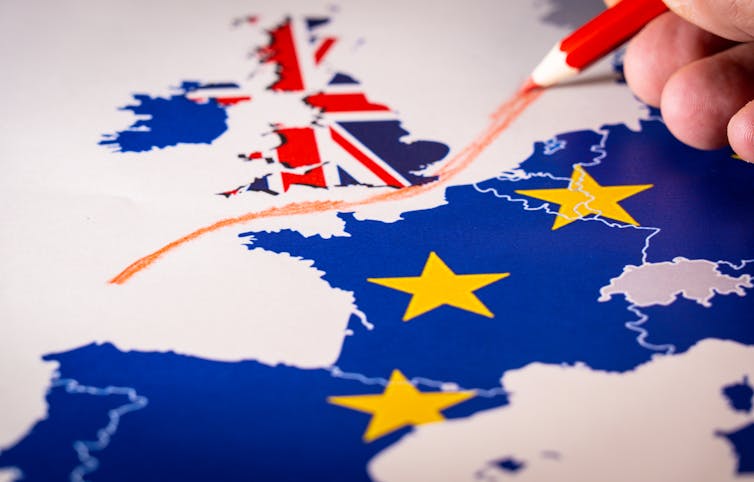
Britain is facing an uncertain future and an uneasy relationship with Europe after Brexit. Among other things, the country’s woeful inability to learn languages has been raised as a key stumbling block – with the decline in foreign language learning among school and university students across the UK also raising alarm.
English is one of the official languages of the EU, along with 22 others, and also one of the three working languages of its institutions (with German and French). On top this, English is the most commonly taught foreign language in Europe, which is a major factor in why it is the most commonly used working language. Although not everyone is happy about this, including the French EU ambassador who recently walked out of a meeting on the EU budget when the Council decided to use only English translations.
So, even if Britain leaves the EU, English will remain not only an official language –- because of the member status of Malta and Ireland –- but it will likely also remain the principal working language of the EU institutions.
English is also often used globally as a common language between speakers of different languages. In other words, conversations are happening in English that do not involve native English speakers. This, of course, has a long and fraught colonial past – as the British Empire forced English on its colonies. But the decline of the Empire did not mean the decline of English. On the contrary, as the US rose to be a global economic power, globalisation drove the spread of English across the world – and continues to do so. And the European Union is no exception.
As part of my ongoing PhD research on the translation profession, I interviewed some British translators working at the European Commission. From their perspective, English will remain the principal working language following Brexit, as switching to only French and German, or adding another language would be unrealistic and require a huge investment in training by the EU. Instead, they report that English will continue to be used, and will simply evolve and change in these settings.
So-called “EU speak” is an example of this. Non-native speakers’ use of English is influenced by their native languages, and can result in different phrasing. For example, within the EU institutions, “training” is often used as a countable noun, meaning you can say: “I’ve had three trainings this week”. In British English, however, it is uncountable, meaning you would probably say something like: “I’ve had three training sessions this week”.
This is a minor linguistic point, but it shows how English is changing within the EU institutions due to the influence of non-native speakers. For the time being, native English speaking translators and editors limit the extent of these changes – particularly in documentation intended for the public.
But if Britain leaves the EU, there will be a dramatically reduced pool of native English speakers to recruit from, because you need to have an EU passport to work in the institutions. As people retire, fewer native speakers will work in the EU, meaning they will have less and less influence on and authority over the use of English in these contexts. This means “EU English” will likely move away from British English at a faster pace.
Such change is nothing new – especially with English. “Singlish” or Singaporean English has its roots in colonial rule and has since become independent from British English, integrating grammar and vocabulary from languages that reflect Singapore’s immigrant history – including Malay, Cantonese, Mandarin, and Tamil among others. Singlish has developed its own words and expressions out of this hybrid of languages and has evolved and shifted in response to the migrations of peoples and cultures, new technologies and social change.
Only time will tell whether “EU English” will ever move so far from its moorings. But, according to one translator I spoke to, even if Britain were to stay in the EU, English would continue to change within the institutions:
English doesn’t belong to us anymore as Brits, as native speakers, it belongs to everyone.
And the frequent exposure to and use of English in daily life means other language communities are increasingly gaining a sense of ownership over the language.
The ubiquity of English is sometimes touted as a demonstration of the enduring importance of Britain – and the US – on the world stage. From what I have seen researching translation, this assumption in fact shows how complacent English speaking countries have become.
This does not mean the economic, cultural, and military power of these countries should be dismissed. But this doesn’t change the fact that English is used as a common language in interactions that do not involve any of those countries – take, for example, a Slovenian cyclist being interviewed in English by a French journalist about his performance in the Italian cycling event Giro d’Italia.
Linguistic diversity certainly needs to be championed to ensure we do not lose humanity’s great variety of languages and dialects, and some great work is being done on this. Nevertheless, it is clear that English has developed a role distinct from its native speakers as a shared language that facilitates communication in an increasingly globalised world.
Emma Seddon, PhD Candidate in the School of Geography, Politics and Sociology, Newcastle University
This article is republished from The Conversation under a Creative Commons license. Read the original article.
The link below is to an article reporting on Calibre now supporting the Nook Glowlight Plus.
For more visit:
https://goodereader.com/blog/barnes-and-noble-nook-ereader-news/calibre-now-has-support-for-the-nook-glowlight-plus-7-8

Enrica Maria Ferrara, University College Dublin
Does it matter who we really are? It definitely does in the eye of the law or if we are in a line of work in which our identity is crucial to perform our job correctly. For example, if we say that we can fly an aeroplane and we are subsequently hired as commercial pilots, our identity really does matter to the hundreds of people whose lives would be in danger if we had never received appropriate training for it.
But there’s a professional field in which, according to world-renowned writer Elena Ferrante, registry office records and formal education do not really count. As she wrote in her column for The Guardian in April 2018:
In the work of art, biography and autobiography have a truth completely different from that which we attribute to a CV or an income tax return. In that space there is, there has to be, a freedom of invention that allows one to violate all the agreements about truth in everyday life.
Ever since her debut novel, L’amore molesto (Troubling Love) was published in 1992, Ferrante has been consistent with this attitude – revealing very little about her CV and even less about her income tax return. That is, until the day journalist Claudio Gatti published a report of his investigation into the identity of the writer in October 2016. Based on Gatti’s analysis of publisher’s accounts, there is evidence to suggest that the author of the Neapolitan Novels coincides with one particular bank account holder: the translator Anita Raja, wife of Neapolitan writer Domenico Starnone.
In April 2017 I interviewed Starnone at the Italian Cultural Institute in Dublin. Being a voracious reader of his books I was really looking forward to that meeting and had been preparing for a few months. The tension started rising when I heard that Raja was also going to be in Dublin. I was warned not to ask any questions which could imply in any way that I believed Raja – or Starnone, for that matter – could be the brains behind the “Elena Ferrante” books: “Domenico gets really angry when someone asks him if he is Elena,” I was told.
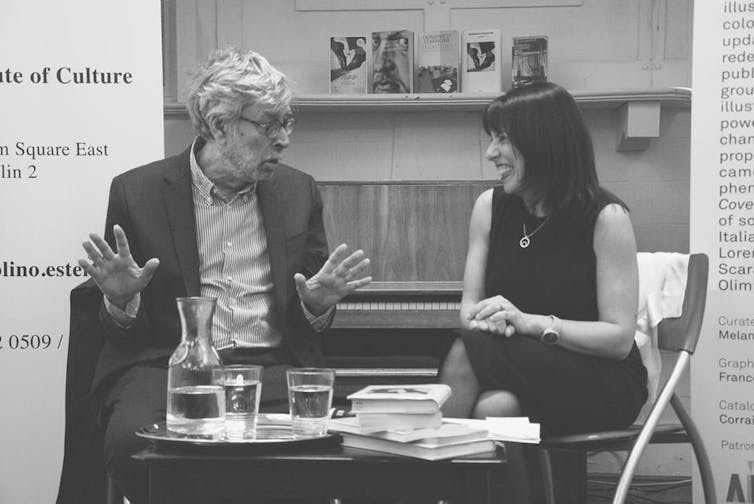
But I couldn’t resist the temptation and I allowed myself one question that could be indirectly hinting at the issue of Ferrante’s identity. It had to do with Starnone’s 2016 novel Ties, which starts off with a series of letters written by the protagonist Vanda, who is distraught after her husband Aldo has abandoned her for a younger woman. I asked him:
Ties is divided into three sections written from three different points of view: the husband, the wife and the children. How challenging was it to write the story from Vanda’s perspective? Generally speaking, is it hard for a male writer to engage in a first-person narrative from a female perspective?
Starnone gave me a hard stare. I could feel the tension. Then, unexpectedly, he gave one of his wide disarming smiles. “It depends on the writer’s mimetic ability, which is one of the crucial elements of storytelling,” he started. According to Starnone, a good writer is one who can put him or herself in anyone’s shoes. The written word can speak the voice of anything, “even the flickering flame of a burning match”.
The metaphor was powerful. A flickering flame: one moment it’s there and the next it isn’t. Like the face and gender of the author Elena Ferrante.
My personal research on Ferrante’s notion of identity combines well with Starnone’s discourse on the importance of empathy to negotiate “otherness”. To create convincing characters, Starnone seems to argue, writers must be able to feel what others feel, think what others think – “become” others, if only on paper.
Equally, in Ferrante – as I contend in an in-depth study of her work – the “I” is always defined via a relationship with a “you” and therefore identity is always relational. Furthermore, the “you” in question might not be another human being but also an animal, an object, the environment, or a technological device. This special type of empathy between human and nonhuman entities gives birth to a new identity which is not just “relational” but indeed posthuman.
To understand how we are becoming posthuman, think of the ways smartphones and social media are shaping our daily lives so that we are constantly connected with others by means of technology. Think how emotionally bound we are to pets and animals whose status of creatures with feelings might soon be legally recognised. Or think how the debate on climate change is affecting our eating habits, social behaviour and even our reproductive ethos, as shown by birth-strikers (women who are refusing to have children because of climate change).
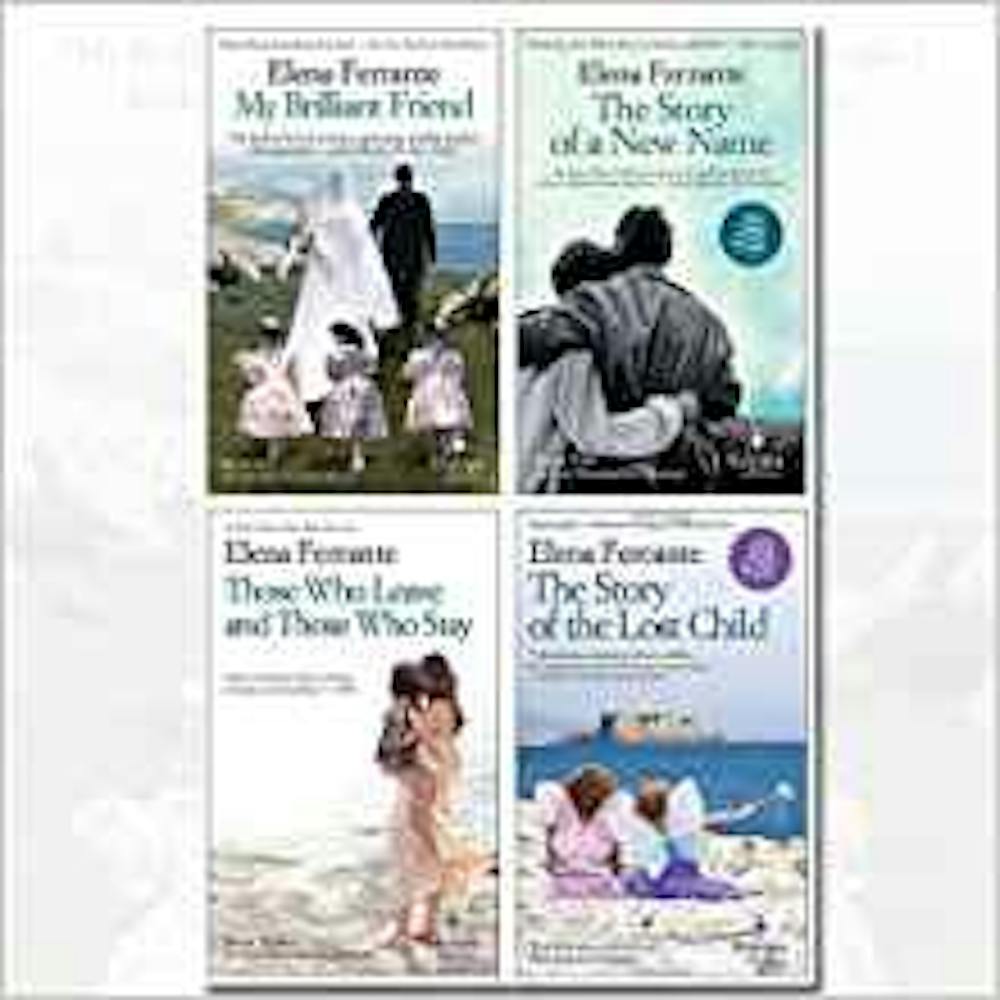
On the topic of posthuman identity, I have edited a forthcoming volume of collected essays, [Posthumanism in Italian Literary and Film. Boundaries and Identity]. In my chapter on Ferrante I explain why the symbiotic relationship between the two friends Elena and Lina, protagonists of My Brilliant Friend (also now a successful television series) may be defined as “posthuman”.
Elena and Lina’s identities are so closely bound to one another and to the porous Neapolitan landscape – described, at times, as an unstable mass of flesh, objects, inert matter, energy, blood, lava – that often readers and viewers are left wondering whether the two characters are in fact just one: the dyad Elena-Lina.
Through this loss of boundaries between the two characters and their surroundings, Ferrante intends to bring attention to the unsettling matter of a crumbling, fragmented world without margins, a world in which singular identity feels constantly threatened by the “other” – man, woman, avatar, the animal, the environment.
What is Ferrante’s answer to this threat? How does she advise us to counteract our fear of a borderless world in which the identity of the human is at risk of vanishing?
Read more:
Elena Ferrante has her reasons for anonymity – we should respect them
Rather than suggesting that we die, destroy ourselves or disappear, like Lina in the Neapolitan quartet, Ferrante alludes to the fact that we are done with individualism and its notion of borders. If our identity is constantly redefined through dialogue with others, individuals and their names no longer matter. Our collaborative effort is what matters, our empathy with others – whether it’s humans, nonhuman animals, the environment or even our technological avatars.
Enrica Maria Ferrara, Lecturer/Assistant Professor, School of Languages, Cultures and Linguistics, University College Dublin
This article is republished from The Conversation under a Creative Commons license. Read the original article.
The link below is to a book review of ‘Siege – Trump Under Fire,’ by Michael Wolff.
For more visit:
https://www.theguardian.com/us-news/2019/jun/02/siege-review-michael-wolff-trump-fire-and-fury
The links below are to articles reporting on the winner of the 2019 PEN Pinter Prize, Lemn Sissay.
For more visit:
– https://www.theguardian.com/books/2019/jun/03/pen-pinter-prize-2019-poet-lemn-sissay-wins
– https://publishingperspectives.com/2019/06/pen-america-slams-donald-trump-english-pen-names-sissay-to-2019-pinter-prize/
The link below is to an article that reports on Apple Books getting a reading goals feature.
For more visit:
https://the-digital-reader.com/2019/06/04/apple-books-to-get-reading-goals-feature/
 At the BookShelf
You must be logged in to post a comment.