
Unknown's avatar

Crime of culture: American Animals and the history of rare book heists


File 20180917 158219 gol8og.jpg?ixlib=rb 1.1

STX Entertainment

Leah Henrickson, Loughborough University

American Animals, a film recounting the true story of a 2004 rare book theft, was recently released in cinemas across the UK. The film is a dramatic retelling of events based on director Bart Layton’s interviews and written correspondence with the convicted book thieves – interactions which began while the thieves were serving seven-year prison sentences following their guilty pleas.

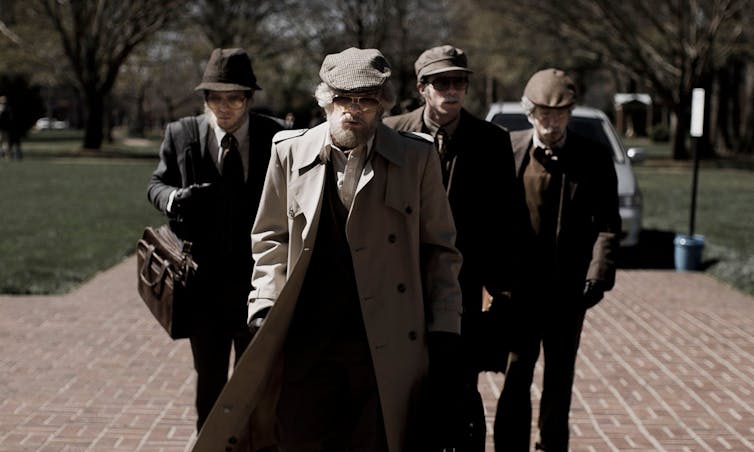
In 2004, four friends in their early 20s – Charles Allen, Eric Borsuk, Warren Lipka, and Spencer Reinhard – attempted to execute an elaborate plan to steal more than US$12m worth of textual treasures from Lexington, Kentucky’s Transylvania University (Transy) Special Collections.

After a year in the planning, the heist involved the men disguising themselves as elderly, shooting librarian Betty Jean Gooch with a stun gun and simply shoving valuables into backpacks. When the day came, the men managed to escape with approximately US$750,000 worth of books in their backpacks, including a first edition of Charles Darwin’s On the Origin of Species, an illuminated medieval manuscript, and a copy of John James Audubon’s A Synopsis of Birds of North America.

Rushing from Lexington to New York, the men attempted to appraise their loot at Christie’s, but never managed to sell their ill-gotten gains. They returned home with the books and were tracked down by the FBI within a matter of months. The entire ordeal was so poorly organised that Vanity Fair deemed it “one part Oceans 11, one part Harold & Kumar”.

Light fingers

But this was by no means the only notable rare book heist in living memory. Earlier in 2018, an audit of the special collections of the Carnegie Library of Pittsburgh uncovered a series of thefts of rare books and book pages with a total value of around US$8m over a period of more than 20 years. It turned out that the former manager of the Carnegie Library’s rare book room, Gregory Priore, and bookseller John Schulman had been working together to sell the stolen goods through the rare book trade and auction houses.

The books stolen from Carnegie included Isaac Newton’s Philosophiæ Naturalis Principia Mathematica, a first edition of The Journal of Major George Washington, and a first edition of Adam Smith’s The Wealth of Nations. Unaware of where these books came from, booksellers from across the globe bought and sold them on to their own private and institutional customers.
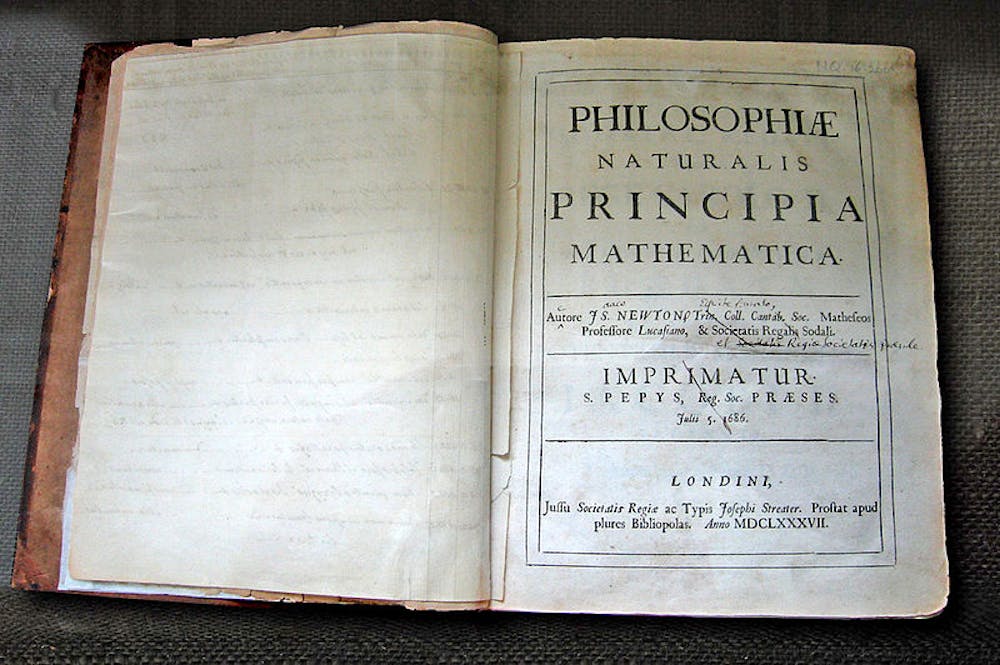
Sir Isaac Newton’s own first edition copy of his Philosophiae Naturalis Principia Mathematica with his handwritten corrections for the 20th edition.
Andrew Dunn via Wren Library, Trinity College, Cambridge, CC BY-SA

These sales can be difficult to track on such a large scale and, while some works have been recovered (often at the booksellers’ own expense), hundreds of the stolen items remain missing. An up-to-date list of those items believed to have been stolen is provided by the Antiquarian Booksellers’ Association of America.

Library thefts are nothing new. Throughout the 1840s, Italian count Guglielmo Libri Carucci dalla Sommaja stole approximately 30,000 items in his job as chief inspector of French Libraries (he later made a comfortable living selling this loot in England).

More recently, in 1990, American bibiomaniac Stephen Blumberg was arrested for stealing more than 20,000 books valued at more than US$5m from more than 200 universities and museums across North America.

The Great Library of Alexandria, O. Von Corven, 19th century.
Wikimedia commons, CC BY-NC

He served four years in prison and became known as the “Book Bandit”.

But on a more systemic and institutional level one could go as far back as the ancient Library of Alexandria, which supposedly seized any books found on ships arriving at the port. These books were copied by professional scribes who then deposited the original works into the library and gave the copies to the books’ owners.

Book ‘em

While library thefts are commonplace, the release of American Animals and the news of the recent Carnegie Library thefts have made this crime front page news. After all, the sheer value of some of these books makes them a very attractive proposition for thieves. But it’s not always just about money – the young men in American Animals fantasise about getting their hands on culturally revered items, while Guglielmo Libri and Blumberg were bibliomaniacs with a recognised condition. And the Library of Alexandria had a larcenous ambition to become a “universal library”, gathering all of the known world’s knowledge under a single roof.

The rare book trade is lucrative, certainly. Individuals and institutions are willing to spend healthy amounts to enhance their collections. But books represent more than just profit. They are cultural artefacts that span space and time to carry the voices of those who have meaningfully contributed to the world’s knowledge. As the primary means of communication for thousands of years, books reflect and perpetuate cultural heritage and – ultimately – help us understand what it means to be human.

Whether someone is stealing books for financial gain, the thrill of the game, or the overwhelming love of these objects, library theft is always underpinned by an understanding of books as valuable cultural artefacts. The young men in the American Animals heists are animals because they tried to plunder these relics of human development.The Conversation

Leah Henrickson, PhD Candidate, Loughborough University

This article is republished from The Conversation under a Creative Commons license. Read the original article.
Unknown's avatar

For centuries, anonymous insider accounts have chipped away at ruling regimes – and sometimes toppled them


File 20180912 133898 1ffx51y.jpg?ixlib=rb 1.1
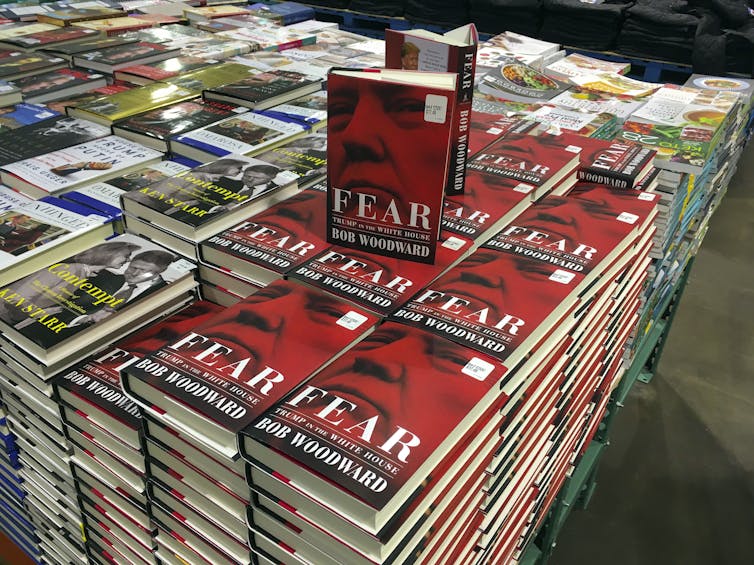
Copies of Bob Woodward’s ‘Fear: Trump in the White House’ are displayed for sale at a Costco in Virginia.
AP Photo/Pablo Martinez Monsivais

Rachel Carnell, Cleveland State University

Bob Woodward’s new book, “Fear: Trump in the White House,” seems to contain scant new information.

Like Michael Wolff’s “Fire and Fury: Inside the Trump White House,” it portrays President Donald Trump as an “emotionally overwrought, mercurial and unpredictable leader,” whose senior staff struggle to contain his most dangerous impulses.

This same view of Trump was reiterated in a Sept. 5 anonymous New York Times op-ed, which, as Nebraska Sen. Ben Sasse observed, is “just so similar to what so many of us hear from senior people around the White House, you know, three times a week.”

But whether “Fear” tells us something new matters less than the fact that the book is yet another broadside against Trump’s image. It adds more fuel to the suspicions many have about the president’s behind-the-scenes behavior.

In fact, Woodward’s “Fear” – together with Wolff’s “Fire and Fury,” Omarosa Manigault’s “Unhinged” and the anonymous op-ed – is part of a long tradition of political “secret histories,” a genre that recounts salacious and scandalous details about the dealings, relationships and temperaments of those in power. It’s a practice that goes back centuries, and it’s one that my co-editor and I explore in our book “The Secret History in Literature, 1660-1820.”

Secret histories tend to take two forms. There is the plain-spoken, just-the-facts approach, similar to Woodward’s “Fear.” Then there are novelistic accounts with major figures depicted using pseudonyms, as in “Primary Colors,” a lightly fictionalized dramatization of the Clinton White House.

But the secrets unveiled in these works usually don’t come out of nowhere. Instead, they contain anecdotes that have long been whispered or suspected. The goal of secret histories is to emphasize embarrassing stories about a ruler or government – to propel the drumbeat of negative coverage in order to strengthen the opposition and, in some instances, to even topple governments.

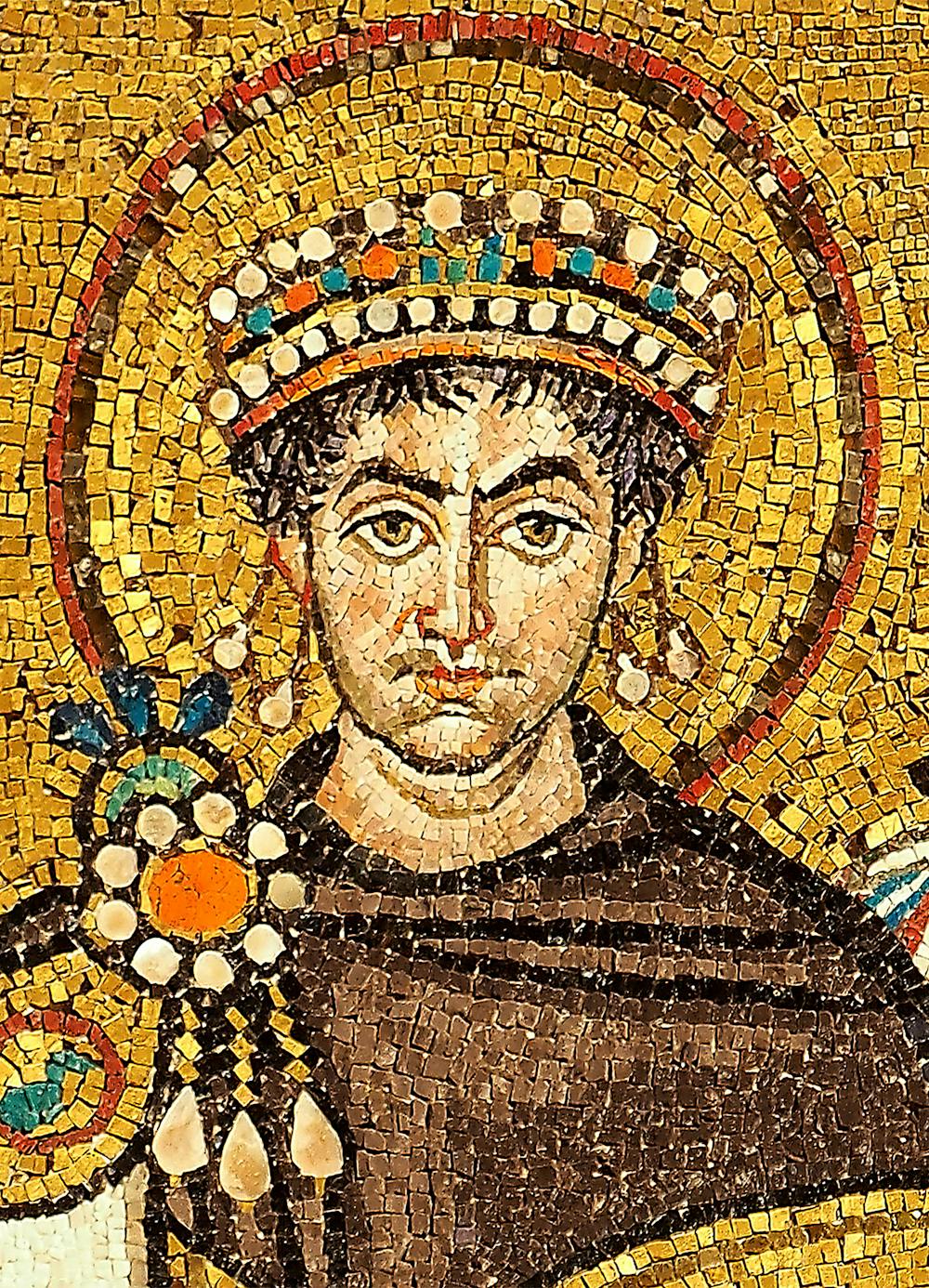
Justinian was the subject of a secret history circulated by the military historian Procopius.
Petar Milošević

Secret histories date back at least to the sixth century, when the military historian Procopius wrote down sordid anecdotes about Byzantine Emperor Justinian and his wife, Theodora, in a work that became known as “Anekdota,” which translates to “unpublishable things.” Ten centuries later, it appeared in Latin as “Historia Arcana,” or “Secret History.”

As a military historian, Procopius had helped create the myth of Justinian’s greatness in his eight-book treatise “The Wars of Justinian.” But in his “Anekdota,” Procopius finally told the ugly backstory of Justinian’s reign: his lust, his seizure of others’ property, his petty vengefulness and his persecution of non-Christians. The work was almost certainly circulated in manuscript scroll among Justinian’s enemies. While it probably damaged his standing, Justinian was nonetheless able to retain his grip on power.

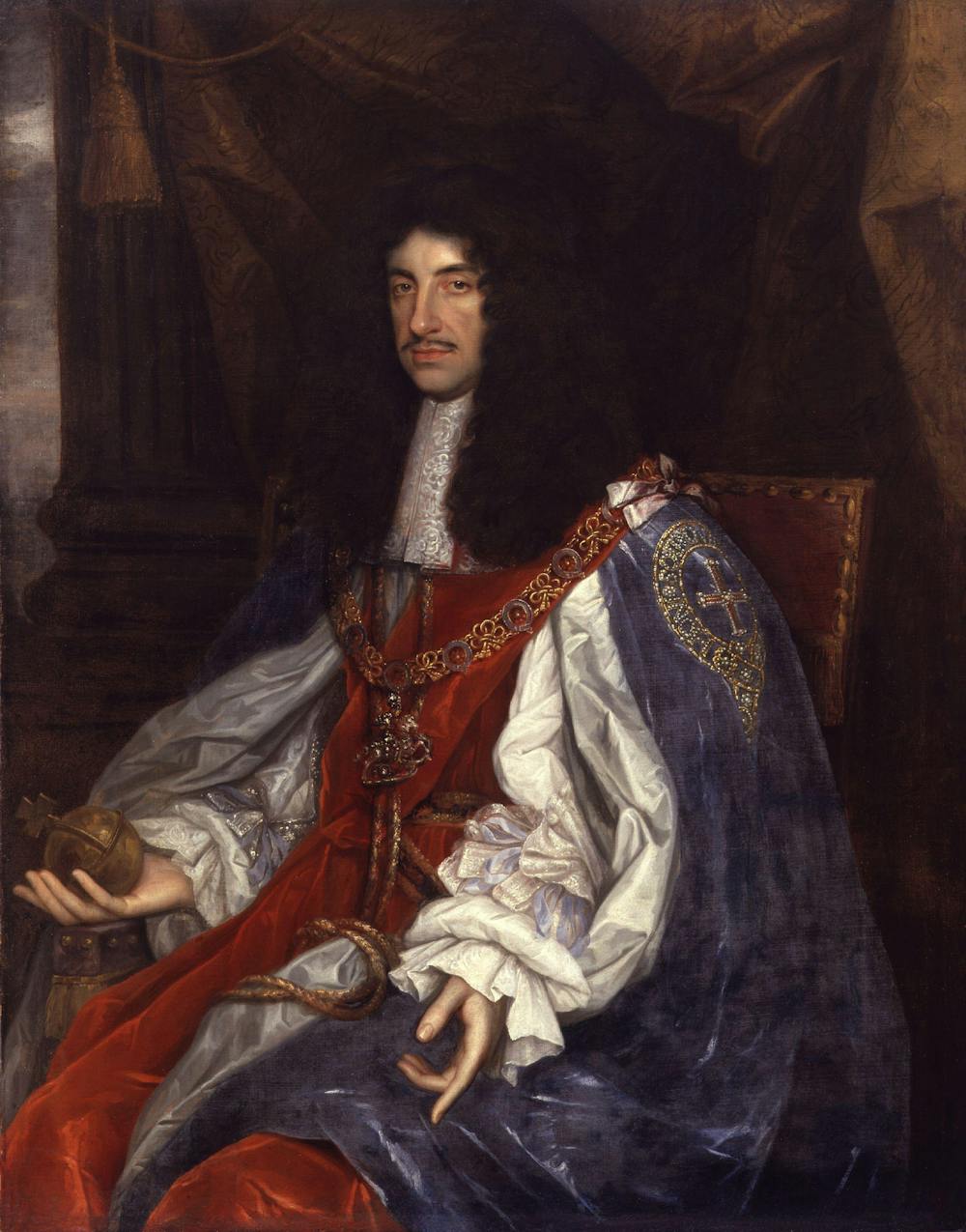
After French and English translations of Procopius’ “Anekdota” appeared in 1669 and 1674, secret histories in the same style began to appear about King Charles II of England.

These tended to focus on his mistresses – particularly the infamous Duchess of Cleveland, who manipulated Charles for over a decade, persuading him to grant her land and money and bestow titles of nobility on their illegitimate children.

Speculation over King Charles II’s relationship with the Duchess of Cleveland was rampant during his reign.
National Portrait Gallery

These reports, which read like tabloid-style gossip, were never just about sex.

Readers of one account, titled “The Amours of the King of Tamaran,” likely realized that if the king could be duped and controlled by his powerful mistress, he was also susceptible to being influenced by England’s adversaries.

Indeed, he was: Another secret history, Andrew Marvell’s “Account of the Growth of Popery and Arbitrary Government in England,” described the backstory of the Secret Treaty of Dover, in which Charles II accepted large sums of money from the French king in exchange for promising to return England to Catholicism.

These publications didn’t bring down the politically skilled Charles II, who was glad to take Louis XIV’s money but savvy enough to decide against changing his country’s religion.

They did, however, sow suspicion towards Charles II and his family. After Charles II’s death, his openly Catholic younger brother, James, ascended the throne in 1685, instilling fear that England would return to Catholicism. Seven Englishmen wrote to Prince William of Orange – who was a Protestant – pleading that he invade England. In the Glorious Revolution that ensued, James II fled to France, and Parliament declared William and his wife, Mary, joint monarchs of England.

The Glorious Revolution of 1688 helped inspire American colonists to rebel against another British monarch, with the not-so-secret history of George’s III’s “repeated injuries and usurpations” enshrined in the Declaration of Independence.

Some might disparage Woodward’s book as “anonymously-sourced gossip.”

But gossip has always been important to humankind. As Israeli historian Yuval Noah Harari notes in “Sapiens,” his best-selling account of early human history:

“It is not enough for individual men and women to know the whereabouts of lions and bison. It’s much more important for them to know who in their band hates whom, who is sleeping with whom, who is honest, and who is a cheat.”

Those who dismiss Woodward’s book underestimate the power that gossip and behind-the-scenes revelations wield over politics – and the way it has shaped the course of human history.The Conversation

Rachel Carnell, Professor of English, Cleveland State University

This article is republished from The Conversation under a Creative Commons license. Read the original article.
Unknown's avatar

Listening Vs Reading


The link below is to an article that takes yet another look at the audiobook vs reading debate.

For more visit:
http://time.com/5388681/audiobooks-reading-books/

Unknown's avatar

The 2018 BBC National Short Story Award Shortlist


The link below is to an article that takes a look at the 2018 BBC National Short Story Award shortlist.

For more visit:
https://www.theguardian.com/books/2018/sep/14/bbc-short-story-prize-selects-all-female-shortlist-for-fifth-time

Unknown's avatar

2018 National Book Award Longlist for Poetry


The link below is to an article that takes a look at the longlist for the 2018 National Book Award for Poetry.

For more visit:
https://bookriot.com/2018/09/13/2018-national-book-award-longlist-for-poetry/

Unknown's avatar

Podcasts


The link below is to an article that takes a look at 31 podcasts aimed at book lovers.

For more visit:
https://www.buzzfeed.com/kirbybeaton/podcasts-every-type-book-lover