
Unknown's avatar

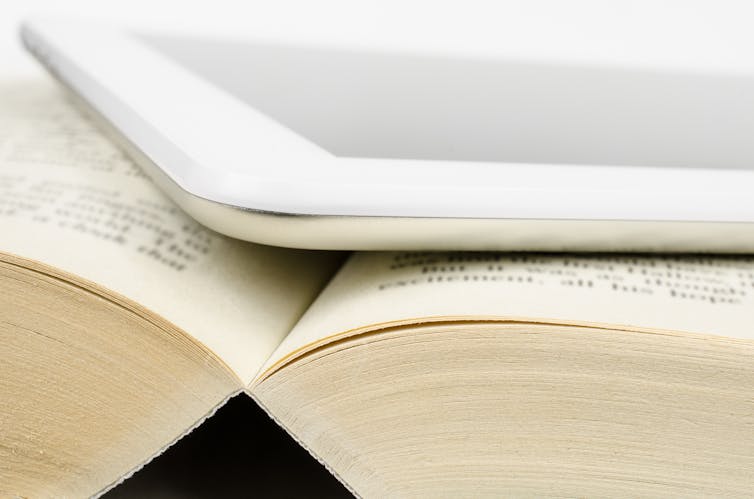
The enduring power of print for learning in a digital world


File 20171002 12115 5nz9dp

PHOTO FUN

Patricia A. Alexander, University of Maryland and Lauren M. Singer, University of Maryland

Today’s students see themselves as digital natives, the first generation to grow up surrounded by technology like smartphones, tablets and e-readers.

Teachers, parents and policymakers certainly acknowledge the growing influence of technology and have responded in kind. We’ve seen more investment in classroom technologies, with students now equipped with school-issued iPads and access to e-textbooks. In 2009, California passed a law requiring that all college textbooks be available in electronic form by 2020; in 2011, Florida lawmakers passed legislation requiring public schools to convert their textbooks to digital versions.

Given this trend, teachers, students, parents and policymakers might assume that students’ familiarity and preference for technology translates into better learning outcomes. But we’ve found that’s not necessarily true.

As researchers in learning and text comprehension, our recent work has focused on the differences between reading print and digital media. While new forms of classroom technology like digital textbooks are more accessible and portable, it would be wrong to assume that students will automatically be better served by digital reading simply because they prefer it.

Speed – at a cost

Our work has revealed a significant discrepancy. Students said they preferred and performed better when reading on screens. But their actual performance tended to suffer.

For example, from our review of research done since 1992, we found that students were able to better comprehend information in print for texts that were more than a page in length. This appears to be related to the disruptive effect that scrolling has on comprehension. We were also surprised to learn that few researchers tested different levels of comprehension or documented reading time in their studies of printed and digital texts.

To explore these patterns further, we conducted three studies that explored college students’ ability to comprehend information on paper and from screens.

Students first rated their medium preferences. After reading two passages, one online and one in print, these students then completed three tasks: Describe the main idea of the texts, list key points covered in the readings and provide any other relevant content they could recall. When they were done, we asked them to judge their comprehension performance.

Across the studies, the texts differed in length, and we collected varying data (e.g., reading time). Nonetheless, some key findings emerged that shed new light on the differences between reading printed and digital content:

  • Students overwhelming preferred to read digitally.

  • Reading was significantly faster online than in print.

  • Students judged their comprehension as better online than in print.

  • Paradoxically, overall comprehension was better for print versus
    digital reading.

  • The medium didn’t matter for general questions (like understanding the main idea of the text).

  • But when it came to specific questions, comprehension was significantly better when participants read printed texts.

Placing print in perspective

From these findings, there are some lessons that can be conveyed to policymakers, teachers, parents and students about print’s place in an increasingly digital world.

1. Consider the purpose

We all read for many reasons. Sometimes we’re looking for an answer to a very specific question. Other times, we want to browse a newspaper for today’s headlines.

As we’re about to pick up an article or text in a printed or digital format, we should keep in mind why we’re reading. There’s likely to be a difference in which medium works best for which purpose.

In other words, there’s no “one medium fits all” approach.

2. Analyze the task

One of the most consistent findings from our research is that, for some tasks, medium doesn’t seem to matter. If all students are being asked to do is to understand and remember the big idea or gist of what they’re reading, there’s no benefit in selecting one medium over another.

But when the reading assignment demands more engagement or deeper comprehension, students may be better off reading print. Teachers could make students aware that their ability to comprehend the assignment may be influenced by the medium they choose. This awareness could lessen the discrepancy we witnessed in students’ judgments of their performance vis-à-vis how they actually performed.

3. Slow it down

In our third experiment, we were able to create meaningful profiles of college students based on the way they read and comprehended from printed and digital texts.

Among those profiles, we found a select group of undergraduates who actually comprehended better when they moved from print to digital. What distinguished this atypical group was that they actually read slower when the text was on the computer than when it was in a book. In other words, they didn’t take the ease of engaging with the digital text for granted. Using this select group as a model, students could possibly be taught or directed to fight the tendency to glide through online texts.

4. Something that can’t be measured

There may be economic and environmental reasons to go paperless. But there’s clearly something important that would be lost with print’s demise.

In our academic lives, we have books and articles that we regularly return to. The dog-eared pages of these treasured readings contain lines of text etched with questions or reflections. It’s difficult to imagine a similar level of engagement with a digital text. There should probably always be a place for print in students’ academic lives – no matter how technologically savvy they become.

Of course, we realize that the march toward online reading will continue unabated. And we don’t want to downplay the many conveniences of online texts, which include breadth and speed of access.

The ConversationRather, our goal is simply to remind today’s digital natives – and those who shape their educational experiences – that there are significant costs and consequences to discounting the printed word’s value for learning and academic development.

Patricia A. Alexander, Professor of Psychology, University of Maryland and Lauren M. Singer, Ph.D. Candidate in Educational Psychology, University of Maryland

This article was originally published on The Conversation. Read the original article.

Unknown's avatar

We, robot: the computer co-authoring a story with a human writer


File 20171002 12115 f0kpql
shutterstock.
Shutterstock

Leah Henrickson, Loughborough University

In Isaac Asimov’s I, Robot, a collection of nine short stories about robotics, Asimov explores the possibilities of human-computer interaction. How can humans and computers co-exist? How can they work together to make a better world?

A research group from the Meertens Instituut in Amsterdam and the Antwerp Centre for Digital Humanities and Literary Criticism recently introduced a new digital creative writing system. Using a graphical interface, an author drafts a text sentence by sentence. Then, the system proposes its own sentences to continue the story. The human and the computer work together to create what the system’s developers call “synthetic literature”.

The paper detailing this project describes the text generation system as an attempt to:

Create a stimulating environment that fosters co-creation: ideally, the machine should output valuable suggestions, to which the author retains a significant stake within the creative process.

How to train your robot

To learn language and sentence structure, the system has been trained using the texts of 10,000 Dutch-language e-books. Additionally, the system was trained to mimic the literary styles of such renowned authors as Asimov and Dutch science fiction author Ronald Giphart by generating sentences that use similar words, phrases, and sentence structures as these authors.

As part of this year’s annual Nederland Leest (The Netherlands Reads) festival, Giphart has been trialling the co-creative writing system to write a tenth I, Robot story. Once Giphart’s story is completed it will be published at the end of a new Dutch edition of Asimov’s classic text. Throughout November, participating libraries throughout the Netherlands will be offering free copies of this edition to visitors to get people thinking about this year’s festival theme: Nederland Leest de Toekomst (The Netherlands Reads the Future).

As Giphart types new sentences into the system’s graphical interface, the system responds by generating a selection of sentences that could be used to continue the story. Giphart can select any of these sentences, or ignore the system’s recommendations altogether.

The point of the system, its developers explain, is to “provoke the human writer in the process of writing”. Giphart says he still considers himself “the boss, but [the system] does the work”. One article even described the system as being ideal “for those who have literary aspirations, but who lack talent”.

Can a computer be creative?

The “synthetic literature” referred to by this system’s developers implies a combined production effort of both human and computer. Of course, the human still guides production. As co-developer Folgert Karsdorp explained: “You have numerous buttons to make your own mix. If you want to mix Giphart and Asimov, you can do that too.” The system follows its user’s direction, responding by using its own capacity for creativity.

But can a computer ever be truly creative? This is a question that the field of computational creativity has been studying since computers were invented. The field generally accepts that a computer can be called creative if its output would be considered creative had it been produced by a human.

Computational creativity debates are all rooted in one underlying question: is the computer merely a tool for human creativity, or could it be considered a creative agent itself? In a discussion about computer-generated art, creativity scholar Margaret Boden noted that:

It is the computer artist [the developer] who decides what input a system will respond to, how the system will respond, how unpredictable the system’s output will be, and how transparent the system’s functionality will be to users.

Even the most unpredictable output, according to Boden, results from choices the computer artist has made. While a developer may not be able to predict a system’s exact output, the output nevertheless reflects the choices the developer has made while programming.

Computer systems can be trained to mimic the language and sentence structure of particular writers.
Shutterstock

The co-creative writing system Giphart is using isn’t able to produce an entire book by itself, but it can produce paragraphs that continue Giphart’s story for him. Giphart, though, ultimately has the power to choose what computer output he uses.

But does this mean that Giphart alone will be credited as the author of his Ik, robot story, or will his computer be given credit as a co-author? It’s still unclear. Although it could be hotly debated whether the creative writing system is just a tool for Giphart’s vision or could be considered an agent itself, we won’t be seeing the demise of human authors any time soon.

One Nederland Leest blog post compares this new method of writing to the evolution of the electric guitar. It may have existed for nearly a century, but it wasn’t until Jimi Hendrix showed us how to really play the instrument that its potential was realised. Similarly, we still need to discover how to “play” this writing system to get the best results, whatever they might be.

So is synthetic literature the future? Maybe. Keep reading to find out.

The ConversationA video explaining the project is available here, in Dutch.

Leah Henrickson, PhD Candidate, Loughborough University

This article was originally published on The Conversation. Read the original article.

Unknown's avatar

Not My Review: A Modest Proposal, by Jonathan Swift (1729)


The link below is to a book review of ‘A Modest Proposal,’ by Jonathan Swift.

For more visit:
https://www.theguardian.com/books/2017/oct/09/100-best-nonfiction-books-jonathan-swift-a-modest-proposal

Unknown's avatar

Not My Review: A Short History of the Girl Next Door, by Jared Reck


Unknown's avatar

Nobel-winner Kazuo Ishiguro shows us the illusion of connection with the world


Jen Webb, University of Canberra

English author Kazuo Ishiguro has won the 2017 Nobel Prize for Literature. For some weeks now, the bookies have been offering odds on the likely winner. Kenya’s Ngũgĩ wa Thiong’o was front runner earlier this week, followed closely by Japan’s Haruki Murakami. Ishiguro was some way down the list of favourites: a surprise win, no doubt, for the bookies, and one that is likely to generate plenty of discussions and debate.

The commentary about this year’s prize, though, is unlikely to run as hot as it did last year, following the bombshell announcement that Bob Dylan was the new Laureate. With Ishiguro, love him or not, we are unquestionably in the company of a noteworthy writer, one who has been widely honoured. He has been winning literary awards since 1982, when A Pale View of the Hills won the Winifred Holtby Memorial Prize.

Despite this record of success – or perhaps as an inevitable consequence of the current media climate — Ishiguro seems to have been caught unawares by the win. Not unlike Helen Garner’s first response to the email telling her she’d won the Windham-Campbell prize, he thought the announcement of the award was fake news.

This year’s award was based on Ishiguro’s contribution as a writer “who, in novels of great emotional force, has uncovered the abyss beneath our illusory sense of connection with the world”. Sara Danius, Permanent Secretary to the Nobel Academy, added that he is “a writer of great integrity”, one who tackles those complex and enduring themes of “memory, time, and self-delusion”.

Ishiguro’s 1989 novel The Remains of the Day.
Goodreads

Personally, I’m delighted with the win. Ishiguro’s novels have helped give shape and texture to my life. An Artist of the Floating World (1986; winner of the Costa Book Award) and Remains of the Day (1989; Booker Prize winner) accompanied me through long insomniac nights. The uncertainty, barely-declared unhappiness and sense of dislocation found in both narrators fitted perfectly with my experience of being a stranger in a strange land. When We Were Orphans (2000), with its awkward misfit narrator and its haunting/haunted location, might be considered his least successful book, but I found all that unresolved guilt and unconfirmed identity both compelling and disturbing.

Never Let Me Go was named as Time Magazine’s Book of the Year in 2005. Its exquisite voice, and exquisitely painful dystopia, seemed to fit perfectly the mood of anxiety threading through that decade, one characterised by both late capitalism and the rapidly changing environment associated with the Anthropocene. And, most recently, The Buried Giant (2015) catapulted readers back to post-Arthurian Britain, weaving narrative threads from across history and treating enduring love and failing memory with equal compassion.

Ishiguro is often described as an author who writes across and between genres, moving from speculative fiction, to crime fiction, to social realism and fantasy. However I don’t find it instructive to pigeonhole his books into generic categories.

Ishiguro’s 2005 novel Never Let Me Go.
Goodreads

If anything, his writing demonstrates the permeability of the rules of genre. His technical and literary capacity, along with his closely observed — and coldly if tenderly rendered portraits – locate his writing outside formulae or conventions. The worlds he creates, and the characters that people them, are startlingly authentic – an empty term that I don’t like to use, but which feels right in this context.

Alfred Nobel established the prize, in his will, as one that is designed to reward “the person who shall have produced in the field of literature the most outstanding work in an ideal direction”. “Ideal” is another of those empty terms, but it seems to me that a writer who has consistently tackled problems of ethical relationships, social responsibility, questions of memory, gaps in meaning and identity, and done it all with a light touch and deep empathy fits that bill.

The ConversationIshiguro’s characters are often hard to love, but easy to care for, and their struggles with “the abyss beneath our illusory sense of connection with the world” offer ways of seeing and thinking about what lies beneath our own feet.

Jen Webb, Director of the Centre for Creative and Cultural Research, University of Canberra

This article was originally published on The Conversation. Read the original article.

Unknown's avatar

Nobel Prize in Literature 2017


The Nobel Prize in Literature has been awarded to Kazuo Ishiguro. The link below is to an article reporting on the announcement.

For more visit:
https://www.theguardian.com/books/2017/oct/05/kazuo-ishiguro-wins-the-nobel-prize-in-literature

Unknown's avatar

Not My Review: Uncomfortable – The Awkward and Essential Challenge of Christian Community by Brett McCracken


The link below is to a book review of ‘ Uncomfortable – The Awkward and Essential Challenge of Christian Community,’ by Brett McCracken.

For more visit:
https://www.9marks.org/review/book-review-uncomfortable-by-brett-mccracken/

Unknown's avatar

Not My Review: Without Merit, by Colleen Hoover


https://www.youtube.com/watch?v=55WzMVRvazI

Unknown's avatar

Not My Review: City on Fire, by Garth Risk Hallberg


https://www.youtube.com/watch?v=JV4ETWhQku0

Unknown's avatar

Not My Review: A Treatise of Human Nature, by David Hume (1739)


The link below is to a book review of ‘A Treatise of Human Nature,’ by David Hume.

For more visit:
https://www.theguardian.com/books/2017/oct/02/david-hume-treatise-human-nature-nonfiction-robert-mccrum-100-best”>https://www.theguardian.com/books/2017/oct/02/david-hume-treatise-human-nature-nonfiction-robert-mccrum-100-best