
Unknown's avatar

Once upon a time … ‘sleeping beauties’ and the importance of storytelling in science


File 20180904 45163 44j213.png?ixlib=rb 1.1

Wes Mountain/The Conversation, CC BY-ND

Jennifer Byrne, University of Sydney

I’m a regular biomedical scientist, although in one sense I’m perhaps a bit different, in that I really like the process of writing.

From speaking with colleagues and teaching postgraduate students about the process of scientific writing for more than ten years, I estimate that eight or nine of every ten biomedical researchers would say they don’t like writing.

Now, while I do like writing, that’s not to say I find it easy. When I’m in the thick of getting my thoughts onto the page, terms such as “bloodbath” and “fight to the death” flood my mind.


Read more:
Bored reading science? Let’s change how scientists write


I have images of fighting a slippery dragon, trying to break its back. I feel as if I’m fighting my own ideas or whatever I’m trying to write, and there’s only one possible outcome: breaking these ideas down, whatever the cost.

And remember, I like writing, so imagine what it’s like for the majority of scientists who don’t.

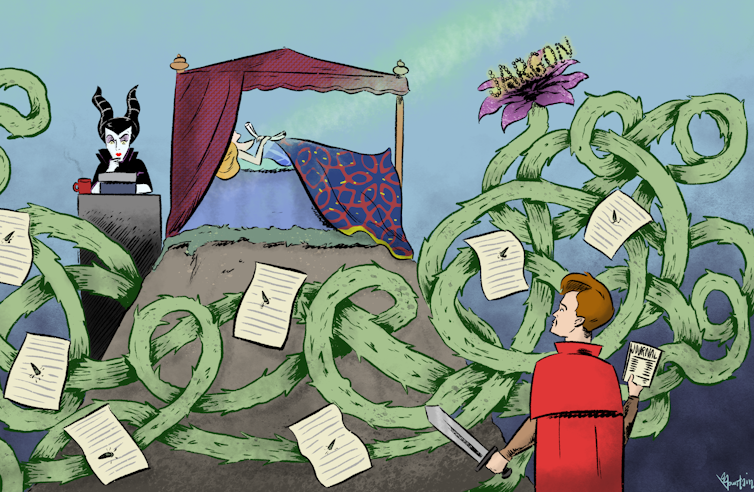
To illustrate what can go wrong with the writing process, I’m going to refer to an old fairy tale: Sleeping Beauty.

A fairy tale

This is the story of a princess who was cursed to fall into a deep sleep, along with her family and everyone else living in the castle. They sleep for 100 years, and during this time a thick thorny forest grows up around the castle, shielding it from view.

One day, a prince who has heard about the sleeping beauty arrives on horseback, with a sword. With great difficulty, he cuts his way through the forest to eventually reach the castle. He finds the princess, wakes her up, and they presumably live happily ever after.

So what has this got to do with scientific writing? Well, scientific results and ideas can be viewed as something valuable, and yet they can be wrapped up in forests of words that lack structure and overuse complex language.


Read more:
How not to write about science


Sometimes this just reflects a lack of training, but there can also be an assumption that scientific ideas deserve to be discovered by those who are clever enough.

This means readers are expected to hack their way through the word forest, if they’re really committed to understanding the results.

The only problem with this approach is that it doesn’t consider the sheer number of papers that scientists need to read. Most researchers and academics can’t keep up with their fields, so if a paper is hard to understand, or unclear, researchers may simply put it down and pick up the next one in the pile.

Expecting too much of the reader can lead to a paper sinking within the literature and effectively falling asleep.

The ‘sleeping beauties’ of science

In fact, a “sleeping beauty” is now a recognised type of academic paper. A sleeping beauty experiences what is also termed “delayed recognition”, sleeping within the literature for up to 100 years until another paper known as the “prince” recognises its value.

The sleeping beauty goes on to be highly cited and influential, sometimes in a different field. Researchers now study sleeping beauties and their princes, as a kind of extreme example of how science works – or doesn’t, depending on your perspective.

It’s generally assumed that sleeping beauties describe ideas that were ahead of their time. But I wonder whether some of these papers might have also been asleep in their forests of words.

After all, we only know about these scientific sleeping beauties through their awakening, in the same way that without the prince’s determination, the story of Sleeping Beauty may never have been told. It is very difficult to know how many other ideas may be lying dormant in the literature, wrapped in their forests of words.

What can we do about this? We need to recognise that to avoid the word forest, the research team needs to hack through their ideas and lay these out as clearly as possible.

This is really difficult, and learning how to do this takes years of practice and effort. As researchers and academics, we need to talk about this process and embrace it.

We expect that professional sportspeople will push themselves to the limit, and be supported to do this. Scientists are essentially intellectual athletes, so we need to talk about the virtue of pushing ourselves to the limit when writing, how to do this, and what kind of support we need.


Read more:
Informed Aussies less likely to want a prostate cancer test


Many features of scientific life, such as crowded work environments, and generally measuring quantity over quality, do not favour the truly difficult process of hacking through our ideas so others can understand them.

It’s important to remember that in the story of Sleeping Beauty, many people fell asleep in the castle. Also, scientific papers are not just about their authors, but also about the public funds and the many supporting resources that make them possible.

We can’t afford the risk that our results and ideas fall asleep. Humanity doesn’t have the next 100 years to wait.The Conversation

Jennifer Byrne, Professor of Molecular Oncology, University of Sydney

This article is republished from The Conversation under a Creative Commons license. Read the original article.

Unknown's avatar

Good Writing vs Good Storytelling


Lauren Rosewarne, University of Melbourne

A friend – both close and a little odd odd – gave me a novel a few days before I left on a long haul fight.

In The Unlikely Event.

Judy Blume’s first novel in fifteen years, I like to believe that the gift was based on a debate we’d had about Michael’s name for his penis in Blume’s Forever. As opposed to her thinking I’d want to read about plane crashes. While on a bloody plane.

(Ralph. For the record. Although I maintain, stubbornly, that naming a penis Roger just makes more sense).

I hadn’t read any Blume since devouring her back-catalogue in primary school, twenty-odd years ago. Are You There God, It’s Me Margaret? – with its brow-furrowing menstrual pining and complex feminine hygiene appartus – and the title character in Deenie rubbing her “special spot” in the shower. Blume provided me with my first taste of everything salacious. While I’ve never really had idols – nor for that matter even a mentor – reading those Blume books likely did set me on an lifelong journey of skewed discovery.

Prior to opening In the Unlikely Event I read an interview with Blume where she claimed not to be a good writer but a good storyteller.

I’ve been stuck on this idea. About whether there is a distinction. About whether, in fact, it matters.

While I’ve read hundreds of books since novels like Tiger Eyes and Then Again Maybe I Won’t, it’s the Blume books that have stayed with me. Not the most interesting or beautifully written ones I’ve read, but memorable. They spoke to an information-ravenous nine-year-old in an era before the Internet and provided a gentle introduction into the capacity to carve a career from writing about the taboo.

A good writer or a good storyteller?

At 9-years-old I suspect I had no real clue about good writing. Those Blume books lingered on likely because they were doing something that the The Baby-Sitters Club, Enid Blyton, Hunter Davies and Sheila Lavelle books I’d been reading hadn’t. Because we have a tendency to attach disproportionate acclaim to the material we enjoyed in our formative years. Because we remember with excessive fondness our earliest – even if merely vicarious – forays into adulthood.

In The Unlikely Event.

At 35 I’d like to think I’m a better judge of good writing than I was in primary school. This assertion however gets challenged daily when I read gushing praise for books I thought thoroughly wretched or those I adored but got reviewed no further than Amazon.

Equally, when I look at my own writing, some of the pieces I’ve been happiest with are the ones that are least read, and those written in much haste and probably without much heart got devoured. (And don’t get me started about the slew of bizarre (read: bullshit) “good writing” lessons gleaned from too many semesters of Creative Writing at university).

In The Unlikely Event.

In one scene good Greek girl Christina describes first-time sex with her beau, Jack, culminating in him ejaculating on her stomach.

“Like a pool of hot sauce.”

Good writing? Uh, no. Good storytelling? A trickier question.

Something that irritated me throughout the novel were the constant qualifiers: “She looked out the window and saw a moonscape. Or what she thought a moonscape would look like.” Invariably these were the thoughts of her teenage characters. Is it fair then, to think teenagers would actually think of semen feeling akin to, say, a good splash of béchamel on the belly? Mornay? Velouté? Is it good writing if we’re inside the head of a character who isn’t a very good scribe themselves?

To its credit, In the Unlikely Event actually achieves quite a lot. It introduced me to an unfamiliar period in U.S. history – New Jersey in the 1950s where three fatal crashes happened in a six month period – and did so through the eyes of a mind-boggling number of characters. (Too many I thought, but forgiveable).

I finished it, I teared up in the way that I do if any TV show/book/film dares flash forward decades into the future to show who lived, died, thrived. In the Unlikely Event may not be a beautiful piece of writing but it’s a solid read, an enjoyable story and perhaps, if you ask me in a few years, it might even be memorable.

Maybe that’s what matters most in a world where agreeing on “good” is thoroughly fraught.

The Conversation

Lauren Rosewarne, Senior Lecturer, University of Melbourne

This article was originally published on The Conversation. Read the original article.

Unknown's avatar

Article: Are Audiobooks the Future of Storytelling?


The link below is to an article that asks the question, ‘are audiobooks the future of storytelling?’ I really doubt they are, but you may believe differently. Please share your thoughts via the comments.

For more visit:
http://bookriot.com/2013/08/08/are-audiobooks-the-future-of-storytelling/

Unknown's avatar

Infographic: Rules for Storytelling


The link below is to an article containing an infographic on 22 rules for storytelling. If you’re a writer, you may find this quite helpful.

For more visit:
http://www.huffingtonpost.com/2012/07/30/pixar-storytelling_n_1718854.html