Unknown's avatar

Edwin Morgan: remembering Scotland’s first poet laureate at 100


James McGonigal, University of Glasgow

Grey over Riddrie the clouds piled up,
dragged their rain through the cemetery trees.
The gates shone cold. Wind rose
flaring the hissing leaves, the branches
swung, heavy, across the lamps.
From King Billy (1963)

Why do we remember particular poems and poets – and happily forget others? The Scottish poet Edwin Morgan was born 100 years ago, and this week marks the the start of a year of celebration of the man and his work. It goes ahead in a virtual way, with public events cancelled in days of lockdown or deferred to 2021 – an advantage of a year-long celebration.

Born in Glasgow on April 27, 1920, Edwin George Morgan led a remarkable and wide-ranging creative life. He published 25 collections of his own poetry and translated hundreds of Russian, Hungarian, Italian, Spanish, Portuguese, French and German poems too. He also wrote plays, opera libretti, radio broadcasts, journalism, book and drama reviews and literary criticism.

His work continues to be published, produced, taught and celebrated. His poetry is memorable not only for Glasgow, his native city, and for Scotland – but for a wider audience thanks to Morgan’s lifelong concern with universal and cosmic matters.

Glasgow and Scotland

Morgan loved the city of his birth for its energy, industrial inventiveness, humour and crowded streets. He warmed to its humanity, shared its sorrows, wrote against scarring deprivation, recovered its history (real and imagined), and projected several Glasgows into the future.

He celebrated its changing cityscape in The Starlings in George Square, and its interactive street culture in Trio, where we encounter three Glaswegians bearing Christmas gifts of a guitar festooned with mistletoe, a new baby and a chihuahua, cosy in a tartan coat. He recorded the darker elements of Glasgow too, such as the city’s sectarian violence and notorious tribal gang culture in King Billy.

The directness of these interactions is carried in authentic urban speech rhythms new to Scottish poetry at the time. In the Snack-bar and Death in Duke Street vividly describe the long deprivation and the sudden death that are also part of the scene:

Only the hungry ambulance
howls for him through the staring squares.

Morgan taught English at Glasgow University all his working life, and became the city’s first poet laureate in 1999. He became Scotland’s laureate too, in 2004 – its first “makar” or national poet. He celebrated Scotland’s varied landscapes, people and places, whether humorously in Canedolia, or reflectively in Sonnets from Scotland.

For Morgan, part of a poet’s job was to remind Scots that if they want to achieve something in the world and to really be taken seriously, then they need to find words to show the world what they stand for. Poets and other writers can help them to do this. When Scotland’s ambitious new parliament building opened at Holyrood at the foot of the Royal Mile in Edinburgh, he wrote:

What do the people want of the place? They want it to be filled with thinking
persons as open and adventurous as its architecture.
A nest of fearties is what they do not want.
A symposium of procrastinators is what they do not want.
A phalanx of forelock-tuggers is what they do not want.
And perhaps above all the droopy mantra of “it wizny me” is what they do not want.
Lines from For the Opening of the Scottish Parliament, October 9 2004

The world, the universe and love

Morgan travelled widely – to Africa and the Middle East during the second world war, to Russia and Eastern Europe during the Cold War, to the US, New Zealand and the North Pole. These are the places he writes of in his poetry. The New Divan is his mysterious war poem in which he records in 100 sharp filmic stanzas, memories from the second world war desert campaign that shift like characters in an Arabian Nights tale – and yet are modern soldiers and lovers too.

Space and time travel fascinated him. A supersonic flight by Concorde to Lapland was the nearest he could actually get to outer space, where he had often journeyed in his imagination. The First Men on Mercury dramatises a linguistic encounter between Western astronauts and Mercurian beings that ends in a complete and hilarious transposition of language and power. Morgan believed that humanity would ultimately endeavour to create “A Home in Space”, which is the title of another poem that follows “a band of tranquil defiers” who decide to cut off all connection with the Earth.

This was a poet who could speak as a space module or a Mercurian, and also as an apple, a computer, an Egyptian mummy. He was an acrobat of words and identities. Perhaps his own identity as a gay man, risking censure or imprisonment through most of his life, encouraged that ability to shape-shift. His love poems are haunting. Some deal with loss or transience, as in One Cigarette, or Absence, or Dear man, my love goes out in waves, or with the physical risks of a forbidden lifestyle, as in Glasgow Green or Christmas Eve, which tells of a fleeting encounter with another man on a bus.

But his poems also celebrate ways in which all lovers share the tender details of everyday life together, as in Strawberries. His writing of gay and queer experience had a significant impact on social attitudes and political change in Scotland. His voice spoke for many young or isolated gay people, with an advocacy that was subtle but powerful in effect.

Collaboration

Morgan was an individualist, in some senses a loner. And yet he was also an inspirer of creative partnerships – in art, photography, opera, music and drama, cultural journalism and poetry in performance. His early support was invaluable to an array of groundbreaking poets and artists such as Ian Hamilton Finlay, Alasdair Gray, Tom Leonard, Liz Lochhead and Jackie Kay, and he enjoyed collaborations with Scots musicians such as jazz saxophonist Tommy Smith and indie band Idlewild.

Such lists could be extended. They continue to grow through the Edwin Morgan Trust, set up to administer his cultural legacy by supporting new poets and poetry in Scotland and Europe as well as wider artistic responses to Morgan’s work. There are centenary publications too with new collections of selected poems and prose. For those who loved this quiet man of Scottish poetry it promises to be a memorable year.The Conversation

James McGonigal, Emeritus Professor of English in Education, University of Glasgow

This article is republished from The Conversation under a Creative Commons license. Read the original article.
Unknown's avatar

7000 Books Stolen From Libraries


The link below is to an article reporting on a man who has been jailed for stealing 7000 books from libraries in Scottish Universities.

For more visit:
https://www.theguardian.com/uk-news/2019/sep/18/man-jailed-stealing-books-scottish-universities-darren-barr

Unknown's avatar

Scotland just bucked the print-is-dying trend with two new Sunday newspapers


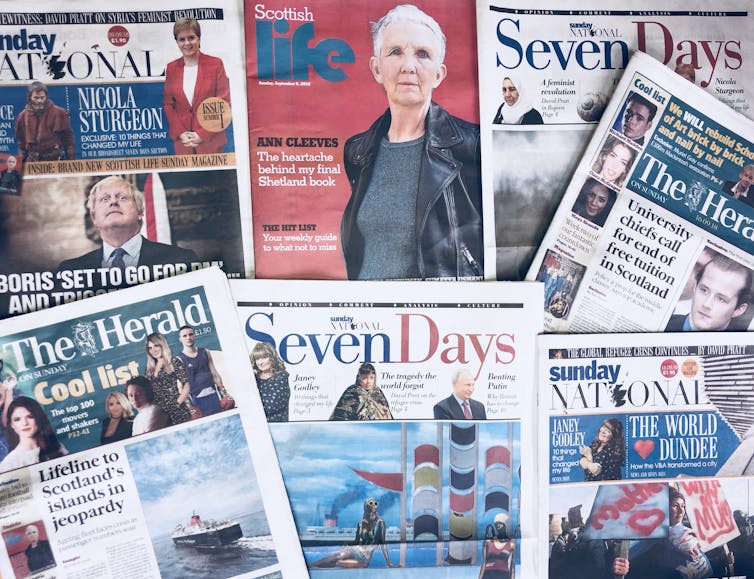
File 20180919 158240 13bs3g8.jpg?ixlib=rb 1.1
What’s inside?
GingerInc

Tom Collins, University of Stirling

My first job as a trainee reporter was on a Sunday title. Sundays are a breed apart. We had contempt for our daily sister, were drunk until Thursday and staffed by some of some of the oddest journalists in town. Unsurprisingly, the paper doesn’t exist any more.

There is a different rhythm to newsgathering. Much of the Sunday paper has to be away early, with stories that won’t date. Front page leads have to be exclusives, it’s just too risky relying on events to bail you out – even in Northern Ireland in the 1980s where I was working. This is one reason why the sting and the “kiss-and-tell” are among Sunday staples.

If you are a Sunday paper news editor, you live in fear that the splash (the front page story) you have been nursing all week will leak to another title. The news business is a kleptocracy, and colleagues on your sister title are the enemy. All’s fair in love, war and newsgathering.

Promiscuous Sunday readers

Sunday newspaper readers are different, too. They still have a little time on their hands, and a desire to be entertained. They will frequently buy titles at odds with their daily habits: Guardian readers flirting with the Sunday Times; Sun readers, bereft of the News of the World, picking up the Sunday Mirror or heading “upmarket” to the Mail on Sunday.

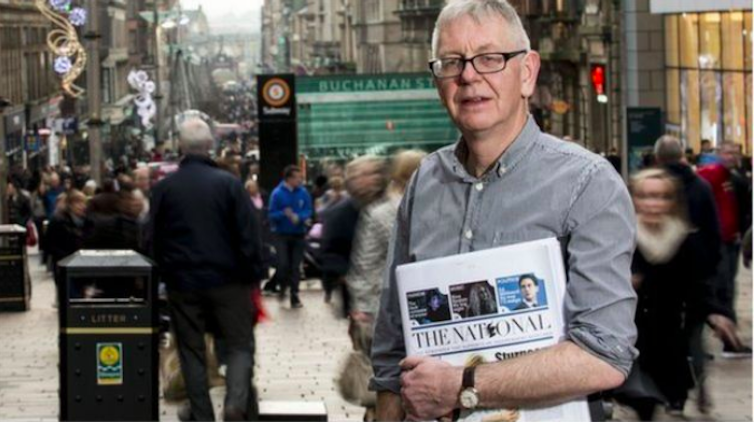
Richard Walker, now editor of the Sunday National.
Newsquest

Sunday is also the day readers are tempted to take a second title; and in those parts of the UK the BBC euphemistically calls “the nations and the regions”, indigenous papers rub shoulders with the big London players from what is still called Fleet Street.

But as the economics of publishing a newspaper become increasingly challenging, stand-alone titles published once a week look like a luxury to the accountants who now run media organisations. So seven-day operations make sense. In 2012, Rupert Murdoch replaced the discredited News of the World with a Sunday edition of the Sun.

Heritage, politics and independent views

Newsquest executives in Scotland came to the same conclusion when they announced in August that the Herald – its daily broadsheet – was to run seven days a week. The victim was the Sunday Herald, then without an editor.

In normal circumstances, that would have been that. But this is Scotland, and Scotland is not normal. Newsquest’s problem was the Sunday Herald’s editorial support for Scottish independence. Taken down that road by its urbane editor, Richard Walker, the Sunday Herald was the lone media voice supporting independence in the 2014 referendum. Walker went on to become founding editor of the National – designed to tap into nationalist sentiment after the independence referendum.

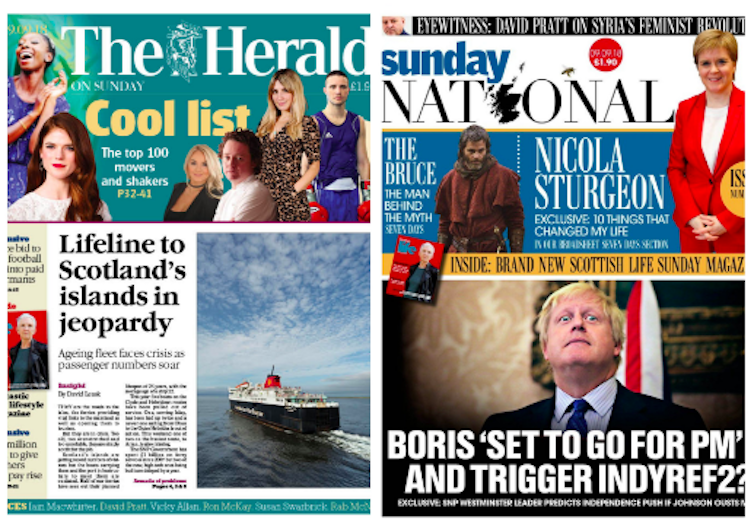
The first front pages.
Newsquest

Although the Herald claims to be neutral on independence – even the dogs in the street know where it sits on the issue. It may not wear a sash and a bowler hat, but it is temperamentally unionist.

With the SNP now established as the natural party of government in Scotland, and with a second independence referendum on the political agenda, killing off the only Sunday in favour of Scotland as a sovereign nation would have displayed a distinct lack of pragmatism.

So, against the tide of consolidation, Newsquest’s single title was replaced by two. Say hello to the “neutral” Herald on Sunday in a racy tabloid livery, and the Sunday National – with Richard Walker again as launch editor.

What the papers say

It’s a brave move for both titles. It is notoriously difficult to persuade readers to change their habits. Can a Herald reader who is wedded to the Observer or Mail on Sunday be seduced back? And what about the fledgling National? It’s tough out there.

The journalism is solid, but – in the first two weeks at least – neither generated the front pages they needed to compete effectively. Rule 101 of a launch edition is to have an exclusive. The Herald’s “Lifeline to Scotland’s islands in jeopardy” did not cut it. The Sunday National led on “Boris ‘set to go for PM’ … and trigger Indyref2”. Billed as an “exclusive”, it was one of those exclusives nobody else would want.

Inside, the National was pacier than the Herald. Even Sundays need news, and it delivered. The internet sensation “giggling granny” was a classic Sunday read, and Jennifer Johnston’s big spread on Scotland’s postcode lottery for primary one parents deserved its prominence.

Foreign correspondent David Pratt brings insight, gravitas and an international perspective to the Sunday National’s broadsheet Seven Days section; its news and features agenda is not quite as unremittingly politically driven as the daily, though Nicola Sturgeon got star billing.

The Herald suffers most from the transition. In tabloid form, it’s like an ageing uncle wearing a baseball cap. The daily broadsheet can sell a story; on the tabloid, the squeezed-in lead barely makes a splash. Inside, the flow of news and features is clunky. “The Week” section, opening the paper, is a mess. A spread on Strictly Come Dancing up front jarred, and the big read on pages six and seven kills the pace up front.

That may change as the paper settles down. But it should be taken as a warning not to mess with the format of the daily, especially if trying to align the titles.

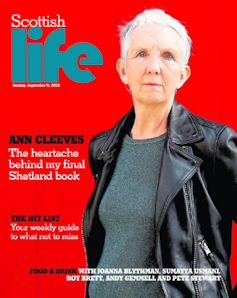
The lifestyle magazine shared between the two titles.
Newsquest

Oddly, both share the same sports coverage and an unbranded Sunday Life supplement. The National needs it to bulk up. It’s a catch-all lifestyle supplement that doesn’t have a clear sense of purpose. The papers also share David Pratt – a great journalist, but sharing writers and sections muddies the waters. Sundays need to be individualistic.

At their best, Sundays are distinctive, tribal and totally attuned to their readers. If they are to carve out a place for themselves, these two new Sundays are going to have to do more to break exclusives that set the agenda for the week ahead – and give Scottish readers the excuse they need to change their buying habits.The Conversation

Tom Collins, Senior lecturer, Communications, Media and Culture, University of Stirling

This article is republished from The Conversation under a Creative Commons license. Read the original article.
Unknown's avatar

Most Scottish authors want to break up the Union – why don’t they write about it?


File 20180314 113458 817acq.jpg?ixlib=rb 1.1
Barking.
eAlisa

Colin Kidd, University of St Andrews and Gerard Carruthers, University of Glasgow

Glasgow’s annual book festival, Aye Write!, is getting underway. Now in its 11th year, big name writers making appearances include the philosopher AC Grayling, broadcast journalist Robert Peston, crime writer Val McDermid and the mountaineer Chris Bonington.

The name of the festival is a play on “aye right”, a sarcastic Scottish way of saying no. This encapsulates much about the literary outlook in this part of the world – a vernacular defensiveness, a strident overcompensation in the face of imagined English snootiness about Glaswegian speech. A neutral might conclude that the arts in Scotland exist in a state of perma-froth at presumed metropolitan condescension.

If support for Scottish independence can be considered a proxy for such froth, there is certainly much in evidence. At the time of the 2014 independence referendum, the Scottish literary scene was near unanimously in favour of a Yes vote – nowhere close to the 55-45 split among the wider population.

This normally disputatious crowd felt overwhelmingly that the Union was inimical to Scottish culture and that the literary tradition would best flourish with independence. Little has changed since. Don’t expect much enthusiasm from them about Theresa May’s Britain at this year’s festival.

This mood didn’t begin in 2014, it must be said. In the Thatcher-hating days of 1988, the pro-devolution Campaign for a Scottish Assembly gave this starkly black and white assessment:

The Union has always been, and remains, a threat to the survival of a distinctive culture in Scotland.

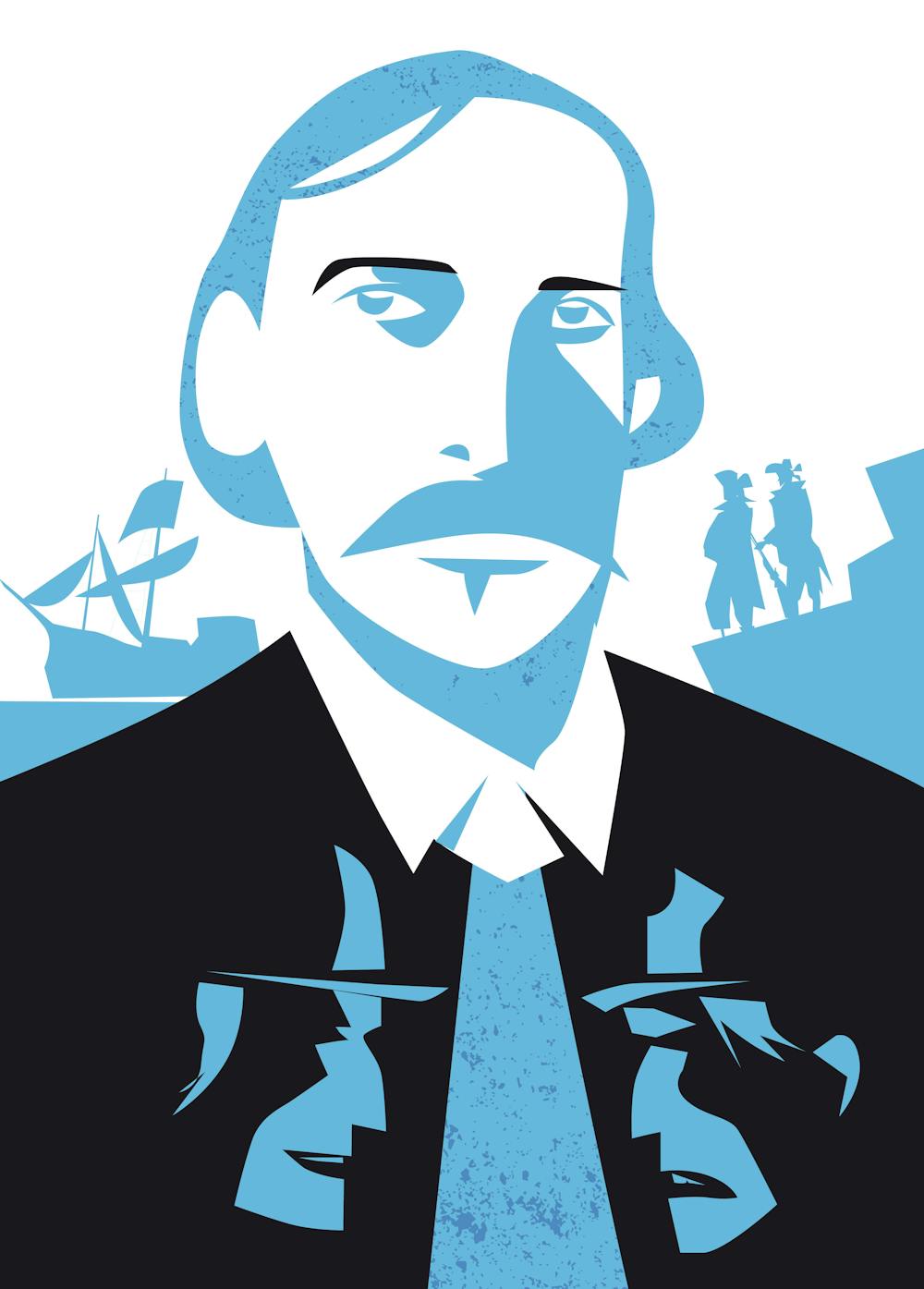
Is this right? Most great Scottish writers – Robert Burns, Walter Scott and Robert Louis Stevenson, for example – thrived within the Union between Scotland and England. Indeed, most Scots will know much more about their nation’s literature since 1707 than about previous eras.

Bovvered? Robert Louis.
Mario Breda

If the Union was such a problem for Scottish writers, why was it invisible in what they had to say? Why is there no tradition of anti-Unionist invective? Aside from Burns’s well-known 1791 poem condemning the “parcel o’ rogues” who “bought and sold” Scotland “for English gold”, the Union is at best an absent presence. Even today it receives little attention from Scottish writers – why?

Before nationalism

Scottish literature’s relationship with the Union is the focus of a new book of essays which we have edited, Literature and Union: Scottish Texts, British Contexts. The most compelling explanation for the lack of literary attention to the Union is that until recently, other questions were more important to Scottish writers, especially in the 18th and 19th centuries.

In particular, partisanship and religion long trumped national identity. Indeed, they were deeply interwoven, shaping two distinctive mythical representations of Scotland.

One was Presbyterian and democratic, the myth of Scotland’s godly Covenanting tradition. The other was Episcopalian, royalist and Jacobite, the cause of Bonnie Prince Charlie and the Forty-five Rising. Each reached back to earlier periods – the Covenanters claimed to be the true heirs of the Scottish Reformation; Jacobite sympathisers were entranced by the romantic plight of Mary, Queen of Scots, imprisoned and finally beheaded by a Protestant queen.

Walter Scott’s Waverley (1814) might be the classic example of the Jacobite representation, recounting many of the events of 1745 from a perspective very sympathetic to the Highland rebels. It was followed by a long stream of Jacobite literature – and Scott himself returned to the theme both in Rob Roy (1817) and Redgauntlet (1824).

Depictions of Covenanters are variously positive and negative in Scottish literature. Many 19th-century novels present them as heroes for their democratic outlook, with their roots in the culture of ordinary folk. John Galt’s Ringan Gilhaize (1823) is one example, telling the story of three generations of rural people.

Other writers are repelled by the illiberal and philistine totalitarianism they discern in the tradition. The most notorious example is James Hogg’s 1824 satire, The Private Memoirs and Confessions of a Justified Sinner, whose lead character considers that having attained his place among God’s saved, he has carte blanche to commit terrible crimes.

Hugh McDiarmid.

Nationalism took hold on the Scottish literary scene over the course of the 20th century, primarily under the enduring influence of Hugh MacDiarmid. Even so, he and others held to a view that Scotland’s Reformation had been just as bad, if not worse, than the Union. For McDiarmid, it was the founding of the Protestant church – and not the merger with England – that was the beginning of the repression of Scottish folk and their authentic culture.

Novels and poems about Covenanting and Jacobitism still abound today. James Robertson, for example, who is appearing at this year’s Aye Write!, makes sport with Covenanting fanaticism in The Fanatic (2000) and The Testament of Gideon Mack (2006). Robertson has also written the only novel that has brought Scottish nationhood into focus in recent years: And the Land Lay Still (2010). More generally, the Union remains a submerged and largely invisible feature of the Scottish literary landscape.

Stark contrasts

While it is true that the Union never enjoyed much of a fanfare among Scottish writers of previous generations, it was rarely if ever the focus of their work. Several even made conspicuous contributions to British – indeed to English – national identities. How else do we account for the fact that the figure of John Bull was the coinage of a Scottish doctor, John Arbuthnot, and Rule, Britannia the work of the Scottish poet, James Thomson?

It is hard to imagine a Scottish writer expressing a similar sentiment in their work today. Yet the reluctance to write about independence has continued, despite writers’ enthusiasm for the cause. It is as if the literary tradition weighs heavy on their shoulders and encourages them to look elsewhere for inspiration.

The ConversationIn sum, the relationship between Scottish literature and the Union turns out to be much more tangled, ironic and surprising than might have been expected. Today’s nationalists do indeed dominate Scotland’s literary scene, and will undoubtedly be in force at Aye Write!, but they do not have all the best tunes. It will be fascinating to see to what extent this changes in future.

Colin Kidd, Professor of History, University of St Andrews and Gerard Carruthers, Francis Hutcheson Professor of Scottish Literature, University of Glasgow

This article was originally published on The Conversation. Read the original article.

Unknown's avatar

Book Art : Scotland – Edinburgh


The link below is to an interesting article about book scultpures turning up as gifts in places throughout Edinburgh. Now there is an exhibition of these highly skilled book sculptures.

For more visit:
http://www.huffingtonpost.com/2012/08/02/mysterious-book-sculpture_n_1732688.html