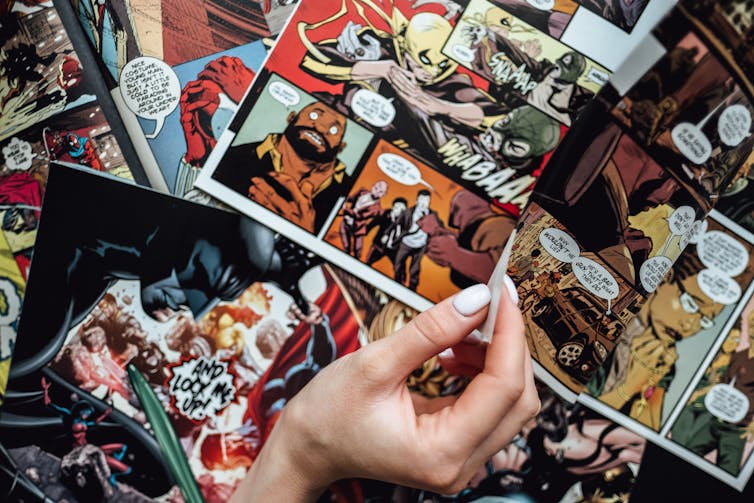
People may think of comics and science as worlds apart, but they have been cross-pollinating each other in more than ways than one.
Many classic comic book characters are inspired by biology such as Spider-Man, Ant-Man and Poison Ivy. And they can act as educational tools to gain some fun facts about the natural world.
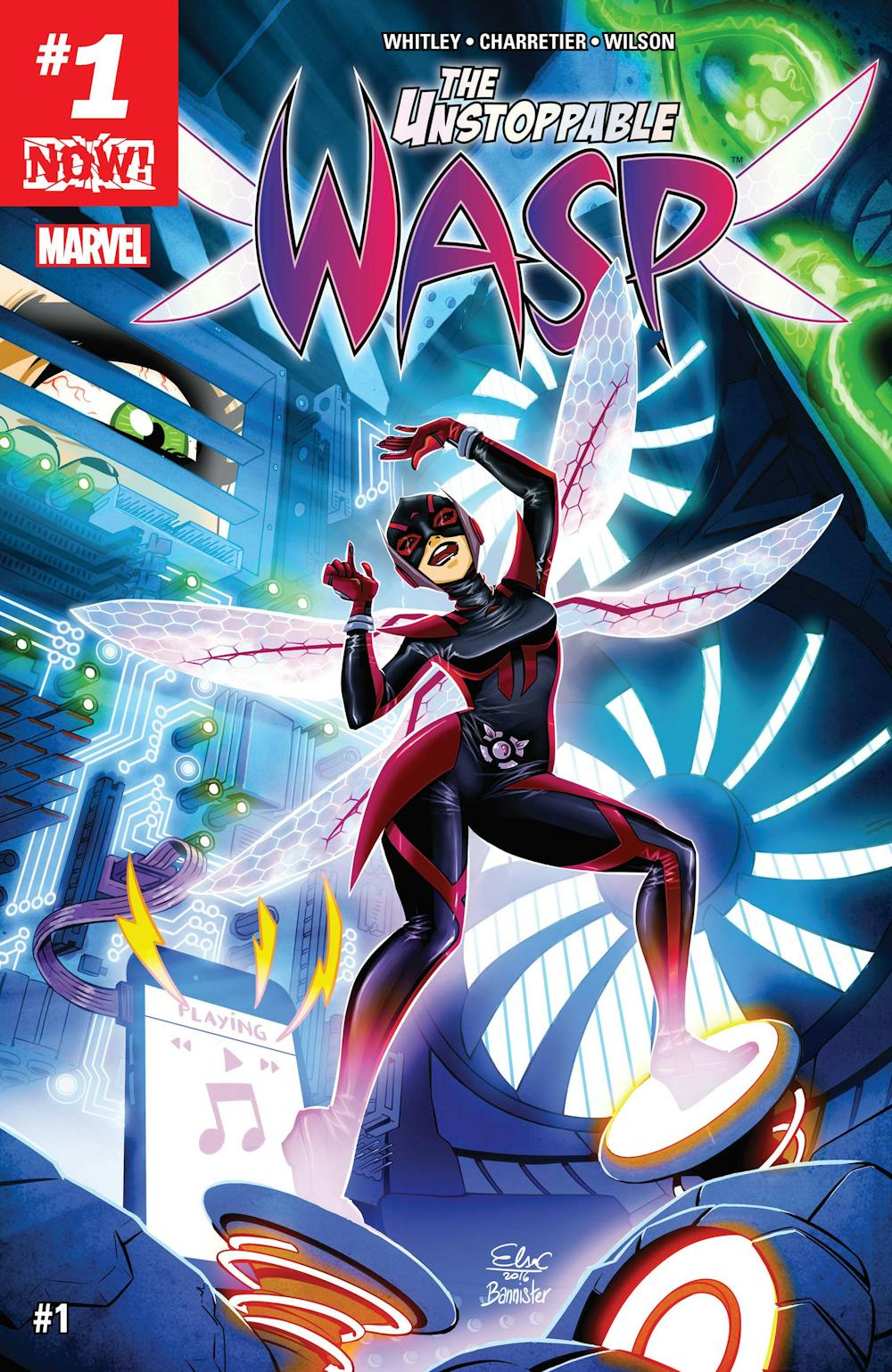
Some superheroes have scientific careers alongside their alter egos. For example, Marvel’s The Unstoppable Wasp is a teenage scientist. And DC Comics’ super-villain Poison Ivy is a botanist who saved honey bees from colony collapse.
Superheroes have also crept into the world of taxonomy, with animals being named after famous comic book characters. These include a robber fly named after the Marvel character Deadpool (whose mask looks like the markings on the fly’s back) and a fish after Marvel hero Black Panther.
I am a PhD student researching bee behaviour and I have spent most of my university life working at a comic book store. Here’s how superheroes could be used to make biology, and other types of science, more intriguing to school students.
While it’s hard to directly prove the advantages of comics over other forms of reading, they can be engaging, easy to understand learning tools.
Comics have similar benefits to classic textbooks in terms of understanding course content. But they can be more captivating.
A study of 114 business students showed they preferred graphic novels over classic textbooks for learning course content.
In another study in the United States, college biology students were given either a textbook or a graphic novel — Optical Allusions by scientist Jay Hosler, that follows a character discovering the science of vision — as supplementary reading for their biology course.
Both groups of students showed similar increases in course knowledge, but students who were given the graphic novel showed an increased interest in the course.
The Unstoppable Wasp is a teenage scientist. Marvel
Educational comics such as the Science Comics series, Jay Hosler’s The Way of the Hive and Abby Howard’s Earth Before Us series frequently have a narrative structure with a story consisting of a beginning, middle and resolution.
Students often find information inside storytelling easier to comprehend than when it’s provided matter-of-factly, such as in textbooks. As readers follow a story, they can use key information they have learnt along the way to understand and interpret the resolution.
2. They teach important concepts
In science-related comic books, as the story unfolds, scientific concepts are often sprinkled in along the way. For example, Science Comics: Bats, follows a bat going through a rehabilitation clinic while suffering from a broken wing. The reader learns about different bat species and their ecology on this journey.
Comics also have the advantage of permanance, meaning students can read, revisit and understand panels at their own pace.
Many science comics, including Optical Allusions, are written by scientists, allowing for reliable facts.
Using storytelling can also humanise scientists by creating relatable characters throughout comics. Some graphic novels showcase scientific careers and can be a great tool for removing stereotypes of the lab coat wearing scientist. For example, Jim Ottaviani and Maris Wick’s graphic novels Primates and Astronauts: Women on the Final Frontier showcase female scientists in labs, the field and even space.
The Marvel series’ Unstoppable Wasp also includes interviews with female scientists at the end of each issue.
3. They can give a visual insight into strange worlds
Imagery combined with an easy to follow narrative structure can also give a look into worlds that may otherwise be hard to visualise. For example, Science Comics: Plagues, and the Manga series, Cells at Work!, are told from the point of view of microbes and cells in the body.
Imagery can also show life cycles of animals that are potentially dangerous, or difficult to encounter, such as a honeybee colony, which was visualised through Clan Apis.
The author would like to acknowledge neuroscientist and cartoonist Matteo Farinella, whose advice helped shape this article.
Three centuries ago, when modern science was in its infancy, the gender disparity in education was not a gap but an abyss: few girls had any decent schooling at all.
The emerging new science was clearly a male enterprise.
But it arose from a sense of curiosity, and women, too, are curious. If you look closely enough, it’s clear women played an important role, as both readers and authors, in the history of science writing.
New vs old ideas
Both science and science writing were up for grabs in the 17th century. Technology was rudimentary and researchers struggled to obtain even the simplest observational evidence, and then searched for ways to make sense of it.
You can see this struggle in the Italian astronomer Galileo Galilei’s famous Dialogues of 1632 and 1638. He painstakingly and somewhat tortuously tries to justify his arguments for heliocentrism – in which the planets go around the Sun – and the nature of motion and gravity.
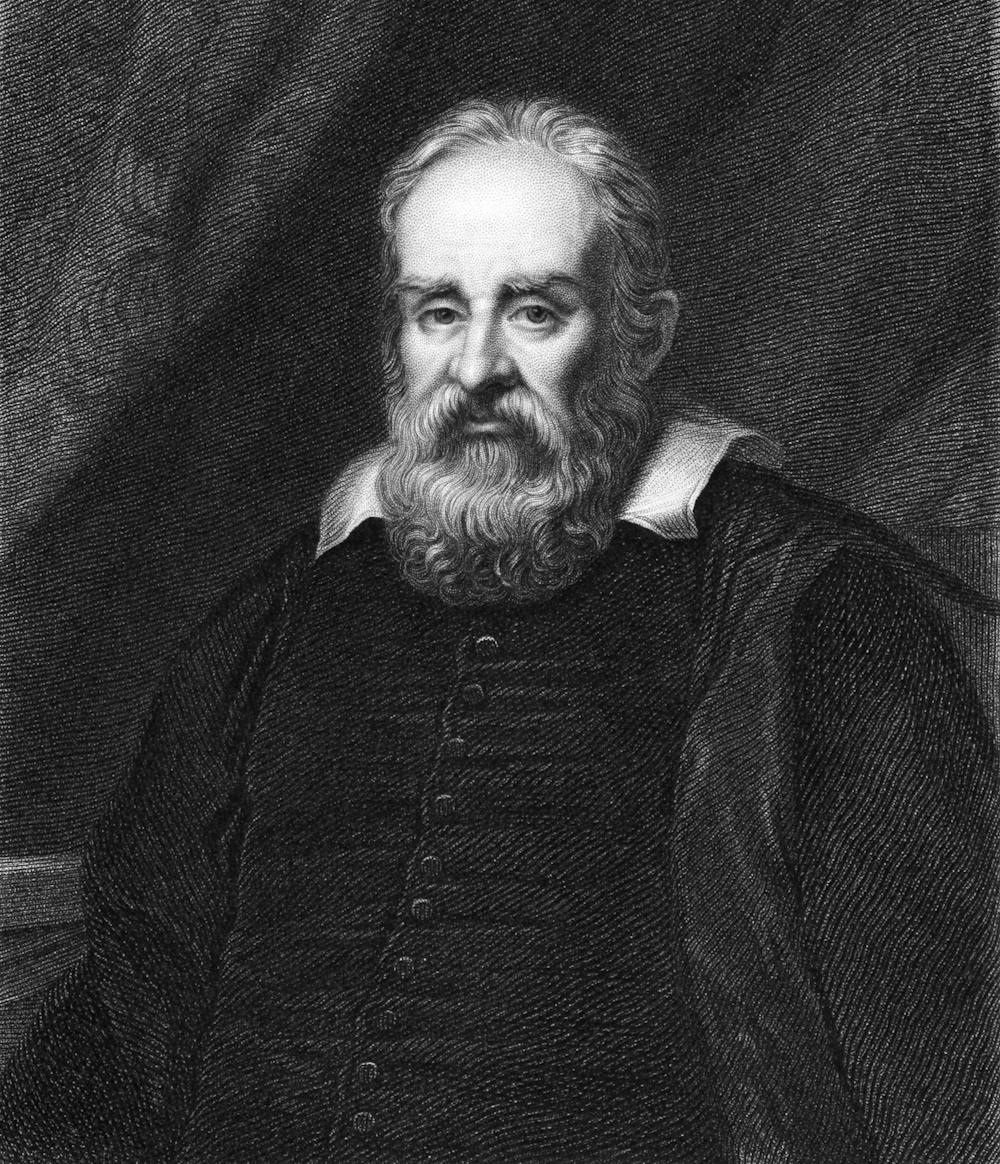
Galileo Galilei (1564-1642). Engraved by R Hart and published in The Gallery Of Portraits With Memoirs encyclopedia, United Kingdom, 1833. Shutterstock/Georgios Kollidas
Tortuously, not only because he was bending over backwards to please the censors – heliocentrism was held to defy scripture – but especially because most of the experiments, methods, and even the mathematical symbolism of modern science did not yet exist.
So although yesteryear’s scientific content was simple compared with today’s overwhelming complexity, Galileo’s Dialogues show that the lack of data, methods and scientific language presented its own problems for science communication.
Conversation in science
Galileo resorted to the Socratic device of a conversation, in which he debated his ideas in a long dialogue between an innovative philosopher, Salviati, and two (male) friends.
In trying to convince even the least scientifically learned of his interlocutors, Galileo was writing what we might call popular science (although the more complex parts of the 1638 Dialogue read more like a textbook).
There were no scientific journals then, and there wasn’t quite the same distinction between the announcement of scientific discoveries to colleagues and the communication of those ideas to a wider public.
It was a runaway success that helped non-specialists accept the Copernican system – a Sun-centred solar system – rather than the time-honoured, seemingly self-evident geocentric one with Earth at the centre.
The hero of Fontenelle’s story, too, is a male philosopher – but this time he is conversing with a pretty marquise, who is spirited and quick to grasp new facts. Although its style was flirtatious, Fontenelle’s book was a significant recognition that women are curious and intelligent.
Science gets complex
Then, the very next year, everything changed. The English physicist and mathematician Isaac Newton published his monumental Principia Mathematica. Suddenly science became a whole lot more complex.
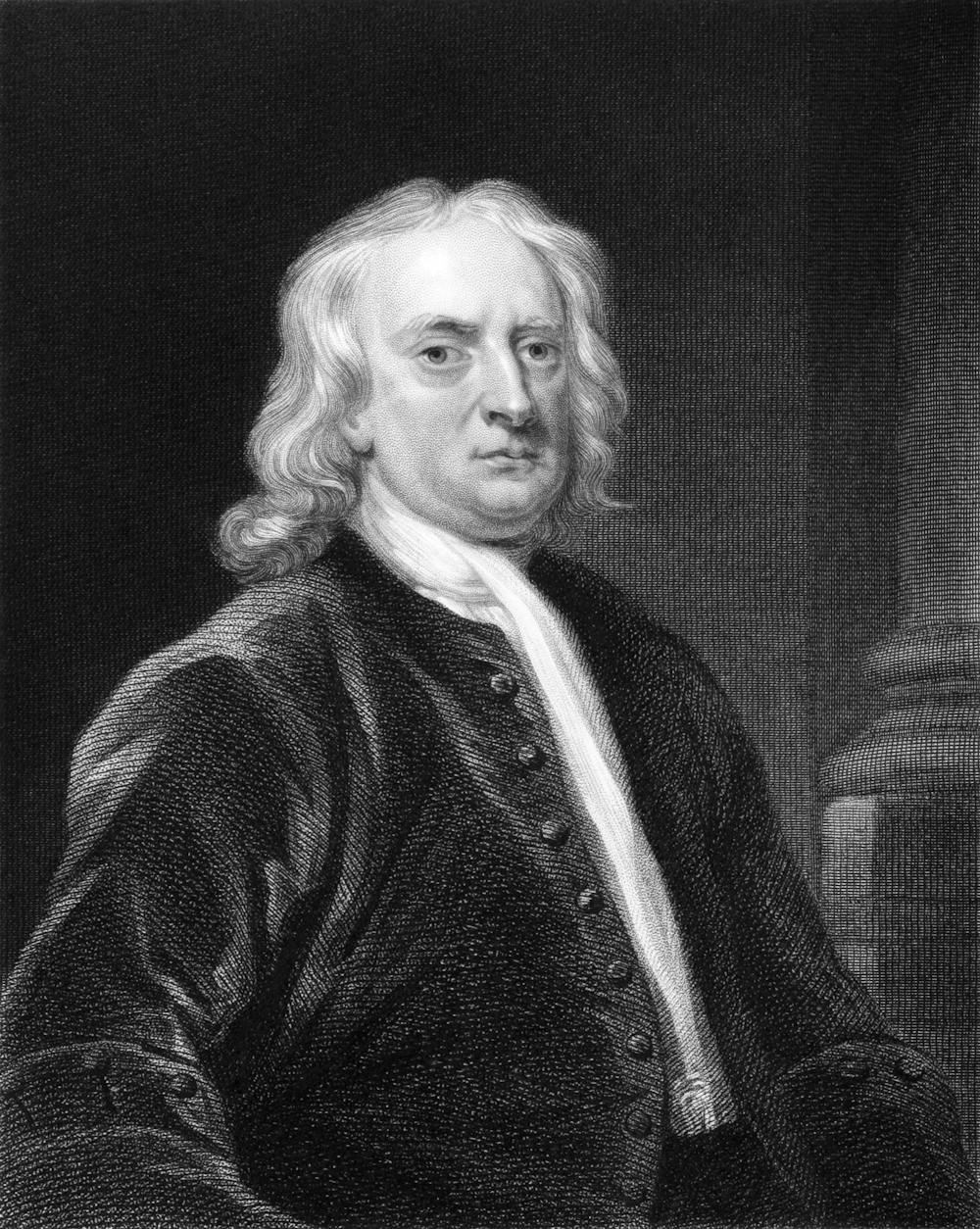
Isaac Newton (1643-1727). Engraved by E Scriven and published in The Gallery Of Portraits With Memoirs encyclopedia, United Kingdom, 1837. Shutterstock/Georgios Kollidas
For instance, Fontenelle’s explanation of the cause of heliocentrism had been based on Frenchman René Descartes’ notion that the planets were swept around the Sun by gargantuan cosmic ethereal vortices.
Newton replaced this influential but unproven idea with his predictive theory of gravity, and of motion in general, which he developed in 500 dense pages of axioms, observational evidence, and a heap of mathematics.
Principia provided the modern blueprint for experimentally based, quantitative, testable theories – and it showed the fundamental role of mathematics in the language of physics.
The trouble was that only the best mathematicians could understand it. It was so innovative (and tortuous in its own way) that some of the greatest of Newton’s peers were sceptical, and it took many decades for his theory of gravity to become universally accepted in Europe.
Science writers played a key role in this process.
Something ‘for ladies’
The earliest popularisations of Newton’s work were short or semi-technical, such as that by the French mathematician Pierre-Louis Moreau Maupertuis.
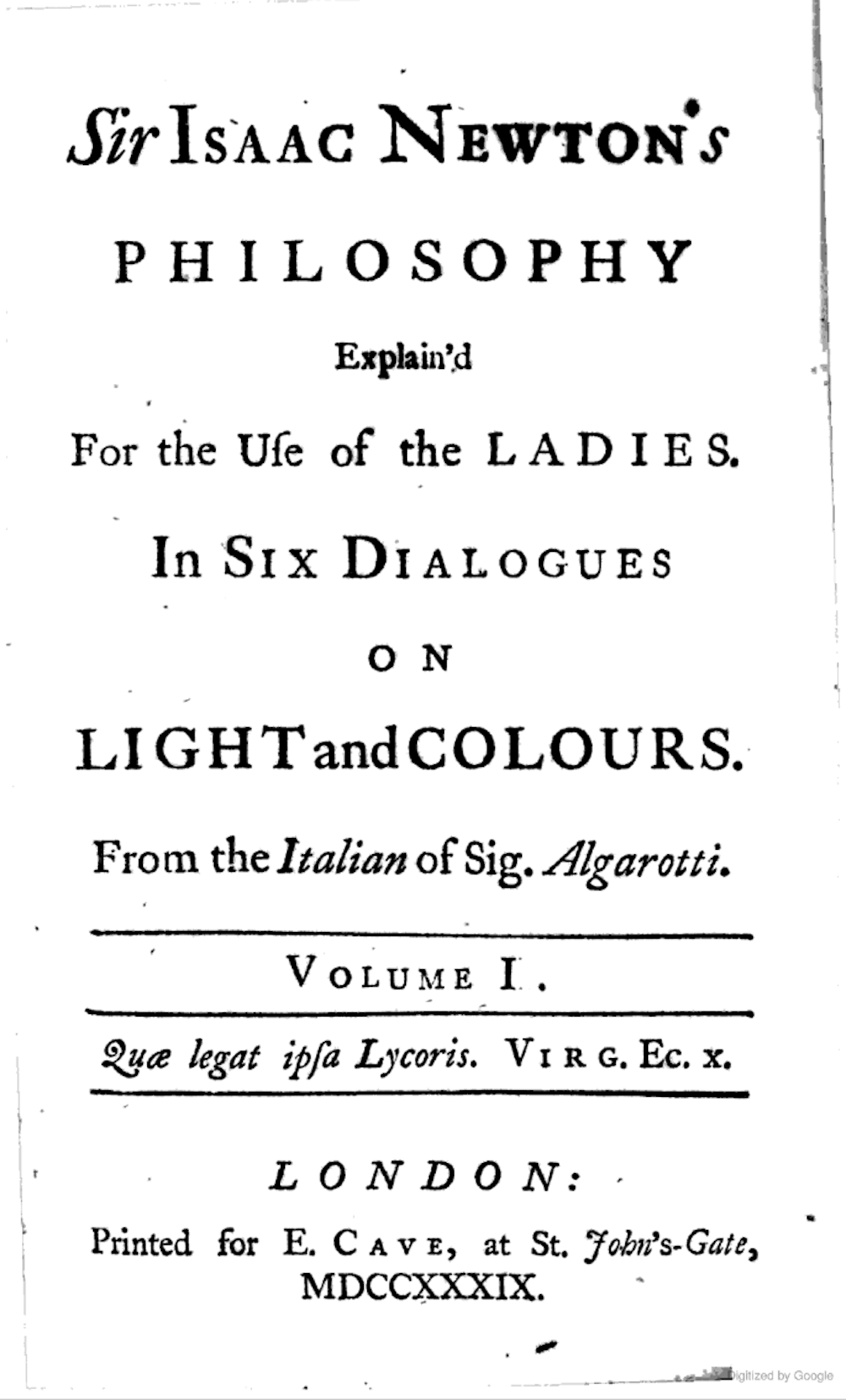
In the 1730s, Maupertuis tutored a real-life marquise, Émilie du Châtelet, but she was of a very different calibre from Fontenelle’s fictional student – or indeed the curious but rather flighty marquise in another mass market popularisation: the Italian Francesco Algarotti’s Newtonianism for “the ladies”.
Translated from the original French: l newtonianismo per le dame ovvero dialoghi sopra la luce e i colori. Google Books
Newtonianism here referred not just to Newton’s theory of gravity. As its somewhat patronising title might suggest, it focused mostly on his more accessible 1704 work, Opticks, which explains his experiments on the behaviour of light and the nature of colour. But these, too, were controversial, and Algarotti was an expert in optics.
He had been inspired to address “the ladies” by two outstanding female contemporaries: his French mathematical friend Émilie du Châtelet, and the Italian physicist Laura Bassi. But both women disliked his book’s flirtatious style.
An oil painting of Madame Du Châtelet at her desk. Wikimedia
Du Châtelet and her lover Voltaire were writing their own more serious (and non-gendered) popularisation of Newton’s work. Du Châtelet later wrote a very successful popular synthesis of the scientific ideas of Newton and his German rival Gottfried Wilhelm Leibniz – Bassi used the Italian translation of it in her own teaching.
Du Châtelet then went on to produce the first translation of Principia outside Britain – an insightful work that is also interesting in the context of popular science writing. She appended a 110-page commentary, summarising Newton’s method in everyday language, and explaining more recent applications of his theory.
The self-taught science writers
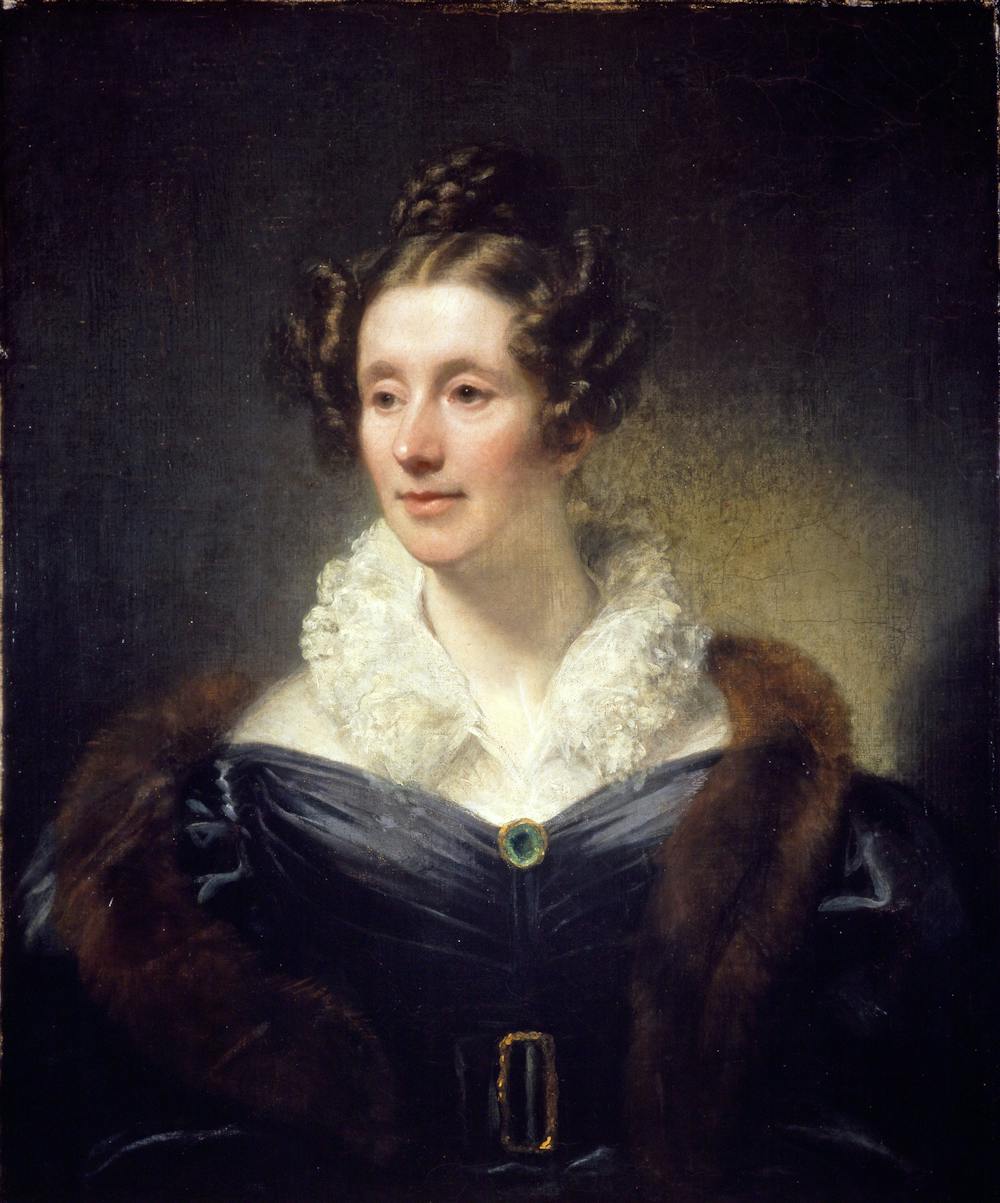
Nearly a century later, the Scottish mathematician Mary Somerville felt the same compulsion to reach out to the non-specialist reader – male and female – in the introduction to her book explaining the latest developments of Newton’s theory, Mechanism of the Heavens.
It is worth celebrating the fact that Somerville’s Mechanism was used at Cambridge as an advanced textbook in celestial mechanics – and at a time when women were not allowed to attend university.
Like Du Châtelet, Somerville was mostly self-taught. She understood the importance of science writing in educating the public, especially those denied formal education, and went on to write two best-selling popular science books: On the Connexion of the Physical Sciences and Physical Geography.
They were built around conversations between two teenage girls and their female teacher. Unlike Fontenelle’s and Algarotti’s works for “the ladies”, these books were down-to-earth, non-patronising attempts to educate women in practical chemistry and physics.
But like those of Fontenelle and Algarotti, Marcet’s books proved popular with male lay readers, too – including the self-taught British physicist and chemist Michael Faraday, who went on to become co-discoverer of electromagnetism.
Biology was also progressing in the 19th century, but this had a downside for women. The discovery that women had smaller brains was used to reinforce the stereotype that women were incapable of intellectual study.
Somerville wrote movingly on how this affected her life. She would have been thrilled to read this year’s book by female neuroscientist Gina Rippon, The Gendered Brain, which asserts that brain plasticity and connectivity should displace old notions of gendered brains.
Do women and men have different brains? An interview with Gina Rippon.
Rippon’s is one of a growing number of female-authored popular science books on all aspects of science, and it is also an example of how women can contribute important new perspectives to scientific topics.
Another example is the ecological perspective of pioneering biologist and science writer Rachel Carson, whose 1962 Silent Spring played a leading role in launching the modern environmental movement.
Scientific understanding is often driven initially by a reductionist approach, and Carson was the first to clearly point out the role of artificial pesticides on the whole food chain.
Having diverse voices of all kinds in science and science writing is a good thing for science, as even a brief look at history shows. As far as women’s participation goes, we’ve come a long way.
But we still need more women to help shape and tell the story of science.
I’m a regular biomedical scientist, although in one sense I’m perhaps a bit different, in that I really like the process of writing.
From speaking with colleagues and teaching postgraduate students about the process of scientific writing for more than ten years, I estimate that eight or nine of every ten biomedical researchers would say they don’t like writing.
Now, while I do like writing, that’s not to say I find it easy. When I’m in the thick of getting my thoughts onto the page, terms such as “bloodbath” and “fight to the death” flood my mind.
I have images of fighting a slippery dragon, trying to break its back. I feel as if I’m fighting my own ideas or whatever I’m trying to write, and there’s only one possible outcome: breaking these ideas down, whatever the cost.
And remember, I like writing, so imagine what it’s like for the majority of scientists who don’t.
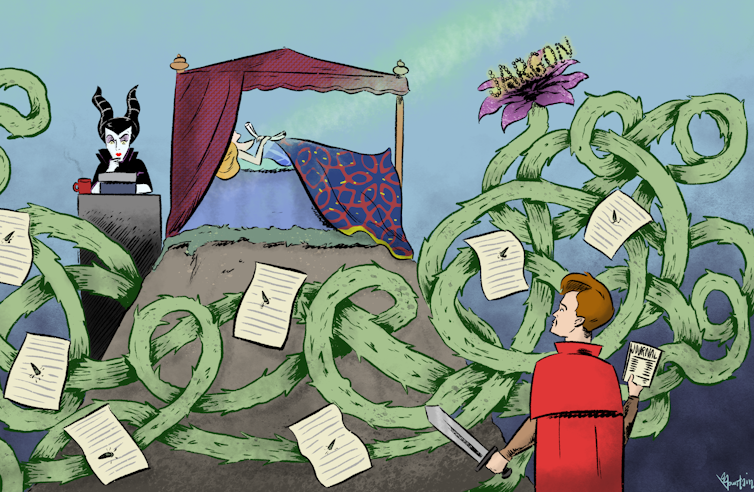
To illustrate what can go wrong with the writing process, I’m going to refer to an old fairy tale: Sleeping Beauty.
A fairy tale
This is the story of a princess who was cursed to fall into a deep sleep, along with her family and everyone else living in the castle. They sleep for 100 years, and during this time a thick thorny forest grows up around the castle, shielding it from view.
One day, a prince who has heard about the sleeping beauty arrives on horseback, with a sword. With great difficulty, he cuts his way through the forest to eventually reach the castle. He finds the princess, wakes her up, and they presumably live happily ever after.
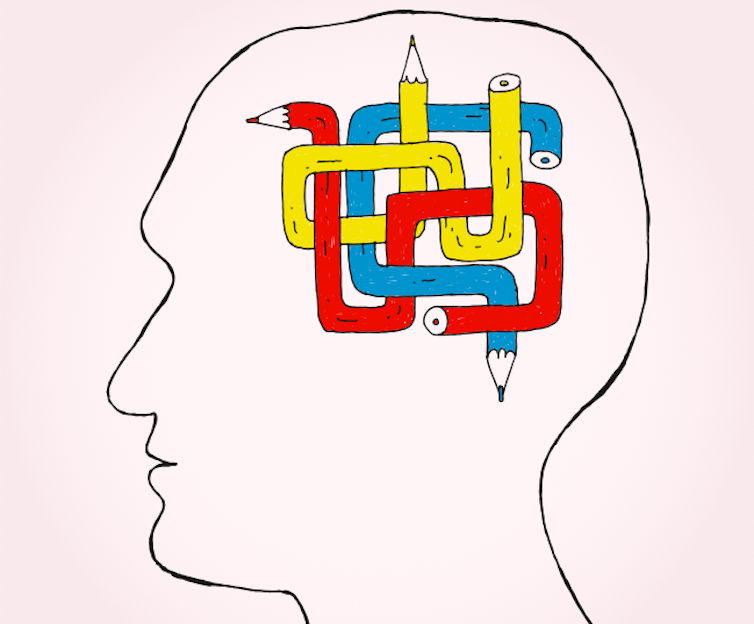
So what has this got to do with scientific writing? Well, scientific results and ideas can be viewed as something valuable, and yet they can be wrapped up in forests of words that lack structure and overuse complex language.
Sometimes this just reflects a lack of training, but there can also be an assumption that scientific ideas deserve to be discovered by those who are clever enough.
This means readers are expected to hack their way through the word forest, if they’re really committed to understanding the results.
The only problem with this approach is that it doesn’t consider the sheer number of papers that scientists need to read. Most researchers and academics can’t keep up with their fields, so if a paper is hard to understand, or unclear, researchers may simply put it down and pick up the next one in the pile.
Expecting too much of the reader can lead to a paper sinking within the literature and effectively falling asleep.
The ‘sleeping beauties’ of science
In fact, a “sleeping beauty” is now a recognised type of academic paper. A sleeping beauty experiences what is also termed “delayed recognition”, sleeping within the literature for up to 100 years until another paper known as the “prince” recognises its value.
The sleeping beauty goes on to be highly cited and influential, sometimes in a different field. Researchers now study sleeping beauties and their princes, as a kind of extreme example of how science works – or doesn’t, depending on your perspective.
It’s generally assumed that sleeping beauties describe ideas that were ahead of their time. But I wonder whether some of these papers might have also been asleep in their forests of words.
After all, we only know about these scientific sleeping beauties through their awakening, in the same way that without the prince’s determination, the story of Sleeping Beauty may never have been told. It is very difficult to know how many other ideas may be lying dormant in the literature, wrapped in their forests of words.
What can we do about this? We need to recognise that to avoid the word forest, the research team needs to hack through their ideas and lay these out as clearly as possible.
This is really difficult, and learning how to do this takes years of practice and effort. As researchers and academics, we need to talk about this process and embrace it.
We expect that professional sportspeople will push themselves to the limit, and be supported to do this. Scientists are essentially intellectual athletes, so we need to talk about the virtue of pushing ourselves to the limit when writing, how to do this, and what kind of support we need.
Many features of scientific life, such as crowded work environments, and generally measuring quantity over quality, do not favour the truly difficult process of hacking through our ideas so others can understand them.
It’s important to remember that in the story of Sleeping Beauty, many people fell asleep in the castle. Also, scientific papers are not just about their authors, but also about the public funds and the many supporting resources that make them possible.
We can’t afford the risk that our results and ideas fall asleep. Humanity doesn’t have the next 100 years to wait.
Recently I did something that many people would consider unthinkable, or at least perverse. Before going to see “Avengers: Infinity War,” I deliberately read a review that revealed all of the major plot points, from start to finish.
Don’t worry; I’m not going to share any of those spoilers here. Though I do think the aversion to spoilers – what The New York Times’ A.O. Scott recently lamented as “a phobic, hypersensitive taboo against public discussion of anything that happens onscreen” – is a bit overblown.
These cognitive tendencies help explain why plot twists can be so satisfying. But somewhat counterintuitively, they also explain why knowing about a plot twist ahead of time – the dreaded “spoiler” – doesn’t really spoil the experience at all.
The curse of knowledge
When you pick up a book for the first time, you usually want to have some sense of what you’re signing up for – cozy mysteries, for instance, aren’t supposed to feature graphic violence and sex. But you’re probably also hoping that what you read won’t be entirely predictable.
To some extent, the fear of spoilers is well-grounded. You only have one opportunity to learn something for the first time. Once you’ve learned it, that knowledge affects what you notice, what you anticipate – and even the limits of your imagination.
What we know trips us up in lots of ways, a general tendency known as the “curse of knowledge.”
For example, when we know the answer to a puzzle, that knowledge makes it harder for us to estimate how difficult that puzzle will be for someone else to solve: We’ll assume it’s easier than it really is.
When we know the resolution of an event – whether it’s a basketball game or an election – we tend to overestimate how likely that outcome was.
Information we encounter early on influences our estimation of what is possible later. It doesn’t matter whether we’re reading a story or negotiating a salary: Any initial starting point for our reasoning – however arbitrary or apparently irrelevant – “anchors” our analysis. In one study, legal experts given a hypothetical criminal case argued for longer sentences when presented with larger numbers on randomly rolled dice.
Plot twists pull everything together
Either consciously or intuitively, good writers know all of this.
An effective narrative works its magic, in part, by taking advantage of these, and other, predictable habits of thought. Red herrings, for example, are a type of anchor that set false expectations – and can make twists seem more surprising.
A major part of the pleasure of plot twists, too, comes not from the shock of surprise, but from looking back at the early bits of the narrative in light of the twist. The most satisfying surprises get their power from giving us a fresh, better way of making sense of the material that came before. This is another opportunity for stories to turn the curse of knowledge to their advantage.
Remember that once we know the answer to a puzzle, its clues can seem more transparent than they really were. When we revisit early parts of the story in light of that knowledge, well-constructed clues take on new, satisfying significance.
Consider “The Sixth Sense.” After unleashing its big plot twist – that Bruce Willis’ character has, all along, been one of the “dead people” that only the child protagonist can see – it presents a flash reprisal of scenes that make new sense in light of the surprise. We now see, for instance, that his wife (in fact, his widow) did not snatch up the check at a restaurant before he could take it out of pique. Instead it was because, as far as she knew, she was dining alone.
Even years after the film’s release, viewers take pleasure in this twist, savoring the degree to which it should be “obvious if you pay attention” to earlier parts the film.
The pluses and minuses of the spoiler
At the same time, studies show that even when people are certain of an outcome, they reliably experience suspense, surprise and emotion. Action sequences are still heart-pounding; jokes are still funny; and poignant moments can still make us cry.
In fact, when a major turn in a narrative is truly unanticipated, it can have a catastrophic effect on enjoyment – as many outraged “Infinity War” viewers can testify.
If you know the twist beforehand, the curse of knowledge has more time to work its magic. Early elements of the story will seem to presage the ending more clearly when you know what that ending is. This can make the work as a whole feel more coherent, unified and satisfying.
Of course, anticipation is a delicious pleasure in its own right. Learning plot twists ahead of time can reduce that excitement, even if the foreknowledge doesn’t ruin your enjoyment of the story itself.
Marketing experts know that what spoilers do spoil is the urgency of consumers’ desire to watch or read a story. People can even find themselves so sapped of interest and anticipation that they stay home, robbing themselves of the pleasure they would have had if they’d simply never learned of the outcome.
The book was launched at The Australian Museum. The blurb says:
Good writing about science can be moving, funny, exhilarating, or poetic, but it will always be honest and rigorous about the research that underlies it.
This is what we’re all about at The Conversation – making sure that all our articles are supported by evidence, and at the same time helping readers see the relevance, the importance, the nuances but also the joy of science and technology.
In Gender equity can cause sex differences to grow bigger, Rob Brooks writes that moves toward gender equity in opportunity – including the dismantling of patriarchal power structures – might, paradoxically, also widen sex differences.
Robert Fuller’s piece How ancient Aboriginal star maps have shaped Australia’s highway network likens many thousand year old Indigenous travel techniques with modern day GPS tracking. Aboriginal people have long used the stars to help remember routes between distant locations, and these routes are still alive in our highway networks today.
These The Conversation pieces are presented in the book alongside 27 other selected science essays published in Australia during 2017, and written by scientists, journalists, philosophers and writers.
Science writer and artist Margaret Wertheim received the UNSW Scientia Medal for Science Communication at the book launch, and prizes for science writing by students in years 7-10 were also awarded.
Interviewing scientists – shown here is physicist Louise Harra – is a skill that takes experience and in depth knowledge on the part of the journalist. uclmaps/flickr , CC BY-SA
Specialist science journalists are vital in our society in a few key ways. These include as public disseminators of sound science that can lead to policy, as identifiers of flawed journalism and “dodgy” (even life-threatening) science, and as gatekeepers between public relations departments in research institutions and the general media.
And yet the number of specialist science reporters in Australia is in serious decline.
Channel 10’s The Project presented evidence-based coverage of the science of vaccination. The Roast (ABC TV) also took a humorous approach to covering the story.
Not only was the story given robust and prominent coverage across Australian news media platforms, the Daily Telegraph and news site MamaMia also ran campaigns encouraging readers to pledge to immunise their children.
In 2013 the Daily Telegraph followed up with a “No jab, no play” concept, promoting the idea that childcare centres should ban children who had not been immunised. State and federal governments have subsequently introduced legislation to effect this proposal. The program is still being monitored.
Linked to this coverage, a successful case was mounted in the NSW Office of Fair Trading against anti-immunisation activist group the Australian Vaccination Network. The network’s name was found to be misleading and the group has now re-badged itself as the “Australian Vaccination-Skeptics Network”.
Journalism as a gatekeeper for “bad” science
Sound peer review and editorial procedures are in place in many research journals, but sometimes what can best be described as “dodgy” science is published, and this can lead to disastrous results.
The classic example is the (now falsified) study in 1998 that reported on autism-like symptoms and gastrointestinal abnormalities in children associated with the MMR (measles, mumps, rubella) vaccination. The study was small (only 12 children), observational, and submitted for publication without key disclosures from lead author Andrew Wakefield.
In a subsequent press conference, Wakefield expressed his concerns about the MMR vaccine. The media’s enthusiastic reporting and less than critical response to these claims took an ethically and scientifically unsound report and turned it into what has been described as “perhaps the most damaging medical hoax of the last 100 years”. In 2008 measles was reported to be once again endemic in the UK, a development that has been linked to reduced MMR take-up.
Had the journalists at that initial press conference been equipped to appraise the findings critically, the poor science may have been revealed from the start. The paper was later found to be fraudulent by investigative journalist Brian Deer, who published stories in print and made a documentary revealing the hoax.
Science journalism vs science PR
Science journalism and science public relations (PR) can be difficult to distinguish. The job of the PR specialist is to maximise eyeballs on each story. The job of the journalist is to find the story and report the evidence behind it, no matter whose story it is.
Stories that are written with a university press release – rather than a peer-reviewed science paper – as the main source of evidence can easily cross the line into infotainment rather than independent reporting.
It’s also the case that some stories that look like science journalism are heavily sponsored by universities and research institutions. This so-called “native content” – in that it looks appropriate for its context – is becoming more prevalent.
It’s a trend exacerbated by the movement of journalists from media organisations into communication roles in academic and research institutions. While the writing style is journalistic, the focus is to promote the science from the institutions that employ them. This bypasses robust and independent examination of the evidence.
There may be more of this to come as science journalists become an endangered species.
An endangered species
Embedded in Australian news rooms, the investigative science journalist is a rare beast; the most recent in a long line of casualties are Marcus Strom from The Sydney Morning Herald, and Bridie Smith of Melbourne’s The Age, who left Fairfax last week after 16 years.
It seems the ABC is the only mainstream media outlet with a science unit. Here, specialists Anna Salleh and Jake Sturmer along with experienced science journalists, communicators and broadcasters (Robyn Williams, Natasha Mitchell, Joel Werner, Bernie Hobbs, Ruben Meerman and Dr Karl amongst others) present regular science content on various platforms.
Journalists in specialities such as environment, health and technology do still hold positions at major media platforms, and Cosmos Magazine provides another platform for science content in Australia. Freelance science journalists including Bianca Nogrady, Leigh Dayton and Graham Readfearn work on specific projects across a variety of platforms.
Specialist correspondents develop a deep and complex understanding of their round over time, and carry a knowledge of what’s gone before that surpasses a quick internet search. They might, for instance, recognise that a particular “breakthrough” is simply an old study repackaged, that a study is very small, or that its promises have been made before without amounting to much. Or that the “faster than light” neutrinos were a statistical anomaly (and an error) rather than a tested matter of fact.
The disappearance of the specialist science correspondent means a loss of personnel with the time and the expertise to probe deeply and to ask uncomfortable questions. The consequences are declines in the breadth, depth and quality of science coverage. Pair this with an increased workload, the need for journalists to apply multimedia skills and the constant pressure to publish (driven by the 24-hour news cycle), and the opportunities for genuine investigation are slim.
New ways to cover science
As the number of science correspondents has fallen, the science sector has rushed in to fill the online void with blogs and social media sites (some terrifically successful).
Facilities such as the Australian Science Media Centre now work to support and facilitate evidence-based science journalism. The Centre boasts 1,600 subscribers and informs hundreds of reporters who attend regular briefings.
When the Australian Science Media Centre started in 2005, there were around 35 specialist science reporters in mainstream newsrooms around the country. Now you need less than one hand to count them.
This loss of specialist reporters means that there is no one to fight for good science in editorial meetings or look for science angles in everyday news stories.
We’re all going to have to do everything we can to help general reporters cover science and make sure they don’t miss the important stuff.
The Australian Science Media Centre is a not-for-profit resource that supports evidence-based science coverage.
The future of science journalism
It may be that science journalism has never enjoyed a consistent position in media outlets – some report that “peak science journalism” happened in 1987. In an important review of the history of popular science, writer Martin Bauer points out that science journalism is prone to a “boom and bust cycle”.
The call for more and improved science journalism is based on an assumption that lives are worse off without it. This is an easy leap for academics to make; after all, our very existence is based on the idea that more knowledge is better than less knowledge.
But how can we convince the general public this is the case? Studying the “decline of science journalism” – fewer numbers of journalists, diffuse science reporting, the rise of branded and native content – will not be enough to show that we need more science journalists. We must be able to clearly identify a public good, and convince media-saturated consumers that science deserves a place in their lives.
We must also develop a clear business case that supports science journalism. Relatively new media platforms such as Nautilus and narrative.ly provide some evidence that blending science with creative nonfiction, philanthropic funding, subscription services, paywalls, and hybrid models of journalism and public relations are worth further exploration.
However there has yet to be a convincing case of overwhelming public support for robust science journalism. In our view, this is a shame. We think academic and media groups, and those private sectors that rely on science and technology, should start articulating the public value of science journalism.
A colleague in New Zealand, Rebecca Priestly, has put some money behind finding out, though establishing a fund for science journalism. Perhaps it’s time to do the same in Australia.
This article was co-authored with Kylie Walker, Chief Executive Officer of Science and Technology Australia, and Visiting Fellow at the Australian National Centre for the Public Awareness of Science, Australian National University.
Amid the many calls for scientists to engage with the general public, there are some who feel that scientists ought to remain aloof and disconnected from the broader public.
They believe academics shouldn’t even attempt to communicate their research to common folk. And many scientists oblige them, by writing in a turgid manner that is highly effective at keeping the public (and their peers) at bay.
So, here are a few of the tricks that scientists use to produce such turgid science writing. These methods restrict science to the smallest and most specialist audience possible.
But writers beware! Stray from these methods and you risk finding an audience for your writing.
What was done by whom?
Keeping yourself out of the picture is an old-fashioned way of reducing interest in science. Windell Oskay/flicr
You probably already know of journalists’ penchant for “who, what, where, when, why and how”. These are the essentials for creating a captivating story (at least according to journalists). But for scientists who want to remain in the ivory tower, a good start is dropping the “who.”
Hence the passive “it was found that…” rather than the active “I found…” or “scientists discovered…”. Excessive use of such passive voice can easily drain the agency and sparkle from science writing.
This depopulated style was once the norm in many academic journals but even bastions of science such as Nature prefer the active voice. No longer should scientists write themselves out of their own manuscripts.
That said, a few funding agencies and journals still encourage the old style of science writing. For example, in hundreds of ARC Discovery Project summaries the word “we” occurs a mere 30 times. I’ve even seen guides for students encouraging the use of the passive voice. Nice to see that universities’ devotion to old traditions isn’t limited to dull lectures and silly graduation garments.
What’s a picture worth?
A scientist writing about science may well be forced to use images and plots. This obviously presents a risk of clear and concise means of communication. A picture is worth a thousand words? Wrong!
The key to unlocking a science image or plot is often in the caption. I can show you a plot of supernovae distances and velocities, but if you are unfamiliar with the plot and its conclusions it may tell you nothing. It’s Nobel Prize-winning significance can remain hidden from view.
A caption can tell you what to look for, warn you about subtleties in the image, or just tell you what the axes represent. A poorly worded caption can guarantee that a picture tells far less than a thousand words. Alternatively, an overly long caption can bury key points in a wall of text.
And there are even more ways of keeping science out of the limelight with images and plots. Some scientists choose font sizes, symbols and colours that don’t work well when viewed on a screen. More than a dash of clutter can stymie insight too. That can reduce the chance that images are understood by an increasingly small audience.
This image could tell you a lot about galaxies, but not with this perfunctory caption. Michael Brown / SDSS
Language
There are all sorts of ways scientists can hinder communication by misusing language. Unnecessary jargon and acronyms (UJAA) are an obvious starting point. Indeed, a recent study found that scientists committing fraud use more jargon than other scientists, presumably to obscure true understanding of their “research”.
Scientists can also water down the impact of their work with excessively cautious language. Or perhaps, it is possible they might potentially water down any likely impact of their preliminary study with language that could in some circumstances be consistent with excessive caution.
Scientists can antagonise their audiences too. Stating something is “obvious” or “clear” without any quantitative analysis is a good start. They may even want to ignore their data, so the text doesn’t match the analysis. Scientists may be pleasantly surprised at how often they can get away with this.
What I did on my science
An incredible labour-saving device is a slavish devotion to chronology. Some science writers don’t organise and synthesise, but just doggedly follow the time line. You may be familiar with this writing style from primary school essays, such as the timeless classic “what I did on my holiday”.
The pursuit of science is not particularly linear. There are methodological dead ends, repeated analyses, new questions and the random arrival of genuine insights. With the benefit of hindsight, a researcher would invariably do things differently, but they don’t need to share that hindsight with others.
Rather than summarising methodological dead ends, pages can be devoted to them, despite their marginal benefit to others. A slavish devotion to chronology allows scientists to get bogged down in method, rather than distractions such as motivations and findings.
Scientists can scatter the fundamental questions and key insights throughout their writing (ideally in the middle of paragraphs), which will then be overlooked by all but the most dedicated readers.
By being slavishly chronological, you can get bogged down in method and reduce the organisation of your science writing. J Mark Dodds/flickr
With these simple techniques scientists can resist the siren call of public engagement. Interest and insight can be avoided, keeping the public at arm’s length.
Indeed, with sufficient devotion to this turgid and disorganised writing style, scientists may even keep interest and insight hidden from themselves.
In the uncertain realm of traditional publishing, August/ September looms large as a preferred time to release new Christmas titles. Part of that involves authors strutting their stuff at writers festivals. And this year – at events such as the Melbourne Writers Festival (MWF) – it’s hard to avoid noticing that science, and scientists, are receiving special billing.
During MWF, participants will be discussing the science behind Steven Soderbergh’s terrific disaster movie Contagion (2011). As I discussed in my book Pandemics: What Everyone Needs to Know (2013), we haven’t endured a plague like that since the Black Death of the 14th century, but there’s always the possibility.
Issues around climate change and place were aired this past weekend by Tony Birch, Jacynta Fuamatu, Michael Green and Vanessa O’Neill, while Katie Mack and Brian Schmidt are aiming to demystify astrophysics.
As a relatively recent recruit to the literary world after decades of speaking at scientific conferences and striving with data-driven research papers and reviews, I’ll be discussing The Knowledge Wars (2015) – my latest effort at public science communication – in Melbourne and Brisbane.
Having a science profile may explain why I’m also performing at Sydney’s Festival of Dangerous Ideas (September 5-6). Science drives rapid change: politicians who cling to the past can view the scientist’s addiction to evidence (especially in relation to the the environment) as highly subversive. Literature is, of course, also dangerous.
Writers festivals feature current and veteran social revolutionaries who, like Germaine Greer, have morphed into cultural icons. Other stars are famous (or emerging) novelists, philosophers (AC Grayling) and gurus, who try to explain us to us. Self-knowledge does not necessarily sit well with a conservative worldview.
Writers festivals offer a very personal experience. Pay for the book and you can meet your favoured author! Downloading the electronic version to a Kindle or iPad means passing on that autograph and brief encounter at the signing table. But, though it’s by no means the same experience, e-readers are fantastic for someone like me who spends too much time on planes and in hotel rooms.
It’s great to travel with a library of diverse titles, purchased because they might be a good read, or from a need to know more about an unfamiliar endeavour. These e-versions take up no space and, if badly written or of little substance, they don’t clutter the bedside table.
Éditions du Seuil, Harvard University Press.
So what am I reading now on my iPad? Apart from easily-digested murder mysteries, I’m persisting through Thomas Piketty’s monumental Capital in the Twenty-First Century (2013). His general message, that the increasing prominence of inherited “aristocracies” of wealth is a present and ever-increasing disaster for human society, makes sense though, on the small screen, I’m missing a lot of the detail that’s in various graphs and the like.
Capital is one book that’s best experienced in print, where it’s also more convenient to flip back and forth. Why read Capital? All of us are impacted by policies based in economics, and most would like a better understanding. There’s an unfinished copy of the awful “Neocon Bible” (Ayn Rand’s Atlas Shrugged (1957) on our bookshelves.
It’s horrifying to think that Alan Greenspan (former Chair of the US Federal Reserve) found this to be intellectually incisive, given he was implicated in the Global Financial Crisis. .
That negative view could just reflect the way that I see the world and may be why, on my iPad, I raced through, and greatly enjoyed, Jeff Madrick’s very readable Seven Bad Ideas: How Mainstream Economists Have Damaged America and the World (2015). Madrick, a former economics columnist for Harpers and the New York Times, points out how the neoliberal/economic rationalist belief system based in the revelations of Nobel Prize Winner Milton Friedman has minimal grounding in data and has, in fact, done enormous damage to Western Society.
UWA Press
Paul Krugman refers to such practices as “zombie ideas”: killed over and over by evidence but, undead, they continue to disinter and do even more damage. Does their “immortality” reflect that they work to transfer even more wealth to the rich and powerful?
Checking a list of e-books is one thing, but there’s nothing more satisfying than picking up something unexpected in a good bookstore. Browsing in Reader’s Feast (one of Melbourne’s “independents”) recently I chanced on Ann Moyal’s A Woman of Influence: science, men and history (2014). This sequel to Moyal’s autobiographical Breakfast With Beaverbrook (1995) is an easy read, dealing with life after she helped organise press baron Max Aitken’s (UK Minister for Aircraft Production, 1940-45) memoirs.
Checking the bookshelves at home can also provide welcome surprises. People give us books, we buy books on whim and, particularly if they are too big to lug onto planes, they often sit around, unread and ignored.
Random House Australia
A recent “excavation” turned up two heavy volumes of Frank Moorhouse’s Edith trilogy. I’ve started number three, Cold Light (2011), which has the heroine, former League of Nations star Edith Campbell Berry, hoping for political preferment back in Bob Menzies’ Canberra (1949-51), when the conservatives were intent on outlawing the communist party. Moorhouse uses his characters to probe continuing, long-term political and sexual tensions.
So my reading of late has, in one sense or another, been somewhat Canberra oriented. That’s where the economists with real power in Australia live, and both the Ann Moyal and Frank Moorhouse books describe familiar locations and attitudes.
It is, along with the current polarisation in federal politics, suggesting some different thought on the workings of our national capital.
Well-written books remain central to my intellectual life. Though I use online media, and played a very small part in helping start The Conversation, nothing beats dipping into a hard copy lifted casually from a desk or coffee table. The inexorable decline of print newspapers is a real concern. We need insights that go beyond the increasingly constrained realm of investigative journalism.
Ink on paper or electronic, a well-researched and honest book has enormous power.
Peter Doherty is appearing at the Festival of Dangerous Ideas, Sydney, on September 5 and 6, details here. And at the Melbourne Writers Festival on August 29, details here.







 Marketing experts know that what spoilers
 Science writer and artist Margaret Wertheim received the UNSW Scientia Medal for Science Communication at the book launch, and prizes for science writing by students in years 7-10 were also awarded.


 This article was co-authored with Kylie Walker, Chief Executive Officer of Science and Technology Australia, and Visiting Fellow at the Australian National Centre for the Public Awareness of Science, Australian National University.


 At the BookShelf
