
The link below is to an article that takes a look at not finishing books.
For more visit:
https://bookriot.com/2019/02/27/dnf-a-book/

The link below is to an article that takes a look at not finishing books.
For more visit:
https://bookriot.com/2019/02/27/dnf-a-book/

Emma Vardy, Coventry University
For book lovers, reading to their children may seem obvious. Why would they not want to pass on their love of literature? However, researchers have shown there are more benefits for both adult and child that come with reading than just building a bond – particularly when it comes to education.
A lot of research has been done into the effects of children engaging with literacy related activities at home. Much of this focuses on the early years, and how the literacy environment helps to develop emergent literacy skills. Shared book reading early on stimulates language and reading development, for example.
But the home literacy environment doesn’t stop being important once children have learnt to read. The opportunities that a child has to read at the home, and parental beliefs and behaviours, continue to impact on children’s reading throughout the school years. Here are just five ways that reading with your child can help their general education.
Reading together as a family can instil a love of books from an early age. By taking the time to turn the pages together, adults can help children see that reading is something to enjoy and not a chore. Some schoolchildren read because they like it but others do it because they will be rewarded – with stickers in a school reading diary for example. Those children who read because they enjoy it read more books, and read more widely too. So giving your child a love of books helps expand their horizons.
Children judge their own ability to read from observing their classroom peers, and from conversations with parents and teachers. When sharing a book, and giving positive feedback, parents can help children develop what is known as self-efficacy – a perceived ability to complete the specific activity at hand. Self-efficacy has been shown to be important for word reading. Children who think they cannot read will be less inclined to try, but by using targeted praise while reading together, parents can help children develop belief in their own skills.
Studies have shown that the more opportunities a child has to engage with literacy based activities at home, the more positive their reading attitudes tend to be. Children are more likely to read in their leisure time if there is another member of the family that reads, creating a reading community the child feels they belong to. Parental beliefs and actions are related to children’s own motivations to read, though of course it is likely that this relationship is bidirectional –- parents are more likely to suggest reading activities if they know that their child has enjoyed them in the past.

When reading a book together, children are exposed to a wide range of language. In the early stages of literacy development this is extremely important. Good language development is the foundation to literacy development after all, and increased language exposure is one of the fundamental benefits of shared book reading.
Shared book reading early on can have a long-term benefit by increasing vocabulary skills. And if they encounter a word they don’t understand, they have a grown up on hand to explain it to them in a way that makes sense to them. When children are taught to read while sharing a book, it can improve alphabet knowledge, decoding skills, spelling, and other book-related knowledge (such as how to actually read a book). Doing something as simple as sounding out the letters of a word they do not understand can vastly improve a child’s skills.
Formal shared reading can also involve the use of intonation, rhythm and pauses to model what is known as prosody. This is not a skill that is directly taught, but by simply pausing when needed or changing the tone of your voice can help children develop fluency when reading aloud. This is one of the reasons that shared book reading is not just for pre-schoolers. Demonstrating what is involved in reading complex text aloud fluently is very valuable for children of all ages.
You don’t need a lot of money, or even hours of spare time to read with children. Even small efforts can have big benefits. Nor does it have to be just at bedtime. Sharing a book, a magazine or a comic can take place any time of the day.
The most important thing to remember is to have fun. Interest in reading emerges from enjoying it with a parent. If you’re interested and make an effort, it can have a huge impact on a child’s engagement with reading.
Emma Vardy, Research Associate, Psychology of Education, Coventry University
This article is republished from The Conversation under a Creative Commons license. Read the original article.
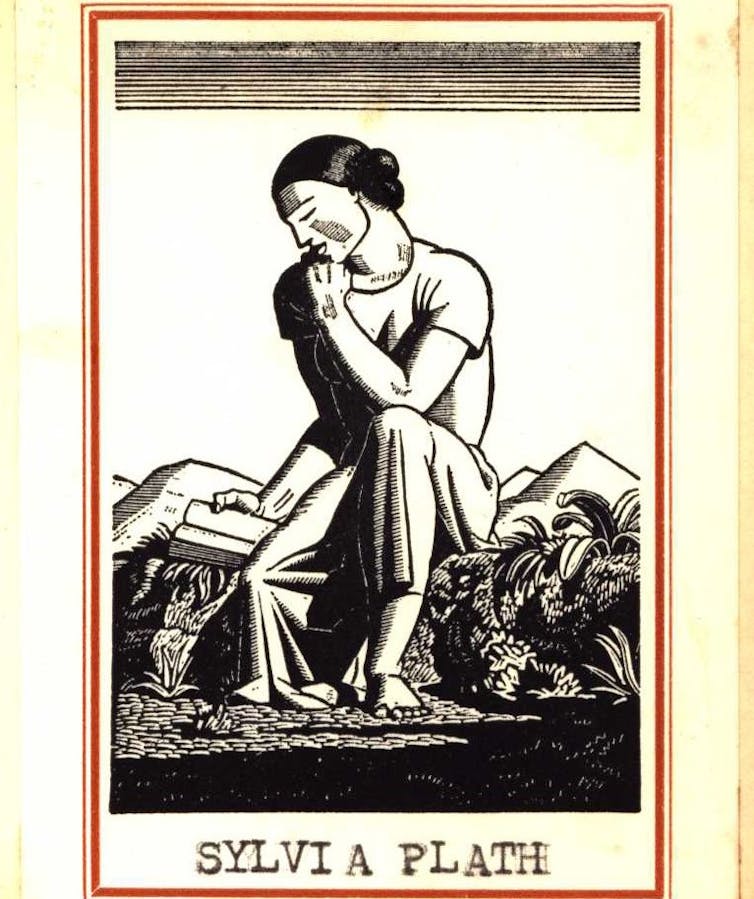
Jeanne Britton, University of South Carolina
As a rare books curator, I get to interact with first editions of novels I love, illustrated versions of my favorite poets’ works, and lavish editions of historical engravings.
In 2015, I started using the University of South Carolina’s first edition of “Lyrical Ballads” in my survey of British literature courses. Written by William Wordsworth and Samuel Taylor Coleridge, this collection of poems is commonly thought to have launched British Romanticism.
I would bring the volume to class to discuss its visual appearance as a printed text. But each time I shared the volume with a new group of students, we found ourselves drawn to the comments written in the book’s margins by its early owner, John Peace.
Peace was, I learned, an acquaintance of Wordsworth. And some of his comments in the margins of one of the volume’s most well-known poems, “Tintern Abbey,” explore the poem’s themes of memory, place and return.
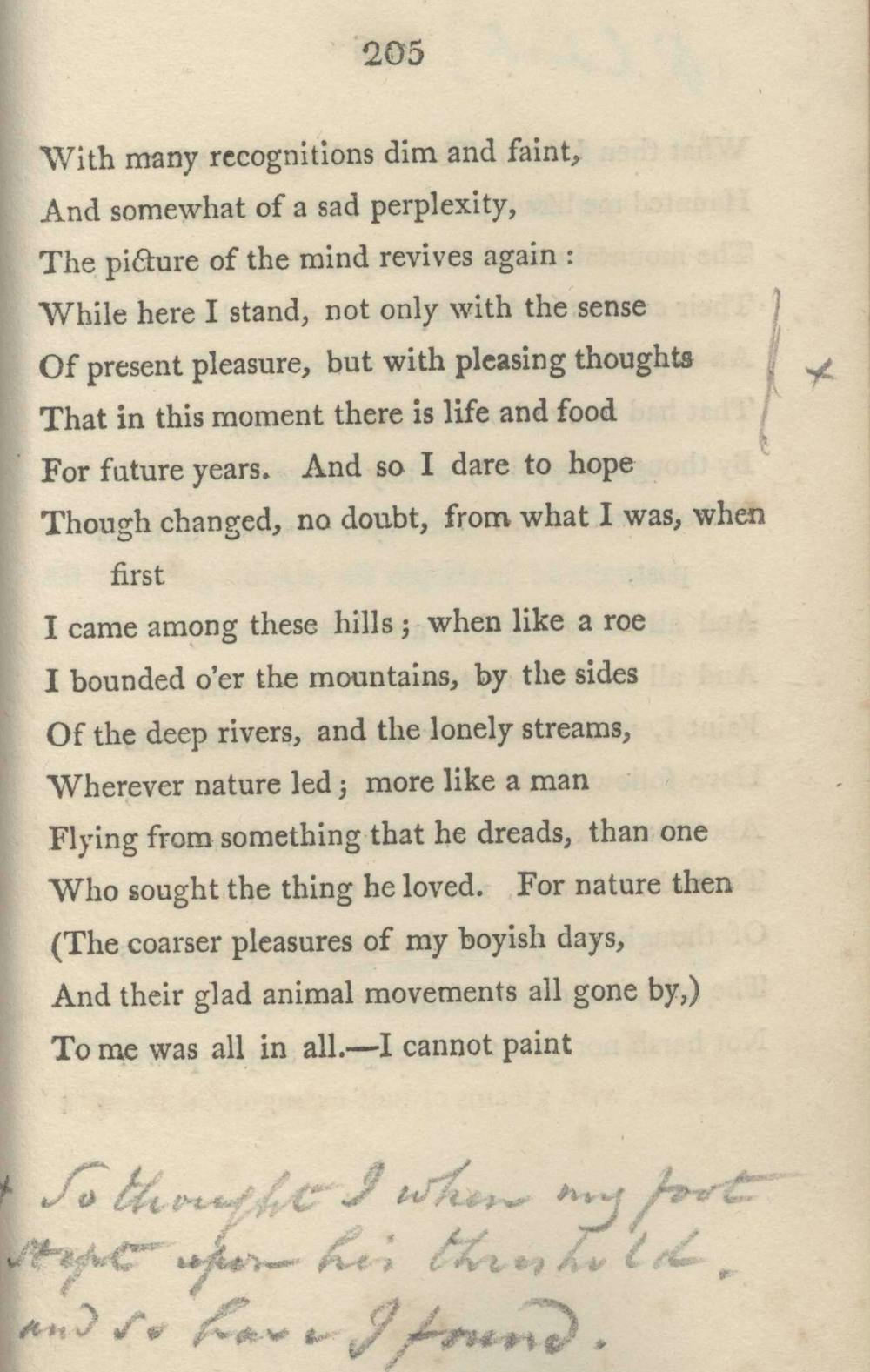
In this poem, Wordsworth describes his return to the Wye River valley after an absence of five years. He also recalls his memories of his first visit to the valley and looks forward to the memories this second visit will create.
“In this moment,” he writes, “there is life and food / For future years.”
When Peace responds to these lines, he describes a different kind of experience – visiting the poet in his home – in a similar way: “So thought I when my foot first step’t upon his threshold, and so have I found.”
It is a singular piece of literary history, and it’s one example of how the study of words written in the margins of historic texts – called “marginalia” – can illuminate the history of reading in new ways.
As prominent book historian Roger Chartier has noted, marginalia can reconstruct past reading experiences through the “sparse and multiple traces” ordinary readers left behind.
One particularly vivid example that is far from ordinary is Sylvia Plath’s copy of “The Great Gatsby.”
Acquired by the University of South Carolina in 1994 from a former professor, the Matthew J. & Arlyn Bruccoli Collection of F. Scott Fitzgerald includes Fitzgerald’s personal ledger, a flask from his wife Zelda, and early drafts of his works.
It also includes an inexpensive 1949 edition of “The Great Gatsby.” Compared to other items in this collection, it might not seem like anything special.
But the book’s owner – and the words she wrote in its margins – are quite noteworthy.
The bookplate identifies Sylvia Plath as the owner of this copy, which she most likely read as an undergraduate at Smith College. Some marginal comments were probably notes she took during lectures about the novel. But others show the way Fitzgerald’s novel sparked her imagination and inspired her own work.
She wrote on almost every page, underlining passages in black and blue ink, drawing stars beside her favorites and occasionally writing notes – some quite arresting – in the margins.
Plath wrote “L’Ennui” – a French word that describes a feeling of listlessness and boredom – next to a description of the character Daisy’s world-weary view of life: “I’ve been everywhere and seen everything and done everything.” “L’Ennui” would become the title of a poem Plath is thought to have written shortly after reading this novel.
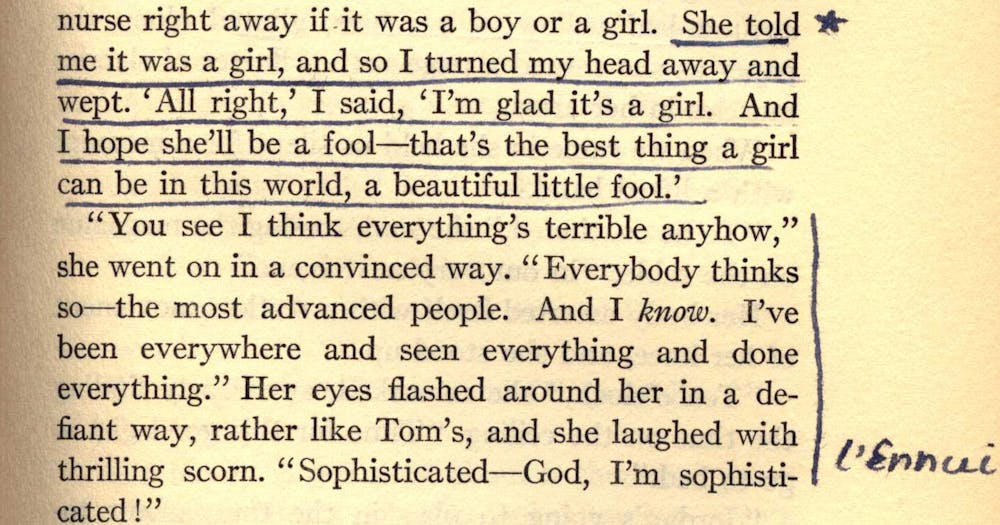
Other notes are, in the context of Plath’s painful life and tragic suicide, haunting.
She writes that Daisy shows a “desire for a secure future” – a longing that seems to have struck a chord for Plath.
On another page, she hints at masculine aggression when she comments, as Gatsby watches the Buchanans from outside their home, “knight waiting outside – dragon goes to bed with the princess.” This was a motif that would reappear in her own life: In her recently published letters, Plath details the physical and emotional abuse her husband, the poet Ted Hughes, inflicted upon her in the months before her death.
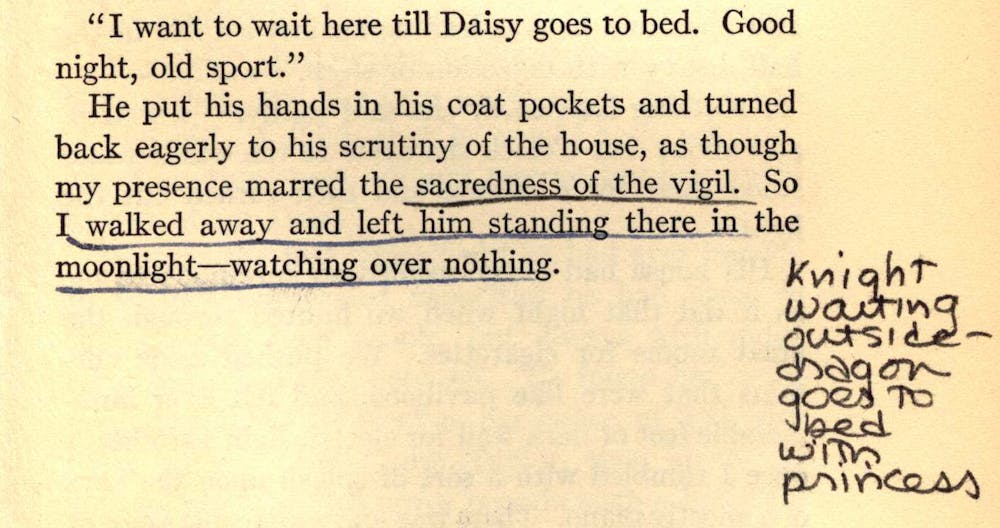
Sylvia Plath’s copy of “The Great Gatsby” speaks to the value of marginalia. As Makenzie Logue, a student of mine who is currently studying the volume, put it, preserving these notes means that you can “read The Great Gatsby with Sylvia Plath.”
In recent years, marginalia left by ordinary readers has become a subject of large-scale data collection efforts.
At the University of Virginia, English professor Andrew Stauffer leads a team that has made a book’s annotations, inscriptions and insertions discoverable as part of UVA’s online library catalog. Any user will be able to find such markings through a simple online search.
At the University of California, Los Angeles, librarians are developing ways to discover marginalia digitally – and quickly – across large digital collections.
Using the methods developed at the University of Virginia, my colleague Michael Weisenburg and I have organized searches for historical markings in library books at the University of South Carolina. Student workers and library staff have enhanced records for annotated volumes in the school’s online catalog.
While digital technology has made marginalia more accessible, digital reading has made the actual habit of writing in books much less common.
What would Sylvia Plath and John Peace have done if they had a Kindle? Would they have still left traces of their reactions to the texts – so valuable to scholars today – behind?
Jeanne Britton, Curator, Irvin Department of Rare Books and Special Collections, University of South Carolina
This article is republished from The Conversation under a Creative Commons license. Read the original article.

Sally O’Reilly, The Open University
My happiest times in childhood were spent reading the books of E. Nesbit, C.S. Lewis and Joan Aiken. Preferring to read in hidden corners where nobody could find me, I immersed myself completely in these stories and believed utterly in their magic, even attempting to enter Narnia via the portal of my grandmother’s wardrobe. As an adult, I still call myself a passionate reader, but sometimes feel as if I’ve lost my way compared to my childhood self. I buy vast quantities of books, talk about books, read as many as possible, sometimes even write them – but it’s not often I find that same pure immersion in an imagined world which has been such a lasting inspiration.
Celebrations like World Book day promote children’s reading and remind us all of the pleasures of a good book. Many of us make resolutions to read more, but these days there’s increasing pressure to read the “right” thing. The adult world presents a constant temptation to turn every activity into a competitive sport, and reading is no exception: it is beset with targets, hierarchies and categorisations. We guilt-read chick-lit and crime, skim-read for book groups and improvement-read from book prize shortlists.
Underpinning this is a relentless quest for self-improvement, demonstrated by the popularity of reading challenges, in which readers set themselves individual book consumption targets. On Good Reads, some participants have modest goals, others aim for as many as 190 in the year, which translates to 15.8 books a month, 3.6 a week or just over half a book each day. Impressive? Maybe, but others are reading even faster. One journalist recently embarked on a seven day social media detox and read a dozen books in that time. It’s a far cry from my days with Mr Tumnus.
This raises a fundamental question: why do we read at all? Do we want to enjoy books, or download them into our brains? Are we so obsessed with being able to tick a book title off a check-list that we risk forgetting that reading is a physical and emotional activity as well as an intellectual one? The perceived benefits of reading are often given more attention than the experience itself: campaigners tend to stress its utilitarian value and research findings that it increases empathy and even life expectancy.
But the reading experience is important. A sure sign of loving a book is slowing down when you come to the final pages, reluctant to leave the world it creates behind. As the UK reading agency puts it, “in addition to its substantial practical benefits, reading is one of life’s profound joys”. Children seem to know this intuitively, and engage fully with a story, often to the exclusion of all else. They are demanding, honest readers, more interested in what happens in a tale and where it takes them than whether it’s a Carnegie prize-winner.

As an adult, it is possible to recapture that immersive involvement with a book. What we need is the opportunity to focus entirely on the words, and a willingness to ignore stress-inducing challenges and targets. When I was writing my second novel I lived in Barcelona for a year, day-job free. During that time I read just six books, one of them Joseph Conrad’s The Secret Agent. At a recent writing retreat, I spent two hours a day reading Michel Faber’s The Crimson Petal and the White. I engaged completely with these novels, forgetting the outside world, and they have stayed with me, their characters and plot twists vivid and familiar when other books, read hurriedly in snatches amid distractions, have faded from my mind.
I’m not alone in seeing the value of immersive, non-competitive reading. In a recent Guardian article, author Sarah Waters admitted to feeling out of the loop when current writing is discussed. Asked which book she is “most ashamed not to have read” (a telling phrase), she responded, “Anything people are currently raving about. I’m a slow reader, and I read old books as often as new ones, so I always feel like a hopeless failure when it comes to keeping up with brand new titles”.
There are already advocates of slow living, and a cultural shift toward slowing down life’s pace, savouring experience and rediscovering human connection. Perhaps it is time for this to encompass reading too. 184,000 books are published each year in the UK alone, and we’re not going to make much of a dent in that pile even if we read 12 books a week. Indeed, no matter how fast we read, the vast majority of books will remain unknown to us. If there is one skill that adult readers can usefully learn from children, it is that of reading purely for pleasure.
Sally O’Reilly, Lecturer in Creative Writing, The Open University
This article is republished from The Conversation under a Creative Commons license. Read the original article.
The link below is to an article that takes a look at reading what you want to read, regardless of what others might think.
For more visit:
https://www.theguardian.com/books/2019/feb/08/theres-no-shame-in-reading-whatever-books-you-want-literary-snobs-be-damned
The link below is to an article that takes a look at alternative iOS reading apps to Apple Books.
For more visit:
https://blog.the-ebook-reader.com/2019/02/10/best-alternative-ios-reading-apps-to-apple-books/
The link below is to an article and infographic looking at the world’s reading habits in 2018.
For more visit:
https://ebookfriendly.com/state-of-books-reading-2018-infographic/
Margaret Kristin Merga, Edith Cowan University
Words are powerful, and a rich vocabulary can provide young people with significant advantages. Successful vocabulary development is associated with better vocational, academic and health outcomes.
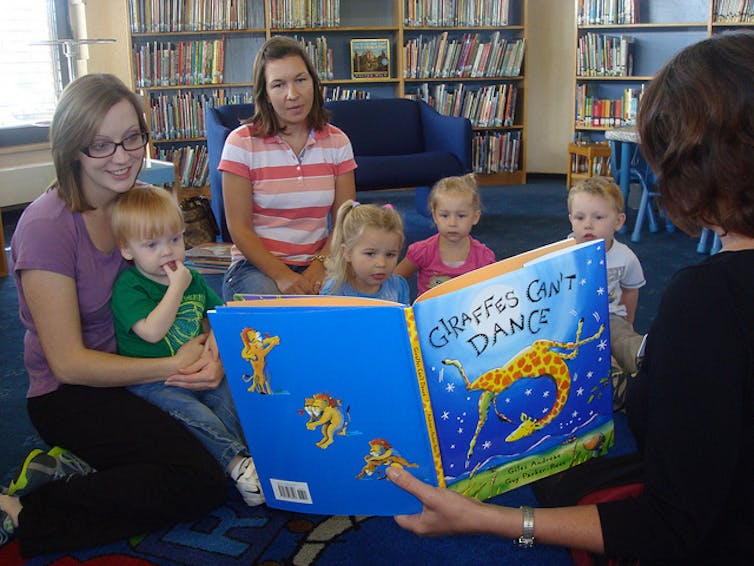
When parents read books aloud to their children from an early age, this offers notable advantages for children’s vocabulary development. This gives them a broader range of possible word choices.
Read more:
Research shows the importance of parents reading with children – even after children can read
Research also suggests children who don’t have the opportunity for shared reading are comparatively disadvantaged. If we want our children to be able to draw on a rich vocabulary to express themselves clearly, we need to read to them. Developing a child’s vocabulary is a valuable investment in their future.
In the very early years, spoken vocabularies have been associated with higher achievement in reading and maths, and better ability to regulate behaviour. Vocabulary is also linked to success in reading comprehension and related word recognition skills.
Much of a child’s vocabulary is acquired through daily conversations. Shared reading aloud can provide a valuable additional source of new words children can use to power their expression. Research suggests the text of picture books offers access to more diverse vocabulary than child-directed conversations.
At some point, most of us have experienced the frustration of searching for an elusive word that is essential to clearly communicate an idea or a need. When children speak or write, they draw on their vocabulary to make word selections that will optimise the clarity and accuracy of their expression.

Beyond vocabulary, reading aloud offers numerous additional benefits for children. Reading aloud may support students to develop sustained attention, strong listening skills, and enhanced cognitive development.
Recent research also suggests children who are read to from an early age may be less likely to experience hyperactivity. Children who are at risk of reading difficulties may particularly benefit from being read to. Children who are learning English as an additional language may experience better reading comprehension when they are read to in English.
Reading aloud with your child is also valuable parent-child time. It can strengthen the parent-child relationship and foster reading engagement, which is essential if we want our children to enjoy the benefits of being a life-long reader.
Vocabulary development can be improved through explicit teaching techniques such as providing definitions for new words. For example, while reading to your child, when you encounter a new word you may pause and ask the child what they think it means.
If they’re unsure, you can then read a little further along so the word is encountered in a context that can give valuable clues about meaning. If the meaning is still unclear, you can provide a definition for your child so you can move on.
A recent study found approaches that involve pointing, providing definitions, and asking some questions as you read together can be good for vocabulary building.
Recent research found nearly identical gains in vocabulary where children were read to either using explicit techniques (such as pointing and giving definitions) or a more engaging storytelling approach. In the storytelling approach, the adult reading to the child added contextual information, which made the child more interested and engaged in the story.
Read more:
Enjoyment of reading, not mechanics of reading, can improve literacy for boys
Children will also benefit from hearing the same story a number of times. It’s also a good idea to use some of the new language in subsequent conversation if possible. This can increase exposure and strengthen retention of new words.
Read more:
There’s a reason your child wants to read the same book over and over again
We may not always have a book at hand. In these cases, you can draw on your creativity and tell a story, which can also benefit vocabulary.
While there is limited research in this area, one study compared telling a child a story or reading them a story with a child reading silently to themselves. The study found all three groups of children learned new words. But telling a story and reading a story to a child offered superior gains in vocabulary.
Research suggests that children may be aware of the benefits of listening to books read aloud. This awareness can be a source of regret for the child when reading aloud at home ends, but they still enjoy shared reading. Children may continue to enjoy and benefit from being read to beyond the early years. You should keep reading with your children as long as they let you.
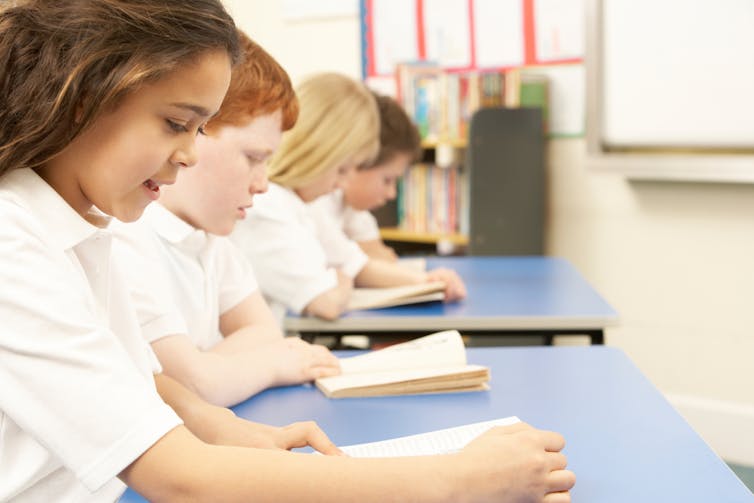
By far, the biggest barrier raised by parents to reading aloud to their children was the formidable barrier of time. If reading aloud becomes a routine part of family life, like dinner and bedtime, this barrier may be overcome as the practice becomes an everyday event.
Due to diverse issues faced in homes and families, not all parents will be able to read their child a book, or tell them a story. This is why it’s still so important for schools to provide opportunities for students to regularly listen to engaging and culturally diverse books.
Read more:
Ten ways teacher librarians improve literacy in schools
But reading aloud is not a typical daily classroom practice. We should increase the number of opportunities children have to hear stories both at home and in schools so children can experience the many benefits of a rich and varied vocabulary.
Margaret Kristin Merga, Senior Lecturer in Education, Edith Cowan University
This article is republished from The Conversation under a Creative Commons license. Read the original article.
The link below is to an article that takes a look at how to introduce children to books and getting them into reading.
For more visit:
https://momlovesbest.com/reading-for-kids
 At the BookShelf
You must be logged in to post a comment.