

Unknown's avatar

How to read Shakespeare for pleasure


Martin’s Droeshout portrait of William Shakespeare (1623)
Bodleian Library, Oxford.

Emma Smith, University of Oxford

In recent years the orthodoxy that Shakespeare can only be truly appreciated on stage has become widespread. But, as with many of our habits and assumptions, lockdown gives us a chance to think differently. Now could be the time to dust off the old collected works, and read some Shakespeare, just as people have been doing for more than 400 years.

Many people have said they find reading Shakespeare a bit daunting, so here are five tips for how to make it simpler and more pleasurable.

1. Ignore the footnotes

If your edition has footnotes, pay no attention to them. They distract you from your reading and de-skill you, so that you begin to check everything even when you actually know what it means.

It’s useful to remember that nobody ever understood all this stuff – have a look at Macbeth’s knotty “If it were done when ‘tis done” speech in Act 1 Scene 7 for an example (and nobody ever spoke in these long, fancy speeches either – Macbeth’s speech is again a case in point). Footnotes are just the editor’s attempt to deny this.
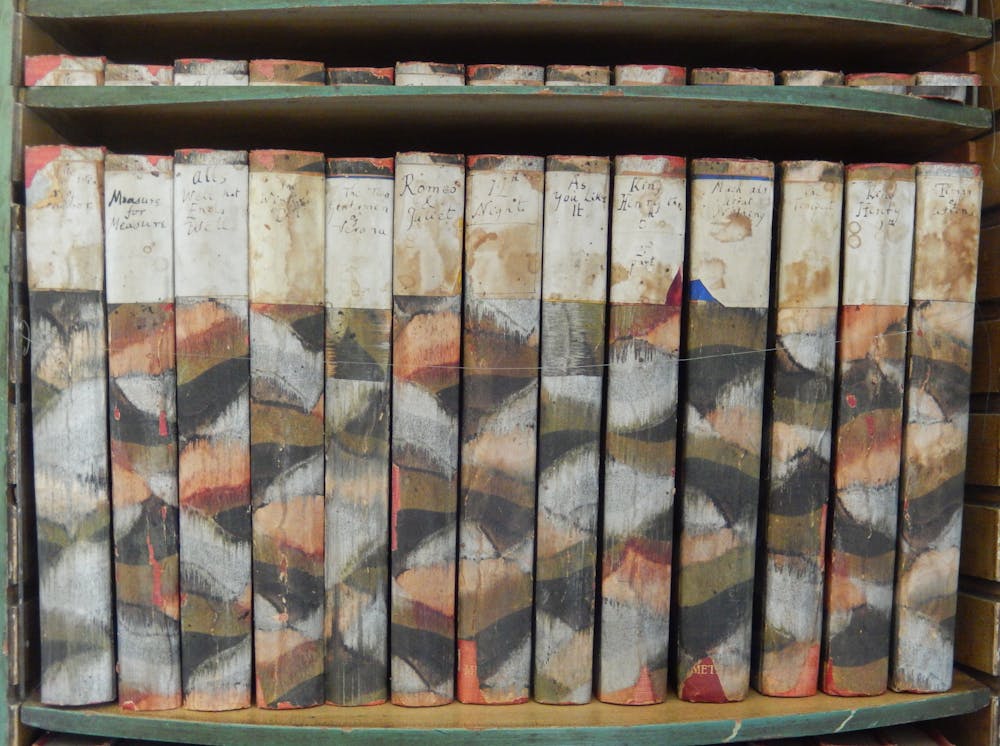
Shakespeare plays hand bound by Virginia Woolf in her bedroom at Monk’s House, Rodmell, Sussex, UK.
Ian Alexanber/Wikimedia Commons, CC BY-NC-SA

Try to keep going and get the gist – and remember, when Shakespeare uses very long or esoteric words, or highly involved sentences, it’s often a deliberate sign that the character is trying to deceive himself or others (the psychotic jealousy of Leontes in The Winter’s Tale, for instance, expresses itself in unusual vocabulary and contorted syntax).

2. Pay attention to the shape of the lines

The layout of speeches on the page is like a kind of musical notation or choreography. Long speeches slow things down – and, if all the speeches end at the end of a complete line, that gives proceedings a stately, hierarchical feel – as if the characters are all giving speeches rather than interacting.

Short speeches quicken the pace and enmesh characters in relationships, particularly when they start to share lines (you can see this when one line is indented so it completes the half line above), a sign of real intimacy in Shakespeare’s soundscape.

Blank verse, the unrhymed ten-beat iambic pentamenter structure of the Shakespearean line, varies across his career. Early plays – the histories and comedies – tend to end each line with a piece of punctuation, so that the shape of the verse is audible. John of Gaunt’s famous speech from Richard II is a good example.

This royal throne of kings, this sceptered isle,
This earth of majesty, this seat of Mars.

Later plays – the tragedies and the romances – tend towards a more flexible form of blank verse, with the sense of the phrase often running over the line break. What tends to be significant is contrast, between and within the speech rhythms of scenes or characters (have a look at Henry IV Part 1 and you’ll see what I mean).

3. Read small sections

Shakespeare’s plays aren’t novels and – let’s face it – we’re not usually in much doubt about how things will work out. Reading for the plot, or reading from start to finish, isn’t necessarily the way to get the most out of the experience. Theatre performances are linear and in real time, but reading allows you the freedom to pace yourself, to flick back and forwards, to give some passages more attention and some less.

Shakespeare’s first readers probably did exactly this, zeroing in on the bits they liked best, or reading selectively for the passages that caught their eye or that they remembered from performance, and we should do the same. Look up where a famous quotation comes: “All the world’s a stage”, “To be or not to be”, “I was adored once too” – and read either side of that. Read the ending, look at one long speech or at a piece of dialogue – cherry pick.

One great liberation of reading Shakespeare for fun is just that: skip the bits that don’t work, or move on to another play. Nobody is going to set you an exam.

4. Think like a director

On the other hand, thinking about how these plays might work on stage can be engaging and creative for some readers. Shakespeare’s plays tended to have minimal stage directions, so most indications of action in modern editions of the plays have been added in by editors.

Most directors begin work on the play by throwing all these instructions away and working them out afresh by asking questions about what’s happening and why. Stage directions – whether original or editorial – are rarely descriptive, so adding in your chosen adverbs or adjectives to flesh out what’s happening on your paper stage can help clarify your interpretations of character and action.

One good tip is to try to remember characters who are not speaking. What’s happening on the faces of the other characters while Katherine delivers her long, controversial speech of apparent wifely subjugation at the end of The Taming of the Shrew?

5. Don’t worry

The biggest obstacle to enjoying Shakespeare is that niggling sense that understanding the works is a kind of literary IQ test. But understanding Shakespeare means accepting his open-endedness and ambiguity. It’s not that there’s a right meaning hidden away as a reward for intelligence or tenacity – these plays prompt questions rather than supplying answers.

Would Macbeth have killed the king without the witches’ prophecy? Exactly – that’s the question the play wants us to debate, and it gives us evidence to argue on both sides. Was it right for the conspirators to assassinate Julius Caesar? Good question, the play says: I’ve been wondering that myself.

Returning to Shakespeare outside the dutiful contexts of the classroom and the theatre can liberate something you might not immediately associate with his works: pleasure.The Conversation

Emma Smith, Professor of Shakespeare Studies, University of Oxford

This article is republished from The Conversation under a Creative Commons license. Read the original article.

Unknown's avatar

As Harry Potter turns 20, let’s focus on reading pleasure rather than literary merit


File 20170619 22075 zx0ld5
Platform 9 and ¾, the portal to Harry Potter’s magical world, at Kings Cross in London.
Harry Potter image from http://www.shutterstock.com

Di Dickenson, Western Sydney University

It’s 20 years on June 26 since the publication of Harry Potter and the Philosopher’s Stone, the first in the seven-book series. The Philosopher’s Stone has sold more than 450 million copies and been translated into 79 languages; the series has inspired a movie franchise, a dedicated fan website, and spinoff stories.


Goodreads

I recall the long periods of frustration and excited anticipation as my son and I waited for each new instalment of the series. This experience of waiting is one we share with other fans who read it progressively across the ten years between the publication of the first and last Potter novel. It is not an experience contemporary readers can recreate.

The Harry Potter series has been celebrated for encouraging children to read, condemned as a commercial rather than a literary success and had its status as literature challenged. Rowling’s writing was described as “basic”, “awkward”, “clumsy” and “flat”. A Guardian article in 2007, just prior to the release of the final book in the series, was particularly scathing, calling her style “toxic”.

My own focus is on the pleasure of reading. I’m more interested in the enjoyment children experience reading Harry Potter, including the appeal of the stories. What was it about the story that engaged so many?

Before the books were a commercial success and highly marketed, children learnt about them from their peers. A community of Harry Potter readers and fans developed and grew as it became a commercial success. Like other fans, children gained cultural capital from the depth of their knowledge of the series.

My own son, on the autism spectrum, adored Harry Potter. He had me read each book in the series in order again (and again) while we waited for the next book to be released. And once we finished the new book, we would start the series again from the beginning. I knew those early books really well.

‘Toxic’ writing?

Assessing the series’ literary merit is not straightforward. In the context of concern about falling literacy rates, the Harry Potter series was initially widely celebrated for encouraging children – especially boys – to read. The books, particularly the early ones, won numerous awards and honours, including the Nestlé Smarties Book Prize three years in a row, and were shortlisted for the prestigious Carnegie Medal in 1998.

The seven books of the Harry Potter series, released from 1997 to 2007.
Alan Edwardes/Flickr, CC BY-NC-ND

Criticism of the literary merit of the books, both scholarly and popular, appeared to coincide with the growing commercial and popular success of the series. Rowling was criticised for overuse of capital letters and exclamation marks, her use of speech or dialogue tags (which identify who is speaking) and her use of adverbs to provide specific information (for example, “said the boy miserably”).

The criticism was particularly prolific around the UK’s first conference on Harry Potter held at the prestigious University of St Andrews, Scotland in 2012. The focus of commentary seemed to be on the conference’s positioning of Harry Potter as a work of “literature” worthy of scholarly attention. As one article said of J.K. Rowling, she “may be a great storyteller, but she’s no Shakespeare”.

Even the most scathing of reviews of Rowling’s writing generally compliment her storytelling ability. This is often used to account for the popularity of the series, particularly with children. However, this has then been presented as further proof of Rowling’s failings as an author. It is as though the capacity to tell a compelling story can be completely divorced from the way a story is told.

Daniel Radcliffe in his first outing as Harry Potter in the Philosopher’s Stone, 2001.
Warner Brothers

Writing for kids

The assessment of the literary merits of a text is highly subjective. Children’s literature in particular may fare badly when assessed using adult measures of quality and according to adult tastes. Many children’s books, including picture books, pop-up books, flap books and multimedia texts are not amenable to conventional forms of literary analysis.

Books for younger children may seem simple and conventional when judged against adult standards. The use of speech tags in younger children’s books, for example, is frequently used to clarify who is talking for less experienced readers. The literary value of a children’s book is often closely tied to adults’ perception of a book’s educational value rather than the pleasure children may gain from reading or engaging with the book. For example, Rowling’s writing was criticised for not “stretching children” or teaching children “anything new about words”.

Many of the criticisms of Rowling’s writing are similar to those levelled at another popular children’s author, Enid Blyton. Like Rowling, Blyton’s writing has described by one commentator as “poison” for its “limited vocabulary”, “colourless” and “undemanding language”. Although children are overwhelmingly encouraged to read, it would appear that many adults view with suspicion books that are too popular with children.

There have been many defences of the literary merits of Harry Potter which extend beyond mere analysis of Rowling’s prose. The sheer volume of scholarly work that has been produced on the series and continues to be produced, even ten years after publication of the final book, attests to the richness and depth of the series.

The ConversationA focus on children’s reading pleasure rather than on literary merit shifts the focus of research to a different set of questions. I will not pretend to know why Harry Potter appealed so strongly to my son but I suspect its familiarity, predictability and repetition were factors. These qualities are unlikely to score high by adult standards of literary merit but are a feature of children’s series fiction.

Di Dickenson, Director of Academic Program BA, School of Humanities and Communication Arts, Western Sydney University

This article was originally published on The Conversation. Read the original article.

Unknown's avatar

As Harry Potter turns 20, let’s focus on reading pleasure rather than literary merit


File 20170619 22075 zx0ld5
Platform 9 and ¾, the portal to Harry Potter’s magical world, at Kings Cross in London.
Harry Potter image from http://www.shutterstock.com

Di Dickenson, Western Sydney University

It’s 20 years on June 26 since the publication of Harry Potter and the Philosopher’s Stone, the first in the seven-book series. The Philosopher’s Stone has sold more than 450 million copies and been translated into 79 languages; the series has inspired a movie franchise, a dedicated fan website, and spinoff stories.


Goodreads

I recall the long periods of frustration and excited anticipation as my son and I waited for each new instalment of the series. This experience of waiting is one we share with other fans who read it progressively across the ten years between the publication of the first and last Potter novel. It is not an experience contemporary readers can recreate.

The Harry Potter series has been celebrated for encouraging children to read, condemned as a commercial rather than a literary success and had its status as literature challenged. Rowling’s writing was described as “basic”, “awkward”, “clumsy” and “flat”. A Guardian article in 2007, just prior to the release of the final book in the series, was particularly scathing, calling her style “toxic”.

My own focus is on the pleasure of reading. I’m more interested in the enjoyment children experience reading Harry Potter, including the appeal of the stories. What was it about the story that engaged so many?

Before the books were a commercial success and highly marketed, children learnt about them from their peers. A community of Harry Potter readers and fans developed and grew as it became a commercial success. Like other fans, children gained cultural capital from the depth of their knowledge of the series.

My own son, on the autism spectrum, adored Harry Potter. He had me read each book in the series in order again (and again) while we waited for the next book to be released. And once we finished the new book, we would start the series again from the beginning. I knew those early books really well.

‘Toxic’ writing?

Assessing the series’ literary merit is not straightforward. In the context of concern about falling literacy rates, the Harry Potter series was initially widely celebrated for encouraging children – especially boys – to read. The books, particularly the early ones, won numerous awards and honours, including the Nestlé Smarties Book Prize three years in a row, and were shortlisted for the prestigious Carnegie Medal in 1998.

The seven books of the Harry Potter series, released from 1997 to 2007.
Alan Edwardes/Flickr, CC BY-NC-ND

Criticism of the literary merit of the books, both scholarly and popular, appeared to coincide with the growing commercial and popular success of the series. Rowling was criticised for overuse of capital letters and exclamation marks, her use of speech or dialogue tags (which identify who is speaking) and her use of adverbs to provide specific information (for example, “said the boy miserably”).

The criticism was particularly prolific around the UK’s first conference on Harry Potter held at the prestigious University of St Andrews, Scotland in 2012. The focus of commentary seemed to be on the conference’s positioning of Harry Potter as a work of “literature” worthy of scholarly attention. As one article said of J.K. Rowling, she “may be a great storyteller, but she’s no Shakespeare”.

Even the most scathing of reviews of Rowling’s writing generally compliment her storytelling ability. This is often used to account for the popularity of the series, particularly with children. However, this has then been presented as further proof of Rowling’s failings as an author. It is as though the capacity to tell a compelling story can be completely divorced from the way a story is told.

Daniel Radcliffe in his first outing as Harry Potter in the Philosopher’s Stone, 2001.
Warner Brothers

Writing for kids

The assessment of the literary merits of a text is highly subjective. Children’s literature in particular may fare badly when assessed using adult measures of quality and according to adult tastes. Many children’s books, including picture books, pop-up books, flap books and multimedia texts are not amenable to conventional forms of literary analysis.

Books for younger children may seem simple and conventional when judged against adult standards. The use of speech tags in younger children’s books, for example, is frequently used to clarify who is talking for less experienced readers. The literary value of a children’s book is often closely tied to adults’ perception of a book’s educational value rather than the pleasure children may gain from reading or engaging with the book. For example, Rowling’s writing was criticised for not “stretching children” or teaching children “anything new about words”.

Many of the criticisms of Rowling’s writing are similar to those levelled at another popular children’s author, Enid Blyton. Like Rowling, Blyton’s writing has described by one commentator as “poison” for its “limited vocabulary”, “colourless” and “undemanding language”. Although children are overwhelmingly encouraged to read, it would appear that many adults view with suspicion books that are too popular with children.

There have been many defences of the literary merits of Harry Potter which extend beyond mere analysis of Rowling’s prose. The sheer volume of scholarly work that has been produced on the series and continues to be produced, even ten years after publication of the final book, attests to the richness and depth of the series.

The ConversationA focus on children’s reading pleasure rather than on literary merit shifts the focus of research to a different set of questions. I will not pretend to know why Harry Potter appealed so strongly to my son but I suspect its familiarity, predictability and repetition were factors. These qualities are unlikely to score high by adult standards of literary merit but are a feature of children’s series fiction.

Di Dickenson, Director of Academic Program BA, School of Humanities and Communication Arts, Western Sydney University

This article was originally published on The Conversation. Read the original article.

Unknown's avatar

Reading for Pleasure


The link below is to an article that takes a look at reading for pleasure.

For more visit:
http://www.teleread.com/reading-2/the-neil-gaiman-reading-agency-lecture-reading-for-pleasure-is-one-of-the-most-important-things-one-can-do/