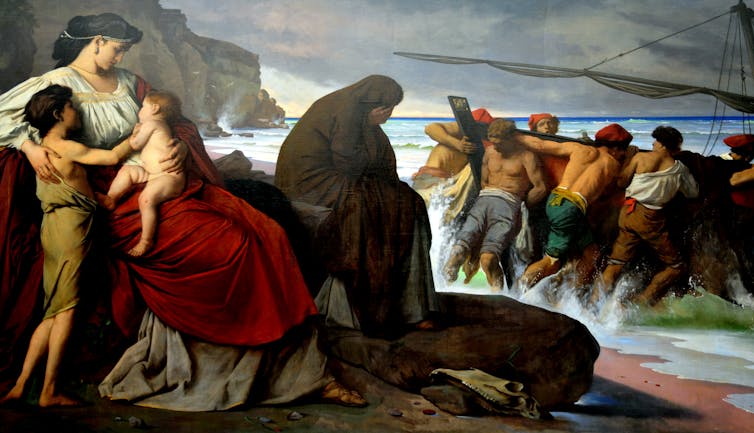
Anselm Feuerbach’s depiction of Medea, circa 1870: the play is particularly cogent today in the context of the #MeToo movement’s assault on patriarchal power. Wikimedia Commons
The Athenian poet Euripides was the last of the three great Greek tragedians (after Aeschylus and Sophocles) and also the least successful.
Greek tragedies were performed competitively at religious festivals in Athens in honour of the god Dionysus. While 18 of his 90-odd plays have survived, Euripides claimed only four festival victories. One prize was awarded posthumously, indicating that at the Dionysia, as with the Oscars, death could be a handy avenue to success.
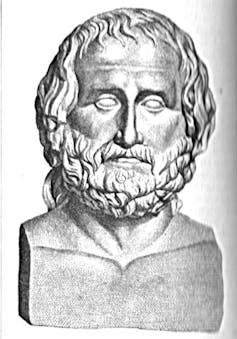
Sculpture of Euripides. Wikimedia
It’s not difficult to see how Euripides estranged the festival judges. Unlike the intricate plotting of Sophocles, exemplified by the intriguing whodunit devices employed in Oedipus The King, Euripides’ interest lay in the psychological motivations of his characters. Some scholars accordingly describe his plays as more modern than his contemporaries.
Euripides challenged conventions by depicting strong, passionate female characters and cynical, often weak male mythological heroes. He was considered more of a social critic than his contemporaries, who disparaged his emphasis on clever women.
In Aristophanes’ comedy The Thesmophoriazusae, the women of Athens use an annual fertility festival to plot secret revenge on Euripides for his depiction of them as crazed, sex-addicted killers. The central joke is not that Euripides is defaming women in his plays, but rather that he is onto them and must be stopped before he reveals more.
Euripides’ dismissal by some as a misogynist sits uncomfortably alongside his complex and sympathetic female characters. Medea is a case in point: a sorceress and former princess of the “barbarian” kingdom of Colchis, she mourns the loss of her husband’s love, the hero Jason. To further his political ambitions, Jason abandons Medea in order to marry a Corinthian princess.
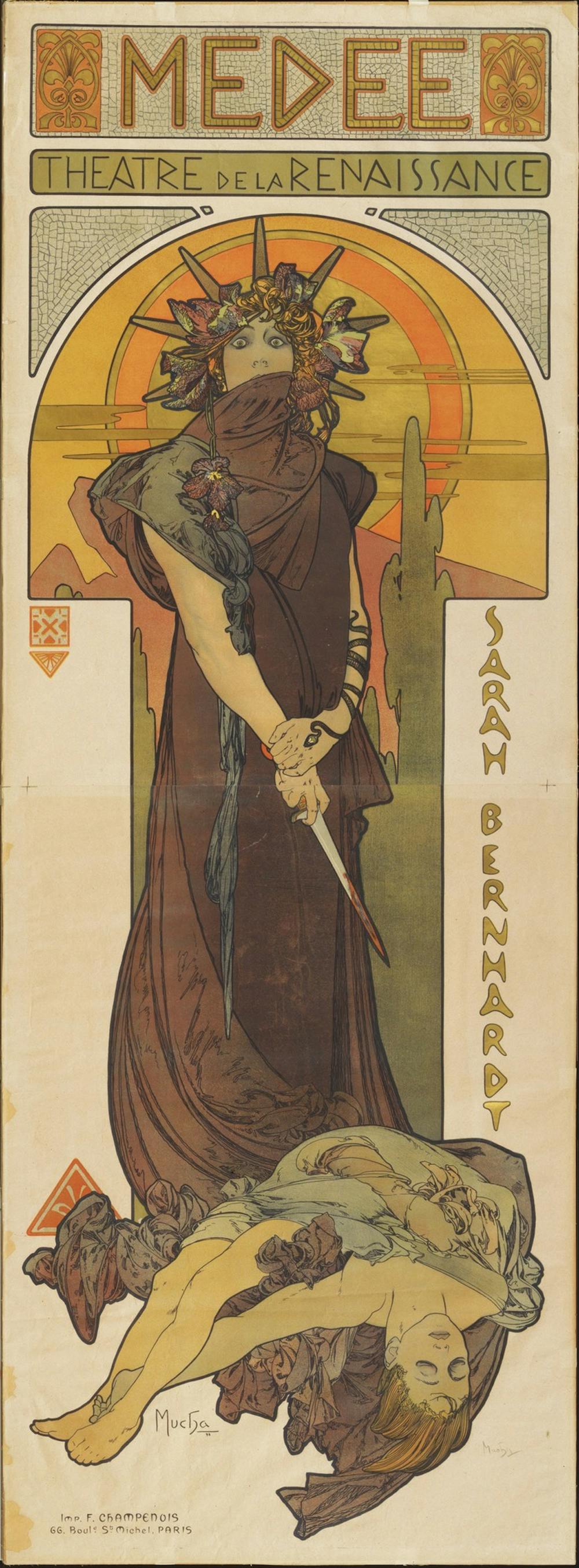
An 1898 poster for the play.
Medea confides her grief to her nurse and the Chorus of Corinthian women who sympathise, but fear her response; and these fears are well-founded. Medea takes horrible vengeance on Jason by murdering his new wife then slaughtering their own children.
The play ends like a brutal thunderclap as Medea escapes to Athens in a dragon-drawn chariot, flanked by the corpses of her sons, mocking Jason’s agony and revelling in her victory.
Jason predicts justice will pursue Medea (“The curse of children’s blood be on you! Avenging justice blast your being!”) but so complete is his defeat, this threat seems empty. Medea has inflicted savage sacrifices to wreak her revenge and now, revealed in all her supernatural splendour, no one can touch her.
The Athenians don’t seem to have responded particularly well to Medea in so far as the festival judges placed it third. This might in part be attributable to poor timing. Medea was performed first in the spring of 431 BC, a few weeks before the Spartan king Archidamus invaded Attica – initiating the 27-year Peloponnesian War that proved catastrophic for Athens. War had been brewing for a decade and in their state of profound anxiety perhaps Athenians were simply in no mood for the horrors Euripides was offering.
But there are other reasons for Medea’s failure. As a barbarian from the wild realm of Colchis (in modern Georgia) Medea would be inherently untrustworthy to an Athenian audience. They might sympathise with her feelings of isolation and homesickness (“Of all pains and hardships none is worse than to be deprived of your native land”) but she remained associated with the Eastern “other” that marched into Greece under the Persian king Xerxes and sacked Athens 50 years previously.
Traditionalists might also have objected to Medea’s sexual politics. In Medea more than his other plays (The Trojan Women excepted) Euripides depicts a world where the steadfastness and bravery of women count for nothing amid the machinations of men (“we women are the most wretched…I’d rather stand three times in the front line than bear one child”).
Artemisia Gentileschi, Medea, circa 1620. Wikimedia Commons
Medea’s lament may seem admirably subversive to a modern audience but it appears that the festival judges had little appetite for the gender conflict that so fascinated Euripides. It’s worth noting that Euripides’ plays grew in popularity after his death, so it’s likely their “salacious” content enjoyed a better reception outside the formal competition environment.
Despite Euripides’ popularity with modern audiences Medea remains a challenging play. Although scenarios of fathers “avenging” themselves on their wives through killing their children are depressingly familiar to us, the resolve of a mother to destroy her enemies through sacrificing her children is fundamentally distancing.
Medea may be a prisoner to her passion (“Oh, what an evil power love has in people’s lives!”) but she plans her vengeance with cold brutality. Only her female confidants sense with dread what she is up to and who can they tell?
Adaption of the classic
That said, Medea’s remorseless depiction of a woman forced to strike against an oppressive patriarchy did see it embraced by the 1960s counterculture. Pasolini adapted the play in his polarising style in 1969, but Medea’s themes were not borrowed to the extent of other Greek works during the American cinematic Renaissance of the 1970s (Roman Polanski, for instance, used Sophocles’ Oedipus as his canvas for 1974’s Chinatown).
A sympathetic depiction of a grieving mother killing her children to ruin her husband seemed too great a hurdle for filmmakers. Decades later, however, Ridley Scott channeled Medea’s denouement in having Thelma and Louise take violent revenge against the patriarchy and refuse to be taken – “escaping” in their airborne chariot, their male pursuers looking on impotently.
Thelma and Louise take violent revenge against the patriarchy and refuse to be taken – “escaping” in their airborne chariot.
Medea is particularly cogent today in the context of the #MeToo movement’s assault on patriarchal power. Euripides’ fascination with women outscheming their “masters” and striking back lethally springs from an anxiety at the heart of Athenian society.
Medea, Hippolytus and Aristophanes’ comedies seemingly demonstrate that the cloistering of Athenian women did not result from a male assumption they were unintelligent or weak. On the contrary, it reflects a belief in a vicious cycle where the subjugation of women made them intent on revenge, making it a social necessity to oppress them further.
As a modern articulation of Medea’s themes, the play’s central message was distilled to its essence in Clint Eastwood’s 1992 revisionist Western Unforgiven. A “chorus” of prostitutes commission bloody revenge on men who mutilated one of their sisterhood.
When townsmen gather angrily outside the brothel after one of the murders, the group matriarch screams from above “He had it coming! They all have it coming!” To Medea, truer words were never spoken.
For Marie Colvin, it was Lebanon’s War of the Camps that brought home the power of journalism. In April 1987 Burj al Barajneh, a Palestinian refugee camp, was besieged by Amal, a Shia militia backed by the Syrian regime.
Colvin and her photographer Tom Stoddart paid an Amal commander to briefly hold fire while they ran into the camp across no-man’s land. The assault on the camp was relentless and women were forced to run a gauntlet of sniper fire to get food and water for their families.
One young woman, Haji Achmed Ali, was shot as she tried to re-enter the camp with supplies. As she lay there wounded, no man dared pull her to safety. But then, Colvin reported:
Two [women] raced from cover, plucked Achmed Ali from the dust and hauled her to safety. It is the women who are dying and it was women who tired of men’s inaction.
Despite the best efforts of volunteer medics, Achmed Ali would not survive. At the hospital another woman appealed to Colvin to tell the world the young woman’s story.
Penguin
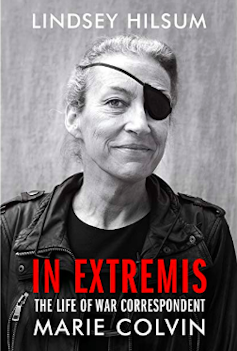
War on Women, the powerful piece Colvin wrote, was splashed across the front page of the Sunday Times on 5 April 1987. “The facts were clear and brutal,” writes Lindsey Hilsum in In Extremis: The Life of War Correspondent Marie Colvin, “as Marie had seen it with her own eyes”.
The effect was almost immediate. Three days later the Syrian regime ordered its proxy militia to stand down and for the first time the International Committee of the Red Cross (ICRC) was able to enter the camp. A herd of journalists soon followed. “In a few days the War of the Camps was over,” writes Hilsum.
Complexity
In Extremis is Hilsum’s riveting story of how Colvin went from a carefree idealistic youth in Oyster Bay, NY, to an audacious war correspondent who reported from sites of merciless violence in Lebanon, Palestine, Chechnya, East Timor, Sri Lanka, the Balkans and Libya. Until her death at the hands of the Syrian regime, Colvin remained indefatigable, never losing her idealism or youthful energy.
By eschewing hagiography for complexity, Hilsum has created a captivating portrait. The Colvin that Hilsum reveals is shaped by the loss of a beloved father, by the spirit of competition, by being a woman in a male-dominated field, and, above all, by a moral commitment to bearing witness and a natural affinity for the underdog.
By casting Colvin’s triumphs against the demons that pursued her – the turbulence of failed romances, the struggles with alcohol, the traumas of war – Hilsum gives a truer sense of the challenges that she faced. By capturing Colvin’s vivacity, generosity, humour and affability, Hilsum also shows how this inveterate raconteur came to be loved and admired in equal measure.
Like Ernest Hemingway, Colvin had invested in her own legend and sometimes strained to live up to it. But there was nothing inauthentic about her capacity for empathy or her commitment to the truth. Though in times of peace she struggled to distinguish herself, in times of crisis she unfailingly outshone her peers. While the Middle East remained her main beat, she also ventured farther afield, from Chechnya to Sri Lanka and East Timor.
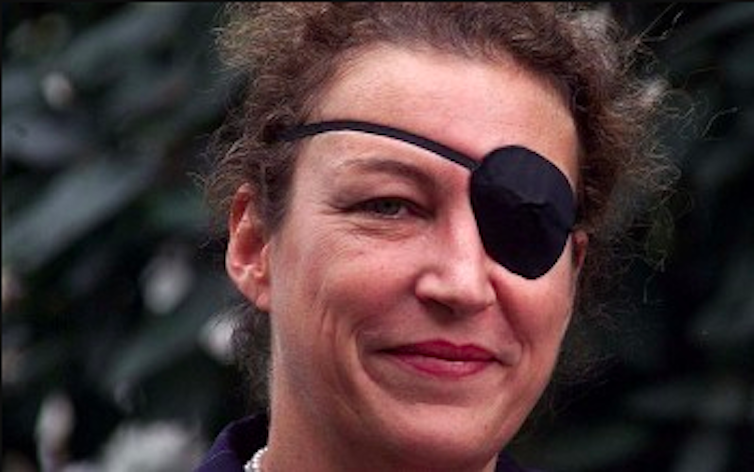
But if East Timor was the site of her greatest triumph (her defiant refusal to abandon trapped refugees eventually led to their safe evacuation), Sri Lanka became the site of her greatest trauma, losing an eye to a soldier’s grenade while returning from a visit to the Tamil-controlled north. But while the trauma would haunt her and briefly sapped her confidence, she remained undeterred. She courted greater danger in subsequent years and turned the eye-patch into part of her legend.
Colvin’s last report from Syria, hours before she died.
The making of a legend
By the time Colvin entered Syria in 2012, the reporting landscape had changed. Israel and Putin’s Russia had demonstrated that journalists could be targeted with impunity and killers elsewhere had taken note. Before Colvin entered the besieged Syrian enclave of Baba Amr with photographer Paul Conroy, they had been warned that regime soldiers had orders to summarily execute journalists found in the area.
But Colvin and Conroy agreed that the story was worth the risk; they crawled through three kilometres of a drainage pipe to infiltrate. They found Baba Amr’s only functioning hospital inundated with the dead and the dying; they met nearly 150 widows and orphans in a crowded basement sheltering from the regime’s shelling. Widows’ Basement, Colvin’s haunting last story for the Sunday Times, was also her most poignant.
What happened next fused Colvin’s life and legend and placed her convictions beyond any cynic’s doubt. Five days before her death, Colvin had made it safely out of Baba Amr. But having seen what she had seen, she felt a moral compulsion to return. Conroy had misgivings, but he shared Colvin’s sense of commitment.
The regime meanwhile had tightened the siege and an informer had alerted it to the journalists’ presence. Colvin was conscious of the risks but made a fateful choice: hoping that her reporting would once again stir the international community into restraining a killer, she spoke to the BBC and CNN, emphasising the urgency of the situation. The regime used the signal from her satellite phone to pinpoint her location and killed her with artillery. The regime would lay many more sieges and no western journalist would dare enter another.
At a 2006 Frontline Club (a London hub for foreign correspondants) event about the killing of Russian journalist Anna Politkovskaya, Colvin interrupted the panellists’ abstract digressions and encouraged everyone to ask the more pertinent question:
Who killed Anna? That’s the best thing we can do … That’s what we can do as journalists.
Now Colvin’s family is trying to establish the same about her killers. And this is also the best thing we can do as citizens: support the investigation and ensure that Colvin’s killers don’t enjoy the impunity that Politkovskaya’s did. Until we resolve to protect our truthtellers, truth will remain fragile and justice will be denied.
For all her emotional turmoil, personal flaws and misjudgements, Colvin was an exemplary friend, human being and journalist. She maintained an unwavering commitment to showing “humanity in extremis” – with truth, empathy and responsibility. Hilsum has written a book as compelling as its subject.





 At the BookShelf
You must be logged in to post a comment.