Unknown's avatar

Giving back to English: how Nigerian words made it into the Oxford English Dictionary


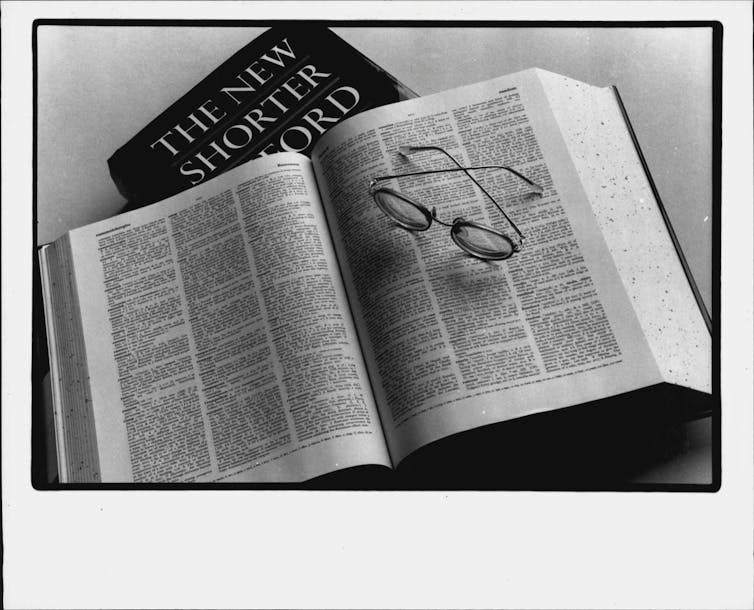
Photo by Bruce Milton Miller/Fairfax Media via Getty Images.

Kingsley Ugwuanyi, Northumbria University, Newcastle

Nigeria was recently in the spotlight when the Oxford English Dictionary announced that its January 2020 update included 29 Nigerian English words.

The reception, in both the traditional and new media, was nothing short of sensational. Most Nigerians expressed a great sense of pride in the fact that the unique ways in which they use English were being acknowledged internationally.

The Oxford English Dictionary said in the release note:

By taking ownership of English and using it as their own medium of expression, Nigerians have made, and are continuing to make, a unique and distinctive contribution to English as a global language.

Interestingly, the idea of Nigerians owning English is the fulcrum of my doctoral research. In it, I found that increasingly Nigerians are demonstrating a strong sense of ownership of the English language, and in particular their use of it.

The inclusion of Nigerian English words in the Oxford English Dictionary is, in a sense, a recognition of the tremendous efforts by scholars of Nigerian English many of whom have produced discipline-shaping research. This has included four published dictionaries of Nigerian English.

These developments indicate that Nigerian English has indeed come of age. They also validate the concentric circle model developed by Professor Braj Kachru, the father of world Englishes research. This avers that the ‘outer-circle’ varieties of English (where Nigerian English belongs) is ‘norm-developing’. In other words, that Nigerian English is adding to the norms of English.

I think the English, indeed the English-speaking world, should be thankful to Nigeria for this historic gift.

So how were the words chosen?

As the Nigerian consultant to the project which saw the inclusion of the words, I have insights into the process the team underwent in adding them. These include the rationale for adding them, and the enormous significance the inclusion holds for the English language.

How, and why, new words are added

The Oxford English Dictionary has a wide variety of resources to track the emergence of new words and new senses of already existing words.

The Oxford English Corpus is one. This is an electronic database of different types of written and spoken texts specifically designed for linguistic research. In the case of Nigerian English and other World English varieties, for instance, suggestions of new words and senses come from the corpus, reading books and magazines written in the English varieties in question as well as looking at previous studies, and the review of existing dictionaries, if any.

Once there is a list of candidates, a team of expert editors at the Oxford English Dictionary looks closely at the databases to ensure that there are several independent instances of the words being used. And how they are being used.

Other factors that are considered include the time period over which words have been used, as well as their frequency and distribution. But there’s no exact time-span and frequency threshold. Some words – such as Brexit – are relatively young but were included quickly because of the huge social impact they had in a short space of time. Others are not used frequently but are included because they are of specific cultural, historical, or linguistic significance to the community of their users. An example is ‘Kannywood’, the word describing the Nigerian Hausa-language film industry, based in the city of Kano.

It’s clear therefore that the editors don’t simply select the words or senses that appeal to them. Instead, they are guided by use, which links in with the prevailing thought in lexicography and linguistics more generally: that the remit of dictionaries and linguistic research is not to prescribe how languages should be used but to describe how languages are being used.

Words are added because the Oxford English Dictionary recognises that English is a universal language. It believes that including words from varieties of English all over the world enables it to tell a more complete story of the language.

These varieties also reflect the unique culture, history, and identity of the various communities that use English across the world. Nigerian English is a good example. Like other English varieties, it is a living ‘being’ with its own unique vocabulary, encompassing all sorts of lexical innovations. These include borrowings from local languages, new abbreviations, blends and compounds.

Failure to capture such words would deny English an opportunity to grow. It would also deny the flavour of what the speakers of these varieties contribute to the development of English.

What does it mean for English?

One of the reasons previous world languages such as Egyptian and Ancient Greek ceased to exert dominance internationally was their inability to keep pace with developments around the world.

Perhaps this is one factor that clearly distinguishes English. It has demonstrated a capacity for growth by keeping its borders open, helping it to develop from a West Germanic dialect spoken in a small island into a world language. English is now spoken by about 1.75 billion people – a quarter of the
world’s population
. This includes first and second language speakers.

One way English grows is by admitting new words and senses not just from other English varieties but from virtually all languages of the world. For instance, English has had the word ‘postpone’ since the late 15th century, but it was through India that its opposite ‘prepone’ entered English in current use during the 20th century.

Similarly, Nigerian English is reintroducing the verb meaning of ‘barb’, which existed in 16th century British English.

This is how English maintains its dominance. In addition, the Internet has given today’s Oxford English Dictionary editors wider access to non-traditional sources of linguistic evidence. This has enabled them to widen and improve the dictionary’s coverage of world varieties of English, affirming Oxford English Dictionary’s claim as “the definitive record of the English language”.The Conversation

Kingsley Ugwuanyi, Lecturer/Doctoral Researcher, Northumbria University, Newcastle

This article is republished from The Conversation under a Creative Commons license. Read the original article.
Unknown's avatar

Nigerian writers compare genocide of Igbos to the Holocaust


File 20190208 174864 ldpkgf.jpg?ixlib=rb 1.1
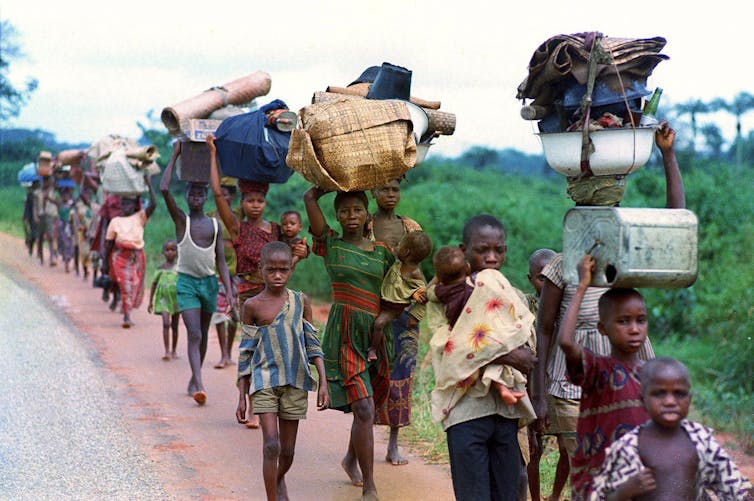
Biafran refugees flee federal Nigerian troops on a road near Ogbaku, Nigeria in this 1968 photo. Between one and three million people are estimated to have died.
(AP Photo/Kurt Strumpf)

Chigbo Arthur Anyaduba, University of Winnipeg

During the massacre of Igbos in Nigeria between 1966 and 1970, one to three million people died. In the decades since, writers have worked to make sense of the immense human tragedy.

These literary representations of the massacres use the Holocaust as an important point of reference.

The war in Nigeria, with its associated mass atrocities, is arguably one of the first major moments in postcolonial Africa when accusations of genocide were made. Following military coups in Nigeria in 1966, the military and ethnic extremists systematically targeted and killed Igbos across the then Northern and Western regions of Nigeria.

Massacres of Igbos and other Easterners across the country led to thousands of deaths and the displacement of millions.

The massacres led the Eastern Region of Nigeria to declare its secession from Nigeria. The region was renamed the republic of Biafra. Nigeria invaded Biafra in July 1967, leading to a protracted war. The federal government used starvation tactics which led to upwards of three million civilian deaths in Biafra. Biafra officially surrendered to Nigeria in January 1970.

After its genocidal war, the Nigerian government proceeded to engineer a culture of denial.

To counter that propaganda, writers reflecting on that past have often framed the war as genocide. A common feature in the writings is the comparison of Igbo experiences of atrocities to Jewish ones during the Holocaust.

The Holocaust as cultural icon of genocide

During the Biafran War, U.S.-based Igbo poet, Onwuchekwa Jemie, compared the murder of Igbos in Nigeria to the Nazi German murder of Jews during the Second World War. His poem, “Requiem” (from his 1970 poetry collection, Biafra: Requiem for the Dead in War) reflects this:

Once in 53 
Three times in 66 
Nigerians shoot civilians
through the ears
rehearsing all known tortures
murdering all males
and raping old women
forcing teenage girls in leper clinics
hundreds butchered…
the 30,000 innocents
mowed down Nazi fashion
a final solution
that failed again. 

In “Requiem,” Jemie catalogues the systematic persecutions and murders of Igbo civilians, which he considers similar to the Nazis’ “final solution.”

The lines “a final solution / that failed again” encapsulate the poet’s defiant view that Biafra will survive the genocidal onslaught from Nigeria.

Global history scholar Lasse Heerten has explained in his work on Biafra, that such comparisons of Igbo suffering to the Nazi genocide of Jews reveal the growing awareness of the Holocaust in African conflict zones at the time.

The comparison of Igbo suffering to the Holocaust offers a way for the writers to internationalize Igbo experience in Nigeria. In so doing, they are sharing a moral message about the universal condition of human cruelty.

The cruel human condition

Similarly, the 1971 poem “Vultures” by Chinua Achebe reflects on the troubling realization that humans possess simultaneously a capacity for human care and a vulture’s inhumane savagery. The poet imagines a Nigerian military commander as a vulture and compares him to the Commandant of the Nazis’ death camp at Belsen:

Thus the Commandant at Belsen 
Camp going home for 
the day with fumes of 
human roast clinging 
rebelliously to his hairy 
nostrils will stop 
at the wayside sweetshop 
and pick up a chocolate 
for his tender offspring 
waiting at home for Daddy’s 
return… 
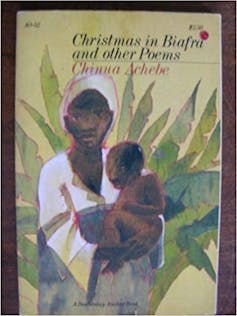
‘Christmas in Biafra and other Poems’ by Chinua Achebe was published in 1973 and includes ‘Vultures.’
Anchor Books

Achebe’s reference to the Holocaust evokes the Nazi death camps as a site of savagery: “fumes of / human roast.” He seems to be alluding to Paul Celan’s 1948 poem, “Death Fugue,” which describes the cremation of Jewish victims in the Nazi camps as a “grave in the sky.”

Reference to the Holocaust in Achebe’s poem provides a way to meditate on the ironic condition of human cruelty.

Another writer who used the Holocaust as a metaphor for moralizing about the human condition is Nobel laureate Wole Soyinka, who was jailed for his attempts to mediate between Biafra and Nigeria. His 1972 prison memoir The Man Died expresses his frustration over the unending cycles of brutality and the pattern of genocidal murders taking place in Nigeria. Soyinka’s other books, plays and poems on the 1966-1970 crisis equally draw on the Holocaust as a way to comment on cruelty.

‘And the World Has Remained Silent’

Half of a Yellow Sun.

Such comparison between Igbo suffering and the Holocaust intending to convey a moral message on human condition can be found in several other writings, including Flora Nwapa’s Never Again, Chris Abani’s Graceland (2004), Nnedi Okorafor’s fantasy novels, Who Fears Death (2010) and The Book of Phoenix (2015), and notably too in Chimamanda Ngozi Adichie’s novel, Half of a Yellow Sun (2006).

In Half of a Yellow Sun, there are several instances comparing the experiences of Igbos to those of Jews under the Nazis.

For example, the title of the character Ugwu’s story, ‘The World Was Silent When We Died,’ echoes the original Yiddish title of Elie Wiesel’s Holocaust memoir, Un di Velt Hot Geshvign, (“And the World Has Remained Silent”).

Universalize can also mean generalize

I believe these literary analogies between Jewish and Igbo experiences have helped to make the atrocities public and known. However, these analogies can also overwhelm the particulars of the Nigerian context of the crisis.

Because the political contexts of such historical mass atrocities being compared vary significantly, these comparisons may come at the cost of our understanding of genocide in African states. Both African and European historical contexts within which these atrocities occurred may become de-territorialized and depoliticized.

In the meantime, local suppression of political questions of Igbo self-determination and justice in the war’s aftermath remain unaddressed.The Conversation

Chigbo Arthur Anyaduba, Assistant Professor, University of Winnipeg

This article is republished from The Conversation under a Creative Commons license. Read the original article.