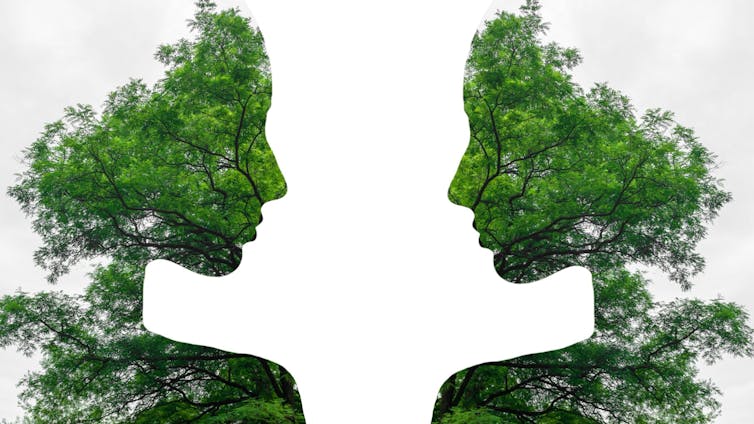
Dostoyevsky’s story ‘The Double’ explores the uncanny theme of a replica of oneself, but today’s literary foes are often amorphous ones like environmental degradation. (Shutterstock)
Beyond the viral contagion of COVID-19, the pandemic’s accompanying social and economic hardships have challenged many people’s physical and mental wellness. Over the past year of navigating living in a pandemic, it’s become clear that relationships matter to health: relationships between body and mind, between neighbours and between individuals and their societies.
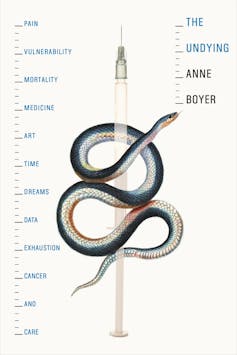
Literature was dissecting these connections long before the outbreak. Recent memoirs, non-fiction, fiction, poetry and graphic novels related to physical and mental health examine not just the fragility of individuals but how individuals relate to social and power structures like capitalism, racism or colonialism. Writers have also explored how people’s social roles and identities shape their relationships to narrative itself. As American poet and memoirist Anne Boyer writes in her Pulitzer Prize-winningmemoir, The Undying, “I do not want to tell the story of cancer in the way that I have been taught to tell it.”
For several years, I have been researching, writing about and teaching literary texts related to maladies like depression, substance abuse and cancer. I’m interested in how narratives about health published today explore the interdependence of bodies and their environments in a way that may teach us important lessons during the pandemic, and beyond it.
These health stories pit mentally ill characters against individual antagonists like husbands, mothers, doctors and nurses, or, fighting oneself as seen through the ancient literary theme of the double or dopplegänger (as in Dostoyevsky’s tale). Yet some critics have also explored how these narratives examine individuals battling formidable but intangible foes, and thus comment on social ills: For example, patriarchy in The Bell Jar
and “The Yellow Wallpaper.”
‘The Undying’ by Anne Boyer. (Farrar, Strauss and Giroux)
For instance, Boyer damns the American health-care system, with its outrageous costs and lack of guaranteed sick leave, but also capitalism as a whole. For her, like Susan Sontag, cancer infuses culture as much as human bodies, but economic pressures also cast a huge shadow.
Blending personal experience and big-picture analysis can be found in other recent health memoirs. In The Recovering: Intoxication and Its Aftermath, American writer Leslie Jamison discusses her own experiences of alcoholism as a white woman alongside the racism of the American criminal justice system. As she observes: “White addicts get their suffering witnessed. Addicts of colour get punished.”
The best-selling essay collection A Mind Spread Out on the Ground, by Tuscarora writer Alicia Elliott, examines
how systematic oppression of Indigenous communities is linked to depression.
Her settler therapist can’t understand why she’s depressed, and none of her self-help books actually help.
As one character fills out a daily wellness report, the reader may realize anyone would feel depression and anxiety in such a world.
Health among the living
Meanwhile, Fady Joudah, a Palestinian American poet and practising doctor, weighs economic inequity and a lack of sustainability in “Corona Radiata,” a poem about COVID-19 published last March. “Corona Radiata” argues that we need to understand health as contingent on relationships between humans — and between humans and other living things. Joudah suggests that:
“Far and near the virus awakens
in us a responsibility
to others who will not die
our deaths, nor we theirs,
though we might …”
He’s right, if hopeful. Until the vaccine is widely distributed, public health will depend on our ability to understand ourselves as part of an inconceivably vast network.
American novelist Richard Powers’sThe Overstory, which won the Pulitzer Prize for fiction in 2019, also unites health with responsibility. In the novel, characters challenged by physical disabilities and strokes find ways to communicate with and through nature. A scientist almost dies by suicide early in the novel before recommitting herself to loving as well as studying the trees. Environmental activism gives them purpose, even if it doesn’t heal them.
The new health literature also reminds us that our health and the planet’s are inextricably linked. In the near future, this genre is likely to increasingly address the impact of climate change on our physical and mental well-being, such as the rise in eco-anxiety. I think we’ll see a blending of literature, medicine and environmental studies more and more often.
The television premiere of Benjamin Law’s adapted memoirs The Family Law may have had us laughing last night, but a foray into the recent past of the family memoir genre reveals an ethical minefield of sibling conflicts, clashing memories, and unwanted exposés.
Benjamin Law’s memoir The Family Law (2010) has been adapted for TV. Black Inc
In response to biographies scrutinizing his marriage to Sylvia Plath, the poet Ted Hughes said, “I hope each of us owns the facts of his or her own life”. In family memoir such hopes are dashed.
When writers tell the story of their lives they also divulge the experiences of siblings, parents, and lovers. They make the private public, often with a unique spin on events and not always with the consent of those involved.
Given the intimate nature of family life these tangles are perhaps unavoidable. The facts of our lives are always shared.
But life writing still raises important ethical questions. The memoirist’s candid account of family struggles can destigmatise taboo topics – such as divorce, sexuality, and suicide – but at what cost to those whose lives are laid bare? What should come first for a writer, loyalty to the truth of their own experience or respect for the privacy of others?
These questions have troubled a series of high-profile memoirs and autobiographical novels. Writers such as Karl Ove Knausgaard, Hanif Kureishi, Lily Brett, and David Sedaris have upset family members by using personal details in their literary works.
These cases alert us to the difficulty of narrating shared life stories. How do we get to the truth when people remember the past differently and have conflicting investments in how the story is told?
But we might also see the potential social benefit of tell-all family memoirs. By representing the conflicts and silences that families live with writers can introduce more diverse and honest accounts of family life into public culture.
Whose struggle?
By the time literary sensation Karl Ove Knausgaard published the first volume in his six part autobiographical series, My Struggle (2009), several members of his family were no longer speaking to him.
Karl Ove Knausgaard’s memoir Min Kamp (My Struggle) (2009) caused serious family conflict. Forlaget okober
The Norwegian writer’s aim was to describe the banality and drama of his daily life in raw detail. Critics have hailed the result as Proust for the 21st century. Readers have said they feel as though he has written their innermost secrets onto the page. For Knausgaard’s family this is more than just a feeling. It is their reality.
Knausgaard doesn’t pull any punches. While much of the series is devoted to vivid descriptions of ordinary life, like brewing a cup of tea or going for a run, there are also details that most of us would shudder to have on the record.
Gossipy, post-dinner party conversations that he and his wife have about their guests are recounted verbatim. The rancid excrement that stains his incontinent grandmother’s couch, his father’s descent into squalor and alcoholism, the spoken and unspoken insults of his marital rows, the fumbling sexual encounters of his youth, his second wife’s struggle with bipolar, his feelings of frustration and boredom as a parent: it’s all there on the page.
Not surprisingly, when Knausgaard sent copies of the first manuscript to his family, they were unhappy. His paternal uncle tried to halt publication, threatened to sue, and attacked the book in the Norwegian press. Tonje Aursland, Knausgaard’s ex-wife, recorded a radio program about the experience of having her private life exposed in the novel, and then again in all of the media scrutiny that followed.
Knausgaard admits that the series also took a toll on his current marriage. The relentless attention caused his wife, Linda Boström, to have a breakdown, which Knausgaard details in the final episode of My Struggle.
Knausgaard made a decision to publish a tell-all book. He exposes his own struggles to be a good husband, father, writer, brother, and son with disarming candour, sometimes even to the point of self-humiliation.
But the people who share his life did not make this decision. They didn’t know that their words and actions, sometimes at very vulnerable moments, would be published let alone read by millions of people, almost half a million in Norway alone. In a country of five million, that’s roughly one in ten people who know the intimate details of your private life.
The author is well aware of his indiscretion and what it costs him and his family. “I do feel guilty,” he has said, “I do. Especially about my family, my children. I write about them and I know that this will haunt them as well through their lives”. Knausgaard also understands his father’s family’s response to the novels:
I wish this could have been done without hurting anyone. They say they never want to see or talk to me again. I accept that. I have offended them, humiliated them just by writing about this.
Familiar characters
British novelist and screenwriter Hanif Kureishi is less remorseful about using his family as source material. In 2008 his sister published a letter in the Independent titled Keep Me Out of your Novels.
Hanif Kureishi’s ex-wife accused him of writing about their marriage in Intimacy (1998). Faber and Faber
She claims that most of his works use family members as characters. These include his parents in The Buddha of Suburbia (1991), his uncle in My Beautiful Laundrette (1985), his ex-girlfriend in the film Sammy and Rosie Get Laid (1987), and an account of leaving his wife and children for a younger woman in his novel Intimacy (1998).
Yasmin Kureishi is most upset about her brother’s portrayal of her in the 2003 film The Mother. “It made excruciating viewing,” she says, “It was like he’d swallowed some of my life, then spat it back out.”
After reading Intimacy, Tracy Schoffield, Kureishi’s ex-wife, criticised him for thinly veiling the break-up of their marriage as fiction:
He says it’s a novel. But that’s an absolute abdication of responsibility. You may as well call it a fish.
In defence, Kureishi argues that by writing candidly about his life he gives voice to a collective experience:
Why would you vilify me? I’m just the messenger. I’m writing a book about divorce – an experience that many people have had – or separation, children, all that. … That book was a record of that experience.
I don’t see why I should be vilified for writing an account of it. … If you’re an artist your job is to represent the world as you see it – that’s what you do.
The same has been said of Knausgaard’s work. He disregards the privacy of his family. But he also challenges the rules of what we can and cannot say. He drags the darkness of our everyday thoughts into the light. In doing so, he de-shames social taboos, or at least offers the truth of what he thinks rather than what he should think. He sees the role of an artist as that of a social truth-teller.
But the tension around family memoirs brings into question the idea that an artist is simply documenting the truth. In some cases families are not upset that their lives are being represented so much as that the representation is, to them, inaccurate.
That’s not what I remember…
Can the memory of one person capture the true complexity of social events? What happens when people recall things differently? Kureishi’s sister and mother insist that he is not simply a messenger. His descriptions of his roots support the identity he desires in the present. Yasmin Kureishi, for example, recollects a very different image of her father than the one her brother paints in The Buddha of Suburbia.
Doris Brett wrote Eating the Underworld (2001) to tell her own version of her childhood. Vintage
In the radio documentary Knausgaard’s ex-wife recorded in 2010, Tonje’s Version, she says what annoys her is that her memories will always be secondary to his work of art. People assume they know the truth of what happened in her life because they have read My Struggle.
Doris Brett was so opposed to her sister Lily Brett’s autobiographical renderings of their childhood that she published her own counter-story. Lily Brett has written novels and essays based on her experience of growing up in Melbourne as the daughter of Holocaust survivors.
In Eating the Underworld (2001), Doris claims that her sister wrongly depicts their mother as depressed and sometimes cruel. Doris doesn’t recall her mother screaming in the night. The two sisters seem to remember their mother as two very different women.
When Lily Brett and her father received copies of Eating the Underworld, Lily issued a statement:
There are some things not worth replying to. This book is one of them.
This book by my daughter Doris, is a book of madness. … I recognise very little of our family life in this book.
Doris Brett chalked their public response up as further evidence of the bullying and favouritism she describes in her book.
For Yasmin Kureishi, Tonje Aursland, and Doris Brett the issue is not simply about privacy. They are all willing to tell their own stories in the public eye. Rather they want their life represented accurately, as they remember it. They insist that there is more to the shared story of their family than what is seen through the quixotic eyes of the memoirist. But of course the same question of memory’s unreliability also applies to them.
Tangled lives
With tongue in cheek, David Sedaris addresses the blurring of memory and imagination by describing his family memoirs as “realish”. Sedaris has forged a successful career by recounting the foibles of his family life in best-selling collections such as Dress Your Family in Corduroy and Denim (2004).
David Sedaris’ book Dress Your Family in Corduroy and Denim (2004) was the first his sister Tiffany allowed him to include her in. Little Brown & Co.
Along the way, his sister, Tiffany, requested to be left out of his stories. In a 2004 interview with the Boston Globe, she said “I was the only [sibling] who told him not to put me in his books. I don’t trust David to have boundaries”. Like Aursland, she became upset by the consequences of the stories. People read them as fact, and an invitation to discuss her private life.
In 2014, Sedaris came under fire for an essay he published in the New Yorker, Now We Are Five. The essay describes the Sedaris family’s attempt to deal with their grief over Tiffany’s suicide.
A friend of Tiffany, Michael Knoblach, published a letter in the Somerville Journal accusing Sedaris of ignoring her request not to be a subject in his stories and exploiting her death for artistic and monetary gain. (The letter has since been taken down, but a similar version is reposted in the comments here).
Should Sedaris have published Now We Are Five after his sister’s death? Some may argue that he should have respected her request not to be represented in his stories. On the other hand, the story is also about her parents, and her siblings. It speaks candidly about grief, guilt, and the way death jolts us into reality. Even when faced with estrangement and loss, the life of the family remains intertwined.
The Family Law
Australia’s own David Sedaris, Benjamin Law, has written a memoir about growing up in a large Chinese-Australian family in 1990s Queensland. The Family Law (2010) was adapted for television and premiered on SBS yesterday. Law’s memoir offers a funny take on the everyday quirks of family life, but it also deals with sensitive issues such as his parents’ divorce.
The Family Law is unlikely to draw the kind of scandal that greeted Kureishi or Knausgaard. In a recent keynote at the Asia Pacific Auto/Biography Association’s Conference, Law noted that when he gave his family the manuscript to read before publication, they were mostly concerned with correcting his grammar. Law’s father insisted that audiences are smart enough to know the story is told from only one point of view, and with comedic license.
Law may win our hearts with the help of his siblings. They weren’t to know their teenage travails would be re-staged on national television. It might also be strange for his parents to hear the public weighing in on their divorce. But Law’s story will be a welcome addition to a television landscape that currently doesn’t come close to representing the diversity and richness of Australian families.
Social secrets
In her research about family secrets, sociologist Carol Smart talks about two kinds of families: families “we live with” and families “we live by”. Families we live with are our actual families, which may be ridden with tensions. Families we live by are the ideal versions of happy, cohesive families that Smart says we draw from popular culture.
We tell family secrets, Smart thinks, to bring the reality closer to the ideal. We edit certain experiences from the public eye so our family fits with dominant ideas about what a family should be.
In this context, to reveal a family secret might be to refuse pressures to pretend. To disclose conflicts within families can open up a space to talk honestly about family life, to question social norms, and acknowledge different kinds of relationships. It can be a way of bringing the ideal closer to the reality.
Revealing family secrets can be insensitive and ethically dubious when the teller is not the only one who has to live with the repercussions. But it can also be a way to rethink the reasons why we keep certain things secret in the first place.
For family memoirists, where is the line between rattling social proprieties and respecting others’ privacy? This is not an easy question to answer. And the answer would be different in each case.
But it is worth remembering that the true stories that enrich our public sphere are often drawn from the intimate and shared lives of their authors. It is not only Law who gives generously of his life to bring a new story to Australian viewers this week, but also the supporting cast, his family.
Or that we’re fascinated by the personalities, policies and procedures that shape our political landscape. But are we really, and if not, why so many books?
The deluge shows no signs of abating, with a similar number of titles expected this year. Already we’ve seen the release of Shadow Minister Chris Bowen’s The Money Men, reflections by Federal Labour members Mark Butler and Andrew Leigh, with former Victorian Labour leader John Brumby’s practical “lessons”, The Long Haul, in press.
Liberals, once laggards in this genre, are stepping up in growing numbers. Federal Minister Christopher Pyne’s “hilarious”A Letter To My Children is out, and Peter Reith’s The Reith Papers is underway. Also in press is the genuinely unauthorised Born to Rule: the Unauthorised Biography of Malcolm Turnbull.
First nurtured by John Iremonger of Hale & Iremonger, Melbourne University Press now leads the way with the genre. MUP Director, Louise Adler, is notorious for her enthusiasm and her efforts to contract politicians of all parties and persuasions. But even Adler has reservations, writing in September’s Meanjin that “the political memoir is unabashedly myopic, subjective and reflexively partisan”.
Tony Abbott, then Federal Oppositon MP, signs copies of his book during the launch Battlelines in Sydney in 2009. Dean Lewins/AAP, CC BY-ND
One argument for the proliferation of political memoirs is that they enable the public to engage with politicians outside the frenzy of the 24/7 news cycle. Certainly the popularity of Annabel Crabb’s ABC show Kitchen Cabinet suggests there’s some weight to this “getting to know the person beyond the sound-bite” theory.
Some argue the 24-hour media cycle has debased politics to such a degree that voters are searching for a depth of focus missing from parliament and mainstream media coverage and finding it through other channels.
Based on the sales figures, a publisher can safely bet that an Australian political memoir or biography is likely to pay its own way, at the very least. Even the slow ones mostly sell more than a few thousand copies.
But do sales say anything meaningful about these books’ impact on our political process or cultural debate? And how to measure the impact of the political memoir on democratic process?
The genre has been trending for a few years now, propelled in no small part by the success of Bob Hawke’s The Hawke Memoirs (1994) which sold 75,000 copies, and John Howard’s Lazarus Rising (2011), which sold upwards of 100,000.
As far back as 2007, David Marr in his analysis of John Howard’s prime ministership, His Master’s Voice: the corruption of public debate under Howard, despaired of the increase in public “chatter” and the sabotage of free speech. Paradoxically, it was during this period, and subsequently, that political memoirs and biographies increased in number.
Thanks to the introduction of Nielsen BookScan in 2002 and its collection of reliable national book sales figures, metrical research into the book industry and reading patterns is now possible.
But what readers make of the content of these books, and how they contribute to Australian culture, is difficult to accurately discern.
Dr Jan Zwar conducted a close analysis of a range of narrative nonfiction books and their contribution to cultural debate during the Howard years 2003-2008. In an essay for the Journal of the Association for the Study of Australian Literature she observed that “experiences of the actual readers remain a mystery behind the wall of data”.
Former Prime Minister Julia Gillard launching her book My Story in Sydney, 2014. Dean Lewins/AAP
Other forms of media mediate the relationship between the memoir, its author and the wider readership. Syndicated publication of extracts, the author’s appearances through radio, television, online and print media to discuss the book, and appearances at writers festivals and festivals of ideas are all channels key to ensuring the possibility of the memoir’s broader ideas being promulgated.
Former PM, Julia Gillard, by way of example, has appeared at half a dozen writers festivals in Australia and New Zealand alongside her memoir, My Story (2015), although no one I spoke to nominated the memoir as being influential or contributing to the debate. Yet, with large live audiences, Gillard clearly is contributing.
The memoir is the prop for the event, and contributes to an already existing discussion of broader “Gillard” topics such as women in politics and education reform.
Similarly, Anna Bligh, former Premier of Queensland, speaking on the ABC program Q&A in August, firmly linked her memoir, Through the Wall: Reflections on Leadership, Love and Survival (2015), to her key message of encouragement to young women to pursue a career in politics, and not to be fearful of the walls “built of the solid bricks of prejudice” (to quote from the book).
The Latham Diaries by former federal opposition leader Mark Latham go on sale in Sydney in 2005. Mick Tsikas/AAP
Mark Latham’s Latham’s Diaries, originally published in 2005, eclipses all other political memoirs and autobiographies in my research for impact, in terms of readers recalling and engaging with its dissection of the Labor Party in the post-Keating years, the Australian political system more broadly, and its insistence that there ought to be serious debate about political philosophy.
Whatever one may think of Latham today, this memoir has contributed to debate and critiques of Australian democratic process in the new century. Natalie Mast recently argued on The Conversation that, ten years on from its publication, “the flaws in our political system that Latham highlighted continue to affect us”.
It is both the specialist and the general reader that the politicians are appealing to, with general readers contributing the bulk of sales, and thus the economic viability of the genre. But it is the political analysts and historians, journalists, lobbyists, festival directors, politicians and would-be politicians who are the most critical readers of these books and who enable a memoir’s impact.
Laura Tingle, the Australian Financial Review’s political editor, has possibly read them all. According to Tingle, the “young things” in the current caucus are “hoovering up” Gareth Evans’ Inside the Hawke–Keating Government: A Cabinet Diary (2014) to gain an understanding of how the government worked.
Knowing what happened is not of course equivalent to energetic debate and discourse, but it is a starting point.
Ex-Foreign Minister Bob Carr signs his Diary of a Foreign Minister in Sydney in 2014. Jesse Matheson/AAP
Tingle nominated three other books of influence from recent years. Tony Abbott’s Battlelines (2013) continues to “reverberate” as readers realise it has not clarified Abbott’s beliefs, but just added to the mix. Malcolm Fraser’s Dangerous Allies (2014), which followed on from his Political Memoirs, is having impact because of the quality of its insights and argument, though strictly speaking it is not a memoir.
Tingle also nominates Bob Carr’s Diary of a Foreign Minister (2014), despite it blowing up across social media over Carr’s love of activated almonds and other personal nonsense about his abs and pyjamas. But from Tingle’s perspective, Carr’s diary holds value for its uniquely positioned observations of the Gillard cabinet.
You effectively had an outsider/ journalist reporting on what he saw in a government that was crumbling. For that reason, I think it is going to be an on-going source for many years on what happened in the Gillard period.
Margaret Simons, Director of the Centre for Advanced Journalism and co-author of Malcolm Fraser: The Political Memoirs, pointed to other works as influential, but again, they’re not wholly memoirs, nor all recent: suggesting the genre does indeed have limitations.




 At the BookShelf