Unknown's avatar

How a lost manuscript revealed the first poets of Italian literature


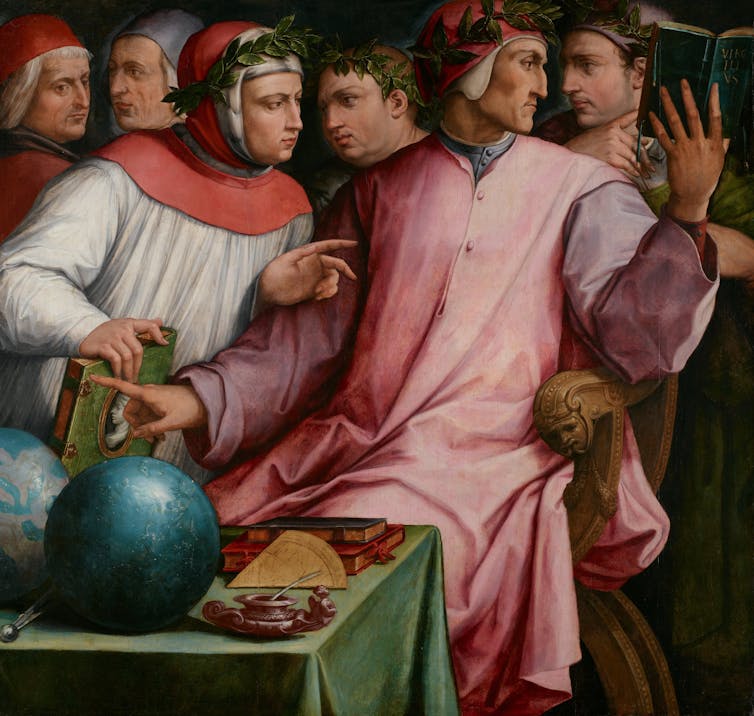
Six Tuscan Poets by Giorgio Vasari, 1544. Dante Alighieri,
Giovanni Boccaccio, Petrarch, Cino da Pistoia, Guittone d’Arezzo and Guido Cavalcanti are depicted in the oil painting.
Wikimedia/MIA

Maria Clotilde Camboni, University of Oxford

Imagine a world where we knew the name of Homer, but the poetry of The Odyssey was lost to us. That was the world of the early Italian Renaissance during the second half of the 15th century.

Many people knew the names of some early poets of Italian literature – those who were active during the 13th century. But they could not read their poems because they had not been printed and were not circulating in manuscripts.

Then, in around 1477 the de facto sovereign of Florence, Lorenzo de’ Medici – “the Magnificent” – commissioned the creation of an anthology of rare early Italian poetry to be sent to Federico d’Aragona, son of the king of Naples.

The luxurious manuscript became one of Federico’s most prized possessions. It was exhibited to and coveted by patricians and intellectuals for half a century – until its disappearance in the early 16th century.
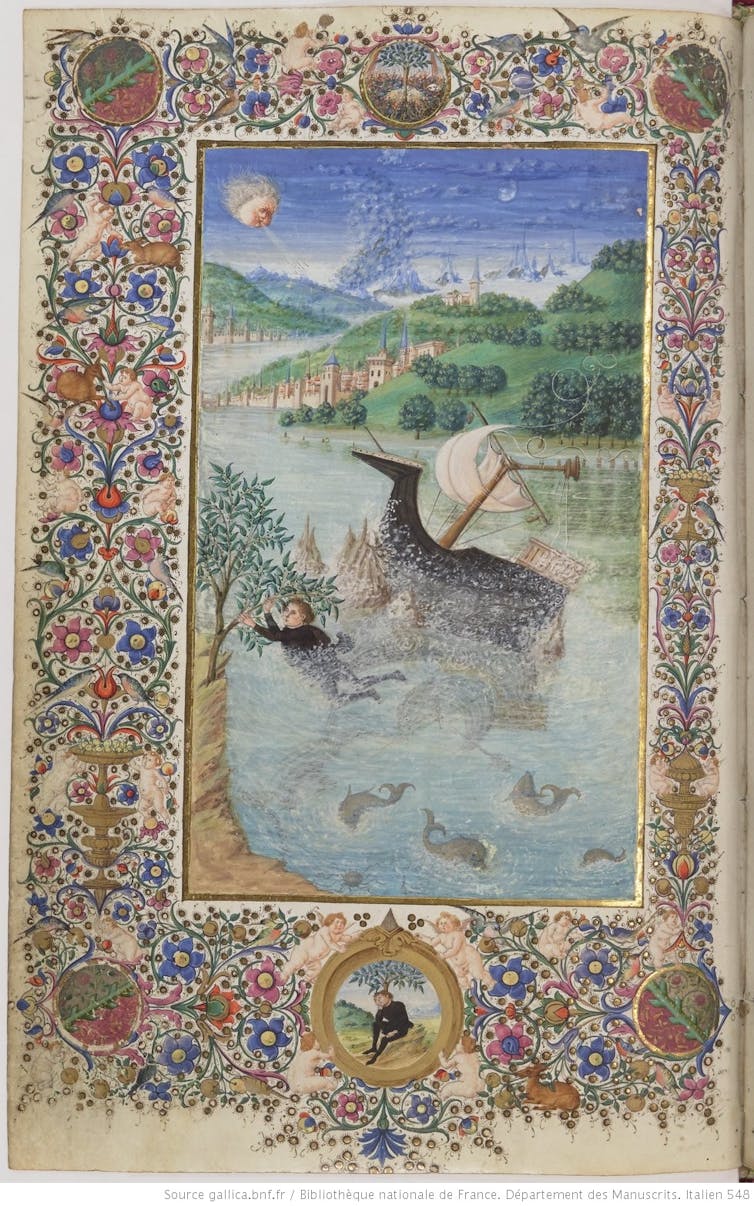
An ornate colour photograph of a manuscript from 1476.
A page from another manuscript of vernacular poetry commissioned by Lorenzo the Magnificent in 1476.
Gallica/Bibliothèque nationale de France

But it did not disappear completely. The interest aroused by this manuscript generated a paper trail of letters, partial copies and other materials which I, along with other researchers, have managed to piece together. These documents allow us to reconstruct not only the trajectory of the manuscript through different courts in Europe, but – crucially – what works it may have contained.

Who were the vernacular poets?

Vernacular literature – that is, literature written in the language normally spoken by the people – only had a marginal role during the Middle Ages and early Renaissance. The “real” culture was Latin. This meant that interest in the early poets who wrote in the Italian vernacular was limited – until the flourishing of the Italian language in the age of Lorenzo de’ Medici.

One of these 13th-century poets, Cino da Pistoia, was loved and celebrated by Dante Alighieri in his treatise on the art of poetry, “De vulgari eloquentia”. Dante said of his contemporary Cino:

There are a few, I feel, who have understood the excellence of the vernacular: these include Guido, Lapo … and Cino, from Pistoia, whom I place unworthily here at the end, moved by a consideration that is far from unworthy.
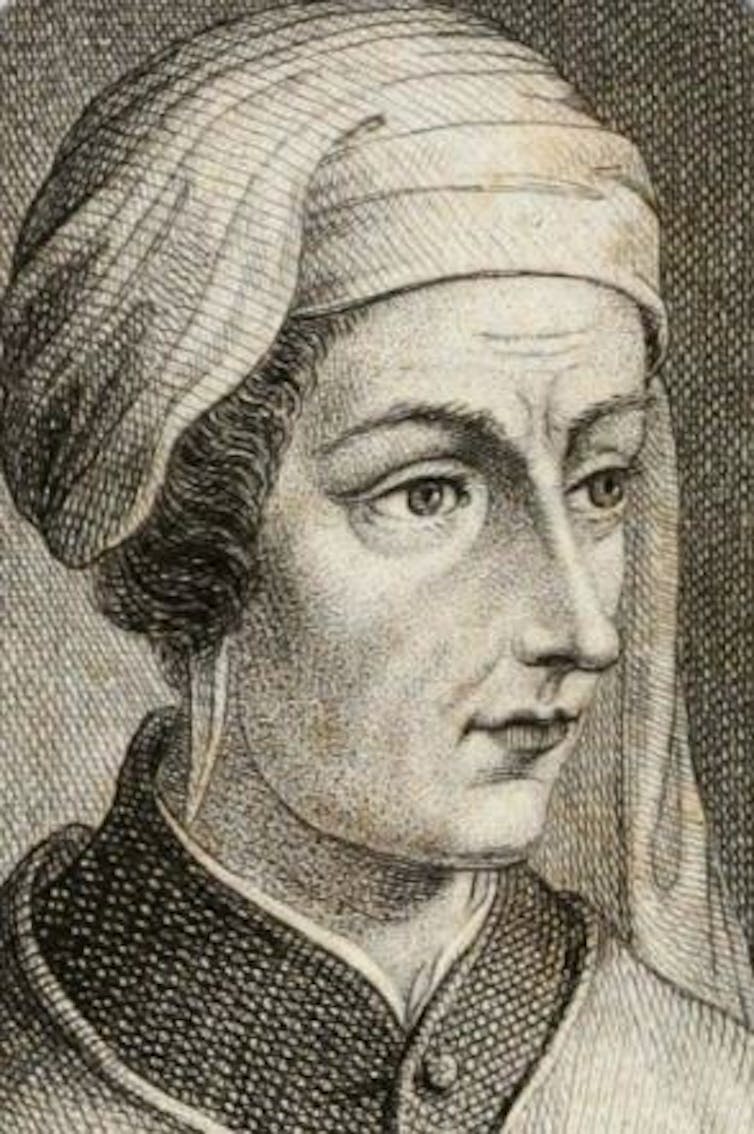
A black and white portrait of Cino.
A drawing of Cino da Pistoia from the 1808 book, Memorie della vita de Messer Cino da Pistoja by Sebastiano Ciampi.
Britannica.com

Guido Cavalcanti was another love poet. He and Dante were best friends and Dante regarded Cavalcanti as an authority on poetry. Cavalcanti is mentioned in Dante’s early poetry collection, the Vita nova.

The whole work is addressed to Cavalcanti and Dante even implies that he is writing in Italian because of him. But despite Dante’s popularity, even the Vita nova was hard to get hold of before 1576 when it was printed for the first time.

Guittone d’Arezzo was another highly regarded poet. He started as a love poet before becoming the most important author (before Dante) writing on moral and political themes.

The Raccolta Aragonese

The collection of Tuscan poetry sent to Federico d’Aragona by Lorenzo de’ Medici in 1477 contained Dante’s Vita nova, as well as rare poems recovered from ancient manuscripts by Cino, Guittone, Cavalcanti and many others. The collection was opened by a letter signed by Lorenzo himself.

The manuscript was later named after its owner and became the Raccolta Aragonese (“the Aragon collection”). It became one of Federico’s most prized possessions and the object of widespread interest and curiosity.

Federico took it with him when he travelled to Rome at the end of 1492 to swear allegiance to the Borgia Pope Alexander VI. During this trip, he showed it to the scholar Paolo Cortesi, who immediately wrote to Piero de’ Medici – the son of the recently deceased Lorenzo the Magnificent. In this letter, Cortesi recounts that he had been shown a manuscript with poems by early vernacular poets, chiefly Cino and Guittone. The excitement is palpable: Cortesi is able to read poems by these authors whose names he had only ever heard mentioned before.
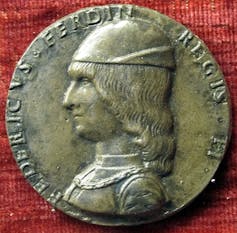
A coin bearing the image of Federico d'Aragona
King Federico of Naples (1451-1504) portrayed on a Francesco di Giorgio medal.
Wikimedia, CC BY-SA

Such was the interest in these lost poets that partial copies of the Raccolta started to circulate. The first one was probably made by someone in Federico’s inner circle before he became King of Naples in 1496. News about his collection of rare early Italian poems was spreading.

The widow queen and the duchess

Federico was the last sovereign of his dynasty. He lost his throne when Louis XII of France invaded Italy. When he left Naples in the summer of 1501, Federico took the books of the royal library with him. He later had to sell part of them to sustain himself and his followers during his exile in France. But the Raccolta Aragonese was not sold and after his death in 1504 it was passed on to his widow, Isabella del Balzo.
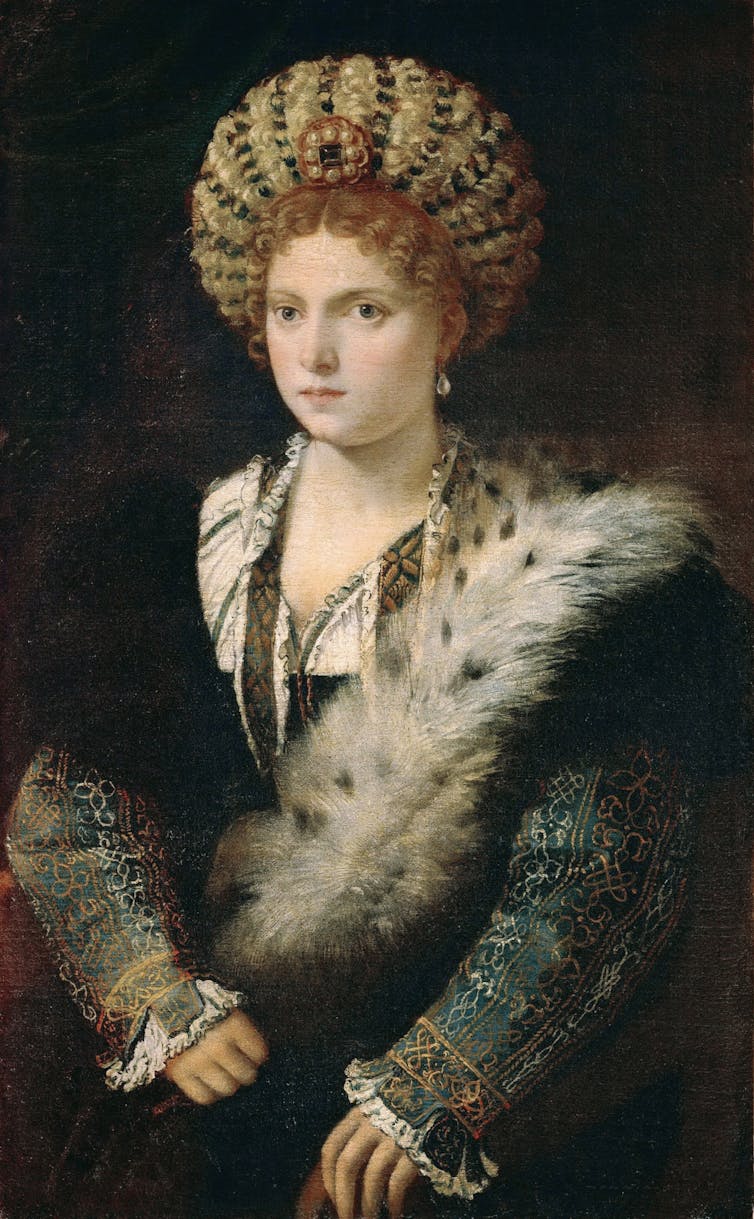
An oil painting of Isabella d'Este
Portrait of Isabella d’Este by Titian (circa 1534-1536).
Wikimedia/KunsthistorischesMuseum

The widow queen then lent the collection to Isabella d’Este, the Duchess of Mantua, in northern Italy, in 1512. She kept it for two months and, even though in her letters she promised not to leave it in other people’s hands, it is likely that she commissioned a complete copy which led to further partial copies being made.

Even though the transmission of these copies was in manuscript form – and so not widespread – several Renaissance intellectuals managed to read these “lost” works and were influenced by them in their attempts to reconstruct the history of Italian literature.

The real game-changer came in 1527 when a printed collection of vernacular poetry finally took the works of masters like Cino, Guittone and Cavalcanti to a much wider audience. This is when they stopped being obscure and arcane authors and finally took their place in the canon of Italian literature.The Conversation

Maria Clotilde Camboni, , University of Oxford

This article is republished from The Conversation under a Creative Commons license. Read the original article.

Unknown's avatar

The Gandhara Scroll


The link below is to an article reporting on the Gandhara Scroll, an historically important Buddhist manuscript, that has been made available online.

For more visit:
http://www.openculture.com/2020/08/one-of-the-oldest-buddhist-manuscripts-has-been-digitized-put-online.html

Unknown's avatar

How two women pulled off a medieval manuscript heist in post-war Germany


Two manuscripts of the visionary, writer and composer St. Hildegard of Bingen (1098-1179) survived the Dresden bombings after a librarian stashed them in a bank vault.
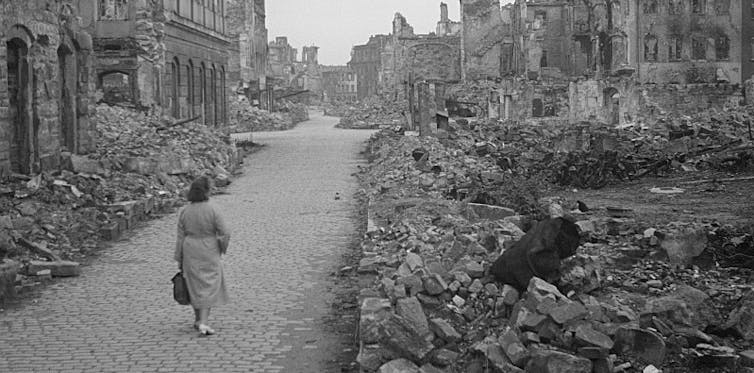
(Avraham Pisarek/Deutsche Fotothek/Wikimedia), CC BY-SA

Jennifer Bain, Dalhousie University

Seventy-five years ago, in February 1945, during the Second World War, Allied forces bombed the magnificent baroque city of Dresden, Germany, destroying most of it and killing thousands of civilians.

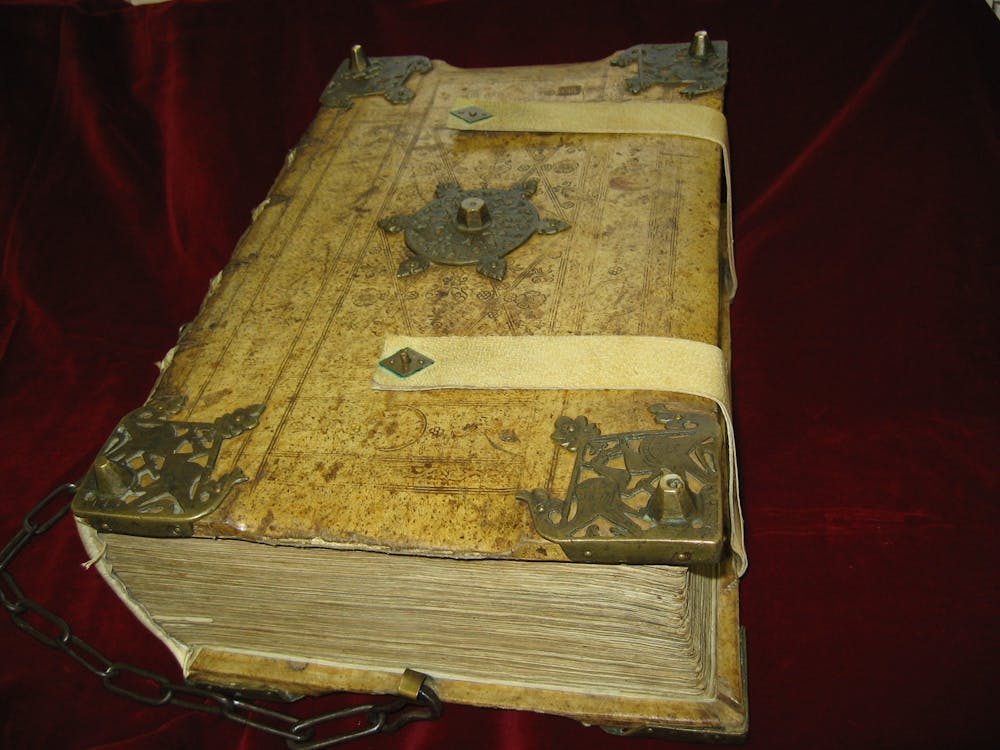
In central Dresden, however, a bank vault holding two precious medieval manuscripts survived the resulting inferno unscathed. The manuscripts were the works of the prolific 12th-century composer, writer and visionary, St. Hildegard of Bingen (1098-1179), who had established a convent on the Rhine River, near Wiesbaden and 500 kilometres west of Dresden.

Hildegard Abbey, near Wiesbaden, Germany.
(Kate Helsen), Author provided

Hildegard, whose writings documented her religious visions, including a theology of the feminine and an ecological consciousness, and who practised medicinal herbology, was venerated locally as a saint for centuries. The Catholic Church only recently recognized her as one, and also designated her a Doctor of the Church.

After the Dresden bombings, the Soviet Army seized and inspected the surviving vault. The first bank official to enter the vault afterwards found it pillaged, with only one manuscript remaining. The bank could never confirm if the vault was emptied in an official capacity or if it was plundered.

The missing manuscript has not been seen in the West since. The other made its way back to its original home of Wiesbaden, on the other side of Germany, through the extraordinary efforts of two women.

This is the story of how those women conspired to return the manuscript home.

The librarian

In 1942, Gustav Struck, the director of the state library in Wiesbaden, became worried about local air raids. Following many European institutions, he decided that his library’s manuscripts needed to be sent elsewhere for safe keeping.

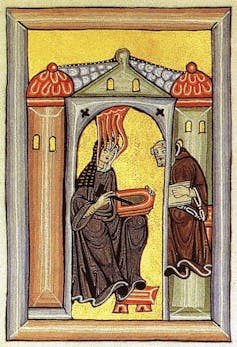
Hildegard receiving visions, a reproduction of an image from the ‘Scivias’ manuscript.
(Wikimedia/Miniatur aus dem Rupertsberger Codex des Liber Scivias)

Two of the library’s most valuable possessions were manuscripts of Hildegard’s works. One was a beautifully illuminated copy of Scivias, a collection of 26 religious visions. The other manuscript, known as the Riesencodex, is the most complete compilation of her works, including the visionary writings, letters and the largest known collection of her music.

Why Struck chose to store the manuscripts in a bank vault in Dresden is still a mystery, but their journey there by train and streetcar mid-war is thoroughly documented.

The manuscripts sat in the bank vault for three years until the attack on Dresden.

After the war

Immediately after the war, the Americans sacked Struck in their denazification efforts. Librarian Franz Götting took over his job.

Götting inquired about the manuscripts as soon as mail service to Dresden resumed, and learned that the Scivias manuscript was missing, either seized or plundered, but that the bank still had the Riesencodex.

Götting asked repeatedly for the Riesencodex to be returned from Dresden to Wiesbaden. The difficulty was that Dresden was in the newly formed Soviet zone, while Wiesbaden was in the American zone. (The Allies had divided Germany into four occupation zones, and similarly divided Germany’s capital city, Berlin, into four sectors.) The Soviets had issued a decree stating that all property found in German territory occupied by the Red Army now belonged to them.

Hildegard’s composition ‘O Most Noble Greenness.’

The plan

A scholar and medievalist in Berlin, however, came up with a scheme to retrieve the manuscript. Margarethe Kühn, a devout Catholic who expressed a great love for Hildegard, held a position as a researcher and editor with the Monumenta Germaniae Historica project. After the war she found herself living in the American sector of Berlin and working in the Soviet sector.

Photograph of the 12th-century ‘Risencodex’ manuscript.
(Wikimedia/Landesbibliothek Wiesbaden), CC BY

Kühn had stayed at the Hildegard Abbey for several days in March 1947 and had even explored joining the Abbey as a nun herself. She must have heard while she was there that the Riesencodex was being held in Dresden without any promise of return. She devised a plan to help.

Kühn asked Götting for permission to borrow the manuscript for study purposes. Götting asked the Soviet-run Ministry for Education, University and Science in Dresden on Kühn’s behalf. Much to the librarian’s surprise, ministry officials agreed to send the manuscript for Kühn to examine at the German Academy, a national research institute established in 1946 in Berlin by the Soviet administration.

Kühn was convinced that the bureaucrats in Dresden would not recognize the Riesencodex. She decided that when returning the manuscript, with help from the Wiesbaden librarian, Götting, she would send a substitute manuscript to Dresden, and the original to Wiesbaden.

The crossing

Kühn enacted the plan with the help of an American woman, Caroline Walsh.

How exactly Kühn and Walsh met is not known, but Caroline’s husband Robert Walsh was in the American air force and was stationed in Berlin as the director of intelligence for the European command from 1947-48.

In an interview in 1984, Robert explained that when he and Caroline were in Berlin she had “worked a great deal with the Germans and with the religious outfits over there, too.” Since the Walshes were also Catholic, it is likely that they and Kühn met through Catholic circles in the city.

Caroline’s position as the wife of a high-ranking military officer may have made it easier for her to travel across military occupation zones and sectors.

In any case, we know that Caroline travelled by train and car and delivered the manuscript in person to the Hildegard Abbey in Eibingen on March 11, 1948. The nuns notified Götting at the Wiesbaden library and returned the manuscript.

The swap

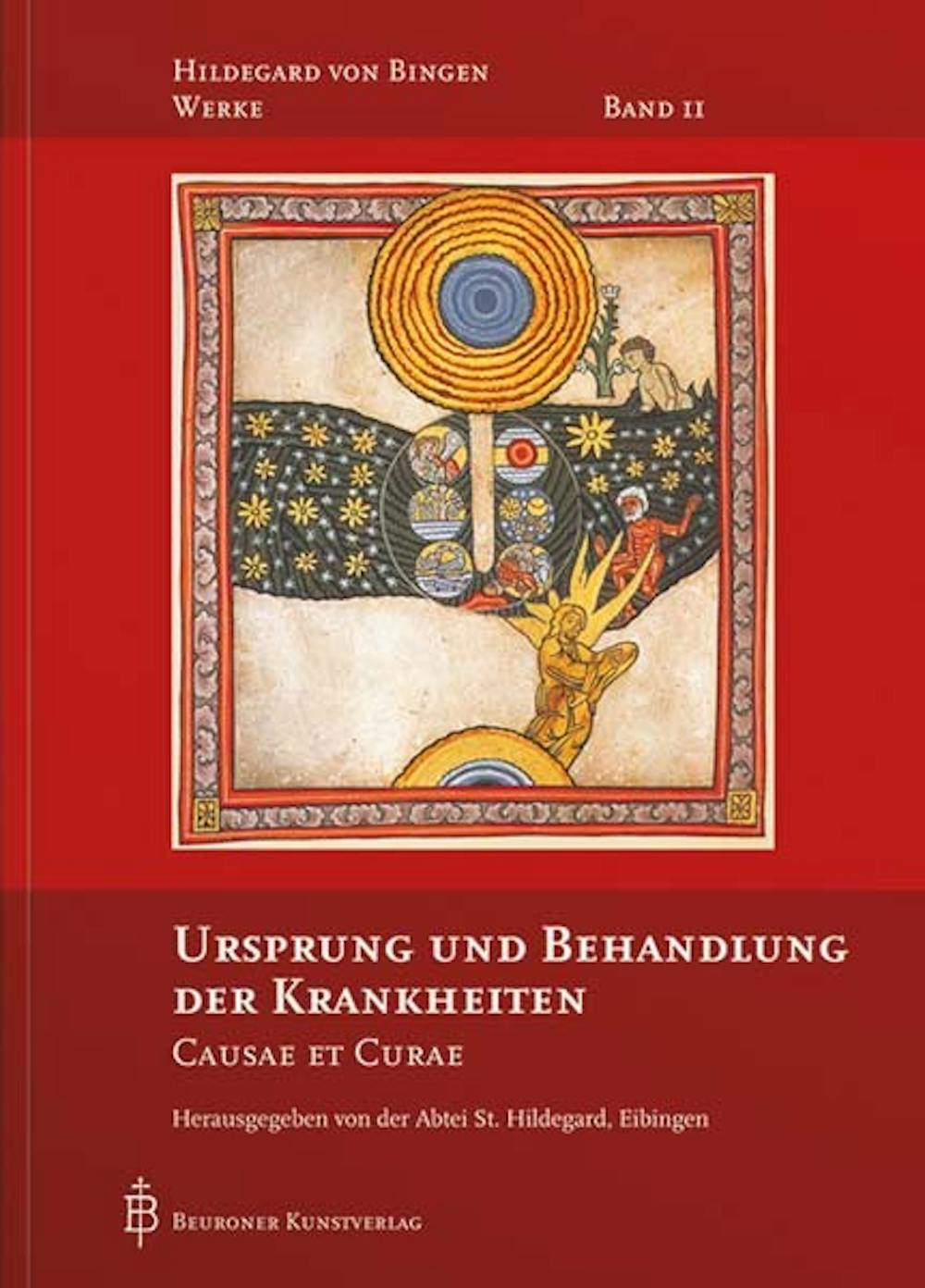
A Scivias illumination on an edition of Hildegard’s medical works.
Beuroner Kunstverlag

Götting, meanwhile, had not found a suitably sized manuscript to stand in for the large Riesencodex to trick the Soviets. He instead selected a 15th-century printed book of a similar size and had sent this to Kühn in Berlin.

It took some time for Kühn to deliver it to the Ministry for Education, University and Science in Dresden, and two further months before anyone there opened the package in January 1950. By that time, Hildegard’s manuscript was safely in Wiesbaden. But officials spotted the deception and Kühn was in trouble.

An official in Dresden wrote to the German Academy in Berlin demanding to know why they had been sent a printed book rather than the Riesencodex manuscript.

Kühn’s boss, Fritz Rörig, who received the letter was furious with her. Rörig and Götting smoothed things over with Dresden by offering another manuscript in exchange. But Rörig told Kühn that the East German police were inquiring about her, the implication being that he had reported her.

One still missing

Although she remained deeply worried for some time afterwards, Kühn never lost her job at the Monumenta nor was she arrested, despite Rörig’s threats. For the rest of her life she maintained a rare cross-border existence, living on Soviet wages in the American sector while continuing at the same job until her death in 1986, at the age of 92.

As one of many scholars who regularly consults the Riesencodex, now available online, I am enormously grateful to Caroline Walsh, and particularly to Kühn who risked her livelihood for the sake of a book.

I am not alone, however, in hoping that during my lifetime someone, somewhere will find the pilfered Scivias manuscript and return it as well.The Conversation

Jennifer Bain, Professor of Musicology and Music Theory, Dalhousie University

This article is republished from The Conversation under a Creative Commons license. Read the original article.
Unknown's avatar

Grolier Codex ruled genuine: what the oldest manuscript to survive Spanish conquest reveals


Elizabeth Graham, UCL

The Maya were, at their height, one of the world’s great civilisations. In the “classic” period, from AD 250–900, Maya cities with monumental architecture and huge populations spread across a large area through what is now Mexico, Belize, Guatemala and western Honduras. Extensive trade networks connected the Maya to the rest of Mesoamerica, producing the dynamic landscapes and bustling ports reported in early Spanish accounts.

Much of what we know of the Maya comes from codices – screenfold books made of paper from the bark of a fig tree. Pages were coated in a white stucco wash and then painted by scribes with text, which was often accompanied by images. The Spanish in the 16th century reported a flourishing manuscript tradition comprising histories, prophecies, songs, genealogies and detailed information on the movements of the heavenly bodies.

Of the thousands of books produced throughout the Mayas’ long history, however, only three Maya codices were known to have survived, all written in the “postclassic” period after AD 900 and brought to Europe sometime after the conquest. They are named after the cities where they were archived: Dresden, Madrid, and Paris. Now, after years of debate over its authenticity, we can add a fourth manuscript – the Grolier Codex.

The last Maya codices

Information in the surviving codices is presented as either tables or almanacs. Tables record historical events in the absolute calendar system used by the Maya, known as the Long Count, in which time is reckoned after a fixed date. Our Gregorian calendar reckons similarly in that years are counted after the birth of Christ. The Maya counted from a day which in the Gregorian calendar is August 11, 3114 BC. Almanacs on the other hand are organised around the 260-day calendar used throughout Mesoamerica for keeping track of named days for various events. Unlike the Long Count, this 260-day calendar is cyclical, like our own repeated cycles of named weekdays and months.

Of the surviving codices, the Dresden is the most finely executed and best preserved, containing astronomical tables as well as almanacs. Some scholars have speculated that the Dresden was in the spoils of conquest sent by Cortes to Charles V, Emperor of the Holy Roman Empire. About eight inches high and 11 feet long when unfolded, some of the Dresden’s content is believed to have been copied from Late Classic sources, but most of it seems to have been written just before the Spanish conquest.

Six sheets of the Dresden Codex, showing the sequence of eclipses, multiplication tables and the flood.
SLUB

At 56 pages, the Madrid Codex is the longest of the surviving manuscripts. It is believed to have been written in the Yucatan region of Mexico or perhaps by Yucatec speakers living in Guatemala in the 17th century. The Madrid Codex contains about 250 almanacs concerned with a range of activities related to agriculture, rituals associated with the coming of the rains and the rain deity Chaak, the cycle of the solar year, deer hunting and trapping, the killing of war captives, carving images of the gods, and beekeeping.

The Paris Codex contains histories that have so far eluded translation, but also includes pages devoted to deities, dates, and unique set of pages devoted to constellations. Its origins are unknown, but scholars agree that the book was in use at the time of the conquest and was very likely produced in Mayapan in Mexico, around AD 1450.

A new survivor

A page from the Grolier codex.
Justin Kerr/www.mayavase.com

The fourth codex came to light in 1971, when the Grolier Club in New York City exhibited a manuscript reportedly found in a cave in Mexico. Because the manuscript was recovered by looters, rather than archaeologists, and then passed into the hands of a private collector, its authenticity has been questioned. A major critic was the famous British Maya scholar Sir J Eric S Thompson, who maintained that the codex was a forgery – modern painting on Pre-Hispanic paper.

Recently, four Maya scholars carried out an exhaustive study of the Grolier codex, bringing together and thoroughly analysing all available data on the manuscript. The overwhelming conclusion is that the codex is authentic, making it the oldest known Mesoamerican manuscript. It is believed to have been written between AD 900 and AD 1250, when Classic traditions were fast disappearing and the scribes of the Maya area were becoming heavily influenced by artistic styles associated with central and southern Mexico. As someone who works at Maya sites that thrived during this period (Lamanai in northern Belize, and Marco Gonzalez on Ambergris Caye), the relatively early date of the manuscript makes it especially exciting to me.

The manuscript’s authenticity has been supported in several ways. Details in the Grolier Codex of astronomical tables and gods are what would be expected for the early Postclassic period. The manufacturing of the paper and the book all match what we know about Maya paper-making traditions, and radiocarbon analysis dates the codex to the end of the Early Postclassic period, around AD 900–1250. The appearance of red sketch lines beneath the black ink of the final version matches what is known of Maya painting methods, especially methods in use at Chichen Itza in the Yucatan. The proportions and conventions of the way bodies are drawn match works that span the period from Chichen Itza’s peak until the conquest.

The Grolier contains astronomical Venus tables and day signs, but the later Dresden, Madrid and Paris codices are marked by more complex grammar, explanatory texts and denser imagery. It seems the Grolier is a scaled-down work meant for use by individuals less skilled in reading and writing, but capable of keeping time and linking the days, the gods and their significance to the cycles of Venus.

That so few Maya books have survived is partly owing to the humid tropical climate, which is not conducive to preserving paper. Only rarely are codices encountered by archaeologists – and then as unreadable stucco fragments. In the 16th century, however, the Spanish invaders described vast numbers of books on a range of topics in use by the Maya. Their loss is attributable to the Spanish friars, who believed all Maya books promoted heresy and burned them. The most zealous was Diego de Landa, a Franciscan friar who served as bishop of Yucatan, who burned thousands of books. It is a tragedy that has left just four remaining, with the Grolier Codex taking its place as the oldest of these remarkable manuscripts.

The Conversation

Elizabeth Graham, Professor of Mesoamerican Archaeology, UCL

This article was originally published on The Conversation. Read the original article.

Unknown's avatar

Article: Stolen Codex Calixtinus Recovered


The link below reports on the recovery of the stolen Codex Calixtinus, a 12th century manuscript that was stolen from a library in Spain’s Cathedral of Santiago de Compostela a year ago.

For more visit:
http://www.finebooksmagazine.com/fine_books_blog/2012/07/codex-calixtinus-recovered.phtml