The link below is to an article about an Australian, Chris Browne, and his library of 12 000 books. This is a library of traditional books and he has me there. I have something like 2000. But if you were to add digital books I think I could give Chris a run for his money. In the comments below share with us (if you are willing of course) what your library is like.
The link below is to an article that looks at some 15 ways to organise your books. I don’t use any of these methods. I use a personalised version of the Dewey system, which if your familiar with Dewey will mean you can more-or-less follow my way of doing things.
This was the first time Congress ever intervened over a Library of Congress subject heading change. Even though many librarians and the American Library Association opposed Congress’s decision, “Illegal aliens” remains the authorized subject heading today.
Cataloging and classification are critical to any library. Without them, finding materials would be impossible. However, there are biases that can result in patrons not getting the materials they need. I have worked in university libraries for over 20 years, and I’d like to highlight some issues of bias that you need to be aware of in order to find what you’re looking for.
How library catalogs work
The U.S. does not have an official national library. However, the Library of Congress fills this role on several fronts.
Many libraries across the U.S. adopt policies established by the Library of Congress, such as their call numbers and subjects for cataloging books. Its subject headings system is one of the most popular in the world.
Subjects are used to assign call numbers, so that items on similar topics are grouped together. An item will have only one call number, but it can have multiple subjects.
Using a specific system ensures consistency. For example, imagine how many variations of “William Shakespeare” you might have to search for if libraries did not use the authorized term “Shakespeare, William, 1564-1616.”
Today, when I search for subjects containing “women” or “men,” the results are unbalanced. There are 4,065 subject terms containing “women” and only 444 containing “men.”
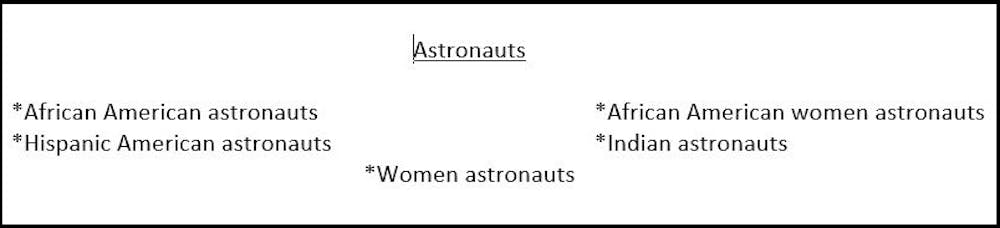
One example of bias is subjects containing the word “astronauts.”
Women are designated with “Women astronauts” and “African American women astronauts,” but there is no subject heading for male astronauts. A book about astronauts who are men would have the general subject “Astronauts,” unless the racial identity prompted the use of a subject like “Hispanic American astronauts” or “Indian astronauts.” Likewise, a book about Russian astronauts would have a geographic subdivision added: “Astronauts – Soviet Union” instead of “Russian astronauts.”
Official Library of Congress subject headings involving astronauts. Amanda Ros, CC BY
Without gender, race or geographic qualifications, “Astronauts” can be assumed to mean white American men in terms of library subjects.
Another exercise I did was to search for professions that are traditionally perceived as female. Nurses, for example, were divided equitably, with subjects for both “Male nurses” and “Female nurses.” However, under “Prostitutes,” there was only a “Male prostitute” subject heading, revealing the generic assumption that most prostitutes are female.
Official Library of Congress subject headings for three professions traditionally perceived as female. Amanda Ros, CC BY
Gender identity is also an area where positive changes have been made. LGBT subjects have been distinguished and classed under “Sexual minorities” since 1972, rather than being under the subject “Sexual deviations,” as they previously were. “Sexual deviations” does not even exist as a subject heading anymore.
In December, the Library of Congress changed the broader term from “sexual minorities” to simply “persons,” in order to align with how other minorities are handled.
The classification dilemma
Many items cover multiple subjects, yet a single physical item can only be shelved in one location. Selecting a call number automatically devalues other subjects, but it must be done.
Catalogers rely upon publisher-assigned subjects and summaries to help assign library subjects. These subjects, the Book Industry Standards and Communications codes, consist of 52 main categories, which are not as specific as Library of Congress subject headings. This can result in incorrect subjects being applied.
For example, I recently cataloged a book about basketball. The BISAC subject was “sports.” While it’s true that basketball is a sport, if I assigned “sports” as the main subject, it would be classed somewhere around GV704, but if I assigned the subject “basketball” it would be classed under GV885. Between these numbers, there could be books covering rules, the Olympics, equipment, air sports, water sports, winter sports and roller skating before the “Ball sports” starting with baseball. This difference could result in the patron not finding the book if browsing the shelves where the other basketball books are.
So the issue is that, by prioritizing certain subjects over one another, it might be more difficult for readers to find what they’re looking for. Women’s history books (HQ1121) may be far away from books about the Depression of 1929 (HB3713); therefore, someone looking for books about the Great Depression might not find the book she needed if it was classed in women’s history.
In my experience, catalogers try to be unbiased when applying subject headings and call numbers. But established subjects are created and adapted based on societal norms. If you can’t find what you need in your library, be aware that the term you use today might not be the term that was previously created. Ask your librarian for help.
A recent article about a new approach to a school library sparked vigorous discussion on social media. Many worried the school had completely abolished traditional library services. The article describes how a Melbourne school changed its library to a technology-focused centre staffed by “change adopters” who host discussions with students and encourage creative thinking.
The school’s principal was forced to defend the library’s restructure. She wrote that its traditional purpose hadn’t been lost.
The College Library has been transformed into a Learning Centre that continues to offer all library services to students and staff, including a significant collection of fiction and non-fiction books, journals, newspapers, magazines and other print resources, as well as online access to other libraries.
This school’s approach isn’t unique. Many schools have reconfigured their library spaces to embrace a model of integrating library services – where traditional library resources are combined with technology. Some have installed new technologies in so-called “maker spaces”. These are where students can be creative, often using technologies such as 3D printers and recording suites.
The purpose of today’s libraries isn’t only to maintain the traditional roles of promoting reading, developing information literacy and providing access to a collection of books and other resources. Today’s school libraries are fundamental to broader digital literacy, information provision and developing critical evaluation of information.
School libraries improve student achievement. A synthesis of international studies demonstrates that having a library leads to successful curriculum outcomes, including information literacy and positive attitudes to learning. It also improves academic achievement through higher test or exam scores.
A detailed study of 30 teacher librarians in Australia showed they also play a key role in supporting students with special educational needs. They do this by identifying readers and students at risk and working with them to improve both educational and social outcomes.
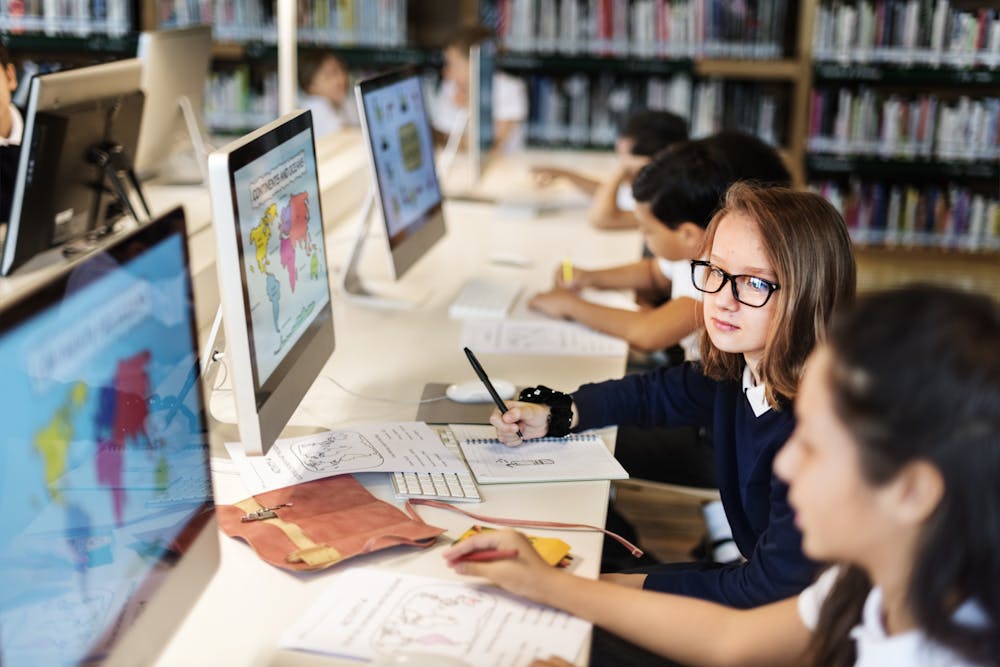
Today’s students need guidance in interpreting online information. from shutterstock.com
Libraries and library staff have consistently responded to the changing needs of society. And library professionals have been at the forefront of embracing technology: from establishing the first computer labs in schools in the 1980s through to working with students and teachers to use new technologies such as 3D printing, robotics, gaming and recording suites in learning and creativity.
There is a lack of understanding of what librarians can do for a school community and a belief children don’t need help with learning how to use technology. Information can be inaccessible, and misunderstood, without proper instruction, guidance and support. This is especially true for students from disadvantaged backgrounds who don’t have good access to the internet at home, or those with learning differences.
As the evidence base for what makes an effective library grows, it’s becoming recognised that
the 21st century school library professional is a digital leader, an innovator, a creator, a promoter, a resource and research specialist, a curriculum adviser, and much more.
Teacher librarians educate children in the core skills of searching and evaluating information. They also support and empower students in areas such as digital citizenship. This enables children to fully participate and engage with the complex digital landscape.
As Chelsea Quake, a teacher librarian at a Melbourne public school, told us:
Students leave school reading fake news, turning to Instagram for answers to their health questions, and falling flat on their first university paper, because they never truly learnt how to research.
Skills such as information and digital literacy are core requirements for civic participation. Young people have tremendous opportunities to leverage the power of technologies to ensure their voices are heard about issues that will affect them and their children in the future. And they need new and evolved library services to help them get there.






 At the BookShelf
You must be logged in to post a comment.