Justice League director Zach Snyder has said he is interested in working on a “faithful retelling” of Arthurian myth. Cut to a small horde of Arthurian scholars (myself included) entering stage left to loudly proclaim that there is no such thing as a “faithful retelling” of the King Arthur myth. King Arthur is one of the most pervasive legends of all time. What scholars call the “Arthurian mythological concept” has developed over several centuries – and over several cultures. Indeed, what makes the Arthur legend so enduring is its very lack of fidelity.
Although many of us today get our first taste of the Arthurian legend from films such as Guy Ritchie’s King Arthur: Legend of the Sword (2017) or TV shows such as the BBC’s Merlin (2008-2012), the core elements of the story that we recognise remain largely medieval.
Arthur’s name first appears in the work of ninth century Welsh historian Nennius. However, the legend as we know it today – knights in shining armour, damsels in distress, Round Table, Holy Grail etc – gallops into view from around the 12th century onward. This heralds the start of what is now known as the “Romance Tradition”.
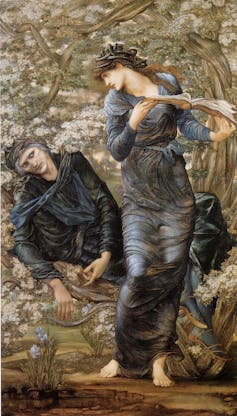
The Beguiling of Merlin by Edward Burne Jones depicts the wizard being seduced by the Lady of the Lake. Wikimedia
Chances are that if you’ve read a version of the Arthur story today it is likely to be one of these Romances – most likely Thomas Malory’s 15th-century Morte D’Arthur or an early 20th-century re-telling such as TH White’s The Once and Future King. The tradition also proved very popular with the Victorians – especially with the Pre-Raphaelites, whose visual depictions of Arthurian legend frame the way we see the legend today.
For example, their paintings popularised captivating female figures such as the virginal Maid of Astolat (or Shallot), the dangerous enchantress Morgan Le Fay and the beguiling Lady of the Lake, the temptress Nimue.
One thing that remains consistent throughout the centuries however is the Arthurian myth’s ability to remain relevant to the people, countries, and eras in which it is being retold.
Reworkings and re-imaginings
In the late 17th-century, for example, Arthur was enlisted in the wake of the Glorious Revolution of 1688 as a means of bolstering support for the new Protestant regime and their political allies. Physician-poet Richard Blackmore wrote two lengthy epic poems – Prince Arthur (1695) and King Arthur (1697) – comparing the new King William III to Arthur and praising the way in which the monarch’s religious (and, crucially, Protestant) piety would “fresh Life to Albion […] impart”.
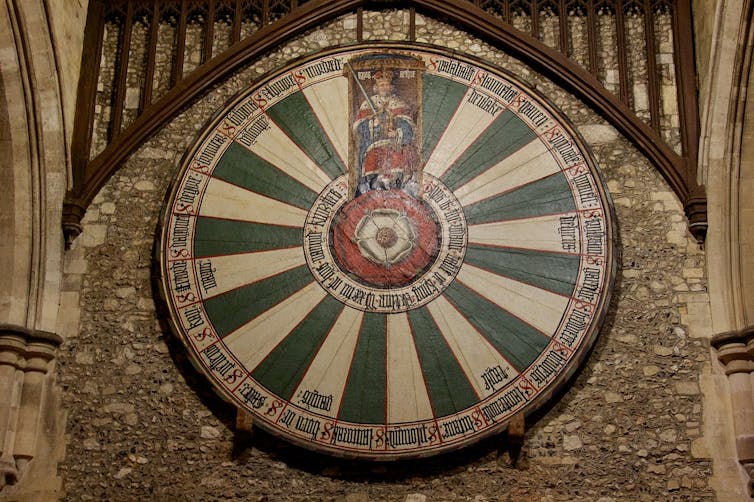
This was certainly not the first time Arthur had been associated with the English throne. Both the Tudors and the Stuarts adopted the mythical king to suit their own political purposes, with Henry VII going so far as to repaint the Winchester Round Table with a Tudor Rose at its centre. The paint job was probably in honour of a state visit by the Holy Roman Emperor Charles V in 1522 and – just to ensure that Charles got the message – Henry also had himself depicted on the table, sitting in Arthur’s place.
The Winchester Round Table, showing Henry VII sitting in Arthur’s seat and with a Tudor Rose at its centre. Wikimedia/Mike Peel, CC BY-SA
Nor was it the last time that Arthur would find himself so conscripted. Elements of the Arthurian story – most notably the figure of Merlin – were used in the early 18th-century by the Hanoverian monarchs and their supporters to bolster their own claims to an inherently “British” identity.
Queen Caroline, a clever and well-informed curator of her own public image, capitalised upon the 18th-century’s rediscovery of its national history through ancient heroes. In collaboration with architect William Kent, she developed Merlin’s Cave – a name suggestive of a grotto but in reality more of a thatched folly (a round house with a thatched roof) designed around the Merlin myth – in the gardens at Richmond in 1735.
Numerous panegyric poems – poems designed to publicly praise and flatter – followed including two by “a lady subscribed Melissa”. The first praises “Her Majesty Queen Guardian” as the inheritor of Merlin’s legacy. The second, entitled Merlin’s Prophecy, envisages Frederick, Prince of Wales as “Ordain’d, to wield the Sceptre Royal […] And rule o’er Britons, Brave, and Loyal”.
As these examples illustrate, the one thing we can really say with any certainty about the Arthurian mythos is that fidelity is – as with any myth – an impossible concept.
The early trailers for Guy Ritchie’s King Arthur: Legend of the Sword (2017) were released last (northern) summer, which means my favourite season in life as a medievalist academic is coming: the season of The Truth About King Arthur. It doesn’t matter if the movie itself is good or bad: the question I will be getting is “but how accurate is it?” Does it represent the “real” legend of King Arthur?
Knowing Guy Ritchie’s films, the answer is going to be a glorious “no, and it’s not even trying”, but modern audiences often seem to be attracted to the idea of an adaptation that is more true than others.
The 2004 film King Arthur, a glorious romp featuring Kiera Knightley in an impractical outfit fighting hand-to-hand with an even more impractical short bow, billed itself as telling the “real” story of King Arthur as we’d never seen it before. Set, ostensibly, in the 5th century, it promised the story of a beleaguered Briton warlord rallying his people against the Saxons – but it also gave us a love triangle featuring Arthur, his wife Guinevere, and the knight Lancelot; a tale which first appeared in the 12th century, in France.
Can you tell a King Arthur story to a modern audience without including the royal love triangle? The Australian animated series Arthur! And His Square Knights of the Round Table (1966), aimed at young audiences who presumably weren’t supposed to comprehend a complicated narrative of love, betrayal and sin, is nevertheless peppered with in-jokes about the Queen’s devotion to the comically inept Lancelot.
The BBC’s Merlin (2008), a delightful festival of historical inaccuracies, made the triangle a key part of Guinevere’s character arc for several seasons, ending with poor Lancelot as the tool of necromancy and plots against the throne.
Interestingly, Guy Ritchie’s Legend of the Sword seems to have cast no Lancelot; it remains to be seen if modern audiences will accept a Lancelot-less Camelot as “real” Arthuriana. But whether they do or do not, Ritchie’s work will be compared to an imagined true story of King Arthur, which never existed, even in the Middle Ages. The medieval sources dealing with King Arthur are numerous, inconsistent, and wildly ahistorical in and of themselves.
The historical sources
‘King Arthur’ by Charles Ernest Butler. Charles Ernest Butler [Public domain], via Wikimedia Commons
The name Arthur first appears in the work of the 9th century Welsh historian Nennius, who lists twelve battles this Arthur fought against invading Saxons. Similarly, the Welsh Chronicles (written down in the 10th century) make some references to battles fought by Arthur. On this shaky foundation, along with a scattering of place-names and oblique references, is an entire legend based.
Ask any scholar of Arthurian literature if King Arthur really existed, and we’ll tell you: we don’t know, and we don’t really care. The good stuff, the King Arthur we all know and love, is entirely fictional.
The “Arthurian Legend” really kicked off in the early 12th century, with Geoffrey of Monmouth’s History of the Kings of Britain (1138), which purported to describe the entire history of Britain from the day dot until about the 7th century.
He describes the founding of Britain by the (mythical) Trojan warrior Brutus; he covers a lot of the historical events described in Nennius’ earlier work; and his account is the first to really describe King Arthur’s reign, his wars against the Saxons, and the doings of the wizard Merlin. Some elements, like the part where Merlin helps Arthur’s father Uther deceive and sleep with another man’s wife, thus conceiving Arthur, remain key parts of the Arthurian legend today. Other elements modern audiences expect, like the Round Table, are still absent.
Geoffrey of Monmouth wrote in Latin, and his book was read and treated as a history book in the Middle Ages. But very quickly, the material was re-worked into French and English poetry. The Norman poet Wace, whose audience included people living in both France and England, based his Roman de Brut (1155) on Geoffrey’s History. He added many things to the story, including the Round Table itself.
Around the turn of the thirteenth century, an English poet named Layamon took both Geoffrey and Wace’s works, combined them, and added more in his long English poem Brut. Arthur is not the only subject covered in the Brut, but it’s the first treatment of King Arthur in English.
These versions, and some of the later English romances like Of Arthur and of Merlin, focus on battles and political tensions. Aside from Merlin they feature few supernatural elements, and do not usually devote much attention to love. In these versions, the traitor Mordred who defeats Arthur at the battle of Camlann is usually his nephew, not his illegitimate son; and Guinevere may willingly marry him after Arthur’s death.
The Romances
Arthurian romance is where things really start getting fun, from the 12th century onwards. The earliest romances did not focus on Arthur himself, but on various heroes and knights associated with his court.
The very first might be the Welsh Culhwch and Olwen, the events of which rarely make an appearance in later Arthurian works, but which share with them a common basic plot structure: a young man needs to prove himself to win the hand of a fair lady, goes to Arthur’s court, undergoes a series of supernatural adventures, and is eventually able to marry his lady and settle down.
‘Arthur’s Tomb’ by Dante Gabriel Rossetti. Dante Gabriel Rossetti [Public domain], via Wikimedia Commons
The earliest surviving French Arthurian romances are by an author named Chrétien de Troyes. He wrote five romances, of which the most fun, in my humble opinion, is The Knight of the Lion (1176). The most famous is The Knight of the Cart (1180), which introduces Lancelot and his love affair with Queen Guinevere.
Hot on its heels came The Story of the Grail (1181), which introduces Perceval and the Grail quest – although Chrétien himself never finished that work. At around about the same time, a separate tradition of romances about the knight Tristan and his affair with Queen Isolde of Cornwall was also circulating.
Over the 13th to 15th centuries countless romances were written in French and in various other European languages, telling tales of the adventures of individual knights associated with King Arthur.
For instance, in the 14th century English poem Sir Gawain and the Green Knight (1390), a young Gawain is challenged to cut off the head of the Green Knight, in return for which the Green Knight will cut off Gawain’s head a year later. Unfortunately for Gawain, the green knight has supernatural headless-survival powers which Gawain lacks, and so the adventure unfolds as Gawain seeks to keep his bargain and his head.
After Chrétien de Troyes’ day, the Grail quest story became extremely popular: there are several continuations of his unfinished poem, a complete reworking in German by a Wolfram von Eschenbach, and many translations. In these, Perceval is the hero who becomes keeper of the Grail. In the complex French prose version known as The Quest of the Holy Grail (1230), Lancelot’s illegitimate but extraordinarily holy son Galahad takes that honour.
How Sir Galahad, Sir Bors and Sir Percival Were Fed with the Sanct Grael; but Sir Percival’s Sister Died by the Way by Dante Gabriel Rossetti. Dante Gabriel Rossetti [Public domain], via Wikimedia Commons
The death of Arthur
If you read no other piece of medieval Arthuriana, read the 13th century French prose romance The Death of King Arthur (1237). The Penguin translation by James Cable is eminently readable, and cheap too. This romance circulated in the middle ages as the last of a “series” of Arthurian works beginning with the Grail’s arrival in Britain and ending with the break-up of the Arthurian court and Arthur’s own death. We call this whole series the Vulgate Cycle, or the Lancelot-Grail Cycle.
This series, rather like many modern fantasy series, was written out of order: the long romance known as the Lancelot Proper and the Quest of the Holy Grail (the one with Galahad, mentioned above) were composed first, by different authors; very quickly afterwards the Death of King Arthur was added, and then the prequel material dealing with the origin of the Grail and the birth of Merlin was added.
In the Death of King Arthur, the Arthurian court is aging. Lancelot has lost his chance at the Grail, the court’s harmony is shattered as Guinevere’s adultery comes to light, Mordred betrays Arthur, and everything falls to pieces.
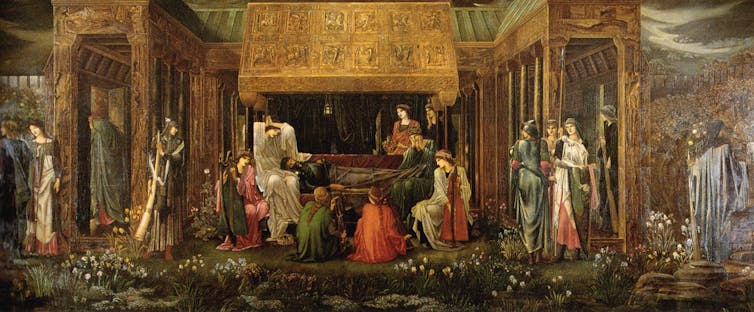
A detail of the painting The last sleep of Arthur by the Pre-Raphaelite painter Edward Burne-Jones, 1898. via Wikimedia Commons
Fast forward to the 15th century, and an English knight named Thomas Malory, serving time in prison in Calais for attempting to abduct a young heiress, gets hold of the Vulgate Cycle, the Tristan romances, and a range of other material, and produces the most famous piece of English-language (despite its French title) Arthuriana: Le Morte d’Arthur. Malory, whatever else he might have been, was a completist, and he tried very hard to make a single coherent story out of the many contradictory he sources he had.
Chances are, if someone in an English-speaking country says to you they’ve read the “original” story of King Arthur, it’s Malory they mean. Its great popularity is explained by the fact that William Caxton put out a printed edition in the late fifteenth century. You can find that for free online, but the best reading version is the Oxford World’s Classics translation by Helen Cooper.
The ‘real’ Arthur today
Very few people get their first idea of King Arthur from a medieval text, today. When I taught Arthurian classes at Sydney Uni I used to ask the group to describe their first encounter with the Arthurian legend – it got oddly confessional at times, liking asking people to describe their religious conversions or coming-out experiences.
A lot of people my age and younger met Arthur through the movie The Sword in the Stone (1963), although in my case it was the infinitely funnier and more terrible Quest for Camelot (1998).
I was reading Arthurian stories long before I learned that the way we’re supposed to judge an adaptation in the modern world is its “fidelity” to its source. I loved Howard Pyle’s The Story of King Arthur (1903) and the 1998 miniseries Merlin and the ridiculous BBC children’s show Sir Gadabout (2002), and the last thing I worried about was whether or not they incorporated exactly the same plot elements.
There’s a distinct pleasure, though, in reading your favourite story told again in new ways: Sir Gadabout was so funny to me precisely because it plays fast and loose with elements that are treated as sacred in the solemn Victorian style of Howard Pyle, or the serious moralising of T.H. White’s Once and Future King (1958).
Ask a group of medievalists what the best Arthurian movie is, and 95% of us will answer Monty Python and the Quest for the Holy Grail (1975). The reason for that is not, as anyone who has seen it can guess, because it is exceedingly faithful to Thomas Malory’s monumental work, or to any other particular text.
Monty Python and the Holy Grail (1975) EMI Films
What Monty Python did so brilliantly was take the cultural “idea” of Arthur (perhaps at that time best encapsulated in the musical Camelot (1967)), along with a broad knowledge of Arthurian traditions both medieval and modern, and have fun with it on various levels. You don’t need to have read the weird romances dealing with the Questing Beast to laugh at the Black Beast of Argh, for instance, but if you have, knowledge of the “original” can only improve your appreciation of the adaptation.
And so I contend that whether or not Guy Ritchie includes Lancelot is immaterial. As far as I’m concerned it’s not a real Arthurian movie unless it contains the Beast of Argh, and that’s the stance I’m sticking to.
Readers interested in the history and development of Arthuriana could consult the second edition of The Arthurian Handbook (Routledge, 1997), or explore the texts, images and mini-histories at The Camelot Project.




 At the BookShelf


