
Unknown's avatar

Five tourist trips in England inspired by classic novels


Heather Green, Nottingham Trent University

Some books can really bring to life the place in which they’re set. Their words knit together in such a way that whole landscapes or entire floorplans of buildings you’ve never visited before spring forth in your mind.

Often these settings are based upon real places. So with domestic travel restrictions set to be relaxed from April, that might be the opportune moment to discover some of the UK’s best literary heritage sites. From violently beautiful windswept moors to boisterous town squares, here are five such places and the books they inspired:

1. Greenway, Devon in Agatha Christie’s Dead Man’s Folly

Poirot commented on the geography of the property, ‘So many paths, and one is never sure where they lead’ … They passed the Folly and zig-zagged down the path to the river.

Agatha Christie’s house at Greenway on the River Dart is the setting for her 1956 novel Dead Man’s Folly. About a charity game of murder that becomes a bit too real, this Hercule Poirot mystery vividly came to life on my visit to Greenway.

Not only is the Georgian house itself perfectly depicted, but the zig-zagging path to the murder scene in the boathouse is so uncannily described that to visit it is chilling. The house and grounds are so evocative that Greenaway was used in ITV’s 2013 adaptation of the book.

2. Nottingham in Alan Sillitoe’s Saturday Night and Sunday Morning

Market Square lights danced all around him.

Sillitoe’s cult novel set among the working class in Nottingham follows Arthur Seaton (rebel, thinker, drinker and womaniser) after he puts away 11 pints and seven gins one Saturday night.
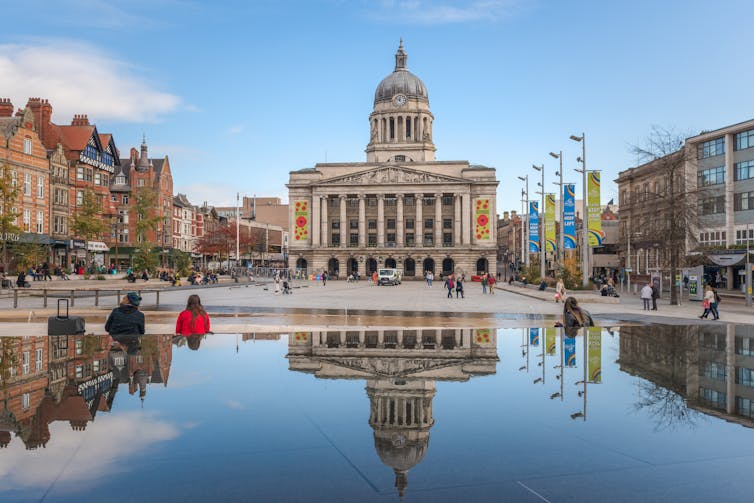
Town sqyare with fountain, bordered by shops.
Nottingham’s Market Square.
Destinos Espetaculares/Shutterstock

Nottingham might have changed somewhat since 1958, but Sillitoe’s detailed descriptions of the city’s streets are still wonderfully recognisable. Nothing says Nottingham like wondering amid the drunken revellers in Market Square or experiencing the cacophony of the annual Goose Fair, one of the largest funfairs in the UK. The many locations Seaton visited over his fateful weekend can be further explored on The Sillitoe Trail.

3. Wirksworth, Derbyshire in George Eliot’s Adam Bede

Look at the canals, an’ th’ acqueducs, an’ th’ coal-pit engines, and Arkwright’s mills there at Cromford.

George Eliot’s Adam Bede (1859) provides a snapshot of the rural Midlands at the beginning of the 18th-century. Eliot’s aunt was a Methodist preacher in Wirksworth, and the local landscape, coupled with her aunt’s reminiscences, became the germ of the novel
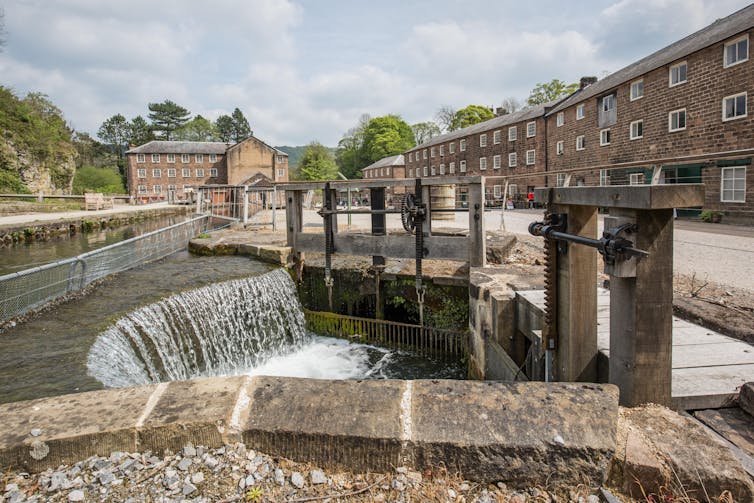
Waterways at Arkwright's Mill, Cromford, Derbyshire.
Arkwright’s Mill, Cromford, Derbyshire.
Daniel Matthams/Alamy

Thoough Eliot irritably rejected suggestions that any of her characters or settings were carbon copies of real life, Wirksworth can certainly be found in the industrial landscape that she conjures. Arkwright’s mills can be still be explored, the canal strolled along, and the remains of the mining industry discovered.

4. The West York Moors in Emily Brontë’s Wuthering Heights

But it was one of their chief amusements to run away to the moors in the morning and remain there all day, and the after-punishment grew a mere thing to laugh at.

Wuthering Heights (1847) is a tale of obsessive love. Divided in life, Cathy and Heathcliff are finally joined in death and their spirits roam the Yorkshire moors. For me, Emily Brontë’s classic is more about the landscape than love. When first reading the novel, my interest in Cathy and Heathcliff’s undying love was secondary to my imaginings of the moorland that is their playground and escape. The windswept barren landscape feels synonymous with freedom.
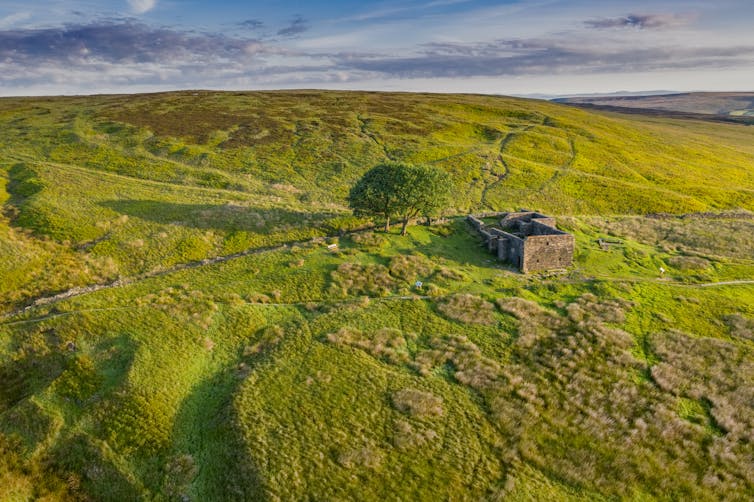
Aeiral shot of the ruins of the Top Withins farmhouse
The ruins of the Top Withins farmhouse.
Julian Hodgson/Shutterstock

You can walk in the Brontë sisters’ footsteps by following the Brontë Stones, which are situated between Thornton, where the girls were born, and Haworth, where they wrote their classic novels. The Emily Walk is marked by a poem carved into a rocky outcrop from Kate Bush, whose 1978 number one Wuthering Heights was inspired by the novel. The walk leads you away from civilisation and takes in the lovely ruins of Top Withins farmhouse, which is believed to be the inspiration for the Earnshaw home in Wuthering Heights.

5. Eastwood, Nottinghamshire in DH Lawrence’s Sons and Lovers

The Bottoms consisted of six blocks of miners’ dwellings, two rows of three, like the dots on a blank-six domino, and twelve houses in a block.

Lawrence’s most autobiographical novel, Sons and Lovers (1913), follows the fates of a mining family in Nottinghamshire.

The once coal-mining town of Eastwood and the surrounding landscape has been recreated in detail gleaned from Lawrence’s memories of his childhood, from The Breach where his family lived (“The Bottoms” in the novel) to descriptions of the Moon and Stars pub (actually the Three Tuns). Visiting The DH Lawrence Birthplace Museum, visitors can step inside a typical mining family home of the period.The Conversation

Heather Green, PhD Candidate, Literary Heritage, Nottingham Trent University

This article is republished from The Conversation under a Creative Commons license. Read the original article.
Unknown's avatar

Frankenstein: the real experiments that inspired the fictional science


File 20181025 71032 1uut1t2.jpg?ixlib=rb 1.1
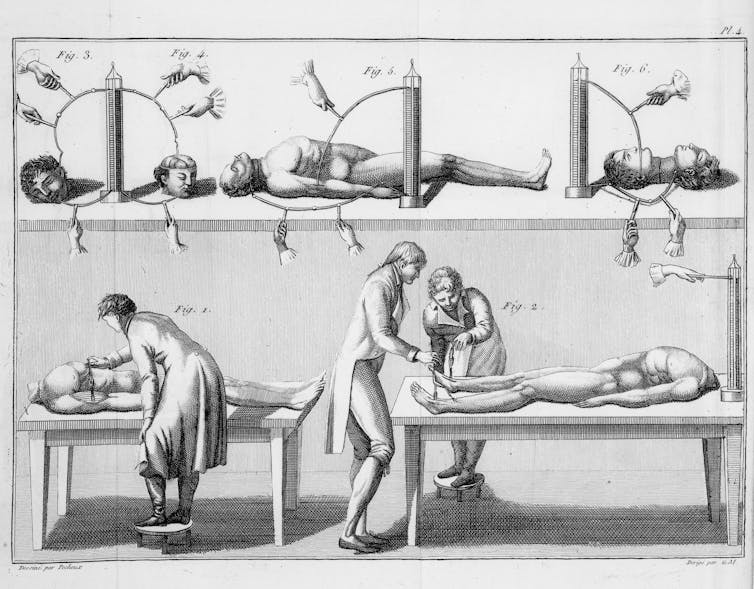
Giovanni Aldini’s experiments with a human corpse.
Wellcome Collection, CC BY-SA

Iwan Morus, Aberystwyth University

On January 17 1803, a young man named George Forster was hanged for murder at Newgate prison in London. After his execution, as often happened, his body was carried ceremoniously across the city to the Royal College of Surgeons, where it would be publicly dissected. What actually happened was rather more shocking than simple dissection though. Forster was going to be electrified.

The experiments were to be carried out by the Italian natural philosopher Giovanni Aldini, the nephew of Luigi Galvani, who discovered “animal electricity” in 1780, and for whom the field of galvanism is named. With Forster on the slab before him, Aldini and his assistants started to experiment. The Times newspaper reported:

On the first application of the process to the face, the jaw of the deceased criminal began to quiver, the adjoining muscles were horribly contorted, and one eye was actually opened. In the subsequent part of the process, the right hand was raised and clenched, and the legs and thighs were set in motion.

It looked to some spectators “as if the wretched man was on the eve of being restored to life.”

By the time Aldini was experimenting on Forster the idea that there was some peculiarly intimate relationship between electricity and the processes of life was at least a century old. Isaac Newton speculated along such lines in the early 1700s. In 1730, the English astronomer and dyer Stephen Gray demonstrated the principle of electrical conductivity. Gray suspended an orphan boy on silk cords in mid air, and placed a positively charged tube near the boy’s feet, creating a negative charge in them. Due to his electrical isolation, this created a positive charge in the child’s other extremities, causing a nearby dish of gold leaf to be attracted to his fingers.

In France in 1746 Jean Antoine Nollet entertained the court at Versailles by causing a company of 180 royal guardsmen to jump simultaneously when the charge from a Leyden jar (an electrical storage device) passed through their bodies.

It was to defend his uncle’s theories against the attacks of opponents such as Alessandro Volta that Aldini carried out his experiments on Forster. Volta claimed that “animal” electricity was produced by the contact of metals rather than being a property of living tissue, but there were several other natural philosophers who took up Galvani’s ideas with enthusiasm. Alexander von Humboldt experimented with batteries made entirely from animal tissue. Johannes Ritter even carried out electrical experiments on himself to explore how electricity affected the sensations.

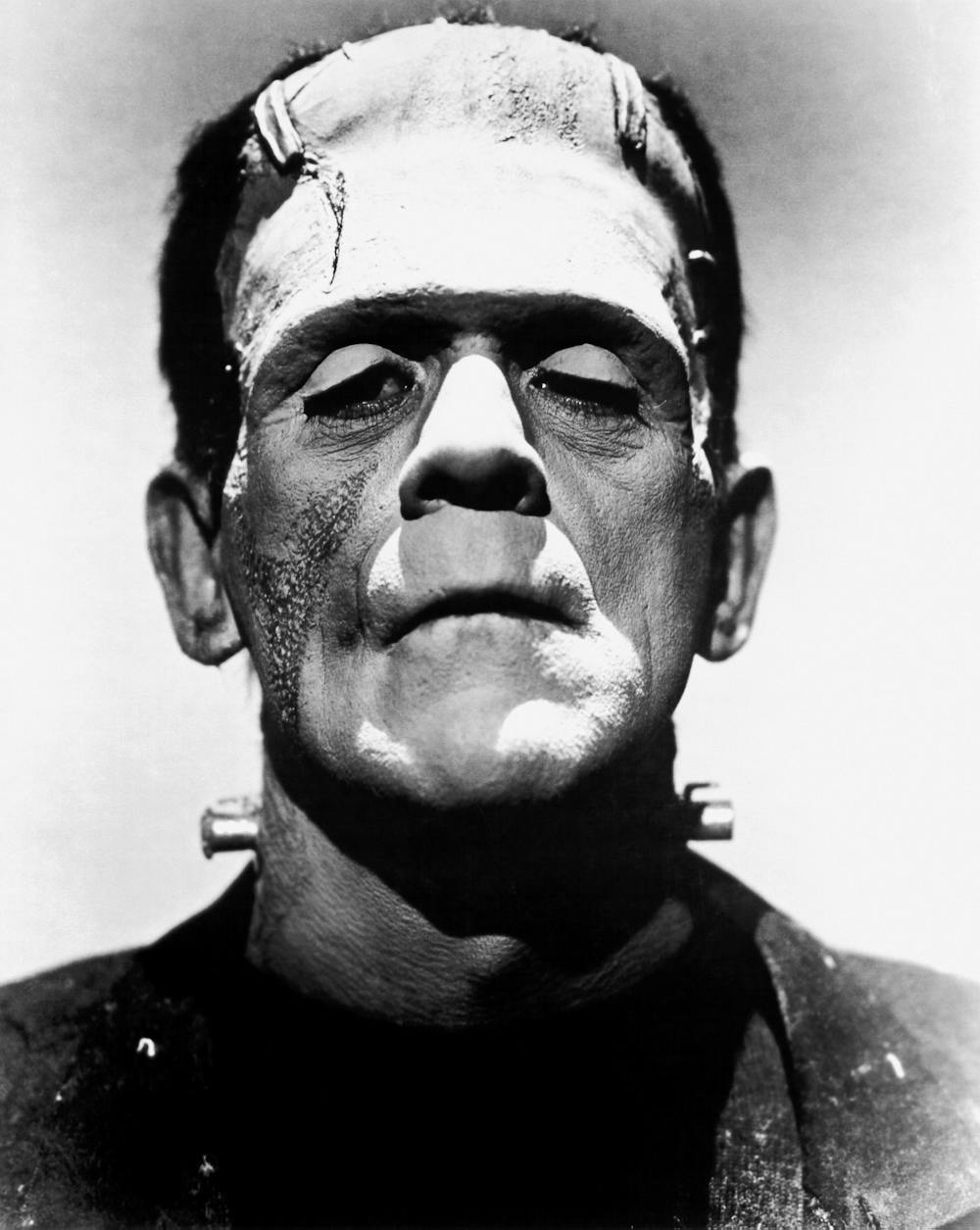
Actor Boris Karloff as Frankenstein’s monster, 1935.
Wikimedia

The idea that electricity really was the stuff of life and that it might be used to bring back the dead was certainly a familiar one in the kinds of circles in which the young Mary Wollstonecraft Shelley – the author of Frankenstein – moved. The English poet, and family friend, Samuel Taylor Coleridge was fascinated by the connections between electricity and life. Writing to his friend the chemist Humphry Davy after hearing that he was giving lectures at the Royal Institution in London, he told him how his “motive muscles tingled and contracted at the news, as if you had bared them and were zincifying the life-mocking fibres”. Percy Bysshe Shelley himself – who would become Wollstonecraft’s husband in 1816 – was another enthusiast for galvanic experimentation.

Vital knowledge

Aldini’s experiments with the dead attracted considerable attention. Some commentators poked fun at the idea that electricity could restore life, laughing at the thought that Aldini could “make dead people cut droll capers”. Others took the idea very seriously. Lecturer Charles Wilkinson, who assisted Aldini in his experiments, argued that galvanism was “an energising principle, which forms the line of distinction between matter and spirit, constituting in the great chain of the creation, the intervening link between corporeal substance and the essence of vitality”.

In 1814 the English surgeon John Abernethy made much the same sort of claim in the annual Hunterian lecture at the Royal College of Surgeons. His lecture sparked a violent debate with fellow surgeon William Lawrence. Abernethy claimed that electricity was (or was like) the vital force while Lawrence denied that there was any need to invoke a vital force at all to explain the processes of life. Both Mary and Percy Shelley certainly knew about this debate – Lawrence was their doctor.

By the time Frankenstein was published in 1818, its readers would have been familiar with the notion that life could be created or restored with electricity. Just a few months after the book appeared, the Scottish chemist Andrew Ure carried out his own electrical experiments on the body of Matthew Clydesdale, who had been executed for murder. When the dead man was electrified, Ure wrote, “every muscle in his countenance was simultaneously thrown into fearful action; rage, horror, despair, anguish, and ghastly smiles, united their hideous expression in the murderer’s face”.

Ure reported that the experiments were so gruesome that “several of the spectators were forced to leave the apartment, and one gentleman fainted”. It is tempting to speculate about the degree to which Ure had Mary Shelley’s recent novel in mind as he carried out his experiments. His own account of them was certainly quite deliberately written to highlight their more lurid elements.

Frankenstein might look like fantasy to modern eyes, but to its author and original readers there was nothing fantastic about it. Just as everyone knows about artificial intelligence now, so Shelley’s readers knew about the possibilities of electrical life. And just as artificial intelligence (AI) invokes a range of responses and arguments now, so did the prospect of electrical life – and Shelley’s novel – then.

The science behind Frankenstein reminds us that current debates have a long history – and that in many ways the terms of our debates now are determined by it. It was during the 19th century that people started thinking about the future as a different country, made out of science and technology. Novels such as Frankenstein, in which authors made their future out of the ingredients of their present, were an important element in that new way of thinking about tomorrow.

Thinking about the science that made Frankenstein seem so real in 1818 might help us consider more carefully the ways we think now about the possibilities – and the dangers – of our present futures.The Conversation

Iwan Morus, Professor of History, Aberystwyth University

This article is republished from The Conversation under a Creative Commons license. Read the original article.

Unknown's avatar

Infographic: Desserts Inspired By Your Favourite Books


The link below is to an infographic that looks at 20 desserts inspired by your favourite books.

For more visit:
http://www.berries.com/blog/20-desserts-inspired-by-your-favorite-books?

Unknown's avatar

Article: What Think Ye of Book Art?


The link below is to an article that takes a look at book inspired art and asks what do you think of book art? I ask the same question – does book art of any sort interest you? Please leave your thoughts in the comments.

For more visit:
http://www.teleread.com/books/book-art-good-idea-or-not/

Unknown's avatar

Zite adds 7 new publishing partners; updates iOS app with Google Reader-inspired features


Unknown's avatar

Article: Dead Writers Perfume


The link below is to an article that looks at perfumes inspired by dead writers.

For more visit:
http://bookriot.com/2013/01/29/dead-writers-perfume/

Unknown's avatar

Article: Buildings Inspired by Books


The link below is to an article reporting on 10 buildings inspired by books.

For more, visit:
http://flavorwire.com/286088/10-beautiful-buildings-inspired-by-famous-books