
Unknown's avatar

Why Christmas ghost stories have such enduring appeal


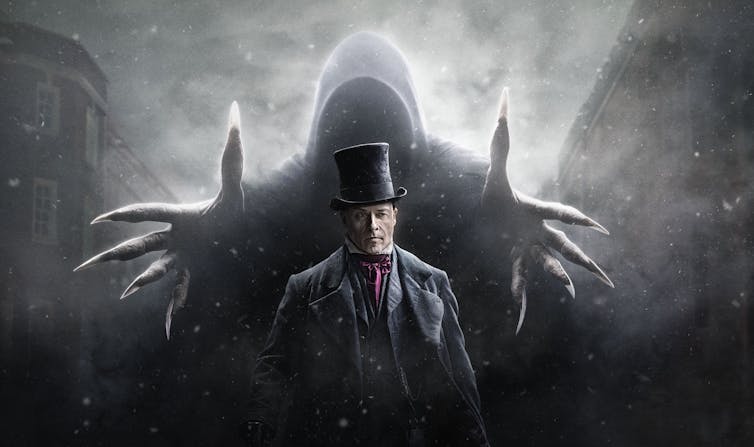
A modern Christmas Carol.
BBC/Scott Free/FX Networks

Sally O’Reilly, The Open University

Our fascination with ghostly tales around Christmas time goes back thousands of years and is rooted in ancient celebrations of the winter solstice. In the depths of winter, pagan traditions included a belief in a ghostly procession across the sky, known as the Wild Hunt. Recounting tales of heroism and monstrous and supernatural beings became a midwinter tradition. Dark tales were deployed to entertain on dark nights.

Ghosts have been associated with winter cold since those ancient times. According to art historian Susan Owens, author of The Ghost, A Cultural History, the ode of Beowulf is one of the oldest surviving ghost stories, probably composed in the eighth century. This is the tale of a Scandinavian prince who fights the monster Grendel. Evil and terrifying, Grendel has many ghostly qualities, and is described as a “grimma gaest” or spirit, and a death shadow or shifting fog, gliding across the land.

In 1611, Shakespeare wrote The Winter’s Tale, which includes the line: “A sad tale’s best for winter, I have one of sprites and goblins.” Two centuries later, the teenage Mary Shelley set her influential horror story Frankenstein in a snowy wasteland, although she wrote it during a wet summer in Switzerland.

The Victorians invented many familiar British Christmas traditions, including Christmas trees, cards, crackers and roast turkey. They also customised the winter ghost story, relating it specifically to the festive season – the idea of something dreadful lurking beyond the light and laughter inspired some chilling tales.

Both Elizabeth Gaskell and Wilkie Collins published stories in this genre, but the most notable and enduring story of the period was Charles Dickens’ A Christmas Carol (1843). In this vivid and atmospheric fable, gloomy miser Ebenezer Scrooge is confronted first by the spirit of his dead business partner, Jacob Marley, and thereafter by a succession of Christmas ghosts.

Their revelations about his own past and future and the lives of those close to him lead to a festive redemption which has spawned a host of imitations and adaptations.

Dickens wrote the story to entertain, drawing on the tradition of the ghostly midwinter tale, but his aim was also to highlight the plight of the poor at Christmas. His genius for manipulating sentiment was never used to better effect, but perhaps the most enjoyable elements of the story are the atmospheric descriptions of the hauntings themselves – the door knocker which transforms into Marley’s face and the sinister, hooded figure of the Ghost of Christmas Yet to Come.

The tradition was further developed in the stories of M R James, a medieval scholar who published Ghost Stories of an Antiquary in 1904. His chilling Gothic yarns focused on scholars or clergymen who discovered ancient texts or objects with terrifying supernatural consequences.

Chilling tales

Typically, James used the framing device of a group of friends telling stories around a roaring fire. In the introduction to Ghost Stories he said: “I wrote these stories at long intervals, and most of them were read to patient friends, usually at the seasons of Christmas.”

Seminal stories in his oeuvre include Number 13, Oh Whistle & I’ll Come to You and A School Story. Like Dickens, James has been widely imitated and adapted, with Stephen King citing him as an influence. King’s The Shining certainly fits into to the genre of ice-bound chiller.

Christmas ghost stories morph into new forms as time passes, like ectoplasm. Spin offs of A Christmas Carol include Frank Capra’s 1946 classic It’s a Wonderful Life, in which the story is transposed to small town America, and the 2019 film Last Christmas, the tale of a dysfunctional young woman permanently dressed as a Christmas elf, ripe for Yuletide redemption. This contemporary version conveys messages about integration and the value of diversity.

A new, high-octane version of A Christmas Carol will be shown on TV this Christmas, written by Peaky Blinders creator Stephen Knight. And M R James’ Martin’s Close, the story of a 17th century murder and its supernatural outcome, has also been adapted for the small screen.

So it seems the atavistic desire to lose oneself in tales of the supernatural is still with us. Christmas ghost stories enhance our enjoyment of the mince pies and mulled wine, and the frisson of a paranormal tale offsets the “feel-good” festive spirit that might otherwise be cloying.

Some things never change – we still have a fear of the unknown, a yearning for what is lost and a desire to be secure. In an uncertain, fast-paced world, mediated through smartphones and social media, the seasonal ghost story is here to stay. The jolt of fear and dread such stories convey make the Christmas lights glitter even more brightly.The Conversation

Sally O’Reilly, Lecturer in Creative Writing, The Open University

This article is republished from The Conversation under a Creative Commons license. Read the original article.
Unknown's avatar

Fantasmagoriana: the German book of ghost stories that inspired Frankenstein


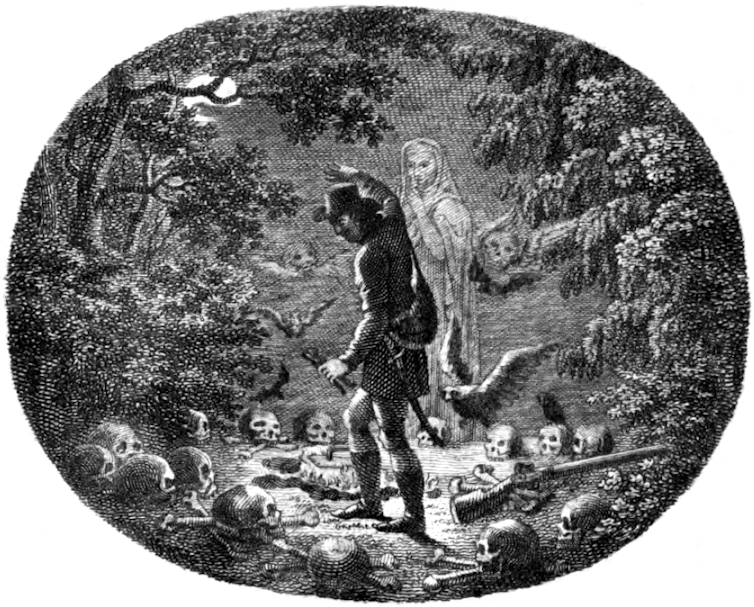
File 20181029 76413 65m8ga.png?ixlib=rb 1.1
Frontispiece from the original German version of Fantasmagoriana.
Schnorr von Carolsfeld

Fabio Camilletti, University of Warwick

The story of how Frankenstein was born is well known, and largely relies on the account given by Mary Shelley in her preface to the 1831 edition to her novel. She and her (soon-to-be) husband, the poet Percy Bysshe Shelley, were summering on the shores of Lake Geneva and close by Lord Byron and his personal physician John Polidori. It was 1816 – the so-called “year without a summer” and the inclement weather kept the party indoors, reading ghost stories as a pastime.

In one of the most famous propositions in literary history, Lord Byron suggested that each of them should try their hand at writing a supernatural tale. Ironically, it was the two novice writers, Mary Shelley and Polidori, whose works have endured. Almost out of nothing, the pair invented modern horror. Polidori’s story, The Vampyre, would inspire Bram Stoker 80 years later to write Dracula, while the 18-year-old Shelley wrote Frankenstein – which also has a good claim to be the first science fiction novel.


Read more:
Older than Dracula: in search of the English vampire


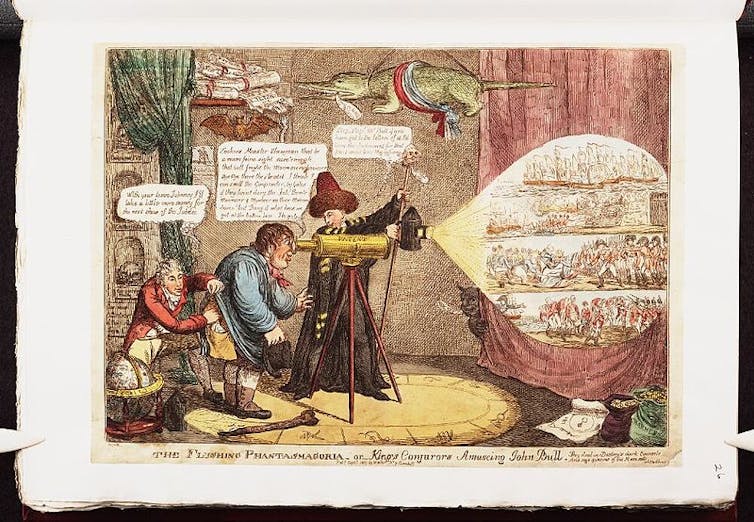
The book the Shelleys, Byron, and Polidori were reading during their trip was called Fantasmagoriana. It was an anthology of eight stories of the supernatural published in Paris in 1812 but translated from the German. No indication of authors or of original sources was given and readers were invited to think of stories as of embellished versions of real supernatural cases. The title joyfully played with this ambiguity, evoking the kind of shows, popular at the time, which were known as phantasmagorias.

A Victorian depiction of a phantasmagoria, or magic lantern show.
William Heath (1794–1840)

Based on the magic lantern (an ancestor of cinema), these shows enabled audiences to see ghosts floating in the air, devils appearing and disappearing, young girls transforming into skeletons. In the end, the impresario came upon the stage, explaining it was all a trick. But in Paris, around 1798-99, such shows had been briefly shut down by the police, when rumours had spread that the phantasmagoria could bring the king, Louis XVI, back from the dead. The book read by our holidaying writers proposed a similar gallery of horrors. As Mary Shelley recalled:

There was the History of the Inconstant Lover, who […] found himself in the arms of the pale ghost of her whom he had deserted. There was the tale of the sinful founder of his race, whose miserable doom it was to bestow the kiss of death on all the younger sons of his fated house […] he advanced to the couch of the blooming youths, cradled in healthy sleep.

It’s worth looking into the influence of such stories on Frankenstein. At some point in Shelley’s novel, Victor Frankenstein dreams to hold in his arms the “pale ghost” of his bride to be, which may remind us of the story Shelley referred to as History of the Inconstant Lover (in truth, La Morte Fiancée or The Corpse Bride, by Friedrich August Schulze).

Frankenstein’s “Creature” is a gigantic being who causes the extermination of an entire family – a plot device that may have been inspired by what she calls “tale of the sinful founder of his race” who “bestows the kiss of death” on his descendants (actually a story called Le Portraits de Famille – or The Family Portraits, by Johann August Apel).

But if we read Frankenstein with Fantasmagoriana in mind, we see that the influence of those stories is definitely more profound than a simple inspiration.

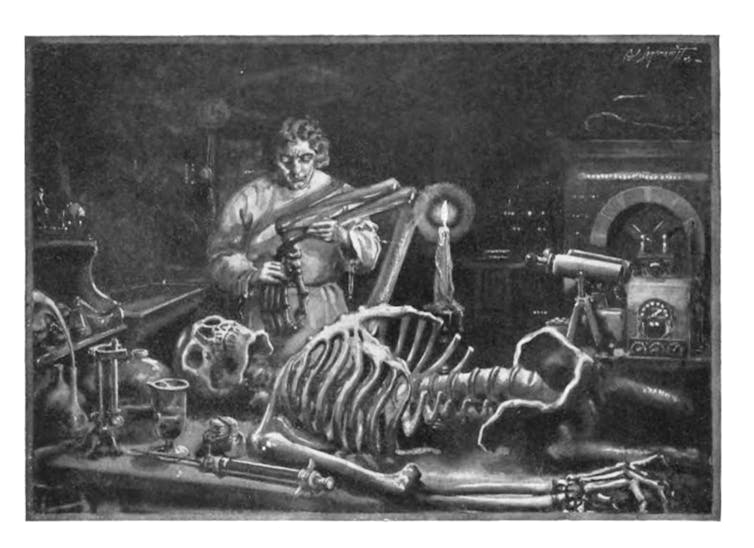
Illustration from the 1922 edition of Frankenstein, or the Modern Prometheus.
Cornhill Publishing Company

While trying to describe in the preface to the book: “How I, then a young girl, came to think of, and to dilate upon, so very hideous an idea,” Shelley describes her mental processes as a phantasmagorical show. Imagination, in her words, is a screen onto which stories project impressions. At night, in her bed, Shelley sees “with shut eyes, but acute mental vision” the central scene of her novel to be – the idea of the novel comes first as an image, not as a plot.

It is an image she knows perfectly not to be true – but which is nonetheless frightening: like the ghosts of phantasmagoria shows or of Fantasmagoriana, which were explained to be tricks of the mind, but still left the imperceptible feeling of the uncanny. In Les Portrais de Famille, Shelley read of a ghost “advanc(ing) to the couch of the blooming youths, cradled in healthy sleep” – half asleep she imagines a man in bed, beholding “the horrid thing” he created “stand(ing) at his bedside, opening his curtains”. The story read, in other words, mirrors and anticipates the story to be written.

At her bedside, Shelley too is visited by a ghost – in this case, the ghost of the novel:

On the morrow I announced that I had thought of a story.The Conversation

Fabio Camilletti, Head of Italian Studies, University of Warwick

This article is republished from The Conversation under a Creative Commons license. Read the original article.
Unknown's avatar

Article: PacMan Ghost Bookshelf


The following link is to an article on a PacMan Bookshelf. This one is so not for me.

For more, visit:
http://www.etsy.com/listing/95640660/3d-ghost-shelf