
Unknown's avatar

Fan of sci-fi? Psychologists have you in their sights


Liu zishan via Shutterstock

Gavin Miller, University of Glasgow

Science fiction has struggled to achieve the same credibility as highbrow literature. In 2019, the celebrated author Ian McEwan dismissed science fiction as the stuff of “anti-gravity boots” rather than “human dilemmas”. According to McEwan, his own book about intelligent robots, Machines Like Me, provided the latter by examining the ethics of artificial life – as if this were not a staple of science fiction from Isaac Asimov’s robot stories of the 1940s and 1950s to TV series such as Humans (2015-2018).

Psychology has often supported this dismissal of the genre. The most recent psychological accusation against science fiction is the “great fantasy migration hypothesis”. This supposes that the real world of unemployment and debt is too disappointing for a generation of entitled narcissists. They consequently migrate to a land of make-believe where they can live out their grandiose fantasies.

The authors of a 2015 study stress that, while they have found evidence to confirm this hypothesis, such psychological profiling of “geeks” is not intended to be stigmatising. Fantasy migration is “adaptive” – dressing up as Princess Leia or Darth Vader makes science fiction fans happy and keeps them out of trouble.

But, while psychology may not exactly diagnose fans as mentally ill, the insinuation remains – science fiction evades, rather than confronts, disappointment with the real world.

The case of ‘Kirk Allen’

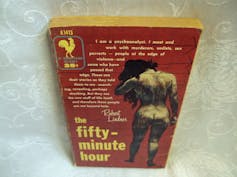
The psychological accusation that science fiction evades real life goes back to the 1950s. In 1954, the psychoanalyst Robert Lindner published his case study of the pseudonymous “Kirk Allen”, a patient who maintained an extraordinary fantasy life modelled on pulp science fiction.
Case studies from the edge.
Schnoodles blog, CC BY

Allen believed he was at once a scientist on Earth – and simultaneously an interplanetary emperor. He believed he could enter his other life by mental time travel into the far-off future, where his destiny awaited in scenes of power, respect, and conquest – both military and sexual.

Lindner explained Allen’s condition as an escape from overwhelming mental anguish rooted in childhood trauma. But Lindner, himself a science fiction fan, remarked also on the seductive attraction of Allen’s second life, which began to offer, as he put it, a “fatal fascination”. The message was clear. Allen’s psychosis was extreme, but it showed in stark clarity what drew readers to science fiction: an imagined life of power and status that compensated for the readers’ own deficiencies and disappointments.

Lindner’s words mattered. He was an influential cultural commentator, who wrote for US magazines such as Time and Harper’s. The story of Kirk Allen was published in the latter, and in Lindner’s book of case studies, The Fifty-Minute Hour, which became a successful popular paperback.

Critical distance

Psychology had very publicly diagnosed science fiction as a literature of evasion – an “escape hatch” for the mentally troubled. Science fiction answered back, decisively changing the genre in the following decades.
What if Hitler had written science fiction?
Amazon

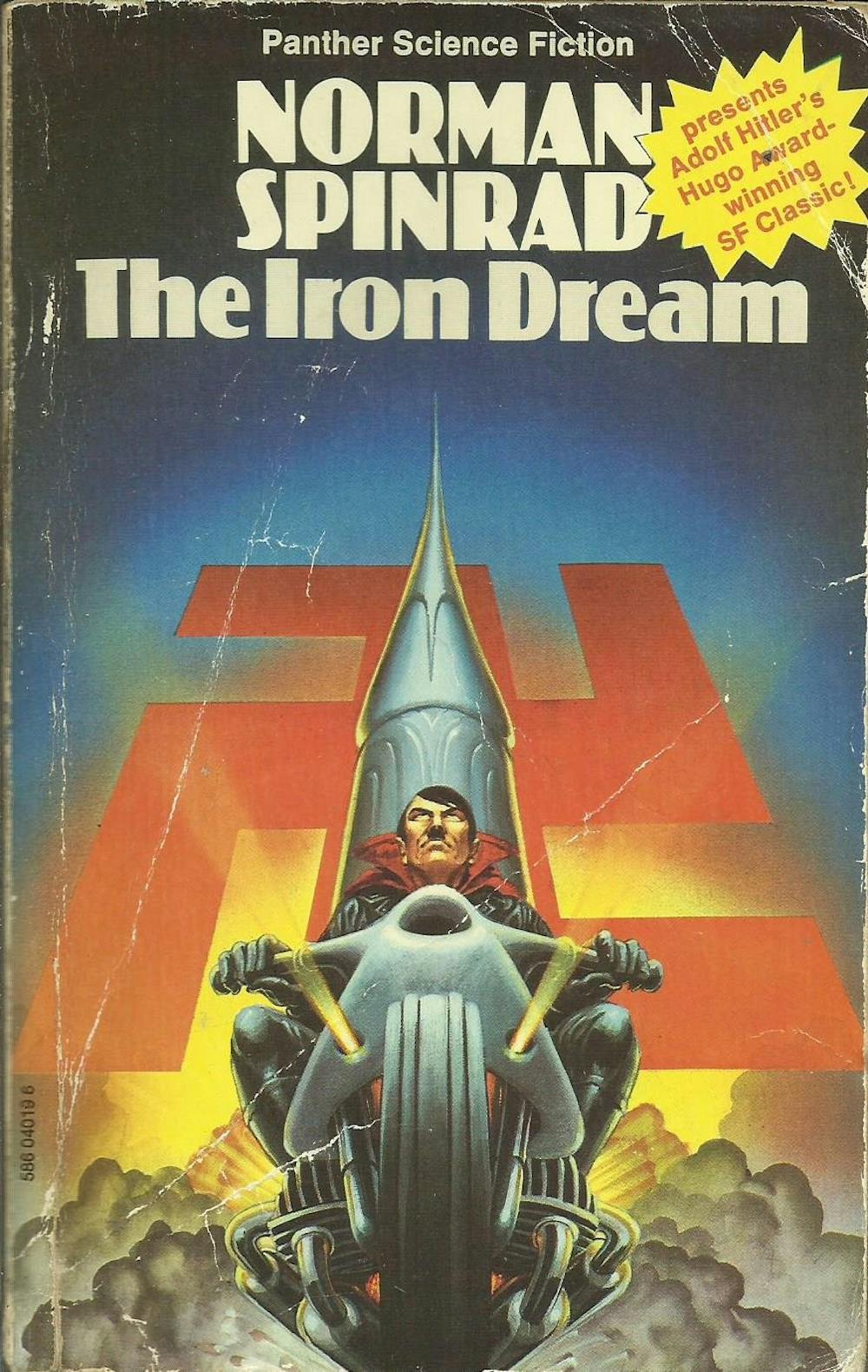
To take one example: Norman Spinrad’s The Iron Dream (1972) purports to reprint a prize-winning 1954 science fiction novel. The novel is apparently written, in an alternate history timeline, by Adolf Hitler, who gave up politics, emigrated to the US, and became a successful science fiction author and illustrator. A fictional critical afterword explains that Hitler’s novel, with its “fetishistic military displays and orgiastic bouts of unreal violence”, is just a more extreme version of the “pathological literature” that dominates the genre.

In her review of The Iron Dream, the now-celebrated science fiction author Ursula Le Guin – daughter of the distinguished anthropologist Alfred Kroeber – wrote that the “essential gesture of SF” is “distancing, the pulling back from ‘reality’ in order to see it better”, including “our desires to lead, or to be led”, and “our righteous wars”. Le Guin wanted science fiction to make strange the North American society of her time, showing afresh its peculiar psychology, culture, and politics.

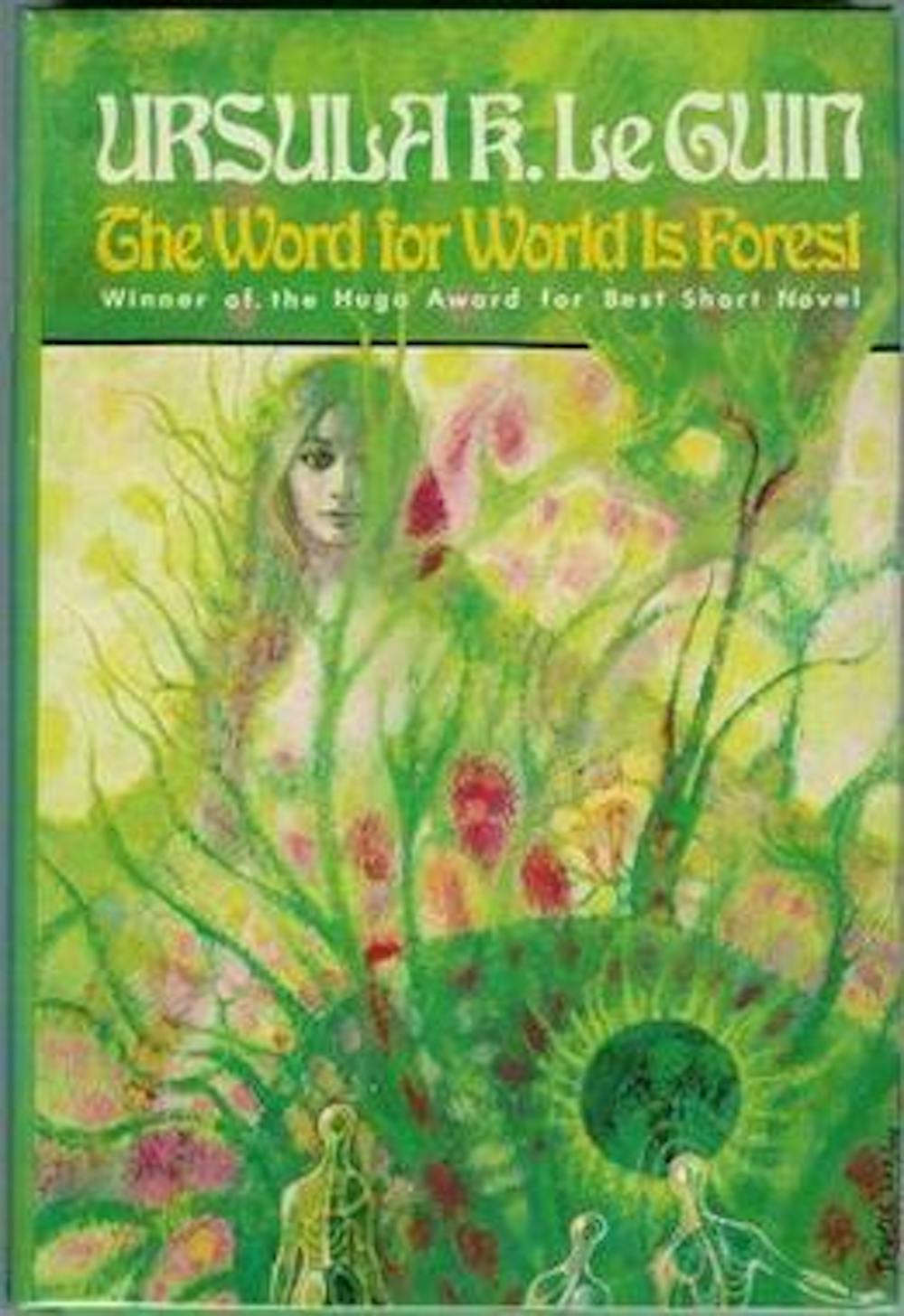
In 1972, the US was still fighting the Vietnam War. In the same year, Le Guin offered her own “distanced” version of social reality in The Word for World is Forest, which depicts the attempted colonisation of an inhabited alien planet by a macho, militaristic Earth society intent on conquering and violating the natural world – a semi-allegory for what the USA was doing at the time in south-east Asia.
The Vietnam War reimagined.
Wikipedia, CC BY

As well as repudiating the worst parts of the genre, such responses implied a positive model for science fiction. Science fiction wasn’t about evading reality – it was a literary anthropology which made our own society into a foreign culture which we could stand back from, reflect on, and change.

Rather than ask us to pull on our anti-gravity boots, open the escape hatch and leap into fantasy, science fiction typically aspires to be a literature that faces up to social reality. It owes this ambition, in part, to psychology’s repeated accusation that the genre markets escapism to the marginalised and disaffected.The Conversation

Gavin Miller, Senior Lecturer in Medical Humanities, University of Glasgow

This article is republished from The Conversation under a Creative Commons license. Read the original article.

Unknown's avatar

Who owns Dumbledore – JK Rowling or the Harry Potter fans?


Jessica Seymour

What would Dumbledore do? It’s a question that’s galled many die-hard fans of JK Rowling’s phenomenally successfully Harry Potter books since the author last week signed an open letter opposing a cultural boycott of Israel, and instead advocated for cultural dialogue between the two countries.

Their responses have played out in a flurry of Twitterverse exchanges, with many fans arguing that the lesson of the Harry Potter story was, as Helen Lewis summarises in The Guardian:

That talking wasn’t enough to end conflicts. Look at the Wizarding War […] If Harry had tried to coax Lord Voldemort to a UN summit in Geneva rather than destroying his Horcruxes, everyone would have ended up dead. Not just Tonks, Remus Lupin and one of the Weasley twins.

One Potter fan in particular gained media attention with a Facebook letter to the author which presented the argument in the following way:

I am writing to you in response to your public support for Israeli-Palestinian dialogue and opposition to the BDS movement in the Guardian’s Culture for Coexistence. As a Palestinian, I have to say that I was completely disappointed when I read about this, because your books have been the very source of all the hope I have for peace and justice in my homeland someday.

Rowling, in her response to the fan, also drew on Dumbledore and the Harry Potter series to make her point, stating that:

I’ve received a lot of messages over the past few days that use my fictional characters to make points about the Israeli cultural boycott. This isn’t a complaint: those characters belong to the readers as well as to me, and each has their own life in the heads of those who have read them. Sometimes the inner lives of characters as imagined by readers are not what I imagined for them, but the joy of books is that we all make our own mental cast.

What began as a debate about the Israeli-Palestinian conflict has since developed into a discussion about whether Rowling had the right to use Dumbledore’s characterisation to support her argument. It’s a discussion that raises interesting questions about the relationship between authors and fans of their work.

According to French theorist Roland Barthes, the author has been dead for many decades, but Barthes was writing before social media gave us unprecedented access to authors’ thoughts and feelings. The author has, in a manner of speaking, been revived. But does this change the audience’s relationship with authorial intent?

Debate on Twitter centred on the appropriateness of Rowling using Dumbledore to discuss the Israeli-Palestinian conflict. Fans cited his character’s sympathy with pure-blood supremacy in his youth. Others opined Dumbledore is too powerful to stand in for either side in the political debate. Others claim the conflict is too dense to be reflected in an example from Harry Potter.

While the latter point may be valid, it would be remiss not to acknowledge the way Harry Potter books explore grand themes such as racism and discrimination.


Stimpdawg

As fans have noted, the wizarding world becomes obsessed with purging “muggle-borns” during the reign of Voldemort, despite the fact that many talented witches and wizards come from non-magical backgrounds (Hermione Granger, Harry’s best friend and the brightest witch of her age, is a prime example of this).

The desire to attack people who are different is the central concern of the story, and as Rowling herself noted in her Twitter exchange:

It was true in the Potter books and it is true in life that talking will not change wilfully closed minds.

Rowling’s use of a fictional magician to articulate her political beliefs was considered by some to be “misguided” – particularly because, in some cases, fans considered her approach to be a misinterpretation of the spirit of the books. To which Rowling responded:

I can only say that a full discussion of morality within the series is impossible without examining Dumbledore’s actions, because he is the moral heart of the books. He did not consider all weapons equal and he was prepared, always, to go to the hilltop.

What we must remember when discussing the interpretive potential of Dumbledore and the Harry Potter franchise as a whole is that the books are more than just books. Hogwarts is not an object that people can examine objectively – every fan of the Harry Potters series has interpreted it in their own way, and often the way that it is interpreted can say more about the interpreter than it does about the story.

JK Rowling in 2011.
EPA/Andy Rain

There are generally two ways that people tend to approach interpreting the Harry Potter universe: through the canon, which is all of Rowling’s writings and commentary, and extra-textual spaces such as Pottermore.com; or through “fanon”, which is how fans have developed the series through their discussions, fan-produced art and stories, and their “head canons” (or their personal interpretations of characters and events).

Fans have begun to approach Rowling’s extra-textual interpretations of the texts by examining them, deciding whether they fit into their overall interpretation of the work, and either incorporating or discarding them. Readers may embrace the ridiculously-named Fleamont Potter (Harry’s grandfather) but take issue with Rowling’s assertion that Remus Lupin never fell in love before he met Nymphadora Tonks (because many fans interpret him as bisexual, with a potential love interest in Sirius Black).

It is heartening to see Rowling acknowledge the fraught relationship between reader interpretation and authorial intent. In the response Rowling posted on Twitter, titled “Why Dumbledore went to the hilltop”, she wrote:

Sometimes the inner lives of characters as imagined by readers are not what I imagined for them, but the joy of books is that we all make our own mental cast […] All books dealing with morality can be picked apart for those lines and themes that best suit the arguer’s perspective.

There is a question of ownership at work here which will not be resolved through a social media exchange, but it is clear that while the author may have been revived the fans are not taking her words as gospel. At this point, Dumbledore is under the joint custody of JK Rowling and her legion of fans.

The Conversation

Jessica Seymour, Sessional Academic

This article was originally published on The Conversation. Read the original article.

Unknown's avatar

Interactive Game of Thrones Map with Spoilers Control


Interactive Game of Thrones Map

‘A Song of Ice and Fire,’ by George R. R. Martin has been a massive success, as has the television show based on the book. This link is to an interactive map for ‘A Game of Thrones’ fans.

Unknown's avatar

Book Review: Currently Reading – Print is Dead, by Jeff Gomez


I have been reading ‘Print is Dead – Books in our Digital Age,’ by Jeff Gomez and have now reached ‘Writers in a Digital Future.’ Here Gomez explores the possibilities for authors, possibilities that weren’t available in the past. Some attempts at interactive narrative have appeared prior to the digital world, but the opportunities for experimentation are now seemingly endless. As I have mentioned before, the possibilities now exist for the inclusion of various media, such as pictures, music, video, etc. Hyperlinks to other features can now be included in ebooks, allowing in-depth studies of characters for novel writers/readers, treatments of historical events at length and so on. There is just so much room for experimentation in the digital world for authors of all genres, even in ways perhaps not yet imagined.

There is however more opportunity for the digital author, for he/she is now able to interact with the reader via means other than the actual ebook being read. The opportunity exists for collaborative websites, forum and chat room interaction, live video interviews and so many other avenues to interact with fans and readers of his/her material. Of course social networks like Facebook and MySpace provide the means for setting up fan pages and the like also.

So the digital world offers many opportunites and the possibilities for a brave new world of literature are there waiting to be seized. Sooner, rather than later, the digital future will arrive in a big way and authors/publishers need to be ready to meet the online demand that will surely come.

See also:
http://www.dontcallhome.com/books.html (Website of Jeff Gomez)
Podcast (Excerpts from the Book)
Google Books
Amazon