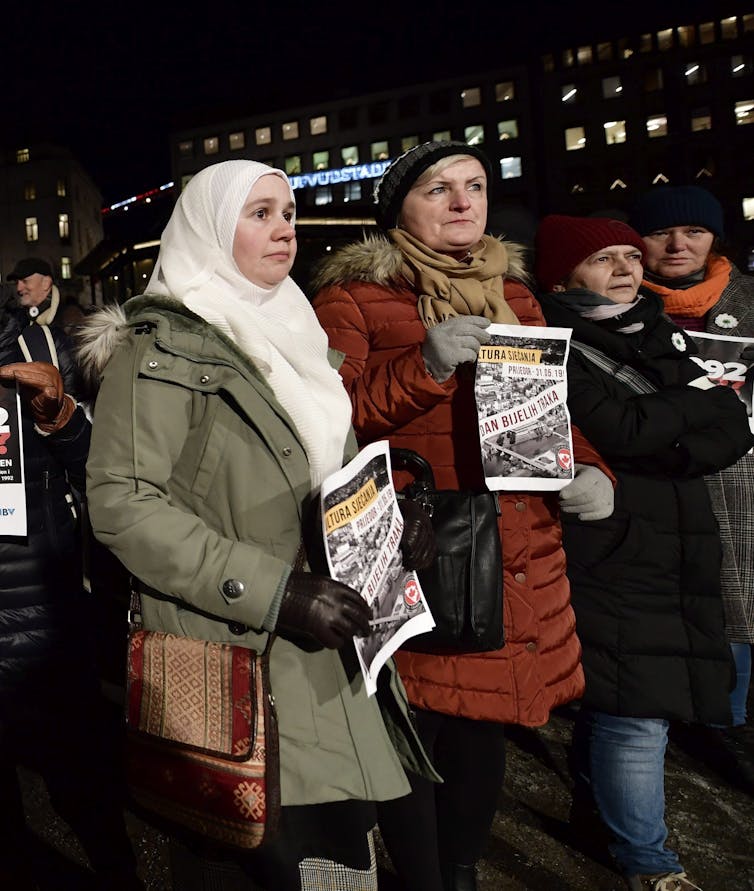
Demonstrators protest the awarding of the 2019 Nobel literature prize to Peter Handke in Stockholm, in December 2019. Stina Stjernkvist/TT News Agency via AP
Austrian writer Peter Handke received the 2019 Nobel Prize in literature. The award is for “a writer’s life work,” and Handke has written novels, travelogues, theatre plays, screenplays and poetry.
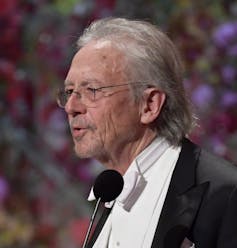
Literature laureate 2019 Peter Handke gives his speech during the Nobel banquet at Stockholm City Hall, on Dec. 10, 2019. Anders Wiklund/TT News Agency via AP
The announcement of the award generated public uproar.
The controversy has spurred long-standing debates about where stories come from, who is responsible for them and what it means as a writer to bear witness to truth — and also, which persons or institutions have the authority to do so.
The publisher of the English-language 1997 translation describes the book on its jacket as both a “sensitive and nuanced meditative travelogue through Serbia,” and a “scathing criticism of western war reporting.”
Handke’s Nobel nomination particularly inflamed journalists and survivors of the Srebrenica genocide, where more than 8,000 Bosnian Muslim men and boys were killed in July 1995, during the 1992-95 war in Bosnia. Various intellectuals, as well as the broader public voiced their dissent about Handke receiving the award on Twitter following the award announcement.
The bigger context is that some perpetrators denied findings of the International Criminal Tribunal for the former Yugoslavia (sometimes referred to as the Hague Tribunal, based in The Hague, Netherlands) — and the tribunal documented atrocious strategies to conceal crimes, such as moving mass graves. Denials of the Srebrenica genocide continue today.
Many statements in defence of the award echo earlier French and British 20th century literary criticism.
Evaluating the text’s language alone?
The French philosopher Roland Barthes’s influential 1967 essay “The Death of the Author” served to elevate literary work and its language. Barthes wrote: “It is language which speaks, not the author.”
For French philosopher Michel Foucault, the author is a kind of scribe who commits language to paper. The implication is that the author is writing down the realities of the world outside. In his view, “the function of the author is to characterize the existence, circulation and operation of certain discourses within a society” — meaning, ideas and messaging, as he elaborated in his 1969 essay “What is an Author?”
Before them, T.S. Eliot proclaimed in 1919 that writing “is not the expression of personality, but an escape from personality.”
As feminist literary scholar Cheryl Walker has noted, independence-of-the-text critiques have to a certain extent helped “liberate the text for multiple uses,” like re-reading canonical texts from critical feminist perspectives.
But such critiques have also been at odds with literary traditions on the margins.
Historically, the significance of lived personal and collective experiences have been central features of texts by women, Black, Indigenous and people of colour, queer or transgender writers.
These literatures, their readers and their institutions of criticism have long resisted calls to separate author, text and political or social impact.
They have have asserted either that the personal is political or that perspective is situational — and rejected the notion that literary work can considered unpolitical.
Award fuelled ethnonationalist politics
Critics of Handke’s receipt of the Nobel award challenge the notion that Handke’s literary work can be evaluated apart from its political implications.
How or if the Swedish Academy will respond to these developments as the public demands it approach the award more cautiously remains to be seen. It seems unlikely that it will rescind Handke’s award.
But the academy is implicated in this affair no matter what.
In recent times the Nobel Prize for Literature has been plagued by controversy – the link below is to an article that takes a look at the fairly recent resignations of members of the committee.
The links below are to articles with the latest on the copyright and piracy controversy engulfing the Internet Archive, with a response from the Internet Archive.



 At the BookShelf