Unknown's avatar

Guide to the classics: the Epic of Gilgamesh


Image 20170322 27966 yag6gc
Gilgamesh explores what it means to be human, and questions the meaning of life and love.
Wikimedia Commons

Louise Pryke, Macquarie University

“Forget death and seek life!” With these encouraging words, Gilgamesh, the star of the eponymous 4000-year-old epic poem, coins the world’s first heroic catchphrase. The Conversation

At the same time, the young king encapsulates the considerations of mortality and humanity that lie at the heart of the world’s most ancient epic. While much has changed since, the epic’s themes are still remarkably relevant to modern readers.

Depending upon your point of view, Gilgamesh may be considered a myth-making biography of a legendary king, a love story, a comedy, a tragedy, a cracking adventure, or perhaps an anthology of origin stories.

All these elements are present in the narrative, and the diversity of the text is only matched by its literary sophistication. Perhaps surprisingly, given the extreme antiquity of the material, the epic is a masterful blending of complex existential queries, rich imagery and dynamic characters.

The narrative begins with Gilgamesh ruling over the city of Uruk as a tyrant. To keep him occupied, the Mesopotamian deities create a companion for him, the hairy wild man Enkidu.
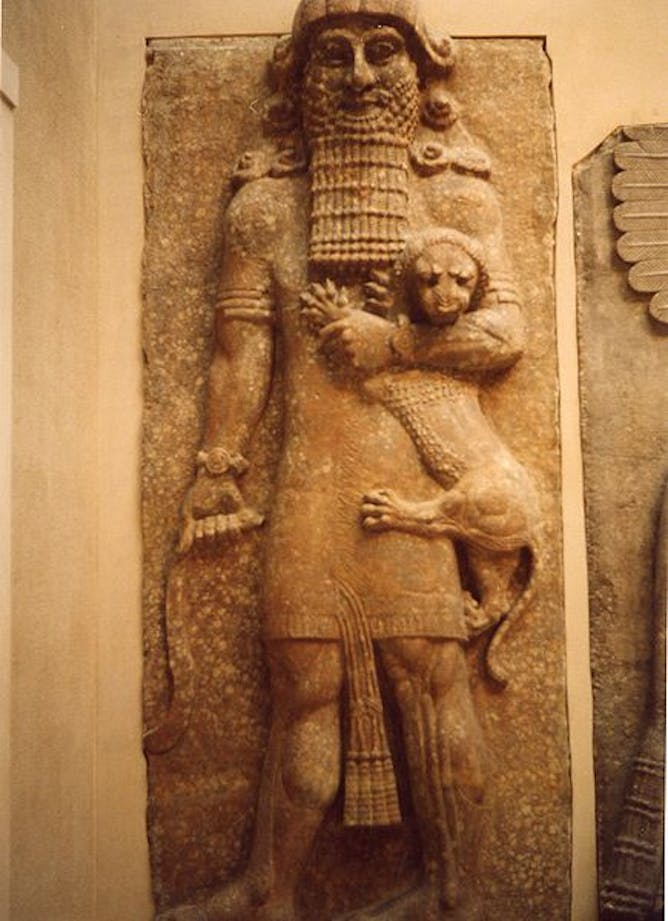
Gilgamesh in his lion-strangling mode.
TangLung, Wikimedia Commons, CC BY

Gilgamesh sets about civilising Enkidu, a feat achieved through the novel means of a week of sex with the wise priestess, Shamhat (whose very name in Akkadian suggests both beauty and voluptuousness).

Gilgamesh and Enkidu become inseparable, and embark on a quest for lasting fame and glory. The heroes’ actions upset the gods, leading to Enkidu’s early death.

The death of Enkidu is a pivotal point in the narrative. The love between Gilgamesh and Enkidu transforms the royal protagonist, and Enkidu’s death leaves Gilgamesh bereft and terrified of his own mortality.

The hero dresses himself in the skin of a lion, and travels to find a long-lived great flood survivor, Utanapishtim (often compared with the biblical Noah). After a perilous journey over the waters of death, Gilgamesh finally meets Utanapishtim and asks for the secret to immortality.

In one of the earliest literary anti-climaxes, Utanapishtim tells him that he doesn’t have it. The story ends with Gilgamesh returning home to the city of Uruk.

Mesopotamian mindfulness

Gilgamesh and his adventures can only be described in superlative terms: during his legendary journeys, the hero battles deities and monsters, finds (and loses) the secret to eternal youth, travels to the very edge of the world — and beyond.

Despite the fantastical elements of the narrative and its protagonist, Gilgamesh remains a very human character, one who experiences the same heartbreaks, limitations and simple pleasures that shape the universal quality of the human condition.

Gilgamesh explores the nature and meaning of being human, and asks the questions that continue to be debated in the modern day: what is the meaning of life and love? What is life really — and am I doing it right? How do we cope with life’s brevity and uncertainty, and how do we deal with loss?

The text provides multiple answers, allowing the reader to wrestle with these ideas alongside the hero. Some of the clearest advice is provided by the beer deity, Siduri (yes, a goddess of beer), who suggests Gilgamesh set his mind less resolvedly on extending his life.

Instead, she urges him to enjoy life’s simple pleasures, such as the company of loved ones, good food and clean clothes — perhaps giving an example of a kind of Mesopotamian mindfulness.

The king-hero Gilgamesh battling the ‘Bull of Heaven’.
Wikimedia Commons, CC BY

The epic also provides the reader with a useful case study in what not to do if one is in the exceptional circumstance of reigning over the ancient city of Uruk. In ancient Mesopotamia, the correct behaviour of the king was necessary for maintaining earthly and heavenly order.

Despite the gravity of this royal duty, Gilgamesh seems to do everything wrong. He kills the divinely-protected environmental guardian, Humbaba, and ransacks his precious Cedar Forest. He insults the beauteous goddess of love, Ishtar, and slays the mighty Bull of Heaven.

He finds the key to eternal youth, but then loses it just as quickly to a passing snake (in the process explaining the snake’s “renewal” after shedding its skin). Through these misadventures, Gilgamesh strives for fame and immortality, but instead finds love with his companion, Enkidu, and a deeper understanding of the limits of humanity and the importance of community.

Reception and recovery

The Epic of Gilgamesh was wildly famous in antiquity, with its impact traceable to the later literary worlds of the Homeric epics and the Hebrew Bible. Yet, in the modern day, even the most erudite readers of ancient literature might struggle to outline its plot, or name its protagonists.

A statue of Gilgamesh at the University of Sydney.
Gwil5083, Wikimedia Commons, CC BY

To what might we owe this modern-day cultural amnesia surrounding one of the world’s greatest works of ancient literature?

The answer lies in the history of the narrative’s reception. While many of the great literary works of ancient Greece and Rome were studied continuously throughout the development of Western culture, the Epic of Gilgamesh comes from a forgotten age.

The story originates in Mesopotamia, an area of the Ancient Near East thought to roughly correspond with modern-day Iraq, Kuwait and parts of Syria, Iran and Turkey, and frequently noted as “the cradle of civilisation” for its early agriculture and cities.

Gilgamesh was written in cuneiform script, the world’s oldest known form of writing. The earliest strands of Gilgamesh’s narrative can be found in five Sumerian poems, and other versions include those written in Elamite, Hittite and Hurrian. The best-known version is the Standard Babylonian Version, written in Akkadian (a language written in cuneiform that functioned as the language of diplomacy in the second millennium BCE).

The disappearance of the cuneiform writing system around the time of the 1st century CE accelerated Gilgamesh’s sharp slide into anonymity.

For almost two millennia, clay tablets containing stories of Gilgamesh and his companions lay lost and buried, alongside many tens of thousands of other cuneiform texts, beneath the remnants of the great Library of Ashurbanipal.

Tablet V of the Epic of Gilgamesh.
Osama Shukir Muhammed Amin, Wikimedia Commons

The modern rediscovery of the epic was a watershed moment in the understanding of the Ancient Near East. The eleventh tablet of the Epic was first translated by self-taught cuneiform scholar George Smith of the British Museum in 1872. Smith discovered the presence of an ancient Babylonian flood narrative in the text with striking parallels to the biblical flood story of the Book of Genesis.

The story is often repeated (although it may be apocryphal) that when Smith began to decipher the tablet, he became so excited that he began to remove all his clothing. From these beginnings in the mid-19th century, the process of recovering the cuneiform literary catalogue continues today.

In 2015, the publication of a new fragment of Tablet V by Andrew George and Farouk Al-Rawi made international news. The fragment’s discovery coincided with increased global sensitivity to the destruction of antiquities in the Middle East in the same year. The Washington Post juxtaposed the “heart-warming story” of the find against the destruction and looting in Syria and Iraq.

Ancient ecology

The new section of Tablet V contains ecological aspects that resonate with modern day concerns over environmental destruction. Of course, there are potential anachronisms in projecting environmental concerns on an ancient text composed thousands of years prior to the industrial revolution.

Yet, the undeniable sensitivity in the epic’s presentation of the wilderness is illuminating, considering the long history of humanity’s interaction with our environment and its animal inhabitants.

A cedar forest in Turkey.
Zeynel Cebeci, Wikimedia Commons, CC BY

In Gilgamesh, the wilderness is a place of beauty and purity, as well as home to a wild abundance. The splendour and grandeur of the Cedar Forest is described poetically in Tablet V:

They (Gilgamesh and Enkidu) stood marvelling at the forest,

Observing the height of the cedars …

They were gazing at the Cedar Mountain, the dwelling of the gods, the throne-dais of the goddesses …

Sweet was its shade, full of delight.

While the heroes pause to admire the forest’s beauty, their interest is not purely aesthetic. Gilgamesh and Enkidu are aware of the economic value of the cedars, and the text provides a clear picture of competing commercial and ecological interests.

Where to read Gilgamesh

Since Gilgamesh’s reappearance into popular awareness in the last hundred years, the Standard Babylonian Version of the epic has become accessible in numerous translations. This version was originally compiled by the priest, scribe and exorcist, Sin-leqi-uninni, around 1100 BCE.

The scholarly standard among modern translations is Andrew George’s The Babylonian Gilgamesh Epic: Introduction, Critical Edition and Cuneiform Texts (2003).

Despite its all-around excellence, the two-volume work is decidedly unwieldly, and the less muscle-bound reader would be well directed to The Epic of Gilgamesh: A New Translation (1999), by the same author. Most readable among modern treatments is David Ferry’s Gilgamesh: A New Rendering in English Verse (1992), which gives a potent, poetic interpretation of the material.

Like the snake that steals Gilgamesh’s rejuvenation plant, the Epic of Gilgamesh has aged well. Its themes – exploring the tension between the natural and civilised worlds, the potency of true love, and the question of what makes a good life – are as relevant today as they were 4,000 years ago.

Note: Translations are sourced from Andrew R. George 2003. The Babylonian Gilgamesh Epic: Introduction, Critical Edition and Cuneiform Texts, Volume 1. Oxford: Oxford University Press.

Louise Pryke, Lecturer, Languages and Literature of Ancient Israel, Macquarie University

This article was originally published on The Conversation. Read the original article.

Unknown's avatar

Guide to the classics: Neil Gaiman’s American Gods


Image 20170316 10911 1d0qtvq
Yggdrasil, the tree that supports the world in Norse myth, can be found in America in Neil Gaiman’s mash-up of world religion.
Starz

Elizabeth Hale, University of New England

Fans of Neil Gaiman are having a bountiful year. In February there was the release of his retelling of the Norse myths. In March, Dark Horse is releasing the comic book adaptation of his influential 2001 novel American Gods. And in April, American Gods comes to the small screen, released through Starz. The Conversation

If you like your literary gods multiple and varied, from cultures galore, in a controlled riot of power, fear, wit, and wisdom, then American Gods is for you.

Its premise is one of the book’s many appeals: the United States contains all sorts of ancient gods from abroad, surviving in the myths and stories and imaginations of the immigrants who brought them there. It’s a novel that investigates the American condition through its beliefs, and its contradictions, and offers the idea that gods walk among us (if we only know where to look for them).

‘All the tradition we can get’

In American Gods, a man named Shadow is released from prison when his wife dies in a car accident. As he travels home, he falls in with Mr Wednesday, a mysterious grifter, who offers him a job as a bodyguard. When he accepts the offer, they seal the deal by drinking mead, the honey-wine that is the drink of Norse gods and warriors. “We need all the tradition we can get,” says Wednesday, referring to the seriousness of their deal, but also to the key concept of the novel.

It emerges that Wednesday is really the Norse god, Odin, drawn to the US by Viking voyagers. “Tradition,” in the form of old gods like Odin, is under threat, he tells Shadow. People don’t believe in old gods any more; they’re too busy worshipping new gods, or concepts, like cities and towns, roads and rails, high finance, media, and digital technology. As an “old” god, Wednesday is preparing to do battle with the new ones. A god who is not believed in suffers a particularly final form of death.

With Shadow in tow, Wednesday traverses the US, calling the old gods to action, convincing them to gather and fight enemies like Mr Town and Media.

They call on Czernobog, the Bulgarian god of darkness, who lives in Chicago with the Zorya star sisters of Morning, Evening and Night. And Easter, the German goddess of fertility and rebirth, in whose footsteps flowers bloom, who is living in San Francisco. Mr Jacquel, the Egyptian god Anubis, runs a funeral parlour with his partner Ibis (the god Thoth), in Cairo, Illinois. Mr Nancy, Anansi the African spider-trickster god, and Mad Sweeney, an original Irish leprechaun, appear from time to time, as do many others.

Wednesday (Ian McShane) and Shadow Moon (Ricky Whittle) in the 2017 adaption of American Gods.
Starz

From Haitian Voodoo figures to Hungarian Kobbolds this America is inhabited by a panoply of old gods. It’s symbolic of the elaborate tapestry of heritage that makes up a nation that prides itself on its newness, but is uneasily aware of its traditions. As Shadow crosses America, he reflects on these ironies, as well as the local quirks he observes, slotting them into an increasing sense of the nation’s variety and commonalities.

Interspersed throughout American Gods are extracts from a history, ostensibly written by Mr Ibis (the Old Egyptian God, Thoth). These extracts tell how other gods and mythical beings make their way to the US, in the beliefs and stories of different culture. There’s Essie Tregowan, a Cornish con-artist who is transported to America, and who brings with her the piskies of her youth, or Salim, a taxi-driver from Oman who becomes a jinn. Postmodern novels often use approaches like this to broaden the range of reference; these inset stories provide a neat way of exploring different gods and myths as they connect to Gaiman’s America.

While American Gods is a serious reflection on the nature of American culture, its most appealing aspect is the concept that the gods live among Americans, hiding in plain sight.

This is the key to American Gods’ continued popularity, I think: it offers the fantasy, the hope, (or the fear) that our reality is merely one plane of existence, that just out of sight, or in plain sight if we choose to look, is something bigger, something mythical, something more powerful.

Shadow Moon crosses America, gathering its tapestry of heritage.
Starz

And if you know how to find them, you have the opportunity to collect them, as Wednesday and Shadow do, to gather them together for a final battle, much as one might in an epic game of Dungeons and Dragons, or a supernatural round of Pokemon Go.

I do believe in fairies

Gaiman is not alone in exploring the power of belief and fantasy to keep the gods alive. It’s a theme that never quite goes away: witness JM Barrie’s comment in Peter and Wendy (1908):

Every time a child says, ‘I don’t believe in fairies,’ there is a fairy somewhere that falls down dead.

In Michael Ende’s The Neverending Story (1979), eroding belief in fiction is killing an imaginary kingdom called Fantasia, until an ideal child reader can bring it back to life. In contrast are Terry Pratchett’s piling of myth upon myth in the hugely popular Discworld series, or Rick Riordan’s recasting of the Perseus myth in the Percy Jackson series. All play in different ways with ideas about mythology, the role of belief, and the endurance of ancient ideas about power and creation.

In American Gods, Gaiman contrasts belief in the old gods with the flattening, meaningless forms of new media and digital technologies. But a lot has changed since June 2001 – not least the continuing evolution of the internet – which has turned into the ideal tool for reinvigorating and investigating them.

A new god, Technical Boy, played by Bruce Langley.
Starz

From online gaming communities, to exhaustive wikis, to the project I’m currently involved in, Our Mythical Childhood, which gathers and analyses the retellings of classical myth and culture in children’s texts around the world, people interested in mythlore are finding ways to think about myth using technology.

We like observing the gods, exploring their powers, telling their stories in different ways, collecting them, arranging them, playing with them. We seem to like all the tradition we can get, even on the most cutting edge of technological advancement.

‘Right angles to reality’

American Gods is a response to the perceived flat soullessness of a tech-heavy, media-heavy, corporatised, citified, sophisticated world. Divorced from the old gods, which symbolise the meaningful association with life and the land, Wednesday wonders what hope is there for society.

And yet, it emerges that Mr Wednesday is as much of a soulless con-artist as any of the new gods he despises, manipulating the battle for his own power. It takes an act of real, primal sacrifice on Shadow’s part to let him to see through the con, and understand that, when it comes down to it, as a human, all you have is yourself:

You know, I think I would rather be a man than a god. We don’t need anyone to believe in us. We just keep going anyhow. It’s what we do.

Though the advertisements for the upcoming television series exhort viewers to “Believe,” the response might well be: “Believe in what?”

In the novel, it is the land that eclipses gods and men, as Whiskey Jack, the Native American trickster spirit, tells Shadow after the battle is over:

Listen, gods die when they are forgotten. People too. But the land’s still here. The good places, and the bad. The land isn’t going anywhere.

Believe in the land, then. Gaiman’s novel finds its power in the land, in the people’s relation to the land, in the quirky, carnivalesque, homespun totems and places of power he nominates as places to overlay his web of mythicalism. This is the ultimate appeal of American Gods: the idea that all you have to do is find the places of power.

In this novel they are out-of-the-way carnivalesque sites carved into rock-faces, such as Tennessee’s Rock City and Illinois’ House on the Rock (both real-life American tourist attractions).

Gaiman turns the surreal – and highly popular – House on the Rock attraction into an all-American place of power.
House on the Rock

To access the mythical plane, go to places like these, and turn at “right angles to reality” (easier said than done, but at least Gaiman gives us the clue). That’s the ultimate point of novels like this, which invest reality with mythology, magic or fantasy: the promise of finding out the true story lying beneath the surface, the secret to the universe.

This book, beyond collecting, analysing, and arranging American gods, is an examination of power – what is real power, and what is not. “Mythologies,” Gaiman said, round about the time he must have been mulling over American Gods, “have always fascinated me. Why we have them. Why we need them. Whether they need us.”

It will be interesting to see what the TV adaptation does with American Gods, whether it takes on this questioning. But the questioning may also have changed. The novel was published in June 2001, and the Western world turned sharply at right angles to itself not long after.

One new element of the adaptation, preview writers have noticed already, is the addition of Vulcan, the Roman God of metallurgy and weaponry. It’s a highly appropriate comment on an America now more than ever in the grip of gun-ownership, and intriguingly it adds a figure from the classical Roman pantheon, missing from the original. Adaptations always move the conversation on a little. Perhaps the gods, too, move with the times.

Elizabeth Hale, Senior Lecturer in English and Writing (children’s literature), University of New England

This article was originally published on The Conversation. Read the original article.

Unknown's avatar

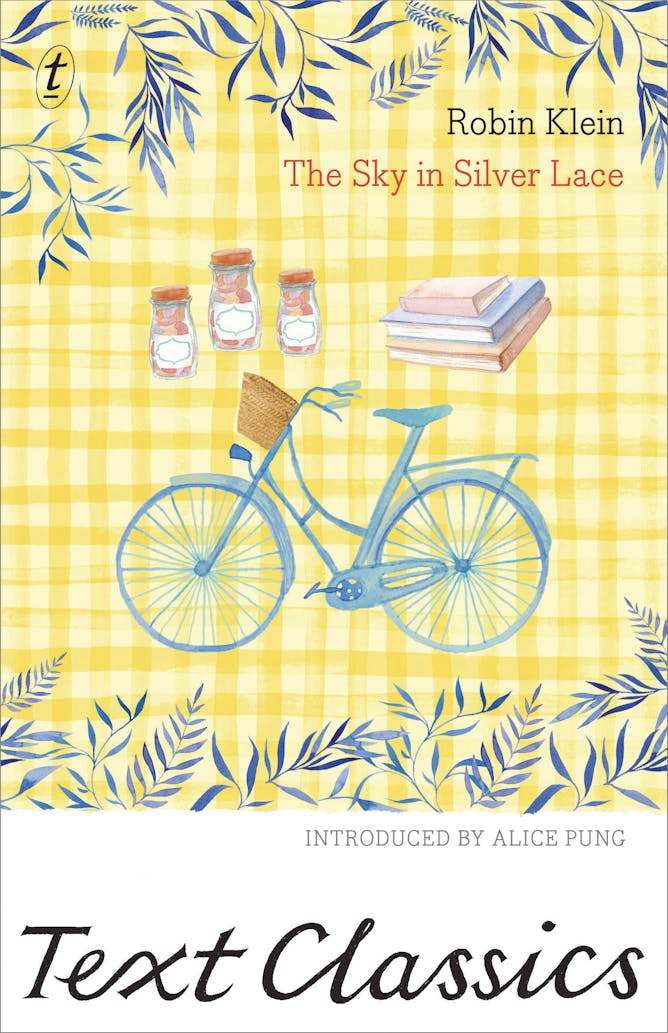
Guide to the classics: Alice Pung on Robin Klein’s The Sky in Silver Lace


Alice Pung, University of Melbourne

I can still remember reading All in the Blue Unclouded Weather when I was 12, and then the excitement I felt when the librarian at our tiny Catholic school, Mrs Kerr, told me that there was a sequel. She put it on reserve for me, and I read Dresses of Red and Gold when I was 13. Finally, when I read The Sky in Silver Lace at 16, I remember the curious melancholy I felt long afterwards.

By then I was at my fourth school in five years, a selective-entry, all-girls high school in the city, not all that different from Cathy and Heather Melling’s. I missed my librarian friend, our Book Week dress-ups, and the innocence of those earlier days. More so than any other contemporary “teenage girl fiction” of the time, Robin Klein’s trilogy conveyed for me most accurately and achingly, the transition from girlhood to young adulthood, from naïve hope to acute awareness of one’s class and circumstances.

The Melling sisters — like Alcott’s March sisters and Austen’s Bennett sisters — are a quartet of girls who become women during the course of tribulation. There is Grace the beauty, Cathy the tomboy, Heather the performer and Vivienne the dreamer, all growing up in an Australia that has just seen the Great Depression and two world wars.

Unlike the Marches or Bennetts, however, there is no superimposed didactic altruism in Klein’s Melling sisters: she depicts their secret selfish longings and embarrassments of poverty with such honesty that you can’t help rooting for these girls.

In fact, with its cast of supercilious relatives, its small-town scuttlebutting and girlish rivalries, Klein’s trilogy resonated strongly with me, an Asian girl with refugee parents growing up in the 1980s and 1990s. It reminds me now, as an adult, that no matter how genteel our veneer, we are all come from a history of feral battlers just trying to make it.

In all the years since my first reading, there was a peripheral character I never forgot, not her name, appearance or her circumstances: Phyllis Gathin. Phyllis’ character contained all that was true and devastating about the forced humility of the destitute. Back in the country town, the Mellings were poor but not as poor as the Gathins.

Phyllis does not make an appearance in this book, now that the Mellings have moved to the city, but her legacy lingers. To now be the recipients of charity—second-hand discounted uniforms, lodgings, a housing-commission flat—deeply wounds the collective pride of the Melling sisters. Yet their longings bring vast ingenuity and insight into their lives.

Instead of making them insipid whiners, the girls’ desire for material things is the catalyst for their resourcefulness, self-agency, energy, inventiveness and even charity. They invent games, make things, write stories. However, city life confines the Mellings to those far-flung suburbs without community, and the girls have never felt so alienated. Even when they visit the city centre, they find it to be a hostile place, peopled by mean relatives, expensive shops and unfriendly characters.

‘Dirty big chunks of steel wool’

As she was in the first books of the trilogy, Vivienne is the heartbeat of this novel. As the youngest sister, she is allowed to have uncomplicated feelings of sadness and longing for Wilgawa, Klein’s fictional country town that represents the warmth of a post-war rural community. The “sky in silver lace” is Vivienne’s euphemistic metaphor for the encroaching hard times. Cathy, always to the point, finds Vivienne’s diary and mocks her for it:

If you mean rainclouds, they don’t look a bit like lace—more like dirty big chunks of steel wool. Not to mention all the other soppy stuff about leaving Wilgawa that came earlier…

Vivienne’s loss of innocence happens over a gentle gradient, like the seasons changing from autumn to winter. As their physical world contracts — to a few back rooms in Captain Fuller’s house, to petty Aunt Elsa’s where they are unwelcome guests, and finally their own tiny flat — so do their movements. Heather’s magnetic personality is confined to the stage, Cathy’s adroit rambling limbs to the hockey court, and even poor Isobel is a fish out of water on her visit to the city.

Robin Klein.
Text publishing

By the end of the day, she is trailing Vivienne and lagging behind her now-insufferable cousins who rabbit on and on about their new school. Your heart breaks for Isobel’s “squashed voice”.

Gone are the hijinks of previous novels — Isobel’s mild case of kleptomania, Cathy’s three-storeyed treehouse, the girls’ ghost-hunting — but in their place is deeper character development. We gain insight into Connie Melling, the loving and once wonderfully eccentric mother — maker of doyley flatteners, creator of poems
for bereaved community members — now burdened with a weightier responsibility, as she singlehandedly navigates a changed city with her four daughters.

Her stoicism and resilience is now tested in a world filled with hostile, stressed-out, easily irritated adults who know very well how tenuous their jobs, statuses and hold on their homes are. Oldest sister Grace, a minor character in the previous books, now comes into her own in a powerful, dignified chapter.

Characters of grit and mettle

All three books unabashedly focus on the interests of burgeoning teenage girls: their preoccupations with dolls, bridesmaids’ dresses, little blue rowboats, fancy school tunics, delicious teacakes, matinee-movie stars and Tennysonian maidens floating down a river stream.

Each chapter is filled to the brim with delightful sartorial details — Grace’s purple cape and hat, Cathy’s pinafore, Isobel’s Bonnie Prince Charles outfit, Dior’s New Look — at a time when “respectable people” went out in public with white hankies, gloves and a hat.

But to dismiss these as books dealing with shallow feminine pursuits is to say that Little Women is about four girls who sew while they wait for their father to come home from the war. The gutsiness of these Australian siblings lies in their ability to find extraordinary plea- sure in ordinary existence during a time of uncertainty and flux.

The Melling girls’ larger-than-life larrikin father is absent in this final book, and the only males to appear are three minor characters: crotchety old Captain Fuller who provides Mrs Melling with work, a kindly old man who restores her self-regard and one preening young narcissist who bores the sweet bejesus out of Heather.

These are not girls who live for the male gaze, and they probably wouldn’t care what that was. Too many authors self-consciously inject doses of feminist fuel into their young-adult novels. Such is the skill and integrity of Klein that she doesn’t mar the magic of her historical fiction with political anachronisms, but rather creates full characters made of grit and mettle who are dealing with their world at their time.

While the endgame for the Bennett sisters was matrimony, and for the March sisters domesticity (Good Wives), what will become of the Melling sisters and their cousin?

This last book is the most bittersweet volume, because the reader knows that after this we will never hear from them again. We leave them forever moving towards the middle of the last century. But we know that whatever they are doing, wherever they end up, their personalities will always triumph over their circumstances.

Robin Klein’s trilogy of Young Adult novels about the Melling sisters, All in the Blue Unclouded Weather (1991), Dresses of Red and Gold (1992) and The Sky in Silver Lace (1995) will be republished as Text Classics from February 27.

The Conversation

Alice Pung, Author (non-fiction, fiction, young adult), University of Melbourne

This article was originally published on The Conversation. Read the original article.

Unknown's avatar

Origins of Classic Fairy Tales


The link below is to an article that takes a look at the origin of several classic fairy tales, including Sleeping Beauty and Snow White.

For more visit:
http://www.omnivoracious.com/2017/01/abebooks-grimm-fairy-tales-amazon-book-review.html

Unknown's avatar

Guide to the classics: Moby-Dick, by Herman Melville


Sascha Morrell, University of New England

Pick up Herman Melville’s Moby-Dick (1851) expecting the story of a mad one-legged captain chasing a white whale and you’ll get more than you bargained for. This is a novel that announces itself as the tale of a whaling voyage, and expands from there as if to encompass the whole of existence. Its narrator, Ishmael, admits he is overwhelmed:

Friends, hold my arms! For in the mere act of penning my thoughts of this Leviathan, they weary me, and make me faint with their out-reaching comprehensiveness of sweep, as if to include the whole circle of the sciences, and all the generations of whales, and men, and mastodons, past, present, and to come, with all the revolving panoramas of empire on earth, and throughout the whole universe, not excluding its suburbs.

For Ishmael, everything is connected and “there is no staying in any one place; for at one and the same time everything has to be done everywhere”.

Herman Melville. By Joseph O. Eaton and an unknown etcher – Library of Congress.
Wikimedia Commons

The forward progress of “what there may be of a narrative in this book” is constantly hampered by Ishmael’s need to consider his subject from all angles, addressing the viewpoints of different characters as well as the perspectives of different cultures and branches of learning, together with historical and mythic parallels, technical details, workplace practices and the philosophical questions these give rise to.

Even in the midst of the final chase that drives the novel to a close with extraordinary momentum, Ishmael cannot resist inserting a footnote to clarify his use of the term “pitchpoling”.


The result is a radically discontinuous, multi-stranded text which insists on its own incompleteness as “but a draft of a draft”. In The Modern Epic (1996), the great literary scholar Franco Moretti contends that novels such as Herman Melville’s Moby-Dick and James Joyce’s Ulysses have become like:

sacred texts that the modern West has subjected to a lengthy scrutiny, searching in them for its own secret.

But whereas the ancient epic presents the world as a unified and coherent totality, the modern world can only hope to express itself through fragmentation, dialogue, digression and collage.

Moby-Dick’s explosion of narrative conventions was so revolutionary in its time that it perplexed Melville’s contemporaries and passed quickly into obscurity.

“There are evidently two if not three books in Moby Dick, rolled into one”, Melville’s mentor Evert Duykinck marveled. Readers wanted more of the relatively straightforward sea-faring adventure that Melville had delivered in his early novels Typee (1846) and Omoo (1847).

And at first, Moby-Dick seems to offer just that.

Although the famous invitation that opens the novel – “Call me Ishmael” – suggests an assumed or even an arbitrary identity, Ishmael initially presents as a more-or-less conventional first-person protagonist, telling how he packed his bag and “started for Cape Horn and the Pacific”.

But through the unlikely bond he forms with a Pacific Islander, Queequeg, Ishmael is liberated from the bounds of his individual perspective, and his cultural and racial biases.

He escapes the prison of interiority, “melting” into Queequeg through a same-sex, mixed-race “marriage” that sets the precedent for the more radical dissolution of Ishmael’s persona that takes place when he joins the Pequod’s crew.

For once the whaling cruise is underway, Ishmael tends to recede from his own narrative, declining to detail his own part in events while impossibly gaining access to a range of viewpoints far exceeding his own, including the private soliloquies of Captain Ahab.

Illustration of Queequeg and his harpoon. IW Taber – Moby-Dick – edition: Charles Scribner’s Sons, New York, 1902.
Wikimedia Commons

Ishmael turns out to be less a character than a conduit for other voices and perspectives. This is either a daring experiment in omniscient first-person narration, or a sign that Ishmael is utterly unreliable.

Other voices take over whole chapters, especially that of Ahab as he thumps the ship’s boards like a Lear or Richard III on the Elizabethan stage. As “one in a whole nation’s census […] formed for noble tragedies”, Ahab exerts a strong pull on the narrative, but Ishmael is eager to celebrate the “democratic dignity” of the Pequod’s multiethnic crew of “mongrel renegades and castaways and cannibals”.

The dramatic dialogue form of “Midnight—Forecastle” (Chapter 40) gives space to the voices of different crewmen, singly and in chorus, framed only by minimal “stage directions”. Generally, Ishmael declines to distinguish himself from the collective; he is merely “one of that crew” whose “shouts [go] up with the rest”.

Title page of the first edition of Moby-Dick, 1851. Source: Beinecke Library, Yale University.
Wikimedia Commons

He is also democratic in his levelling of all cultures, crediting the Hindu tradition of Vishnu’s “ten earthly incarnations”, consulting the views of “the highly enlightened Turks” alongside those of Western authorities, and beginning his history of Nantucket not with European but with American-Indian sources.

But there are limits to the novel’s inclusiveness, not least in that women are almost wholly absent. Two very minor female characters briefly appear: a chowder-making landlady and Charity, the prudish sister of one of the ship’s owners.

On the other hand, the novel makes numerous appeals to the maternal forces in nature. It also breaks down gender norms and boundaries, from Ishmael’s surrender to Queequeg’s “bridegroom clasp” to Ahab boasting of his “queenly personality” to the ambiguous mingling of “milk and sperm” in the infamously erotic chapter A Squeeze of the Hand.

Illustration from an early edition of Moby-Dick. A. Burnham Shute – Moby-Dick edition – C. H. Simonds Co. 1892.
Wikimedia Commons

Though he recedes as a character, Ishmael’s voice remains distinct in meditative passages and in his extended inquiries into the lore and science of whales and whaling. In a series of parodically “encyclopaedic” chapters that coincide with the cutting up of a whale by the ship’s crew, Ishmael presents a breakdown of the whale’s body so comprehensive that it not only separates the “skin of the creature” but even “the skin of the skin”.

This provides material for inquiries into disciplines as diverse as astronomy, lexicography, economics and jurisprudence. This may sound dry, but so infectious is Ishmael’s intellectual energy that chapters featuring such inauspicious titles as The Blanket, Cisterns and Buckets and Of the Less Erroneous Pictures of Whales and the True Pictures of Whaling Scenes can be some of the novel’s most engrossing.

At the same time, Ishmael undermines scientific authority by privileging forms of knowledge gained through immediate, hands-on experience:

Ere entering upon the subject of Fossil Whales, I present my credentials as a geologist, by stating that in my miscellaneous time I have been a stone-mason, and also a great digger of ditches, canals, and wells, wine-vaults, cellars, and cisterns of all sorts …

Unsatisfied with simply giving the comparative dimensions of Sperm and Right Whale’s heads, he asks us to actually enter their spaces; to see and touch their surfaces. Incidentally, Melville’s life experience had been as “miscellaneous” as Ishmael’s; aspects of his extraordinary biography are reimagined in Ron Howard’s film In the Heart of the Sea (2015).

Declaring that “there is an aesthetics in all things”, Ishmael demands that his reader take interest in such matters as work-tools and their usage, devoting whole chapters to these matters. With genial bravado, he continually advances the heroic claims of his apparently mundane industrial subject (the “whale fishery”) and appropriates a lofty epic language—as when he proposes to “sing” the “romantic proceeding of decanting off [the] oil into the casks.”

A global narrative

None of this is to say that the novel is lacking in narrative incident. There are feats of superhuman prowess; there is an encounter with a giant squid; there is a typhoon producing pyrotechnic terrors.

Fast-paced action abounds as other whales are chased and caught or lost at great peril (one of the crew, the Native American harpooneer Tashtego, nearly drowns inside a sperm whale’s head).

There is the tension between Ahab and the first mate Starbuck, who comes close to killing his captain, and the spectacle of Ahab dazzling the crew with his demagoguery.

There are encounters with other ships, including a stirring contest with a German vessel, and the tale-within-a-tale of a mutiny aboard another American whaler, the Town-Ho. And let us not forget, there is voyage round the globe.

A native New Yorker, Melville commences his story in the “isle of the Manhattoes” then takes readers in a “devious zig-zag world circle” across the Atlantic and Indian Oceans via Sumatra and the Sunda Strait, the Java and Chinese Seas, through Japanese waters to a fatal conclusion somewhere along the equator in the South Pacific.

Australia rates a mention, as “that great America on the other side of the sphere”, and Sydney as the source of the world’s most treacherous sailors (Melville himself had shipped on the Sydney whaler The Lucy-Ann in 1842). The voyage also yields political allegory, as numerous hints frame the Pequod as a symbolic “ship of state”, with running analogies between the whaling voyage and the United States’ imperial expansion, and various allusions to class conflict and slavery (especially when Ahab briefly forms a bond with the black ship’s boy Pip).

The novel conveys the wild energy of whaling life. A whaleman is “rocked to sleep between billows […] while under his very pillow rush herds of walruses and whales”. He spends so long at sea that the land starts to smell “strange[r] than the moon would to an Earthman”.

Physical and meta-physical

Melville excels in physical description, and he knows the bodily pleasures of such words as “plunge” and “suck”. He can raise us to giddying heights as Ishmael and Ahab revolve the mysteries of existence, then plunge us back to earth with bawdy humour, as in Chapter 95 when one of the crew wears the skin of a whale’s mighty penis (AKA “the Grandissimus”) as protective clothing.

Extraordinary metaphors and similes collapse the distance between disparate realms, as when Ishmael peeps into a Sperm whale’s head to find:

a really beautiful and chaste-looking mouth! from floor to ceiling, lined, or rather papered with a glistening white membrane, glossy as bridal satins.

Like the metaphysical poets, Ishmael fuses the abstract and the mechanical: “Top-heavy was the ship as a dinnerless student with all Aristotle in his head”, we read in Chapter 110.

Vivid violence

Be prepared for violence against nature. To the extent that Melville draws on his own whaling experience, animals were harmed in the making of this book. But though Ishmael is hardly out to “save the whales”, he can be sensitive to animal rights, contending that “the first man that ever murdered an ox” deserved to be “put on his trial by oxen” and that a cannibal is no worse than the “civilized” gourmand who tortures geese to get his pâté de foie gras.

He enters into non-human perspectives, imagining “how appalling to the wounded whale” the boats that surround it must appear, though the victim has “no voice” in its “agony of fright”.

One of the oldest known whaling paintings, by Bonaventura Peeters, at The Mariners’ Museum. 1645.
Wikimedia Commons

The whales in this novel are silent: Melville did not know about whale-song, and in any case sperm whales do not sing, though the music of the prose conveys a sense of their awesome vitality.

The impotence of humankind against the ocean’s physical force and destructive capacity is also a constant theme, and Ishmael introduces “archaeological, fossiliferous, and antideluvian points of view” that challenge anthropocentricism itself (fittingly, a recently discovered fossil whale was named albicetus – meaning “white whale” – in honour of Moby-Dick).

He even reflects on climate change, gaining “dim, shuddering glimpses into those Polar eternities; when wedged bastions of ice pressed hard upon what are now the Tropics” when contemplating a whale’s bones.

All about Ahab

While Ishmael’s digressive habits threaten to derail the narrative, Ahab’s “fixed and fearless, forward dedication” always steers things back on track. Ahab’s desire for vengeance stems from a previous encounter with the white whale in which he lost his leg.

He piled upon the whale’s white hump the sum of all the general rage and hate felt by his whole race from Adam down; and then, as if his chest had been a mortar, he burst his hot heart’s shell upon it.

Ahab himself admits the insanity of the hunt:

All my means are sane, my motive and my object mad.

With no regard for the lives of his crew, Ahab is at once an archaic “sea-king” bent on “supernatural revenge” and a modern industry boss whose soul runs on “iron rails” and who views his men as mere “wheels” to his “cogged purpose”.

When obstacles arise, he is a master of insults and curses, coining such gems as “The black vomit wrench thee!” But his greatest vitriol is reserved for the white whale itself:

to the last I grapple with thee; from hell’s heart I stab at thee; for hate’s sake I spit my last breath at thee.

Insight into Ishmael

What about Ishmael? For him, the horror of the whale lies principally in its whiteness. In “The Whiteness of the Whale” (Chapter 42), Ishmael offers a sublime disquisition on whiteness as “the intensifying agent in things the most appalling to mankind”, a terrifying blank that “shadows forth the heartless voids and immensities of the universe”.

Illustration of the final chase of Moby-Dick. IW Taber – Moby-Dick – edition: Charles Scribner’s Sons, New York. 1902
Wikimedia Commons

Ahab shares Ishmael’s nihilistic dread: his desire to spear the white whale is partly a desire (as he says) to “strike through the mask!” of outward appearances, though there may be “naught beyond”. Literary critics have found various other meanings in the white whale, seeing it variously as an image of divinity, white supremacy, indifferent nature, a “toothed womb”, a Lacanian phallus. Ultimately, the whale is a cipher that can bear all these interpretations, and does not require us to choose between them.

Moby-Dick is a tragic, comic, eccentric and electrifying attempt to come to terms with the riddle of existence; to heal the Cartesian splitting of mind from body; to engage with the whole history of ideas and socio-political forms.

The jolting juxtaposition of disparate elements makes for a wilder ride than any linear narrative could offer—hence the annual marathon readings at the New Bedford Whaling Museum, where enthusiasts from around the globe gather to read this great world-text aloud (it takes about thirty hours).

Figures as diverse as William Faulkner and Barack Obama have named it their favourite book. Moby-Dick is not Melville’s only well-known work (his novella Bartleby the Scrivener (1853) has been described as “the original Occupy Wall Street”) but it is certainly his most celebrated, rising up like an iceberg – or the great white whale itself – from the waters of 19th-century fiction.

More than 150 years after its publication, readers continue to search for its secret.

Pitch an article idea for the Guide to the Classics series to the Arts + Culture editor.

The Conversation

Sascha Morrell, Lecturer in English, University of New England

This article was originally published on The Conversation. Read the original article.

Unknown's avatar

Bah, humbug: the misery of Christmas in classic literature


Michelle Smith, Deakin University

Every festive season guarantees a television re-run of the National Lampoon’s Christmas Vacation, with the deflating turkey, incinerated tree, and extreme Griswold household lighting display that is now sufficiently commonplace for the joke to be compromised.

Most modern Christmas films angle for comedy with a touch of sentimental schmaltz. In contrast, literary Christmases frequently tap into the anxiety and sadness that often accompany the “happiest time of year”.

Charles Dickens’ A Christmas Carol (1843) is the quintessential Christmas tale. Even for those who have never read any Dickens, the miserly Ebeneezer Scrooge has permeated our culture, from 1940s Scrooge McDuck cartoons to the Muppets adaptation of A Christmas Carol in 1992.

Scrooge (1935). The first sound version of A Christmas Carol.

Money-lender Scrooge’s greed extends to denying the pleasures of Christmas to himself and his employees. The ghosts of Christmas Past, Christmas Present, and Christmas Yet to Come aid Scrooge in reconciling his pain at the loss of a past love and redeeming himself among the living, so that he can find a welcoming place in the world on Christmas day.

As Tara Moore explains, Dickens and other writers in the Victorian period shaped “a certain version of urban Christmas—plum pudding, mourning the lost, holly and hearth-love” that we continue to idealise and reproduce.

Truman Capote’s autobiographical short story A Christmas Memory (1956) transports the theme of mourning happier times and beloved people from the snowy cobblestone streets of London to small-town Alabama.

The seven-year-old narrator, Buddy, describes the pleasures of a poor – but loving and inventive – Christmas with his elderly cousin, complete with scandalous nips of whisky after baking fruitcakes.

This is Buddy’s last Christmas with her, as he subsequently moves to military school. As time passes, dementia erases the cousin’s memories of Buddy and a November finally arrives,

when she cannot rouse herself to exclaim: “Oh my, it’s fruitcake weather!”

Other literary Christmases struggle to even find a bittersweet strand to the holiday. Dostoyevsky’s A Christmas Tree and a Wedding (1848) is a disturbing story in which the narrator recalls a past Christmas party in which a male landowner watches a rich girl playing with a doll.

The landowner calculates that when the girl is old enough marry that her dowry will total half a million roubles; he attempts to kiss the girl and extract a promise of love from her. The wedding of the title, which the narrator has just attended, is revealed to be that of the landowner and the rich girl, held five years after their Christmas meeting.

Clement Clarke Moore’s poem ’Twas the Night Before Christmas (1823) popularised an idyllic children’s vision of Christmas rendered magical by Saint Nicholas and his flying reindeer. In several of Hans Christian Andersen’s fairy tales with festive settings, however, he does not soften his trademark melancholy for the sake of Christmas cheer.

Stories of perfect Christmases are often tinged with sadness, as in Hans Christian Andersen’s ‘The Fir Tree’.
Author provided

In the little-known story The Fir Tree (1844), a tree is impatient for the day when it will be tall enough to take the exciting journey that other trees in the forest enjoy each December.

The fir tree is blissful when he is felled, transported, and decorated with candles and a gleaming star for a family’s Christmas Eve celebrations. He is then discarded in the household attic and eventually chopped to pieces and tossed on a fire. “Past! past!” the tree cries as he burns, realising that he should have taken pleasure during his lifetime in the forest, rather than eyeing an unknown future.

The Little Match Girl (1845) is similarly heart-rending, as a hungry, barefooted girl attempts to sell matches on snowy streets on New Year’s Eve.

She lights several matches to warm herself and is comforted by a series of visions, including a Christmas scene with a tree shining with “thousands of candles” and a stuffed goose that jumps from its dish,

and waddle[s] along the floor with a knife and fork in its breast, right over to the little girl.

The girl freezes to death on the street. As is typical of Andersen, her lonely death is intended to be a happy ending, as she will join with her grandmother and God in heaven.

Christmas is a backdrop for confronting feelings of isolation, strangeness and escalating family tensions in a range of fiction. Peter Carey’s Oscar and Lucinda (1988), set in the 19th century, is a striking example of Christmas serving as a lightning rod for intergenerational conflict.

Oscar’s father, Theophilus, is a fundamentalist Christian preacher who shuns Christmas feasting and celebration as pagan in origin. The servants covertly cook a plum pudding for Oscar, but his father catches him eating the “fruit of Satan” after one life-changing spoonful.

Theophilus strikes his son, forcing him to spit out the forbidden pleasure. Oscar, seeking a divine sign, asks God “if it be Thy will that Thy people eat pudding, then smite him!”. His father is soon bleeding with an injury and Oscar’s rejection of his father’s religion is set in motion.

In literature, as in our lived experiences of Christmas, the expectations of family, togetherness, and plenitude can heighten a sense of loneliness, loss, and conflict.

While there are many cheerful stories of Christmas, for children in particular, a significant number of literary Christmases scratch away at its twinkling veneer of tinsel and goodwill.

There’s an element of humbug in the mythology of Christmas, as Scrooge would have it, after all.

The Conversation

Michelle Smith, Research fellow in English Literature, Deakin University

This article was originally published on The Conversation. Read the original article.

Unknown's avatar

When is a Classic a Modern Classic?


Unknown's avatar

Penguin Classics from Australia


The link below is to an article that looks at Penguin classics from Australia.

For more visit:
http://bookriot.com/2014/10/24/book-obsessions-classic-penguins-australia/

Unknown's avatar

What is a Classic Novel


Unknown's avatar

Which Books Should We Stop Calling Classics?