Unknown's avatar

Parents play a key role in fostering children’s love of reading


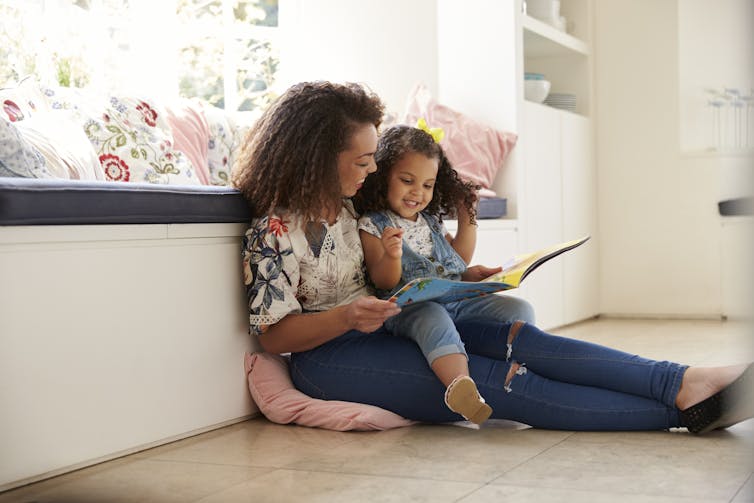
Reading books with your child means children learn to connect reading with feelings of warmth and sharing.
(Shutterstock)

Lorraine Reggin, University of Calgary; Penny Pexman, University of Calgary; Sheri Madigan, University of Calgary, and Susan Graham, University of Calgary

Learning to read is one of the most important developmental achievements of childhood, and it sets the stage for later school and life success. But learning to read is not straightforward. As child development researchers, parents often ask us how they can help their children to become good readers.

Parents can play a key role in supporting the development of children’s early language skills and fostering a love of reading, before and after children start formal schooling.

Literacy begins early

The building blocks of literacy are laid down during infancy. Even newborn babies’ brains are sensitive to the sounds and complexities of language. Babies don’t just need to hear language, they need to participate in language too.

Even though babies may only be able to say sounds like “ga,” “ba,” and “da,” they benefit from having these sounds repeated back to them in what are called conversational turns. A recent study found that the number of conversational turns between babies and parents is a key ingredient to building language skills.

The number of conversational turns between babies and parents is key to building language skills.
(Shutterstock)

So, when your baby says “ba,” respond. You can repeat “ba” or ask “Is that so?” or try to guess what they are saying (“Did you see a ball?”).

We know that babies who hear more words, speak more words and who hear more complex language produce more complex language later in childhood. These language skills help children get ready to read.

Early childhood

As babies turn into toddlers and preschoolers, their language gets more complex and they start to build the knowledge of words that they will eventually need for reading. By building language skills, preschoolers are also developing the attention, memory and thinking skills that will prepare them for school.

Preschoolers benefit from having books read to them. When parents read to children, it helps build children’s vocabulary and expands conversations. You can start with short picture books like Goodnight Moon and move onto longer picture books like Where the Wild Things Are or Corduroy.

Preschoolers also learn important language skills during play. Board games, games like “I Spy,” singalongs and acting out stories all help build the language skills they need for learning to read. When parents interact and talk out loud with toddlers and preschoolers during play, it supports the child’s learning of sounds and words.

Reading books and talking with your child helps your child build a positive attitude towards language and literacy.
(Shutterstock)

Having conversations, reading books to your child and playing with your child are all activities that help your child build a positive attitude towards language and literacy. They will learn to connect reading with feelings of warmth and sharing. You can encourage them to choose the books, and the place where you will read them, and in turn start to foster their identity as a reader. These positive experiences support your child’s emotional and intellectual development.

Ready to read

Researchers have long debated how children learn how to read, and how best to teach them. Today, it is clear that children need explicit phonics instruction (learning which sounds match different letters), lots of practice, and support for understanding written material. This means that children must learn how to “crack the code” of reading.

Children need to learn that lines, curves and dots make up a letter and that each letter matches to a sound. Although the English language has 26 letters, these letters make up 44 different sounds. Children start to learn that the letters are paired up with certain sounds through various activities at school, and you can help your child practise when they read out loud to you at home.

Once children have learned to map sounds to letters, they need to learn to map the sounds to meaning or match the sounds to the words they know. They also need to build reading fluency. Fluency means reading accurately, smoothly and with expression. As a child gains fluency, they read more naturally, faster and more easily.
As a child gains reading fluency, they read faster.
(Shutterstock)

Parent tips for early readers

Most children begin home reading programs in Grade 1 and continue with home reading into grades 2 and 3. Below are some suggestions for nurturing and building a positive home reading experience.

  1. Try to set aside at least 15 minutes a day for reading time.

  2. Consider the factors that set reading up for success in your home. For example: What times of day might work best for your child to do their home reading with you? Where do they most like to read, on the couch or in their bed?

  3. Practise reading books that are simple and easy for your child to repeat. If your child cannot get through the book, the level may be too advanced.

  4. Point out periods and commas where your child should pause, and talk about using different voices. Point out different kinds of expressions. For example, if the character in the story said “STOP IT,” you could explain to your child that they could use a louder voice.

  5. Indulge and support your child’s love of certain stories. The best way for children to become fluent readers on their own is through practice, and repeating beloved stories is one way to encourage practice.

  6. Continue to read to your child. When parents read, children can listen and enjoy books that they wouldn’t be able to read yet. This helps build their vocabulary and enjoyment.

  7. Check your child’s understanding of the book. You can help your child by asking questions before, during and after reading. Your questions create opportunities for conversation. You might ask questions like:

“Why do you think the children snuck downstairs?”

“Does this story remind you of anything we have done?”

“Leaped is an interesting word. What does that mean? Do you know another word we could have used there?”

Then you could mention jumped, hopped or skipped.

Some children will learn to read more quickly than others, but all children need practice to become skilled readers. A consistent home reading program can start children on the path to literacy and all of its benefits.

[ Thanks for reading! We can send you The Conversation’s stories every day in an informative email. Sign up today. ]The Conversation

Lorraine Reggin, PhD student, Cognitive Psychology, University of Calgary; Penny Pexman, Professor of Psychology, University of Calgary; Sheri Madigan, Assistant Professor, Canada Research Chair in Determinants of Child Development, Owerko Centre at the Alberta Children’s Hospital Research Institute, University of Calgary, and Susan Graham, Professor and Director, Owerko Centre, University of Calgary

This article is republished from The Conversation under a Creative Commons license. Read the original article.

Unknown's avatar

You could be putting your child off reading – here’s how to change that


shutterstock

Isang Awah, University of Cambridge

Not every child is a bookworm, but research shows that developing a love of reading early in life can provide many benefits. From a positive impact on academic achievement, increased general knowledge, vocabulary growth, improved writing ability, and helping children to develop empathy, it’s clear reading can play an important role in a child’s development.

It has also been argued that on top of providing pleasure, reading literature helps children to cultivate an imagination. And an overview of several studies on reading for pleasure suggests that it may also be a way to combat social exclusion and raise educational standards.

But despite the huge benefits that reading offers, evidence suggests that young people are reading less and that many children fall behind in reading from about the age of 10.

Some teachers believe that parents should be more active in supporting their child’s reading. This is understandable as studies on successful literacy achievement often feature either support from a parent or a teacher – indicating how both can help children to develop a love for reading.

But while it’s important that parents and teachers become actively involved in helping children to read more, my research reveals there are some things parents and teachers may do that actually put children off reading.

Let them choose their own books

In my research with children between the ages of nine and 12, I explored the extent to which they read for pleasure and the different factors that affected their reading engagement.

Things such as parents or teachers selecting the books the children read in their leisure time, or parents not allowing the children to read their preferred books were shown to have a negative impact on children’s reading engagement. As were parents or teachers forcing children to read and parents insisting that children read books to the end.

Children enjoy reading more when they’ve chosen their own books.
Shutterstock

Some of the children in my study complained that their parents always selected the books they read in their leisure time and that the parents’ selections were not always books that the children liked. A little boy described the books his father selected for him to read at home as “hard books” and could only recall one occasion when he had enjoyed reading the book his father selected.

There were also complaints by other children that their teachers selected the books they read during the reading period at school, and that usually, they did not like the books and often did not read them.

Don’t force it

Some children also complained that their parents did not allow them to read the books they had an interest in. For instance, one boy said that he liked Enid Blyton books, but his father did not allow him to read these. A girl complained that her father stopped her from reading Diary of a Wimpy Kid books because “they don’t teach anything”.

A few children complained of either being forced to read when they would rather not read, or being forced to complete a book they had lost interest in.

So, as important as reading is for a child’s development, my research shows why children must be allowed to exercise their right to not read or stop reading at anytime – as to do otherwise is likely to put them off reading altogether.

Make it fun

From my interviews with the children, I also discovered that it was common practice for teachers and parents to ask children questions about the books they read and that reading aloud done by teachers at school was usually accompanied by questions. While this might seem like a useful learning technique, it’s not one that goes down well with the kids.

All the children I spoke with said they did not like being asked questions after reading – and that it took away the fun from reading. One boy said that knowing he would be asked questions about the reading “kind of makes me feel like they’re going to give us an exam or a test afterwards”.

Don’t force it, reading should feel fun for kids.
Shutterstock

As the findings from my study show, when it comes to books, it’s important to respect your child’s preferences – even if they do not meet your expectations. Indeed, there is evidence to show that children best enjoy reading books they self-select – and doing otherwise may reduce the potential for pleasurable engagement in reading.

So given this, both parents and teachers would do well to remember that sometimes children just want to curl up with a good book, of their choice, and simply enjoy the process of reading for what it is.The Conversation

Isang Awah, PhD Candidate in Education, University of Cambridge

This article is republished from The Conversation under a Creative Commons license. Read the original article.

Unknown's avatar

Rivet


The link below is to an article that takes a look at Google’s ‘River,’ a reading app for kids.

For more visit:
https://9to5google.com/2019/05/14/rivet-google-smart-reading-app/

Unknown's avatar

How Children’s Books Have Changed


The link below is to an article that looks at how children’s books have changed.

For more visit:
https://globalnews.ca/news/5246618/how-childrens-books-have-changed/

Unknown's avatar

Getting Kids to Love Books


The link below is to an article that looks at how to turn kids into bookworms.

For more visit:
https://www.theguardian.com/books/2019/may/11/how-do-you-turn-kids-into-bookworms-all-10-childrens-laureates-share-their-tips

Unknown's avatar

Children Prefer Printed Books


The link below is to an article that reports on children preferring printed books.

For more visit:
https://goodereader.com/blog/digital-education/children-prefer-print-books-are-we-still-surprised

Unknown's avatar

Book-Based Birthday Parties


The link below is to an article that takes a look at book-based birthday parties for kids.

For more visit:
https://www.chicagoparent.com/learn/general-parenting/book-based-birthday-party/

Unknown's avatar

Batman Books for Kids


With Batman turning 80 this year, the link below is to an article that takes a look at the best Batman books for kids.

For more visit:
https://bookriot.com/2019/03/28/batman-books-for-kids/

Unknown's avatar

How to Read Aloud to Children


The link below is to an article that takes a look at how to read aloud to children.

For more visit:
https://www.lifehacker.com.au/2019/04/how-to-read-aloud-to-your-kid-according-to-audiobook-narrators/

Unknown's avatar

Fives ways that reading with children helps their education


File 20181003 52681 69md8i.jpg?ixlib=rb 1.1
Story time.
Moneky Business Images/Shutterstock

Emma Vardy, Coventry University

For book lovers, reading to their children may seem obvious. Why would they not want to pass on their love of literature? However, researchers have shown there are more benefits for both adult and child that come with reading than just building a bond – particularly when it comes to education.

A lot of research has been done into the effects of children engaging with literacy related activities at home. Much of this focuses on the early years, and how the literacy environment helps to develop emergent literacy skills. Shared book reading early on stimulates language and reading development, for example.

But the home literacy environment doesn’t stop being important once children have learnt to read. The opportunities that a child has to read at the home, and parental beliefs and behaviours, continue to impact on children’s reading throughout the school years. Here are just five ways that reading with your child can help their general education.

1. It opens up new worlds

Reading together as a family can instil a love of books from an early age. By taking the time to turn the pages together, adults can help children see that reading is something to enjoy and not a chore. Some schoolchildren read because they like it but others do it because they will be rewarded – with stickers in a school reading diary for example. Those children who read because they enjoy it read more books, and read more widely too. So giving your child a love of books helps expand their horizons.

2. It can build confidence

Children judge their own ability to read from observing their classroom peers, and from conversations with parents and teachers. When sharing a book, and giving positive feedback, parents can help children develop what is known as self-efficacy – a perceived ability to complete the specific activity at hand. Self-efficacy has been shown to be important for word reading. Children who think they cannot read will be less inclined to try, but by using targeted praise while reading together, parents can help children develop belief in their own skills.

3. It can build positive reading attitudes

Studies have shown that the more opportunities a child has to engage with literacy based activities at home, the more positive their reading attitudes tend to be. Children are more likely to read in their leisure time if there is another member of the family that reads, creating a reading community the child feels they belong to. Parental beliefs and actions are related to children’s own motivations to read, though of course it is likely that this relationship is bidirectional –- parents are more likely to suggest reading activities if they know that their child has enjoyed them in the past.

Sharing an old favourite.
VGstockstudio/Shutterstock

4. It expands their language

When reading a book together, children are exposed to a wide range of language. In the early stages of literacy development this is extremely important. Good language development is the foundation to literacy development after all, and increased language exposure is one of the fundamental benefits of shared book reading.

Shared book reading early on can have a long-term benefit by increasing vocabulary skills. And if they encounter a word they don’t understand, they have a grown up on hand to explain it to them in a way that makes sense to them. When children are taught to read while sharing a book, it can improve alphabet knowledge, decoding skills, spelling, and other book-related knowledge (such as how to actually read a book). Doing something as simple as sounding out the letters of a word they do not understand can vastly improve a child’s skills.

5. It can help their speech and language awareness

Formal shared reading can also involve the use of intonation, rhythm and pauses to model what is known as prosody. This is not a skill that is directly taught, but by simply pausing when needed or changing the tone of your voice can help children develop fluency when reading aloud. This is one of the reasons that shared book reading is not just for pre-schoolers. Demonstrating what is involved in reading complex text aloud fluently is very valuable for children of all ages.

You don’t need a lot of money, or even hours of spare time to read with children. Even small efforts can have big benefits. Nor does it have to be just at bedtime. Sharing a book, a magazine or a comic can take place any time of the day.

The most important thing to remember is to have fun. Interest in reading emerges from enjoying it with a parent. If you’re interested and make an effort, it can have a huge impact on a child’s engagement with reading.The Conversation

Emma Vardy, Research Associate, Psychology of Education, Coventry University

This article is republished from The Conversation under a Creative Commons license. Read the original article.