
The link below is to an article that explores the need for difficult books and comments on the 2018 Man Booker winner, ‘Milkman,’ by Anna Burns.
For more visit:
https://www.theguardian.com/books/2018/nov/10/anna-burns-milkman-difficult-novel

The link below is to an article that explores the need for difficult books and comments on the 2018 Man Booker winner, ‘Milkman,’ by Anna Burns.
For more visit:
https://www.theguardian.com/books/2018/nov/10/anna-burns-milkman-difficult-novel
The link below is to an article that takes a look at six book apps for reading and discovering new books.
For more visit:
https://www.epicreads.com/blog/best-book-apps/
The link below is to an article that lists the 100 notable books of 2018 according to The New York Times.
For more visit:
https://www.nytimes.com/interactive/2018/11/19/books/review/100-notable-books.html
Simmone Pogorzelski, Edith Cowan University and Robyn Wheldall, Macquarie University
A child’s early experiences with books both at home and later in school have the potential to significantly affect future reading performance. Parents play a key role in building oral language and literacy skills in the years prior to school. But it’s teachers who are responsible for ensuring children become readers once at school.
While there’s much we know about how students learn to read, research on books used to support beginning reading development is sparse. Guidelines provided in the Australian Curriculum
and the National Literacy Progressions complicate matters further. Teachers are required to use two types of texts: decodable and predictable books.
Read more:
Explainer: what is phonics and why is it important?
Each book is underpinned by a different theory of reading, arguably in conflict. This contributes to uncertainty about when and how the books might be used.
Predictable books and their associated instructional strategies align with a whole-language approach to reading.
In this approach, meaning is prioritised. Children are encouraged to draw on background knowledge, memorise a bank of the most common words found in print, and to use cues to guess or predict words based on pictures and the story. This method is not consistent with a phonics approach.
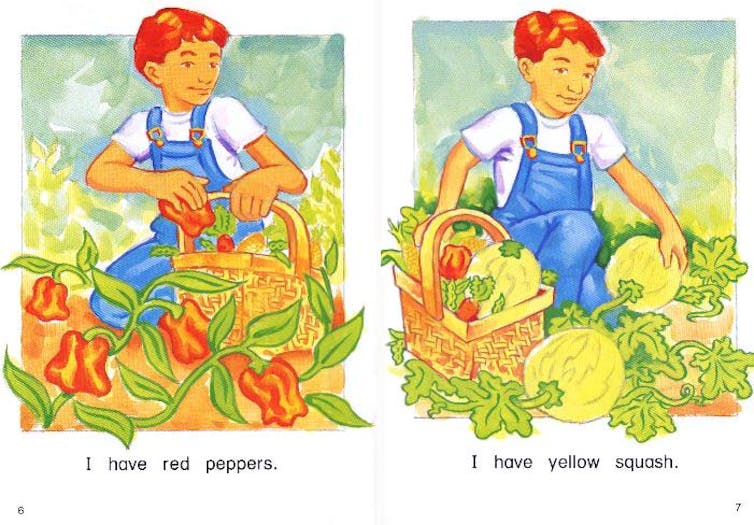
At the earliest levels, predictable and repetitive sentences scaffold beginning readers’ attempts at unknown words. Word identification is supported by close text to picture matches and familiar themes for children in the early years (such as going to the doctor).
While there is some evidence the repetitive nature of predictable books facilitates the development of fluency, the features contained within disadvantage young readers as they do not align with the letter-sound correspondences taught as part of phonics lessons. This is particularly problematic for children who are at risk of later reading difficulties.
In comparison, decodable books consist of a high percentage of words in which the letters represent their most common sounds. Decodable books align with a synthetic phonics or code-based approach to reading. This approach teaches children to convert a string of letters (our written code) into sounds before blending them to produce a spoken word.
When reading decodable books, children draw on their accumulating knowledge of the alphabetic code to sound out any unknown words. Irregularly spelt words (for example was, said, the) are also included, and children receive support to read these words, focusing on the sounds if necessary.
There is mounting evidence for the use of decodable books to support the development of phonics in beginning readers and older kids who haven’t grasped the code easily. Decodable books have been found to promote self-teaching, helping children read with greater accuracy and independence. This leads to greater gains in reading development.
Children need lots of opportunities to practise reading words in books. Given research demonstrates a synthetic phonics approach provides young readers with the most direct route to skilled reading, there’s a strong logical argument for supporting early reading with decodable books.
Read more:
As easy as ABC: the way to ensure children learn to read
Until the most recent version of the Australian Curriculum, only predictable books were included in the Foundation and Year one English curricula. The addition of decodable books recognises the critical support they provide beginning readers. But this places teachers in a difficult position because the elaborations in the curriculum documents place more emphasis on the strategies designed primarily for use with predictable books.
While reading is an extraordinarily complex process, a model of reading called the Simple View of Reading is very helpful from an educational perspective. It explains skilled reading as the product of both decoding and language comprehension. This helps us understand what we need to do when teaching children to read, and the types of books they need to support early reading development.
Before they enter school, the majority of children are considered to be in the “pre-alphabetic” stage of reading. In this stage, children have little or no understanding the written code represents the sounds of spoken language. They would not have the skills to use decodable books.
Instead, they recognise words purely by contextual clues and visual features. For example, children know the McDonalds sign because of the big yellow arches (the M) or can read the word “stop” when they see the sign, but not out of that context.
Predictable books would help the pre-alphabetic reader gain insight into the workings of texts, especially with regard to meaning. In particular making the connection between spoken words – which they are familiar with – and written words, which they are not.

Beyond this stage, predictable texts become less useful because memorisation and meaning-based strategies aren’t sustainable long term. Once children have advanced to the partial and full alphabetic stages of reading, usually fairly quickly after starting formal reading instruction, they benefit more from decodable books which allow them to apply the alphabetic code.
There is no evidence children benefit from the continued use of decodable books beyond the beginning stages of reading. In the absence of any empirical studies, we suspect it would be a good idea to move children on once they have sufficient letter-sound knowledge and decoding skills that they can apply independently. At this point, the introduction of real books would benefit students and provide access to more diverse language structures and vocabulary.
Read more:
International study shows many Australian children are still struggling with reading
Given what we know about how reading works, it makes sense for children in the early stages of learning to read to be given decodable books to practise and generalise their developing alphabetic skills. At the same time, they will continue to benefit from hearing the rich vocabulary and language forms in the children’s books being read with (to) them.
It’s less clear what predictable texts contribute to beginning reading in schools when considering how reading skills develop. But there is evidence they might have a useful role to play in pre-school prior to the start of formal reading instruction.
Simmone Pogorzelski, PhD Candidate, Sessional Academic, Edith Cowan University and Robyn Wheldall, Honorary Fellow, Macquarie University
This article is republished from The Conversation under a Creative Commons license. Read the original article.
Archie Dick, University of Pretoria
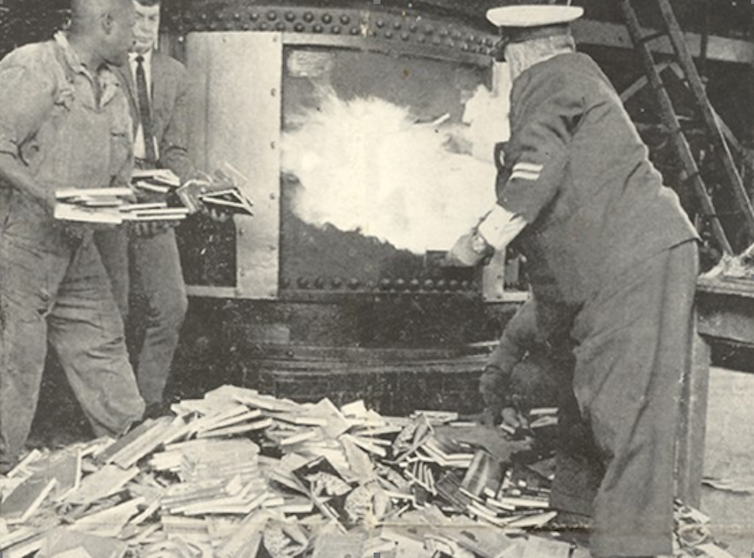
On the advice of the State Librarian one fine day in the 1970s, a truck transported thousands of books and magazines from Pretoria’s Central Police Station to a dark hall at the Iscor state steel company, just outside the South African capital. A large mechanical shovel scooped up and dropped them into a 20 metre high oven, causing it to spew flames and smoke. This was another truckload of material that had been banned for political reasons and was routinely burned in furnaces across South Africa from the 1950s to the 1970s.
Historical examples show that books are banned and destroyed because they offend the politics, morals, or religion of the day. Information science academic Rebecca Knuth, wrote in Burning Books and Leveling Libraries that if a regime is racist, it destroys the books of groups deemed inferior; if nationalistic, the books of competing nations and cultures; and if religiously extremist, all texts contradicting sacred doctrines.
Sometimes these forces combine. Recent examples include the destruction of Muslim books and libraries in Bosnia in the 1990s by
Serbian nationalist forces. In 2013 there was the burning by Islamist insurgents of the Timbuktu library and the next year the same happened in Lebanon to Tripoli’s historic Al Sa’eh Library.
The apartheid era – from the middle of the 20th century – had its own variation on the theme. Thousands of books were banned, ranging from Russian novelist Fyodor Dostoyevsky’s The Insulted and Humiliated to popular Westerns writer Louis L’Amour’s Hopalong Cassidy series.
The fact that books were burnt underscored the state’s desire to make sure the printed word was utterly destroyed. The practice also revealed a darker side of the library profession which connived in the book burning. Between 1955 and 1971 most librarians didn’t protest when thousands of books and other reading material were taken from libraries, and burned at municipal incinerators and furnaces. Some even joined in.
State sanctioned book burnings were common as authoritarianism accompanied a growing Afrikanerisation of South African society as the dominant, ruling Afrikaner elite started to impose its culture on all spheres of society. Members of the elite did this first by unifying Afrikaner cultural and church organisations. This took the form of a declaration on behalf of “Volksorganisasies” (Afrikaner people’s organisations) that was signed in 1941 and pledged support for conservative Christian national ideology.
This sometimes involved the burning of books as a symbol of purification. One of the more worrying aspects was the solid support from ordinary South African librarians for these treacherous acts.
Even when books were burned by public libraries, the profession meekly accepted the situation. This signified support and agreement with what was happening, and reflected the dominant authoritarian mood and spirit in South Africa and the library community at that time.
In October 1955, the city librarian of Johannesburg, exclaimed:
All copies are brought in to me and I destroy them personally.
In the same month, a Cape Town newspaper reported that a couple of hundred books had been burned. Two years later, the deputy city librarian of Cape Town announced the fate of banned books returned from branch libraries to his Central Library:
We will have a big bonfire and burn them.
What started as the burning largely of imported pornographic books, became an all-out attack on free speech after the findings of a commission of inquiry into “undesirable publications” were made public in October 1957. The inquiry gave the Nationalist government the excuse to destroy books and pamphlets critical of its policies, and of dramatic developments in the country.
Each new issue of the Government Gazette included the latest additions to the list of banned books. Books on communism and those that criticised apartheid dogma were targeted. In 1954 banned titles included the Pravda and Daily Worker newspapers, and Vladimir Lenin’s Two Tactics of Social-Democracy in the Democratic Revolution. Books on innocuous topics about communist countries, like China’s “Railways and Labour Insurance Regulations of the People’s Republic of China”, were also deemed subversive and added to the list.
Even Ray Bradbury’s dystopian novel Fahrenheit 451 (which, ironically, is the temperature at which book paper starts burning) was burned. From the town of Brakpan in the North to Durban in the East and Cape Town in the South, several thousands of books were removed from library shelves and burned. In July 1964 Cape Town City library services announced that more than 800 books had been burned.
By this time the list of banned publications had swelled to a total of 12 000 titles. In June 1968, a newspaper reported that 5 375 books of the Natal Provincial libraries had been withdrawn from circulation and burned. By April 1971 books were still steadily being burned in Cape Town – at the rate of two per day.
It was only in the late 1980s that successful appeals from a few brave librarians to the state censors saw restricted books unbanned, and saved from apartheid’s furnaces.
In the early-1990s as South Africa moved towards becoming a democracy hundreds of archival documents and public records were shredded and burned by the apartheid state’s security establishment – once again in the furnaces of Iscor.
Could book burning happen again in contemporary South Africa? Given a similar set of circumstances, there is every reason to believe that it can. South Africans should remain diligent and alert to threats to freedom of expression.
The ashes of burnt books tell of the barbarism to which a society can descend.
Archie Dick, Head of Department and Professor of Information Science, University of Pretoria
This article is republished from The Conversation under a Creative Commons license. Read the original article.
The link below is to an article that takes a look at 10 famous book hoarders. According to the article I qualify as a book hoarder, which to be honest, I already knew. How about you? Are you officially a book hoarder?
For more visit:
https://lithub.com/10-famous-book-hoarders/
The link below is to an article that looks at a new study that confirms growing up in a home full of books is good for you.
For more visit:
http://mentalfloss.com/article/559956/new-study-confirms-growing-home-filled-books-good-you
The link below is to an article that looks at why the writer doesn’t organise her bookshelves.
For more visit:
https://bookriot.com/2018/09/29/why-i-dont-organize-my-bookshelves/
Kamilla Elliott, Lancaster University
There have been several attempts over the years to make a movie out of DM Thomas’s critically acclaimed 1981 novel, The White Hotel. But despite the involvement of such giants of the screen as David Lynch, Bernardo Bertolucci, Terrence Malik and David Cronenberg – who made a name for himself as a director who can adapt so-called “unfilmable books” – the novel has this far proved resistant to film adaptation.
In the absence of a film version, the book was recently adapted for radio by the BBC, directed by Jon Amiel and based on a screenplay written by the late Dennis Potter in the 1980s.
DM Thomas himself wrote in 2004 about the tortuous and sometimes tortured battle over screen rights for his novel, but apart from the saga over rights – so familiar to any novelist whose work has pricked the attention of film-makers – what was it about the book itself that meant a radio adaptation succeeded when film adaptations have failed?
There are a number of media, cultural and economic conventions that can explain this. But, in general, books that have been called “unfilmable” are books that are hard to read: weighty, ponderous, abstract, complex, convoluted, labyrinthine, densely allusive and excessively long. Or books that treat terrifying, horrifying, revolting or repulsive subjects.

The White Hotel is a difficult read – for a start there’s the unreliable, psychologically disturbed, potentially hallucinating narrator, whose obscene and surreal narratives are followed by representations of horrific historical events and natural disasters. The book’s sections shift jarringly across textual forms and styles – rational, psychoanalytic case notes melt into mythological explorations of psychological symbols. Stories of strange mental states jolt into collective, realist histories. It’s a challenging read.
By contrast, mainstream film conventions require a clear narrative structure and a degree of temporo-spatial logic and continuity. They tend not to favour excessively “talky” screenplays, preferring to tell their stories through visuals and structure them via editing.
These and other reasons that books have been considered unfilmable have been widely discussed. They include historical sprawl (Gabriel Garciá Marquez’s One Hundred Years of Solitude), multiple worlds (Stephen King’s Dark Tower series), too many characters (David Foster Wallace’s Infinite Jest), and multiple unreliable narrators who confuse the story (Mark Z. Danielewski’s House of Leaves).
Some novels are written with a stream of consciousness that keeps the story inside a character’s head (James Joyce’s Ulysses and Thomas Bernhard’s Woodcutters); there may be lack of clear plot and dynamic action (Virginia Woolf’s To the Lighthouse), fantasies too elusive for film’s special effects (H.P. Lovecraft’s At the Mountains of Madness), or a book may be too distressing or obscene to visualise realistically (Art Spiegelman’s Maus and The White Hotel).
Censorship has also limited the number and scope of books that are allowed to be filmed – as films are more tightly controlled and censored than books. The reasons for this tighter control of visual images have ancient roots in Judaic, Islamic and Protestant Christian religions which represent the word as divine and the visual image as profane.
Their legacy persists in secular censorship practices. The US Motion Picture Production Code (MPCC) of 1930 ruled that: “The latitude given to film material cannot … be as wide as the latitude given to book material,” because “a book reaches the mind through words merely; a film reaches the eyes and ears through the reproduction of actual events”. It concluded that:
The mobility, popularity, accessibility, emotional appeal, vividness, straightforward presentation of fact in the films makes for intimate contact on a larger audience and greater emotional appeal. Hence the larger moral responsibilities of the motion pictures.
The MPCC advocated censoring films more stringently than books because film “reaches every class of society”, while other arts have their “grades for different classes”.
Even following the relaxation of the MPPC and similar censorship laws in other nations in the late 20th century, these considerations persist. When James Joyce’s Ulysses (1922) was made into a film by Joseph Strick in 1967, it remained banned in Ireland until 2000, whereas the book was never officially banned in Ireland.
When David Cronenberg filmed William S. Burroughs’s so-called unfilmable Naked Lunch (1959) in 1991, and was criticised for not being faithful to the book, he retorted that a “straightforward adaptation”, featuring all of the book’s far-flung locations and representing its most shocking scatological and sexual passages would “cost US$100m and be banned in every country in the world”. So the book could be filmed, but it could not be financed or pass film censorship laws.
Financing and censorship are interconnected: films have to reach a much larger audience than novels or radio plays to turn a profit, and must therefore appeal to the mainstream. BBC Radio 4 has a much smaller audience and can appeal to other demographics on other radio channels.
For all of these reasons, a word-only adaptation for the niche audience of BBC Radio 4, aired on a Saturday afternoon – a time when listener numbers are close to being the lowest of the week – clearly offered an economically viable and socially acceptable venue for transmitting this brilliant and challenging novel in another media form. For this, at least, we must be grateful.
Kamilla Elliott, Professor of Literature and Media, Lancaster University
This article is republished from The Conversation under a Creative Commons license. Read the original article.
 At the BookShelf

You must be logged in to post a comment.