
The link below is to a book review of ‘Leviathan,’ by Thomas Hobbes.
For more visit:
https://www.theguardian.com/books/2017/nov/20/the-100-best-nonfiction-books-no-94-leviathan-thomas-hobbes-1651

The link below is to a book review of ‘Leviathan,’ by Thomas Hobbes.
For more visit:
https://www.theguardian.com/books/2017/nov/20/the-100-best-nonfiction-books-no-94-leviathan-thomas-hobbes-1651
The link below is to a book review of ‘Seven Leaders – Preachers and Pastors,’ by Iain Murray.
For more visit:
https://www.9marks.org/review/book-review-seven-leaders-by-iain-murray/
The link below is to a book review of ‘Hydriotaphia, Urn Burial, or A Brief Discourse of the Sepulchral Urns Lately Found in Norfolk,’ by Sir Thomas Browne.
For more visit:
https://www.theguardian.com/books/2017/nov/13/100-best-nonfiction-books-sir-thomas-browne-urn-burial
The link below is to a book review of ‘The Diary of Samuel Pepys,’ by Samuel Pepys.
For more visit:
https://www.theguardian.com/books/2017/nov/06/the-diary-of-samuel-pepys-100-best-nonfiction-books-of-all-time-review-robert-mccrum

Marc Hudson, University of Manchester
Richard Denniss doesn’t mind pissing people off. He’s good at it. His entertaining and punchy book Curing Affluenza will, with luck, kickstart a conversation about mindless consumerism and what we do about it.
Denniss needs little introduction to followers of the Australian policy scene – has been an strategy advisor to Bob Brown, chief of staff of Natasha Stott-Despoja, a former chief executive and now chief economist at The Australia Institute. He’s been sticking his hand in hornets’ nests for a while, whether on climate policy, taxation, the (ab)uses of economic modelling or pretty much anything.
Read more: Enough’s enough: buying more stuff isn’t always the answer to happiness
Denniss co-authored an earlier book with Clive Hamilton called Affluenza, which obviously covered some of the same territory. Affluenza, to cure your suspense, is “that strange desire we feel to spend money we don’t have to buy things we don’t need to impress people we don’t know”.
Ironically enough, there is already a towering pile of published books covering the economic, environmental and psychological costs of consumerism, as well as the pursuit of loneliness, the culture of narcissism, whether the path to happiness is to have or to be, and the collision course our species is on. (I could probably spark joy by decluttering my own shelves of these and other volumes.)
Denniss’ book, which he has been plugging on the radio,
is a bit lighter (in both positive and negative ways) than some of these weighty tomes, striking a tone more akin to the 2007 documentary Story of Stuff.
The book has nine punchy chapters, plus eight additional contributions by thinkers and doers including Kumi Naidoo, Marilyn Waring, Leanne Minshull, and Bill McKibben.
Denniss writes with passion and wit, peppering his argument with memorable metaphors and acerbic questions. The book seeks to show that affluenza is “economically inefficient, the root cause of environmental destruction and that it worsens global inequality”, and to “broaden the menu from which choices can be made – by individuals, communities and countries”.
Denniss distinguishes between consumerism – a love of buying things – and materialism – the love of things themselves. The latter may be beneficial, as long as you care for your things, make sure that they can be repaired, and ensure they are made to last.
He deals well with the “the market won’t stand for it” argument, explaining that “what that really means is ‘rich people who own a lot of shares would react angrily’”. He also perceptively observes that “the process of making things people don’t need and then recycling them into other things they don’t need is now called ‘wealth creation’ or ‘job creation’. More accurate descriptions would be ‘resource destruction’ and ‘waste creation’.”
He’s also good on the relationship between technology and culture, arguing that it’s not that “technology will fix everything, but that technology and culture can and will change everything. The pace and direction of that change, like rope in a tug-of-war, will be determined by the relative strength of forces pulling on it.” But he could have written more on the fact that states are now crucial actors in the innovation game.
And this touches on the book’s biggest weakness: it identifies the problem and asks what is to be done, but largely fails to consider who should do it. Chapters 7 and 8 do contain a series of policy proposals around “banning some or all forms of advertising, banning corporate donations to politicians, preventing former politicians from working as lobbyists”, as well as proposing a ban on new coal mines. But Dennis, curiously, does not propose a universal basic income, which might have some rather interesting effects in getting consumers off the hedonic treadmill.
Read more: The ‘simple life’ manifesto and how it can save us
It’s not always clear who Denniss thinks will get this done, and how they are not going to be fobbed off, demonised, co-opted or demoralised. For my money (actually, I was sent a review copy) I think Denniss underestimates how hard it is for people to take the “voluntary simplicity” route (social status is a powerful driver of consumption), and he could have done more to name and shame companies that are trying to foster psychological insecurity to create consumers for life (covert marketing at children? I mean, seriously?)
Denniss could also have introduced a few more economic concepts (such as positional goods, which decline in value as more people obtain them) and some more case studies, such as the classic example of the Ford Model T, which won the usefulness/cheapness/reliability battle but was defeated by competing car companies that made annual minor cosmetic changes.
You can’t please everyone. The book will doubtless get a kicking from the following groups:
So-called conservatives such as the Minerals Council of Australia, which cops several serves for its lobbying and modelling
Hardcore anti-capitalists (the word capitalism doesn’t appear until page 192, and Denniss somewhat sidesteps the discussion) and economic degrowthers, who think the scale of the problem goes beyond voluntary simplicity
Marxists who will ask who is this “we” in sentences like “we have built a culture where buying things is increasingly unrelated to using things” and wince at the assumption that readers will have “five cashed-up friends”
Social movement strategists who worry that the light green rhetoric will pull focus from more fundamental problems.
 But Denniss, I am pretty sure, has not written this book for any of those groups of baked-in enemies, malcontents and despairers. I think he’s written it for Joe and Jane Public, who worry about their kids’ future. And there are enough good metaphors, clear thinking and provocation here to get a good conversation going. So in that sense, mission accomplished.
Marc Hudson, PhD Candidate, Sustainable Consumption Institute, University of Manchester
This article was originally published on The Conversation. Read the original article.
Michelle Smith, Deakin University
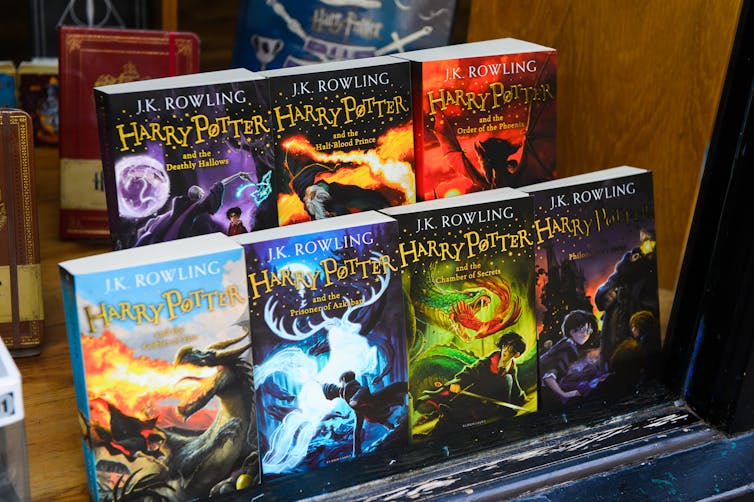
The twentieth anniversary celebrations of the highest-selling book series of all time are now coming to a close. 2017 has been a milestone year for Harry Potter fans in their twenties and thirties, who spent much of their youth in anticipation of the release of each new book or film.
Last week’s Wheeler Centre event Harry Who? The True Heroes of Hogwarts brought together writers, comedians and musicians to celebrate the series. While Harry and his broken glasses predominate at most Potter tourist sites and film screenings, Harry Who? asked the audience to consider who really is the true hero of J.K. Rowling’s stories.
As readers contemplate the long-term legacy of the Potter universe and whether it will endure, it’s also important to consider the overarching messages of Rowling’s series as the most popular example of children’s literature to date.
Harry embodies the key characteristic of some of the most memorable protagonists of classic children’s literature. From centuries-old stories of Cinderella onwards, child and youth characters who are orphans not only foster the reader’s empathy, but are also freed from the expectations and restrictions that biological parents impose.
Melanie A. Kimball explains the twin effects of child orphans in literature:
Orphans are at once pitiable and noble. They are a manifestation of loneliness, but they also represent the possibility for humans to reinvent themselves.
Without the tragedy of Harry’s parents being violently killed by the evil Lord Voldemort, Harry would have had no compulsion to go beyond the “typical” experience of a child with a witch and a wizard for parents.
At Harry Who?, writer Ben Pobjie pointed out that Harry is not exceptional, but that it is his nemesis, Voldemort, who propels Harry to importance. With reference to his dubious celebrity, Pobjie joked that if Voldemort was in Australia, he would “be on Sunrise every morning”. As with the importance of Harry’s lack of parental influence and constraint, the extreme adversity of being Voldemort’s inadvertent nemesis establishes a heroic scenario for Harry to inhabit.
One of the repeated claims throughout the event was that Harry is not much of a hero at all, particularly as he relies on other people to succeed. In the first book of the series especially, Hermione Granger possesses most of the personal attributes and knowledge required to defeat the ever-present threat posed by Voldemort. She is clearly the most intelligent of the Harry, Ron and Hermione trio, and works hard where her male counterparts often attempt to shirk the effort required.
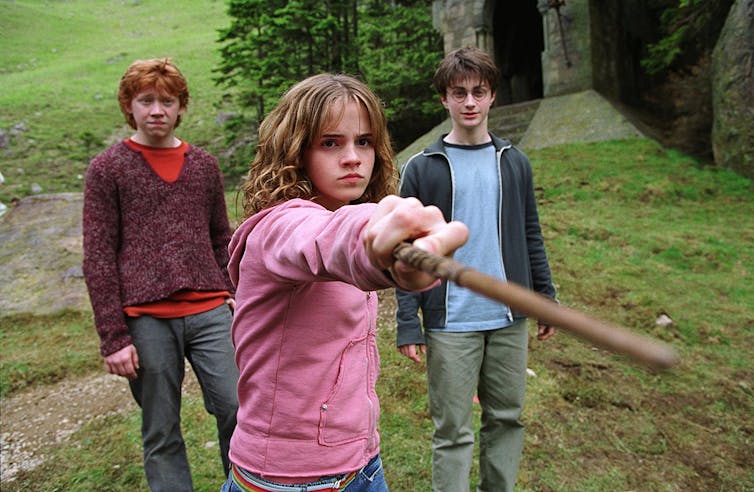
While Hermione’s heroism is important, she clearly plays a supporting role to Harry: the series is, after all, named after him. The emphasis on Harry is reflective of the deep gender bias in children’s literature throughout the past century.
A 2011 study of twentieth-century children’s books found that, on average, in each year, no more than a third of children’s books featured central characters who were adult women or female animals. In contrast, adult men and male animals usually featured in 100 per cent of children’s books.
Though the Harry Potter series does depict some strong and beloved female characters including Professor Minerva McGonagall, it is reflective of an era in which protagonists in children’s literature are usually male unless a book is specifically marketed at a girl readership. In addition, the series is also lacking in the depiction of queer characters, regardless of J.K. Rowling’s post-book declaration that Hogwarts’ headmaster Professor Albus Dumbledore is gay.
With the rapid changes in attitudes toward social and cultural issues including same-sex marriage and children with non-normative gender and sexual identities, the Harry Potter series — as a product of the 1990s and early 2000s – might not endure as well as some might imagine.
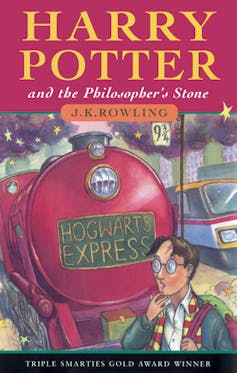
Indeed, the issue of changing social norms means that very few children’s “classics” continue to be read by children as decades and even centuries pass. It could be that the series is eventually understood as somewhat outdated and more about producing nostalgia for adults in the same way as the once ubiquitous books of Enid Blyton are viewed today.
One crucial part of the Harry Potter legacy, however, is its effectiveness in encouraging readers, viewers, and now theatre goers with Harry Potter and the Cursed Child, to embrace fantastic stories about young people once again.
Adults in the late 19th and early 20th centuries delighted in children’s stories and made up a significant segment of the audience for plays such as Peter Pan. The dual audience of children’s literature, for both adults and children, was once the norm and one that did not bring any shame or embarrassment with it.
 Twenty years on, today’s adults are still gathering to talk about and celebrate the Potter novels they enjoyed as children and have continued to re-read. In addition, other series such as Twilight, The Hunger Games and Riverdale, show the continuing popularity of stories about young people for adults. In 2037 we will be able to tell if the Potter-effect has lasted or if its magic only worked for a brief spell.
Michelle Smith, Senior lecturer in Literary Studies, Deakin University
This article was originally published on The Conversation. Read the original article.

 At the BookShelf
You must be logged in to post a comment.