
The link below is to an article that looks at why the New York Times Bestsellers List is ‘the’ list.
For more visit:
https://bookriot.com/2020/02/13/new-york-times-bestsellers-list/

The link below is to an article that looks at why the New York Times Bestsellers List is ‘the’ list.
For more visit:
https://bookriot.com/2020/02/13/new-york-times-bestsellers-list/

Beth le Roux, University of Pretoria
Books in South Africa don’t often make headline news. But a controversial subject, protests and disruptions at a book launch, and threats of book burning are sufficient to get South Africans talking about the place of books in society once again.
This is exactly what has happened with investigative journalist Pieter-Louis Myburgh’s latest book “Gangster State”.
“Gangster State” is an exposé of current African National Congress (ANC) Secretary General Ace Magashule’s alleged murky dealings as premier of the Free State province, and his rise to one of the governing party’s most influential positions. The book has stirred up passionate reactions, both for and against its contents.
This last happened in late 2017 when another investigative reporter Jacques Pauw published a similar book, “The President’s Keepers”. That book dealt with South Africa’s previous head of state, Jacob Zuma, who’s been closely linked to massive corruption. Zuma denies the allegations.
Read more:
Two books that tell the unsettling tale of South Africa’s descent
Clearly, this kind of book touches a certain chord in South African society. A quick glance through the top-selling books in the past few years shows that non-fiction, and particularly political non-fiction dealing with very topical events, is the most popular genre.
The trend can be traced back through a number of years, with nonfiction consistently dominating the Nielsen’s BookScan sales charts – the most comprehensive figures collected on book sales through commercial booksellers. This raises the question: why do political books do so well in South Africa?
This isn’t a uniquely South Africa phenomenon. Nonfiction is popular around the world. Celebrities’ memoirs or biographies, as well as history titles, are more likely to become bestsellers than any other kinds of nonfiction. Indeed, Michelle Obama’s memoir “Becoming” caused a paper shortage in the US towards the end of 2018, as it was reprinted in such large quantities and at short notice to keep up with audience demand. This title has now sold more than 10 million copies worldwide.
Where South Africa differs is in the balance of sales between nonfiction and fiction. In most of the largest publishing markets, fiction is bought at much higher rates than nonfiction. In the US, for instance, average sales for fiction titles are between 4 000 and 8 000 copies, while the nonfiction average is lower, at 2 000 to 6 000 copies.
In South Africa, it’s the reverse. Nonfiction outsells fiction. This is not a new trend, either: political books found a ready audience throughout the apartheid period.
There are a few categories of nonfiction that do particularly well: political nonfiction, South African history (especially political history), religious books – and the ubiquitous cookbooks. The authors that have the edge tend to be journalists rather than academics, probably because their writing is so much more accessible.
Statistically, too, men write more nonfiction than women in South Africa, and so are more likely to produce top-selling titles, as was found by one of my post-graduate students, Kelly Ansara, in her Master’s study of the gender balance in SA publishing.
In analysing the publishing lists and sales figures of the local nonfiction publishers – Pan Macmillan, Jonathan Ball, Penguin SA, Tafelberg and Jacana, on the whole – another difference becomes apparent. Books by and about celebrities are not as popular in South Africa as in the US and UK. Their sales are thus less predictable.
For instance, while former Springbok rugby coach Jake White’s “In Black and White” sold more than 60 000 copies in a week in 2008, star rugby player Joost van der Westhuizen’s “Man in the Mirror” was less successful. Comedian Trevor Noah’s memoir, “Born a Crime”, has been extremely successful, but titles by local musicians and actors such as Bonang Matheba and Somizi Mhlongo have sold comparatively few copies.
The raft of competing titles that hit the shelves after the murder conviction of former Paralympian athlete Oscar Pistorius did not take off as well as expected. Excellent titles on topics as diverse as climate change and South African art sell a respectable number, but don’t make the bestseller list.
Many of the country’s nonfiction titles sell several thousand copies very quickly, but few of them have staying power. Current interest is intense in topics like state capture and corruption scandals. But it fades quickly, leading to a short shelf-life for a number of political books. Only a few gain the perennial interest and staying power of a title like “I Write What I Like” by Steve Biko or Nelson Mandela’s “Long Walk to Freedom”.
Many commentators suggest that the interest in political and current affairs titles reflects a nation trying to make sense of its tumultuous political environment. The huge political and social shifts of the past 20 to 30 years are still influencing South Africans’ daily lives. With one corruption scandal following another, trust in the authorities is low. But citizens still seek authoritative overviews and answers – in the nonfiction titles that line our shelves.
There is little reason to predict that the trend will change. However, if the threats mount, then we may see authors and publishers shifting to less controversial topics. For now, it’s great to see books in the news again.
Beth le Roux, Associate Professor, Publishing, University of Pretoria
This article is republished from The Conversation under a Creative Commons license. Read the original article.
The link below is to an article that takes a look at the biggest nonfiction bestsellers of the last 100 years.
For more visit:
https://lithub.com/here-are-the-biggest-nonfiction-bestsellers-of-the-last-100-years/
The link below is to an article that takes a look at the last 100 years of fiction bestsellers.
For more visit:
https://lithub.com/here-are-the-biggest-fiction-bestsellers-of-the-last-100-years/
Anne-Marie Evans, York St John University
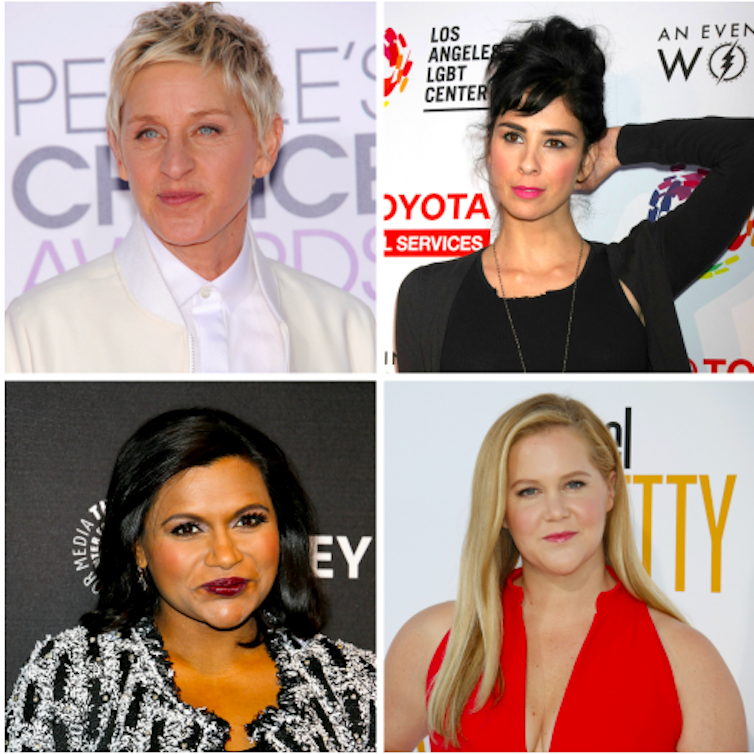
The reviews have not always been kind. The texts are rarely perceived as “literary” or even particularly important – so they don’t get taken seriously. But the celebrity “femoir” – a memoir authored by a well-known female actor or comedian – has become a staple of the publishing trade over the last few years.
As I explain in a recent book chapter, the femoir occupies an important place in contemporary women’s writing because they promote female empowerment. The books also embrace body positivity, and address the importance of having a supportive female community of friends.
These women writers already have hugely successful careers before they begin to write their femoirs. Lena Dunham, for example, was the creator, writer, star, and sometimes director of the hit HBO series Girls – which received a range of Emmy awards and nominations. Amy Poehler and Tina Fey are both veterans of Saturday Night Live, and Fey was the creator, writer, and star of 30 Rock, while Poehler starred in the hugely popular Parks and Recreation. Mindy Kaling, on the other hand, was the first Indian American woman to both star in and produce her own show, The Mindy Project. So why this sudden need to tell their story in print?
One reason might be that writing, and autobiography in particular, is a great way for women to develop their public brand. Suzanne Ferris, who has researched and published on popular women’s writing, compares the femoir to chick lit – as this new style of memoir often follow the traditional structure of a female protagonist overcoming various personal and professional obstacles.
The reader might hear about one of Kaling’s bad dates, or about Fey’s struggles to balance being a mother and being a professional working woman. But within the genre, each writer also emphasises professional advancement over personal success.
None of these books ever offer any real details about the women’s personal lives beyond a few anecdotes that could be shared on a late night talk show. But the femoir offers the reader the illusion they are being told highly privileged information, and this is hugely important part of the genre’s appeal.
For Dunham, Fey, Poehler and Kaling, writing has always been an important part of their career. Although they are famous for performing, most of them started out as writers. Kaling, for example, got her break as a one of the writers for the US version of The Office.
Writing for The Guardian Hadley Freeman suggests that the main difference between memoir and femoir is the construction of the narrative voice. A memoir is usually published because the story is special or unique, but the very appeal of the femoir is that its writer is – apparently – just like the imagined (female) reader.
As a narrative voice, the author of the femoir must be funny and relatable. She must be every woman to every reader, or her book will not be successful. This is a hugely important part of the brand. A femoir is not meant to be a weighty autobiography but instead is designed to be a fun and entertaining read.
As well as a life story, a femoir nearly always features some kind of interactive element. Amy Poehler’s Yes Please is broken up with collages and photos, and there are even several sections where the reader can make her own notes, suggesting an even closer imagined affinity between celebrity narrative voice and the reader.
Men, of course, are rarely asked to account for their professional achievement. But for these authors, telling their story becomes a useful way for female comedians to explain their brand and recount their successes.
One of the most striking features of the femoirs is how much the writers tend to reference other female writers in the genre. There is a lot of emphasis on how important it is to have the support of other women. Fey, for example, writes several “love letters” to her friend and frequent collaborator, Poehler, encouraging the idea that female community is central to individual female accomplishment.
There are, of course, a lot of criticisms to be made of the femoir. They are highly performative types of writing, they are designed to be commercial, and some of them have clearly been helped along by ghost writers. But the genre is still hugely popular and several UK performers – Caitlin Moran, Sara Pascoe, Sarah Millican – have joined the ranks in recent years.
 Although femoirs are often dismissed as celebrity memoir (which is undeniably what they are) it is sometimes forgotten that many of these women all wrote their own material for the stage and screen long before they began to write a version of their autobiographies. The femoir is just their latest medium.
Anne-Marie Evans, Subject Director: English Literature, York St John University
This article was originally published on The Conversation. Read the original article.
The link below is to an article that takes a look at Kindle’s bestsellers from 2007 to 2017.
For more visit:
https://ebookfriendly.com/amazon-reveals-kindle-bestsellers-each-year-2007-2017/
The link below is to an article reporting on Scribd now offering bestsellers to Australians as part of their subscription service.
For more visit:
http://goodereader.com/blog/e-book-news/scribd-brings-bestselling-ebooks-to-australia
The link below is to an article that reports on the average price for best-selling ebooks, which continues to drop.
For more visit:
http://www.teleread.com/ebooks/average-price-of-best-selling-e-books-drop-to-all-time-low/
The link below is to an article that looks at ebook daily deals and bestsellers.
For more visit:
http://www.afr.com/p/technology/daily_deals_making_books_instant_sG7qvLfX2xfupaBwd5rpxH
 At the BookShelf
