The Black Summer bushfires may have ended, but the cultural cost has yet to be counted.
Thousands of Aboriginal sites were likely destroyed in the 2019 bushfires. But at present, there is no clarity about the numbers of precious artefacts lost.
Though recent by comparison, relics from Australian literary heritage have also been reduced to ash. Last year’s bushfires destroyed a hut built specially for author Kylie Tennant (1912–1988) at Diamond Head, and many High Country huts associated with A.B “Banjo” Paterson’s The Man From Snowy River.
Thankfully, NSW Parks and Wildlife Service are making plans to rebuild Kylie Tennant’s hut. But after this devastating loss, it’s impossible to ever fully recreate the authentic atmosphere of Tennant’s writing retreat.
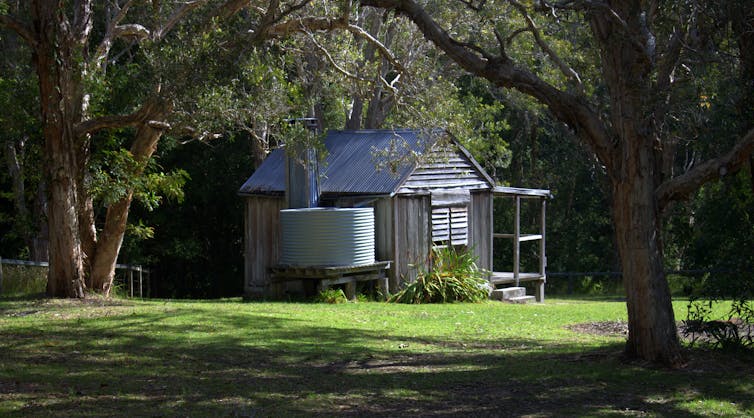
Kylie’s hut after the recent bushfires tore through. NSW National Parks and Wildlife Service
The undeniable romance of Kylie’s hut
Tennant was best known for her social realist studies of working-class life from the 1930s, including her Depression novels The Battlers (1941) and Ride on Stranger (1943).
During the second world war, Tennant moved to Laurieton with her husband and their daughter Benison, and lived there until 1953. At nearby Diamond Head, she met Ernie Metcalfe, a returned serviceman from the first world war and well-known local bushman.
Metcalfe felt Tennant had paid him too much for the land she bought from him, which was partly why he offered to build the hut. Bill Boyd, who later restored the hut, remembers
Kylie would insist on paying him […] she only paid him about 25 pounds which was a lot of money in that time.
Metcalfe was memorialised in her non-fiction book The Man on the Headland (1971). From the beginning, fire played a part in the hut’s life.
The first summer, as though Dimandead [Diamond Head] had made a sudden bid against this new invasion, a fire leapt the creek and came so close to the house that one window cracked in the heat.
Ernie fought the fire single-handed and when we arrived he was standing sooty with ash in his beard in a blackened desert with the house safe in the middle.
While appearing to be an ordinary bushman’s dwelling, “the romance” of Kylie’s Hut was “undeniable”, according to Andrew Marshall, a marine wildlife project officer in the NSW Parks and Wildlife Service. It’s fondly remembered by locals, tourists and aspiring writers who have visited since the 1980s.
Its location in a campground was unique because it quietly coexisted with holidaymakers rather than being relegated to a specially demarcated, curated space. However, this lack of protection left it exposed to the elements and the predations of climate change.
In 1976, Tennant donated the hut and the surrounding land to Crowdy Bay National Park, partly to try to protect the environment from ongoing rutile mining.
The creation of the Crowdy Bay National Park was facilitated not only by Tennant’s gift, but also by the earlier dispossession of the Birpai peoples and the re-zoning of their land.
Kylie Tennant donated her hut to Crowdy Bay National Park. Shutterstock
The erroneous belief that previous inhabitants had “disappeared”, meant the story of Tennant and Metcalfe’s friendship, symbolised by the hut, effectively obscured earlier stories of the Traditional Owners.
Restoration worthy of preservation
Local bush carpenter Bill Boyd substantially refurbished Kylie’s Hut in the early 1980s. A master of old forestry and timber working tools, Boyd used the restoration of Kylie’s Hut as a way to share his knowledge of the uses of broad-axe and adze (an axe-like tool with an arched blade).
Aside from its association with Tennant, the hut has additional significance because it was built using “unpretentious construction techniques” and displays “a unity of form, design and scale”, according to Libby Jude, a ranger from the NSW Parks and Wildlife Service.
It was composed of “strong, natural textures” associated with the fabric of the place in which it stood. And the specialised restoration methods Boyd used are heritage practices that are themselves worthy of preservation.
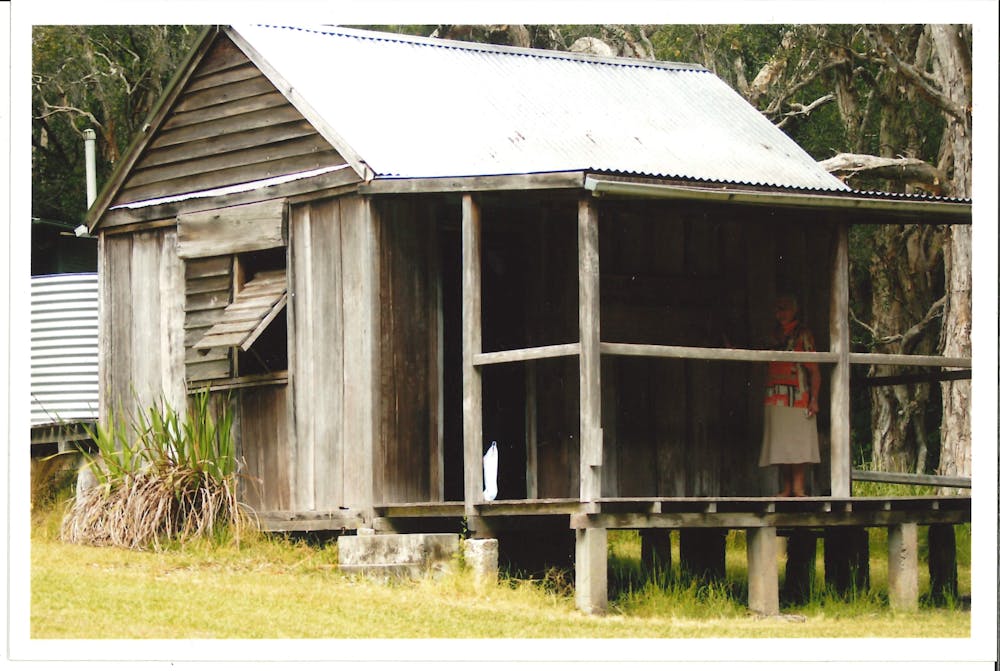
Kylie’s Hut post restoration. Benison Rodd, Author provided
Boyd also passed on his knowledge to younger carpenters while restoring many of the High Country huts, some dating back to the 1860s and associated with The Man From Snowy River. Most of these were also razed by the recent bushfires.
Members of the Kosciuszko Huts Association have expressed their desire to restore the huts, but a conversation about when and how they could be reconstructed will be well down the track.
Australian literary heritage is often forgotten
Unlike the United Kingdom, where literary properties are routinely listed on maps, Australia tends not to proudly celebrate sites related to its writers.
Aside from the work done by the National Trust, literary societies and enthusiasts in regional communities mostly drive the protection of Australian literary sites.
Ideally, there should be a more coordinated approach to our literary heritage which could identify vulnerable structures and take steps to ensure that, wherever possible, they’re not wiped out by natural and man-made disasters.
The memorialisation of Kylie’s Hut, which began in the 1980s as a response to her book The Man on the Headland, rendered black history peripheral to the central story of bushmen like Metcalfe living in the area. Nevertheless, it was an accessible literary site stimulating awareness of aspects of our cultural history, which might otherwise remain almost completely unknown.
The origin story of Australian modernism often centres around Heide – the Melbourne artistic community where, from 1934, bohemian art patrons John and Sunday Reed nurtured talents such as Sidney Nolan, Albert Tucker, Joy Hester and John Perceval.
But nestled in the heart of Melbourne’s city laneways was another birthplace of Australian modernism. At 166 Little Collins Street, near the “Paris End” of Collins Street, was the Leonardo Art Shop – a bookshop that during the 1930s and 40s inspired a generation of young artists to create a homegrown avant-garde.
The bookshop was the creation of Gino Nibbi, born in Fermo, Italy, in 1896. Nibbi trained as an accountant, but his passion was modern art. He migrated to Melbourne with his wife in 1928 and established Leonardo Art Shop several months later.
First in Post Office Place, then on Little Collins Street behind King’s Theatre, Nibbi stocked the shelves with imported foreign-language books and colour prints of contemporary European paintings, exposing his customers to images and ideas never before seen in Australia. For the next two decades, Leonardo Art Shop – also known as Nibbi’s – was a “direct link to Europe” for artists and intellectuals ravenous for avant-garde culture.
An intellectual salon
Melbourne then was a far cry from today’s sophisticated and cosmopolitan metropolis. The interwar decades were the heyday of the White Australia policy, and the non-Indigenous population was calculated as 98% “British”. With little diversity and few outside influences, Melbourne was a staid and conservative city, suspicious of new ideas that might challenge the status quo. “The dictatorship of the smug” was how cultural critic P. R. Stephensen summed up the local culture in 1936.
In the art world, this conservatism manifested as a fierce antagonism towards the modernist aesthetics revolutionising art in Europe. Picasso, Matisse, Cezanne, Gauguin – artists we now revere as visionaries – were dismissed by Australian critics as degenerates whose abstracted and expressionist forms threatened the principles of academic painting.
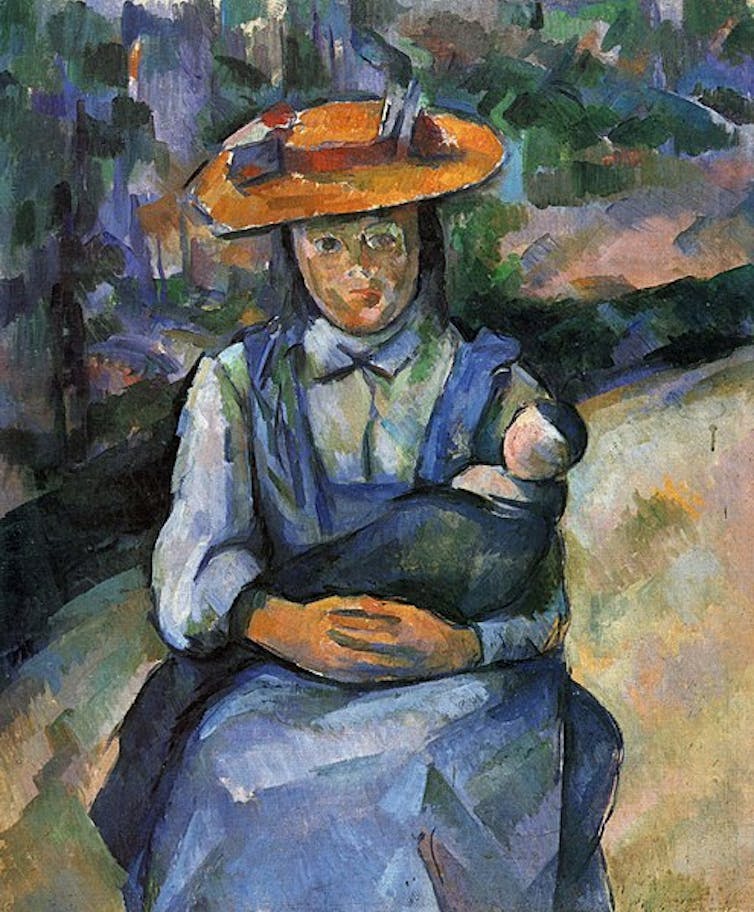
While celebrated internationally, artists like Paul Cézanne (1839-1906) were dismissed by the Australian artistic establishment. Wikimedia Commons
Under the directorship of arch-conservative J. S. MacDonald, the National Gallery of Victoria refused to acquire post-Impressionist art (this position was slowly reversed when MacDonald was replaced in 1941). Throughout the 1930s, art world gatekeepers like MacDonald and critic Lionel Lindsay spurned modernism as an “imported and perverted art” hailing from “the dead hand of European decadence”.
Although local painters Arnold Shore and William “Jock” Frater had begun to experiment with modernism, the nationalist pastoral landscapes of Arthur Streeton and Hans Heysen remained the gold standard of Australian art. When Mary Cecil Allen returned home to Melbourne from New York in 1936, she was excoriated by local critics for exhibiting “distorted” and “bizarre” abstracts that exemplified “the superficial nature of modern painting”.
Melburnians were cut off from the latest artistic and cultural trends. Although mass media circulated modern ideas and aesthetics via design, advertising, cinema and magazines like The Home, the “high culture” fine art world remained wedded to 19th century ideals.
This is where Nibbi’s played a crucial role. Prior to the explosive 1939 Herald exhibition of contemporary European painting, Nibbi’s was the only place in Melbourne where it was possible to view high quality colour reproductions of post-Impressionist art.
Local artists flocked to Little Collins Street to feast on the latest Cezanne, Gauguin or Van Gogh prints newly arrived from Europe, marvelling at the bold colours and abstracted forms. Although the original artists were long dead, their work was little known in Australia. In 1930s Melbourne, avant-garde art from the late 1800s was still breaking news.
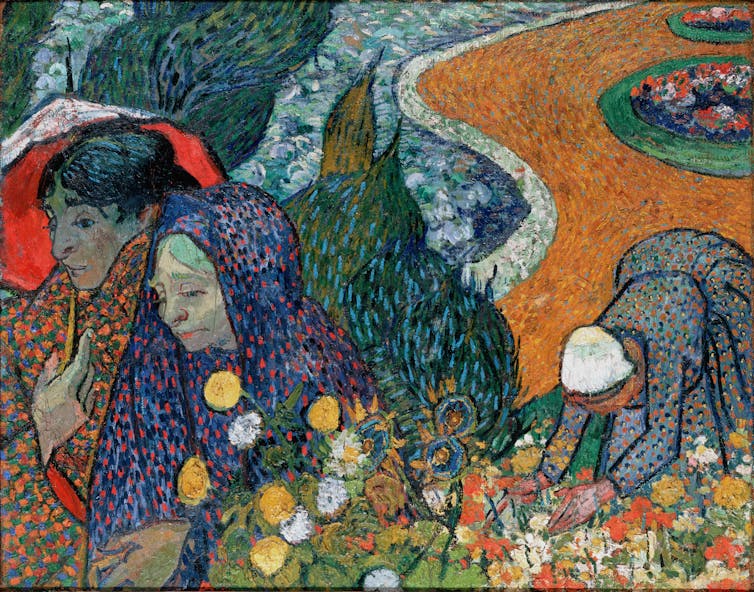
Although van Gogh died in 1890, in the 1930s his use of colour and abstract shapes was still shocking and new to Melbourne. Wikimedia Commons
Future giants of Australian modernism – including Arthur Boyd, John Perceval, Russell Drysdale and Donald Friend – had their minds and eyes opened at Leonardo Art Shop. As the artist Len Crawfordrecalled, Nibbi’s had a “powerful effect” on local artists, introducing them to things “you’d never dreamed of”. Crawford regularly stopped by to pour over the displays. When funds allowed, he’d splash out on a six-penny postcard to take home.
The shop boasted an unparalleled range of books and magazines in German, French, Italian, Spanish, Russian, Norwegian and Dutch, as well as English works by risque writers such as Casanova and Norman Lindsay. A great supporter of the local literary scene, Nibbi stocked small poetry chapbooks, magazines and plays by Melbourne writers. For writer and broadcaster Alister Kershaw, Nibbi’s was simply “the most enchanting bookshop in the world”.
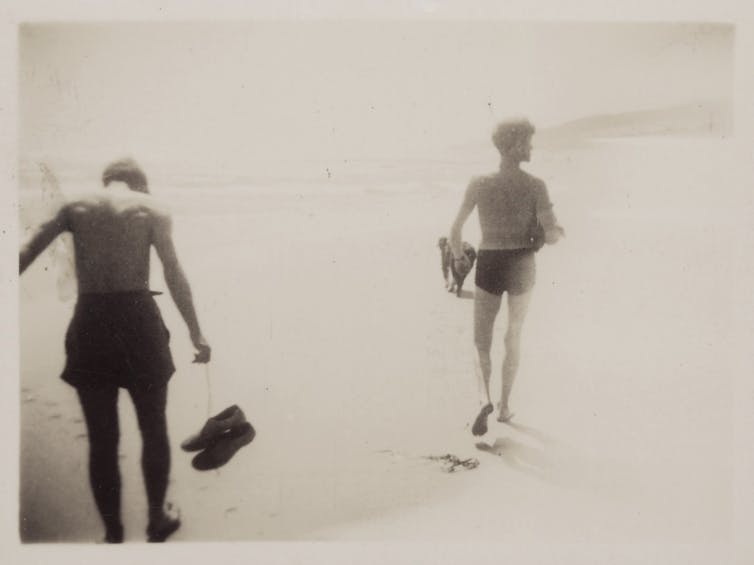
Sidney Nolan and John Reed, c1944-1945. Albert Tucker Photographic Collection, Heide Museum of Modern Art & State Library of Victoria
Meals and mentors
Nibbi’s was a gathering place and intellectual salon, where modernists-in-the-making could meet like-minded souls. Stimulated by the images on display, patrons would linger for hours, chewing over the latest trends in contemporary culture. Heide’s John Reed and poet and artist Adrian Lawlor were both regulars, haunting Nibbi’s to talk art, ideas and politics.
After working up an appetite, the Nibbi’s crowd would head to a Chinese cafe at 201 Lonsdale Street known as Dooey Din’s, the best place in town to catch up on art-world gossip. Also in the neighbourhood was Albert Tucker’s Little Collins Street studio and Cynthia Reed’s interior design shop. At 367 Little Collins, Cynthia Reed’s was notorious in the mid-1930s for exhibiting controversial modernists like Sam Atyeo. Just a few doors down was another independent bookshop, run by Margareta Webber, whose “delightful store” at 343 Little Collins sold imported literary fiction to a similar clientele as Nibbi’s.
For a time, Little Collins street was the centre of Melbourne’s art world conversations. Albert Tucker Photographic Collection, Heide Museum of Modern Art & State Library of Victoria
Nibbi himself was a beloved figure, a polymath who knew everyone and – as artist Len Crowford put it – “had his fingers in everything”.
Nibbi mentored emerging painters, writers and musicians, providing an informal education in modern culture and giving feedback on their work. One of his greatest discoveries was the painter Ian Fairweather, who went on to have his first exhibition at Cynthia Reed’s in 1934. In Crawford’s words, Nibbi was a “most valuable man”, who “did more for general education in Melbourne than anyone I knew of”.
Alongside his wife Elvira, who taught Italian at the Melbourne Conservatorium and the Berlitz School of Languages, Nibbi was a leader in Melbourne’s Italian community. The couple even developed an Italian course for ABC radio, which broadcast on Saturday evenings. Nibbi promoted the Italian language through his Italian-English Reader, self-published in 1936.
The culture wars
Nibbi was an active critic who regularly went into battle for modern art in the press. As he wrote in the Melbourne Herald in 1931, modernism was not a “capricious vogue” but rather an “expression of the spirit of the time”.
He faced considerable resistance in the trenches of Australia’s culture wars. In 1930, he was fined £20 for importing an unnamed “obscene book”, while his art criticism attracted a barrage of reactionary ire.
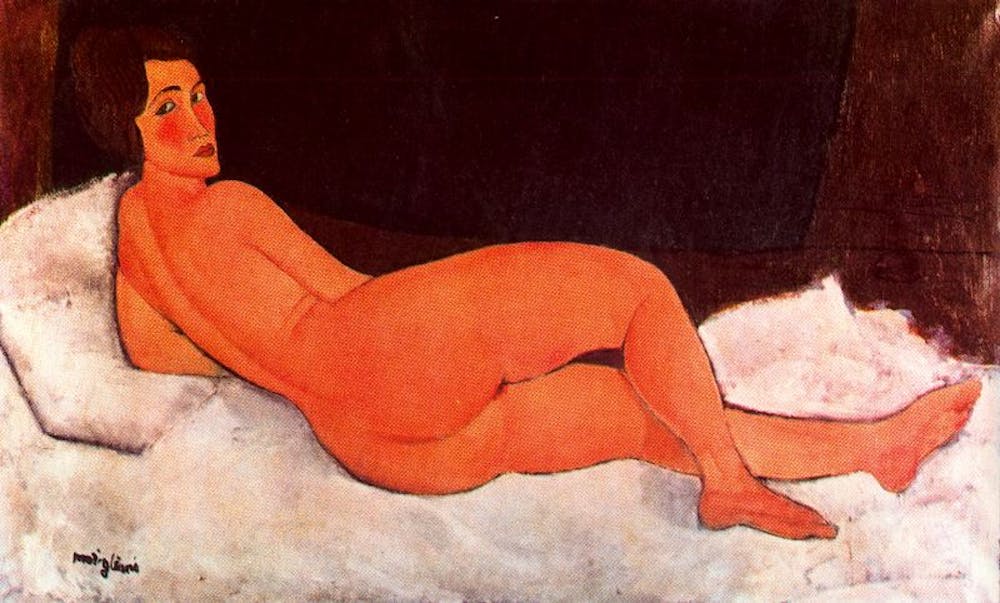
Most notoriously, in 1937 Nibbi was thrown into the national spotlight when Australian customs seized 50 prints of Modigliani’s Lying Nude (1917) imported for sale at Leonardo Art Shop. Although Modigliani nudes hung in the world’s leading galleries, customs officials deemed the image pornographic and earmarked the prints for destruction. Officials feared the nude would “appeal to other than art collectors”.
Lying Nude, Modigliani’s expressionist painting from 1917. Wikiart
This incident outraged artists and reignited a larger debate about censorship in Australian culture. The notoriously combative Adrian Lawlor leapt to Nibbi’s defence, condemning the “bumble-foots” with “ridiculous powers of censorship” working in the customs department. In his view, Modigliani’s nude was a great work of art, “entirely innocent of the least breath of pruriency”.
The Victorian Artists’ Society also protested the decision. In a letter to the customs minister, the society insisted Lying Nude contained “no hint of obscenity”, and was instead the work of a “consummate artist”.
Nibbi himself appealed the seizure of his prints, which he had obtained at great effort and expense during a visit to Italy. In November, the matter was referred to the Book Censorship Board, established in 1933 to advise the customs minister on the censorship of imported books. Under Section 52(a) of the Customs Act, anything judged blasphemous, indecent or obscene would be banned.
The archive is silent as to the board’s final decision regarding the Modigliani prints, but records in the National Archives of Australia suggest it was unmoved by artists’ protests. Although board member Sir Robert Garran admitted the original Modigliani painting was not obscene, he advised Customs that a “crude reproduction” sold at “picture-postcard price” would attract buyers more interested in titillation than “artistic merit”.
Nibbi was not cowed by the controversy. The following year, 1938, he helped establish the Contemporary Art Society alongside Lawlor and George Bell. It was a bold organisation that hosted exhibitions and public lectures about modern art. Over the next decade, the CAS battled against the Australian Academy of Art, a Canberra-based conservative stronghold established in 1937 that was much resented for – in Bell’s words – its “sanctification of banality” and “strict preservation of mediocrity”.
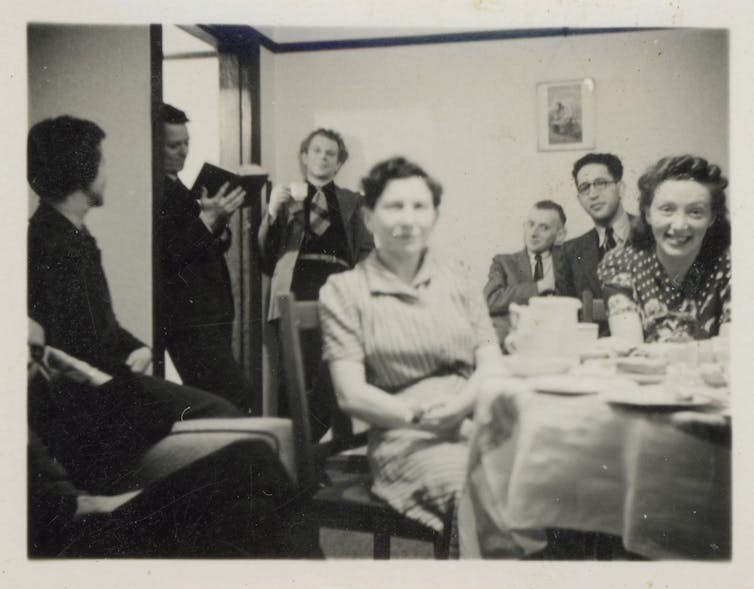
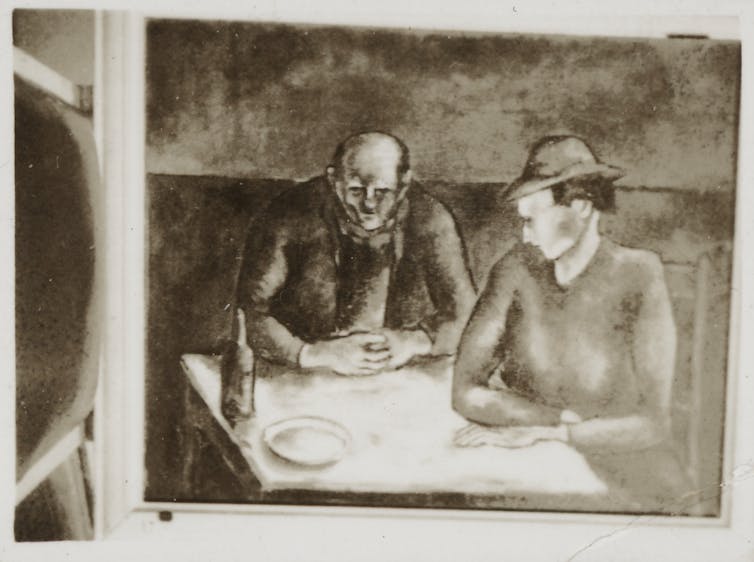
Yoselle Bergner’s The Pie Eaters photographed at the Contemporary Art Society c1940. Albert Tucker Photographic Collection, Heide Museum of Modern Art & State Library of Victoria
The end of an era
In 1947, the lease on Leonardo Art Shop was not renewed. Melburnians mourned the demise of a local institution that had “fostered a cosmopolitan atmosphere” and “didn’t bother with meretricious sidelines”. Unable to secure alternative premises, Nibbi returned to Italy, where he lived until his death in 1969.
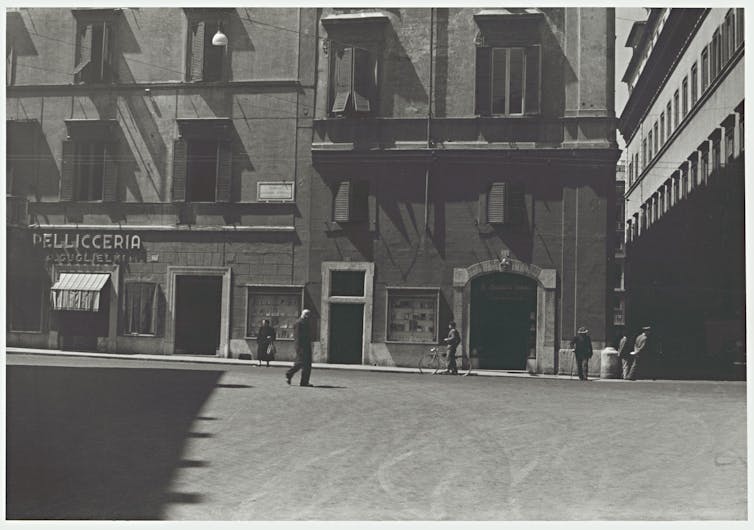
He maintained links with Australia, a country he had come to love. In Rome, he opened a bookshop and art gallery called Ai Quattro Venti (To the Four Winds) that became popular with Australians visiting Europe. In 1952, Nibbi hosted a Sidney Nolan and Albert Tucker exhibition, introducing Australian modernism to Italian audiences.
Gino Nibbi’s Galleria ai Quattro Venti in Rome, c 1953. Albert Tucker Photographic Collection, Heide Museum of Modern Art & State Library of Victoria
In 2020, as our independent booksellers are threatened by coronavirus, it is timely to reflect on their importance to Australia’s cultural life.
In the internet age we’re no longer reliant on bookshops to bring news from overseas, but they remain vital incubators of fresh ideas and creative community.
Leonardo Art Shop seeded a homegrown modernism. Who knows what innovations our contemporary booksellers are bringing into life? We’ll only find out if we give them sufficient custom to survive the pandemic.
Australia’s literary journals are produced in a fragile ecosystem propped up by a patchwork of volunteer labour, generous patrons and, with any luck, a small slice of government funding.
The Sydney Review of Books, the Australian Book Review and Overland were among a group of publications who sought four-year funding from the Australia Council in 2020 but were unsuccessful.
These publications join the ranks of many others – among them Meanjin and Island – defunded by state or federal arts funding bodies in recent years.
These magazines are vital for today’s publishing industry. For many authors literary magazines provide the first opportunity for publication. For editors and arts administrators, they provide a training ground for life-long careers in Australia’s creative sector.
The past decade has seen a steady decline in arts funding going to individuals and organisations. According to Chairman of the Copyright Agency and former media executive, Kim Williams, writing in the Sydney Morning Herald:
[…] if funding for literature had been maintained as in the mid-70s, considering inflation and population growth, it should be at $12 million, at least. Today, it stands at just $5 million (compared with $4.2 million 30 years ago).
The list of defunded writing-focused organisations in the most recent multi-year funding round is stark. Those losing their multi-year status include Artlink, Eyeline, Art Monthly, the Australian Script Centre, Playwriting Australia, Sydney Writer’s Festival and Brisbane Writers Festival.
Without securing medium-term support, these organisations face an uncertain future.
Vital discourse
In response to the 2020 funding announcement, editor of Australian Book Review, Peter Rose, stated the decision demonstrates
little understanding of [the magazine sector’s] contribution to the literary ecology, and no appreciation of the dire consequences for readers, authors, contributors and publishers.
The cultural discussions within the pages of literary journals set the agenda for the more higher-profile but slower-moving institutions such as publishers, prizes and festivals.
Literary magazines are often the first place authors are published. Against the backdrop of an industry largely staffed by white, middle-class people, small magazines are at the forefront of bringing more Australian writing to the surface from writers of colour, First Nations writers, disabled writers, trans writers and working-class writers, challenging those who hold power at the top of the sector.
Writing in 2015 about the position magazines such as Island or Overland occupy, Emmett Stinson noted these publications:
[…] are essential to contemporary literary culture: they showcase new and emerging writers; […] offer more extended literary debates and discussions than the broadsheets; comprise a venue for journalism that contains views outside of the liberal mainstream; serve as rallying points for different communities of readers and coteries of authors […]
Ben Etherington’s essay about the parallel lives and deaths of Mudrooroo and Les Murray, Cher Tan’s exposition and critique of taste production on the internet, and Blak Brow – which was written, edited, illustrated, curated and performed by First Nations creators – are among countless examples of the ways literary magazines carve out space for critique, expression, consideration and reflection.
In shifting funding away from small magazines, we lose the place for these discussions.
Not a competition
Uncertainty, instability and fragility are perhaps the defining characteristics of small magazines.
The decisions to not fund literary magazines not only have a significant impact on the individual publications, but also to Australian cultural discourse.
What gets published within the pages of these magazines can entertain us, it can inspire us to critically examine the world around us, and can help us understand culture that moves us.
Vibrant discussion about culture, society and the arts does not happen by accident. It must be carefully nurtured and requires financial support.
The Australia Council make extremely difficult decisions about what gets funded and what doesn’t.
Not every organisation and publication and festival can receive funding. Those who don’t secure funding are no more or less worthy than those who do. Reduced financial support for Australia’s creative endeavours encourages artists to turn against one another in judgement of what should and should not receive funding.
Australian artists entertain us, challenge us and allow us to see things from different perspectives. Fulfilling a capitalist desire for competition, however, only distracts from the importance of Australian artists and the contribution the creative sector makes to our lives.
Correction: a reference to the Wheeler Centre has been removed as they did not apply for funding in 2020.
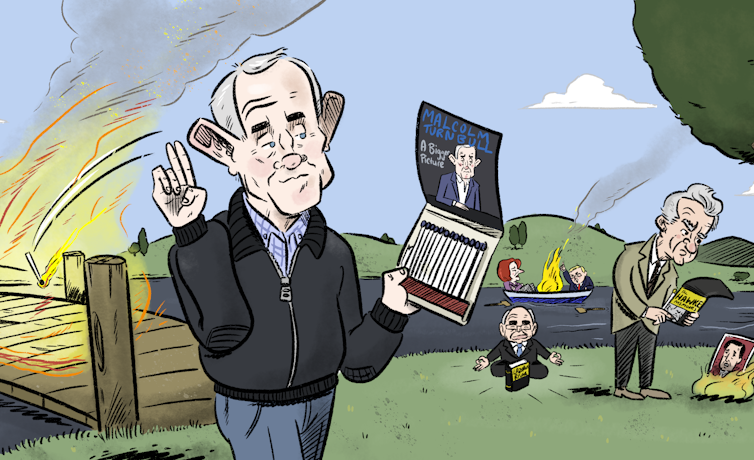
Landing in the middle of the coronavirus pandemic, it may seem strange former prime minister Malcolm Turnbull’s memoir has generated so much political controversy.
In A Bigger Picture, Turnbull deals candidly with his antagonists inside the Coalition, who fought him bitterly on the same-sex marriage reform and climate policy. Similarly, he names and shames those he blames for the leadership insurgency of August 2018. All of this was expected, but none of it must please the current government.
But is the book any more inflammatory than previous prime ministerial memoirs?
Political controversy is a trademark of political memoir publishing in Australia. A Bigger Picture is just another page in that story.
Until the 1960s, prime ministerial memoirs were the exception, not the rule. Between 1945 and 1990, just three former prime ministers chose to publish books about their political lives. Two of them – Billy Hughes and Robert Menzies – produced two books each, and both political veterans sought to avoid “telling tales out of school”. Both seemed more interested in foreign affairs, particularly our imperial relationship to the UK in the case of Menzies.
The dismissal of the Whitlam government provoked both Sir John Kerr and Gough Whitlam to publish their memoirs. After reading extracts of Kerr’s Matters for Judgement, Whitlam decided to “set the record straight immediately” by writing The Truth of the Matter. His second book, The Whitlam Government, was also designed to make a political splash. Promising to explain the “development and implementation” of his policy program, the book was timed for release on the tenth anniversary of the dismissal itself, ensuring maximum publicity.
Since then, political controversy has accompanied prime ministerial memoirs, in part because incumbent political parties and leaders have had a vested interest in how these books might affect their popularity.
In his 1994 political memoir, Bob Hawke accused his rival and successor, Paul Keating, of calling Australia “the arse-end of the world” during an argument about the Labor leadership. Further, Hawke accused Keating of failing to support Australia’s involvement in the Gulf War against Saddam Hussein’s invasion of Kuwait in 1990.
Keating, who was attacked in parliament in October 1994 over the claims, called both allegations “lies”. Hawke offered to take a lie-detector test to prove his sincerity. Senior ALP figures recorded their outrage at Hawke’s memoir. But Hawke hit back, describing them as “precious self-appointed guardians of proper behaviour”.
Hawke’s predecessor also damaged his relationship with his own party in the process of publishing his memoirs. Malcolm Fraser’s Political Memoirs, written with journalist Margaret Simons, was recognised as one of Australia’s top ten books of 2010. His outspokenness – in the book and in his post-prime-ministerial life more generally – earned him many attacks from Coalition MPs.
John Howard handled the politics of his memoirs better than most politicians. Though the book was antagonistic toward his former treasurer, Peter Costello, Howard promised to “deal objectively” with events and relationships in Lazarus Rising. Ever the party stalwart, Howard and his publishers re-issued the book after the 2013 election with a new chapter that touted Tony Abbott’s “high intelligence, discipline […] good people skills”.
Kevin Rudd and Julia Gillard both publicly took aim at one another in their memoirs, which made for plenty of media fodder. In My Story, Gillard described Rudd’s leadership as a descent into “paralysis and misery”. Rudd returned fire, calling her book her “latest contribution to Australian fiction”. However, he was unable to dent the book’s commercial success.
Four years later, Rudd in The PM Years accused Gillard of plotting “with the faceless men” to become prime minister. In a bid to patch over the historic rifts, he subsequently promised the Labor Party’s 2018 National Conference that the “time for healing” had come.
Critics of Turnbull’s book – such as Sky News’ Andrew Bolt and 2GB’s Ben Fordham – have argued that he and his publishers, Hardie Grant, were wrong to “betray confidences” and divulge “private conversations”.
In reality, political memoirs have always pushed against conventions of political secrecy. In the 1970s, British cabinet minister Richard Crossman published his Diaries, which included detailed descriptions of how cabinet functioned. The British establishment subsequently conducted the Radcliffe review into political memoirs and diaries. It found such material should be kept secret for 15 years, but that civil servants could do little to stop their political masters from publishing.
In 1999, Australia’s Neal Blewett was warned that publishing his A Cabinet Diary, recorded seven years earlier, could lead to prosecution under the Crimes Act because it revealed confidential cabinet discussions. Calling the public service’s bluff, Blewett published anyway. He explained in the book that “a few egos will be bruised, but cabinet ministers are a robust lot”. His diary shed significant light on the trials and tribulations of a ministerial life.
Since then, countless MPs and ministers have published books that claim to accurately represent personal conversations, some based on private notes (as Costello claimed in his memoirs), others on diary entries (as is the case in Turnbull’s book). In recent years, politicians have reproduced text messages and email exchanges in their books, as Bob Carr did in his 2014 book, Diary of a Foreign Minister. In each version of history, the author is the essential policymaker.
In his book, Turnbull reveals private conversations and WhatsApp exchanges with colleagues, world leaders, public servants and more. His accounts of cabinet discussions are hardly ground-breaking: cabinet debates about the economy and national security under the Abbott government, for instance, were thoroughly detailed in Niki Savva’s The Road to Ruin, while the acrimonious debates about energy policy, same-sex marriage and home affairs inside the Turnbull government were laid bare in David Crowe’s Venom. Similarly, Turnbull’s criticisms of News Corporation’s biased reporting have been aired elsewhere, and stop short of Rudd’s argument in The PM Years that Rupert Murdoch should be the subject of a royal commission.
Turnbull’s book is another addition to the history of incendiary political memoir publishing in Australia. Political parties and their media associates have confirmed once again that a successful parliamentary memoir requires deft political management.
Ultimately, A Bigger Picture is not the compendium of revelations that some may perceive. Instead, it is another picture of politics in which “character” and “leadership” reign supreme at the expense of all other political forces.







 At the BookShelf
You must be logged in to post a comment.