Unknown's avatar

Australia’s copyright reform could bring millions of books and other reads to the blind


Image 20170322 25755 1y5edm2
Rule change should make it easier for more copyright works to be made available in Braille.
Chinnapong/Shutterstock

Nicolas Suzor, Queensland University of Technology

Proposed changes to Australia’s copyright law should make it easier for people to create and distribute versions of copyrighted works that are accessible to people with disabilities. The Conversation

The Copyright Amendment (Disability Access and other Measures) Bill was introduced to Parliament on Wednesday.

If passed, it would enable people with disabilities to access and enjoy books and other material in formats they can use, such as braille, large print or DAISY audio.

The Australian Human Rights Commission has long been calling for action to end the “world book famine” – only 5% of books produced in Australia are available in accessible formats. This means that people with vision impairment and other reading disabilities are excluded from a massive proportion of the world’s knowledge and culture.

Under the current law, educational institutions and other organisations can produce accessible copies of books, but the system is slow and expensive. Only a small number of popular books are available, and technical books that people need for work are often out of reach.

Technology should make accessibility much easier, but publishers have been slow to enable assistive technologies.

People with disabilities have long complained that they are not able to take advantage of new technologies such as inbuilt screen reading software on computers and smartphones.

Amazon’s Kindle, for example, used to allow text-to-speech to help blind people read books, but Amazon gave in to publishers’ fears and allowed them to disable the feature. Apple’s electronic books are much better, but there are still major gaps.

Our research looked at books available through electronic academic databases, and found that most ebook libraries have some features that frustrate full accessibility.

The Copyright Act in its current form does grant statutory licences for copying by institutions that assist people with disabilities, but there are no comprehensive exceptions for individuals. Research shows that even students in resourced universities have trouble accessing the materials they need to study.

A fair right for people with disabilities

The new Bill aims to create a clear right for individuals to copy materials into accessible formats. Critically, this new “fair dealing” exception also allows other people to help out by creating and sharing accessible versions of books and other materials.

This is a major milestone in making copyright law more fair. It implements Australia’s obligations under the Marrakesh Treaty, a landmark international agreement designed to stop copyright getting in the way of accessibility.

The Marrakesh Treaty, once implemented around the world, will enable organisations to share accessible books to the people who need them in other countries. This is an extremely important change as the costs of scanning and making a book accessible are so high that most blind people are denied access to most works.

Once the laws are clarified, the accessibility of books will increase dramatically. Google has been busy digitising the world’s books, and it has given those books to a charity called Hathi Trust. Soon, Hathi Trust will be able to share those books with blind people around the world.

Google’s partnership with Hathi Trust means that blind people will soon be able to access more than 14 million volumes almost overnight. This figure may grow quickly as Google has already digitised more than 30 million books. Very soon, the proportion of accessible books might jump from 5-10% to closer to 30%.

A missed opportunity

The Bill also proposes a number of other long awaited updates to Australian copyright law. But one thing the Bill does not do is fix a drafting error that has plagued Australian copyright law for the past decade.

When Australia signed the Australia – US Free Trade Agreement, we introduced a system of “notice-and-takedown” that would protect copyright owners. The system provides a way for people to ask online service providers to remove content that infringes copyright.

But the law was poorly drafted. It applied only to a small number of Internet Service Providers (such as Telstra, Optus and iiNet) but not the larger category of search engines and content hosts.

This means it does not apply to giants such as Google and Facebook. It also means that other organisations that host content uploaded by users, such as The Conversation, are also excluded.

These safe harbours provide a shield in case people – outside of the service provider’s control – use their networks to upload content that infringes any copyright laws.

The reason they are so critical is that it is often prohibitively expensive for the companies that host internet content to check all content before a user uploads it.

But the safe harbours aren’t free. The quid pro quo is that the ISP must introduce a notice and takedown scheme. This is one of the few effective mechanisms to get content removed from the internet, and has been a crucial part of protecting the rights of publishers and authors online.

Professor Kim Weatherall explains the drafting error in Australia’s copyright safe harbours.

When the new Bill was first drafted, it was set to fix the drafting error that excludes content hosts, search engines, universities and other organisations from the scheme. But the Bill introduced this week contains no such fix.

The extension of these safe harbours has become highly politicised, with major rightsholders warning that it looked like a win for Google and Facebook.

The past two decades of the internet in the United States have shown how critical the safe harbours are to all developers, both large and small. They reduce uncertainty and allow innovation in the ways that people access content.

So while this new Bill is important, it is also a missed opportunity. The drafting error in Australia’s copyright safe harbours means that neither tech companies or authors and publishers are well protected.


Tess Van Geelen, a Research Assistant at the Faculty of Law, Queensland University of Technology, contributed to this article.

Nicolas Suzor, Associate professor, Queensland University of Technology

This article was originally published on The Conversation. Read the original article.

Unknown's avatar

How 19th century fairy tales expressed anxieties about ecological devastation


Image 20170316 20776 17ofa73
In the Fir Tree, children stamp on a discarded – but feeling – Christmas tree.
The Fir Tree, illustrated by George Dalziel and Edward Dalziel, from Out of the Heart: Spoken to the Little Ones, 1867

Victoria Tedeschi, University of Melbourne

Danish writer Hans Christian Andersen was one of the most popular European fairy tale authors in 19th century England. While today Andersen is known for his agonised mermaids, disabled tin soldiers and disenfranchised match sellers, his Victorian readers celebrated tales that raised environmental concerns during an age of rapid industrialisation. The Conversation

According to a recent international research project, human activity has been the leading cause of global warming since the early stages of the Industrial Revolution – decades before scientists had previously estimated. Global warming is not a 20th-century phenomenon; rather, humans have been impacting the environment for over 180 years.

From 1760 to 1914 in England, vast numbers of people moved from the country to the city for financial security. London’s population swelled, prompting a century-long struggle with filth. An outdated sewage system released all human waste into the capital’s water supply, smoke poured from both factory and domestic chimneys and streets were caked with coal, mud, vegetable matter and animal waste.

As urban life became increasingly distanced from nature, Andersen’s fairy tales thrived. While Victorian fantasy literature often romanticised nature as an escape from the encroaching industrial landscape, Andersen showed human characters as the source of environmental degradation.

For example, Andersen’s stories The Fir Tree, The Daisy and The Flax, feature plants that are tortured and abused by human characters. In these stories, talking plants suffer the dangers of industry.

Illustration for The Daisy, by George Dalziel and Edward Dalziel.
Out of the Heart: Spoken to the Little Ones (1867)

Despite the pain they experience, these plants are selfless providers willing to compromise their personal happiness for human interest. These sympathetic depictions of nature, during a century of environmental devastation, encouraged children to reflect on their impact on the landscape.

Other tales, such as The Great Sea Serpent, detail the emerging conflict between animals and technology. The story describes fish reacting to the installation of the transatlantic telegraph cable, which ran the length of the Atlantic ocean between Europe and America.

With the chaos of the installation, schools of fish become separated, sea-anemones “were so agitated that they threw up their stomachs” and the cod and flounders who once “lived peacefully” began to eat their neighbours.

When the fish rally together to destroy the cable, a shark is impaled by a sword-fish and “great fishes and small, sea-anemones and snails rushed at one another, ate each other, mashed and squeezed in” while “the cable lay quietly and attended to its affairs”. The telegraph cable is not a positive technological breakthrough, but a threat to the environment.

Illustration from A Drop of Water.

A microscopic (yet equally voracious) ecosystem and its parallels with increasingly hostile cities is the subject of Andersen’s Drop of Water. A sorcerer named Creep-and-Crawl examines an extract of ditch water using a microscopic lens. He notices organisms that “hopped and jumped about, pulled one another and pecked one another”. Seeing the organism’s violent, unruly conduct, his colleague assumes that the creatures must be living in a capital city.

The Victorian public was equally horrified by the organisms that were hidden in its drinking water. The fear of contaminated water was well founded: an antiquated sewage system directed London’s cesspools to the Thames, which was the capital’s water reserve. Chemicals from factories were also released into the river, spreading waterborne diseases such as typhoid, cholera, and dysentery.

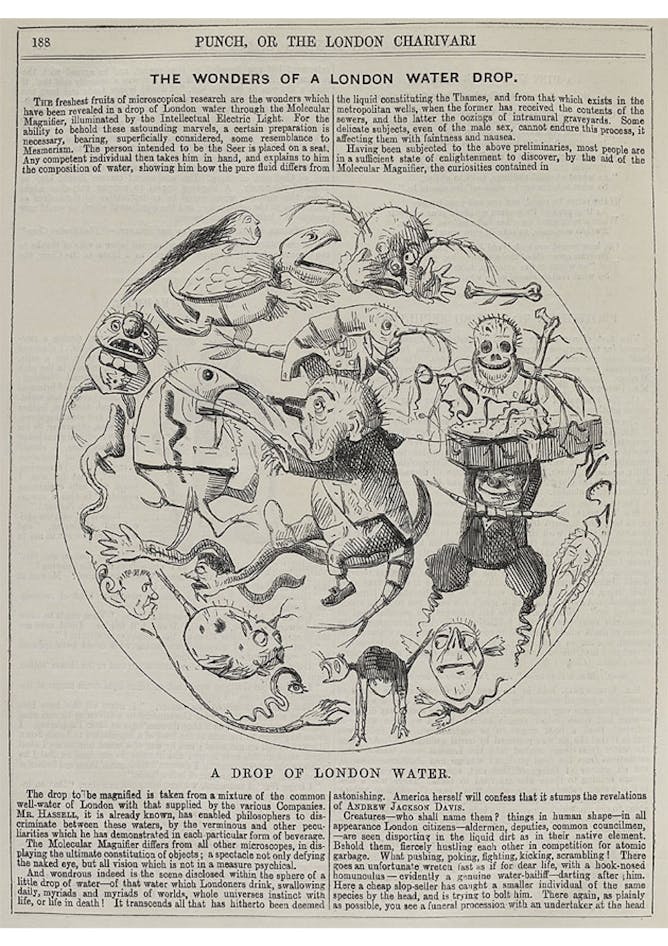
Andersen’s contemporaries also exaggerated microscopic images of organisms (otherwise known as “monster soup”) in contemporary journals. In these illustrations, samples of water from the Thames were filled with a host of aggressive, potentially deadly beasts.

Anonymous engraving in Punch Magazine, The Wonders of a London Water Drop.

For example, an anonymous illustration published in Punch magazine in 1850 shows hybrid and humanoid creatures wearing tuxedos in a petri dish. Amidst the chaos, small worm-like creatures spell out the word “pestilence”.

William Heath’s coloured engraving from 1828 features winged creatures, hybrid animals and crustaceans with protruding fangs; the woman viewing the contaminated water is so disgusted that she drops her cup and saucer.

Monster Soup Commonly Known as Thames Water (1828), William Heath.
Public domain

By exploring the repercussions of an industrialised landscape, Andersen’s fairy tales provided commentary on a very real, looming threat to the English landscape and its population.

Today, with the steady rise of dystopian literature, ecofiction and climate change fiction (otherwise known as “cli fi”), we see similar artistic responses to environmental change which steer readers away from complacency. As authors seek to express the gravity and severity of ecological crises, their literature holds the potential to inspire radical change.

Victoria Tedeschi, PhD candidate, University of Melbourne

This article was originally published on The Conversation. Read the original article.

Unknown's avatar

Reading and Mental Health


The link below is to an article that looks at reading and mental health.

For more visit:
https://www.bustle.com/p/5-proven-ways-reading-can-improve-your-mental-health-43367

Unknown's avatar

Libro.fm: Audiobook Subscription Service


The link below is to an article reporting on how Libro.fm has now launched an audiobook subscription service.

For more visit:
http://the-digital-reader.com/2017/03/10/libro-fm-launches-audiobook-subscriptions/

Unknown's avatar

What would Mark Twain think of Donald Trump?


Image 20170302 14706 11eclga
Twain was an opinionated, prolific commentator on the personalities and political issues of his day.
Terry Ballard/flickr, CC BY

Jeffrey Wasserstrom, University of California, Irvine

Thanks to the criticisms they’ve leveled in articles, interviews, tweets and letters to the editor, we know that many contemporary authors, from Philip Roth to J.K. Rowling, have a dim view of Donald J. Trump. The Conversation

But what would leading writers of the past have made of him?

We can only speculate (well, until someone invents a Rowling-like potion capable of bringing long dead writers back to life). But if I could ask one dead writer what he thinks of Trump, it would be Mark Twain, my favorite American author and someone whose travel articles I’ve written about in the past. While Twain is best-known for his novels, he was also an opinionated, prolific commentator on the personalities and political issues of his day.

I suspect Twain would have found Trump the showman – the pre-2016 version – a fascinating figure. He would have been appalled, however, by much about Trump the president.

A champion of irreverence

I have no doubt about two things that Twain would find objectionable: the way that Trump has lashed out at TV sketches that mock him and his use of the phrase “enemy of the American people” to describe news organizations that criticize him.

Twain felt that no one was too grand to be satirized.

“Irreverence,” he wrote, “is the champion of liberty and its only sure defense.”

In America’s press, he admired its tendency to be “irreverent toward pretty much everything.” Even if this led to the newspapers laughing “one good king to death,” it was a small price to pay if they also “laugh a thousand cruel and infamous shams and superstitions into the grave.”

But pondering what, beyond this, Twain would make of Trump is an apt, tricky and timely exercise.

It’s apt because one of Twain’s novels, “A Connecticut Yankee in King Arthur’s Court,” features a man who travels through time.

It’s tricky because Twain’s views on many issues, including race, changed during his lifetime. Hence there are different Twains – as well as different Trumps – to consider.

Finally, imagining how Twain would view Trump is timely because when some have tried to look to history for an equivalent political moment, they’ll sometimes point to two decades – the 1880s and the 1900s – that happened to also be important in Twain’s life and career.

One of these Trumps is not like the other

The Twain of the 1880s would have probably found the Trump of a decade ago – a brash, self-promoting businessman known for his candid comments and penchant for media attention – fascinating. He may have even befriended him.

But the staunchly anti-imperialist Twain of two decades later would have been as disdainful of Trump now as he was of the man he once called “far and away the worst president we have ever had” – the muscular nationalist Teddy Roosevelt.

My basis for the first claim comes from Twain’s friendship with a flashy, boastful Trump-like showman: Buffalo Bill Cody. Among the most successful entertainment impresarios of his day, Cody founded and starred in a traveling Wild West Show, which drew large crowds in America and Europe and was famous for its reenactments of legendary battles.

In 1884, Twain sent a letter to Cody praising his Wild West Show as a realistic, “distinctly American” form of entertainment. In Cody’s spectacle – as in “The Apprentice” – the emcee was a famous man who played up a version of himself, capitalizing on the audience’s awareness that he had done things in real life that he did in the show: firing guns, in one case; firing people, in the other.

An advertisement for Buffalo Bill’s Wild West, a circus-like show that toured the nation.
NPGpics/flickr, CC BY-NC-ND

During this period, Twain wrote four of his best-known books. It was also a time of intense nativism in the United States. Many white laborers, especially in western states, became convinced that Chinese laborers, who had crossed the Pacific in large numbers during the Gold Rush, were unfairly depriving them of jobs that rightfully belonged to them.

This prejudice triggered several violent outbursts – such as the 1871 Los Angeles riot, which cost 18 Chinese men their lives – and led to the 1882 Chinese Exclusion Act, which forbade the entry of Chinese workers to the United States.

Twain mocked the hypocrisy of the Exclusion Act: Just as the U.S. government was preventing Chinese from coming here, American traders and missionaries in China were denouncing the Chinese government for hindering their pursuit of profits and converts in the Middle Kingdom.

Some critics of Trump’s executive order on immigration say it “eerily recalls” the 1882 Chinese Exclusion Act. In both cases, we see fear, stereotypes and prejudice fomenting an environment in which some groups are deemed less worthy of rights and protections – indeed, less human – than others.

In one of his early works, 1872’s “Roughing It,” Twain was already castigating those who bullied and abused Chinese immigrants as the “scum of the population.” His disdain for xenophobia and prejudice only grew later in life.

He would be a fierce critic of Trump’s nativist rhetoric even if – perhaps especially if – he had previously praised Trump the entertainer.

Twain targets Teddy

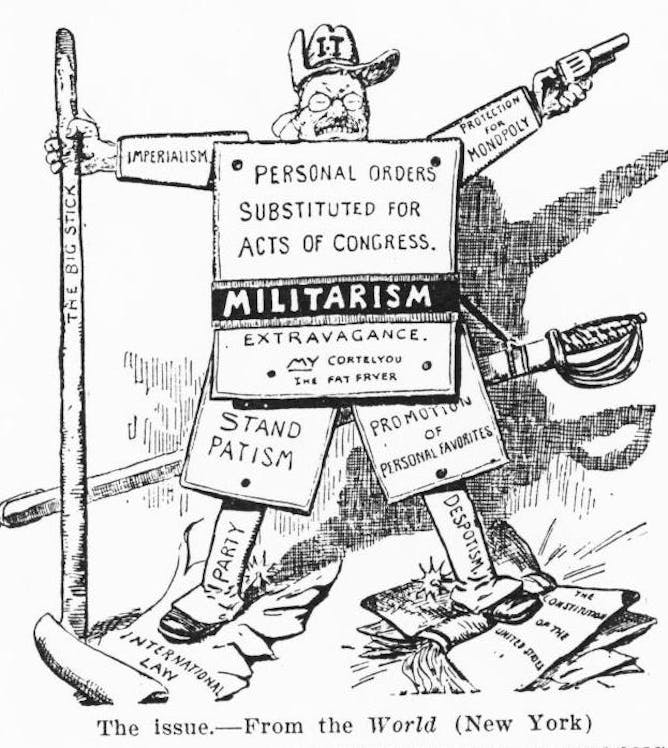
By the early 1900s, Theodore Roosevelt was in the White House. Trump – whom some have compared with Roosevelt – has said that when he speaks of trying to “Make America Great Again,” one period he has in mind is around the turn of the 20th century.

A 1904 New York World cartoon criticizes Teddy Roosevelt’s militaristic and imperialistic impulses.
Wikimedia Commons

Around this time, Twain was not just a celebrated author but a leading figure on the lecture circuit. As both a speaker and an essayist, he was known for his satirical jabs. A key target of his became American expansionists, whom he skewered in, among other works, the 1901 essay “To the Person Sitting in Darkness,” which lambasts Americans for committing violence across the Pacific under the guise of “civilizing” backward peoples.

In 1900, there were two U.S. military campaigns underway in China and the Philippines. In China, U.S. soldiers joined forces with a host of other countries to fight the anti-Christian Boxer militants and the Qing dynasty. In the Philippines, American troops brutally suppressed Filipinos who sought independence.

Teddy Roosevelt was an enthusiastic supporter of these campaigns. The main goal in the Philippines and in China, Roosevelt insisted, was not enrichment but defeating “barbarous” enemies.

Twain disagreed. In his caustic “Salutation Speech from the Nineteenth Century to the Twentieth,” Twain dismissed the military campaigns as “pirate raids” that “besmirched” Christianity’s reputation.

Where Roosevelt saw the Boxers as just the latest wave of savages to be suppressed, Twain viewed them as patriots defending their threatened homeland, spelling out his position in essays, personal letters and public lectures.

Sticking to his guns

The anti-imperialist Twain would likely have criticized other recent presidents. He wouldn’t have approved of George W. Bush’s invasion of Iraq, nor of the way Barack Obama employed drones.

Nonetheless, the writer would find Trump’s disparaging of Muslims and various other groups on the campaign trail – in addition to the immigration ban – particularly distasteful.

He wasn’t afraid to change his mind, and to admit that he had been wrong (as Trump is loath to do). He briefly supported the Spanish-American War, for example, but then spoke openly about how jingoism had blinded his moral concerns. And as American studies professor John Haddad has detailed, Twain’s previous praise for Cody didn’t stop him from walking out of a Wild West Show performance in early 1901. Cody had performed a reenactment of a 1900 Chinese battle, uniformly depicting the foreign invaders as heroes and the Boxers as barbaric villains. Twain thought his old friend was deeply misguided – and he let him know.

In 1901, Twain wasn’t alone in holding and expressing fervently anti-imperialist views. But he was in a minority. Most Americans felt that allied actions in China and U.S. ones in the Philippines were completely justified. So did many famous writers of the time, from Rudyard Kipling to “Battle Hymn of the Republic” lyricist Julia Ward Howe.

That’s one difference from today: Twain would find himself firmly in the literary mainstream – and would be far from alone in saying that a president who wanted to govern a truly “great” America should not look to the country at the turn of the 20th century for inspiration.

Jeffrey Wasserstrom, Professor of Chinese and World History, University of California, Irvine

This article was originally published on The Conversation. Read the original article.

Unknown's avatar

Children prefer to read books on paper rather than screens


Image 20170308 27373 1q6ikjl
Children may actually prefer reading books the traditional way.
from http://www.shutterstock.com

Margaret Kristin Merga, Murdoch University and Saiyidi Mat Roni, Edith Cowan University

There is a common perception that children are more likely to read if it is on a device such as an iPad or Kindles. But new research shows that this is not necessarily the case. The Conversation

In a study of children in Year 4 and 6, those who had regular access to devices with eReading capability (such as Kindles, iPads and mobile phones) did not tend to use their devices for reading – and this was the case even when they were daily book readers.

Research also found that the more devices a child had access to, the less they read in general.

It suggests that providing children with eReading devices can actually inhibit their reading, and that paper books are often still preferred by young people.

These findings match previous research which looked at how teenagers prefer to read. This research found that while some students enjoyed reading books on devices, the majority of students with access to these technologies did not use them regularly for this purpose. Importantly, the most avid book readers did not frequently read books on screens.

Why do we think children prefer to read on screens?

There is a popular assumption that young people prefer to read on screens. This was mainly driven by education writer Marc Prensky who in 2001 coined the term “digital natives”. This term characterises young people as having high digital literacy and a uniform preference for screen-based reading.

But young people do not have a uniform set of skills, and the contention that screens are preferred is not backed up by research.

Despite this, the myth has already had an impact on book resourcing decisions at school and public libraries, both in Australia and in the US, with some libraries choosing to remove all paper books in response to a perceived greater preference for eBooks.

But by doing this, libraries are actually limiting young people’s access to their preferred reading mode, which in turn could have a detrimental impact on how often they choose to read.

Young people are gaining increasing access to devices through school-promoted programs, and parents face aggressive marketing to stay abreast of educational technologies at home.

Schools are motivated to increase device use, with Information and Communication Technology being marked as a general capability to be demonstrated across every subject area in the Australian Curriculum.

The drivers toward screen-based recreational book reading are strong, but they are not well-founded.

Why are students more likely to prefer paper books?

Reading on devices through an application leaves more room to be distracted, allowing the user to switch between applications.

For students who already experience difficulty with attention, the immediate rewards of playing a game may easily outweigh the potentially longer-term benefits of reading.

Digital literacy could also be an issue. In order to use a device to read books, children need to know how to use their devices for the purpose of reading books.

They need to know how to access free reading material legally through applications such as Overdrive or websites such as Project Gutenburg.

Tips for encouraging your child to read

Research shows that reading books is a more effective way to both improve and retain literacy skills, as opposed to simply reading other types of text. Yet international research suggests that young people are reading fewer and fewer books.

While equipping children with devices that have eReading capability is unlikely to encourage them to read, there are a number of strategies, supported by research, that can help encourage children to pick up a book. These include:

  • Be seen to enjoy reading. This study found that a number of students did not know if their literacy teachers actually liked reading. Teachers who were keen readers inspired some students to read more often and take an interest in a broader range of books.

  • Create (and regularly access) reading-friendly spaces at home and at school. Loud noises, poor lighting and numerous distractions will not help provide an enjoyable reading experience, and are likely to lead to frustration.

  • Encourage regular silent reading of books at school and at home. Giving children time to read at school not only encourages a routine of reading, but it also may be the only opportunity a child has to read self-selected books for pleasure.

  • Teachers and parents should talk about books, sharing ideas and recommendations.

  • Continue to encourage your child and students to read for pleasure. While we know that children tend to become disengaged with books over time, in some cases this can be due to withdrawal of encouragement once children can read on their own. This leads children to falsely assume that reading is no longer important for them. Yet reading remains important for both children an adults to build and retain literacy skills.

  • Find out what your child enjoys reading, and support their access to books at school and at home.

Margaret Kristin Merga, Lecturer and Researcher in Adolescent Literacy, Health Promotion and Education, Murdoch University and Saiyidi Mat Roni, Lecturer, Edith Cowan University

This article was originally published on The Conversation. Read the original article.

Unknown's avatar

Best Free Ebook Readers of 2017 for Windows


The link below is to an article that takes a look at the best free ebook readers for 2017 thus far.

For more visit:
http://www.techradar.com/news/the-best-free-ebook-reader-for-windows

Unknown's avatar

Using Google Keep for Quotes


The link below is to an article that takes a look at using Google Keep for curating quotes.

For more visit:
https://ebookfriendly.com/google-keep-collect-digitize-quotes-print-books/

Unknown's avatar

For the Edwardians, bookplates were as rebellious as modern day tattoos


Image 20170222 1358 1p1q12p
Bookplates held a special place in the heart of the Edwardians.
POP/Flickr

Lauren O’ Hagan, Cardiff University

For countless young people, and even the odd deeply defiant older person, tattoos are the ultimate way to express your identity. The Conversation

Go back just over 100 years, however, and revealing your personality to the world was a very different matter. Though tattoos and intimate piercings were had by people at all levels of society – even King Edward’s son, George V, was said to have had a tattoo during his time in the Royal Navy – the slightly more conservative Edwardians turned to something very different: bookplates.

The small decorative labels used to denote book ownership which date back to the 1500s, became hugely popular across the Western world at start of the 1900s, fading into obscurity just before World War I. But they offer a fascinating insight into the people who used them.

The early 20th Century saw a boom in book publishing: literacy levels were on the rise as were family incomes. Numerous public libraries were also established, along with Workers’ Educational Associations and book clubs. The stories published ranged widely in subject matter: this was the era of PG Wodehouse, HG Wells, JM Barrie, Saki and Rudyard Kipling.

In their time, bookplates were the physical embodiment of their owners, featuring bold, lavish and striking designs. They were seen as a decorative expression of a person’s tastes, temperaments and dispositions.

Edwardian readers were expected to share books from their own library with others, and so very special attention was paid to the plate design, to indicate the type of person that the owner was. While the wealthy were able to afford privately commissioned plates by famous artists, the average Edwardian depended on stationers or booksellers for mass-produced plates, or something from a pattern book. For the bibliophile, choosing a bookplate was a delicate process and the purchase commanded quite a price, varying from £2 to £50 – roughly £220-£5,500 today.

Personalised plates

Like the tattoo trends of the 21st Century, bookplates followed style trends, too. The more conscious would choose a socially acceptable design, aware that they may be judged by family and friends. But there was plenty of room for rebellion.

The bookplate of Sir John Forrest, explorer.
Wikimedia

Each illustration or image used in the bookplate was tied to a particular aspect of the owner’s identity. Popular designs related to social class involved coats of arms, for example, or library interior scenes that showed a replica of the owner’s own reading room. Other common identity markers involved maps of the owner’s birthplace, pictures of the family house, and symbols representing the family surname. Biblical landscapes or local churches were also used to reflect religious beliefs, while images of the owner’s occupation or hobbies were other favoured choices.

However, knowing that the book would enter into the hands of other people, owners often used bookplates to portray themselves as funny and likeable, featuring a caricature of themselves or some other funny sketch. Like the more quirky tattoos of today, their reception would have undoubtedly been subjective.

Bookplates could also tell of the intimacy or distance between a husband and wife. Though it may seem a curious way to display such sentiments, the display of unity shown by the couple using a joint design showed that the two people were together. They could tell of other family changes, too, expressing relationship status – a woman marking a bookplate with her new surname following marriage, for instance – or signalling the birth or death of a family member.

Fantasy and insults

Like the novels of the time, the Edwardians also portrayed utopian images of faraway places or exotic landscapes in their personalised plates. These locations were often taken directly from fairy tales or other popular fantasy lands of the era, such as Atlantis and Avalon. These were often accompanied by Chinese or Latin philosophical quotes; for example, resurgam (“I shall rise again”), fac et spera (“Do and hope”) and pro patria (“For the fatherland”).

Pegasus flies through the night sky on this plate from 1904.
Wikimedia

There was a more serious side to bookplates, too. Many designs were intended to make a statement, through striking images or more direct text. This could be political, pledging allegiance to a particular party, religion, or something more personal, relating to family members or friends. One man openly used his bookplate to “name and shame” a friend who ruined his books when helping to move them to his new house. Whatever the context, the declarations were made to shock and surprise.

The Edwardians came out of an era of inequality and poverty, and into a time where imaginations were allowed to soar. And yet, this was still the early 1900s, where social life was much more reserved than it is today. It might not seem like the most rebellious way to express one’s identity now, but then it truly could have been.

Lauren O’ Hagan, PhD Student in Language and Communication, Cardiff University

This article was originally published on The Conversation. Read the original article.
Unknown's avatar

How Tolstoy’s ‘War and Peace’ can inspire those who fear Trump’s America


Image 20170130 7685 15qhqab
A Soviet-era stamp depicts a scene from Leo Tolstoy’s ‘War and Peace.’
Wikimedia Commons

Ani Kokobobo, University of Kansas

As a professor of Russian literature, I couldn’t help but notice that comedian Aziz Ansari was inadvertently channeling novelist Leo Tolstoy when he claimed that “change doesn’t come from presidents” but from “large groups of angry people.” The Conversation

In one of his greatest novels, “War and Peace” (1869), Tolstoy insists that history is propelled forward not by the actions of individual leaders but by the random alignment of events and communities of people.

The unexpected electoral victory of Donald Trump last November was a political surprise of seismic proportions, shocking pollsters and pundits alike. Myriad explanations have been provided. Few are conclusive. But for those who disagree with his policies and feel powerless as this uncertain moment unfolds, Tolstoy’s epic novel can offer a helpful perspective.

The illusory power of an egomaniacal invader

Set between 1805 and 1817 – during Napoleon’s invasion of Russia and its immediate aftermath – “War and Peace” depicts a nation in crisis. As Napoleon invades Russia, massive casualties are accompanied by social and institutional breakdown. But readers also see everyday Russian life, with its romances, basic joys and anxieties.

Tolstoy looks at events from a historical distance, exploring the motivations of the destructive invasion – and for Russia’s eventual victory, despite Napoleon’s superior military strength.

Tolstoy clearly loathes Napoleon. He presents the great emperor as an egomaniacal, petulant child who views himself as the center of the world and a conqueror of nations. Out of touch with reality, Napoleon is so certain of his personal greatness that he assumes everyone must either be a supporter or take pleasure in his victories. In one of the novel’s most satisfying moments, the narcissistic emperor enters the gates of conquered Moscow expecting a royal welcome, only to discover that the inhabitants have fled and refuse to pledge allegiance.

Meanwhile, the heart of a novel about one of Russia’s greatest military victories does not rest with Napoleon, Tsar Alexander I or the army commander, General Kutuzov. Instead, it rests with a simple, loving peasant named Platon Karataev who is sent to fight the French against his will.

But even though Platon has little control over his situation, he has a greater ability to touch others than the authoritarian Napoleon, who only sets a pernicious example. For example, Platon offers the motherless hero, Pierre Bezukhov, an almost feminine and maternal kindness and shows him that the answer to his spiritual searching lies not in glory and blistering speeches but in human connection and our inherent connectivity. Pierre soon has a dream about a globe, in which every person represents a tiny droplet temporarily detached from a larger sphere of water. Signifying our shared essence, it hints at the extent to which Tolstoy believed we are all connected.

The case of Platon and his spiritual power is only one example of the grassroots power of individuals in “War and Peace.” At other times, Tolstoy shows how individual soldiers can make more of a difference in the battlefield by reacting quickly to the circumstances than generals or emperors. Events are decided in the heat of the moment. By the time couriers return to Napoleon – and he boldly reasserts his conquering vision – the chaos of battle has already shifted in a new direction. He is too removed from the real lives of soldiers – and, implicitly, people – to really drive the course of history.

In depicting Napoleon’s campaign this way, Tolstoy seems to reject Thomas Carlyle’s “Great Man” theory of history – the idea that events are driven by the will of extraordinary leaders. Tolstoy, in contrast, insists that when privileging extraordinary figures, we ignore the vast, grassroots strength of ordinary individuals.

In a sense, this vision of history is appropriate for a novelist. Novels often focus on ordinary people who don’t make it into the history books. Nonetheless, to the novelist, their lives and dreams possess a power and value equal to those of “great men.” In this dynamic, there are no conquerors, heroes or saviors; there are simply people with the power to save themselves, or not.

So in Tolstoy’s view, it is not Napoleon who determines the course of history; rather, it’s the elusive spirit of the people, that moment when individuals almost inadvertently come together in shared purpose. On the other hand, kings are slaves to history, only powerful when they’re able to channel this sort of collective spirit. Napoleon often thinks he is issuing bold orders, but Tolstoy shows the emperor is merely engaging in the performance of power.

A united, public opposition

All of these ideas are relevant today, when many who did not vote for President Trump are concerned about how his campaign rhetoric is shaping his presidency and the country.

Obviously, the president of the United States has tremendous power. But here is where “War and Peace” can provide some perspective, helping to demystify this power and sort out its more performative aspects.

There’s quite a bit of action coming from the White House, with President Trump furiously signing one executive order after another before the cameras. It’s hard to say how many of these executive orders can go into immediate effect right away. Many – like the recent ban on immigrants from seven Muslim majority countries – are certainly affecting lives. But others will also require legislative and institutional support. We hear every day about government workers and departments, mayors and governors vowing not to follow President Trump’s orders.

While those who oppose Trump might not have philosopher peasants like Platon Karataev at their disposal, mass marches and protests broadcast united opposition – as do all the petitions, safety pins, pink pussy hats and rogue tweets. Some of this might be derided as #slacktivism. But collectively they map out tenuous networks of connections among individuals.

Thinking in essentialist terms, Tolstoy felt that Napoleon failed to destroy Russia because the collective interests of Russian people aligned against him: a majority of people – wittingly or unwittingly – acted to undermine his agenda. Is it possible that we will see a similar alignment of grassroots interests now? Could men, women, people of color, immigrants and LGBTQIA individuals make their voices heard against some of President Trump’s executive actions, which may threaten many on a personal level?

I can’t see Tolstoy wearing a pink pussy hat. But always a voice of defiance, he would have certainly approved of resistance.

Ani Kokobobo, Assistant Professor of Russian Literature, University of Kansas

This article was originally published on The Conversation. Read the original article.