Editor’s note: The Conversation Canada asked our academic authors to share some recommended reading. In this instalment, Michael Armstrong, an operations research professor at Brock University who has written for The Conversation Canada on topics as diverse as student success rates in school to the mathematics of Civil War battle, shares the top three books that he recommends for guidance on making the most of your career at any age.
Here are three books that I often recommend to my students and friends. All are practical guides that have stood the test of time. The first will help you start your career, the second will help you succeed in it and the third will help you profit from it.
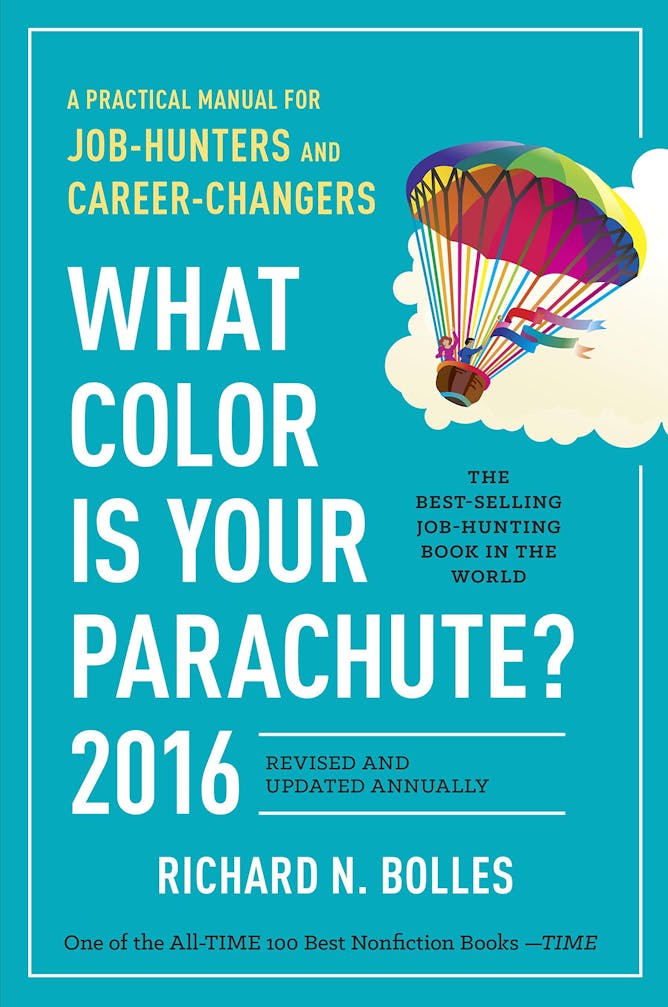
What Color is Your Parachute? by Richard N. Bolles. (Handout)
A Practical Manual for Job-Hunters and Career-Changers
by Richard N. Bolles (Non-fiction. Paperback, 2016 and others. Ten Speed Press.)
This is a popular guide for job seekers. Like most such books, it gives advice on the mechanical details of job hunting, such as good ways to organize a resume.
More importantly — and less commonly — it helps people figure out what they want to do with their lives. What kind of career will best fit your personality? Will you be happier working with people or with data?
The book is an obvious fit for graduates seeking their first job. But it could also help teenagers choose the best education to pursue after high school, or adults trying to make their careers more satisfying.
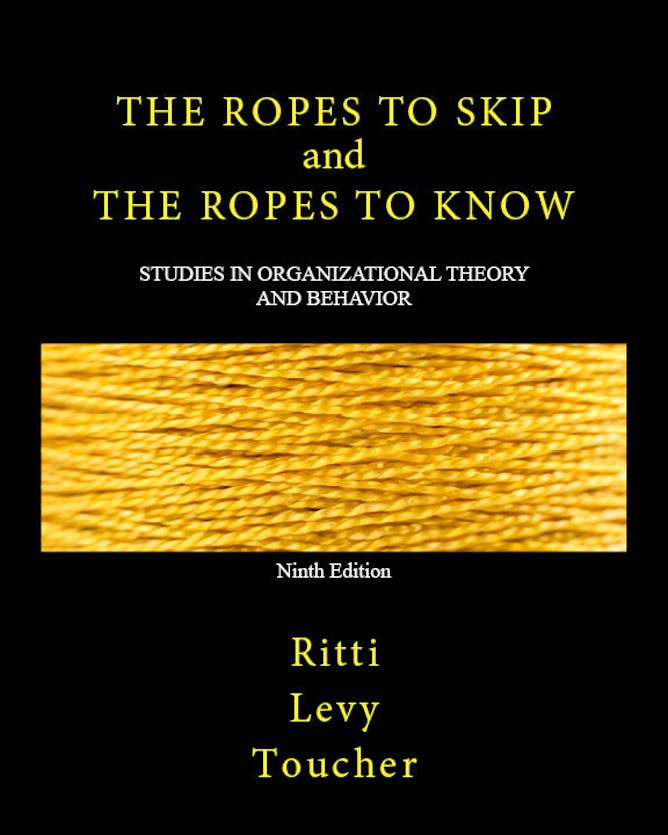
The Ropes to Skip and the Ropes to Know by Ritti, Levy, Toucher. (Handout)
by R. Richard Ritti, Steve Levy and Neil Toucher (Non-fiction. Hardcover, 2016 and others. Chicago Business Press.)
Don’t let the academic-sounding subtitle deter you. This is a highly readable book. It consists of short stories or parables that illustrate how people behave and interact at work.
Every workplace has an official structure and formal rules. But workplaces contain people with individual personalities and relationships. This book will help you understand the unofficial structures and unwritten rules, before they get you into trouble.
I often recommend The Ropes to Skip and the Ropes to Know to people starting their first job. It would be especially good for someone promoted to their first management or supervisory role.
The Common Sense Guide to Successful Financial Planning
by David Chilton (Non-fiction. Paperback, 2002 and others. Stoddart.)
Once you receive your first paycheque, you’ll want to read this beginner’s guide to personal finance. It covers the basics of investing: retirement savings, mutual funds, etc. It also introduces a lot of other financial topics: savings versus spending, insurance that you do or don’t need, and so on.
This probably isn’t the only financial guide you’ll ever need, but it is a good first one. I typically recommend it to recent graduates starting their careers. But it also suits mature adults dealing with money issues for the first time, perhaps after the death or divorce of their spouse.
He is famous for his love of honey, and being a bear of “little brain”. So Winnie the Pooh might be a little surprised to find himself the subject of a major new museum exhibition.
Winnie the Pooh: Exploring a Classic will explore the creative partnership of writer A.A. Milne and illustrator E.H. Shepard. Together they produced the much-loved whimsical stories featured in Winnie the Pooh (1926) and The House at Pooh Corner (1928).
The decision by the Victoria and Albert museum in London to hold the exhibition proves that the bear and his friends have become establishment figures. As children’s literature expert Peter Hunt notes, they are “part of British culture, passing from generation to generation”.
One element of the incredible success of the Pooh books is that they reflect ideas about childhood that emerged in what is widely known as the “golden age” of children’s literature, spanning from the mid-19th century to World War I.
The golden age view of a child’s world was one that was close to nature – the child an innocent before the imposed horrors of school and education, and a figure of loss and nostalgia for the adult. This was very much the landscape of Winnie’s home in Hundred Acre Wood.
As cultural theorist Stefan Herbrechter said: “Children are supposed to live in a world of their own, which is clearly defined and marked out as the space and time for play and in which toys are the main objects and controlling devices of socialisation.”
However, Milne’s books are more poignant and have a slightly different flavour, than other examples, such as Wind in the Willows (of which Milne was a great fan, writing a stage adaptation). They came after World War I, when many illusions about innocence, the upper class, Englishness and patriotism had reached breaking point.
They contain traces of the experiences in the trenches that marked both Milne and Shepard, whose illustrations of carnage at the Somme and Paschendale were the subject of a separate recent exhibition.
The pastoral paradise of Hundred Acre Wood was one that Milne, who wrote passionately in favour of pacifism, conjured from his own childhood memories – back to a time before the terrifying intrusion and destruction of the war.
As such, Milne’s invented world is also saturated with loss, poignantly embodied in the depressed donkey character of Eyore, who sees no reasons to be cheerful. It is also haunted by the threat of leaving the safe space of the wood for places over the horizon that can’t yet be seen. When Christopher Robin and Pooh organise an “expotition” to the North Pole, they find a large pole in the woods and label it accordingly.
Toys, argues Herbrechter, are intimately concerned with storytelling. They are “like little story machines, narrative catalysers, objects that help make sense of the world”.
This idea is addressed with humour and complexity in Milne’s writing, and beautifully rendered in Shepard’s illustrations that always emphasise the “toyness” of the animals. It explains much about why these books have remained so loved.
Pooh the satirist
Milne shows his real life son Christopher (whom Christopher Robin was named after) how playing with his toys is a kind of writing, just as the playwright makes scenes for his characters. Before he wrote the Pooh stories, Milne worked as a playwright and as a satirist at Punch magazine.
We can detect the specific pleasures of introducing the craft of storytelling to his son from a man who made a living from writing. Milne’s stories gently teach the young credulous reader, who reads literally, that they may be other more rewarding ways of interpreting the world, and what the difference is between what people say and what they mean.
Milne offers the pleasures of word play. The narrator explains that “Winnie the Pooh lived in the forest all by himself under the name of Sanders”, which meant “he had the name over the door in gold letters and lived under it”.
The non-literal reader is invited to find this funny. Similarly, if Piglet says anything “carelessly” he is probably concealing a very important wish. He will say he isn’t afraid when he wants to appear brave.
Although the Pooh books were famously dismissed by fellow satirist Dorothy Parker, who wrote a dismayed and withering review of Winnie-the-Pooh, the success of Milne’s works suggests that he managed to translate his love of making stories into a form that beguiled the child reader. Stories which showed how they too might make an imaginative life for themselves in the world of storytelling and understand how to master words and meanings.
In one notable scene Pooh finds himself stuck on the doorway to Rabbit’s house, and must wait for a week until he is thin enough to be pulled free. Christopher Robin sits down with him and reads him a “sustaining book”, such as would help and comfort a Wedged Bear in Great Tightness.
The comforting presence and companionship of a good book is something all readers of Pooh take away with them. And it is perhaps this which explains the enduring popularity of these stories, which taught us how to read and write in our own way.
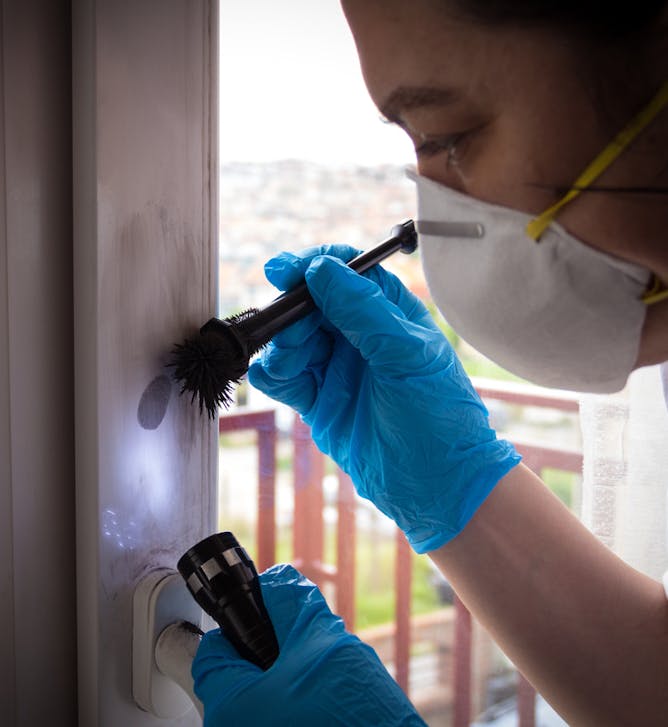
A blackmailer steals a compromising letter from a woman of high standing. The police know he is keeping this letter in his home, but they cannot find it. Using the latest forensic tools they search every inch of the apartment, recording their efforts as follows:
We examined the rungs of every chair …. and, indeed, the jointings of every description of furniture, by the aid of a most powerful microscope. Had there been any traces of recent disturbance we should not have failed to detect it instantly.
A single grain of gimlet-dust, for example, would have been as obvious as an apple. Any disorder in the glueing – any unusual gaping in the joints – would have sufficed to insure [sic] detection.
Back in 1844, this description of the police using a powerful microscope with the promise of instant detection would have dazzled readers of Edgar Allan Poe’s The Purloined Letter. Yet this is not what solves the mystery. Instead the private investigator, Auguste Dupin, correctly surmises that the best place to hide such a letter is in plain sight. He finds it on the blackmailer’s mantelpiece.
The story is one of the earliest and best examples of crime fiction. It suggests that science and technology are sometimes not as powerful as empathy or intuition in solving crimes. Indeed, Poe queries science throughout his writings. In one poem he calls it a vulture that preys on the poet’s heart, replacing the magic of a writer’s imagination with its “dull realities”.
Bloody good.
Try telling that to modern readers of crime fiction. These days, forensic scientists are one of the great staples of the genre. They are integral to everything from popular TV franchises like CSI and Line of Duty to blockbuster names like Patricia Cornwell and Jeffrey Deaver to many of the works showcasing at the Bloody Scotland festival in Stirling. There is also something about their incredible achievements that we often overlook: they are often a long way from the reality.
Criminal comforts
We love crime fiction because it is reassuring. Yes, human beings are capable of evil and cruel deeds, but criminals are always caught and usually punished. This formula, as WH Auden suggested in a 1948 essay on the genre, restores us to a “state of grace”. It helps us believe we are basically innocent and good, and that criminality is an aberration.
Forensic science amplifies this sense of comfort in crime fiction: it produces evidence that cannot lie; it brings the most cunning of criminals to justice. In a world with no god and no certainty, these fictional scientists fill a void. They let us think that our world can be examined, analysed and rendered legible. They are modern-day magicians whose wizardry reveals indisputable truths.
But does forensic science really hold all the answers? Sadly, no. Val McDermid, one of the big names appearing at Bloody Scotland, is one of the few authors who help us understand this. In Out of Bounds (2016) for example, the police are trying to determine whether a man was murdered or shot himself.
The amount of gunshot residue in his hand is inconclusive, we learn, and not inconsistent with a self-inflicted wound. How can scientific evidence be inconclusive? How come scientists talk of things being “not inconsistent”, rather than dealing in certainties?
This is where the trouble begins for forensic experts. Imagine a scientist giving evidence as a witness in court and having to explain the limitations of their field. Jurors are unlikely to appreciate that forensic evidence often relies on human interpretation; that blood spatter patterns or bite mark analysis do not tell a single, compelling and unambiguous story the way they do in books.
Yet the reality of the uncertainty of forensic science was recently laid bare in relation to the DNA laboratory of the office of New York City’s chief medical examiner. Seen as one of the most sophisticated forensics labs in the world, carrying out work for investigators across the US, certain scientists are now claiming some of its methods are unreliable. A group of prominent New York defence lawyers is calling for the inspections watchdog to carry out an investigation.
Meanwhile, America’s National Institute of Standards and Technology recently accused the forensics industry of lagging other professions when it comes to looking into and resolving errors. It said:
In recent years, high visibility errors have occurred at crime labs in almost every state. These have ranged from simple mistakes, such as mislabelling evidence, to testimony that overstates the scientific evidence, to criminal acts.
In thrillers, forensic evidence almost always leads the investigative team to a satisfying conclusion. We never finish a novel thinking the killer might be exonerated when the evidence is re-examined. Even when all is as it should be, forensic scientists have their work cut out trying to communicate the complexity of the evidence, while explaining how it might be both subjective and reliable at the same time.
To make their case, scientists need much more than hard facts. They need to make their expertise accessible by using similes, metaphors and narrative examples. In fact, they need to be a little like novelists – which is ironic given that they have to dispel some of the misconceptions created by novelists in the first place.
If there is a consolation in any of this, these experts can at least thank novelists for their public image. No matter how hard they have to work to seek and communicate knowledge, at least forensic scientists will always look glamorous while doing so. They might be the victims of our need for reassurance and certainty, but we don’t tend to treat them with the same hostility as Edgar Allan Poe.
Research in England has found that the proposed test was no more accurate than the teacher’s judgement in identifying children with reading difficulties. Shutterstock
Minister Birmingham released a report today recommending that all Year 1 students in Australia complete a phonics test. The panel responsible for the report has recommended that Australia adopt the Year 1 phonics screening check that has been used in England since 2011.
What is phonics?
Phonics is the process of matching sounds to letters. It is an important skill when learning to read and write in English. There are two main approaches to teaching children phonics – synthetic phonics and analytic phonics.
Analytic phonics starts with taking a word that children know the meaning of, and then analysing it to see how the sounds in the word match the letters we see within the word. So five-year-old Emma will learn that her name starts with the sound “e” which is represented by the capital letter E, followed by the sound “m” which is represented by the two letters “mm”, and ends with the sound “u”, which is represented by the letter a.
Synthetic phonics starts with letters which the children learn to match with sounds. The meaning of the words are irrelevant, and indeed, inconsequential. The theory is that the children should master letter/sound matches first before trying to attend to meaning.
Which phonics method is better?
There is no evidence that one phonics approach is better than the other. In England, the US and Australia, there have been major inquiries into reading and all have concluded that systematic and explicit phonics teaching is a crucial part of effective reading instruction. But none have found any evidence that synthetic phonics approaches are better than analytic phonics approaches, or vice versa.
All inquiries have concluded that whatever phonic instruction method is chosen, it should be one part of a suite of skills children should have when learning to read.
What is the phonics test?
The phonics test is based on synthetic phonics. The children are given 40 words on a computer screen, with no context. The words are not put in a sentence, or given any meaning. This is deliberate, and an important feature of a synthetic phonics approach, as the children must show they are not relying on meaning or prior experience with the word in order to successfully decode it.
To this end, 20 of the words the children are given are nonsense words, like “thrand”, “poth” and “froom”, to ensure they are not using meaning to decode the words.
Why are we introducing it?
Minister Birmingham is concerned about the numbers of students in Australia who are struggling with literacy. The decline in literacy standards of Year 9 students is very concerning, and he is right to be looking for solutions. But the solution will not be found in this phonics test for six-year-olds.
As the test has been has already been in use for six years in England we are fortunate to be able to learn from their experience. A major evaluation of the test conducted by the Department for Education in England found that the test is not delivering improvements in literacy capabilities, and in fact, is delivering some unwanted side effects, like class time being spent learning to read nonsense words rather than real words.
Numerous other recent studies of the implementation of the phonics test in England provide valuable information that allow us to test the claims for the test against research evidence.
What does the research say?
Claim: The phonics test has improved reading results in England since its introduction.
Evidence: Year 1 children in England are certainly getting better at passing the phonics test. Over the past six years, pass rates have increased by 23%. This means around 90% of Year 1 children in England can now successfully read nonsense words like “yune” and “thrand”.
However research has found that the ability to read nonsense words is an unreliable predictor of later reading success.
As the test only tests single syllable words with regular phonic patterns, it is not possible to know how many English children can read words like “one”, “was”, “two”, “love”, “what”, “who”, or “because”, as such words are not included in the test. This is unfortunate because these are amongst the 100 most common words in the English language, which in turn make up 50% of the words we read everyday – whether in a novel, a newspaper article or a government form.
“Yune”, “thrand” and “poth”, on the other hand, make 0% of the words we read.
Claim: The phonics test will pick up children who are having reading difficulties. Birmingham has stated “the idea behind these checks is to ensure students don’t slip through the cracks”.
Evidence:Research in England has found that the test was no more accurate than the teacher’s judgement in identifying children with reading difficulties. Teachers already know which children struggle. As researchers, teachers and principals
have all said – teachers need more support in knowing how to support those struggling children.
Claim: The phonics test will provide detailed diagnostics to support teachers to make effective interventions. The chair of the panel recommending the test says that the phonics test will drill into the detail of phonics to establish what children know.
Evidence:A thorough analysis of the test’s components found it fails to test some of the most common sound/letter matches in English, and indeed screens for a very limited number of the hundreds of sound/letter matches in English. They found that children can achieve the pass grade of 32 from 40 with only limited phonic knowledge.
Other research found the test fails to give any information about what the specific phonic struggles of a child might be , or whether the struggles are indeed with phonics.
These limitations mean the check has negligible diagnostic or instructional use for classroom teachers.
Learning lessons
Australia is in the fortunate position of being able to learn from the research that has been conducted since the implementation of the phonics test and mandatory synthetic phonics teaching in England. The lesson is clear. The test is unable to deliver what was hoped. Australia should look elsewhere for answers to its literacy challenges.
The announcement of the shortlist for the Man Booker Prize 2017 will certainly encourage many bookworms to catch up with a new set of “must reads”.
This year’s list for the “leading prize for quality fiction in English” includes three debut novelists, as well as previously shortlisted and winning authors. Being shortlisted can lead to a dramatic increase in sales. The winner, announced in October, can also look forward to a £50,000 prize as well as joining a canon which includes Iris Murdoch, Salman Rushdie and Margaret Atwood.
Awards such as the Man Booker can offer a shortcut to the classics of the future, readily assigned by a panel of people regarded as experts in the field. And for some readers, choosing books from an official selection like the Man Booker shortlist makes it easier to know that what they are reading is deemed “acceptable” by the literary elite.
This is not to say that’s the only reason people enjoy poring over such shortlists. But let’s not pretend that what other people think of what we read isn’t important to many of us. For some, this could even mean going so far as to disguise a guilty pleasure by reading it on an e-reader – making it impossible to judge a book (or the reader) by its cover.
Reading together
Despite reading often being seen as something people do in a room of one’s own, in recent years there has been a big rise in the number of book groups and reading clubs, emphasising the social experience reading can bring.
The success of what researchers have called “mass reading events”, like those led by Oprah Winfrey or Richard and Judy, are testament to the power not only of recommendations from people whose opinions we value, but also of feeling that we’re reading the same things as lots of others.
Book groups have long fulfilled this social function of reading for their many members. Over a cup of tea or glass of wine, people share their thoughts about a book they have read (or at least intend to read), debate its merits and its flaws, and collectively explore what it means to them.
More recently, the proliferation of online book groups has also allowed space for readers to interact over their reading from further afield, often focused on specific genres, or with choices influenced or curated by celebrities or vloggers.
Shared experience
Through my own experience of being part of a community reading group, I have also seen how the act of reading itself is something that brings people together.
Shared reading groups have grown in popularity across the country in recent years. They have been an integral part of the work of the Liverpool based charity, The Reader, which promotes the benefits of reading across different communities. In a range of venues including libraries, health centres, schools, and care homes, members of a shared reading group join together to listen to a story or a poem being read aloud, reading along with a copy of the text if they want to. Members join groups for lots of different reasons – not least because of the impact reading can have on well-being.
Reading with friends. Shutterstock
Not only do the members of a shared reading group physically meet to listen to the reading, but they also come together through talking about the story or the poem, listening and responding to each other’s interpretations, and working collaboratively to explore what it means to them.
These types of shared experiences are a powerful reminder that the meanings we make from a text are different every time it is read. In this way, reading groups bring people together in the active sharing of interpretation.
Those shared readings which are made in the moment sit alongside the “expert” readings of critics and judges as part of the richness of what literature represents to different people. And no doubt as the nights draw in, armed with a new shortlist of titles to get stuck into, reading groups up and down the country will be coming together to read and to work at making meanings of their own.
Jeff Jarvis, director of the Tow-Knight Center for Entrepreneurial Journalism speaking with Peter Fray.
As the Federal government attempts to reform Australia’s media ownership laws, evidence is emerging that journalists are moving away from the traditional watchdog role of the press towards satisfying the demands of audiences.
Decades of debate about whether journalists ought to give audiences what they like rather than what journalists think they need is being resolved in favour of what US journalism thinker Jeff Jarvis dismisses as the “cats and Kardashians” model of digital journalism.
But is giving audiences what they want the same as dumbing down?
Results from a recently published study of Australian journalists indicate that journalists are shifting their thinking away from the “citizen orientation” typically associated with the watchdog role of the press to a more consumer focus.
Senior editors say that understanding what audiences want — as recorded by clicks and other forms of web-based feedback — is an essential part of contemporary journalism.
Growing advertising revenues on the basis of audience reach and volume remains the dominant journalism business model.
As Kate de Brito, the editor-in-chief of the country’s most visited news website, news.com.au, puts it, if no one clicks, “you may as well have just emailed it to your mum”.
But Jarvis, the director of the Tow-Knight Center for Entrepreneurial Journalism at City University New York, argues news organisations need to understand that getting more clicks isn’t the same as listening to your audience.
The price of advertising is going down, desperation up. Journalism gets cheapened in the process.
Efforts to reshape how journalism survives and makes money — and serves its multiple roles in society — has emerged as a key sticking point in Federal government moves to change Australia’s media ownership laws.
Reform of the media ownership laws that restrict any one person controlling radio, TV and a newspaper in the same market hinges on the government’s willingness to back measures promoted by Senator Nick Xenophon to support public interest journalism.
Xenophon, a key member of a current senate journalism inquiry, has supported tax breaks to small media companies and other ways to develop new business models for journalism.
The government has been reluctant to support tax relief but reportedly has a more positive attitude to other measures to boost journalism jobs and explore new business models.
Without support from Labor or the Greens, Team Xenophon’s votes will be crucial to the passage of any deal that would also end restrictions on any one person controlling TV licenses that reach more than 75% of the population.
Indications from Canberra are that a compromise deal could be close.
Alternatives to one-size-fits-all mass audience model are under trial or development across the journalism sector, from experiments in surfacing quality journalism using artificial intelligence to moves to personalise news and information feeds.
The New York Times, for instance, has stated it wants to deliver individualised news based on what individuals read, where they live and how often they come to the site.
Given the NYT has 2.3 million digital-only subscribers, this is perhaps the most ambitious attempt yet at active audience listening.
Jarvis calls on media companies of all sizes to recreate journalism as a service based on “relevance and value”; cast aside the idea of mass, rethink audiences as communities and individuals.
But, as he concedes, media companies are understandably finding it hard to build a new house (based on his notion of service) when the old one (based on volume) is burning down.
Audience reach and volume — and the constant flow of metrics that reveal them — drive the news agenda for most media companies. Ratings always have in commercial radio and TV.
But now few media outlets can afford to ignore what audiences are doing (or not) with their content. Advertisers won’t let them.
In the recently published study of Australian journalists, Folker Hanusch, from the University of Vienna, and Edson Tandoc, from Nanyang Technological University in Singapore, explored the impact of audience feedback via readers’ comments, Twitter and web analytics on journalists’ thinking.
In a survey of 358 journalists, they found a marked shift towards providing “the kind of news that attracts the largest audience” as opposed to the more traditional role of holding the politicians and business to account.
This especially held true for journalists working in competitive markets; those freed from market pressures were “able to prioritize their normative functions of being watchdogs and shaping public opinion”.
Even so, most Australian media companies, including the national broadcaster, are enamoured by the sugar hit of audience reach.
In the most recent Nielsen digital ratings, the closest competitor to news.com.au, with its 5,905,000 unique visitors a month, is the ABC. Its combined news sites reach 4,651,000 Australians a month.
Little wonder then that Fairfax chief Greg Hywood gets so upset about the ABC using taxpayers’ money to buy Google ads: smh.com.au is about half a million behind the ABC and no other Fairfax site is in the current top 10.
Hanusch and Tandoc’s work indicates that a radical reshaping of how journalists see their roles is underway.
“Seeing the number of unique visitors to the site, the number of page views a page gets, and the amount of time readers spend on a story, among others, easily and regularly, could be socializing journalists into prioritizing these metrics.”
But what do clicks actually mean?
Results of a recently published Dutch study of news consumers indicate that the act of clicking — or not — is more complex than like or not and driven by a host of considerations. The study also makes the obvious but useful observation: clicks do not account for the preference of consumers who browse without clicking.
The study by Tim Groot Kormelink and Irene Costera Meijer, both from Vrije University in Amsterdam, described 30 considerations for clicking or not clicking among a group of 56 news consumers.
Reasons for not clicking included supersaturation (“not another story about Syria”, said one participant) to “bullshit”: the users instantly dismissed the “pettiness of the headline”.
The study’s participants often engaged in “online browsing patterns that did express interest in news, yet did not necessitate a click”. The authors conclude that “even if one seeks a rough estimate of people’s news interests, clicks are a flawed instrument”.
Therein lies a pressing conundrum for the online news industry: if not clicks, what? If audiences — and advertisers — are going to be fully served, there needs to be better way.




 Have an enjoyable and productive fall!
 The comforting presence and companionship of a good book is something all readers of Pooh take away with them. And it is perhaps this which explains the enduring popularity of these stories, which taught us how to read and write in our own way.


 If there is a consolation in any of this, these experts can at least thank novelists for their public image. No matter how hard they have to work to seek and communicate knowledge, at least forensic scientists will always look glamorous while doing so. They might be the victims of our need for reassurance and certainty, but we don’t tend to treat them with the same hostility as Edgar Allan Poe.
 This may be an issue where Australia is able to overcome its intellectual cringe, and act on the research evidence rather than old colonial ties.

 Those shared readings which are made in the moment sit alongside the “expert” readings of critics and judges as part of the richness of what literature represents to different people. And no doubt as the nights draw in, armed with a new shortlist of titles to get stuck into, reading groups up and down the country will be coming together to read and to work at making meanings of their own.
 Therein lies a pressing conundrum for the online news industry: if not clicks, what? If audiences — and advertisers — are going to be fully served, there needs to be better way.


You must be logged in to post a comment.