Unknown's avatar

Get yer hand off it, mate, Australian slang is not dying


File 20180121 110121 1ridt58.jpg?ixlib=rb 1.1
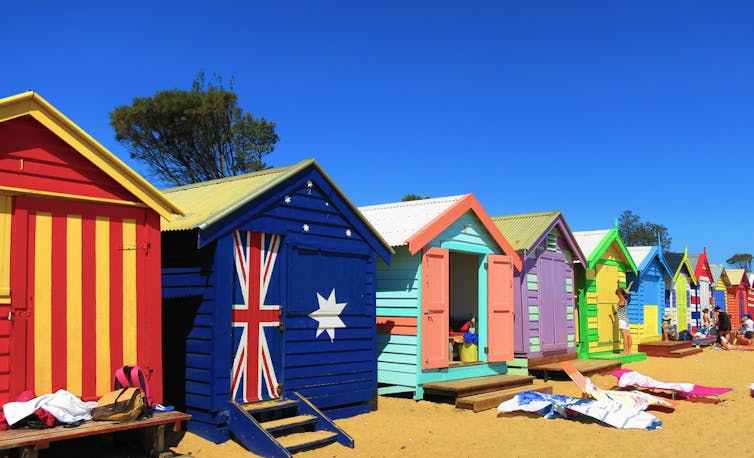
Aussie slang such as ‘budgie’, ‘greenie’, ‘pollie’, ‘surfie’, and even ‘mozzie’ are now also making appearances in global English.
shutterstock

Kate Burridge, Monash University and Howard Manns, Monash University

As the debate continues over whether Australia Day should be celebrated on January 26, this series looks at the politics of some unresolved issues swirling around Australia Day – namely, the republic and reconciliation. And just for good measure, we’ll check the health of Australian slang along the way.


The Australian attachment to slanguage (slang language) goes back to the earliest settlements of English speakers in Australia. As Edward Gibbon Wakefield noted in his 1829 Letter from Sydney:

The base language of English thieves is becoming the established language of the colony … No doubt [terms of slang and flash] will be reckoned quite parliamentary, as soon as we obtain a parliament.

Wakefield’s observation was spot-on. The cant of the underworld (so-called “flash” or “kiddy” language) flourished in these early days. Slang had become an important way of fitting in and avoiding the label “stranger” (or “new chum”) – and, as linguist Evan Kidd confirms, it still is.

Yet, every few years there’s a furphy that our beloved “Strine” slang is doing a Harold Holt.

Reports of the death of slang downunder are total bulldust

Early in 2017, the Australian pie company Four’N Twenty expressed its concern that Australians hadn’t been “slinging slang” enough, and so launched its “Save Our Slang” campaign, aimed at promoting some 70 you-beaut, dinky-di, true-blue Aussie-isms (bloke, bogan, grouse, straya, you bewdy, and so on).

A few years earlier, in 2014, the appearance of Tony Thorne’s Dictionary of Contemporary Slang sparked a series of articles heralding the end of the golden era of Australian slang, prompted by the fact that the work had added only three new (not terribly usual, to our mind) Australian terms: tockley “penis”, ort “buttocks” and unit “bogan”).

We commonly pin the blame for the death of Aussie slang on our anklebiters-cum-adolescents and their love of seppo (short for “septic tank”, rhyming slang for Yank) slang. But it’s worth noting seppo influence has been a lexical and moral concern at least since the introduction of American “talkies” in the 1920s, as documented by historian Joy Damousi:

… that influx of nauseous American slang and vile English which regularly appears upon the screen, and threatens to reduce the Australian vernacular to the level of the New York gutter-snipe.

It’s also worth noting that some of what we consider to be true-blue slang in fact finds its origins in – hold onto your Akubra – early contact with American English.

There was an influx of Americans to the goldfields from the 1850s, and they brought with them a bunch of American colloquialisms. These included bonza/bonzer, which is probably from American English bonanza (originally from Spanish and used in the US in the 1840s for a successful gold mine).

Even waltzing – “carrying” – is probably from American slang, or at least was used at the same time and in the same way. Sure, we have records of Australians “waltzing Matilda” in 1890, but Tom Sawyer and Huck Finn were “waltzing” with this same meaning (albeit sans Matilda) in 1884.

Australian slang: like the eggs of the codfish

Some align the disappearance of Aussie slang with Australia’s maturing as a nation.

Certainly words, more than other aspects of language, are linked to life and culture, and perhaps the changes in Australian society are such that the days of the chiacking larrikin (or cheeky lovable prankster) have passed?

But it is the nature of slang that there will always be a turnover of terms – today’s cobber is tomorrow’s mate, ranga for a redhead replaces blue/bluey, bogan replaces ocker and so on.

As American writer Gelett Burgess put it in his 1902 essay, In Defence of Slang:

Like the eggs of the codfish, one survives and matures, while a million perish.

An expression that fills a need becomes accepted but, as Burgess describes:

… it is a frothy compound, and the bubbles break when the necessity of the hour is past, so that much of it is evanescent.

His own brilliant creation blurb for “a short publicity notice” was clearly one of the eggs that survived – and thrived.

We are continuing to sling slang

It seems we get so obsessed with the death of Australian English that we miss those many great terms that are being created beneath our very eyes in Australia and by Australians. Just look at the slew of recent additions to the Australian National Dictionary (most stemming from the 1980s and 90s):

hornbag, snot block, checkout chick, houso, reg grundies, ambo, rurosexual, seppo, spunk rat (previously also spunk bubble), chateau cardboard, firie, tradie, trackie daks

And we continue to play with these terms – goon has been around for a while, but it keeps on inspiring new creations, including goon bag (1998), goon juice (2000), goon of fortune (2004), goon sack (2009), and so on.

The rhyming hoon is another great example of how language is always on the move. It’s attested as a noun in 1938 (“lout”, “exhibitionist”), but with the shift to “young hooligan, especially as a driver” in the late 80s, we see a rich proliferation of changes, including hoon as a verb (1988), and nouns denoting the act of being a hoon, including hoonery (1987), hoonishness (1993), hoondom (1998) and their weapon of choice, the hoonmobile (1994), with which they could be adjectives hooney or hoonish.

The other interesting thing about hoon is that it illustrates how one meaning can oust another. The driver sense of hoon has pushed out the pimp sense that existed alongside it from the 1950s to the turn of the century (a very rare case where a risqué meaning hasn’t won out).

So, slang continues to flourish. It’s also clear there’s no sign that we’re about to give up our shortenings – as seppo, firie and trackie daks attest, Australians still love abbreviations. And we are exporting them it seems.

Aussie contributions to world lexicon

Australian selfie was the Oxford Dictionaries “Word of the Year” for 2013 (the frequency of the word had increased by a whopping 17,000% since the previous year). Its success was astonishing – in the same year it was even crowned Dutch Word of the Year (no squeamishness about loanwords in the Netherlands).

But there are plenty of other success stories too: budgie, greenie, pollie, surfie, even mozzie are now also making appearances in global English, as are demo, preggo and muso. These join many other exports – no worries, like a rat up a drainpipe, to put the boot in, to rubbish (someone) to name a few.

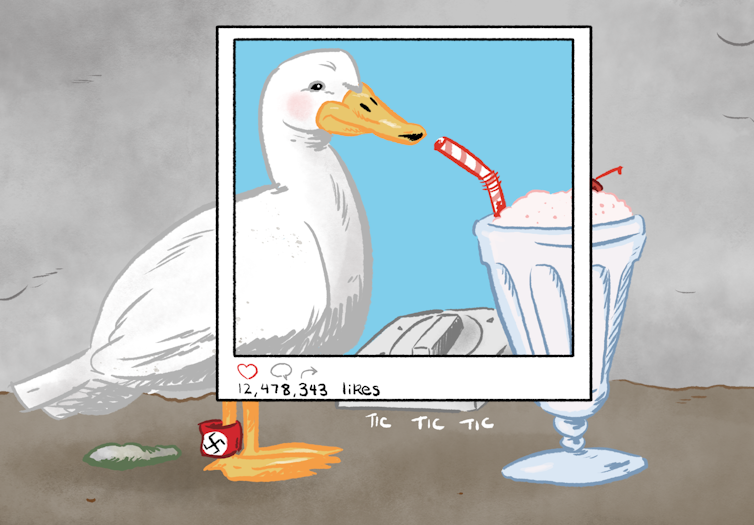
Australia recently scored another global hit with Macquarie’s Word of the Year 2017, milkshake duck, “a person who is initially viewed positively by the media but is then discovered to have something questionable about them, which causes a sharp decline in their popularity”.

It’s a “patriotic pick”, as Tiger Webb points out. Coined by Australian cartoonist Ben Ward, milkshake duck not only marks an Australian contribution to the global lexicon, but also carries shades of an Australian cultural contribution: the tall poppy.

So, let’s not milkshake duck (verb) Australian slang by focusing too much on the past cultural cringe and underplaying the evolving nature of slang.

After all, it’s funny to think that at the same time as we’re complaining about Australian slang dying, the Brits are complaining about Australian language features slipping into their kids’ repertoires.


The ConversationCatch up on others in the series here.

Kate Burridge, Senior Fellow at the Freiburg Institute for Advanced Studies and Professor of Linguistics, Monash University and Howard Manns, Lecturer in Linguistics, Monash University

This article was originally published on The Conversation. Read the original article.
Unknown's avatar

Latest on the Internet Archive Copyright & Piracy Controversy


The links below are to articles with the latest on the copyright and piracy controversy engulfing the Internet Archive, with a response from the Internet Archive.

For more visit:
https://the-digital-reader.com/2018/01/24/internet-archive-responds-coverage-ebook-piracy-good-works-defense/
http://blog.archive.org/2018/01/24/digital-books-on-archive-org/

Unknown's avatar

Google Selling Audiobooks


The links below are to articles reporting on Google now selling audiobooks via the Google Play Store.

For more visit:
http://blog.the-ebook-reader.com/2018/01/23/google-now-selling-audiobooks-get-50-off-first-purchase/
https://goodereader.com/blog/audiobooks/google-audiobooks-launches-in-45-countries
https://ebookfriendly.com/google-audiobooks-play-store-launch/
https://the-digital-reader.com/2018/01/26/googles-support-audiobook-frustrating-disappointing/

Unknown's avatar

Libraries in the Era of Fake News


The link below is to an article that takes a look at the relevance of libraries in the era of fake news.

For more visit:
https://entropymag.org/funding-libraries-is-the-way-to-beat-fake-news/

Unknown's avatar

Book Critics and Criticism


The link below is to an article that takes a look at book critics and criticism.

For more visit:
http://lithub.com/charlotte-shane-on-the-fragility-of-authors-egos/

Unknown's avatar

#MeToo, Sleeping Beauty and the often controversial history of fairy tales


File 20180116 53317 15pv91j.jpg?ixlib=rb 1.1

Henry Meynell Rheam

Pete Newbon, Northumbria University, Newcastle

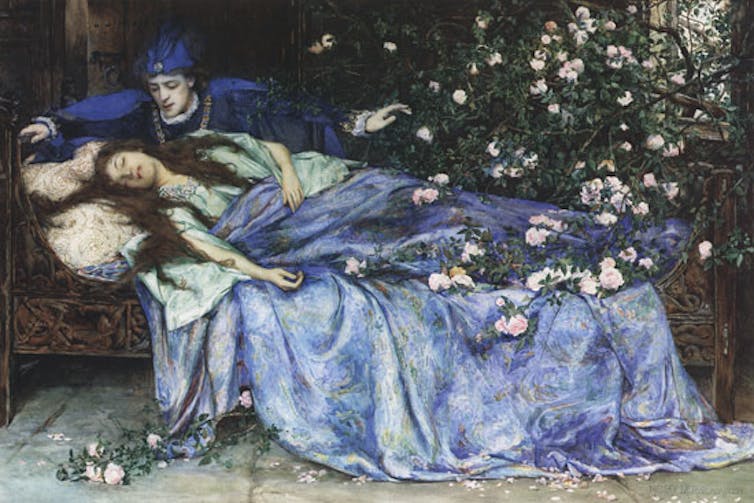
It’s one of the more bizarre episodes to have seen the light of day since the #MeToo movement got going late last year. In November 2017, the British newspaper The Telegraph reported that the mother of a schoolboy who had brought home a copy of the fairy tale Sleeping Beauty was calling for the text to be banned. The reason she gave was that the heroine could not have consented to the kiss that released her from her enchanted sleep.

This news story emerged in the aftermath of the revelations of serial sexual harassment allegations against numerous Hollywood stars, generating the #MeToo hashtag, with which millions of women worldwide shared their experiences of sexual molestation and objectification.

Yet despite the headline – “Mother calls for Sleeping Beauty to be banned” – when you actually read the piece it turns out that, in fact, the mother had suggested that rather than ban the story, the tale might be used as a starting point for discussing personal consent and bodily autonomy with children.

This didn’t deter plenty of media outlets from jumping aboard the bandwagon – whether in support of the proposition that the fairy tale be banned or updated, or scoffing at the notion as needless censorship. And, of course, there was a follow up on the problems with other fairy tales.

Small minds

While fairy tales have existed for millennia as oral folktales, they first entered print in their recognisable form in the 17th century – and initially among the aristocracy. Over the subsequent 300 years or so, fairy tales have frequently been a source of controversy and ideological battle.

A cursory glance at only a few examples illustrates the variety of ways in which they have caused anxiety and consternation. The Neapolitan courtier, Giambattista Basile first produced his collection of fairy tales (including Rapunzel and Cinderella) in 1634. A little later, the French académicien Charles Perrault published his Histoires ou Contes du Temps Passé (1797), containing such prized tales as Little Red Riding Hood, Puss in Boots, Blue Beard – and Sleeping Beauty. Written for an educated and urbane courtly readership, Perrault’s tales smuggle in risqué innuendo under the veil of moralism.

Little Red Riding Hood.
Gustav Dore (1864)

In Britain, one of the first and most influential critics of fairy tales was the philosopher John Locke. In his seminal treatise Some Thoughts Concerning Education (1693), Locke cautioned parents against allowing servants to frighten their children with tales of “Raw-Head and Bloody Bones”.

As a Rationalist, Locke feared that peasant superstition would damage the healthy development of children. In this period, fairy tales in Britain were circulated in the rude tradition of “chapbooks” (rough almanac prints sold by itinerant “chapmen”) and made little distinction between children and adult readers.

It was the pioneering publisher John Newbery (among others) who fused Locke’s respectable suspicion of rude chapbooks with an entrepreneurial appreciation of the potential market for children’s books. His A Pretty Little Pocket-Book (1744) cleverly replicated entertaining aspects of chapbooks – but shorn of their cruder elements in order to appease middle-class parents. This trend continued into the 19th century, when such celebrated authors and adaptors of fairy tales as Hans Christian Andersen and the brothers Jacob and Wilhelm Grimm, all tailored and censored their writings to avoid causing upset.

Culture police

The Romantic generation of artists and writers venerated fairy tales for inspiring childhood fantasy and wonder and as texts that opposed the rationalism of the Enlightenment. But, in the wake of the French Revolution, political and literary culture came under immense scrutiny in Britain from a newly energised Conservative government and press.

With the increased policing of culture for signs of dangerous Jacobins and Democrats, conservative evangelical educationalists including Hannah More and Sarah Trimmer undertook the role of castigating children’s writers deemed politically and religiously seditious. One of their main targets was the anarchist philosopher – turned children’s publisher – William Godwin (the widower of the feminist Mary Wollstonecraft and the father of Mary Shelley, the author of Frankenstein). In order to escape censure, Godwin often published anonymously, or under a series of comical pseudonyms, such as Theophilus Marcliffe.

Godwin was involved with many Romantic-era writers now considered illustrious, but who at the time were often obscure figures. Two of these friends – the poet William Wordsworth and the essayist Charles Lamb – Godwin endeavoured to involve in his publishing, with revealing controversies.

A 19th-century depiction of Beauty and the Beast.
Walter Crane via Wikimedia Commons

Charles Lamb and his sister Mary are best-known for their highly popular Tales from Shakespeare (1807), which was published by Godwin. But when Godwin commissioned Charles to write an adaptation of Homer’s Odyssey for children, the two got into an argument over Lamb’s initial refusal to tone down the gory scene in which the cyclops Polyphemus vomits the remains of Odysseus’ crewmen whom he had consumed. Godwin feared losing custom from a squeamish middle-class readership.

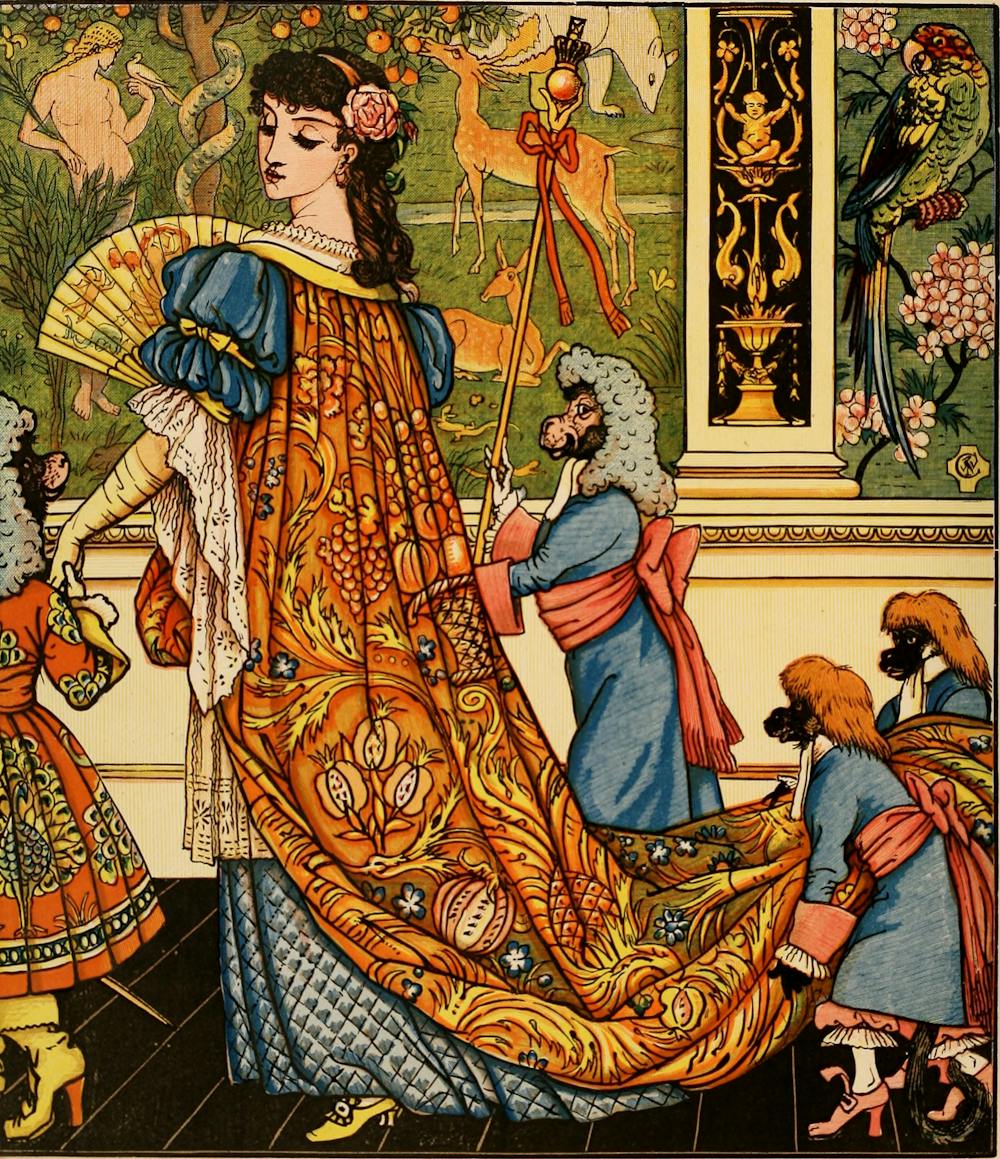
In 1811, Godwin wrote to Wordsworth – who had in youth briefly been his protégé – asking him to translate Beauty and the Beast from the French. Wordsworth’s cantankerous response is extraordinary (in part, he was irate for having to pay the postal fees). The poet responded to the philosopher that he could not bring himself to the task as:

I confess there is to me something disgusting to me in the notion of a human Being consenting to mate with a Beast, however amiable his qualities of heart.

Wordsworth was, in middle age, moving increasingly towards Toryism, and his astonishing response may be interpreted as underlining his rejection of Godwin’s radicalism. It also seems to indicate Wordsworth’s growing religious conservatism, as he justifies his statement by quoting from the poet John Milton’s Paradise Lost – describing Adam as set apart by God from animals: “Among the Beasts no mate for thee was found”.

The ConversationThroughout their history, fairy tales have caused consternation and outrage among the religious and the secular, the progressive and the conservative, wrestling over what goes on in the minds of growing children.

Pete Newbon, Lecturer in Romantic and Victorian Literature, Northumbria University, Newcastle

This article was originally published on The Conversation. Read the original article.

Unknown's avatar

On the Benefits of Ebook Readers


The link below is to an article that takes a look at the benefits of using an ebook reader.

For more visit:
https://goodereader.com/blog/electronic-readers/these-are-the-main-benefits-of-using-an-e-reader

Unknown's avatar

When we needed a new word, Twitter gave us ‘milkshake duck’


File 20180117 53324 pg38y5.png?ixlib=rb 1.1

Wes Mountain/The Conversation, CC BY-ND

Roslyn Petelin, The University of Queensland

What is this milkshake duck that the “whole internet loves”? “A lovely duck that drinks milkshakes”. Had anyone heard this slang term before this week, when the Macquarie Dictionary announced it as their 2017 Word of the Year? Probably not. Unless they move in certain circles on the internet. Surely this is a joke!

Indeed, the term was coined as a joke. Able to be used as both a noun and a verb, it has existed since June 12 2016 when Australian cartoonist Ben Ward tweeted it to cover a trend that he had satirised for which there wasn’t a name: a non-celebrity enjoying a viral rise overnight on the internet, followed shortly thereafter by a rapid fall after being outed on the internet because of an unsavoury act in their past. In Ward’s tweet the cuddly duck is accused of being a vicious racist.

//platform.twitter.com/widgets.js

There is no denying that the term is useful, but is it a totally new phenomenon of the internet age? Efforts to coin words that people wish would exist have a long history and enjoyed a particular vogue in the early 1980s before the rise of commercial internet providers.

For instance, in 1983, in The Meaning of Liff, Douglas Adams and John Lloyd compiled a “dictionary of things that there aren’t any English words for yet, based on names of places in England”. A typical example is Shoeburyness — “the vague uncomfortable feeling you get when sitting on a seat that is still warm from somebody else’s bottom”.

From obscurity to notoriety

Ward tweeted what he obviously thought was a pretty good joke about the power of social media to adulate, elevate, and then reject. What Ward didn’t expect to happen was that it would morph into a meme.

A year after Ward’s tweet the term came to the attention of Oxford Dictionaries Online, via the podcast Reply All, after a high-profile gamer, Tim Soret, was designated as a milkshake duck when it emerged that he had been involved in 2014’s notorious online sexist harassment scandal “Gamergate”. The Oxford Dictionaries Radar column of June 22 2017 noted that the usage of the term milkshake duck was rising and promised to keep an eye on it.

In the Comments column of The New Yorker, the eminent Harvard scholar Louis Menand says: “People prefer to have their neologisms boil up unbidden from the global electronic soup — like, for instance, ‘milkshake duck’.”

Menand’s comment emphasises the inarguable role of social media in the coining of new words, but he resists explaining “milkshake duck” and suggests that his readers Google it. The term is also included in the American Dialect Society’s 2017 Word of the Year list, which announced “fake news” as its winner. Interestingly, fake news, the meaning of which has changed significantly in the past year, was Macquarie’s Word of the Year for 2016.

The Macquarie committee stated in the justification for their choice of “milkshake duck” that it was a “much-needed term to describe something that we are seeing more and more of, not just on the internet but now across all types of media”.

It will be interesting to see if the term does enter the mainstream. No one whom I have spoken to since Monday had heard it used before its announcement as word of the year, but I expect it will gain some impetus with the push from Macquarie.

Sniglets and fugitives

The image of the duck is ridiculous and has no discernible connection to any real event. Its Dadaist absurdity is reminiscent of a Marx Brothers’ film or the anti-joke riddle: “What’s the difference between a duck?” “One of its legs is both the same.” It joins a long line of neologisms coined to meet a specific purpose.

In 1984, Rich Hall, a comedian whom many of us know from Stephen Fry’s QI, published a book, Sniglets, a sniglet being “any word that doesn’t appear in the dictionary, but should”.

My favourites are “mustgo” for an item that’s been in your fridge for so long that it’s a science experiment, “Xiidigitation” for the practice of trying to determine the year that a film was made by deciphering the Roman numerals at the end of the credits, and “merferator” for the cardboard cylinder inside a roll of toilet paper. There have reportedly been English classrooms where students have been encouraged to create sniglets. What a good idea!

Also in the 1980s, Barbara Wallraff created a feature, “Word Fugitives”, in The Atlantic online that capitalised on this fashion for recreational word creation. She invited readers to suggest words that they would like to see available and she and other readers would do their best to coin a new word to represent the phenomenon. For instance, is there a word for when a pet and its owner look alike?

The ConversationIn the meantime, are there any words that readers of this article can suggest are needed and that will deserve a place in the Macquarie Dictionary?

Roslyn Petelin, Associate Professor in Writing, The University of Queensland

This article was originally published on The Conversation. Read the original article.
Unknown's avatar

Audiobook Articles


The links below are to two articles on audiobooks that tell the story of two very different experiences with audiobooks.

For more visit:
http://lithub.com/do-audio-books-count-as-reading/
https://themillions.com/2014/10/the-curious-kick-of-hearing-an-actor-reading-your-writing.html

Unknown's avatar

Machines and Reading


The link below is to an article that takes a look at machines that read.

For more visit:
https://www.theverge.com/2018/1/17/16900292/ai-reading-comprehension-machines-humans