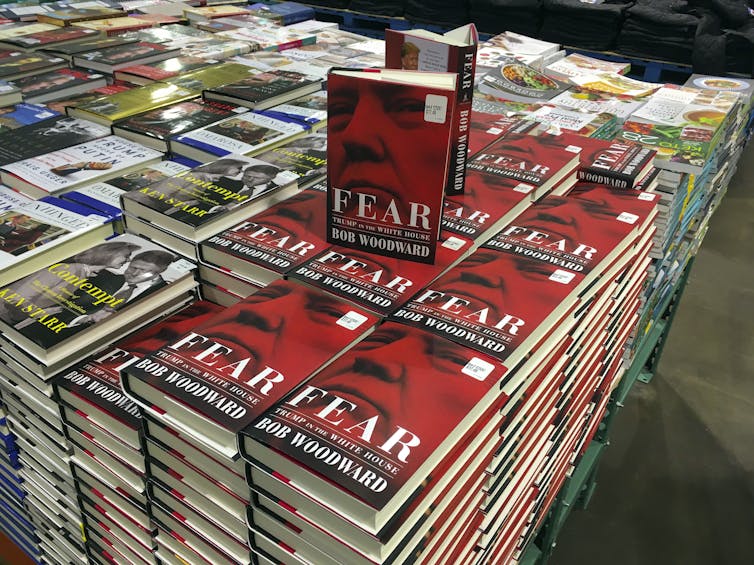
Like Michael Wolff’s “Fire and Fury: Inside the Trump White House,” it portrays President Donald Trump as an “emotionally overwrought, mercurial and unpredictable leader,” whose senior staff struggle to contain his most dangerous impulses.
This same view of Trump was reiterated in a Sept. 5 anonymous New York Times op-ed, which, as Nebraska Sen. Ben Sasse observed, is “just so similar to what so many of us hear from senior people around the White House, you know, three times a week.”
But whether “Fear” tells us something new matters less than the fact that the book is yet another broadside against Trump’s image. It adds more fuel to the suspicions many have about the president’s behind-the-scenes behavior.
In fact, Woodward’s “Fear” – together with Wolff’s “Fire and Fury,” Omarosa Manigault’s “Unhinged” and the anonymous op-ed – is part of a long tradition of political “secret histories,” a genre that recounts salacious and scandalous details about the dealings, relationships and temperaments of those in power. It’s a practice that goes back centuries, and it’s one that my co-editor and I explore in our book “The Secret History in Literature, 1660-1820.”
Secret histories tend to take two forms. There is the plain-spoken, just-the-facts approach, similar to Woodward’s “Fear.” Then there are novelistic accounts with major figures depicted using pseudonyms, as in “Primary Colors,” a lightly fictionalized dramatization of the Clinton White House.
But the secrets unveiled in these works usually don’t come out of nowhere. Instead, they contain anecdotes that have long been whispered or suspected. The goal of secret histories is to emphasize embarrassing stories about a ruler or government – to propel the drumbeat of negative coverage in order to strengthen the opposition and, in some instances, to even topple governments.
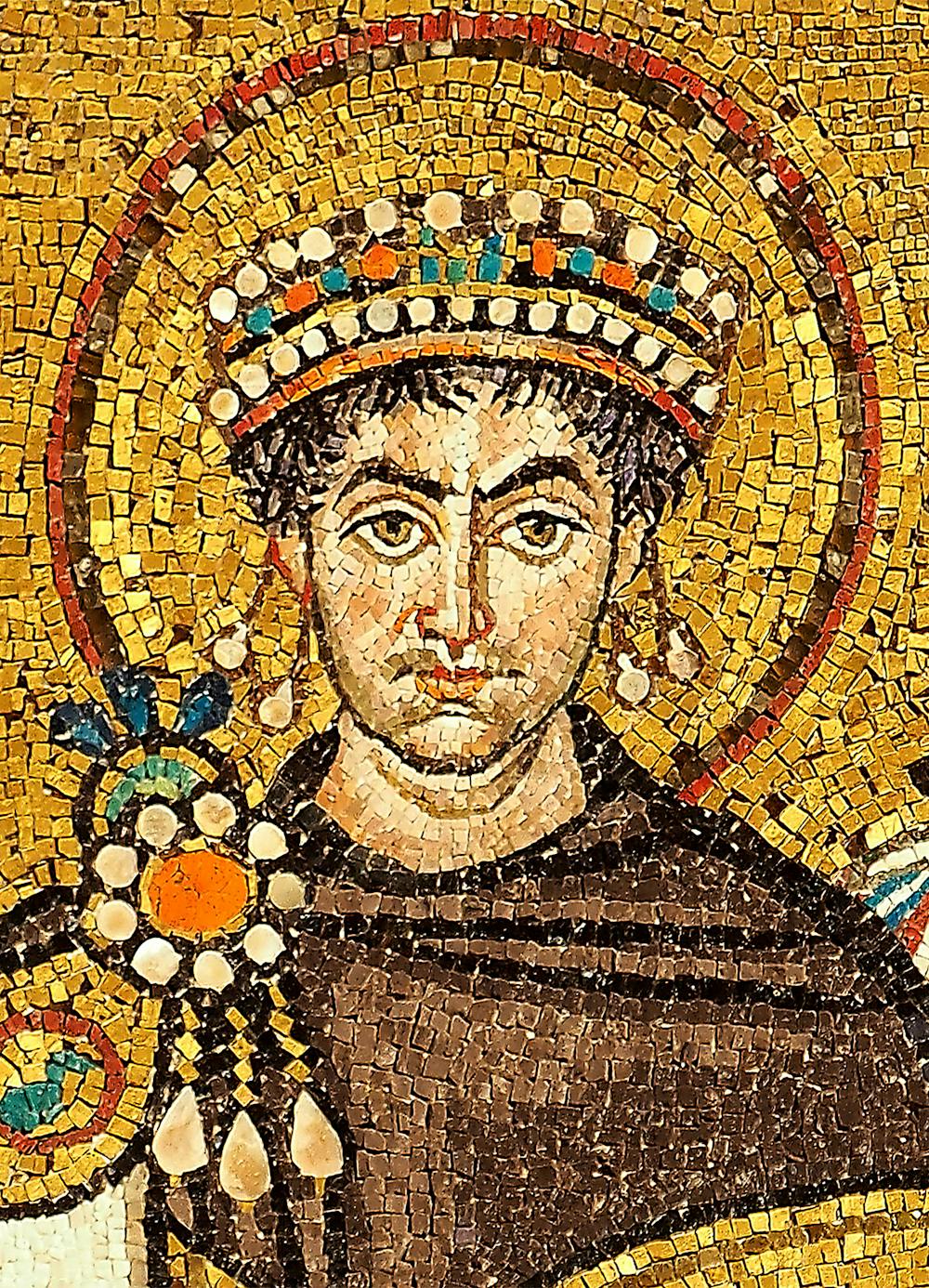
Justinian was the subject of a secret history circulated by the military historian Procopius. Petar Milošević
Secret histories date back at least to the sixth century, when the military historian Procopius wrote down sordid anecdotes about Byzantine Emperor Justinian and his wife, Theodora, in a work that became known as “Anekdota,” which translates to “unpublishable things.” Ten centuries later, it appeared in Latin as “Historia Arcana,” or “Secret History.”
As a military historian, Procopius had helped create the myth of Justinian’s greatness in his eight-book treatise “The Wars of Justinian.” But in his “Anekdota,” Procopius finally told the ugly backstory of Justinian’s reign: his lust, his seizure of others’ property, his petty vengefulness and his persecution of non-Christians. The work was almost certainly circulated in manuscript scroll among Justinian’s enemies. While it probably damaged his standing, Justinian was nonetheless able to retain his grip on power.
After French and English translations of Procopius’ “Anekdota” appeared in 1669 and 1674, secret histories in the same style began to appear about King Charles II of England.
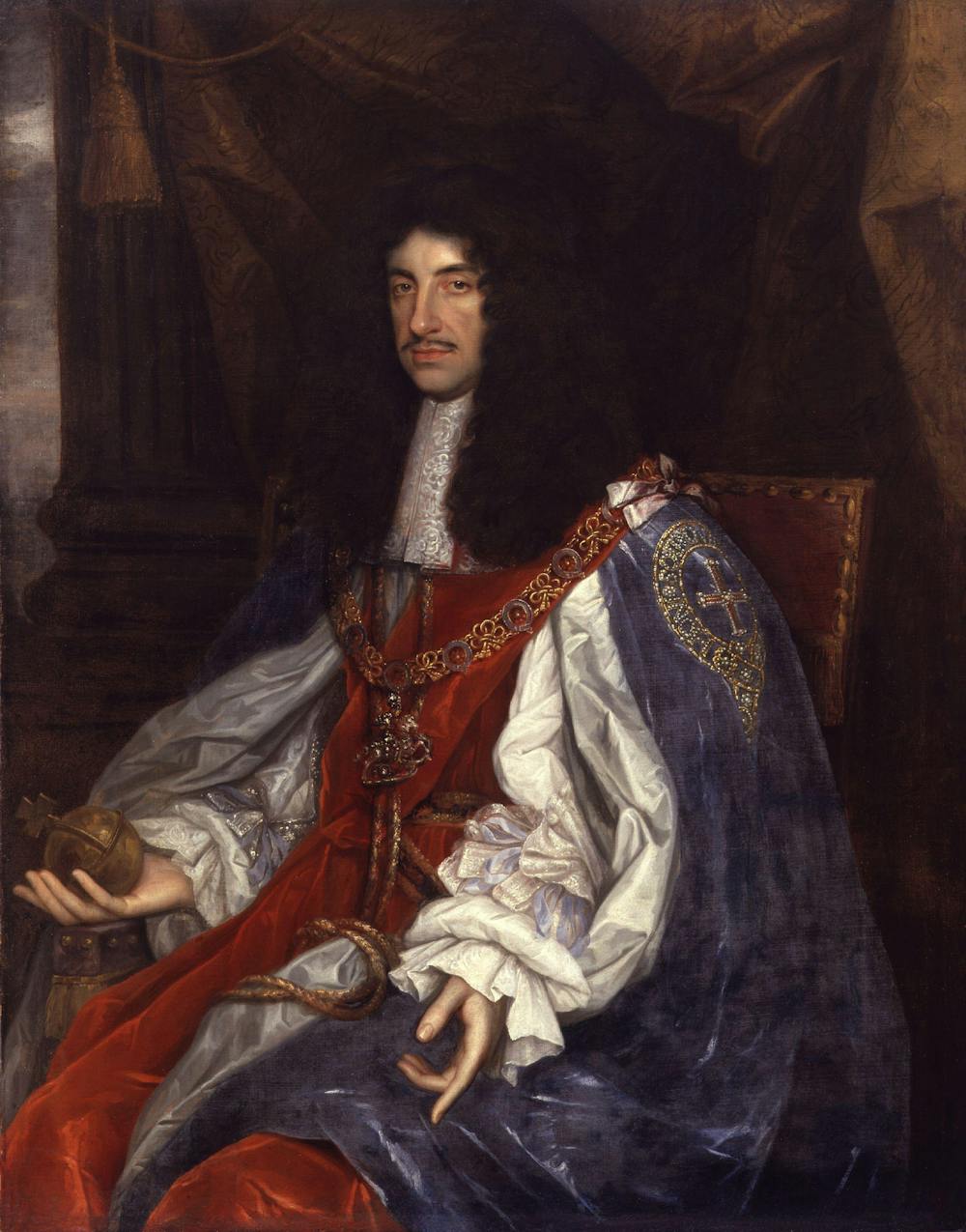
These tended to focus on his mistresses – particularly the infamous Duchess of Cleveland, who manipulated Charles for over a decade, persuading him to grant her land and money and bestow titles of nobility on their illegitimate children.
Speculation over King Charles II’s relationship with the Duchess of Cleveland was rampant during his reign. National Portrait Gallery
These reports, which read like tabloid-style gossip, were never just about sex.
Readers of one account, titled “The Amours of the King of Tamaran,” likely realized that if the king could be duped and controlled by his powerful mistress, he was also susceptible to being influenced by England’s adversaries.
These publications didn’t bring down the politically skilled Charles II, who was glad to take Louis XIV’s money but savvy enough to decide against changing his country’s religion.
They did, however, sow suspicion towards Charles II and his family. After Charles II’s death, his openly Catholic younger brother, James, ascended the throne in 1685, instilling fear that England would return to Catholicism. Seven Englishmen wrote to Prince William of Orange – who was a Protestant – pleading that he invade England. In the Glorious Revolution that ensued, James II fled to France, and Parliament declared William and his wife, Mary, joint monarchs of England.
The Glorious Revolution of 1688 helped inspire American colonists to rebel against another British monarch, with the not-so-secret history of George’s III’s “repeated injuries and usurpations” enshrined in the Declaration of Independence.
Some might disparage Woodward’s book as “anonymously-sourced gossip.”
But gossip has always been important to humankind. As Israeli historian Yuval Noah Harari notes in “Sapiens,” his best-selling account of early human history:
“It is not enough for individual men and women to know the whereabouts of lions and bison. It’s much more important for them to know who in their band hates whom, who is sleeping with whom, who is honest, and who is a cheat.”
Those who dismiss Woodward’s book underestimate the power that gossip and behind-the-scenes revelations wield over politics – and the way it has shaped the course of human history.
Science fiction may seem resolutely modern, but the genre could actually be considered hundreds of years old. There are the alien green “children of Woolpit”, who appeared in 12th-century Suffolk and were reported to have spoken a language no one could understand. There’s also the story of Eilmer the 11th-century monk, who constructed a pair of wings and flew from the top of Malmesbury Abbey. And there’s the Voynich Manuscript, a 15th-century book written in an unknowable script, full of illustrations of otherworldly plants and surreal landscapes.
These are just some of the science fictions to be discovered within the literatures and cultures of the Middle Ages. There are also tales to be found of robots entertaining royal courts, communities speculating about utopian or dystopian futures, and literary maps measuring and exploring the outer reaches of time and space.
The influence of the genre we call “fantasy”, which often looks back to the medieval past in order to escape a techno-scientific future, means that the Middle Ages have rarely been associated with science fiction. But, as we have found, peering into the complex history of the genre, while also examining the scientific achievements of the medieval period, reveals that things are not quite what they seem.
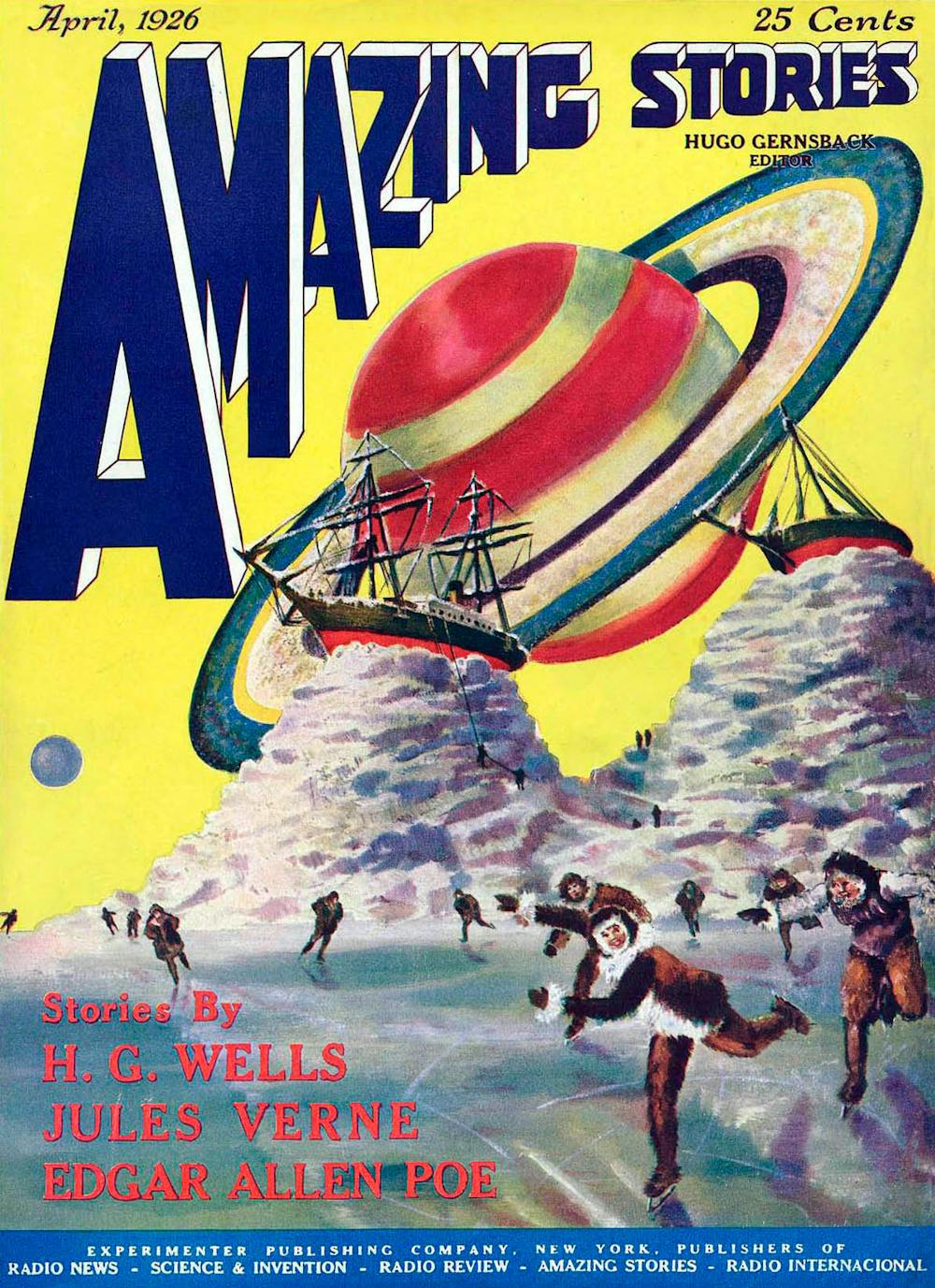
Science fiction is particularly troublesome when it comes to matters of classification and origin. Indeed, there remains no agreed-upon definition of the genre. A variety of commentators have located the beginnings of SF in the early-20th-century explosion of pulp magazines, and in the work of Hugo Gernsback (1884-1967), who proposed the term “scientifiction” when editing and publishing the first issue of Amazing Stories, in 1926.
“By ‘scientifiction’,” Gernsback wrote, “I mean the Jules Verne, H G Wells and Edgar Allan Poe type of story – a charming romance intermingled with scientific fact and prophetic vision … Not only do these amazing tales make tremendously interesting reading – they are always instructive.”
But here Gernsback was already looking backwards in time to earlier writers to define SF. His “definition”, too, was one that could also be applied to literary creations from much further into the past.
Science and fiction
Another longstanding idea is that the “science” in science fiction is key: SF can only begin, many historians of the genre proclaim, following the birth of modern science.
Alongside histories of SF, histories of science have long avoided the medieval period (over a thousand years in which, presumably, nothing happened). Yet the Middle Ages was no dark, static, ignorant time of magic and superstition, nor was it an aberration in the neat progression from enlightened ancients to our modern age. It was actually a time of enormous advances in science and technology.
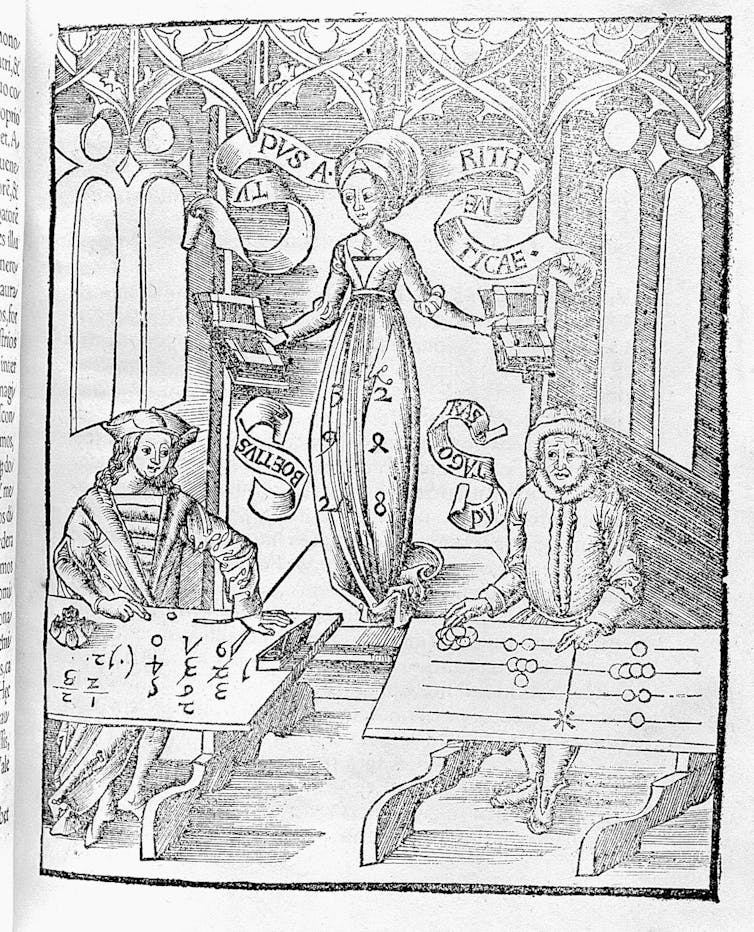
The compass and gunpowder were developed and improved upon, and spectacles, the mechanical clock and blast furnace were invented. The period also laid the foundations for modern science through founding universities, advanced the scientific learning of the classical world, and helped focus natural philosophy on the physics of creation. The medieval science of “computus”, for instance, was a complex measuring of time and space.
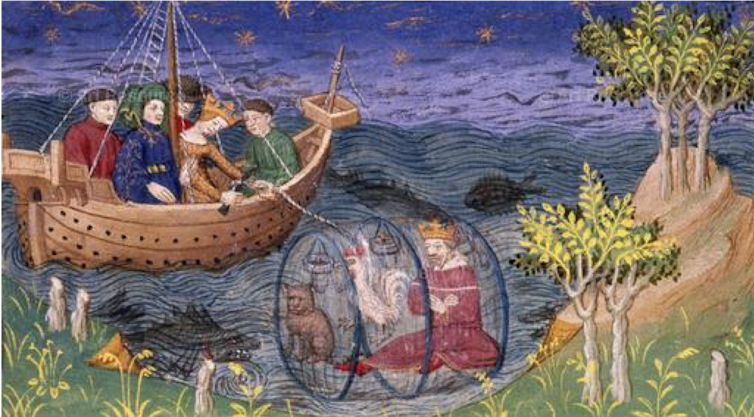
Scholars have started to reveal the convergence of science, technology and the imagination in medieval literary culture, demonstrating that this era could be characterised by inventiveness and a preoccupation with novelty and discovery. Take the medieval romances that feature Alexander the Great soaring heavenwards in a flying machine and exploring the depths of the ocean in his proto-submarine. Or that of the famous medieval traveller, Sir John Mandeville, who tells of marvellous, automated golden birds that beat their wings at the table of the Great Chan.
Like those of more modern science fictions, medieval writers tempered this sense of wonder with scepticism and rational inquiry. Geoffrey Chaucer describes the procedures and instruments of alchemy (an early form of chemistry) in such precise terms that it is tempting to think that the author must have had some experience of the practice. Yet his Canon’s Yeoman’s Tale also displays a lively distrust of fraudulent alchemists, sending up their pseudo-science while imagining and dramatising its harmful effects in the world.
Alexander in his ‘submarine’. British Library, Royal MS 15 E. vi f. 20v, Author provided
The medieval future
Modern science fiction has dreamt up many worlds based on the Middle Ages, using it as a place to be revisited, as a space beyond earth, or as an alternate or future history. The representation of the medieval past is not always simplistic, nor always confined to “back then”.
William M Miller’s immensely detailed medieval future in A Canticle of Leibowitz (1959), for instance, dwells on the way the past consistently reemerges in the fragments, materials and conflicts of a distant future. Connie Willis’s Doomsday Book (1992), meanwhile, follows a time-travelling researcher of the near-future back to a medieval Oxford in the grip of the Black Death.
Although “medieval science fiction” may sound like an impossible fantasy, it’s a concept that can encourage us to ask new questions about an often-overlooked period of literary and scientific history. Who knows? The many wonders, cosmologies and technologies of the Middle Ages may have an important part to play in a future yet to come.
I’m a regular biomedical scientist, although in one sense I’m perhaps a bit different, in that I really like the process of writing.
From speaking with colleagues and teaching postgraduate students about the process of scientific writing for more than ten years, I estimate that eight or nine of every ten biomedical researchers would say they don’t like writing.
Now, while I do like writing, that’s not to say I find it easy. When I’m in the thick of getting my thoughts onto the page, terms such as “bloodbath” and “fight to the death” flood my mind.
I have images of fighting a slippery dragon, trying to break its back. I feel as if I’m fighting my own ideas or whatever I’m trying to write, and there’s only one possible outcome: breaking these ideas down, whatever the cost.
And remember, I like writing, so imagine what it’s like for the majority of scientists who don’t.
To illustrate what can go wrong with the writing process, I’m going to refer to an old fairy tale: Sleeping Beauty.
A fairy tale
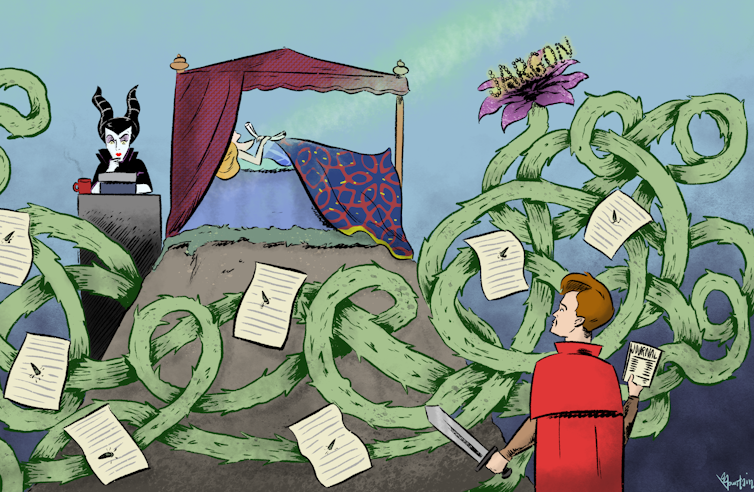
This is the story of a princess who was cursed to fall into a deep sleep, along with her family and everyone else living in the castle. They sleep for 100 years, and during this time a thick thorny forest grows up around the castle, shielding it from view.
One day, a prince who has heard about the sleeping beauty arrives on horseback, with a sword. With great difficulty, he cuts his way through the forest to eventually reach the castle. He finds the princess, wakes her up, and they presumably live happily ever after.
So what has this got to do with scientific writing? Well, scientific results and ideas can be viewed as something valuable, and yet they can be wrapped up in forests of words that lack structure and overuse complex language.
Sometimes this just reflects a lack of training, but there can also be an assumption that scientific ideas deserve to be discovered by those who are clever enough.
This means readers are expected to hack their way through the word forest, if they’re really committed to understanding the results.
The only problem with this approach is that it doesn’t consider the sheer number of papers that scientists need to read. Most researchers and academics can’t keep up with their fields, so if a paper is hard to understand, or unclear, researchers may simply put it down and pick up the next one in the pile.
Expecting too much of the reader can lead to a paper sinking within the literature and effectively falling asleep.
The ‘sleeping beauties’ of science
In fact, a “sleeping beauty” is now a recognised type of academic paper. A sleeping beauty experiences what is also termed “delayed recognition”, sleeping within the literature for up to 100 years until another paper known as the “prince” recognises its value.
The sleeping beauty goes on to be highly cited and influential, sometimes in a different field. Researchers now study sleeping beauties and their princes, as a kind of extreme example of how science works – or doesn’t, depending on your perspective.
It’s generally assumed that sleeping beauties describe ideas that were ahead of their time. But I wonder whether some of these papers might have also been asleep in their forests of words.
After all, we only know about these scientific sleeping beauties through their awakening, in the same way that without the prince’s determination, the story of Sleeping Beauty may never have been told. It is very difficult to know how many other ideas may be lying dormant in the literature, wrapped in their forests of words.
What can we do about this? We need to recognise that to avoid the word forest, the research team needs to hack through their ideas and lay these out as clearly as possible.
This is really difficult, and learning how to do this takes years of practice and effort. As researchers and academics, we need to talk about this process and embrace it.
We expect that professional sportspeople will push themselves to the limit, and be supported to do this. Scientists are essentially intellectual athletes, so we need to talk about the virtue of pushing ourselves to the limit when writing, how to do this, and what kind of support we need.
Many features of scientific life, such as crowded work environments, and generally measuring quantity over quality, do not favour the truly difficult process of hacking through our ideas so others can understand them.
It’s important to remember that in the story of Sleeping Beauty, many people fell asleep in the castle. Also, scientific papers are not just about their authors, but also about the public funds and the many supporting resources that make them possible.
We can’t afford the risk that our results and ideas fall asleep. Humanity doesn’t have the next 100 years to wait.
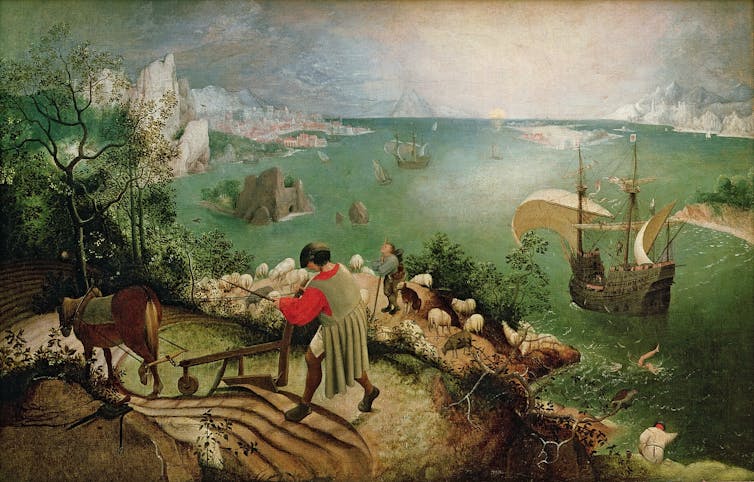
Landscape with the Fall of Icarus, attributed to Pieter Bruegel the Elder, c. 1555. Rosemary Dobson addressed the painting in her poem Painter of Antwerp. Wikimedia
In the first century BCE the Roman poet Horace proposed that, “A poem is like a picture”, meaning that, like painting, poetry engages in mimesis by imitating life, copying it in a fixed medium. But what happens when art imitates art, as in Australian poet Rosemary Dobson’s poem, For the Painter Ben Nicholson, about the work of the British modernist?
Finding and learning
the inner essence,
making and showing
by signs and symbols
that a tree like a glass
contains its tree-ness
and frost is white
on the rim of darkness.
Even more ancient than Horace is the concept of ekphrasis, the poetic description of a work of visual art: painting, sculpture, architecture. In other words, ekphrasis is a kind of translation of one art form into another. Dobson’s poem is a meditation on how a picture can reveal more by suggesting what’s not there – at least to the physical eye – as much as what is.
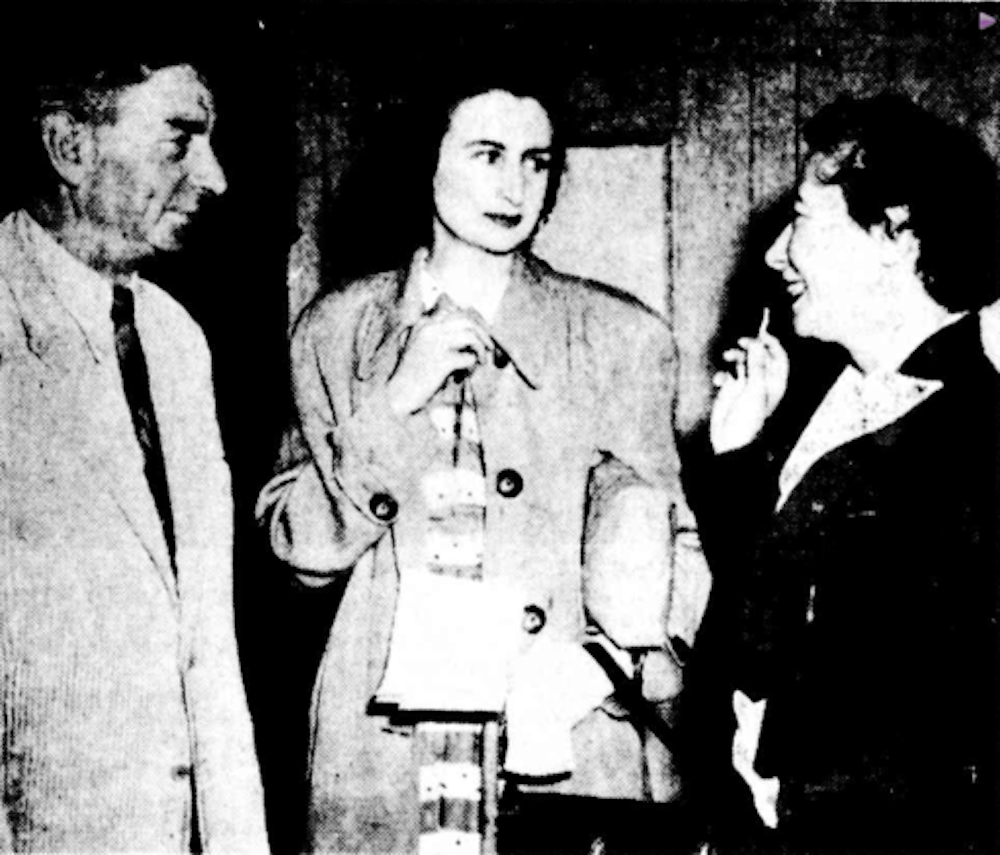
The poet Rosemary Dobson (centre) in 1953. Wikimedia
Across her long career, Dobson was celebrated as a poet who could take the reader beyond the immediate image to another insight. From early on her skill with traditional forms was balanced by a willingness to loosen them in more conversational ways, so she responded better than some of her postwar peers to the cultural shifts of the 1960s and beyond.
At Frensham School in Mittagaong, NSW, where her widowed mother was employed as a house mistress, Dobson’s interest in both poetry and art was actively encouraged. Later, while a non-degree English student at Sydney University, Dobson also studied painting with the artist Thea Proctor.
During the 1940s she worked in the editorial department of the publisher Angus & Robertson, where she met her husband Alec Bolton. Bolton would set up Brindabella Press in 1972 to print fine editions of poems, often including Dobson’s illustrations.
Dobson was fascinated by the ways in which poetry and the visual arts might speak to each other, and late in life described how learning visual design helped her write her poems:
I mean that as one strives for balance of light and shade, weight and airiness in painting, so one can use words and phrases to the same effect in writing poetry.
‘The Arnolfini Portrait’, Jan van Eyck, 1434. Wikimedia
The title poem of her earliest collection, In a Convex Mirror (1944) seems to be inspired by Jan van Eyck’s Arnolfini Portrait (1434), and addresses a poignant irony about all representation: that art, in order to capture life, must inevitably still its pulse:
Shall we be fixed within the frame,
This breathing light to clear-cold glass
Until our images are selves
And words to wiser silence pass?
A painting may preserve the moment, offering a “wiser silence”, but it can’t account for the ravages of time that will inevitably “rive the two of us apart”.
Dobson’s many poems about European paintings are among the finest modern experiments in the ekphrastic mode. Painter of Antwerp evokes Pieter Brueghel’s Landscape with the Fall of Icarus (c. 1555), a work also treated by W.H. Auden and William Carlos Williams.
Dobson reads the painting from the artist’s earthy Flemish point-of-view as he returns north, bemused rather than impressed by the glories of the Italian Renaissance, as symbolised by the classical figure of Icarus fallen from the sky, a minor detail in the picture:
At the top of the Alps he paused perhaps, looked backwards,
Rejecting the fanciful, and took for a painting
Ploughman, fisherman, and moon-faced shepherd,
The furrow cut cleanly, the sheep contented;
Put thumb to nose with neither pride nor envy
At soaring wings – a Southerner’s invention –
Icarus sprawling, two feet out of the sea.
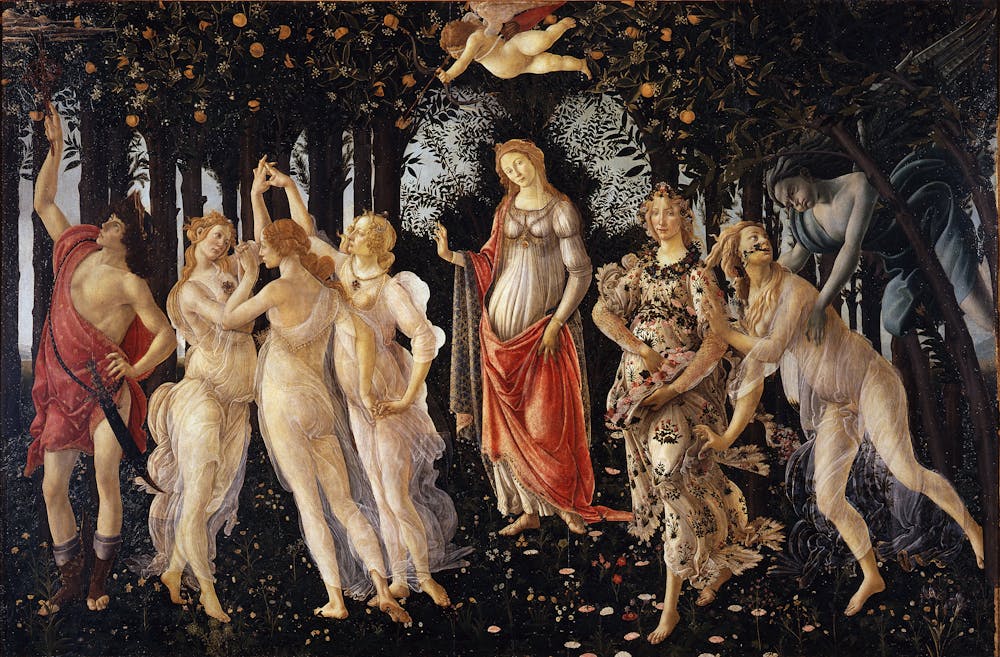
In contrast, the classical world is welcomed in Landscape in Italy, which expresses wonder at the way a painting – here Botticelli’s Primavera (1477-1482) – can re-enchant the everyday world:
One can overemphasise Dobson’s poems about paintings at the expense of the variety of her achievement, along with its distinctly Australian elements. A major reason she gave for writing so little while in England with her husband and family in 1966-71 was: “one needs to write where one’s roots are. Away from one’s country one is taking in rather than giving out”.
During this time her work became more immediately personal – it was an era for “confessional” poetry – and, by becoming so, more elegiac, more concerned with the passing of time and with loss.
The landscape of Dry River offers an “objective correlative”, to use T.S. Eliot’s term, for state of the poet’s mind. Though in a freer form, note the emphasis on dactyls (a poetic foot that starts with one stressed syllable followed by two unstressed), creating a falling cadence:
It was my river. My spirit’s destination.
Abstract of water, a dried depression,
Holed and bouldered and raked with fissures
Where the idea of water channelled
Irresistibly over and under
Endlessly forcing down to the sea.
The poems of Dobson’s middle-age are often more explicitly concerned with women’s experience. In Cock Crow, the responsibility of being a writer, of “Wanting to be myself, alone”, conflicts with the responsibilities owing to “One life behind and one before”, her mother and daughter, whose sleeping forms are unaware that she has fled the house. But morning brings the sound of the crowing cock, that biblical symbol of betrayal, and the poet returns, “Thinking I knew his meaning well”.
In later life, Dobson collaborated with fellow poet David Campbell to produce translations – what they called “imitations” – of the work of several 20th-century Russian poets, which were published alongside more literal renderings of the same poems.
As poet Simon West has remarked, such an exercise is both rare, and rarely celebrated, in a “largely monolingual” literary culture such as ours. But in a way Dobson’s contributions are also like her ekphrastic poems: renderings of the original work in another medium; here, another language.
Poet James McAuley described Dobson’s work as “pellucid”: a highly appropriate word for a poet so invested in painting, which depends on light. But McAuley was also referring to a translucent quality in Dobson, what he called “a meaning within the meaning, or haunting the meaning, a feeling that what the poem says or does is only a way of conveying something else which is ineffable”.
The last of a series of short elegies to David Campbell, The Continuance of Poetry, offers an example, showing as well the influence of Chinese poetry:
Not being able to find the hermit he wanted to visit
Li Po looked deeper into the landscape.
Like Li Po we lean against a pine-tree;
And looking into the landscape find your poems.
For Dobson, in translating the world for us, art necessarily bears the trace of the translator.
With news that the Man Booker Prize long list includes a graphic novel for the first time, the spotlight is on comics as a literary form. That’s a welcome development; the comic is one of the oldest kinds of storytelling we have and a powerful artform.
Right now, the Australian comics community is producing some of the best original work in the world. Australian comics punch above their weight globally. Many have been picked up by international publishers and nominated for international and national literary awards – yet remain little known at home. Some are directed at an adult audience; some are for all ages. They tackle issues ranging from true crime to environmental ruin to life in detention.
As someone who has researched comics for years – and been a fan since childhood – I want to share with you some highlights from the contemporary Australian comic scene. Here are 10 Australian comics of note, in no particular order.
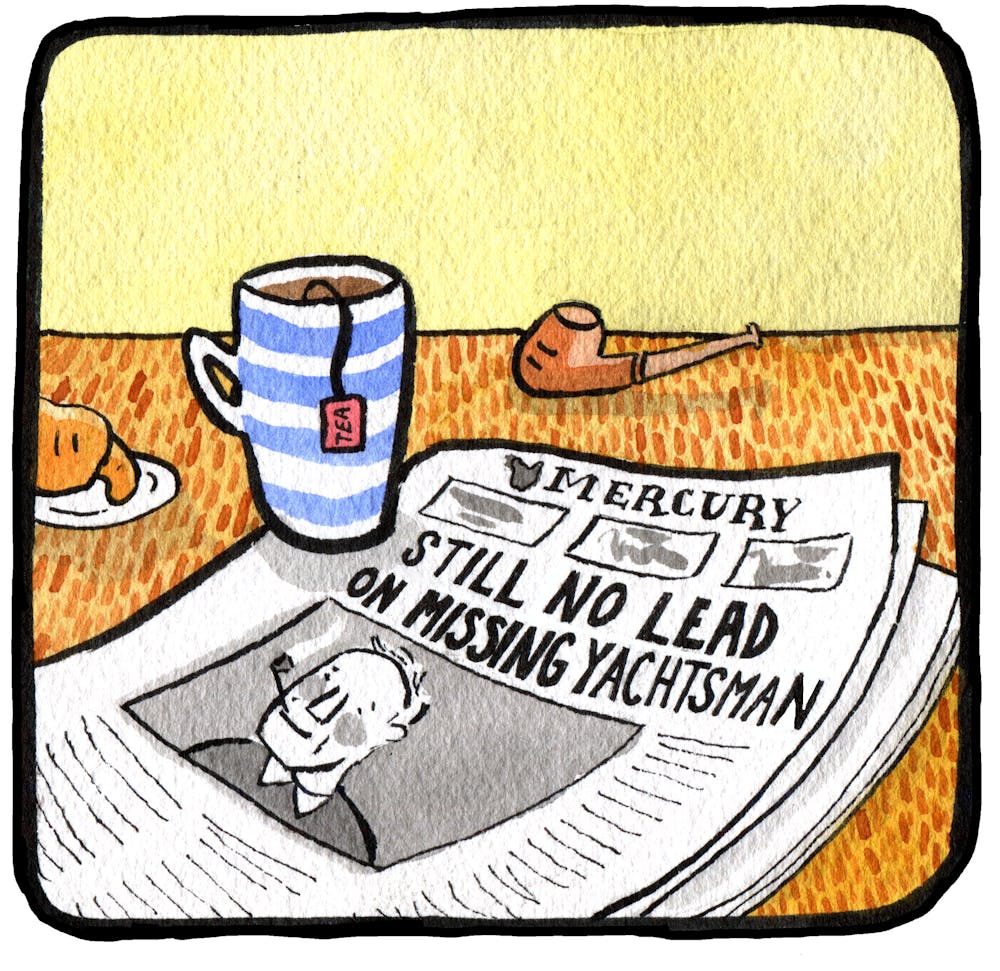
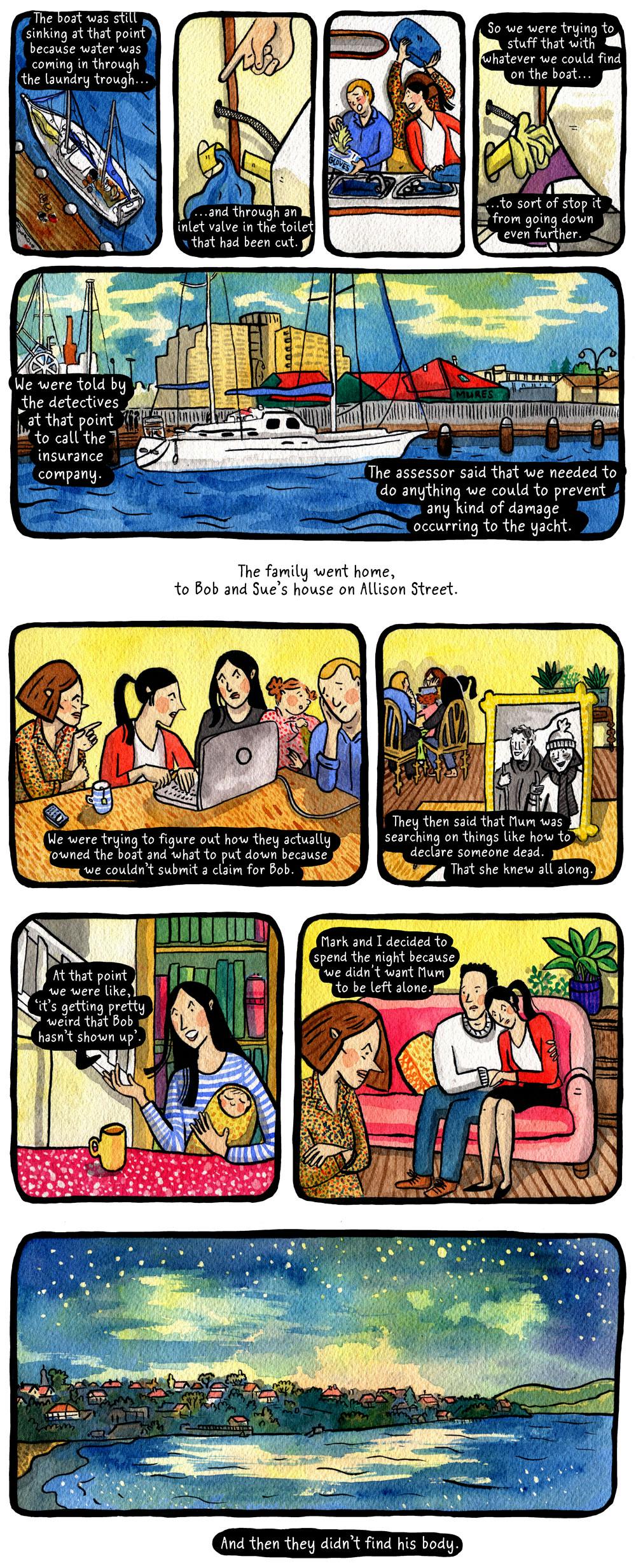
Sue Neill-Fraser’s conviction for the murder of her de-facto partner Bob Chappell in 2009 polarised the Tasmanian city of Hobart. To this day, Sue has maintained her innocence. This piece of long-form comics journalism by cartoonist Eleri Mai Harris takes readers deep into the personal impact this case has had on the families of those involved.
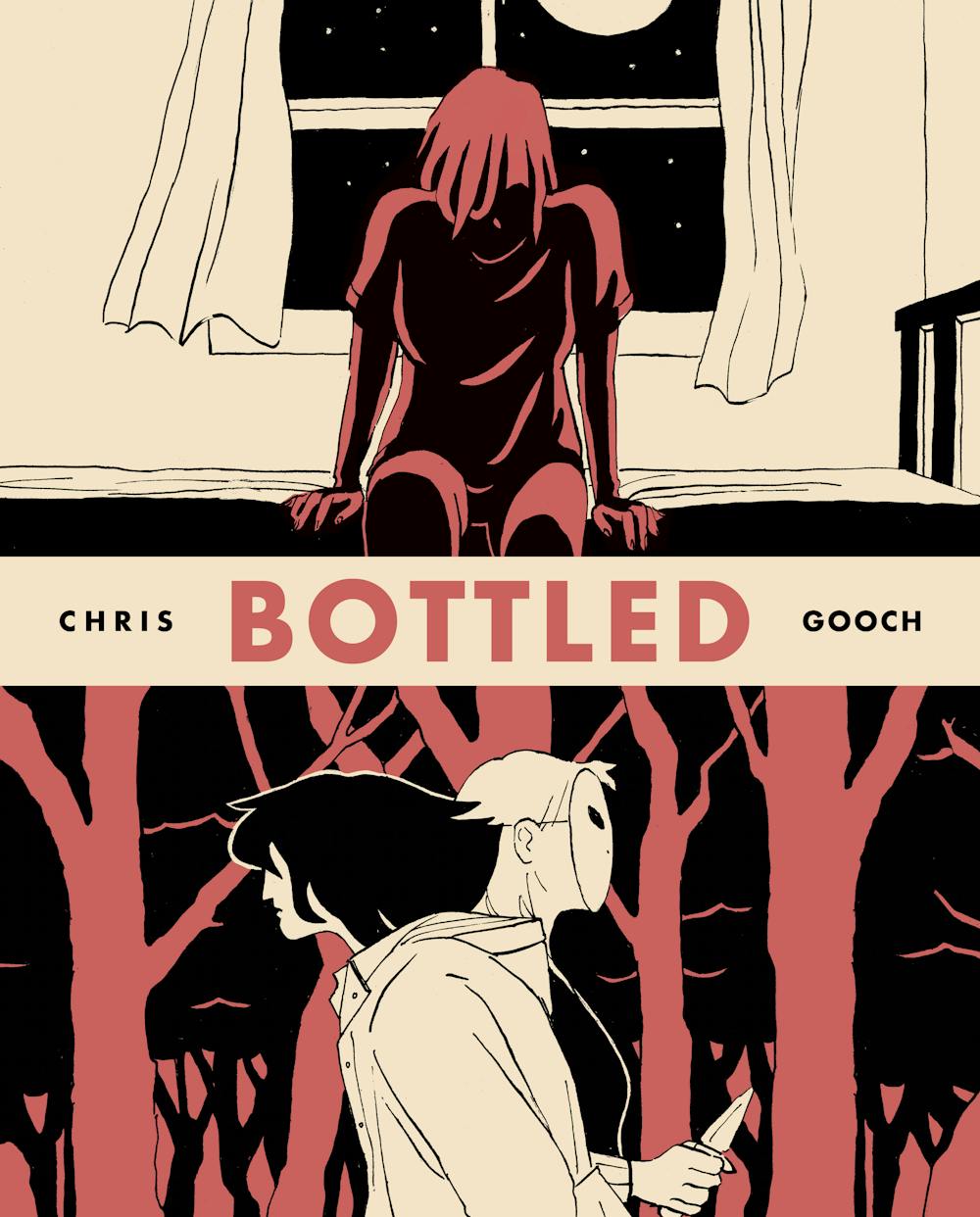
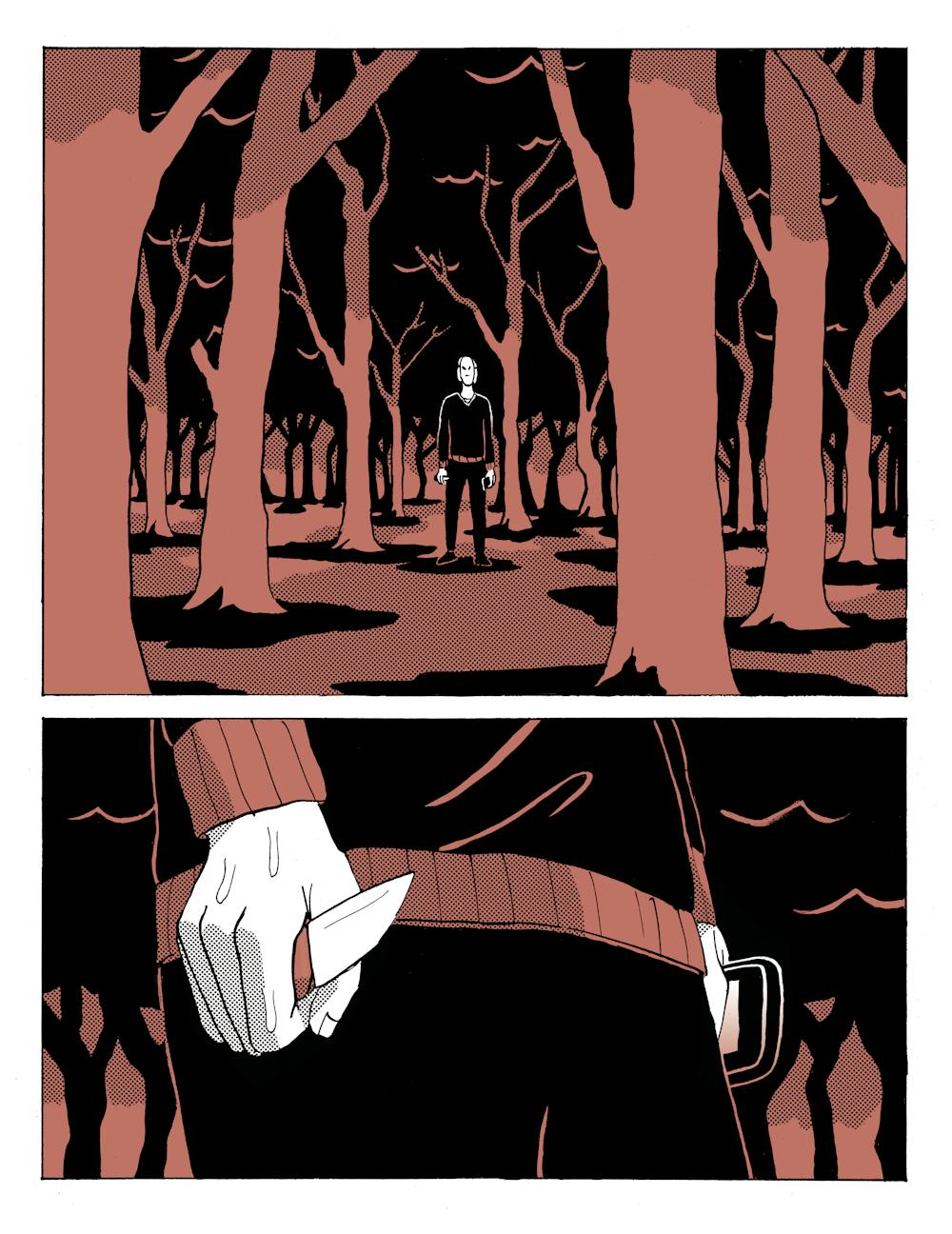
According to one study, mean friends can be good for you. The opposite may be true in this psychological drama, a tale of jealousy, friendship and narcissism. Bottled is a tense piece of suburban noir set in the suburbs of Melbourne, rendered stark and disjointed by Chris Gooch’s striking artwork.
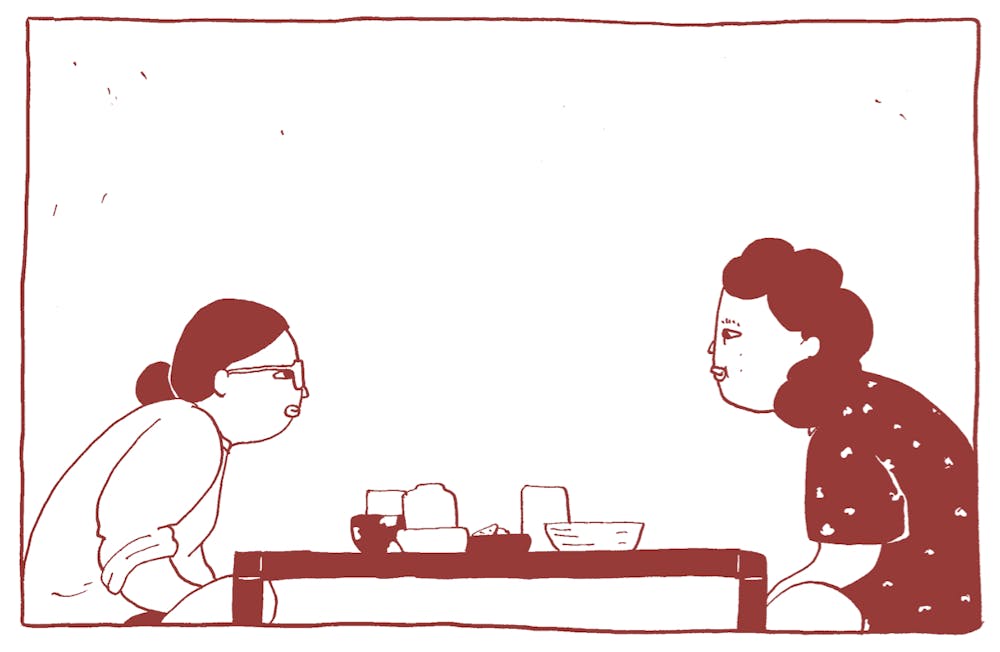
Who is my birth mother? In this autobiographical story, Meg O’Shea travels to Seoul to find an answer to that question, armed with her sense of humour and imagination. This whimsical story of sliding door moments explores the emotional impact of not having solutions and the fatality of not knowing.
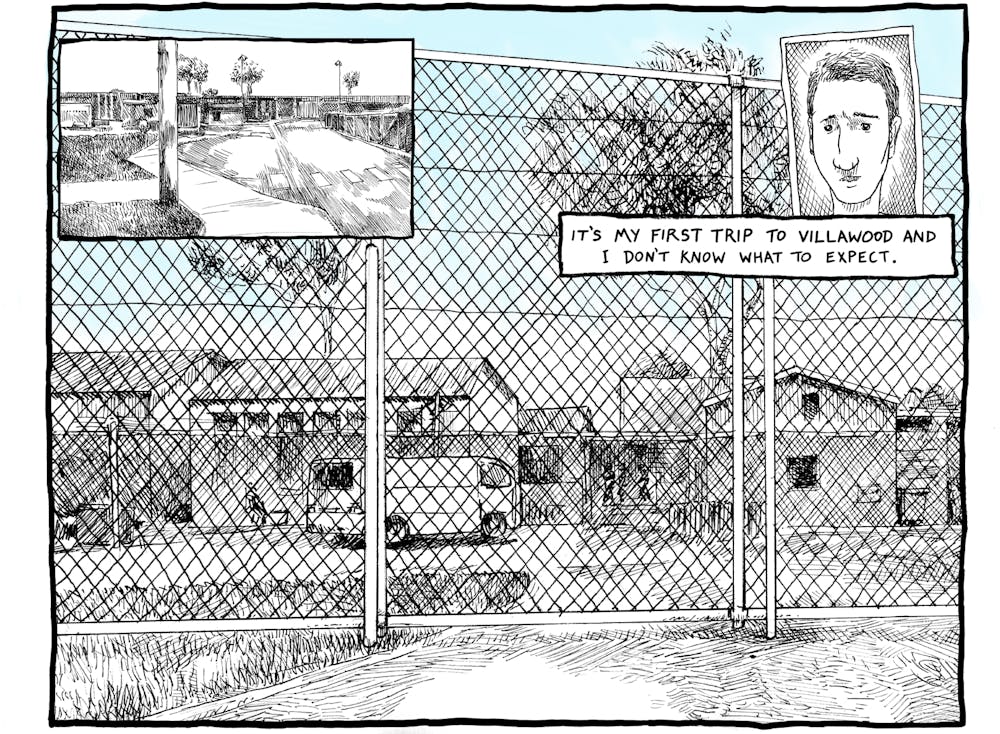
Villawood is a Walkley award-winning piece of comics journalism about the experiences of being held captive in a Sydney asylum seeker detention centre. In sharing the stories and experiences of the detainees, it lays bare the harsh realities of indefinite detention. These stories are made even more real through the inclusion of artwork created by the detainees. Their images sit alongside Safdar’s tense line work, which illustrates the realities of this brutal system.
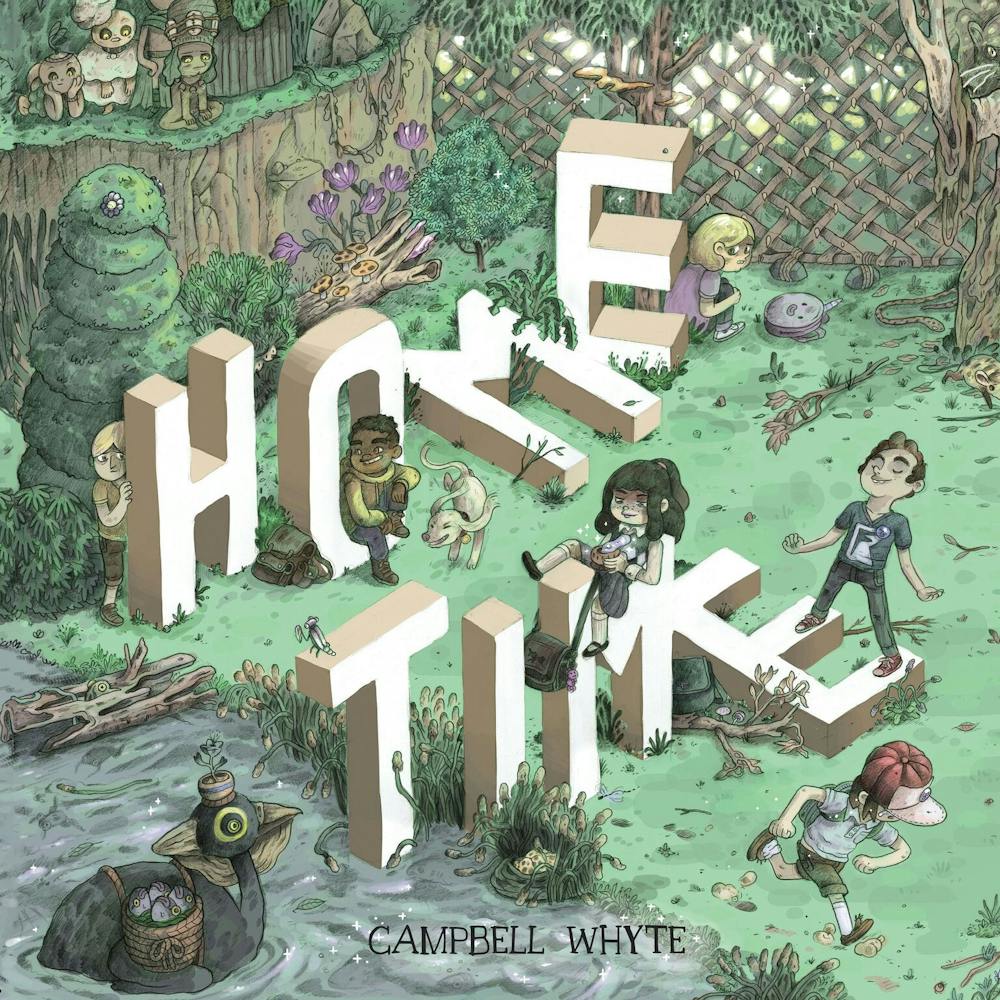
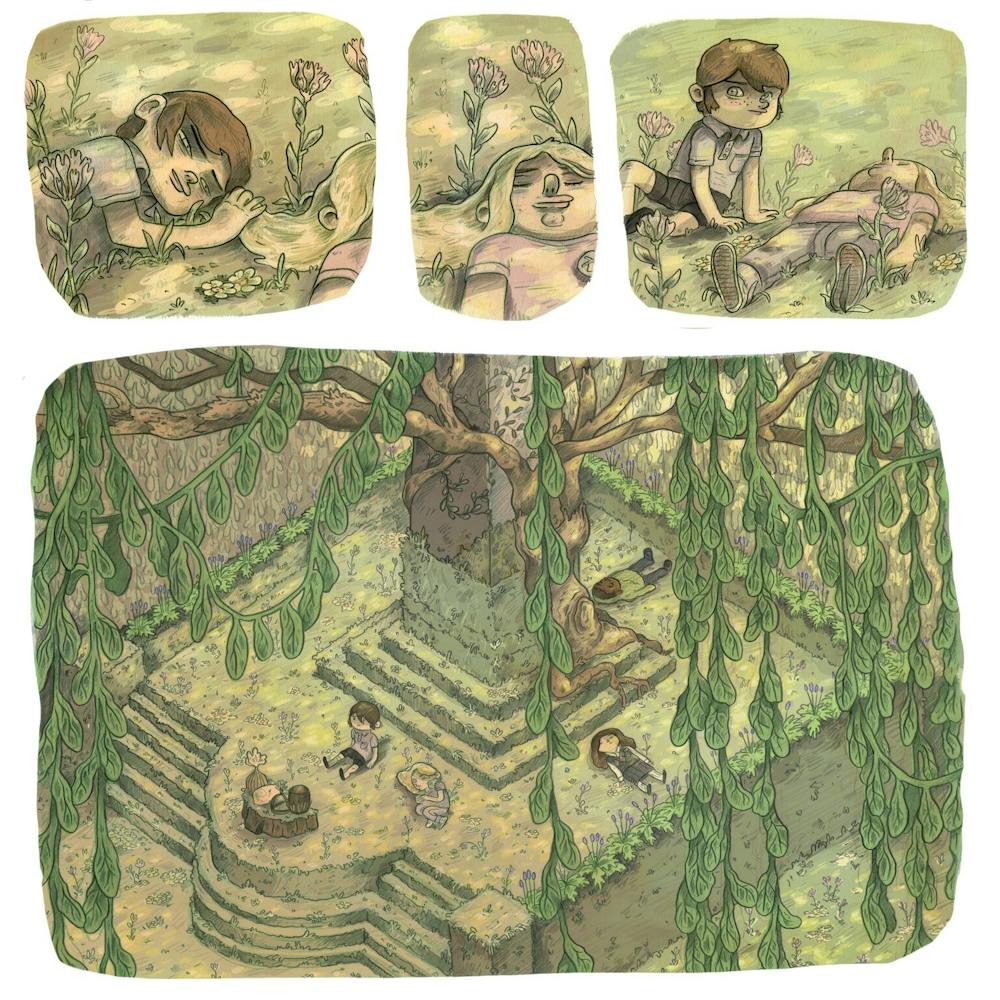
Changes are on the horizon for a group of Year Six school friends who are looking at their last summer together. But their suburban world is transformed after a freak accident transports them to an alternative universe. The friends find themselves in an inverse world filled with creepy gumnut babies, cups of tea and a deceptively familiar Australian landscape. With Home Time, Campbell Whyte has created an intoxicating and visually stunning Australian Narnia.
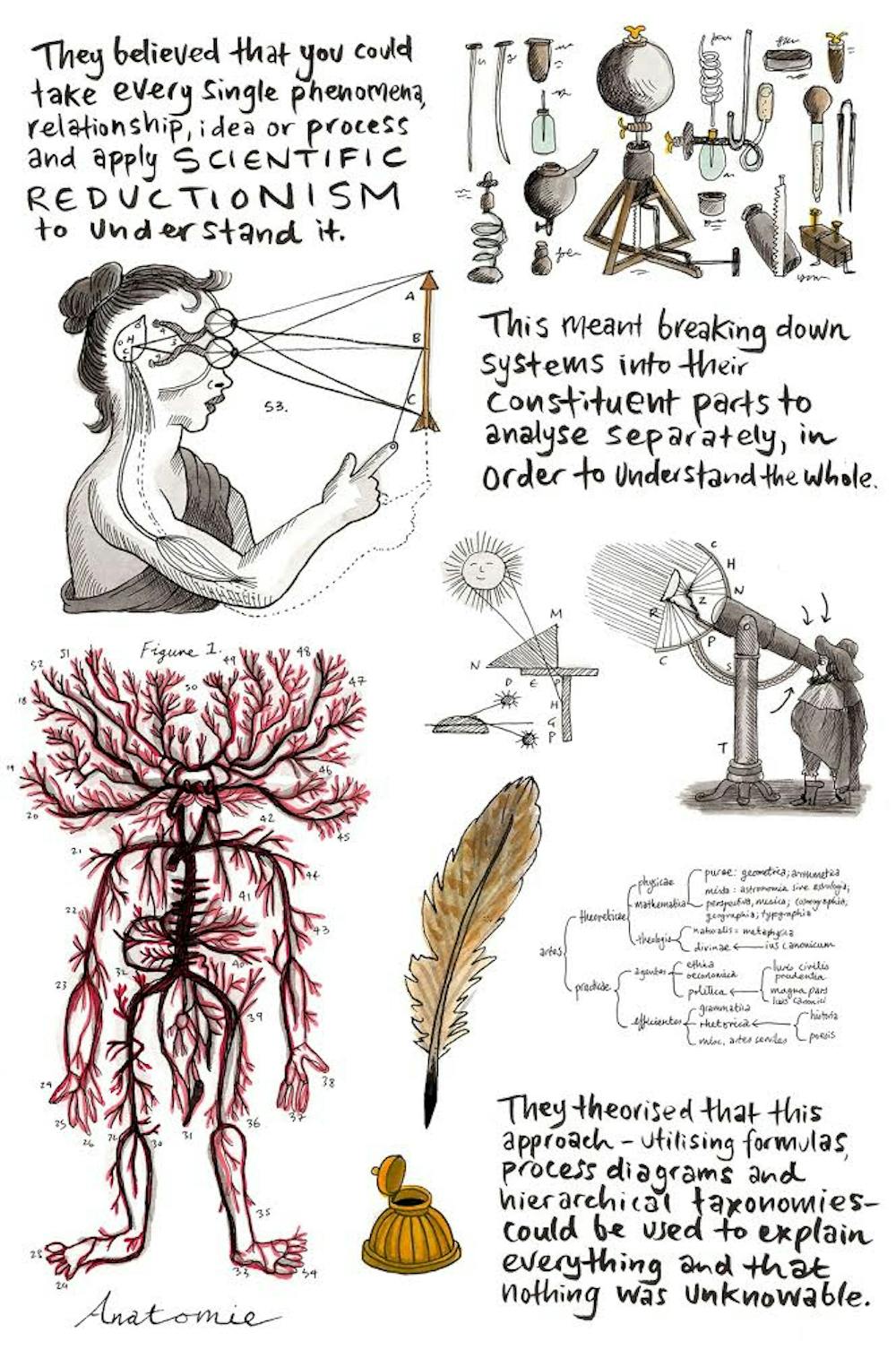
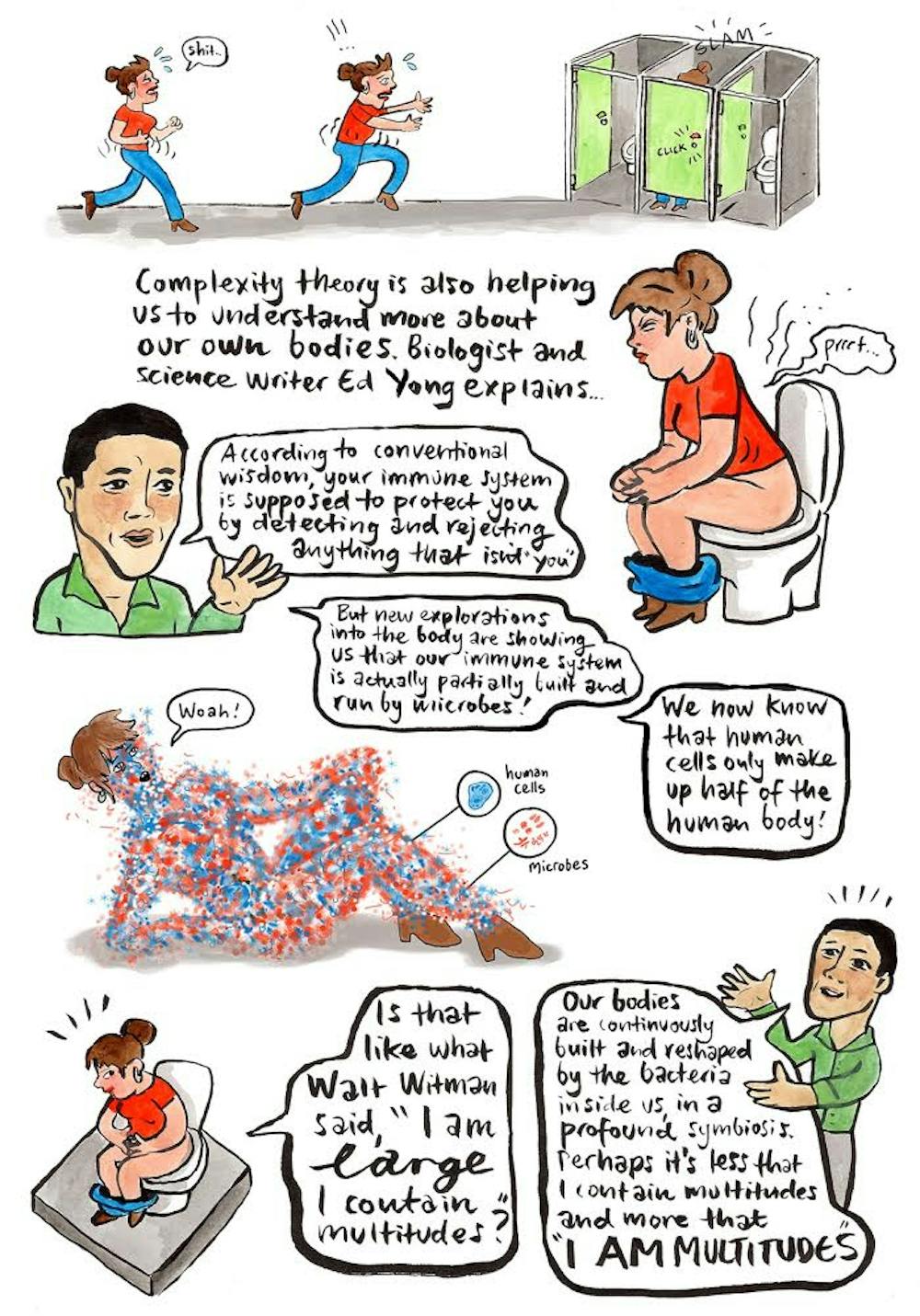
Sarah Catherine Firth’s visual essay explores how we understand the complex systems that exist in the world around us. Through autobiographical anecdotes and humour, it covers the history of scientific thought, unpacks complex ideas and helps provide answers to complicated questions.
You can read Making Sense of Complexity online here.
Making sense of complexityMaking sense of complexity.
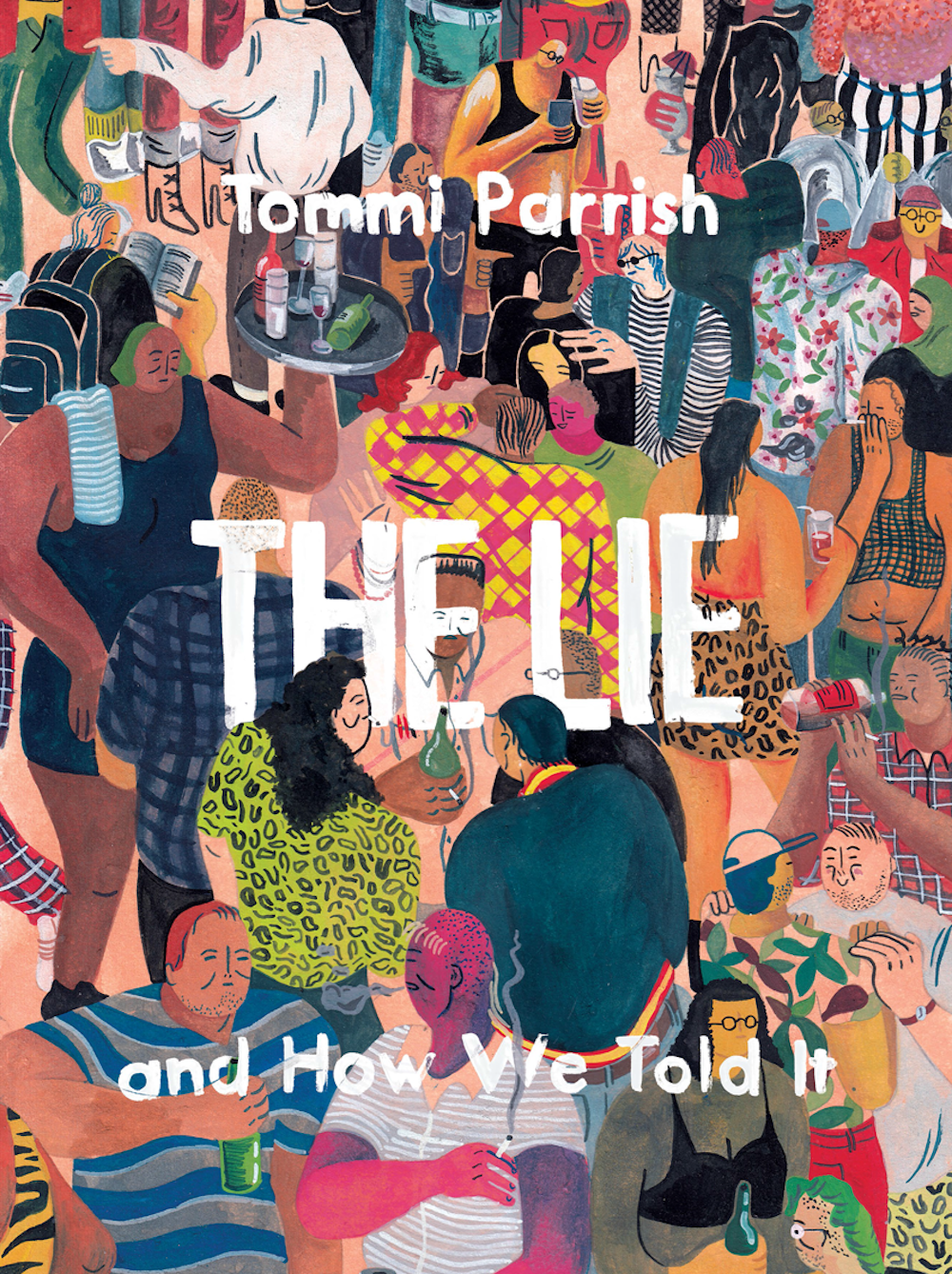
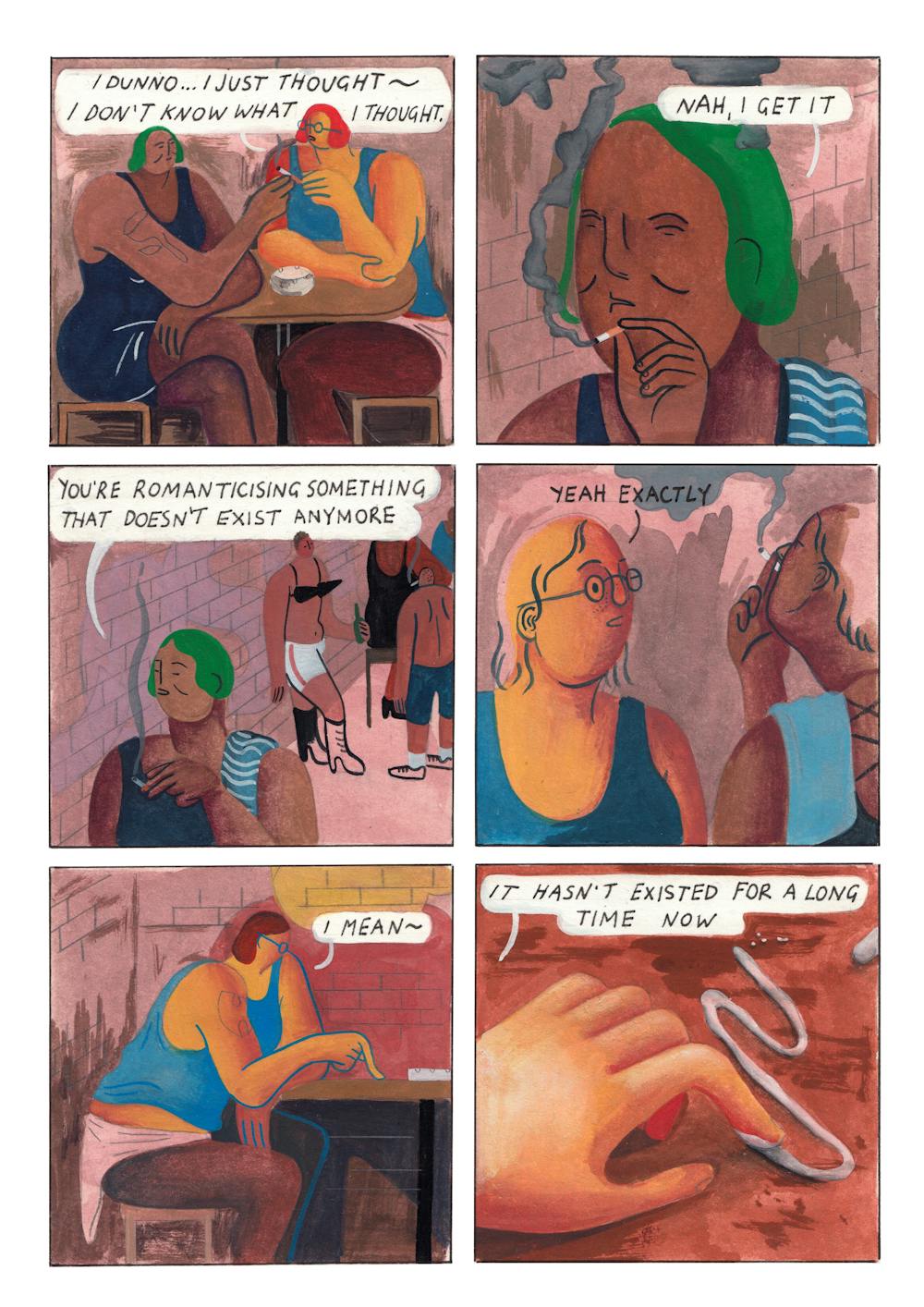
The blurb says The Lie is about how “after a chance encounter, two formerly close friends try to salvage whatever is left of their decaying relationship”. But it’s much more that. Visually, Tommi Parissh’s disproportioned characters dominate the spaces and the panels they inhabit, their uneven bodies reflecting their unease with themselves and their shared history. The Lie is a beautifully poignant tale of confused identities, self-centeredness and regret.
The Lie and How We Told It; cover page.The Lie and How We Told It; inside page.
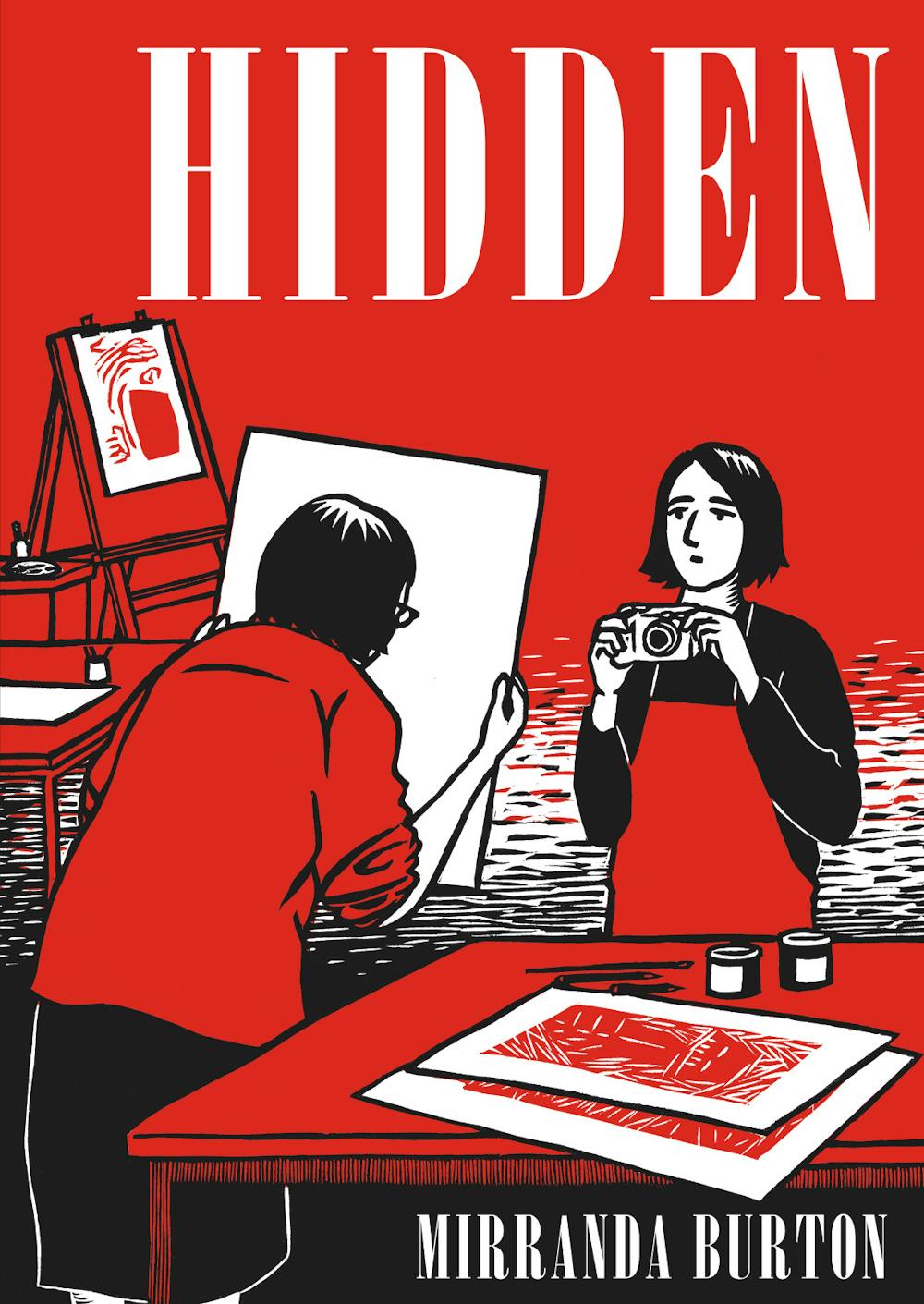
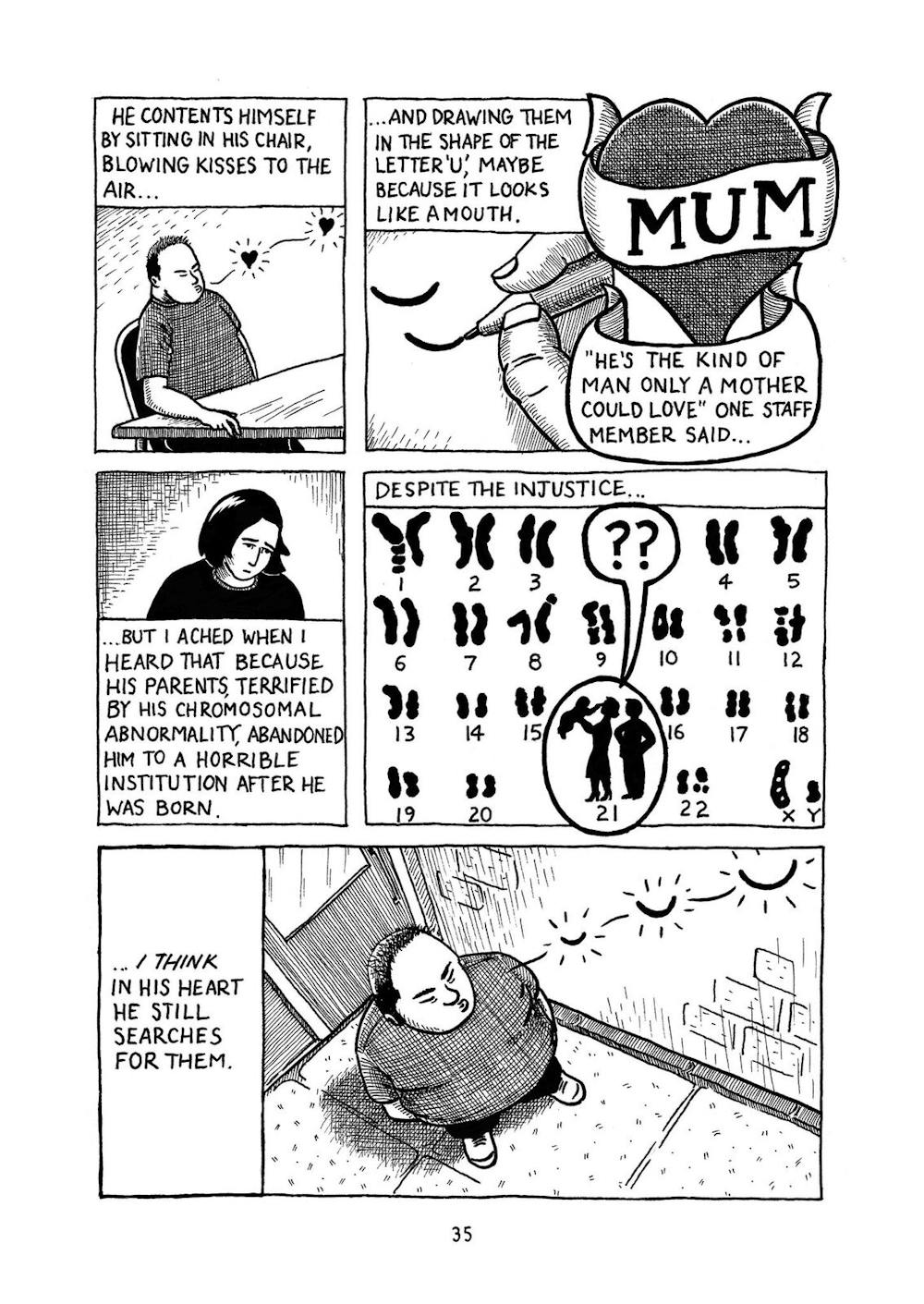
“Everyone sees the world in their own unique way.” That’s how Mirranda Burton introduces Steve, one of the intellectually impaired adults she teaches art to. But Hidden isn’t about how her subjects see the world. It’s about how Mirranda sees them – with care, respect and humour. Mirranda’s fictionalised stories reveal how engaging meaningfully with people can shift your perspectives in beautiful and unexpected ways.
Hidden; cover page.Hidden; inside page.
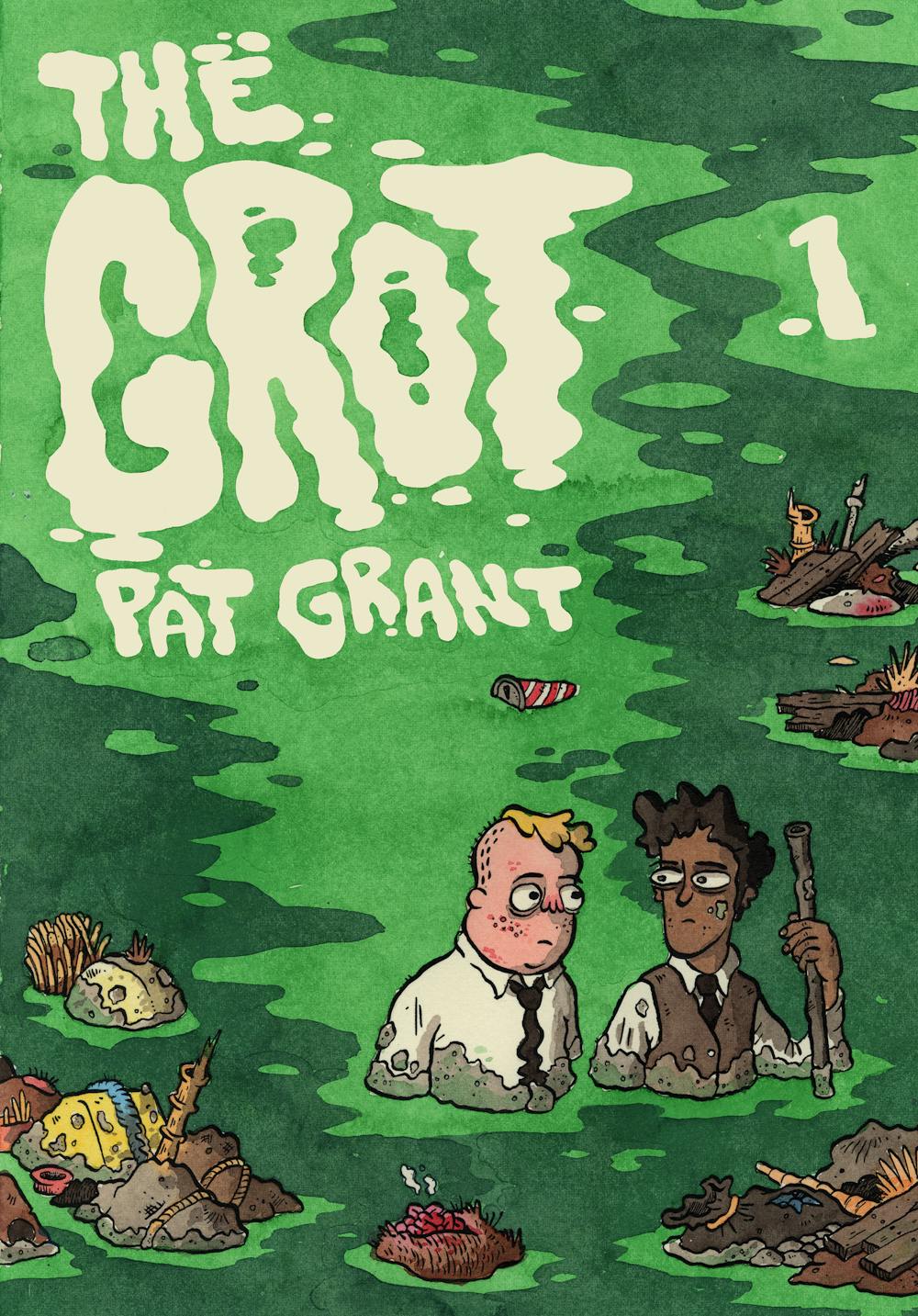
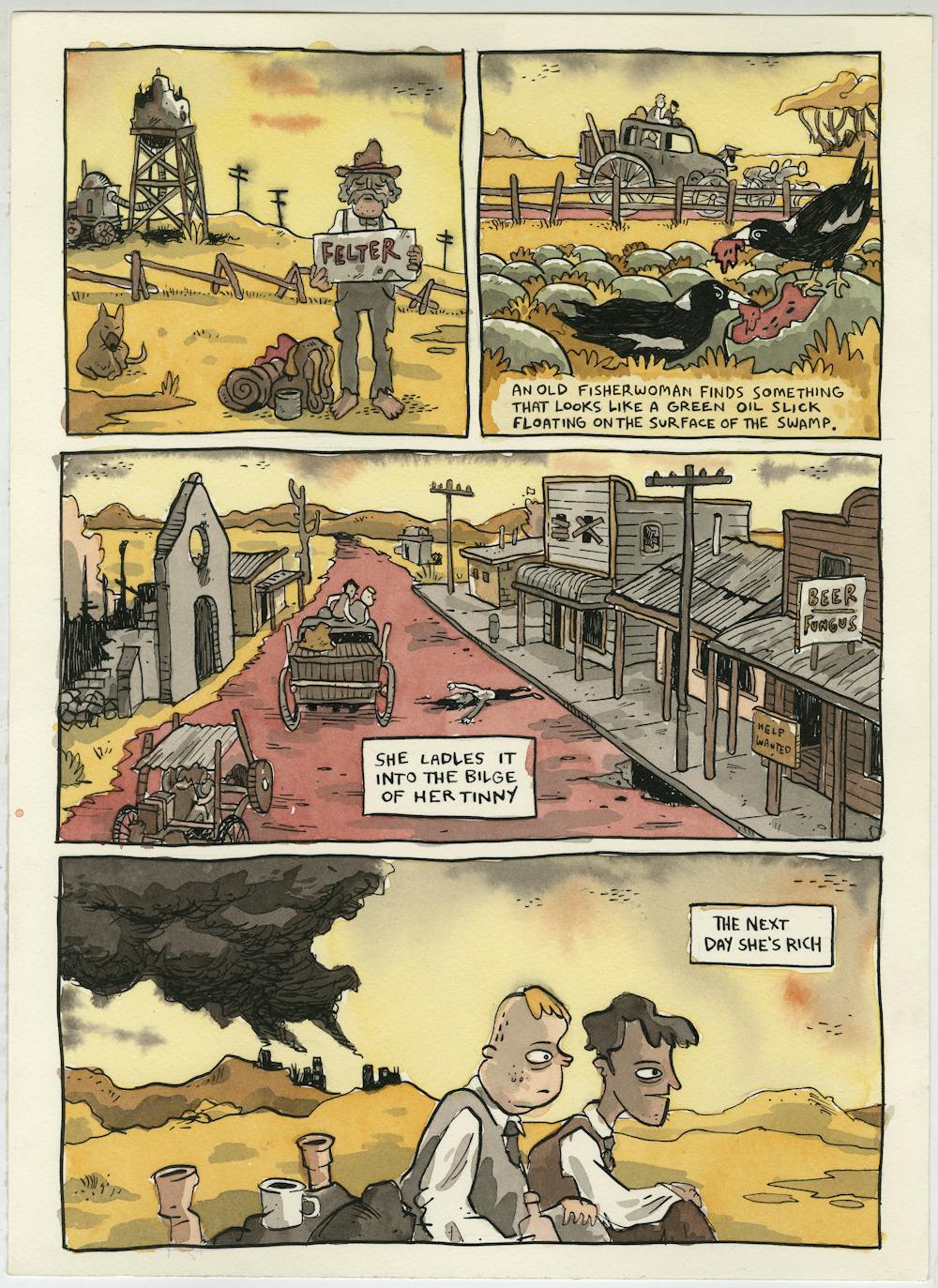
The Grot, by Pat Grant with colours by Fionn McCabe
If everyone you know is trying to get rich at everyone else’s expense, then who can you trust? In The Grot, the world is in the wake of an unnamed environmental catastrophe, technology and society have been reduced to simple mechanics, and everyone is rushing to Felter City to make their fortunes. With The Grot, Pat Grant and Fionn McCabe have created a stained and wondrously dilapidated alternative universe of Australian hustlers and grifters fighting to survive in a new Australian gold rush.
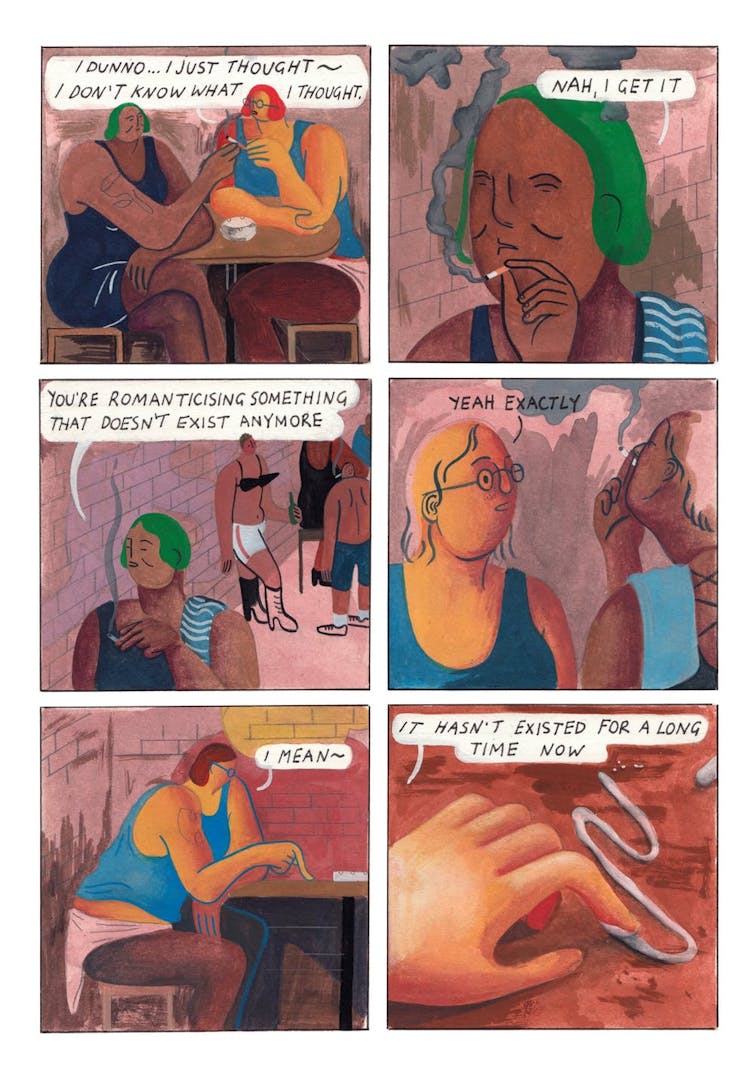
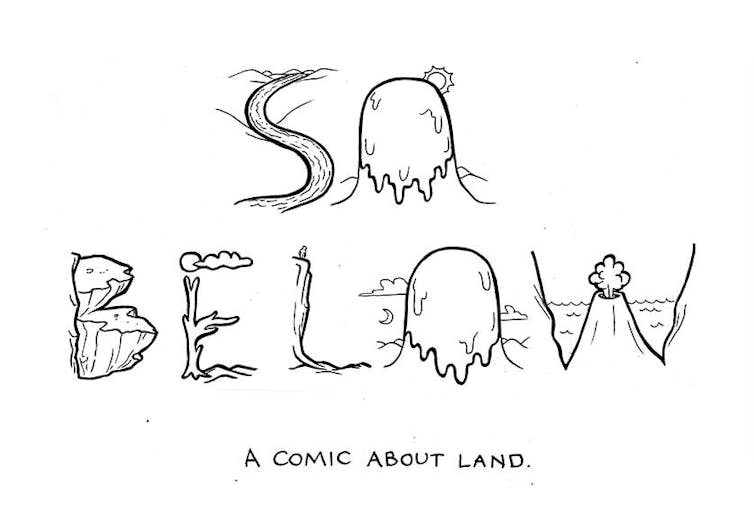
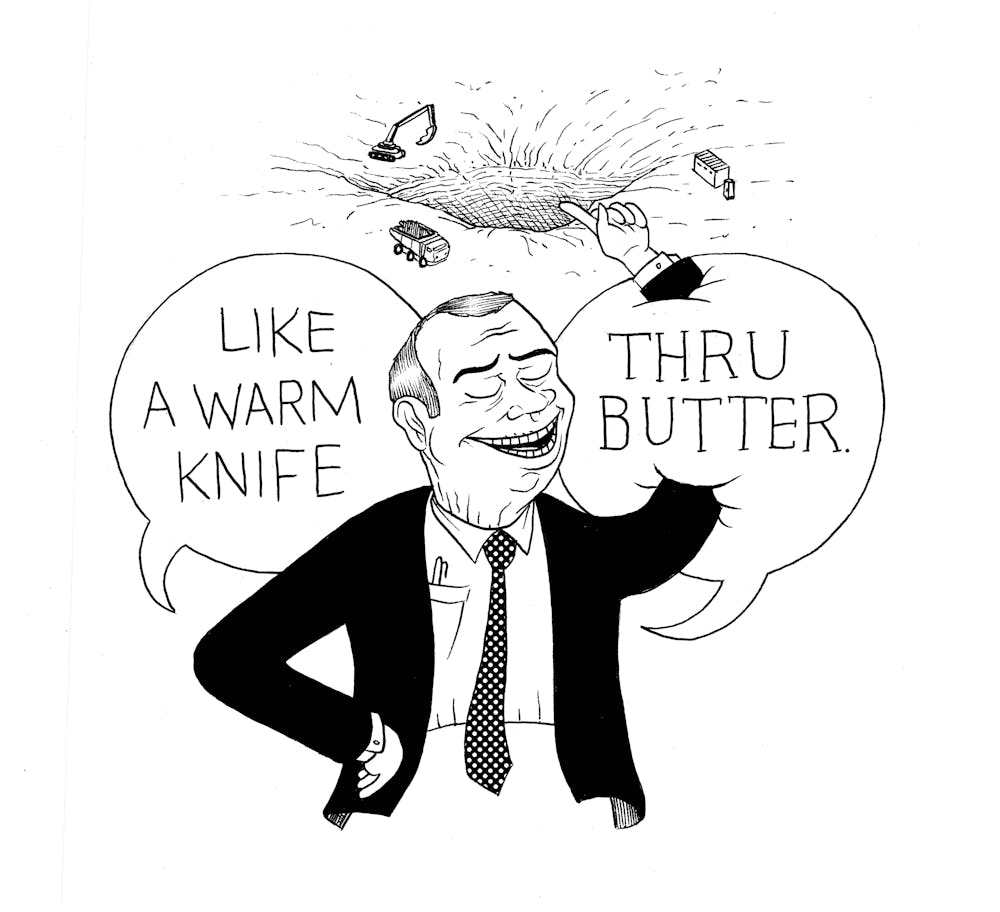
Sam Wallman’s comic essay So Below explores ideas of land ownership and its social and political ramifications. Sam’s poetic artwork guides the reader through complicated questions to reveal the communities impacted by the social construct of land ownership.










 At the BookShelf
.jpg)


You must be logged in to post a comment.