Unknown's avatar

Bibliotherapy: how reading and writing have been healing trauma since World War I


File 20181114 194500 14phsyv.jpg?ixlib=rb 1.1

Viacheslav Nikolaenko via Shutterstock

Sara Haslam, The Open University; Edmund King, The Open University, and Siobhan Campbell, The Open University

Bibliotherapy – the idea that reading can have a beneficial effect on mental health – has undergone a resurgence. There is mounting clinical evidence that reading can, for example, help people overcome loneliness and social exclusion. One scheme in Coventry allows health professionals to prescribe books to their patients from a list drawn up by mental health experts.

Even as public library services across Britain are cut back, the healing potential of books is increasingly recognised.

The idea of the healing book has a long history. Key concepts were forged in the crucible of World War I, as nurses, doctors and volunteer librarians grappled with treating soldiers’ minds as well as bodies. The word “bibliotherapy” itself was coined in 1914, by American author and minister Samuel McChord Crothers. Helen Mary Gaskell (1853-1940), a pioneer of “literary caregiving”, wrote about the beginnings of her war library in 1918:

Surely many of us lay awake the night after the declaration of War, debating … how best we could help in the coming struggle … Into the mind of the writer came, like a flash, the necessity of providing literature for the sick and wounded.

The well-connected Gaskell took her idea to the medical and governmental authorities, gaining official approval. Lady Battersea, a close friend, offered her a Marble Arch mansion to store donated books, and The Times carried multiple successful public appeals. As Gaskell wrote:

What was our astonishment when not only parcels and boxes, but whole libraries poured in. Day after day vans stood unloading at the door.

Gaskell’s library was affiliated to the Red Cross in 1915 and operated internationally – with depots in Egypt, Malta, and Salonika. Her operating principles, axiomatic to bibliotherapy, were to provide a “flow of comfort” based on a “personal touch”. Gaskell explained that “the man who gets the books he needs is the man who really benefits from our library, physically and mentally”.

Her colleagues running Endell Street Military Hospital’s library shared similar views about the importance of books in wartime. On August 12, 1916, the Daily Telegraph reported on the hospital, calling the library a “story in itself”. Run by novelist Beatrice Harraden, a member of the Womens Social and Political Union and also, briefly, the actress and feminist playwright Elizabeth Robins, the library was a fundamental part of the treatment of 26,000 wounded between 1915 and 1918.

“We learned,” Robins wrote in Ancilla’s Share, her 1924 analysis of gender politics, “that the best way, often the only way, to get on with curing men’s bodies was to do something for their minds.”

The books the men wanted first were likely to be by the ex-journalist and popular writer Nat Gould, whose novels about horseracing were bestsellers. Otherwise, fiction by Rudyard Kipling, Marie Corelli, or Robert Louis Stevenson rated highly. In the Cornhill Magazine in November, 1916, Harraden revealed that the librarians’ “pilgrimages” from one bedside to another ensured what she called “good literature” was always within reach, but that the book that would “heal” was the one that was most wanted:

However ill [a patient] was, however suffering and broken, the name of Nat Gould would always bring a smile to his face.

The literary caregivers at Endell Street worked responsively, and without judgement, a crucial legacy.

Library on the frontline

Literary caregiving also took place closer to the front. Throughout the war, the YMCA operated a network of recreation huts and lending libraries for soldiers. After losing his only son, Oscar, at Ypres, the author E. W. Hornung offered his services to the YMCA. Hornung – a relatively obscure figure now, but a literary celebrity then – authored the “Raffles” stories about the gentleman thief of the same name.
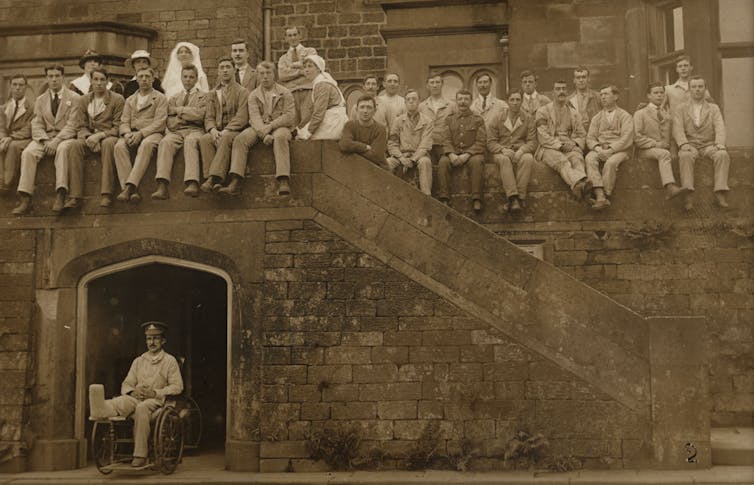
Longshaw Lodge Convalescent Home for Wounded Soldiers, Grindleford, near Sheffield.
Tyne & Wear Archives & Museums

Arriving in France in late 1917, Hornung was initially put to work serving tea to British soldiers. But the YMCA soon found him a more suitable job, placing him in charge of a new lending library for soldiers in Arras. Dispensing tea and books to soldiers helped him process his grief. Hearing soldiers talk about their favourite books played a key role in his recovery – but he also sincerely believed that reading helped soldiers keep their minds healthy while they were in the trenches. Hornung wrote in 1918 that he wanted to feed “the intellectually starved”, while “always remembering that they are fighting-men first and foremost, and prescribing for them both as such and as the men they used to be”.

Writing a new future

Present-day veterans encounter the potential of reading and writing in equally participatory ways as interventions with the charities Combat Stress UK (CSUK) and Veterans’ Outreach Services demonstrate.

In CSUK, we read widely from contemporary work before undertaking writing exercises. These were designed to help provide detachment from the internal repetition of traumatic stories that some with PTSD experience. The director of therapy at CSUK, Janice Lobban, says:

Collaborative work … gave combat stress veterans the valuable opportunity of developing creative writing skills. Typically, the clinical presentation of veterans causes them to avoid unfamiliar situations and the loss of self-confidence can affect the ability to develop creative potential. Workshops within the safety of our Surrey treatment centre enabled veterans to have the confidence to experiment with new ideas.

Another approach, in workshops with Veterans’ Outreach Support in Portsmouth in 2018, explored the role of writing in training veterans to become “peer-mentors” of other veterans wanting to access VOS services, ranging from physical and mental wellness to housing benefits to job-seeking.

The results show that veterans responded positively to opportunities for imaginative writing. Trainee peer-mentors responding to a questionnaire told us that the exercises helped them to write fluently about their own lives. For people who spend so much time filling out forms to access various benefits, the opportunity to write creatively was seen as a liberating experience. As one veteran put it: “We are writing into ourselves”.

For 100 years now, reading and writing have helped veterans build relationships, gain confidence and face the challenges of their post-service lives. Our current research charts the influence of wartime literary caregiving on contemporary practice.The Conversation

Sara Haslam, Senior Lecturer in English, The Open University; Edmund King, Lecturer in English, The Open University, and Siobhan Campbell, Lecturer of Creative Writing, The Open University

This article is republished from The Conversation under a Creative Commons license. Read the original article.
Unknown's avatar

Marie Colvin: Lindsey Hilsum’s revealing biography of courageous war reporter is compelling stuff


File 20181112 83573 7b3m7x.png?ixlib=rb 1.1
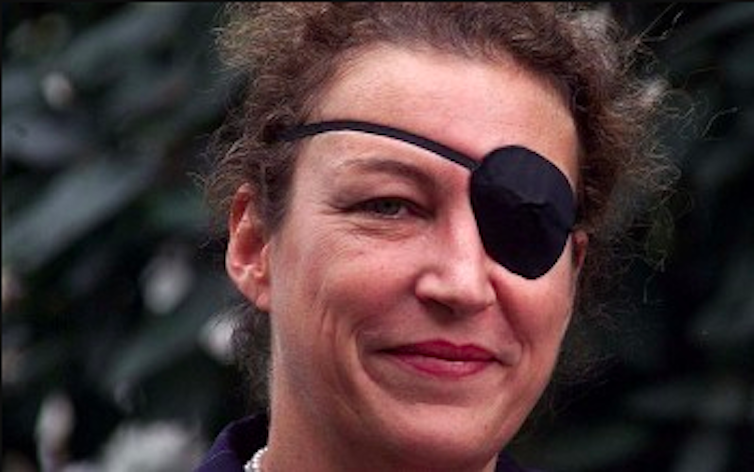
Marie Colvin, who died after being targeted in a shell attack in Homs, Syria, in 2012.
Wikipedia

Idrees Ahmad, University of Stirling

For Marie Colvin, it was Lebanon’s War of the Camps that brought home the power of journalism. In April 1987 Burj al Barajneh, a Palestinian refugee camp, was besieged by Amal, a Shia militia backed by the Syrian regime.

Colvin and her photographer Tom Stoddart paid an Amal commander to briefly hold fire while they ran into the camp across no-man’s land. The assault on the camp was relentless and women were forced to run a gauntlet of sniper fire to get food and water for their families.

One young woman, Haji Achmed Ali, was shot as she tried to re-enter the camp with supplies. As she lay there wounded, no man dared pull her to safety. But then, Colvin reported:

Two [women] raced from cover, plucked Achmed Ali from the dust and hauled her to safety. It is the women who are dying and it was women who tired of men’s inaction.

Despite the best efforts of volunteer medics, Achmed Ali would not survive. At the hospital another woman appealed to Colvin to tell the world the young woman’s story.


Penguin

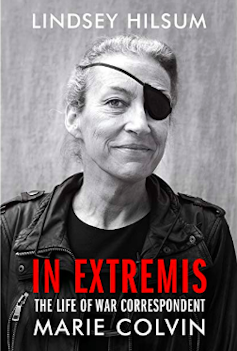
War on Women, the powerful piece Colvin wrote, was splashed across the front page of the Sunday Times on 5 April 1987. “The facts were clear and brutal,” writes Lindsey Hilsum in In Extremis: The Life of War Correspondent Marie Colvin, “as Marie had seen it with her own eyes”.

The effect was almost immediate. Three days later the Syrian regime ordered its proxy militia to stand down and for the first time the International Committee of the Red Cross (ICRC) was able to enter the camp. A herd of journalists soon followed. “In a few days the War of the Camps was over,” writes Hilsum.

Complexity

In Extremis is Hilsum’s riveting story of how Colvin went from a carefree idealistic youth in Oyster Bay, NY, to an audacious war correspondent who reported from sites of merciless violence in Lebanon, Palestine, Chechnya, East Timor, Sri Lanka, the Balkans and Libya. Until her death at the hands of the Syrian regime, Colvin remained indefatigable, never losing her idealism or youthful energy.

By eschewing hagiography for complexity, Hilsum has created a captivating portrait. The Colvin that Hilsum reveals is shaped by the loss of a beloved father, by the spirit of competition, by being a woman in a male-dominated field, and, above all, by a moral commitment to bearing witness and a natural affinity for the underdog.

By casting Colvin’s triumphs against the demons that pursued her – the turbulence of failed romances, the struggles with alcohol, the traumas of war – Hilsum gives a truer sense of the challenges that she faced. By capturing Colvin’s vivacity, generosity, humour and affability, Hilsum also shows how this inveterate raconteur came to be loved and admired in equal measure.

Like Ernest Hemingway, Colvin had invested in her own legend and sometimes strained to live up to it. But there was nothing inauthentic about her capacity for empathy or her commitment to the truth. Though in times of peace she struggled to distinguish herself, in times of crisis she unfailingly outshone her peers. While the Middle East remained her main beat, she also ventured farther afield, from Chechnya to Sri Lanka and East Timor.

But if East Timor was the site of her greatest triumph (her defiant refusal to abandon trapped refugees eventually led to their safe evacuation), Sri Lanka became the site of her greatest trauma, losing an eye to a soldier’s grenade while returning from a visit to the Tamil-controlled north. But while the trauma would haunt her and briefly sapped her confidence, she remained undeterred. She courted greater danger in subsequent years and turned the eye-patch into part of her legend.

Colvin’s last report from Syria, hours before she died.

The making of a legend

By the time Colvin entered Syria in 2012, the reporting landscape had changed. Israel and Putin’s Russia had demonstrated that journalists could be targeted with impunity and killers elsewhere had taken note. Before Colvin entered the besieged Syrian enclave of Baba Amr with photographer Paul Conroy, they had been warned that regime soldiers had orders to summarily execute journalists found in the area.

But Colvin and Conroy agreed that the story was worth the risk; they crawled through three kilometres of a drainage pipe to infiltrate. They found Baba Amr’s only functioning hospital inundated with the dead and the dying; they met nearly 150 widows and orphans in a crowded basement sheltering from the regime’s shelling. Widows’ Basement, Colvin’s haunting last story for the Sunday Times, was also her most poignant.

What happened next fused Colvin’s life and legend and placed her convictions beyond any cynic’s doubt. Five days before her death, Colvin had made it safely out of Baba Amr. But having seen what she had seen, she felt a moral compulsion to return. Conroy had misgivings, but he shared Colvin’s sense of commitment.

The regime meanwhile had tightened the siege and an informer had alerted it to the journalists’ presence. Colvin was conscious of the risks but made a fateful choice: hoping that her reporting would once again stir the international community into restraining a killer, she spoke to the BBC and CNN, emphasising the urgency of the situation. The regime used the signal from her satellite phone to pinpoint her location and killed her with artillery. The regime would lay many more sieges and no western journalist would dare enter another.

At a 2006 Frontline Club (a London hub for foreign correspondants) event about the killing of Russian journalist Anna Politkovskaya, Colvin interrupted the panellists’ abstract digressions and encouraged everyone to ask the more pertinent question:

Who killed Anna? That’s the best thing we can do … That’s what we can do as journalists.

Now Colvin’s family is trying to establish the same about her killers. And this is also the best thing we can do as citizens: support the investigation and ensure that Colvin’s killers don’t enjoy the impunity that Politkovskaya’s did. Until we resolve to protect our truthtellers, truth will remain fragile and justice will be denied.

For all her emotional turmoil, personal flaws and misjudgements, Colvin was an exemplary friend, human being and journalist. She maintained an unwavering commitment to showing “humanity in extremis” – with truth, empathy and responsibility. Hilsum has written a book as compelling as its subject.The Conversation

Idrees Ahmad, Lecturer in Digital Journalism, University of Stirling

This article is republished from The Conversation under a Creative Commons license. Read the original article.

Unknown's avatar

African elephants in literature — lessons in exploitation and compassion


File 20181031 76416 11d6v9z.jpg?ixlib=rb 1.1

Shutterstock

Dan Wylie, Rhodes University

About 15 years ago I was in a Minneapolis conference centre, about to deliver a paper on elephants in Southern African fiction, when I encountered a curious local in an elevator. When I told her that one of my subjects was Wilbur Smith’s thriller, Elephant Song, she enthused,

Oh, I just loved that book; I contribute every year now to the Hohenwald Elephant Sanctuary.

I didn’t tell her that my paper critiqued the novel for being exploitative, and grossly sensationalist. Despite its title, the book is only tangentially interested in elephants – at least in comparison with Dalene Matthee’s famous Circles in a Forest, perhaps South Africa’s most eco-sensitive novel ever.

There’s no telling what people will get out of their reading. Even in our era of super-saturating graphics and television, photography and film, literature still has a considerable effect on public perceptions of environmental issues. Until very recently, of course, reading was the primary mode of information transfer. Many attitudes towards, say, elephants were established through literature, and persist in other media today.

This is the purview of my new book, Death and Compassion: The elephant in Southern African Literature. The book takes the region south of the Zambezi as its stamping-ground. It explores how various genres of literature reflect attitudes towards elephants. It takes literature in a broad sense, probing beyond the standard fiction and poetry into non-fiction forms such as hunting accounts and game-ranger memoirs.

Each chapter asks questions crucial to our understanding of our place in the natural world. It does so conscious that this understanding is the great problem of our times, superseding and enveloping all more localised and political squabbles. What is the relationship between science and compassion? Why do men hunt? How do we educate the young about animals, the environment and us? What sense of “community” might include wild and even dangerous animals?

Conflicting emotions

Elephants raise the conflicting emotions involved in humanity’s ongoing struggle to balance exploitation and well-being, damage and compassion to a particularly intense pitch.

Can we look to indigenous cultures for guidance, as conveyed by rock art, folktales and proverbs? The rock art is relatively opaque, while oral productions are now so refracted through translation into modern literary media that it’s hard to be sure what the originals’ attitudes towards elephants might have been. Reverence, awe, and taboo are evident enough, but it seems that animal compassion is an invention of modernity.

Compassion, at least as it emerges in this literature, seems to develop in response to destruction. It strengthens belatedly but proportionately to the catastrophic decimation of wildlife under invading white firepower, and the consequent sense of loss. I found the chapters on the 18th Century travel accounts (from Pieter Kolbe through François Le Vaillant to John Barrow), and the later nineteenth-century hunting accounts (from Roualeyn George Gordon-Cumming to Frederick Courteney Selous) the hardest to write.

The unremitting slaughter related by these adventurers is stomach-turning to say the least. Not that the hunters were oblivious to an ethical issue: without exception they engage at some level with already-nascent arguments for compassion.

Without exception they find literary methods to evade or suppress any emotions which impede the drive to kill. The genre is distinguished by its evasive manoeuvres designed to avoid thinking about it at all.

The adult fictions, from H. Rider Haggard to Wilbur Smith, are little better, being largely gratuitously gory adventure-tales which come to centre repetitively on a duel-like situation: single hunter versus great old tusker. It seldom ends well for the elephant.

Still, a shift becomes discernible in mid twentieth-century novels. “Conservation” is gaining traction, so the novel, just as it had migrated out of the hunting account, now drifts into some commonalities with the modern game-ranger memoir. The ranger becomes the hero, saving the tusker from poachers.

Of course, shadowing all this is the ivory trade. It had existed for centuries, drove most of the early slaughter and drives the renewed slaughter today. In some estimates, an African elephant is being killed every 15 minutes.

Ironically, because of the colonial-era establishment of game reserves like Kruger, southern Africa’s elephants so flourished that that other side of slaughter – the organised “cull” – for a time became the management tool of choice. The ethics of culling preoccupy both late novels and memoirs by rangers, scientists and managers (such as Caitlin McConnell and Lawrence Anthony).

Perception of elephants

In most recent works, the relatively new perception of elephants not just as mobile repositories of ivory but as emotionally sensitive, uniquely communicative and socially complex – almost human, even a model for humans – achieves unprecedented prominence.

This is especially so in fiction for children, in which compassion and empathy seem more acceptable, as if they are merely childish motivations for action in the world. A disastrous stance.

Poachers and ivory traders are unlikely to be persuaded by literature. Nevertheless, understanding stories – those of the murderous as well as of the compassionate – is vital to generating the critical mass necessary to save natural environments and their multiple denizens, from elephants to herons, from octopi to ants – and ourselves – from the myopia of Mammon.

Compassion alone, unanchored by economic and legislative power, is unlikely to reverse the tide of environmental destruction, but without cross-species compassion, we are surely lost.

Death & Compassion: The elephant in Southern African Literature is published by Wits University PressThe Conversation

Dan Wylie, Professor of English, Rhodes University

This article is republished from The Conversation under a Creative Commons license. Read the original article.

Unknown's avatar

Kristallnacht 80 years on: some reading to help make sense of the most notorious state-sponsored pogrom


File 20181107 74783 1b8ixhf.jpg?ixlib=rb 1.1
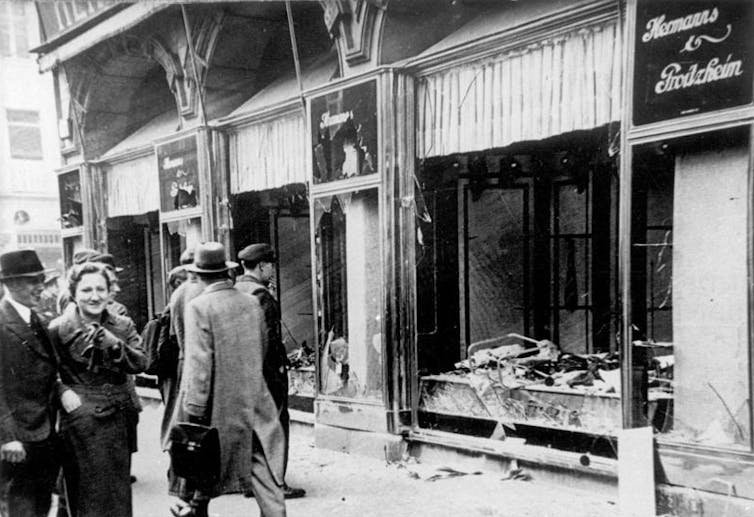
German citizens in Magdeburg the morning after Kristallnacht.
German Federal Archive, CC BY-ND

Martin Goodman, University of Hull

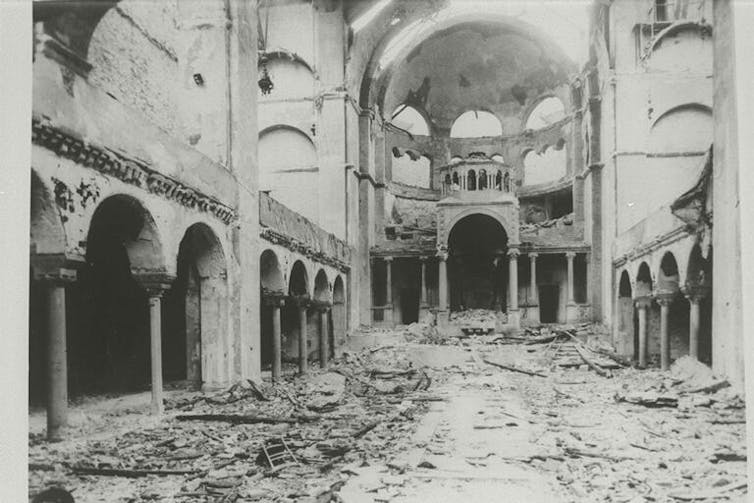
On the evening of November 9 1938 a Nazi pogrom raged across German and Austrian cities. Nazis branded the atrocity with a poetic term: Kristallnacht or “Crystal Night”. In that branding, fiction took hold. In English it translates as “The Night of Broken Glass” but that also tames the horror. Yes, broken glass from Jewish shopfront windows littered the streets, but also hundreds of synagogues and Jewish businesses were burned to the ground while Jews were beaten, imprisoned and killed.

Eight decades later, novelists are still trying to make sense of the pogrom – which was was designed to give the Nazi Party’s antisemitic agenda the legitimacy of public support.

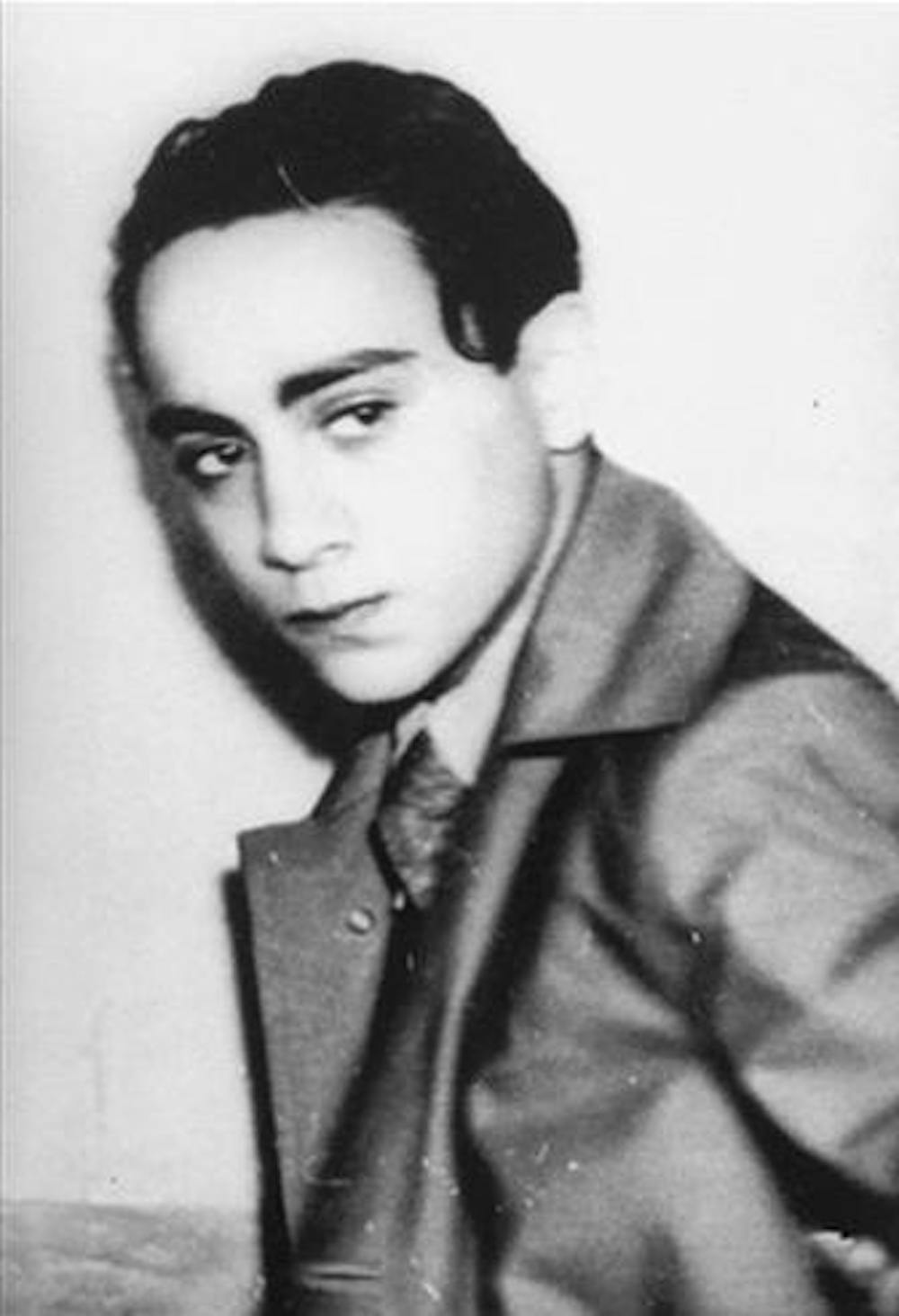
Herschel Grynszpan just after his arrest on November 7 1938.
Bundesarchiv Bild

Kristallnacht marked a new epoch. Earlier pogroms, such as in Russia, were popular riots – now, for the first time, an industrial nation turned the forces of the state against an ethnic group within its own borders. To get away with this, a state needs to control the narrative. In this instance, propaganda minister Joseph Goebbels was the key player. When a young Polish Jew named Herschel Grynszpan entered the German Embassy in Paris and shot a German official, Goebbels saw the possibilities. He used news of the event to trigger Kristallnacht.

Fear and disbelief

The state that attacks its citizens also turns on its writers and free-thinkers – people who can construct a counter-narrative. The future Nobel Prize-winner Elias Canetti and his wife, the writer Veza, were such people. “We shall remember this November”, a Jewish character reflects in Veza Canetti’s novel The Tortoises, “when we are all being punished because a child went wrong and was led astray”.

In the wake of Kristallnacht, the Canettis fled Vienna for Paris and by January 1939 had settled in exile in London, where, in a feverish three months, Veza wrote her novel (unpublished until this century). It provides a window on how intellectuals fought to understand the unimaginable as it unfolded. “The temples are burning!” says one character. “Can you believe that’s possible?” asks another. So why don’t they go and see for themselves? “People haven’t the heart. They feel like criminals. They believe the temple will strike them down if they watch and don’t do anything about it.”

Emil and Karl, the first published novel to feature the pogrom, came out in New York in February 1940. Yankev Glatshteyn, a Polish Jew and immigrant to the US, wrote it in Yiddish to alert American Jewish youngsters to the perils facing their European kindred. It features two friends, one a Jewish boy and the other the son of socialists. Forced to scrub streets clean with their hands after Kristallnacht, both boys learn they must flee their country if they are to stay alive.

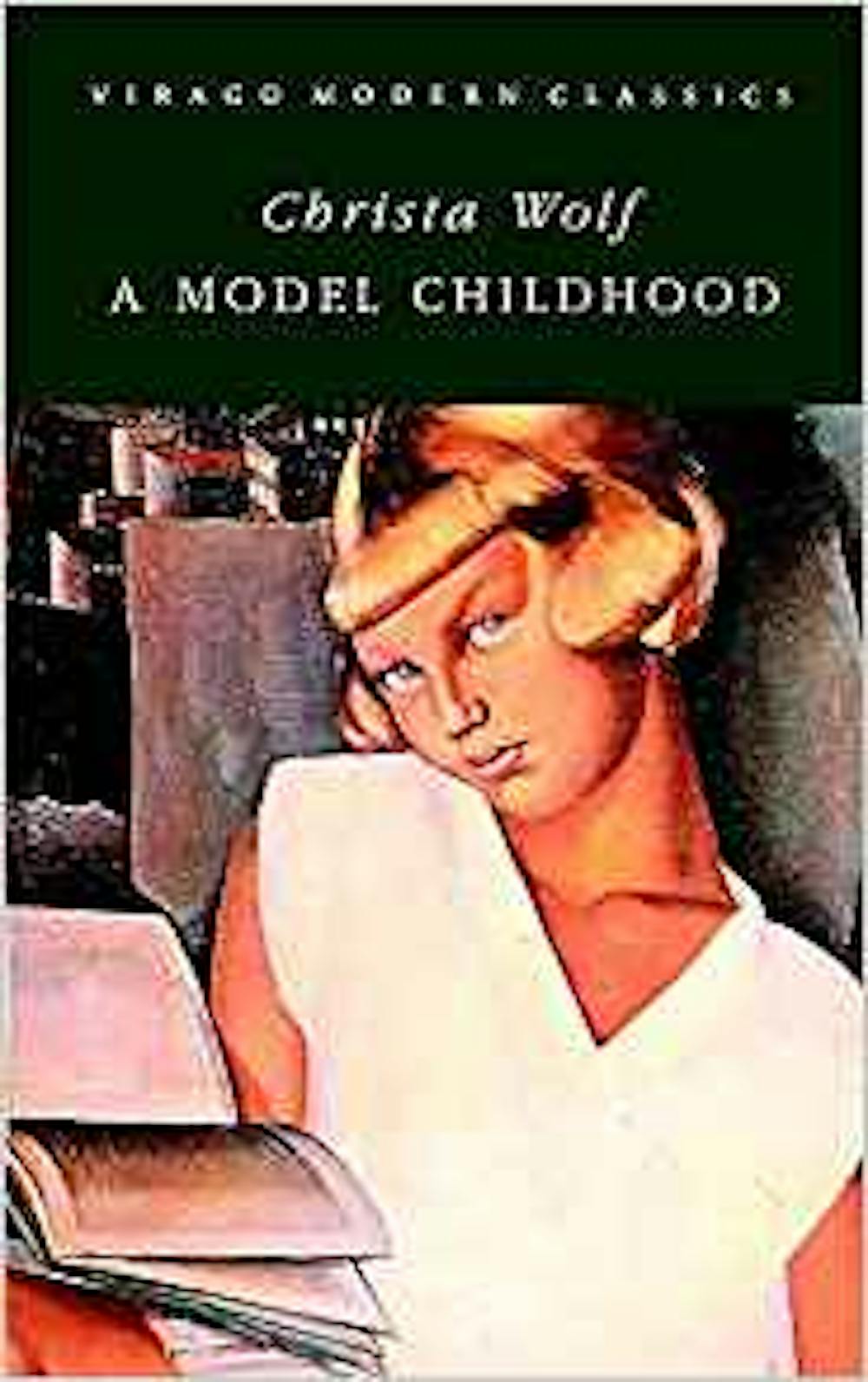
Novelist Christa Wolf was 27 when she witnessed Kristallnacht.
Amazon

Christa Wolf, who forged life as a writer in what became East Germany, fed her memories of the night into Nelly, a character in her 1976 novel A Model Childhood. Nelly knew nothing of Jews, but in that pogrom she witnessed a burning synagogue. “It wouldn’t have taken much for Nelly to have succumbed to an improper emotion: compassion,” Wolf reflected. “But healthy German common sense built a barrier against it: fear.” These asides of bitter irony note the chilling reality of the time: those who showed sympathy for the plight of the Jews risked sharing their plight.

Still burning

So to the 21st century. With events such as Kristallnacht locked away in history, what use are we novelists? Novels unlock history. Governments maintain their hold on narratives that justify abuses of power – but novelists can invert that narrative order to reveal neglected viewpoints.

In 2009, Laurent Binet novelised the life and death of Reinhard Heydrich (a man known as “Hitler’s Brain” – the German acronym which gives the book its title: HHhH. Under orders from Goebbels, Heydrich set the November pogrom in motion. Binet maintains clinical control of the story, anchoring it to archived fact. Heydrich is shown measuring Kristallnacht’s efficiency, including the cost of all the broken glass.

The interior of Fasanenstrasse Synagogue, Berlin, which was burned on Kristallnacht.
Center for Jewish History, New York

In Michele Zackheim’s Last Train to Paris (2013) an American Jewish female journalist is dispatched into Nazi-controlled Berlin. Highlighted here is not the broken glass, but the fires.

[With] no wind, clouds of smoke were perched on top of each burning building. In between the buildings, perversely, as if Mother Nature were laughing at our idiocy, we could see the stars.

Those fires also burn a synagogue in a remote Austrian town in The Lost Letter, the 2017 novel by Jillian Cantor – a novelist who focuses on 20th-century history. Cantor’s novel follows Zackheim’s in looking back over decades, seeking emotional engagement with distant tragedy.

All the toys in the world

Günter Grass was ten on Kristallnacht, the same age as Oskar in his novel The Tin Drum (1952). The Jewish toyshop that supplied Oskar’s drum was burned down that night and the shop owner killed himself – “he took along with him all the toys in the world”. A character akin to Grass appears in John Boyne’s 2018 novel A Ladder to the Sky. In his teens Grass joined the Waffen-SS – a fact he kept secret until old age.

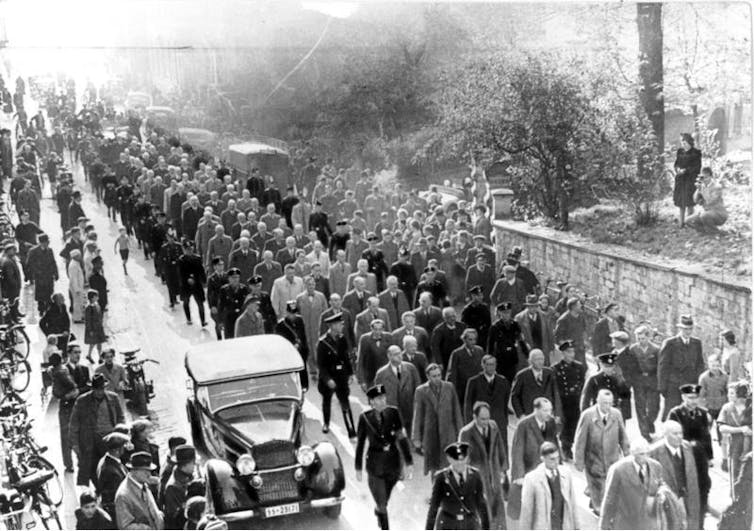
A column of Jews being deported ‘for their own safety’, in November 1938, following the Kristallnacht pogrom.
Federal Archives, CC BY-ND

In Boyne’s book, the central character, a writer, took actions after Kristallnacht that destroyed a Jewish family. Like Grass he contained the story for decades. Of course, the true storyteller must share and not conceal stories. Wolf showed us how fear was a barrier against compassion. Boyne makes us face the consequences of overcoming such fear.

Once people would have said Kristallnacht was unimaginable in a modern context. But they were wrong – do Roma feel safe from the actions of the Hungarian State today? How safe are the Rohingya in Myanmar, Mexicans in the US, the Windrush generation in the UK?

Through fiction we can enter history, encounter suffering and exercise compassion. We close our book, awakened. Fiction sharpens memory for when history repeats itself.The Conversation

Martin Goodman, Professor of Creative Writing, University of Hull

This article is republished from The Conversation under a Creative Commons license. Read the original article.

Unknown's avatar

Explainer: what’s the difference between decodable and predictable books, and when should they be used?


File 20181110 39548 lgzbnu.jpg?ixlib=rb 1.1
It makes sense for children in the early stages of learning to read to be given decodable books.
http://www.shutterstock.com

Simmone Pogorzelski, Edith Cowan University and Robyn Wheldall, Macquarie University

A child’s early experiences with books both at home and later in school have the potential to significantly affect future reading performance. Parents play a key role in building oral language and literacy skills in the years prior to school. But it’s teachers who are responsible for ensuring children become readers once at school.

While there’s much we know about how students learn to read, research on books used to support beginning reading development is sparse. Guidelines provided in the Australian Curriculum
and the National Literacy Progressions complicate matters further. Teachers are required to use two types of texts: decodable and predictable books.


Read more:
Explainer: what is phonics and why is it important?


Each book is underpinned by a different theory of reading, arguably in conflict. This contributes to uncertainty about when and how the books might be used.

The difference between decodable and predictable books

Predictable books and their associated instructional strategies align with a whole-language approach to reading.

In this approach, meaning is prioritised. Children are encouraged to draw on background knowledge, memorise a bank of the most common words found in print, and to use cues to guess or predict words based on pictures and the story. This method is not consistent with a phonics approach.

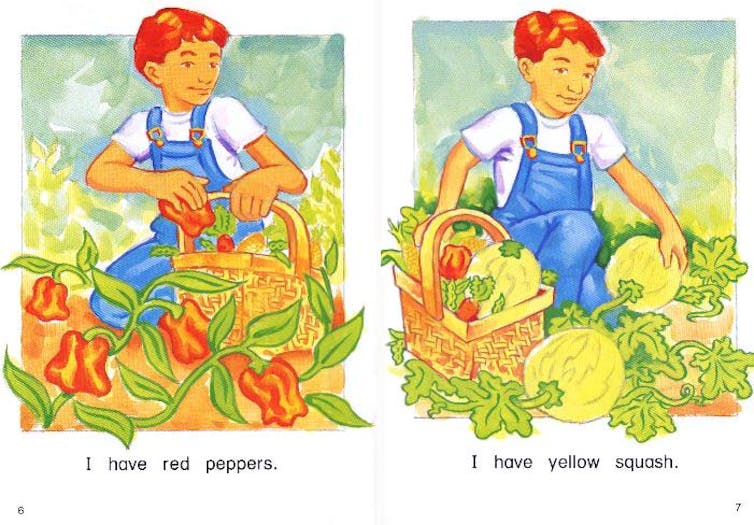
This is a good example of predictable text.
Author provided, Author provided

At the earliest levels, predictable and repetitive sentences scaffold beginning readers’ attempts at unknown words. Word identification is supported by close text to picture matches and familiar themes for children in the early years (such as going to the doctor).

While there is some evidence the repetitive nature of predictable books facilitates the development of fluency, the features contained within disadvantage young readers as they do not align with the letter-sound correspondences taught as part of phonics lessons. This is particularly problematic for children who are at risk of later reading difficulties.

In comparison, decodable books consist of a high percentage of words in which the letters represent their most common sounds. Decodable books align with a synthetic phonics or code-based approach to reading. This approach teaches children to convert a string of letters (our written code) into sounds before blending them to produce a spoken word.

The reading video above is an example of a child reading one of the many widely available decodable books.

When reading decodable books, children draw on their accumulating knowledge of the alphabetic code to sound out any unknown words. Irregularly spelt words (for example was, said, the) are also included, and children receive support to read these words, focusing on the sounds if necessary.

There is mounting evidence for the use of decodable books to support the development of phonics in beginning readers and older kids who haven’t grasped the code easily. Decodable books have been found to promote self-teaching, helping children read with greater accuracy and independence. This leads to greater gains in reading development.

The role of books in early reading development

Children need lots of opportunities to practise reading words in books. Given research demonstrates a synthetic phonics approach provides young readers with the most direct route to skilled reading, there’s a strong logical argument for supporting early reading with decodable books.


Read more:
As easy as ABC: the way to ensure children learn to read


Until the most recent version of the Australian Curriculum, only predictable books were included in the Foundation and Year one English curricula. The addition of decodable books recognises the critical support they provide beginning readers. But this places teachers in a difficult position because the elaborations in the curriculum documents place more emphasis on the strategies designed primarily for use with predictable books.

Using different books in the classroom

While reading is an extraordinarily complex process, a model of reading called the Simple View of Reading is very helpful from an educational perspective. It explains skilled reading as the product of both decoding and language comprehension. This helps us understand what we need to do when teaching children to read, and the types of books they need to support early reading development.

Before they enter school, the majority of children are considered to be in the “pre-alphabetic” stage of reading. In this stage, children have little or no understanding the written code represents the sounds of spoken language. They would not have the skills to use decodable books.

Instead, they recognise words purely by contextual clues and visual features. For example, children know the McDonalds sign because of the big yellow arches (the M) or can read the word “stop” when they see the sign, but not out of that context.

Predictable books would help the pre-alphabetic reader gain insight into the workings of texts, especially with regard to meaning. In particular making the connection between spoken words – which they are familiar with – and written words, which they are not.

After decodable books have been used to get children beyond beginning reading, real books provide broader vocabulary and language structure.
from http://www.shutterstock.com

Beyond this stage, predictable texts become less useful because memorisation and meaning-based strategies aren’t sustainable long term. Once children have advanced to the partial and full alphabetic stages of reading, usually fairly quickly after starting formal reading instruction, they benefit more from decodable books which allow them to apply the alphabetic code.

So where to from here?

There is no evidence children benefit from the continued use of decodable books beyond the beginning stages of reading. In the absence of any empirical studies, we suspect it would be a good idea to move children on once they have sufficient letter-sound knowledge and decoding skills that they can apply independently. At this point, the introduction of real books would benefit students and provide access to more diverse language structures and vocabulary.


Read more:
International study shows many Australian children are still struggling with reading


Given what we know about how reading works, it makes sense for children in the early stages of learning to read to be given decodable books to practise and generalise their developing alphabetic skills. At the same time, they will continue to benefit from hearing the rich vocabulary and language forms in the children’s books being read with (to) them.

It’s less clear what predictable texts contribute to beginning reading in schools when considering how reading skills develop. But there is evidence they might have a useful role to play in pre-school prior to the start of formal reading instruction.The Conversation

Simmone Pogorzelski, PhD Candidate, Sessional Academic, Edith Cowan University and Robyn Wheldall, Honorary Fellow, Macquarie University

This article is republished from The Conversation under a Creative Commons license. Read the original article.
Unknown's avatar

National Book Award Finalist – Adam Winkler


The link below is to an article that takes a look at 2018 National Book Award finalist Adam Winkler.

For more visit:
https://lithub.com/meet-national-book-award-finalist-adam-winkler/

Unknown's avatar

Writing When One Has No Time


The link below is to an article that looks at writing when one has no time – it is the best time.

For more visit:
https://lithub.com/having-no-time-is-the-best-time-to-get-writing-done/

Unknown's avatar

National Book Award Finalist – Colin G. Calloway


The link below is to an article that takes a look at 2018 National Book Award finalist Colin G. Calloway.

For more visit:
https://lithub.com/meet-national-book-award-finalist-colin-g-calloway/

Unknown's avatar

National Book Award Finalist – Sarah Smarsh


The link below is to an article that takes a look at 2018 National Book Award finalist Sarah Smarsh.

For more visit:
https://lithub.com/meet-national-book-award-finalist-sarah-smarsh/

Unknown's avatar

FanFiction


The link below is to an article that considers what FanFiction taught one editor.

For more visit:
https://uncannymagazine.com/article/concrit-in-comments-only-what-writing-fanfiction-taught-me-as-an-editor/