Unknown's avatar

Tribute to biggest collection of artists’ books in the southern hemisphere


File 20190416 147518 9qwwua.jpg?ixlib=rb 1.1
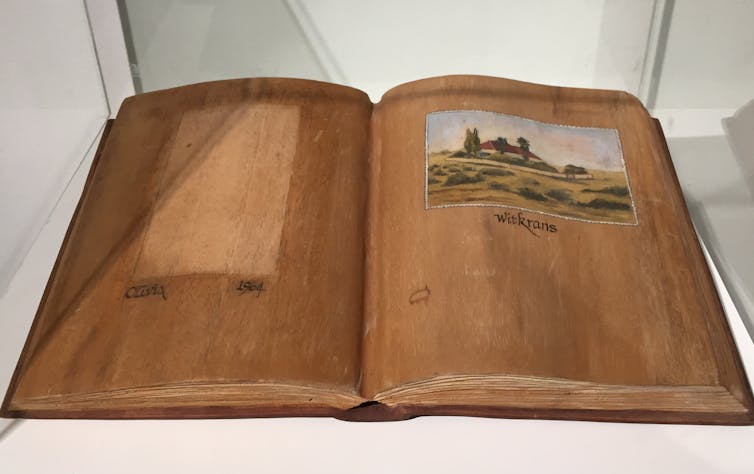
‘Witkrans’ by Ena Carsten (1998), on exhibition at Wits Art Museum, 2019.
Charles Leonard

David Paton, University of Johannesburg

There is a very special section of artworks known as artists’ books. These are artworks in the form of books rather than books about art. South African art collector and philanthropist Jack Ginsberg began collecting in this field in the early 1970s. He recently donated this world-renowned collection – and the biggest in the southern hemisphere – to Wits Art Museum in Johannesburg. Part of the collection, which includes more than 3 000 artworks plus thousands of additional items related to the field of book arts, is on exhibition. The Conversation Africa’s Charles Leonard spoke to David Paton, co-curator of the exhibition.


How would you describe artists’ books?

Artists’ books are artworks in the form of books that explore and unpack their own material being; their bookness. In other words, artists’ books are self-conscious about their function, drawing attention to, as book artist and scholar Johanna Drucker states in The Century of Artists’ Books, the very conventions by which books normally efface their identity.

This reflexive awareness includes a book’s material, shape, structure and navigability. Thus, artists’ books are not sketchbooks, journals or portfolios and certainly not books about, or on, artists. Conventional notions of artists’ books usually include only objects that function as books and exclude sculptural objects, book-like objects, digital books and ephemera.

Give us a brief history of artists’ books.

The rise of artists’ books is a phenomenon of the 1960s and ‘70s in the US. It began with the democratic photographic multiples of Ed Ruscha such as Twentysix Gasoline Stations (1962) and Every Building on the Sunset Strip (1966).

Another maker of artists’ books at this time in Europe was German-Swiss conceptual artist Dieter Roth.

Before this, however, is a rich history of book arts which includes Livres d’Artistes which are fine, limited-edition books incorporating illustrations of famous texts or poems. An example is Henri Matisse’s etchings which accompany Poésies de Stéphane Mallarmé and published in 1932.

Before this are the Futurist and Russian Constructivist books by, for example, El Lissitzky and Ilia Zdanevich (Iliazd). Perhaps the most famous early artists’ book is Sonia Delaunay and Blaise Cendrars’s Prose du Transsibérien et de la Petite Jehanne de France (1913) considered by many to be the first example of simultaneity in art.

In South Africa, perhaps the earliest exemplars are Phil du Plessis’s Hulde Uit 1970, an irreverent addendum to the journal Wurm 12 (1970) and Walter Battiss’s Male Fook Book (begun in 1973).

Who is Jack Ginsberg?

Jack is an accountant by profession but is known for his philanthropic work and support of the arts in South Africa. His collection of artworks by Walter Battiss formed the majority of the 700 pieces on the exhibition “Walter Battiss: I Invented Myself” held at the Wits Art Museum in 2016.

Jack then donated the works to Wits Art Museum’s permanent holdings which now forms the nucleus of a major Battiss Archive. In 2017, a small portion of Jack’s internationally renowned collection of artists’ books was showcased at the “Booknesses: Artists’ Books from the Jack Ginsberg Collection
exhibition at the University of Johannesburg Art Gallery.

Despite this being only a small proportion of his collection, they constituted one of the largest exhibitions of artists’ books held globally. Jack is the director of The Ampersand Foundation a non-profit charitable trust. It supports residencies by South African artists and others working in the arts at the foundation’s apartment in New York.

The Foundation also supports local artists by buying their artworks and donating them to museums and galleries.

Describe the works he donated to Wits Art Museum?

Jack has been collecting artists’ books as well as books on the field, what he calls “the archive on artists’ books” since the 1970s. In 2014 he was one of 10 international collectors of artists’ books (and one of only three from outside of the US) invited to participate in Behind the Personal Library: Collectors Creating the Canon at the Centre for Book Art, New York.

The Wits Art Museum collection is the envy of private collectors, scholars, museums and academic collections globally. It consists of some of the cannon of international exemplars as well as contemporary work from North and South America, Europe, Russia and Asia, Australasia and Africa.

It is also the only collection of South African artists’ books anywhere in the world as Jack has, single-handedly, promoted and supported the book arts in this country. Books that Jack has donated to the Wits Art Museum include most of those mentioned in the “history of artists’ books”. It includes Kara Walker’s remarkable paper engineered Freedom, a Fable as well as books by African artists such as Atta Kwami and Marc Wonga Mancoba.

Jack’s extensive collection also comprises fascinating categories such as popular culture; fine bindings; presses and publishers; ephemera, theses and catalogues along with books with unusual materials (such as glass, cork and metal) and structures (such as pop-up and down and tunnel books).

What’s the significance of the donation?

Jack’s collection of artists’ books and, importantly, his archive, is considered by many to be one of the most comprehensive and accessible collections of materials devoted to the field of the book arts anywhere in the world. Together they constitute some 8 500 items donated to the university.

Making these items publicly available at Wits Art Museum as well as the opportunities for artists, designers and scholars to view and access these bookworks, objects and archival materials is an exciting, unique and timely gift to the South African art world.The Conversation

David Paton, Senior Lecturer in Visual Art, University of Johannesburg

This article is republished from The Conversation under a Creative Commons license. Read the original article.

Unknown's avatar

2019 Stella Prize Shortlist & Winner


The links below are to articles that takes a look at the shortlist for the 2019 Stella Prize, and finally the winner of the prize, ‘The Erratics’ by Vicki Laveau-Harvie.

For more visit:
https://www.theguardian.com/books/2019/apr/07/stella-prize-2019-your-guide-to-the-shortlist
https://www.theguardian.com/books/2019/apr/09/stella-prize-vicki-laveau-harvies-the-erratics-wins-best-book-by-female-australian-writer
https://www.booktopia.com.au/blog/2019/04/09/2019-stella-prize-winner/

Unknown's avatar

Changes at BookBaby


The link below is to an article reporting on recent changes at BookBaby, the self-publishing platform.

For more visit:
https://goodereader.com/blog/indie-author-news/big-changes-at-bookbaby

Unknown's avatar

Books Written By 2020 US Presidential Candidates


The link below is to an article that takes a look at 20 books written by 2020 US Presidential Candidates.

For more visit:
https://www.bustle.com/p/20-books-written-by-2020-presidential-candidates-because-you-can-judge-a-candidate-by-their-book-17219838

Unknown's avatar

Why nonfiction books dominate bestseller lists in South Africa


File 20190423 175510 1w4md7.jpg?ixlib=rb 1.1
Pieter-Louis Myburgh’s “Gangster State” is one of South Africa’s top sellers.
Charles Leonard

Beth le Roux, University of Pretoria

Books in South Africa don’t often make headline news. But a controversial subject, protests and disruptions at a book launch, and threats of book burning are sufficient to get South Africans talking about the place of books in society once again.

This is exactly what has happened with investigative journalist Pieter-Louis Myburgh’s latest book “Gangster State”.

“Gangster State” is an exposé of current African National Congress (ANC) Secretary General Ace Magashule’s alleged murky dealings as premier of the Free State province, and his rise to one of the governing party’s most influential positions. The book has stirred up passionate reactions, both for and against its contents.

This last happened in late 2017 when another investigative reporter Jacques Pauw published a similar book, “The President’s Keepers”. That book dealt with South Africa’s previous head of state, Jacob Zuma, who’s been closely linked to massive corruption. Zuma denies the allegations.


Read more:
Two books that tell the unsettling tale of South Africa’s descent


Clearly, this kind of book touches a certain chord in South African society. A quick glance through the top-selling books in the past few years shows that non-fiction, and particularly political non-fiction dealing with very topical events, is the most popular genre.

The trend can be traced back through a number of years, with nonfiction consistently dominating the Nielsen’s BookScan sales charts – the most comprehensive figures collected on book sales through commercial booksellers. This raises the question: why do political books do so well in South Africa?

Celebrities

This isn’t a uniquely South Africa phenomenon. Nonfiction is popular around the world. Celebrities’ memoirs or biographies, as well as history titles, are more likely to become bestsellers than any other kinds of nonfiction. Indeed, Michelle Obama’s memoir “Becoming” caused a paper shortage in the US towards the end of 2018, as it was reprinted in such large quantities and at short notice to keep up with audience demand. This title has now sold more than 10 million copies worldwide.

Where South Africa differs is in the balance of sales between nonfiction and fiction. In most of the largest publishing markets, fiction is bought at much higher rates than nonfiction. In the US, for instance, average sales for fiction titles are between 4 000 and 8 000 copies, while the nonfiction average is lower, at 2 000 to 6 000 copies.

In South Africa, it’s the reverse. Nonfiction outsells fiction. This is not a new trend, either: political books found a ready audience throughout the apartheid period.

There are a few categories of nonfiction that do particularly well: political nonfiction, South African history (especially political history), religious books – and the ubiquitous cookbooks. The authors that have the edge tend to be journalists rather than academics, probably because their writing is so much more accessible.

Statistically, too, men write more nonfiction than women in South Africa, and so are more likely to produce top-selling titles, as was found by one of my post-graduate students, Kelly Ansara, in her Master’s study of the gender balance in SA publishing.

South African trends

In analysing the publishing lists and sales figures of the local nonfiction publishers – Pan Macmillan, Jonathan Ball, Penguin SA, Tafelberg and Jacana, on the whole – another difference becomes apparent. Books by and about celebrities are not as popular in South Africa as in the US and UK. Their sales are thus less predictable.

For instance, while former Springbok rugby coach Jake White’s “In Black and White” sold more than 60 000 copies in a week in 2008, star rugby player Joost van der Westhuizen’s “Man in the Mirror” was less successful. Comedian Trevor Noah’s memoir, “Born a Crime”, has been extremely successful, but titles by local musicians and actors such as Bonang Matheba and Somizi Mhlongo have sold comparatively few copies.

The raft of competing titles that hit the shelves after the murder conviction of former Paralympian athlete Oscar Pistorius did not take off as well as expected. Excellent titles on topics as diverse as climate change and South African art sell a respectable number, but don’t make the bestseller list.

Many of the country’s nonfiction titles sell several thousand copies very quickly, but few of them have staying power. Current interest is intense in topics like state capture and corruption scandals. But it fades quickly, leading to a short shelf-life for a number of political books. Only a few gain the perennial interest and staying power of a title like “I Write What I Like” by Steve Biko or Nelson Mandela’s “Long Walk to Freedom”.

Making sense

Many commentators suggest that the interest in political and current affairs titles reflects a nation trying to make sense of its tumultuous political environment. The huge political and social shifts of the past 20 to 30 years are still influencing South Africans’ daily lives. With one corruption scandal following another, trust in the authorities is low. But citizens still seek authoritative overviews and answers – in the nonfiction titles that line our shelves.

There is little reason to predict that the trend will change. However, if the threats mount, then we may see authors and publishers shifting to less controversial topics. For now, it’s great to see books in the news again.The Conversation

Beth le Roux, Associate Professor, Publishing, University of Pretoria

This article is republished from The Conversation under a Creative Commons license. Read the original article.
Unknown's avatar

The Unique Relationship Between Authors and Their Translators


The link below is to an article that takes a look at the relationships between book authors and their translators.

For more visit:
https://www.theguardian.com/books/2019/apr/06/its-a-silent-conversation-authors-and-translators-on-their-unique-relationship

Unknown's avatar

How ‘The Hunchback of Notre Dame’ inspired the cathedral’s 19th-century revival


File 20190417 139120 1k4hyut.jpg?ixlib=rb 1.1
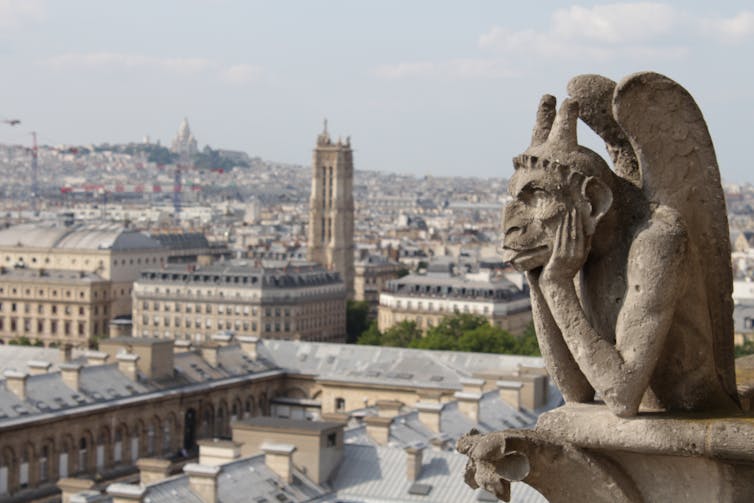
The gargoyles that sit on Notre Dame today were installed as a nod to the cathedral’s past.
Noemiseh91/Wikimedia Commons, CC BY-SA

Julia Walker, Binghamton University, State University of New York

On April 15, people around the world watched in horror as a voracious fire consumed the medieval wooden roof of Paris’s Notre Dame cathedral and felled its spire.

The following day brought some measure of relief: Despite the building’s wrenching losses, its masonry structure was largely intact, and many of its precious relics had been swiftly and lovingly removed by a human chain of church officials and firefighters. The building had steadfastly endured the destructive flames.

Since then, Notre Dame has been hailed as a stable and enduring symbol of French identity.

But it would be more accurate to say that the cathedral’s importance comes from the very instability of its meaning.

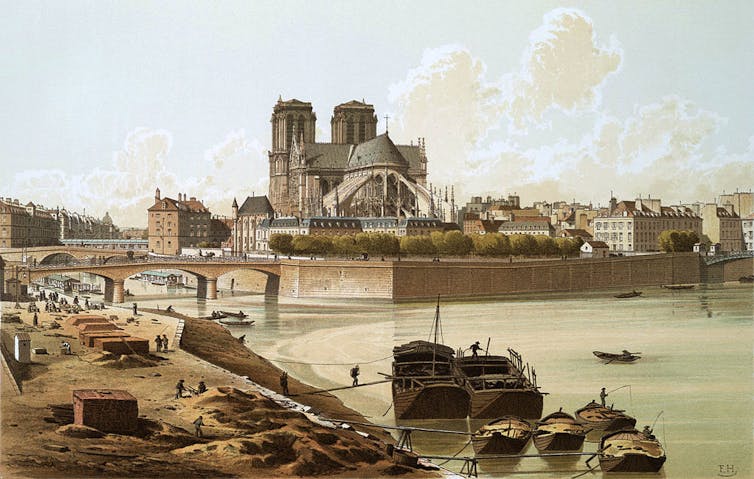
Originally completed in 1345, by the early 19th century Notre Dame stood in a state of dire disrepair. It took an idiosyncratic young architect, moved by Victor Hugo’s “The Hunchback of Notre Dame,” to fashion a new meaning for the building – one that, ironically, looked nostalgically to the past for inspiration.

‘The book will destroy the edifice’

In 1831, when Victor Hugo published his famous novel “Notre Dame de Paris” – known in English as “The Hunchback of Notre Dame” – the country was experiencing rapid social, political and industrial change.

The cathedral, meanwhile, had fallen by the wayside. Years of neglect, blinkered renovation efforts and the anti-Catholic zeal of the French Revolution had left the once-regal building in ruins.

During the French Revolution, many of the treasures of the cathedral were either destroyed or plundered. Only the great bells avoided being melted down, and the church interior was used as a warehouse for the storage of food.
Brown University Library

Set in the 15th century, the novel alluringly evoked a different period in French history. In the novel, Hugo lamented that the printing press had supplanted architecture as the primary communicator of civilization’s cherished values. In one of the book’s most famous moments, the archdeacon Frollo points sadly to a printed book on his table.

“Alas! This will kill that,” he laments, directing his finger to the cathedral looming magisterially outside his window. He continues, “The book will destroy the edifice.”

Like other Romanticist writers and artists, Hugo imagined the Middle Ages as a simpler time, an era when society was governed by pure faith. He believed that back then, the cathedral was able to inspire the masses and guide them toward a life of devotion and morality. Hugo hoped that his novel might spur the building’s rebirth, allowing it to renew France’s ethical core during the Industrial Revolution.

One architect, attracted to the picturesque history on view in Hugo’s novel, would ultimately heed his call.

An architect reaches longingly for the past

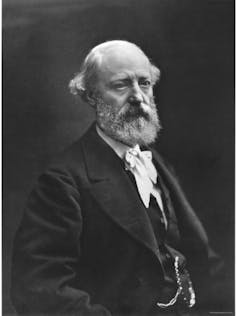
Eugène Emmanuel Viollet-le-Duc was a teenager when Hugo’s novel was published. The book affirmed Viollet-le-Duc’s suspicion that his own age’s riot of styles and tastes reflected the unwieldy chaos of modern life.

Like Hugo, he sought to capture France’s “authentic” past and, like Hugo, was drawn to the Middle Ages.

Eugène Viollet-le-Duc.
Wikimedia Commons

For this reason, he refused to enroll in the École des Beaux-Arts, the main training ground for France’s architects, because of the school’s dogmatic focus on classical architecture. He opted instead to learn on the job, working for architects around Paris while studying the city’s medieval architecture in his spare time.

In 1842, the government announced a competition for Notre Dame’s restoration and the 28-year-old Viollet-le-Duc threw his hat into the ring. By then, he had already established his reputation as an expert in the restoration of medieval buildings.

But for him, restoration was about more than touching up an existing form. It meant breathing life into a building by transforming it.

As he later wrote, “To restore a building is not to preserve it, to repair or rebuild it; it is to reinstate it in a condition of completeness which could never have existed at any given time.” Viollet-le-Duc knew that the very act of restoring old buildings was, itself, a modern notion.

A symbol of stability in uncertain times?

Thus, Viollet-le-Duc’s winning entry would not simply aim to preserve the cathedral as it then stood. Instead, he sought to revive the building’s mythical past.

During the restoration, Viollet-le-Duc redesigned and rebuilt the medieval spire, which had been removed in the 1780s due to its vulnerability in high winds (an absence that had appalled Hugo). He also sprinkled the building with its now-famous gargoyles in accord with Hugo’s atmospheric depiction of a building adorned with “grinning monsters.”

Viollet-le-Duc’s renovated cathedral – the version that we know today – is a product both of the French Middle Ages and of its architectural revival in the 19th century. Like Hugo, Viollet-le-Duc romantically conceived medieval architecture as a stable bulwark against his own uncertain times. He wanted to intensify what he saw as the building’s mystical power – its ability to speak to France’s past at a time when the forces of modernity were threatening to sweep its traces away.

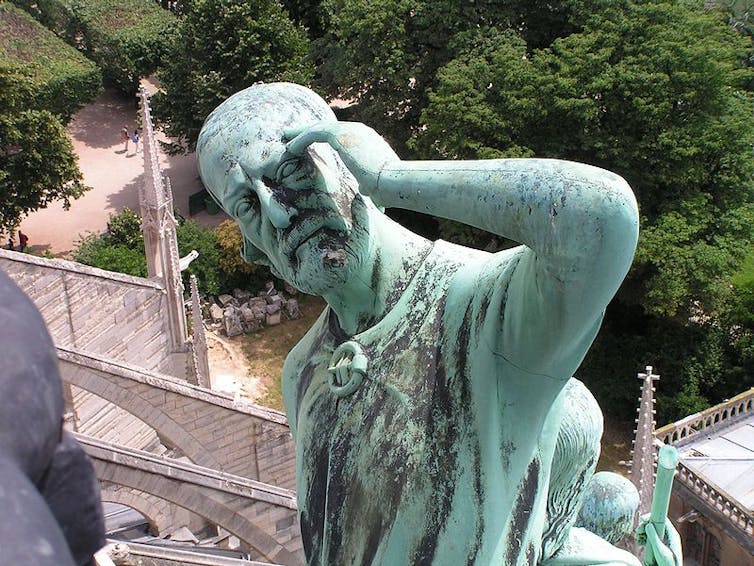
Viollet-le-Duc also ensured his own role in the rehabilitation would forever be preserved: His likeness appears in the face of a copper statue of St. Thomas at the base of the spire.

By good fortune, this statue was removed for the renovation just last week and was spared from the conflagration.

Viollet-le-Duc’s face appears on a statue of St. Thomas.
Harmonia Amanda/Wikimedia Commons, CC BY-SA

Since the fire, many writers have correctly pointed out that the catastrophe is also only one episode in a much longer story of architectural survival.

Notre Dame will certainly live on in some new form; France has been offered astronomical donations for the purpose. In fact, a competition to redesign the spire has already been announced.

Much like Viollet-le-Duc’s restoration, this newest version of Notre Dame will look to the past – selectively – to ensure the building’s future.The Conversation

Julia Walker, Assistant Professor of Art History, Binghamton University, State University of New York

This article is republished from The Conversation under a Creative Commons license. Read the original article.
Unknown's avatar

Scribd Producing Original Content


The link below is to an article that reports on Scribd now producing original content.

For more visit:
https://goodereader.com/blog/e-book-news/scribd-is-now-producing-original-content

Unknown's avatar

2019 Man Booker International Prize Shortlist


The links below are to articles reporting on the 2019 Man Booker International Prize shortlist.

For more visit:
https://publishingperspectives.com/2019/04/five-women-authors-six-women-translators-on-man-booker-2019-internationals-shortlist/
https://www.booktopia.com.au/blog/2019/04/10/man-booker-international-shortlist/
https://bookriot.com/2019/04/10/2019-man-booker-international-prize-shortlist/

Unknown's avatar

2019 Jackson Poetry Prize


The link below is to an article reporting on the winner of the 2019 Jackson Poetry Prize, Joy Harjo.

For more visit:
https://www.pw.org/about-us/joy_harjo_wins_jackson_poetry_prize