
The link below is to an article that takes a look at the shortlist for the 2019 Costa Book Awards.
For more visit:
https://www.booksandpublishing.com.au/articles/2019/11/28/143077/costa-book-awards-2019-shortlists-announced/

The link below is to an article that takes a look at the shortlist for the 2019 Costa Book Awards.
For more visit:
https://www.booksandpublishing.com.au/articles/2019/11/28/143077/costa-book-awards-2019-shortlists-announced/
The link below is to an article that takes a look at books on trees.
For more visit:
https://www.pbs.org/newshour/arts/loved-the-overstory-richard-powers-recommends-26-other-books-on-trees
The link below is to an article that takes a look at finding a book at the library.
For more visit:
https://bookriot.com/2019/11/29/how-to-find-a-book-in-the-library/
The link below is to an article that takes a look at the 2019 Staunch Book Prize Winner (for the best thriller novel in which no woman is beaten, stalked, sexually exploited, raped or murdered), Samantha Harvey for ‘The Western Wind.’
For more visit:
https://www.booksandpublishing.com.au/articles/2019/11/26/142923/medieval-mystery-the-western-wind-wins-2019-staunch-book-prize/
The link below is to an article that takes a look at expansion plans for Scribd.
For more visit:
https://goodereader.com/blog/e-book-news/scribd-intends-on-expanding-into-other-markets
The link below is to an article that considers the best books of 2019 for adults, according to the New York Public Library.
For more visit:
https://www.nypl.org/bestbooksadults2019
The link below is to an article that takes a look at ebooks and libraries.
For more visit:
https://www.washingtonpost.com/technology/2019/11/26/e-books-libraries-are-huge-hit-leading-long-waits-reader-hacks-worried-publishers/

Leah Henrickson, Loughborough University
Christmas is coming, and gifting is at the forefront of many minds. The latest tech changes from year to year, as do the latest fashions. But the gift that never seems to go out of style? A book.
The publishing world is at its busiest in the months leading up to Christmas. In Iceland, there is even a name for this: jólabókaflóð (pronounced yo-la-bok-a-flot) or “Christmas book flood”. The term has also come to refer to the Icelandic custom of exchanging books on Christmas Eve. As a result, a substantial portion of annual hardcover sales are during this period and nearly 850 new titles were released in 2019’s Icelandic book flood alone.
The UK’s annual Christmas book flood begins on Super Thursday: when publishers release a barrage of new titles just in time for the Christmas shopping rush. Some of the heavy hitters among the 426 hardcovers released on October 3 included Philip Pullman’s The Secret Commonwealth, Jojo Moye’s The Giver of Stars, and MP Jess Phillips’ Truth to Power.
People were giving books as gifts even before words were ever put to paper. In one of his books of epigrams, the ancient Roman poet Martial recommended the works of famous Roman writers like “Ovid’s Metamorphoses on parchment” (animal skin) and “Livy (the Roman historian) in a single volume” (appearing in a scroll, on papyrus, or on parchment) as presents for the December festival of Saturnalia. Martial’s recommendations also included book-related items like “a book-case” and “a wooden book-covering”.
As Christmas grew more commercialised, the holiday became increasingly important for the book trade. In his Battle for Christmas, American history professor, Stephen Nissenbaum, argued that books were “on the cutting edge of a commercial Christmas, making up more than half of the earliest items advertised as Christmas gifts”, citing examples from the 18th century. By the Victorian era, periodicals were regularly featuring Christmas book reviews to promote book sales during the holidays.
One such article from a 1914 issue of the New York Times begins with the declaration that “the war is not the greatest thing in the world. It cannot destroy Christmas … The publishers are ready to help”. This article touts various “gift books” suitable for Christmas exchanges: “Sumptuous books, books in the making of which illustrator and printer and binder have exercise their art at its best.”
These 20th-century gift books follow from a tradition of sumptuous books given as holiday gifts. Medieval manuscripts, for example, were gifted for a range of religious, romantic, diplomatic, and festive reasons. A 2015 exhibition about medieval gift gifting at the Getty Museum in Los Angeles, now archived online, further supports the understanding of manuscripts as gifts with personal and social value.
Writing about medieval manuscripts, Geert Claassens noted that a book – whether a medieval manuscript or a modern mass market paperback – always functions as both an object and a text. This observation is especially relevant in a world with e-books, which largely remove the “object” aspect of the book. However, a recent series of focus groups conducted by Laura Dietz at Anglia Ruskin University as part of a wider study about social perceptions of e-books has indicated that readers still prefer gifting and receiving print books over e-books. Maybe this is because it’s remarkably difficult to wrap an e-book and place it underneath the Christmas tree.
In a recent article for the international READ-IT project (Reading Europe Advanced Data Investigation Tool), media professor, Brigitte Ouvry-Vial, describes reading as “a social imaginary” that contributes to both personal and collective development. That is, reading has perceived benefits for both individuals and communities. However, she wrote:
The very motivation for non-prescribed reading has clearly shifted across time from an essentially knowledge-driven cognitive activity, to a broad information-driven cultural experience as well as a leisure activity.
This shift has also led to an association being made between being well-read or reading a lot with well-being, as books are more regularly valued according to the level of psychological uplift and self-healing they provide.
Books represent more than just knowledge; they’ve also taken on the role of highly personalised home decor. This is because books can say things about their owners. Likewise, the book you choose to give someone for Christmas can speak volumes about your relationship with that person. It’s not enough to just give someone a book and call it a day – it has to be the perfect choice.
Books have a long history of being given as Christmas gifts, and there seems little chance of the trend going away. So why not take Martial’s recommendations and bestow upon your loved one “Ovid’s Metamorphoses on parchment”? Alternatively, and more realistically, consider a nice hardcover edition found through consulting members of the Antiquarian Booksellers’ Association or the Provincial Booksellers Fairs Association.
For more modern options, YouTube is teeming with video reviews of the latest releases, as well as of “bookish” gifts to give in lieu of or alongside a book. There are also a variety of monthly book subscription boxes. By giving a book or book-related item in 2019, you’ll be contributing to a long and lovely tradition.
Leah Henrickson, Doctoral Graduate, Loughborough University
This article is republished from The Conversation under a Creative Commons license. Read the original article.
Sally O’Reilly, The Open University
Our fascination with ghostly tales around Christmas time goes back thousands of years and is rooted in ancient celebrations of the winter solstice. In the depths of winter, pagan traditions included a belief in a ghostly procession across the sky, known as the Wild Hunt. Recounting tales of heroism and monstrous and supernatural beings became a midwinter tradition. Dark tales were deployed to entertain on dark nights.
Ghosts have been associated with winter cold since those ancient times. According to art historian Susan Owens, author of The Ghost, A Cultural History, the ode of Beowulf is one of the oldest surviving ghost stories, probably composed in the eighth century. This is the tale of a Scandinavian prince who fights the monster Grendel. Evil and terrifying, Grendel has many ghostly qualities, and is described as a “grimma gaest” or spirit, and a death shadow or shifting fog, gliding across the land.
In 1611, Shakespeare wrote The Winter’s Tale, which includes the line: “A sad tale’s best for winter, I have one of sprites and goblins.” Two centuries later, the teenage Mary Shelley set her influential horror story Frankenstein in a snowy wasteland, although she wrote it during a wet summer in Switzerland.
The Victorians invented many familiar British Christmas traditions, including Christmas trees, cards, crackers and roast turkey. They also customised the winter ghost story, relating it specifically to the festive season – the idea of something dreadful lurking beyond the light and laughter inspired some chilling tales.
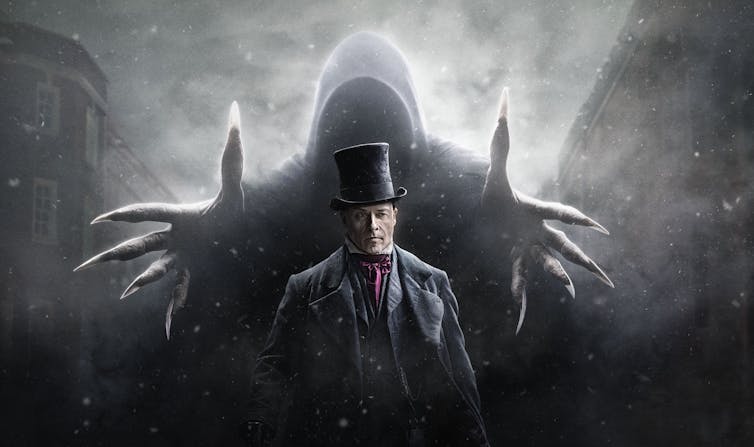
Both Elizabeth Gaskell and Wilkie Collins published stories in this genre, but the most notable and enduring story of the period was Charles Dickens’ A Christmas Carol (1843). In this vivid and atmospheric fable, gloomy miser Ebenezer Scrooge is confronted first by the spirit of his dead business partner, Jacob Marley, and thereafter by a succession of Christmas ghosts.
Their revelations about his own past and future and the lives of those close to him lead to a festive redemption which has spawned a host of imitations and adaptations.
Dickens wrote the story to entertain, drawing on the tradition of the ghostly midwinter tale, but his aim was also to highlight the plight of the poor at Christmas. His genius for manipulating sentiment was never used to better effect, but perhaps the most enjoyable elements of the story are the atmospheric descriptions of the hauntings themselves – the door knocker which transforms into Marley’s face and the sinister, hooded figure of the Ghost of Christmas Yet to Come.
The tradition was further developed in the stories of M R James, a medieval scholar who published Ghost Stories of an Antiquary in 1904. His chilling Gothic yarns focused on scholars or clergymen who discovered ancient texts or objects with terrifying supernatural consequences.
Typically, James used the framing device of a group of friends telling stories around a roaring fire. In the introduction to Ghost Stories he said: “I wrote these stories at long intervals, and most of them were read to patient friends, usually at the seasons of Christmas.”
Seminal stories in his oeuvre include Number 13, Oh Whistle & I’ll Come to You and A School Story. Like Dickens, James has been widely imitated and adapted, with Stephen King citing him as an influence. King’s The Shining certainly fits into to the genre of ice-bound chiller.
Christmas ghost stories morph into new forms as time passes, like ectoplasm. Spin offs of A Christmas Carol include Frank Capra’s 1946 classic It’s a Wonderful Life, in which the story is transposed to small town America, and the 2019 film Last Christmas, the tale of a dysfunctional young woman permanently dressed as a Christmas elf, ripe for Yuletide redemption. This contemporary version conveys messages about integration and the value of diversity.
A new, high-octane version of A Christmas Carol will be shown on TV this Christmas, written by Peaky Blinders creator Stephen Knight. And M R James’ Martin’s Close, the story of a 17th century murder and its supernatural outcome, has also been adapted for the small screen.
So it seems the atavistic desire to lose oneself in tales of the supernatural is still with us. Christmas ghost stories enhance our enjoyment of the mince pies and mulled wine, and the frisson of a paranormal tale offsets the “feel-good” festive spirit that might otherwise be cloying.
Some things never change – we still have a fear of the unknown, a yearning for what is lost and a desire to be secure. In an uncertain, fast-paced world, mediated through smartphones and social media, the seasonal ghost story is here to stay. The jolt of fear and dread such stories convey make the Christmas lights glitter even more brightly.
Sally O’Reilly, Lecturer in Creative Writing, The Open University
This article is republished from The Conversation under a Creative Commons license. Read the original article.

Brigid Maher, La Trobe University
In our series, Guide to the classics, experts explain key works of literature.
Many young children have flirted with the notion of escaping, once and for all, those stifling rules and obligations invoked at dinnertime: eat your greens, finish everything on your plate…
Few (thankfully) will have the kind of commitment required to take this rebellion to the extremes of Cosimo Piovasco di Rondò, protagonist of Italo Calvino’s enchanting novel, The Baron in the Trees.
The meal in question is indeed stomach-turning: snail soup followed by a main course of snails.
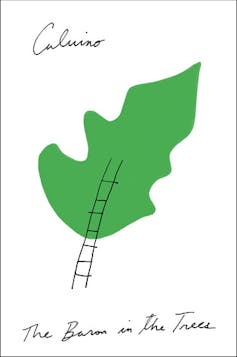
But when, one momentous day in 1767, the 12-year-old Cosimo pushes away his plate and refuses to touch his food, no admonitions from his appalled parents will change the boy’s mind. He runs from the family home and climbs a large holm oak on their estate, never again to come down to earth.
Calvino wrote the novel in 1957, and it remains one of his most loved. The story of Cosimo’s astonishing existence among the trees, where he lives through to adulthood and old age, during times of great turmoil, combines the bizarre imaginative flair of a folktale with a profound meditation on questions of isolation and human interaction.
Calvino was born in Cuba in 1923 to Italian parents who were working there as scientists, but the family moved back to Italy just two years later. His childhood was spent in the small coastal city of Sanremo (Liguria) on the Italian Riviera, very close to the French border.
The landscape of Liguria – in an imagined and idealised form that has since been lost to development – forms the luxuriant setting for Cosimo’s arboreal adventures.
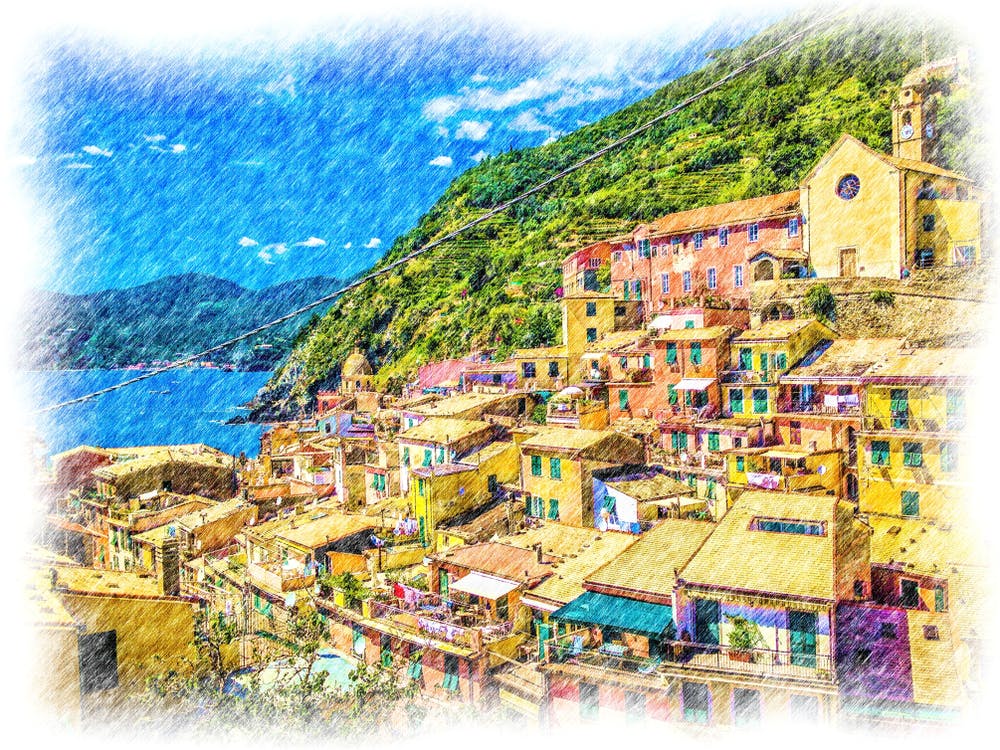
The baron’s (fictional) village of Ombrosa is rich in vegetation, and trees of every kind – oaks and mulberry trees, magnolias and Indian chestnuts, pines and olives – become Cosimo’s kingdom.
Life in the treetops is not without its challenges. Part of the charm of the novel lies in the way Calvino is able to use allegory to explore the human condition, without sidestepping a depiction of how Cosimo manages the practicalities of his peculiar existence.
Many of the funniest moments lie in Cosimo’s ingenuity and determination as he makes himself a permanent, and surprisingly comfortable, home in the trees. Hunting polecats and badgers affords him the fur jacket, hat and leather shoes required for spending cold winters out in the elements, while also lending him an eccentric appearance that little befits a baron.
Yet his life is nothing if not civilised. He comes up with strategies for washing, cooking and toileting; he can access drinking water, and even trains a goat to climb a short way up an olive tree so he can reach down to milk it.
But Cosimo’s day-to-day existence is not focused solely on surviving in his new habitat. He engages in many intellectual pursuits, becoming an avid reader of literature and philosophy. When he befriends the brigand Gian dei Brughi, on the run from the law, the two share this passion for books and soon, procuring reading material for the fugitive is almost a full-time job for Cosimo.
This love of the written word ultimately proves to be Gian dei Brughi’s undoing. He begins to neglect his brigandage and loses all fascination in the eyes of the local people.
When the once-elusive dei Brughi is finally captured, it is because he is too desperate to get back to his novel (Richardson’s Clarissa) to successfully carry out a burglary, and his erstwhile accomplices hand him over to the authorities.

Cosimo, by contrast, has a greater capacity for balance. His extreme rebellion against the strictures of his noble upbringing is never an outright rejection of society or community. He is an eccentric and a free spirit, a true nonconformist, but not an individualist.
Indeed, from his position high in the leaves, Cosimo is often the one to bring the community together. He is a born leader, and is able to organise the villagers into firefighting squads during a time of drought.
Because, for all its fantastical setting and implausible adventures, The Baron in the Trees is still a novel with a political edge, or what in Italian literature is called impegno (political commitment).
The baron’s life embodies the struggle of the intellectual to contribute meaningfully to society, albeit from a position of isolation and distance. This was a struggle Calvino himself had to contend with. He entered adulthood towards the end of World War II, having spent well over a year in the Resistance.
His early work was strongly marked by political themes, but by the 1950s he had begun to see the nexus between politics and literature somewhat differently.
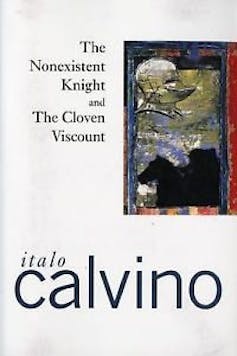
Baron in the Trees, as well as the novels immediately preceding and following it (The Cloven Viscount and The Non-Existent Knight), with which it is now often published as a trilogy of sorts under the title, Our Ancestors) mark the beginning of a move from realism towards a more allegorical and, later, experimental kind of writing.
All three books are deeply philosophical, yet at the same time easy to read and entertaining.
Lightness was a key literary value for Calvino, specifically “the search for lightness as a reaction to the weight of living”, as he put it in Six Memos for the New Millennium.
Cosimo is the very embodiment of this search. Even the baron’s final moments are both poetic and principled as, despite old age and infirmity, he manages to find a way never to return to earth, not even in death.
The Baron in the Trees appeared in English translation (by Archibald Colquhoun) just two years after its original publication in Italy. Fifty years on, a new translation, by Ann Goldstein, has appeared, testament to the novel’s enduring popularity. For despite its historical-fantastical setting, there is a message for our times in this novel, which asks us to question our anthropocentric view of our environment.
The longer Cosimo spends in the trees, the greater his identification with the natural world. His eyes are said to have become like a cat’s or an owl’s, and he begins making speeches and distributing pamphlets advocating greater communion between humans and birds.
Some townspeople view this as a sign of madness but Cosimo is a deeply rational man who believes that “anyone who wishes to look closely at the earth must keep at a necessary distance”.
We, too, have something to learn from Cosimo and the natural world.
Brigid Maher, Senior Lecturer in Italian Studies, La Trobe University
This article is republished from The Conversation under a Creative Commons license. Read the original article.
 At the BookShelf

You must be logged in to post a comment.