The Swedish Academy has announced it will not select a Nobel laureate in literature for 2018. Instead, two laureates will be appointed 2019, one for 2018 and one for 2019. The decision is not unique. The prize has been withheld on no fewer than seven occasions in the past and it has also been postponed for a year five times previously – the last time being in 1949.
The reason for postponing the prize this time, however, is exceptional since it is not related to the academy’s inability to unify behind one single candidate, but is instead the consequence of a more general crisis in the academy in which a number of members resigned their posts over a scandal relating to allegations of sexual harassment made against the husband of one of the members.
According to the academy, the reason for the decision is more specifically the number of members who have withdrawn from participating in its work. Eight members of 18 are no longer academy participants, which will impede its work, and make it hard to evaluate the different authors nominated for the Nobel Prize in literature in particular. Another motive for the decision to postpone, the academy’s announcement said, was the necessity to restore the academy’s reputation after a few months filled with accusations and scandal.
Turbulent history
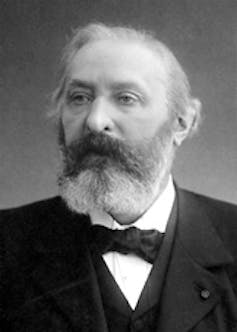
Glancing through the list of Nobel Prizes in literature over the years, from the very first that was awarded in 1901 to French poet and essayist Sully Prudhomme, to the most recent winner, British author Kazuo Ishiguro in 2017, reveals a mix of world-famous authors and names hardly even remembered today by specialists.
First winner: 1901 Nobel laureate, Sully Prudhomme. Nobel Prize Committee
French author François Mauriac, Nobel laureate in 1952, is probably not commonly read anymore, if he ever was. There are also a number of laureates who were rewarded more for their general contributions to human thinking and culture than their skills in literature – persons such as Bertrand Russell (1950), Winston Churchill (1953) and Jean-Paul Sartre, who was selected in 1964 only to decline the prize.
In 1914, when deliberations were upset by the beginning of World War I, the Nobel Prize was withheld. The following year, in 1915, the prize was postponed and was given to the French author Romain Rolland in 1916. The same thing happened in 1918 when the prize was withheld and then the selection of the 1919 laureate, the Swiss author Carl Spitteler, was delayed by a year. To award an author from neutral Switzerland seems to have been safe bet in a time of excited feelings following the end of the war.
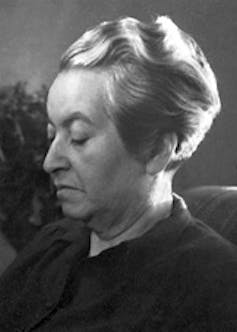
1945 Nobel laureate, the Chilean poet Gabriela Mistral. Nobel Prize Committee
In 1935, no prize was awarded and in 1936 it was postponed, because “the Nobel Committee for Literature decided that none of the year’s nominations met the criteria as outlined in the will of Alfred Nobel”. The 1936 award went to Eugene O’Neill. The same thing happened again during World War II when no prizes were awarded between 1940 and 1943. In 1944, the prize was again postponed to be given to the Danish author Johannes Jensen in 1945 after the war had ended (the 1945 prize went to Chilean poet Gabriela Mistral). The prize of 1949 was postponed by 12 months because the committee couldn’t find a suitable laureate. The 1949 prize was awarded to William Faulkner in 1950. Since then, Nobel laureates in literature have been selected regularly. But not any more.
Uncertain future
The decision to postpone the Nobel Prize in literature 2018 for one year has surprised many commentators. The loss of prestige for the academy is considerable and the decision to postpone the Nobel Prize can only be interpreted as the recognition by the remaining ten members of the academy the need for reform.
The shortlist of authors nominated for the Nobel Prize in literature also changes only slowly from year to year. So the four members of the Nobel Committee for Literature (there should normally be five, but one is among those eight who have left the academy) should already know all about them. The work already done to evaluate earlier shortlisted authors, then, could surely have been used to select a laureate for 2018. So, the decision to postpone the prize should be taken as a sign of how serious the remaining ten members of the Swedish Academy view the turmoil that is disrupting their organisation.
The Nobel Foundation – which is ultimately responsible for administering the intentions of the will of Alfred Nobel – has said it supports the decision made by the Swedish Academy. The foundation has also made it clear that the postponing of the literature prize does not affect other Nobel Prizes in physics, chemistry, medicine and peace.
Alexis Wright’s book Tracker: Stories of Tracker Tilmouth has won the 2018 Stella Prize. Tracker is, in Wright’s words, an attempt to tell an “impossible story”, using the voices of many people to reflect on the life of Tilmouth, a central and visionary figure in Aboriginal politics.
At one telling point in the book, Gulf of Carpentaria activist and political leader Murandoo Yanner relates an encounter between Tracker and Jenny Macklin, then Minister for Indigenous Affairs in the Rudd government. Tracker was helping Yanner to lobby Macklin over the Wild Rivers legislation in Queensland.
Notoriously, Macklin had persisted with the Howard government’s “Northern Territory Intervention”, and was regarded with suspicion by most Aboriginal leaders. Nevertheless, she was the federal minister and had to be dealt with.
Tracker by Alexis Wright, from Giramondo.
As they approached, Tracker called out, “How ya going, Genocide Jenny?”
Yanner recalls the atmosphere that followed: “You could have heard a pin drop and pistols drawn at twenty paces, and the whole thing went sour pretty quickly”.
It tells you a lot about the man. He had regular access to the corridors of power yet still called a spade a spade. He was capable of dealing with politicians of any background and station yet did not forfeit his never-back-down attitude.
He was able to gain the upper hand from the first with an irreverent comment. And, above all, he was a funny bugger. (Another memorable thumbnail character sketch, this one related by Tracker himself, is of current senator Pat Dodson as a “mobile wailing wall”: a place where white people go to confess and forgo their sins.)
It also tells you a lot about Wright’s epic tribute to Tracker. We do not read Wright quoting Yanner, but hear the whole yarn directly from the source. Born in 1954, Tracker was one of the stolen generation. His life spanned the latter years of the White Australia policy, when Aboriginal people were still legally part of the nation’s fauna, to the tumultuous period in Aboriginal politics following the Intervention, until his death in 2015.
This is not a book about Tracker’s life authored by Wright, but consists of stories and recollections told to Wright by the man himself as well as 50 others, from family and school mates, to Aboriginal and non-Indigenous leaders in our time. Wright brilliantly intersperses and weaves these together into an epic of stories and storytelling.
As the tributes to Tracker have flowed in the months since its publication, and many will surely follow as it garners further prizes and draws in ever more readers, so have proliferated the attempts to describe both the work’s genre and the mode of authorship it enacts.
In their award statement, the Stella judges call it a “biography”, but also “new way of writing memoir”. These descriptors capture aspects of the book – a birth to death tale does emerge from Wright’s layering of stories, and these are, of course, conjured from memory – but they also obscure.
Wright didn’t “write” the work but elicited the stories that comprise it through conversation. Towards the end of the book there is an unbroken sequence of nearly 100 pages of Tracker and Wright conversing, the contents of which are largely a mixture of philosophy and political economy. In these pages, Tracker’s voice is mostly serious, even earnest, as he expounds on the need to create a sustainable economic basis on which Aboriginal people can palpably enjoy their hard-won land rights and native title.
While it is no doubt true that readers accustomed to biographies in the European tradition will be struck by the novelty of reading a tribute to a storyman made up of many stories, Tracker’s strengths as a work are are not dependent on this putative departure from the biographical genre. It is simply remarkable to hear Tracker’s genuinely funny jokes and stories told repeatedly, often word for word and channelling Tracker’s unmistakable style, by such a range of different speakers. Over the course of the book, the repetition of these stories consolidates them and imprints them on the memory.
It is fitting that a book written in the mode and genre of Aboriginal storytelling should win a prize that encompasses both non-fiction and fiction. It is a work, epic in scope and size, that will ensure that a legend of Central Australian politics is preserved in myth.


 The Nobel Foundation – which is ultimately responsible for administering the intentions of the will of Alfred Nobel – has said it supports the decision made by the Swedish Academy. The foundation has also made it clear that the postponing of the literature prize does not affect other Nobel Prizes in physics, chemistry, medicine and peace.

 It is fitting that a book written in the mode and genre of Aboriginal storytelling should win a prize that encompasses both non-fiction and fiction. It is a work, epic in scope and size, that will ensure that a legend of Central Australian politics is preserved in myth.
 At the BookShelf
You must be logged in to post a comment.