Nihilism was notably cited during U.S. Senate deliberations after rioting Trump supporters had been cleared from the Capitol.
“Don’t let nihilists become your drug dealers,” exhorted Nebraska Sen. Ben Sasse. “There are some who want to burn it all down. … Don’t let them be your prophets.”
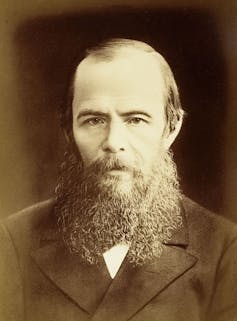
In 2016, I wrote about how Russian novelist Fyodor Dostoevsky had, in his work, explored what happens to society when people who rise to power lack any semblance of ideological or moral convictions and view society as bereft of meaning. I saw eerie similarities with Trump’s actions and rhetoric on the campaign trail.
Fast-forward four years, and I believe the warnings of Dostoevsky – particularly in his most most political novel, “Demons,” published in 1872 – hold truer than ever.
Although set in a sleepy provincial Russian town, “Demons” serves as a broader allegory for how thirst for power in some people, combined with the indifference and disavowal of responsibility by others, amount to a devastating nihilism that consumes society, fostering chaos and costing lives.
But then a disturbing public trial spurred him in a more overtly political direction. A young student had been murdered by members of a revolutionary group, The Organization of the People’s Vengeance, at the behest of their leader, Sergei Nechaev.
Dostoevsky was appalled that politics could be dehumanizing to the point of murder. His focus turned not only to moral questions but also to political demagoguery, which, he argued, if left unchecked, could result in devastating loss of life.
The result was “Demons.” It featured two protagonists: Pyotr Verkhovensky, a former student with no political convictions beyond a lust for power, and Nikolai Stavrogin, a man so morally numb and emotionally detached that he is incapable of purposeful action and stands idly by as violence engulfs his society.
Through these two figures, Dostoevsky tells a broader story about the many flavors of nihilism. Pyotr infiltrates the town’s local social circles, recruits a group of disciples to a revolutionary group and spins lies to band them together so they may do his bidding. Pretending to lead a broad movement of international socialism, Pyotr manipulates those around him into committing violent acts and insurrection against the local government. As a result, one woman is crushed by a mob, a mother and her baby die from chaos and neglect and a fire breaks out that kills multiple others.
Different townspeople espouse multiple and contradictory ideologies; none translates into purposeful action. Instead, they merely leave characters whiplashed and susceptible to being instrumentalized by Pyotor, the master manipulator.
The allure of feeling something
But Pyotr would not prevail without the nihilism of Stavrogin, a local nobleman.
Many townspeople see him as a leader with a strong moral compass. Throughout the novel, Pyotr seeks to loop Stavrogin into his quest for power by either doing him favors that corrupt him or hinting that he will install him as dictator once he successfully carries out a revolution.
On some level, Stavrogin knows better: He should be protecting the town and its people. He ultimately fails to do so, out of sheer despondence and because of the emotional appeal of chaos and violence have for him; they seem to jolt him out of the ennui he often appears to feel.
When given the chance to restrain and turn in to the authorities the escaped convict who perpetrates most of the violence in town, Stavrogin captures him only to eventually let him go. “Steal more, kill more,” he says to a criminal who has already admitted to killing and stealing. Later, when the political climate gets so heated that it seems an insurrection is imminent, he flees town.
In surrendering his responsibility to serve as a moral guardian, Stavrogin becomes complicit in Pyotr’s schemes. He ultimately kills himself – perhaps, in part, out of guilt for his passivity and moral indifference.
Among the two men, Pyotr is the authoritarian figure. And he cleverly insists that members of the revolutionary group break the law together, cementing a loyal brotherhood of criminality.
By contrast, Stavrogin is the novel’s empty center, idly standing by while Pyotr incites violence.
He doesn’t help Pyotr. But he doesn’t stop him, either.
From nihilism to annihilation
A range of nihilistic justifications – each successively hollower than the rest – seems to have shaped the violence at the U.S. Capitol.
The homegrown American insurrection lacked any sort of ideological foundation. Most ideas fueling it are negations of persons or facts. The immediate rallying cry of the insurrection was the falsehood that the election was stolen. Beyond denying the will of over 80 million people who voted for Joe Biden, this lie also qualifies not as an ideology, but as an absolute denial of truth.
Other ideas fomenting the insurrection – such as “America first” or “MAGA” and even white supremacy itself – are quintessentially founded on the denial of others, whether they are immigrants, foreign nationals or persons of color.
The only real purpose that seems to have brought the group together was devotion to Donald Trump, who strikes me as the arch-nihilist in all this, the Pyotr Verkhovensky of this American tragedy. Then there are the other public figures who should have known better, who might have helped stop it all, but couldn’t and didn’t. Some, like Stavrogin, excused themselves and were silent for far too long, as the lie about the election grew bigger and bigger. And others seemed to outright encourage the lie through formalized objections in Congress last week.
Playacting at revolution at the behest of a man seeking to cling to power, the rioters ultimately only managed only to vandalize the building, though they left five people dead in their wake.
Nonetheless, to act violently on the basis of such fictions – and to transgress against the humanity of others for nothing at all – is perhaps the most nihilistic act of them all.
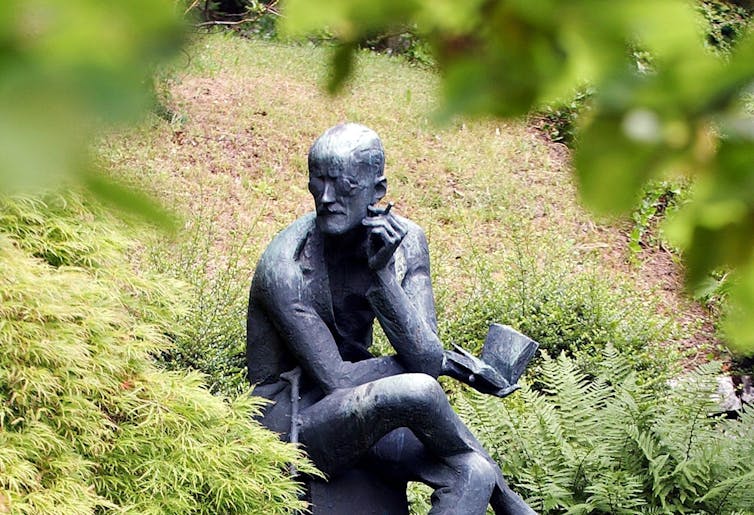
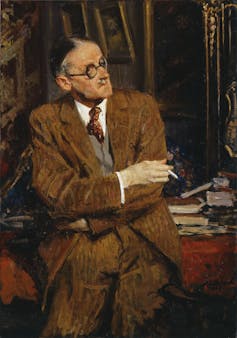
This year marks 80 years since the death of the great Irish writer James Joyce (1882-1941). His most famous novel, Ulysses (1922), is one of those books, like Moby Dick or Infinite Jest, that more people begin than finish. The tome is widely believed to be a stream of consciousness novel and you could certainly be forgiven for thinking that if, like many, you only made it 100 pages or so in.
I often advise against starting at the beginning of the novel. In the case of Ulysses, you are thrown headfirst into the difficult stream of consciousness of Stephen Dedalus, a precocious 22-year-old writer. The fourth chapter, instead, is a much more accessible opening. It too offers a stream of consciousness but an easier sort belonging to the novel’s other main character, Leopold Bloom, a hapless but loveable 38-year-old advertising canvasser. On the day the novel is set, 16 June 1904, Stephen and Bloom strike up an unlikely friendship in Dublin. To read Bloom’s thoughts is to be taken into a stream of sensations, trivia, and wonder.
However, venture further and you’ll discover that Ulysses morphs, becoming instead a great anti-stream of consciousness novel.
Bergson’s stream of consciousness
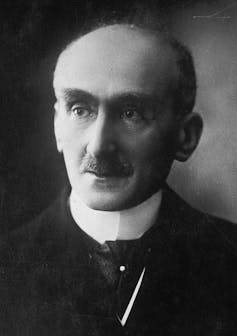
For French philosopher Henri Bergson (1859-1941), our stream of consciousness is our continuous sense of time, in which past, present and future merge. It is the fluid life at the heart of our identity. According to Bergson, these streams are at the centre of every object and every person.
Bergson believed we can either “analyse” or “intuit” things or people. When we “analyse” something, we remain outside its stream. We superimpose on its fluid life our own static symbols, like language. Using words means “we do not see the actual things themselves” just “the labels attached to them”.
Another example is numbers. We impose minutes and hours on fluid life. For instance, you can “analyse” a day, breaking it into 24 hours. But to “intuit” it, to see it from within the stream, is to see that time is not so rigid or easily quantifiable – it moves slower when you’re bored or faster when you’re having fun.
In our workaday lives, “analysis” is a necessary shortcut. We need words and numbers, labels and time, to get things done. Artists, according to Bergson, however, have the gift of intuition.
For example, authors’ imaginative use of language makes words a gateway to the streams at the heart of life, rather than distracting labels imposed upon it. Borrowing such ideas, literary critics posited that the stream of consciousness novelist is one who can “intuit” the stream of consciousness of characters and so become them.
Joyce tries for a moment, becomes his characters but soon gets bored with Stephen and Bloom’s streams of consciousness. By the seventh chapter, he begins a long firework display of other styles. Here on, Stephen and Bloom’s streams of consciousness are elbowed out of the way by newspaper headlines, expressionist drama and even romantic fiction. Or they’re shushed by a scientific manual or an encyclopedia of English prose styles.
Joyce fails to find the stream
So Ulysses is a much less consistent stream of consciousness novel than many. But it’s also an anti-stream of consciousness novel as Joyce comically demonstrates his and his characters’ failure to intuit streams.
Joyce enjoys showing us that people are mechanically absent-minded, often because language itself is a mechanism which gets in the way of our efforts to intuit fluid reality.
For example, Stephen, though a creative writer, isn’t at all intuitive. All he can see is the labels attached to things, albeit highly literary labels. When he sees a dog on the beach, his love of words conjures a horse, a hare, a calf, a bear, a wolf, a leopard, a panther and a stag. He can’t focus on the dog.
Bloom’s mechanical behaviour is less literary (words) and more scientific (numbers). True, he is better at intuiting his cat than Stephen is the dog: “Wonder what I look like to her?” he muses, trying to intuit himself into her stream of consciousness. But soon his mind turns to numbers: “Height of a tower? No, she can jump me.” Here he reverts to analysis as he strains to make sense of their difference in height using his human scale, not the cat’s.
Just as Joyce’s characters can’t intuit streams of consciousness, nor can he. He knows that static literary words can’t account for the fluidity of our interiors. Every time he reaches for a new style, in each new chapter, he acknowledges these failures and moves on with glee to the next.
A stream of consciousness does dominate the last chapter. Here we tune into Bloom’s wife Molly’s stream and hear about her afternoon of sex with a colleague. Is this the stream we have been waiting for? Yes and no.
Molly’s thoughts do flow through past, present and future, uninterrupted and unpunctuated. But the Molly we get to know, while charismatic, is something of a static symbol herself, the stock character of the sexually frustrated wife. As we reflect on 80 years since Joyce’s death, Ulysses reminds us that consciousness will always elude the novel but, really, that’s where the fun lies.





 At the BookShelf

You must be logged in to post a comment.