For countless young people, and even the odd deeply defiant older person, tattoos are the ultimate way to express your identity.
Go back just over 100 years, however, and revealing your personality to the world was a very different matter. Though tattoos and intimate piercings were had by people at all levels of society – even King Edward’s son, George V, was said to have had a tattoo during his time in the Royal Navy – the slightly more conservative Edwardians turned to something very different: bookplates.
The small decorative labels used to denote book ownership which date back to the 1500s, became hugely popular across the Western world at start of the 1900s, fading into obscurity just before World War I. But they offer a fascinating insight into the people who used them.
The early 20th Century saw a boom in book publishing: literacy levels were on the rise as were family incomes. Numerous public libraries were also established, along with Workers’ Educational Associations and book clubs. The stories published ranged widely in subject matter: this was the era of PG Wodehouse, HG Wells, JM Barrie, Saki and Rudyard Kipling.
In their time, bookplates were the physical embodiment of their owners, featuring bold, lavish and striking designs. They were seen as a decorative expression of a person’s tastes, temperaments and dispositions.
Edwardian readers were expected to share books from their own library with others, and so very special attention was paid to the plate design, to indicate the type of person that the owner was. While the wealthy were able to afford privately commissioned plates by famous artists, the average Edwardian depended on stationers or booksellers for mass-produced plates, or something from a pattern book. For the bibliophile, choosing a bookplate was a delicate process and the purchase commanded quite a price, varying from £2 to £50 – roughly £220-£5,500 today.
Personalised plates
Like the tattoo trends of the 21st Century, bookplates followed style trends, too. The more conscious would choose a socially acceptable design, aware that they may be judged by family and friends. But there was plenty of room for rebellion.
The bookplate of Sir John Forrest, explorer. Wikimedia
Each illustration or image used in the bookplate was tied to a particular aspect of the owner’s identity. Popular designs related to social class involved coats of arms, for example, or library interior scenes that showed a replica of the owner’s own reading room. Other common identity markers involved maps of the owner’s birthplace, pictures of the family house, and symbols representing the family surname. Biblical landscapes or local churches were also used to reflect religious beliefs, while images of the owner’s occupation or hobbies were other favoured choices.
However, knowing that the book would enter into the hands of other people, owners often used bookplates to portray themselves as funny and likeable, featuring a caricature of themselves or some other funny sketch. Like the more quirky tattoos of today, their reception would have undoubtedly been subjective.
Bookplates could also tell of the intimacy or distance between a husband and wife. Though it may seem a curious way to display such sentiments, the display of unity shown by the couple using a joint design showed that the two people were together. They could tell of other family changes, too, expressing relationship status – a woman marking a bookplate with her new surname following marriage, for instance – or signalling the birth or death of a family member.
Fantasy and insults
Like the novels of the time, the Edwardians also portrayed utopian images of faraway places or exotic landscapes in their personalised plates. These locations were often taken directly from fairy tales or other popular fantasy lands of the era, such as Atlantis and Avalon. These were often accompanied by Chinese or Latin philosophical quotes; for example, resurgam (“I shall rise again”), fac et spera (“Do and hope”) and pro patria (“For the fatherland”).
Pegasus flies through the night sky on this plate from 1904. Wikimedia
There was a more serious side to bookplates, too. Many designs were intended to make a statement, through striking images or more direct text. This could be political, pledging allegiance to a particular party, religion, or something more personal, relating to family members or friends. One man openly used his bookplate to “name and shame” a friend who ruined his books when helping to move them to his new house. Whatever the context, the declarations were made to shock and surprise.
The Edwardians came out of an era of inequality and poverty, and into a time where imaginations were allowed to soar. And yet, this was still the early 1900s, where social life was much more reserved than it is today. It might not seem like the most rebellious way to express one’s identity now, but then it truly could have been.
As a professor of Russian literature, I couldn’t help but notice that comedian Aziz Ansari was inadvertently channeling novelist Leo Tolstoy when he claimed that “change doesn’t come from presidents” but from “large groups of angry people.”
In one of his greatest novels, “War and Peace” (1869), Tolstoy insists that history is propelled forward not by the actions of individual leaders but by the random alignment of events and communities of people.
The unexpected electoral victory of Donald Trump last November was a political surprise of seismic proportions, shocking pollsters and pundits alike. Myriad explanations have been provided. Few are conclusive. But for those who disagree with his policies and feel powerless as this uncertain moment unfolds, Tolstoy’s epic novel can offer a helpful perspective.
The illusory power of an egomaniacal invader
Set between 1805 and 1817 – during Napoleon’s invasion of Russia and its immediate aftermath – “War and Peace” depicts a nation in crisis. As Napoleon invades Russia, massive casualties are accompanied by social and institutional breakdown. But readers also see everyday Russian life, with its romances, basic joys and anxieties.
Tolstoy looks at events from a historical distance, exploring the motivations of the destructive invasion – and for Russia’s eventual victory, despite Napoleon’s superior military strength.
Tolstoy clearly loathes Napoleon. He presents the great emperor as an egomaniacal, petulant child who views himself as the center of the world and a conqueror of nations. Out of touch with reality, Napoleon is so certain of his personal greatness that he assumes everyone must either be a supporter or take pleasure in his victories. In one of the novel’s most satisfying moments, the narcissistic emperor enters the gates of conquered Moscow expecting a royal welcome, only to discover that the inhabitants have fled and refuse to pledge allegiance.
Meanwhile, the heart of a novel about one of Russia’s greatest military victories does not rest with Napoleon, Tsar Alexander I or the army commander, General Kutuzov. Instead, it rests with a simple, loving peasant named Platon Karataev who is sent to fight the French against his will.
But even though Platon has little control over his situation, he has a greater ability to touch others than the authoritarian Napoleon, who only sets a pernicious example. For example, Platon offers the motherless hero, Pierre Bezukhov, an almost feminine and maternal kindness and shows him that the answer to his spiritual searching lies not in glory and blistering speeches but in human connection and our inherent connectivity. Pierre soon has a dream about a globe, in which every person represents a tiny droplet temporarily detached from a larger sphere of water. Signifying our shared essence, it hints at the extent to which Tolstoy believed we are all connected.
The case of Platon and his spiritual power is only one example of the grassroots power of individuals in “War and Peace.” At other times, Tolstoy shows how individual soldiers can make more of a difference in the battlefield by reacting quickly to the circumstances than generals or emperors. Events are decided in the heat of the moment. By the time couriers return to Napoleon – and he boldly reasserts his conquering vision – the chaos of battle has already shifted in a new direction. He is too removed from the real lives of soldiers – and, implicitly, people – to really drive the course of history.
In depicting Napoleon’s campaign this way, Tolstoy seems to reject Thomas Carlyle’s “Great Man” theory of history – the idea that events are driven by the will of extraordinary leaders. Tolstoy, in contrast, insists that when privileging extraordinary figures, we ignore the vast, grassroots strength of ordinary individuals.
In a sense, this vision of history is appropriate for a novelist. Novels often focus on ordinary people who don’t make it into the history books. Nonetheless, to the novelist, their lives and dreams possess a power and value equal to those of “great men.” In this dynamic, there are no conquerors, heroes or saviors; there are simply people with the power to save themselves, or not.
So in Tolstoy’s view, it is not Napoleon who determines the course of history; rather, it’s the elusive spirit of the people, that moment when individuals almost inadvertently come together in shared purpose. On the other hand, kings are slaves to history, only powerful when they’re able to channel this sort of collective spirit. Napoleon often thinks he is issuing bold orders, but Tolstoy shows the emperor is merely engaging in the performance of power.
A united, public opposition
All of these ideas are relevant today, when many who did not vote for President Trump are concerned about how his campaign rhetoric is shaping his presidency and the country.
Obviously, the president of the United States has tremendous power. But here is where “War and Peace” can provide some perspective, helping to demystify this power and sort out its more performative aspects.
There’s quite a bit of action coming from the White House, with President Trump furiously signing one executive order after another before the cameras. It’s hard to say how many of these executive orders can go into immediate effect right away. Many – like the recent ban on immigrants from seven Muslim majority countries – are certainly affecting lives. But others will also require legislative and institutional support. We hear every day about government workers and departments, mayors and governors vowing not to follow President Trump’s orders.
While those who oppose Trump might not have philosopher peasants like Platon Karataev at their disposal, mass marches and protests broadcast united opposition – as do all the petitions, safety pins, pink pussy hats and rogue tweets. Some of this might be derided as #slacktivism. But collectively they map out tenuous networks of connections among individuals.
Thinking in essentialist terms, Tolstoy felt that Napoleon failed to destroy Russia because the collective interests of Russian people aligned against him: a majority of people – wittingly or unwittingly – acted to undermine his agenda. Is it possible that we will see a similar alignment of grassroots interests now? Could men, women, people of color, immigrants and LGBTQIA individuals make their voices heard against some of President Trump’s executive actions, which may threaten many on a personal level?
I can’t see Tolstoy wearing a pink pussy hat. But always a voice of defiance, he would have certainly approved of resistance.
I can still remember reading All in the Blue Unclouded Weather when I was 12, and then the excitement I felt when the librarian at our tiny Catholic school, Mrs Kerr, told me that there was a sequel. She put it on reserve for me, and I read Dresses of Red and Gold when I was 13. Finally, when I read The Sky in Silver Lace at 16, I remember the curious melancholy I felt long afterwards.
By then I was at my fourth school in five years, a selective-entry, all-girls high school in the city, not all that different from Cathy and Heather Melling’s. I missed my librarian friend, our Book Week dress-ups, and the innocence of those earlier days. More so than any other contemporary “teenage girl fiction” of the time, Robin Klein’s trilogy conveyed for me most accurately and achingly, the transition from girlhood to young adulthood, from naïve hope to acute awareness of one’s class and circumstances.
The Melling sisters — like Alcott’s March sisters and Austen’s Bennett sisters — are a quartet of girls who become women during the course of tribulation. There is Grace the beauty, Cathy the tomboy, Heather the performer and Vivienne the dreamer, all growing up in an Australia that has just seen the Great Depression and two world wars.
Unlike the Marches or Bennetts, however, there is no superimposed didactic altruism in Klein’s Melling sisters: she depicts their secret selfish longings and embarrassments of poverty with such honesty that you can’t help rooting for these girls.
In fact, with its cast of supercilious relatives, its small-town scuttlebutting and girlish rivalries, Klein’s trilogy resonated strongly with me, an Asian girl with refugee parents growing up in the 1980s and 1990s. It reminds me now, as an adult, that no matter how genteel our veneer, we are all come from a history of feral battlers just trying to make it.
In all the years since my first reading, there was a peripheral character I never forgot, not her name, appearance or her circumstances: Phyllis Gathin. Phyllis’ character contained all that was true and devastating about the forced humility of the destitute. Back in the country town, the Mellings were poor but not as poor as the Gathins.
Phyllis does not make an appearance in this book, now that the Mellings have moved to the city, but her legacy lingers. To now be the recipients of charity—second-hand discounted uniforms, lodgings, a housing-commission flat—deeply wounds the collective pride of the Melling sisters. Yet their longings bring vast ingenuity and insight into their lives.
Instead of making them insipid whiners, the girls’ desire for material things is the catalyst for their resourcefulness, self-agency, energy, inventiveness and even charity. They invent games, make things, write stories. However, city life confines the Mellings to those far-flung suburbs without community, and the girls have never felt so alienated. Even when they visit the city centre, they find it to be a hostile place, peopled by mean relatives, expensive shops and unfriendly characters.
‘Dirty big chunks of steel wool’
As she was in the first books of the trilogy, Vivienne is the heartbeat of this novel. As the youngest sister, she is allowed to have uncomplicated feelings of sadness and longing for Wilgawa, Klein’s fictional country town that represents the warmth of a post-war rural community. The “sky in silver lace” is Vivienne’s euphemistic metaphor for the encroaching hard times. Cathy, always to the point, finds Vivienne’s diary and mocks her for it:
If you mean rainclouds, they don’t look a bit like lace—more like dirty big chunks of steel wool. Not to mention all the other soppy stuff about leaving Wilgawa that came earlier…
Vivienne’s loss of innocence happens over a gentle gradient, like the seasons changing from autumn to winter. As their physical world contracts — to a few back rooms in Captain Fuller’s house, to petty Aunt Elsa’s where they are unwelcome guests, and finally their own tiny flat — so do their movements. Heather’s magnetic personality is confined to the stage, Cathy’s adroit rambling limbs to the hockey court, and even poor Isobel is a fish out of water on her visit to the city.
Robin Klein. Text publishing
By the end of the day, she is trailing Vivienne and lagging behind her now-insufferable cousins who rabbit on and on about their new school. Your heart breaks for Isobel’s “squashed voice”.
Gone are the hijinks of previous novels — Isobel’s mild case of kleptomania, Cathy’s three-storeyed treehouse, the girls’ ghost-hunting — but in their place is deeper character development. We gain insight into Connie Melling, the loving and once wonderfully eccentric mother — maker of doyley flatteners, creator of poems
for bereaved community members — now burdened with a weightier responsibility, as she singlehandedly navigates a changed city with her four daughters.
Her stoicism and resilience is now tested in a world filled with hostile, stressed-out, easily irritated adults who know very well how tenuous their jobs, statuses and hold on their homes are. Oldest sister Grace, a minor character in the previous books, now comes into her own in a powerful, dignified chapter.
Characters of grit and mettle
All three books unabashedly focus on the interests of burgeoning teenage girls: their preoccupations with dolls, bridesmaids’ dresses, little blue rowboats, fancy school tunics, delicious teacakes, matinee-movie stars and Tennysonian maidens floating down a river stream.
Each chapter is filled to the brim with delightful sartorial details — Grace’s purple cape and hat, Cathy’s pinafore, Isobel’s Bonnie Prince Charles outfit, Dior’s New Look — at a time when “respectable people” went out in public with white hankies, gloves and a hat.
But to dismiss these as books dealing with shallow feminine pursuits is to say that Little Women is about four girls who sew while they wait for their father to come home from the war. The gutsiness of these Australian siblings lies in their ability to find extraordinary plea- sure in ordinary existence during a time of uncertainty and flux.
The Melling girls’ larger-than-life larrikin father is absent in this final book, and the only males to appear are three minor characters: crotchety old Captain Fuller who provides Mrs Melling with work, a kindly old man who restores her self-regard and one preening young narcissist who bores the sweet bejesus out of Heather.
These are not girls who live for the male gaze, and they probably wouldn’t care what that was. Too many authors self-consciously inject doses of feminist fuel into their young-adult novels. Such is the skill and integrity of Klein that she doesn’t mar the magic of her historical fiction with political anachronisms, but rather creates full characters made of grit and mettle who are dealing with their world at their time.
While the endgame for the Bennett sisters was matrimony, and for the March sisters domesticity (Good Wives), what will become of the Melling sisters and their cousin?
This last book is the most bittersweet volume, because the reader knows that after this we will never hear from them again. We leave them forever moving towards the middle of the last century. But we know that whatever they are doing, wherever they end up, their personalities will always triumph over their circumstances.
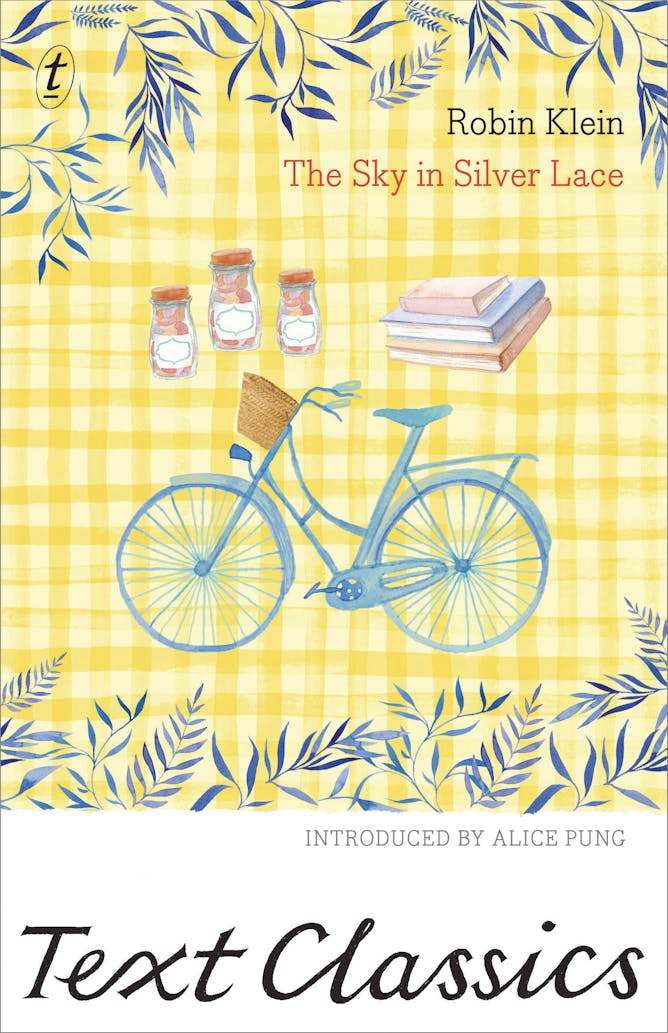
Robin Klein’s trilogy of Young Adult novels about the Melling sisters, All in the Blue Unclouded Weather (1991), Dresses of Red and Gold (1992) and The Sky in Silver Lace (1995) will be republished as Text Classics from February 27.





 At the BookShelf


.jpg)
.jpg/1024px-The_Soviet_Union_1956_CPA_1968_stamp_(Leo_Tolstoy_and_Scene_from_War_and_Peace).jpg)
You must be logged in to post a comment.